REVIEW 4 major objections 5 minor 27 references
The paper argues that a hybrid world model—trained on both pixel reconstruction and latent prediction, but deployed latent-only—resolves the accuracy-versus-robustness trade-off in driving VLAs.
Reviewed by Pith at T0; open to challenge. T0 means a machine referee read the full paper against a public rubric. the ladder, T0–T4 →
T0 review · deepseek-v4-flash
2026-08-01 08:45 UTC pith:KUM423SR
load-bearing objection Sensible hybrid pre-training with a solid ablation suite, but the 'pixel-level grounding' claim is really VQ-token prediction and the v1 gain over DriveVLA-W0 is only 0.4 PDMS. the 4 major comments →
HyWorldVLA: A Vision-Language-Action Model with Hybrid World Modeling for Autonomous Driving
The pith
A machine-rendered reading of the paper's core claim, the machinery that carries it, and where it could break.
Core claim
HyWorldVLA's central claim is that a single autoregressive backbone can learn both pixel-grounded and latent world dynamics without carrying pixel reconstruction into deployment. During pretraining the model predicts discretized next-frame tokens, language tokens, action tokens, and the latent feature of a future video chunk extracted by a text-guided video VAE; during co-fine-tuning it predicts only the latent and feeds it through a joint-attention action expert to output trajectories. The paper reports top scores on NavSim v1 and v2, with ablations showing that removing either supervision half hurts and that the latent path drives the noise robustness.
What carries the argument
The load-bearing mechanism is a two-stage training schedule plus a learnable latent query token inserted into the token sequence. In pretraining, the hidden state at the query position is regressed, via an MLP, toward the video-VAE latent of the future, while cross-entropy on VQGAN first-frame visual tokens supplies the 'pixel-level' anchor; in co-fine-tuning, the same predicted latent conditions the action expert through joint attention. The discrete visual tokens provide fine-grained spatiotemporal grounding; the continuous latent provides a compact, noise-tolerant representation; the schedule ensures only the latent is needed at inference.
Load-bearing premise
The pixel-level grounding is implemented as cross-entropy on VQGAN tokenized first frames, not a true pixel reconstruction loss, so the whole fine-grained-spatial-reasoning advantage rests on those discrete tokens preserving exactly the small cues—lane edges, brake lights, distant vehicles—that planning needs.
What would settle it
Take the NavSim v1/v2 setup and replace the VQGAN visual-token cross-entropy in Eq. (6) with a per-pixel MSE over all reconstructed future frames. If the full HyWorldVLA no longer beats the pixel-only baseline on the rain/fog set, then latent prediction is not the source of robustness. Alternatively, inspect VQGAN reconstructions of the 655 noisy cases: if brake lights and lane-edge pixels are absent while PDMS stays high, the fine-grained-grounding story is not doing the work claimed.
If this is right
- Pixel-level reconstruction can be confined to pretraining: after co-fine-tuning, the model needs only latent prediction, so the fine-grained benefit comes without pixel decoding cost at deployment.
- Discrete visual-token supervision and continuous latent regression can coexist in one autoregressive VLA objective, suggesting world-model supervision is not an either/or choice.
- The reported gains on both selection-based and flow-matching action experts imply the hybrid latent conditioning transfers across action-model families.
- The paper's 655-case rain/fog robustness benchmark is proposed as a reusable evaluation that future models can be measured against.
Where Pith is reading between the lines
- Because the 'pixel-level' term is actually cross-entropy on VQGAN tokens of the first frame of each chunk, the paper's own failure cases—nudging a queuing vehicle whose brake lights are only a few pixels—predict that any fine cue the tokenizer discards will also be lost to the hybrid. A stronger grounding loss may be needed for such cues.
- The hybrid schedule suggests a general recipe outside driving: use a reconstruction-heavy objective during pretraining to regularize latent semantics, then drop the reconstruction head and keep the latent for task execution.
- A direct testable extension is multi-camera input; the appendix attributes turning errors to front-view blind spots, so adding surround views should convert a larger share of the predicted gains.
Editorial analysis
A structured set of objections, weighed in public.
Referee Report
Summary. The manuscript proposes HyWorldVLA, a vision-language-action model for autonomous driving that augments a VLM backbone with a hybrid world model: during pre-training it jointly predicts continuous VAE latents and discrete visual tokens of (the first frame of) each temporal chunk, alongside language and action tokens; during co-fine-tuning an action expert consumes the predicted latents to generate trajectories. The paper reports state-of-the-art PDMS on NAVSIM v1 and EPDMS on v2, and presents a new rain/fog noise-robustness evaluation where it substantially outperforms pixel-based baselines.
Significance. If valid, the proposed hybrid could offer a practical middle ground between pixel-based and latent-based world models, and the noise-robustness analysis is a valuable step toward understanding robustness in this setting. The ablation suite is fairly detailed, including weight sweeps for all three losses and an alternative flow-matching action head. However, the central claim is undermined by a mismatch between the narrative (raw pixel-level supervision) and the actual loss (discrete VQ-token cross-entropy plus VAE-latent L2), and the VAE fine-tuning procedure raises a data-leakage concern given NAVSIM's nuPlan provenance. These issues must be addressed before the contribution can be evaluated properly.
major comments (4)
- [Sec. 3.3, Eq. (6)] The abstract and Sec. 1 claim that the model performs 'pixel-level supervision' and 'simultaneously reconstructs video frames,' but Eq. (6) contains no pixel-space reconstruction term. The third term is cross-entropy over VQGAN tokens of the first frame of each chunk, and the fourth term is L2 on VAE latents. Raw frame reconstruction appears only in the separate VideoVAE pretraining stage (Sec. 3.2), not in the world-model objective. This makes the proposed method a discrete-token plus latent hybrid, not a pixel-plus-latent hybrid as claimed. The authors should either add an explicit pixel-space reconstruction loss during world-model pre-training, or revise the terminology and positioning throughout the paper.
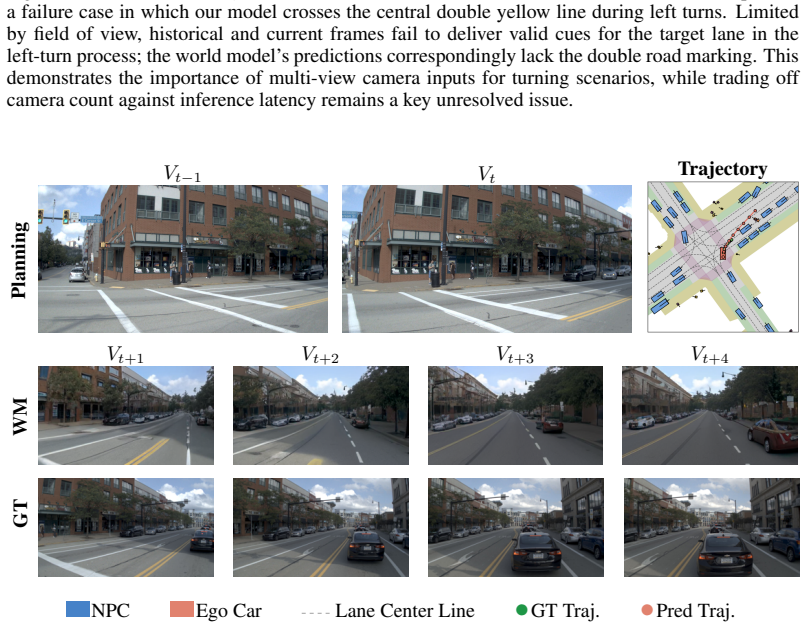
- [Appendix C.3, Fig. 8] The paper's own failure-case analysis admits that the model misses brake lights and queues, whose cue 'is only discernible from a few pixels.' This is internal evidence that the VQ-token bottleneck discards the fine-grained spatial details that the 'pixel-level grounding' claim relies upon. The authors should quantify this information loss (e.g., by computing VQ-token reconstruction quality for tiny objects or by comparing a higher-capacity tokenizer) and discuss how the claimed fine-grained spatiotemporal reasoning can hold if the loss operates on a discrete token grid that erases such cues.
- [Sec. 4.2 (VideoVAE fine-tuning)] The VideoVAE is fine-tuned on the NuPlan dataset, while NAVSIM (the benchmark used in Tables 1 and 2) is built from nuPlan scenes. The paper does not state which nuPlan split is used for VAE fine-tuning. If the full nuPlan dataset, including scenes overlapping NAVSIM evaluation, is used, the encoder may be adapted to the evaluation distribution, inflating reported PDMS. Please specify the exact split, confirm that VAE fine-tuning data is disjoint from the NAVSIM evaluation scenes, and if necessary rerun with a disjoint VAE training set.
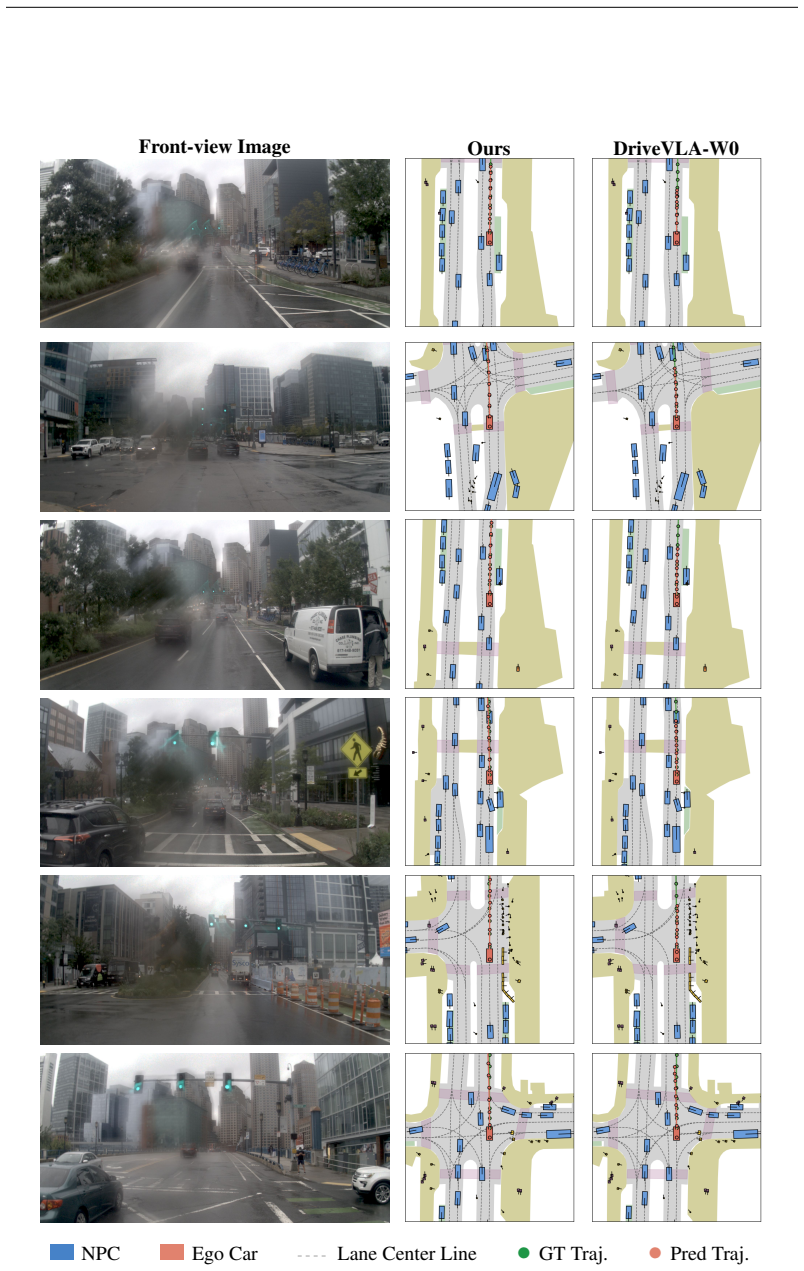
- [Sec. 4.5, Tables 6 and 8] The noise-robustness benchmark is constructed from 655 OpenScene cases but lacks details on case selection, baseline hyperparameter tuning, and statistical stability (no error bars or seeds). The very large gaps in Table 6 could be caused by the baselines being poorly adapted to the noisy test set rather than by the hybrid architecture. Furthermore, Table 8 shows that increasing λ3 from 0.1 to 1.0 improves noisy PDMS from 86.87 to 92.94, while the main text indicates that such increases may hurt clean performance; this clean-vs-noisy trade-off should be explicitly quantified and discussed.
minor comments (5)
- [Sec. 3.3 (Action Modeling)] The same symbol V is used for visual frames and for the action sequence in Eq. (3), causing confusion. Please rename the action sequence (e.g., A).
- [Figure 2] In the version I reviewed, Figure 2 contains garbled '??' placeholders that obscure the architecture. Please ensure the figure is rendered correctly.
- [Tables 1 and 2] The claimed SOTA improvements over the strongest baselines are less than 0.5 PDMS/EPDMS. Please report results over multiple seeds or at least state that no statistical significance tests were performed, so readers can gauge the magnitude.
- [Abstract and Sec. 4.5] The paper says it 'establishes a new benchmark' for noise robustness, but no release plan or URL is given. Provide availability details if the test set is to be reused.
- [Eq. (7)] The flow-matching loss uses |\hat v - v|_2^2, but v is not explicitly defined as the action variable. Clarify notation.
Circularity Check
No circularity found: the derivation is a standard supervised training pipeline with externally grounded components and independent benchmark evaluation.
full rationale
I walked the paper's derivation chain. The claimed contribution—hybrid pixel-level and latent world modeling—is implemented as concrete training losses: Eq. (6) combines cross-entropy over VQGAN-discretized visual tokens, FAST-discretized action tokens, Emu3 language tokens, and an L2 consistency term against latents from a pre-trained video VAE. The VAE itself is an external, independently introduced model (Xing et al., 2024) fine-tuned on NuPlan with its own reconstruction loss, Eq. (1). The co-fine-tuning losses, Eqs. (7)–(8), are likewise standard flow-matching or KL-supervised selection losses plus a latent regression term. No predicted quantity is defined in terms of the output metric, and no fitted parameter is renamed as a prediction: the λ weights are tuned on the validation benchmark and disclosed with ablations in Tables 4–5, which is normal practice. The citations to prior world models are external works, not self-citations, and no uniqueness theorem or ansatz is imported from the authors' own prior work. The one substantive concern—that the so-called 'pixel-level supervision' in Eq. (6) is actually token-level CE on the first frame of each chunk rather than a raw pixel reconstruction loss—is a modeling-fidelity or correctness issue, not circularity: the loss is still a real, externally specified supervision signal, and the paper's own failure-case analysis (Appendix C.3) provides independent, testable evidence of the model's limitations. The paper's central claims are therefore not equivalent to their inputs by construction, and the honest finding is no significant circularity.
Axiom & Free-Parameter Ledger
free parameters (4)
- λ1 (visual token loss weight) =
0.5
- λ2 (latent loss weight in pre-training) =
0.1
- λ3 (latent loss weight in co-fine-tuning) =
0.1
- VAE fine-tuning weights =
λ_GAN=0.5, λ_KL=1e-6
axioms (5)
- domain assumption NAVSIM v1/v2 PDMS/EPDMS scores are a valid proxy for real-world driving competence.
- domain assumption The pre-trained VideoV AEPlus encoder yields latents that capture dynamics relevant to planning.
- domain assumption VQGAN tokenization preserves the visual detail needed for world modeling.
- domain assumption The OpenScenes dataset (120h driving video) is a suitable pre-training domain.
- domain assumption The 655-case noise test set is representative of real rain/fog conditions and is free of selection bias.
read the original abstract
Vision-Language-Action (VLA) models augmented with world modeling represent a promising paradigm for end-to-end autonomous driving. While pixel-level future prediction enables fine-grained spatiotemporal reasoning, it compromises robustness in noisy driving scenarios. Conversely, latent-based world models alleviate this sensitivity but often incur limited interpretability and representational degradation due to absent pixel-level grounding. To reconcile this trade-off, we propose HyWorldVLA, a hybrid world-VLA framework that unifies pixel-level supervision and latent representation learning. In the pre-training stage, HyWorldVLA predicts video latents encoded by a pre-trained video VAE, while simultaneously reconstructing video frames to provide precise pixel-level grounding. During the subsequent co-fine-tuning phase, the model exclusively predicts latent features, which are fed into an action expert to generate trajectories. Extensive experiments on NAVSIM v1 and v2 benchmarks demonstrate that HyWorldVLA significantly outperforms both pixel-based and latent-based world model baselines. Notably, we present the first comprehensive qualitative and quantitative analysis of world model noise robustness in autonomous driving, establishing a new benchmark for evaluating future architectures.
Figures




Reference graph
Works this paper leans on
-
[1]
Alibaba Cloud. Ppu introduction. [Online], 2026.https://help.aliyun.com/zh/ document_detail/2864586.html. Kevin Black, Noah Brown, Danny Driess, Adnan Esmail, Michael Equi, Chelsea Finn, Niccolo Fusai, Lachy Groom, Karol Hausman, Brian Ichter, et al.π 0: A vision-language-action flow model for general robot control.arXiv preprint arXiv:2410.24164,
arXiv 2026
-
[6]
Gaia-1: A generative world model for autonomous driving.arXiv preprint arXiv:2309.17080, 2023a
Anthony Hu, Lloyd Russell, Hudson Yeo, Zak Murez, George Fedoseev, Alex Kendall, Jamie Shot- ton, and Gianluca Corrado. Gaia-1: A generative world model for autonomous driving.arXiv preprint arXiv:2309.17080, 2023a. Tianshuai Hu, Xiaolu Liu, Song Wang, Yiyao Zhu, Ao Liang, Lingdong Kong, Guoyang Zhao, Zeying Gong, Jun Cen, Zhiyu Huang, et al. Vision-langu...
-
[7]
Planning-oriented autonomous driving
Yihan Hu, Jiazhi Yang, Li Chen, Keyu Li, Chonghao Sima, Xizhou Zhu, Siqi Chai, Senyao Du, Tianwei Lin, Wenhai Wang, et al. Planning-oriented autonomous driving. InProceedings of the IEEE/CVF conference on computer vision and pattern recognition, pp. 17853–17862, 2023b. Minqing Huang, Yujiao Xiang, Zihan Liang, Jiajie Huang, Jingqi Wang, Zhi Xu, Feiyang Ta...
-
[9]
Adriver-i: A general world model for autonomous driving.arXiv preprint arXiv:2311.13549,
Fan Jia, Weixin Mao, Yingfei Liu, Yucheng Zhao, Yuqing Wen, Chi Zhang, Xiangyu Zhang, and Tiancai Wang. Adriver-i: A general world model for autonomous driving.arXiv preprint arXiv:2311.13549,
-
[10]
Bo Jiang, Shaoyu Chen, Qian Zhang, Wenyu Liu, and Xinggang Wang. AlphaDrive: Unleashing the power of VLMs in autonomous driving via reinforcement learning and reasoning.arXiv preprint arXiv:2503.07608,
-
[11]
Kailin Li, Zhenxin Li, Shiyi Lan, Jiayi Liu, Yuan Xie, Zuxuan Wu, Zhiding Yu, Jose M Alvarez, et al. Hydra-mdp++: Advancing end-to-end driving via hydra-distillation with expert-guided decision analysis. 2025a. Yingyan Li, Lue Fan, Jiawei He, Yuqi Wang, Yuntao Chen, Zhaoxiang Zhang, and Tieniu Tan. Enhancing end-to-end autonomous driving with latent world...
Pith/arXiv arXiv 2025
-
[12]
Flow matching for generative modeling.arXiv preprint arXiv:2210.02747,
Yaron Lipman, Ricky TQ Chen, Heli Ben-Hamu, Maximilian Nickel, and Matt Le. Flow matching for generative modeling.arXiv preprint arXiv:2210.02747,
-
[14]
Jinghui Lu, Jiayi Guan, Zhijian Huang, Jinlong Li, Guang Li, Lingdong Kong, Yingyan Li, Han Wang, Shaoqing Xu, Yuechen Luo, Fang Li, Chenxu Dang, Junli Wang, Tao Xu, Jing Wu, Jianhua Wu, Xiaoshuai Hao, Wen Zhang, Tianyi Jiang, Lingfeng Zhang, Lei Zhou, Yingbo Tang, Jie Wang, Yinfeng Gao, Feiyang Jia, Lin Liu, Yigu Ge, Hanbing Li, Yuannan Shen, Jianwei Cui...
-
[15]
Zihao Sheng, Xin Ye, Jingru Luo, Sikai Chen, and Liu Ren. Explorevla: Dense world modeling and exploration for end-to-end autonomous driving.arXiv preprint arXiv:2604.02714,
-
[16]
Latent chain-of-thought world modeling for end-to-end driving.arXiv preprint arXiv:2512.10226,
Shuhan Tan, Kashyap Chitta, Yuxiao Chen, Ran Tian, Yurong You, Yan Wang, Wenjie Luo, Yulong Cao, Philipp Krahenbuhl, Marco Pavone, and Boris Ivanovic. Latent chain-of-thought world modeling for end-to-end driving.arXiv preprint arXiv:2512.10226,
-
[17]
Sifan Tu, Xin Zhou, Dingkang Liang, Xingyu Jiang, Yumeng Zhang, Xiaofan Li, and Xiang Bai. The role of world models in shaping autonomous driving: A comprehensive survey.arXiv preprint arXiv:2502.10498,
-
[18]
Linbo Wang, Yupeng Zheng, Qiang Chen, Shiwei Li, Yichen Zhang, Zebin Xing, Qichao Zhang, Xiang Li, Deheng Qian, Pengxuan Yang, et al. Latent-wam: Latent world action modeling for end-to-end autonomous driving.arXiv preprint arXiv:2603.24581,
-
[19]
Wenhai Wang, Jiangwei Xie, ChuanYang Hu, Haoming Zou, Jianan Fan, Wenwen Tong, Yang Wen, Silei Wu, Hanming Deng, Zhiqi Li, et al. DriveMLM: Aligning multi-modal large language models with behavioral planning states for autonomous driving.arXiv preprint arXiv:2312.09245,
-
[20]
Drivedreamer: Towards real-world-drive world models for autonomous driving
Xiaofeng Wang, Zheng Zhu, Guan Huang, Xinze Chen, Jiagang Zhu, and Jiwen Lu. Drivedreamer: Towards real-world-drive world models for autonomous driving. InEuropean conference on computer vision, pp. 55–72. Springer, 2024a. Xinlong Wang, Xiaosong Zhang, Zhengxiong Luo, Quan Sun, Yufeng Cui, Jinsheng Wang, Fan Zhang, Yueze Wang, Zhen Li, Qiying Yu, et al. E...
-
[21]
Large motion video autoencoding with cross-modal video vae.arXiv preprint arXiv:2412.17805,
Yazhou Xing, Yang Fei, Yingqing He, Jingye Chen, Jiaxin Xie, Xiaowei Chi, and Qifeng Chen. Large motion video autoencoding with cross-modal video vae.arXiv preprint arXiv:2412.17805,
-
[22]
Jiazhi Yang, Kashyap Chitta, Shenyuan Gao, Long Chen, Yuqian Shao, Xiaosong Jia, Hongyang Li, Andreas Geiger, Xiangyu Yue, and Li Chen. Resim: Reliable world simulation for autonomous driving.Advances in Neural Information Processing Systems, 38:167710–167741, 2026a. Pengxuan Yang, Ben Lu, Zhongpu Xia, Chao Han, Yinfeng Gao, Teng Zhang, Kun Zhan, XianPeng...
-
[23]
Shuang Zeng, Xinyuan Chang, Mengwei Xie, Xinran Liu, Yifan Bai, Zheng Pan, Mu Xu, Xing Wei, and Ning Guo. Futuresightdrive: Thinking visually with spatio-temporal cot for autonomous driving.arXiv preprint arXiv:2505.17685,
-
[24]
Shuang Zeng, Xinyuan Chang, Mengwei Xie, Xinran Liu, Yifan Bai, Zheng Pan, Mu Xu, and Xing Wei
Accepted to NeurIPS 2025 as Spotlight. Shuang Zeng, Xinyuan Chang, Mengwei Xie, Xinran Liu, Yifan Bai, Zheng Pan, Mu Xu, and Xing Wei. Futuresightdrive: Thinking visually with spatio-temporal cot for autonomous driving. Advances in Neural Information Processing Systems, 38:67299–67318,
2025
-
[25]
Jinqing Zhang, Zehua Fu, Zelin Xu, Wenying Dai, Qingjie Liu, and Yunhong Wang. Resworld: Tem- poral residual world model for end-to-end autonomous driving.arXiv preprint arXiv:2602.10884,
-
[26]
Doe-1: Closed- loop autonomous driving with large world model.arXiv preprint arXiv:2412.09627,
Wenzhao Zheng, Zetian Xia, Yuanhui Huang, Sicheng Zuo, Jie Zhou, and Jiwen Lu. Doe-1: Closed- loop autonomous driving with large world model.arXiv preprint arXiv:2412.09627,
-
[27]
Xingcheng Zhou, Xuyuan Han, Feng Yang, Yunpu Ma, V olker Tresp, and Alois Knoll. Open- drivevla: Towards end-to-end autonomous driving with large vision language action model.arXiv preprint arXiv:2503.23463, 2025a. Zewei Zhou, Tianhui Cai, Seth Z. Zhao, Yun Zhang, Zhiyu Huang, Bolei Zhou, and Jiaqi Ma. Autovla: A vision-language-action model for end-to-en...
-
[2021]
Pseudo-simulation for autonomous driving
Wei Cao, Marcel Hallgarten, Tianyu Li, Daniel Dauner, Xunjiang Gu, Caojun Wang, Yakov Miron, Marco Aiello, Hongyang Li, Igor Gilitschenski, et al. Pseudo-simulation for autonomous driving. arXiv preprint arXiv:2506.04218,
-
[2022]
Lin Liu, Ziying Song, Caiyan Jia, Hangjun Ye, Xiaoshuai Hao, Long Chen, et al. Driveworld-vla: Unified latent-space world modeling with vision-language-action for autonomous driving.arXiv preprint arXiv:2602.06521,
-
[2023]
Daniel Dauner, Marcel Hallgarten, Tianyu Li, Xinshuo Weng, Zhiyu Huang, Zetong Yang, Hongyang Li, Igor Gilitschenski, Boris Ivanovic, Marco Pavone, et al. Navsim: Data-driven non- reactive autonomous vehicle simulation and benchmarking.arXiv preprint arXiv:2406.15349,
-
[2024]
Holger Caesar, Juraj Kabzan, Kok Seang Tan, Whye Kit Fong, Eric Wolff, Alex Lang, Luke Fletcher, Oscar Beijbom, and Sammy Omari. nuplan: A closed-loop ml-based planning benchmark for autonomous vehicles.arXiv preprint arXiv:2106.11810,
-
[2025]
Haoyu Fu, Diankun Zhang, Zongchuang Zhao, Jianfeng Cui, Dingkang Liang, Chong Zhang, Dingyuan Zhang, Hongwei Xie, Bing Wang, and Xiang Bai. Orion: A holistic end-to-end au- tonomous driving framework by vision-language instructed action generation.arXiv preprint arXiv:2503.19755,
-
[2026]
EMMA: End-to-end multimodal model for autonomous driving.arXiv preprint arXiv:2410.23262,
Jyh-Jing Hwang, Runsheng Xu, Hubert Lin, Wei-Chih Hung, Jingwei Ji, Kristy Choi, Di Huang, Tong He, Paul Covington, Benjamin Sapp, et al. EMMA: End-to-end multimodal model for autonomous driving.arXiv preprint arXiv:2410.23262,
discussion (0)
Sign in with ORCID, Apple, or X to comment. Anyone can read and Pith papers without signing in.