REVIEW 1 major objections 4 minor 21 references
A quadratic generalized-uncertainty-principle deformation of the FLRW minisuperspace is consistent with the undeformed expansion at 95% credibility, giving a conditional null constraint rather than evidence for quantum gravity.
Reviewed by Pith at T0; open to challenge. T0 means a machine referee read the full paper against a public rubric. the ladder, T0–T4 →
T0 review · deepseek-v4-flash
2026-08-03 01:42 UTC pith:KVUEUL3Z
load-bearing objection A careful, honest null constraint on a phenomenological GUP deformation, undermined slightly by an unaddressed DESI BAO fiducial-dependence, but still worth refereeing. the 1 major comments →
Late-Time Cosmological Tests of a Minisuperspace Generalized-Uncertainty-Principle Deformation
The pith
A machine-rendered reading of the paper's core claim, the machinery that carries it, and where it could break.
Core claim
A quadratic GUP deformation of the FLRW minisuperspace, at first order in the deformation parameter, changes the expansion law to E²(z) = X(z) + β∗(1+z)⁻⁴ X²(z). Fitted to the CC+Pantheon++DESI DR2 likelihood with r_d free, the baseline posterior gives β∗ = −0.086^{+0.040}_{−0.032} (68%) and −0.142 < β∗ < 0.005 (95%), so β∗ = 0 is allowed. The negative best fit lies on the opposite-sign branch from the conventional positive-coefficient minimum-length GUP, and both the normalization prescription (algebraic root versus strict first order) and the perturbative cutoff move the result; under the conservative ηmax < 0.05 cut the interval becomes [−0.089, 0.020]. The data therefore provide a condit
What carries the argument
The central object is the deformed Poisson bracket {a, p_a} = 1 + β p_a² imposed on the homogeneous minisuperspace; through Hamilton's equation it produces the first-order modified Friedmann equation E² = X + β∗ a⁴ X². The argument leans on two normalization conventions — the algebraic closure root (Eq. 17) and the strictly order-by-order prescription (Eq. 20) — plus an expansion-validity measure ηmax = max(½|β∗| a⁴ X) that controls where first-order perturbation theory is trusted. These pieces carry the claim because the stability (or lack of it) of the inference across them turns a negative best fit into a conditional null result.
Load-bearing premise
The entire constraint rests on the premise that the deformation's only cosmological imprint is the modified homogeneous expansion history H(z), so that standard distance-redshift formulas and the unmodified statistical properties of the three datasets remain valid; if a completion of the bracket changed perturbation-level distances or the sound horizon, the quoted bounds would shift or collapse.
What would settle it
A future cosmic-chronometer sample reaching roughly 0.5% precision on H(z) near z = 1, combined with the same Pantheon+ and DESI likelihoods, would shrink the β∗ error bars to a few hundredths. If the disfavored zero then became excluded under both the exact-root and strict-first-order normalizations — and for all ηmax cuts — the paper's conditional-null conclusion would be overturned.
If this is right
- If the paper is right, late-time background data alone cannot distinguish this GUP-deformed expansion from ΛCDM at decisive significance; detecting a quantum-gravity effect would require perturbation-level observables or a covariant completion.
- The fitted β∗ must not be quoted as a measurement of a fundamental minimum length or Planck-scale coupling; it constrains only the conventionally normalized reduced model.
- The BIC preference for ΛCDM and the mild AIC preference for the deformed model imply that model-comparison verdicts depend on the information criterion, so future background analyses should report this sensitivity.
- The normalization and cutoff ambiguity means that a robust constraint on this class of models requires either a covariant completion or a theoretical argument that fixes the order counting.
Where Pith is reading between the lines
- The paper's normalization sensitivity suggests that any future single-parameter deformation of the Friedmann equation should be quoted with a similar validity-measure cutoff; otherwise the quoted intervals could be mistaken for model-independent bounds.
- Because the sound horizon r_d is fitted as a nuisance, a future independent measurement of r_d from a perturbation-level completion would sharpen the β∗ constraint; until then, the current null result does not bound r_d in a completion-independent way.
- The general lesson extends beyond GUP cosmology: when a Planck-scale-motivated deformation is imposed on a reduced sector without a covariant action, the inferred 'constraint' can depend on convention choices as much as on the data. Treating the normalization as a systematic to marginalize over would be a natural testable extension.
Editorial analysis
A structured set of objections, weighed in public.
Referee Report
Summary. The paper studies a quadratic GUP deformation of the FLRW minisuperspace Poisson algebra, {a,p_a}=1+β p_a^2. At first order in β the modified Hamiltonian constraint gives the background expansion law E^2(a)=X(a)+β* a^4 X^2(a) (Eq. 12), with a dimensionless coefficient β*. The authors fit β* jointly with H0, Ωm0, r_d, M_B to 31 cosmic-chronometer measurements, the 1580-object Pantheon+ Hubble-flow sample, and the 13-component DESI DR2 BAO likelihood, using two normalization prescriptions (exact-root and strict order-by-order) and nested perturbative cutoffs. For the baseline prescription they obtain β* = -0.086^{+0.040}_{-0.032} (68%) and [-0.142,0.005] (95%); the undeformed value is inside the 95% interval. They conclude that the data provide a conditional null constraint on this reduced phenomenological model, not evidence for a fundamental minimum length. The construction's limitations—non-covariance, normalization/fiducial-volume ambiguity, absence of a perturbation sector, and lack of a decoupling mechanism—are explicitly acknowledged and used to frame the result.
Significance. If the analysis is correct, this is a carefully executed null test of a specific minisuperspace deformation. Its strengths include a transparent derivation of Eq. (12), an explicit treatment of the normalization ambiguity through Eq. (17) versus Eq. (20), nested prior/cut stability checks, proper statistical diagnostics (effective sample sizes ≥ ~2180), and a deliberately conservative interpretation that avoids overclaiming a quantum-gravity detection. The conclusion that the apparent negative β* is a convention-dependent feature rather than a detection is well supported. The paper will be useful as a methodological benchmark for testing similar reduced-phase-space deformations against background data.
major comments (1)
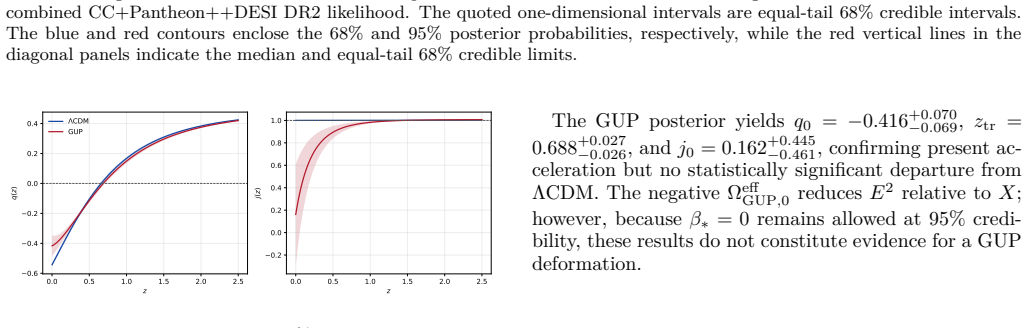
- [Sec. IV / Eqs. (37)-(38)] The DESI DR2 13-component Gaussian likelihood is used as a vector of published D_M/r_d, D_H/r_d, D_V/r_d values. These compressed distances are derived from BAO fits that assume a fiducial expansion history. The paper does not discuss whether the compressed likelihood is valid for the GUP background, whose H(z) differs from the fiducial ΛCDM by ~1% at z≈1 (Fig. 3, middle), comparable to DESI distance errors. I request a quantitative robustness check—e.g., recomputing the BAO term with a GUP-adapted fiducial, or estimating the maximum shift induced by the fiducial choice—and a sentence reporting whether the quoted interval changes by a non-negligible amount. This is the main unaddressed link between the likelihoods and the headline numbers.
minor comments (4)
- [Eq. (2) and following] The gravitational constant is written G_N in Eq. (2) but G in Eqs. (4)–(8). Please define the notation once, for example G ≡ G_N.
- [Fig. 3, middle panel] The axis label appears misformatted: '0.0 0.5 1.0 1.5 2.0 100[HGUP/HΛCDM − 1]' seems to merge tick values with the label. Please separate the tick labels from the y-axis label.
- [Sec. IV] The phrase 'the complete likelihood therefore contains N = 31 + 1580 + 13 = 1624 entries' is slightly misleading: the 13-component DESI likelihood is a multivariate Gaussian block, not 13 independent data points. Consider wording such as 'data points' or 'likelihood terms' to avoid implying complete independence.
- [Table IV / Sec. VII] For the strict-normalization row with ηmax<0.10, the 95% interval excludes zero, which could be misread as a detection. The text explains this, but the caption could state more prominently that this exclusion is conditional on the broad perturbative cutoff and is not robust to the more conservative ηmax<0.05 cut.
Circularity Check
No significant circularity: β* is an openly fitted parameter of an explicit ansatz; derived quantities are labeled as posterior bookkeeping and are not presented as independent predictions.
full rationale
The paper's central result, the 95% interval on β*, is a direct parameter fit. Eq. (6) is introduced explicitly as an ansatz imposed after reduction to homogeneous phase space ('Equation (6) is an ansatz imposed after reduction to the homogeneous phase space'), and the modified Friedmann equation Eq. (12) follows from it by Hamilton's equation; no claimed prediction is equivalent to an input by construction. The cosmographic quantities q0, j0, ztr, and Ωeff_GUP are explicitly called 'bookkeeping' and 'not an independent observable' (Sec. VIII). The paper repeatedly flags the normalization ambiguity (Eqs. 17, 20), the perturbative cutoff dependence (Table IV), the absence of a covariant completion, and the lack of a decoupling mechanism (Sec. IIA). These are limitations, not circular reasoning. There are no self-citations, no imported uniqueness theorems, and no parameter fitted to a subset of data then reported as a prediction of a closely related quantity. The numerical check that β*=0 reproduces the ΛCDM limit in all three likelihood terms to machine precision anchors the analysis to external benchmarks. The reviewer's concern about the DESI DR2 compressed likelihood being fiducial-cosmology-dependent is a potential systematic/correctness issue, not a circularity, and does not affect this score.
Axiom & Free-Parameter Ledger
free parameters (7)
- β* (GUP deformation coefficient) =
−0.086^{+0.040}_{−0.032} (baseline); −0.119^{+0.055}_{−0.048} (strict closure)
- H0 =
67.88^{+1.67}_{−1.68} km/s/Mpc
- Ωm0 =
0.3072^{+0.0082}_{−0.0079}
- rd (sound horizon) =
147.05^{+3.57}_{−3.32} Mpc
- MB (supernova absolute magnitude) =
−19.413^{+0.051}_{−0.053}
- ηmax perturbative cutoff =
0.10 (baseline); 0.075 and 0.05 in nested cuts
- w0, wa (CPL reference model) =
−0.890^{+0.062}_{−0.057}, −0.135^{+0.518}_{−0.458}
axioms (5)
- ad hoc to paper The deformed bracket {a, p_a} = 1 + β p_a² (Eq. 6) is imposed as an ansatz on the reduced homogeneous phase space.
- domain assumption First-order truncation in β with |β p_a²| < 0.1 over 0 ≤ z ≤ 2.33.
- standard math Standard GR minisuperspace Hamiltonian constraint (Eq. 4) with separately conserved radiation, matter, and Λ.
- domain assumption Gravitational effects beyond H(z) are absent: standard distance formulas (Eqs. 28–31) and unchanged perturbation-sector statistics apply to the modified background.
- domain assumption rd carries no model information and may be marginalized freely over [120,170] Mpc.
read the original abstract
The investigation of possible quantum-gravity effects in cosmology is of considerable interest, especially when such effects can be tested against observations of the late-time expansion. In the present work we study a quadratic generalized-uncertainty-principle (GUP) deformation of the FLRW minisuperspace Poisson algebra. At first order in the deformation parameter, the construction modifies the Friedmann equation and hence the homogeneous expansion history. Since it does not determine a unique perturbation sector, we restrict the analysis to background observables, using 31 cosmic-chronometer measurements, the uncalibrated 1580-object Pantheon$+$ Hubble-flow sample, and the 13-component DESI DR2 baryon-acoustic-oscillation likelihood, while treating the sound horizon as a nuisance parameter. We compare the resulting cosmology with flat \LCDM{} and with the Chevallier--Polarski--Linder parametrization. For the baseline normalization we obtain $\betastar=-0.086^{+0.040}_{-0.032}$ at $68\%$ credibility and $-0.142<\betastar<0.005$ at $95\%$ credibility.
Figures




Reference graph
Works this paper leans on
-
[1]
We evaluate these expressions for every retained pos- terior sample, thereby preserving parameter correlations instead of evaluating them only at a marginalized median point. We also define the additive GUP contribution as a frac- tion of the total normalized expansion rate, Ωeff GUP(z) = β∗(1 +z)−4X2(z) E2(z) .(50) This is a bookkeeping quantity for the ...
-
[2]
Veneziano, Europhys
G. Veneziano, Europhys. Lett.2, 199 (1986)
1986
-
[3]
Amati, M
D. Amati, M. Ciafaloni, and G. Veneziano, Phys. Lett. B216, 41 (1989)
1989
- [4]
-
[5]
A. Kempf, G. Mangano, and R. B. Mann, Phys. Rev. D 52, 1108 (1995), arXiv:hep-th/9412167
Pith/arXiv arXiv 1995
-
[6]
L. J. Garay, Int. J. Mod. Phys. A10, 145 (1995), arXiv:gr-qc/9403008
Pith/arXiv arXiv 1995
-
[7]
A. F. Ali, S. Das, and E. C. Vagenas, Phys. Lett. B678, 497 (2009), arXiv:0906.5396
Pith/arXiv arXiv 2009
-
[8]
S. Hossenfelder, Living Rev. Relativ.16, 2 (2013), arXiv:1203.6191
Pith/arXiv arXiv 2013
-
[9]
Appelquist and J
T. Appelquist and J. Carazzone, Phys. Rev. D11, 2856 (1975)
1975
-
[10]
J. F. Donoghue, Phys. Rev. D50, 3874 (1994), arXiv:gr- qc/9405057
arXiv 1994
-
[11]
M. V. Battisti and S. Meljanac, Phys. Rev. D79, 067505 (2009), arXiv:0812.3755
Pith/arXiv arXiv 2009
-
[12]
M. Chevallier and D. Polarski, Int. J. Mod. Phys. D10, 213 (2001), arXiv:gr-qc/0009008
Pith/arXiv arXiv 2001
-
[13]
E. V. Linder, Phys. Rev. Lett.90, 091301 (2003), arXiv:astro-ph/0208512
Pith/arXiv arXiv 2003
-
[14]
R. Jimenez and A. Loeb, Astrophys. J.573, 37 (2002), arXiv:astro-ph/0106145
Pith/arXiv arXiv 2002
-
[15]
M. Moresco, L. Pozzetti, A. Cimatti, R. Jimenez, C. Maraston, L. Verde, D. Thomas, A. Citro, R. Tojeiro, and D. Wilkinson, JCAP05, 014 (2016), arXiv:1601.01701 [astro-ph.CO]
Pith/arXiv arXiv 2016
-
[16]
D. Broutet al., Astrophys. J.938, 110 (2022), arXiv:2202.04077 [astro-ph.CO]
Pith/arXiv arXiv 2022
-
[17]
Abdul-Karimet al.(DESI Collaboration), Phys
M. Abdul-Karimet al.(DESI Collaboration), Phys. Rev. D112, 083515 (2025), arXiv:2503.14738 [astro-ph.CO]
Pith/arXiv arXiv 2025
-
[18]
C. W. Misner, K. S. Thorne, and J. A. Wheeler,Gravi- tation, W. H. Freeman, San Francisco (1973)
1973
-
[19]
Akaike, IEEE Trans
H. Akaike, IEEE Trans. Autom. Control19, 716 (1974)
1974
-
[20]
Schwarz, Ann
G. Schwarz, Ann. Stat.6, 461 (1978)
1978
-
[21]
D. Foreman-Mackey, D. W. Hogg, D. Lang, and J. 10 Goodman, Publ. Astron. Soc. Pac.125, 306 (2013), arXiv:1202.3665 [astro-ph.IM]
Pith/arXiv arXiv 2013
discussion (0)
Sign in with ORCID, Apple, or X to comment. Anyone can read and Pith papers without signing in.