Toward Precision Fragmentation of Ω_(3Q) Baryons: The OMG3Q1.1 Framework
Pith reviewed 2026-06-26 16:58 UTC · model grok-4.3
The pith
The OMG3Q1.1 framework yields the first uncertainty-resolved fragmentation-function set for the Ω_{3Q} sector.
A machine-rendered reading of the paper's core claim, the machinery that carries it, and where it could break.
Core claim
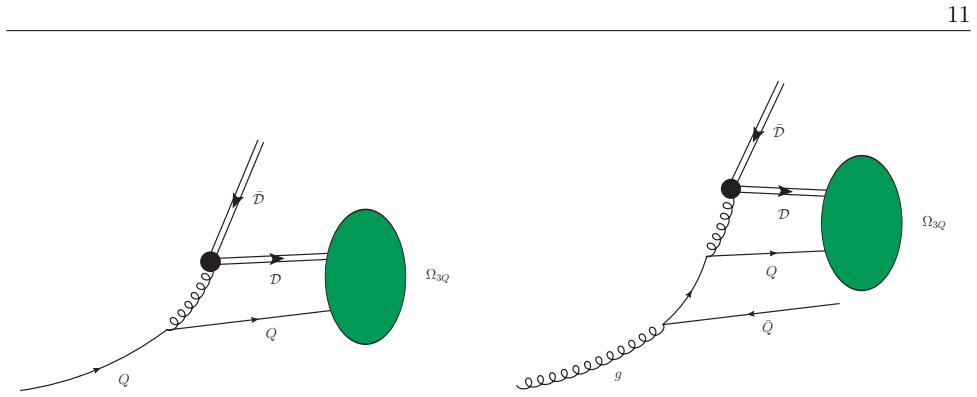
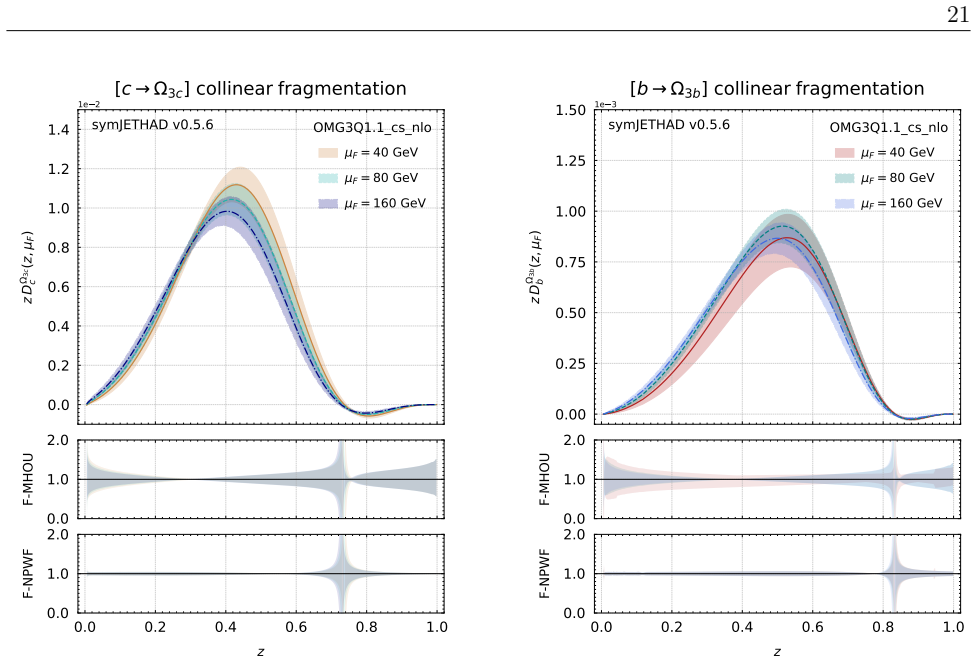
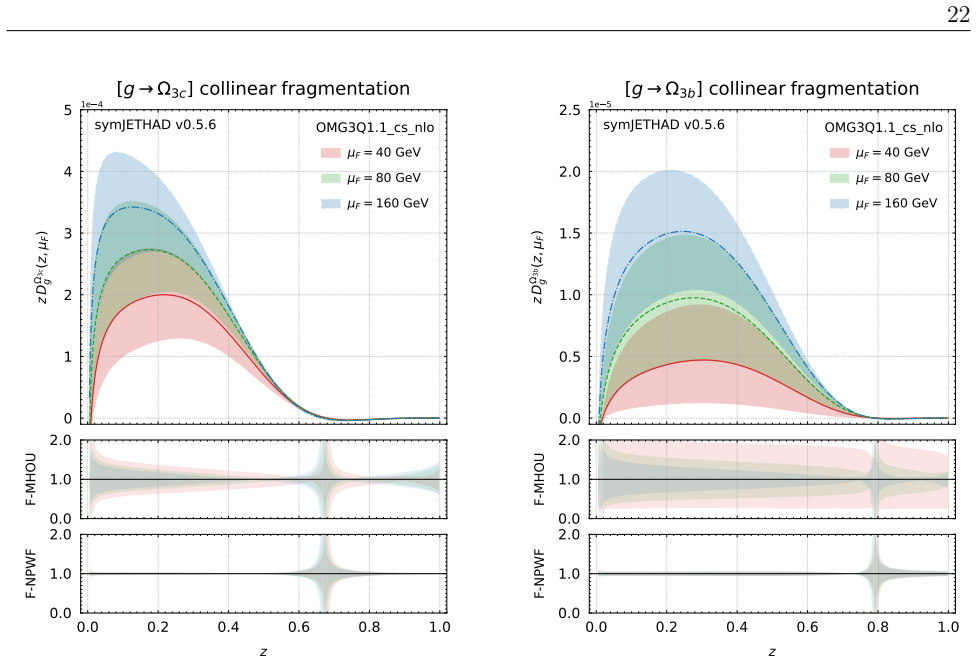
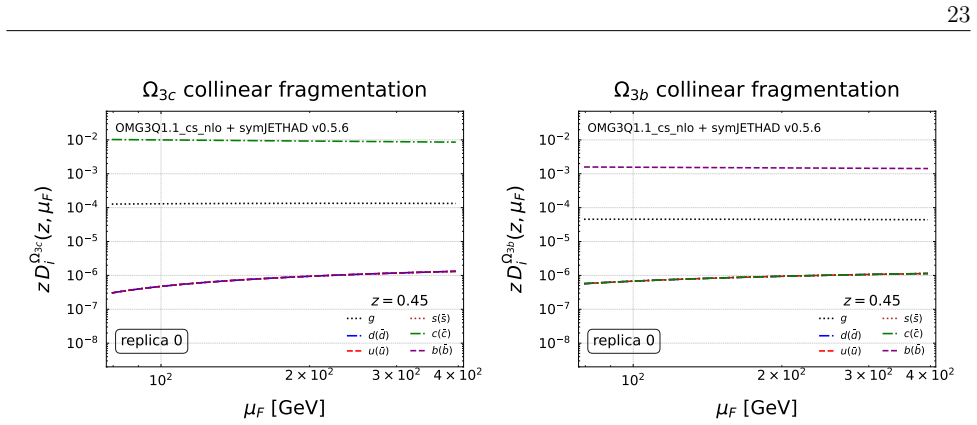
The OMG3Q1.1 framework yields the first uncertainty-resolved fragmentation-function set for the Ω_{3Q} sector by combining diquark-inspired inputs for constituent-heavy-quark and gluon channels with threshold-aware DGLAP evolution within the HF-NRevo scheme and applying a replica-based strategy to quantify perturbative missing-higher-order effects and nonperturbative wave-function uncertainties.
What carries the argument
Replica-based strategy for quantifying missing-higher-order perturbative uncertainties and nonperturbative wave-function uncertainties, applied to diquark-inspired inputs evolved with the HF-NRevo scheme.
Load-bearing premise
Diquark-inspired inputs together with the HF-NRevo evolution scheme capture the dominant physics of Ω_{3Q} fragmentation without large unquantified systematic biases from other nonperturbative effects.
What would settle it
A measurement of the semi-inclusive production rate of Ω_{3Q} baryons plus jets at the LHC that falls significantly outside the uncertainty band of the OMG3Q1.1 grids would show that important contributions have been missed.
Figures
read the original abstract
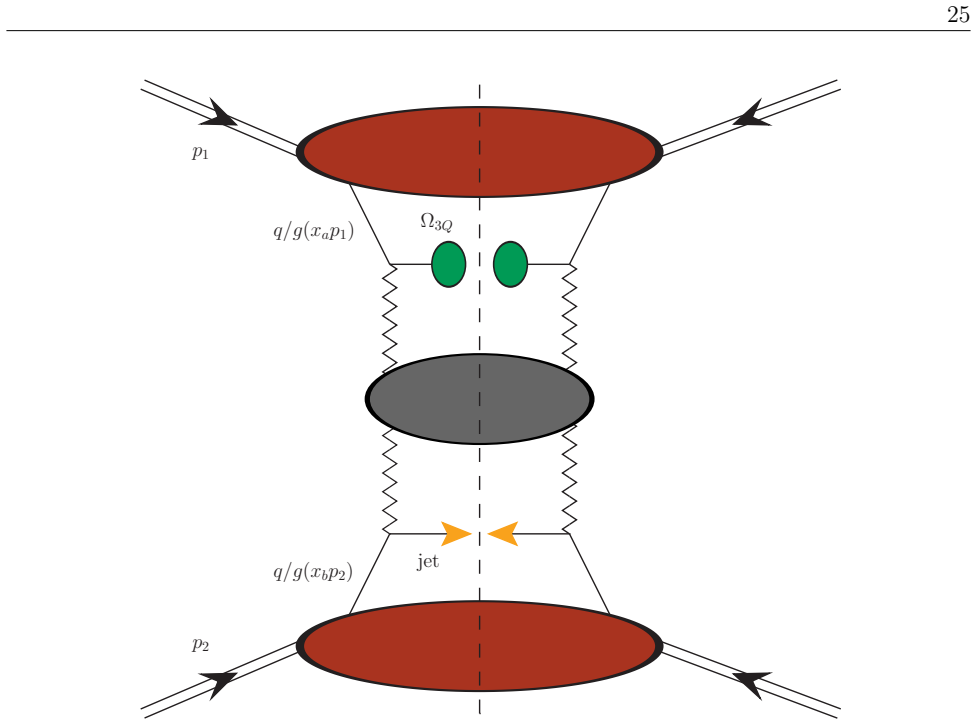
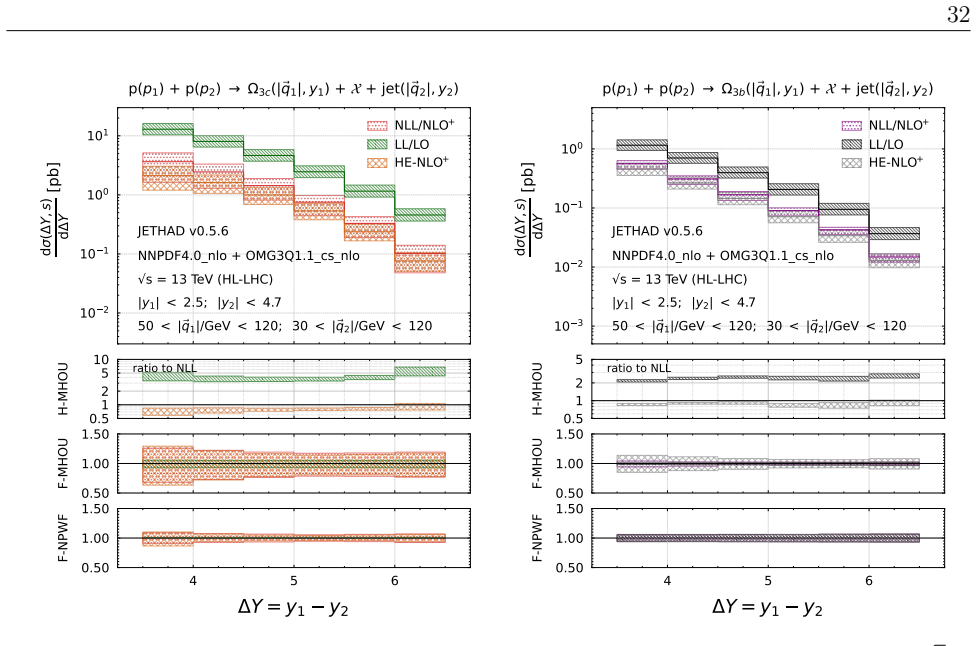
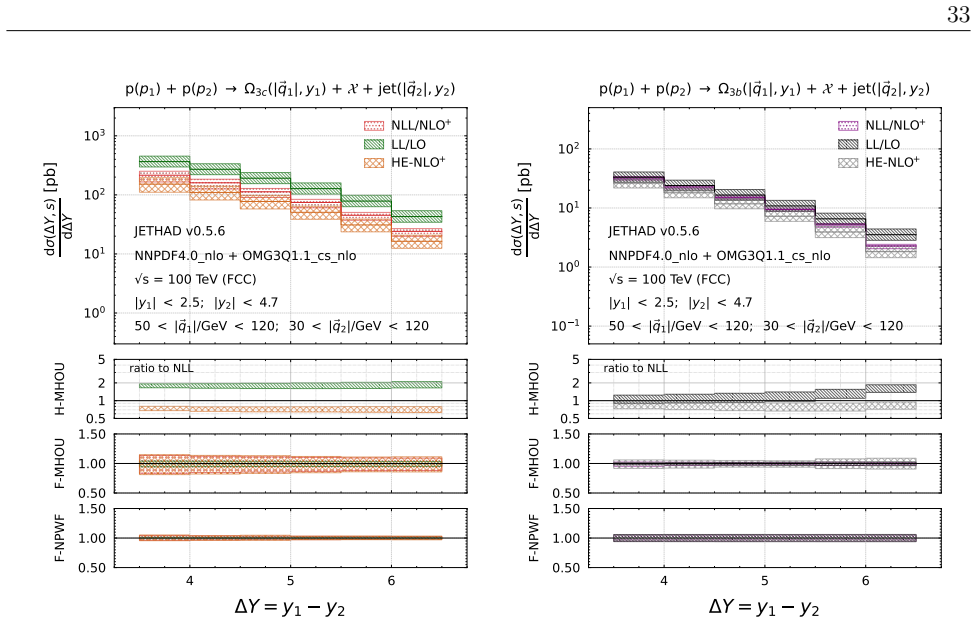
Recent experimental advances in the baryon sector, including the observation of doubly charmed states, have renewed interest in the production mechanisms of increasingly heavy hadronic systems, calling for precision and uncertainty-controlled descriptions. We present the OMG3Q1.1 framework for the fragmentation of same-flavor all-heavy $\Omega_{3Q}$ baryons in high-energy hadronic collisions. The construction combines diquark-inspired inputs for constituent-heavy-quark and gluon channels with threshold-aware DGLAP evolution within the HF-NRevo scheme. A replica-based strategy consistently quantifies perturbative missing-higher-order effects (F-MHOUs) and nonperturbative wave-function uncertainties (F-NPWFs), yielding the first uncertainty-resolved fragmentation-function set for the $\Omega_{3Q}$ sector. The resulting LHAPDF6 grids are employed to investigate semi-inclusive $\Omega_{3Q}$ plus jet production at the HL-LHC and future FCC within the (sym)JETHAD environment. The OMG3Q1.1 framework establishes a precision-oriented baseline for rare triply heavy baryons and provides a foundation for future studies of the heavy-flavor baryon landscape.
Editorial analysis
A structured set of objections, weighed in public.
Referee Report
Summary. The manuscript introduces the OMG3Q1.1 framework for fragmentation functions of same-flavor all-heavy Ω_{3Q} baryons. It constructs inputs via a diquark-inspired model for constituent heavy-quark and gluon channels, applies threshold-aware DGLAP evolution in the HF-NRevo scheme, and uses a replica strategy to quantify F-MHOUs and F-NPWFs. The resulting LHAPDF6 grids are then employed to study semi-inclusive Ω_{3Q} + jet production at the HL-LHC and FCC within the (sym)JETHAD environment, presented as the first uncertainty-resolved set for this sector.
Significance. If the base inputs and replica uncertainties are shown to be robust, the work supplies a needed precision baseline for rare triply heavy baryon phenomenology and collider predictions. The replica-based treatment that consistently propagates both perturbative and nonperturbative uncertainties is a methodological strength worth preserving.
major comments (1)
- [Abstract] Abstract: the claim that the replica strategy yields an uncertainty-resolved fragmentation-function set is load-bearing. The construction rests on diquark-inspired inputs whose validity for all-heavy three-quark systems is not demonstrated; if genuine three-body color and spatial correlations shift the central functions outside the quoted replica bands, the uncertainty-resolution claim is compromised. The manuscript must explicitly test or bound this possibility (e.g., via comparison to alternative three-quark wave-function models) rather than assume the chosen inputs dominate the error budget.
minor comments (2)
- [Abstract] Abstract: the acronym 'OMG3Q1.1' is introduced without expansion or definition.
- [Abstract] Abstract: '(sym)JETHAD environment' appears without citation or brief description of its scope.
Simulated Author's Rebuttal
We thank the referee for the careful reading and the substantive comment on the abstract. We address the concern point by point below.
read point-by-point responses
-
Referee: [Abstract] Abstract: the claim that the replica strategy yields an uncertainty-resolved fragmentation-function set is load-bearing. The construction rests on diquark-inspired inputs whose validity for all-heavy three-quark systems is not demonstrated; if genuine three-body color and spatial correlations shift the central functions outside the quoted replica bands, the uncertainty-resolution claim is compromised. The manuscript must explicitly test or bound this possibility (e.g., via comparison to alternative three-quark wave-function models) rather than assume the chosen inputs dominate the error budget.
Authors: We agree that the validity of the diquark-inspired inputs for all-heavy three-quark systems is an important assumption underlying the uncertainty-resolution claim. The replica strategy in OMG3Q1.1 samples variations in diquark masses, wave-function normalizations, shape parameters, and perturbative orders within the chosen modeling framework, which is motivated by its prior success for doubly-heavy baryons. However, this does not constitute an explicit test against genuine three-body color and spatial correlations that might lie outside the sampled variations. In the revised manuscript we have added a dedicated paragraph in Section 3.2 that qualitatively assesses possible three-body effects and enlarges the replica ensemble to include broader functional variations that partially mimic such correlations, thereby providing a partial bound on the central-value shift. We view this as a proportionate response that strengthens the presentation without requiring a full alternative three-quark calculation at this stage. revision: partial
Circularity Check
No significant circularity detected from provided text
full rationale
The abstract describes a modeling framework that combines diquark-inspired inputs with the HF-NRevo evolution scheme and applies a replica strategy to quantify F-MHOUs and F-NPWFs. No equations, explicit self-citations, or derivations are shown that reduce any central prediction or uncertainty estimate to the inputs by construction. The derivation chain is presented as a new construction for the Ω_{3Q} sector and remains self-contained against external benchmarks in the given material.
Axiom & Free-Parameter Ledger
free parameters (2)
- nonperturbative wave-function parameters
- replica variation parameters for F-MHOUs
axioms (2)
- standard math DGLAP evolution equations remain valid for these heavy baryon fragmentation functions when threshold effects are included
- domain assumption Diquark-inspired inputs provide a sufficient description of the constituent-heavy-quark and gluon fragmentation channels
Reference graph
Works this paper leans on
-
[1]
J. D. Bjorken, AIP Conf. Proc.132, 390 (1985)
1985
-
[2]
Fleck and J
S. Fleck and J. M. Richard, Prog. Theor. Phys.82, 760 (1989)
1989
-
[3]
A. P. Martynenko, Phys. Lett. B663, 317 (2008),0708.2033
Pith/arXiv arXiv 2008
-
[4]
A. P. Martynenko and A. M. Trunin, Phys. Rev. D89, 014004 (2014),1308.3998
Pith/arXiv arXiv 2014
-
[5]
M. Karliner and J. L. Rosner, Phys. Rev. D90, 094007 (2014),1408.5877
Pith/arXiv arXiv 2014
-
[6]
T. Yoshida, E. Hiyama, A. Hosaka, M. Oka, and K. Sadato, Phys. Rev. D92, 114029 (2015),1510.01067
Pith/arXiv arXiv 2015
-
[7]
D. Ebert, R. N. Faustov, V. O. Galkin, and A. P. Martynenko, Phys. Rev. D66, 014008 (2002),hep-ph/0201217
Pith/arXiv arXiv 2002
-
[8]
W. Roberts and M. Pervin, Int. J. Mod. Phys. A23, 2817 (2008),0711.2492
Pith/arXiv arXiv 2008
-
[9]
Y.-Q. Chen and S.-Z. Wu, JHEP08, 144 (2011), [Erratum: JHEP 09, 089 (2011)], 1106.0193
Pith/arXiv arXiv 2011
-
[10]
M. Padmanath, R. G. Edwards, N. Mathur, and M. Peardon, Phys. Rev. D90, 074504 (2014),1307.7022
Pith/arXiv arXiv 2014
-
[11]
Z. S. Brown, W. Detmold, S. Meinel, and K. Orginos, Phys. Rev. D90, 094507 (2014), 1409.0497
Pith/arXiv arXiv 2014
- [12]
-
[13]
N. Mathur and M. Padmanath, Phys. Rev. D99, 031501 (2019),1807.00174
Pith/arXiv arXiv 2019
-
[14]
A. Francis, R. J. Hudspith, R. Lewis, and K. Maltman,Evidence for charm-bottom tetraquarks and the mass dependence of heavy-light tetraquark states from lattice QCD (2019),1810.10550
Pith/arXiv arXiv 2019
-
[15]
E. J. Eichten and C. Quigg, Phys. Rev. D49, 5845 (1994),hep-ph/9402210
Pith/arXiv arXiv 1994
-
[16]
Godfrey and N
S. Godfrey and N. Isgur, Phys. Rev. D32, 189 (1985)
1985
-
[17]
R. N. Faustov and V. O. Galkin, Phys. Rev. D105, 014013 (2022),2111.07702
arXiv 2022
- [18]
-
[19]
F. J. Llanes-Estrada, O. I. Pavlova, and R. Williams, Eur. Phys. J. C72, 2019 (2012), 1111.7087. 39
Pith/arXiv arXiv 2019
-
[20]
K.-W. Wei, B. Chen, N. Liu, Q.-Q. Wang, and X.-H. Guo, Phys. Rev. D95, 116005 (2017),1609.02512
Pith/arXiv arXiv 2017
-
[21]
G. Yang, J. Ping, P. G. Ortega, and J. Segovia, Chin. Phys. C44, 023102 (2020),1904. 10166
2020
-
[22]
M. G´ omez-Rocha, J. More, and K. Serafin, Few Body Syst.64, 44 (2023),2305.06728
arXiv 2023
-
[23]
Z. R. Najjar, K. Azizi, and H. R. Moshfegh, Eur. Phys. J. C84, 612 (2024),2402.14348
arXiv 2024
-
[24]
N. M. de Arenaza, J. J. G´ alvez-Viruet, and F. J. Llanes-Estrada (2024),2407.07232
arXiv 2024
-
[25]
G. Apollinari, O. Br¨ uning, T. Nakamoto, and L. Rossi, CERN Yellow Rep. pp. 1–19 (2015),1705.08830
Pith/arXiv arXiv 2015
-
[26]
M. Benedikt et al. (FCC), Eur. Phys. J. C85, 1468 (2025),2505.00272
Pith/arXiv arXiv 2025
- [27]
-
[28]
M. Benedikt et al. (FCC), Eur. Phys. J. ST234, 5113 (2025), [Erratum: Eur.Phys.J.ST None, (2025)],2505.00273
arXiv 2025
- [29]
-
[30]
A. Hayrapetyan et al. (CMS), Phys. Rev. Lett.132, 111901 (2024),2306.07164
arXiv 2024
- [31]
-
[32]
R. Aaij et al. (LHCb), Phys. Rev. Lett.119, 112001 (2017),1707.01621
Pith/arXiv arXiv 2017
- [33]
-
[34]
Y. Wang (LHCb),Conventional spectroscopy of doubly heavy hadrons at lhcb, Beauty 2026 Conference, Maastricht, The Netherlands (2026), presentation reporting the observation of the doubly charmed baryon Ω + cc
2026
-
[35]
S. S. Gershtein, V. V. Kiselev, A. K. Likhoded, and A. I. Onishchenko, Phys. Rev. D62, 054021 (2000)
2000
-
[36]
A. Ali, J. S. Lange, and S. Stone, Prog. Part. Nucl. Phys.97, 123 (2017),1706.00610
Pith/arXiv arXiv 2017
- [37]
- [38]
-
[39]
E. Braaten, K.-m. Cheung, S. Fleming, and T. C. Yuan, Phys. Rev. D51, 4819 (1995), hep-ph/9409316. 40
Pith/arXiv arXiv 1995
-
[40]
E. Braaten and T. C. Yuan, Phys. Rev. Lett.71, 1673 (1993),hep-ph/9303205
Pith/arXiv arXiv 1993
-
[41]
Braaten, K.-m
E. Braaten, K.-m. Cheung, and T. C. Yuan, Phys. Rev. D48, 4230 (1993),hep-ph/ 9302307
1993
-
[42]
E. Braaten, M. A. Doncheski, S. Fleming, and M. L. Mangano, Phys. Lett. B333, 548 (1994),hep-ph/9405407
Pith/arXiv arXiv 1994
-
[43]
Braaten, K.-m
E. Braaten, K.-m. Cheung, and T. C. Yuan, Phys. Rev. D48, R5049 (1993),hep-ph/ 9305206
1993
-
[44]
V. V. Kiselev, A. K. Likhoded, and M. V. Shevlyagin, Phys. Lett. B332, 411 (1994), hep-ph/9408407
Pith/arXiv arXiv 1994
-
[45]
Anselmino, E
M. Anselmino, E. Predazzi, S. Ekelin, S. Fredriksson, and D. B. Lichtenberg, Rev. Mod. Phys.65, 1199 (1993)
1993
-
[46]
Ebert, T
D. Ebert, T. Feldmann, C. Kettner, and H. Reinhardt, Z. Phys. C71, 329 (1996),hep-ph/ 9506298
1996
-
[47]
S. M. Moosavi Nejad and P. Sartipi Yarahmadi, Eur. Phys. J. A52, 315 (2016),1609. 07422
2016
-
[48]
C.-H. Chang, C.-F. Qiao, J.-X. Wang, and X.-G. Wu, Phys. Rev. D73, 094022 (2006), hep-ph/0601032
Pith/arXiv arXiv 2006
-
[49]
A. D. Adamov and G. R. Goldstein, Phys. Rev. D56, 7381 (1997),hep-ph/9706491
Pith/arXiv arXiv 1997
-
[50]
Yang, Phys
J.-J. Yang, Phys. Rev. D65, 094035 (2002)
2002
-
[51]
M. A. Gomshi Nobary and R. Sepahvand, Phys. Rev. D71, 034024 (2005),hep-ph/ 0406148
2005
-
[52]
S. M. Moosavi Nejad and M. Delpasand, Eur. Phys. J. A53, 174 (2017)
2017
-
[53]
S. M. Moosavi Nejad, Phys. Rev. D96, 114021 (2017)
2017
-
[54]
Delpasand and S
M. Delpasand and S. M. Moosavi Nejad, Phys. Rev. D99, 114028 (2019)
2019
-
[55]
Mele and P
B. Mele and P. Nason, Nucl. Phys. B361, 626 (1991), [Erratum: Nucl.Phys.B 921, 841–842 (2017)]
1991
-
[56]
M. Cacciari and M. Greco, Nucl. Phys. B421, 530 (1994),hep-ph/9311260
Pith/arXiv arXiv 1994
-
[57]
M. Buza, Y. Matiounine, J. Smith, and W. L. van Neerven, Eur. Phys. J. C1, 301 (1998), hep-ph/9612398. 41
Pith/arXiv arXiv 1998
-
[58]
M. Cacciari and S. Catani, Nucl. Phys. B617, 253 (2001),hep-ph/0107138
Pith/arXiv arXiv 2001
-
[59]
A. Mitov and S.-O. Moch, Nucl. Phys. B751, 18 (2006),hep-ph/0604160
Pith/arXiv arXiv 2006
-
[60]
F. G. Celiberto and G. Gatto, Phys. Rev. D111, 034037 (2025),2412.10549
arXiv 2025
-
[61]
F. G. Celiberto, Phys. Rev. D111, L111501 (2025),2504.03949
arXiv 2025
-
[62]
F. G. Celiberto, Phys. Rev. D112, 074041 (2025),2507.09744
arXiv 2025
-
[63]
F. G. Celiberto, Phys. Rev. D, in press (2026),2604.11646
Pith/arXiv arXiv 2026
-
[64]
F. G. Celiberto, Eur. Phys. J. C85, 1395 (2025),2502.11136
arXiv 2025
-
[65]
F. G. Celiberto, Phys. Rev. D, in press (2026),2605.01539
Pith/arXiv arXiv 2026
-
[66]
F. G. Celiberto and F. Lonigro, Phys. Rev. D112, 114040 (2025),2510.10593
arXiv 2025
-
[67]
F. G. Celiberto, in58th Rencontres de Moriond on QCD and High Energy Interactions (2024),2405.08221
arXiv 2024
-
[68]
F. G. Celiberto, PoSDIS2024, 168 (2025),2406.10779
arXiv 2025
-
[69]
F. G. Celiberto, Acta Phys. Polon. Supp.18, 1 (2025),2412.05661
arXiv 2025
-
[70]
F. G. Celiberto and F. Lonigro, PoSEPS-HEP2025, 191 (2026),2510.22449
arXiv 2026
-
[71]
F. G. Celiberto and F. Lonigro (2026),2603.28389
arXiv 2026
-
[72]
F. G. Celiberto (2026),2604.01867
arXiv 2026
-
[73]
F. G. Celiberto, Phys. Rev. D112, 074023 (2025),2506.00776
arXiv 2025
-
[74]
F. G. Celiberto, Eur. Phys. J. C81, 691 (2021),2008.07378
arXiv 2021
-
[75]
F. G. Celiberto, Phys. Rev. D105, 114008 (2022),2204.06497
arXiv 2022
-
[76]
F. G. Celiberto, Universe9, 324 (2023),2305.14295
arXiv 2023
-
[77]
F. G. Celiberto, Symmetry16, 550 (2024),2403.15639
arXiv 2024
-
[78]
F. G. Celiberto, Particles7, 502 (2024),2405.09526
arXiv 2024
-
[79]
F. G. Celiberto, Symmetry18, 29 (2026),2604.01871
arXiv 2026
-
[80]
Cacciari, M
M. Cacciari, M. Greco, S. Rolli, and A. Tanzini, Phys. Rev. D55, 2736 (1997),hep-ph/ 9608213. 42
1997
discussion (0)
Sign in with ORCID, Apple, or X to comment. Anyone can read and Pith papers without signing in.