REVIEW 5 major objections 5 minor 50 references
Reviving Cultural Heritage: A Novel Approach for Comprehensive Historical Document Restoration
T0 review · 5 major / 5 minor · reviewed 2026-08-06 · deepseek-v4-flash
Pith's one-line read AutoHDR restores full-page historical documents by combining OCR, language models, and diffusion in a three-stage pipeline, raising OCR accuracy on severely damaged pages from 46.83% to 84.05%, and to 94.25% when historians review…
desk verdict Useful full-page HDR dataset and pipeline, but the headline OCR gain conflates content prediction with appearance restoration and needs a fix before the claim stands. read the letter →
The pith
A machine-rendered reading of the paper's core claim, the machinery that carries it, and where it could break.
The reading
What carries the argument
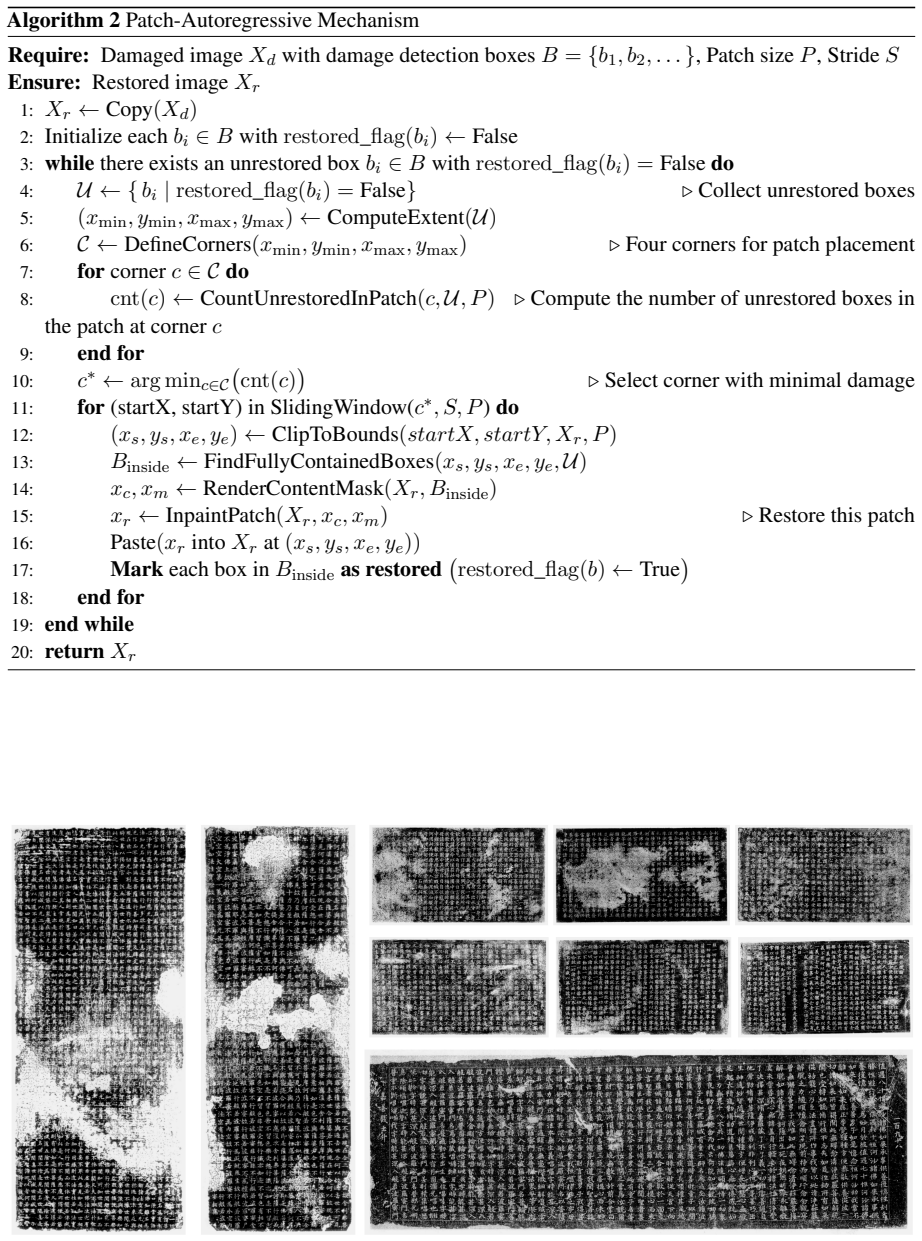
The key machinery is the three-stage module design with the Vision-Language Context Prediction (VLCP) algorithm connecting them. VLCP takes OCR predictions for each damaged character, and when OCR confidence exceeds a threshold it accepts the OCR result; otherwise it computes a composite score combining OCR probability, LLM probability, ranking position in each model's prediction list, and a bonus when both models agree, then selects the top candidate. This lets the system automatically choose visual evidence for lightly damaged characters and contextual language prediction for severely damaged ones. A second load-bearing mechanism is the patch-autoregressive (PAR) inference strategy, which restores the page by repeatedly selecting the corner with the least damage, restoring that patch, and using the restored result as context for the next patch, thereby enabling page-level rather than patch-level restoration.
What would settle it
A specific falsifying test would be to take a set of FPHDR's real severely damaged pages, restore them with AutoHDR, and have expert epigraphers independently verify that the restored characters match the original text and handwriting style. The central claim would be weakened if human experts found systematic hallucinations or style mismatches that the OCR metric did not penalize.
Extended reading notes
Core claim
The discovery is a comprehensive restoration pipeline that combines three stages: OCR-assisted damage localization to find and flag damaged characters; vision-language context prediction (VLCP) that merges OCR visual evidence with LLM textual prediction to reconstruct damaged text; and patch-autoregressive (PAR) diffusion-based appearance restoration that reconstructs the page's visual appearance, progressing from intact to damaged regions. The paper reports that on FPHDR's severely damaged documents, the system raises OCR recognition accuracy from 46.83% to 84.05%, and with historian collaboration to 94.25%, outperforming general image-restoration baselines (NAFNet, Uformer, Restormer) in both appearance quality and OCR readability.
Load-bearing premise
The reported restoration quality is measured mainly by how well a specific OCR engine can read the restored images, which assumes that this OCR accuracy is an unbiased measure of how faithfully the document is restored rather than just legibility to that one engine.
Editorial extensions
If this is right
- If AutoHDR's reported accuracy holds, severely damaged historical documents that currently require thousands of hours of expert labor could be automatically restored and then reviewed by historians, with the system's top-five text suggestions providing a practical collaborative workflow.
- The FPHDR dataset, with real damage annotations and synthetic damaged-restored pairs for the Fangshan Stone Sutras, could serve as a training and evaluation resource that lets other researchers move from patch-level to full-page historical document restoration.
- The modular three-stage design means each component (damage localization, content prediction, appearance restoration) can be improved, swapped, or supervised independently, which is a direct route for integrating human expertise into the system.
- The VLCP fusion approach shows that OCR and LLM predictions are complementary for damaged-character reconstruction, a principle that could transfer to other tasks where visual and linguistic evidence overlap.
- The reported 'restore the old as old and as new' capability suggests the same pipeline could support both faithful restoration and a clean, modern appearance, depending on the user's goal.
Reading between the lines
- A natural test of the pipeline's generality would be applying it to other script families and damage types, such as damaged Greek or Latin inscriptions, since the current claims are built on a Chinese-character corpus.
- The paper's evaluation of appearance restoration uses OCR accuracy on the restored images as the primary proxy for fidelity; a reader should treat that metric as a measure of legibility to a specific OCR engine rather than as definitive proof of historical fidelity.
- The strong reported gain from historian collaboration (85.05% vs. 76.38% for content prediction on a small 23-document sample) suggests that the system's real-world value may lie more in being an expert-assistive tool than in fully autonomous restoration, which the authors largely acknowledge in their limitations section.
- One testable improvement direction is an end-to-end vision-language model that merges all three stages, which the paper itself flags as future work.
Editorial analysis
A structured set of objections, weighed in public.
Referee Report
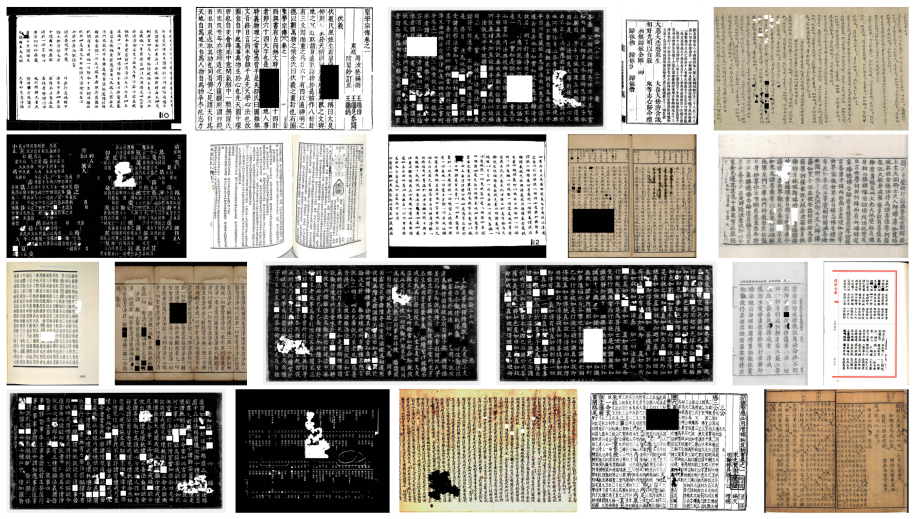
Summary. The paper introduces AutoHDR, a three-stage automated pipeline for full-page historical document restoration, comprising OCR-assisted damage localization, vision-language context prediction (VLCP) for damaged-text restoration, and a patch-autoregressive diffusion-based historical appearance restoration (HAR) module. It also introduces FPHDR, a new dataset of approximately 1,633/1,663 real and 6,543 synthetic full-page images with character-level and line-level annotations. The authors report that AutoHDR raises OCR accuracy on severely damaged documents from 46.83% to 84.05%, and to 94.25% with historian collaboration, and claim state-of-the-art appearance restoration based on OCR accuracy, user studies, and LPIPS. The paper includes pseudocode for the VLCP and PAR algorithms and provides a GitHub repository for the model and dataset.
Significance. If the reported results are reproducible and the evaluation concerns are resolved, AutoHDR would be a practical contribution to cultural heritage preservation: it offers a fully automated, modular pipeline with a human-in-the-loop option, and FPHDR would be a valuable benchmark for full-page historical document restoration. The dataset release and the clear description of the synthetic degradation process are strengths. However, the current evaluation has several load-bearing gaps—most notably the conflation of content prediction with appearance quality in the primary metric, the omission of the most relevant baseline, and an under-specified human-collaboration protocol—that prevent full confidence in the headline claims.
major comments (5)
- [5.1, Eq. (3), Table 5] The primary metric for appearance restoration is OCR Accurate Rate (AR) measured on restored images. Since the HAR stage is conditioned on the content image x_c produced from the DCP predictions (Section 4.4, Algorithm 2), AR chiefly tracks whether DCP guessed the correct characters and whether the rendered glyphs are legible to the evaluation OCR, not whether historical appearance (ink, background, stroke style) is faithfully restored. A trivial baseline that renders the DCP text in a clean font could achieve comparable AR without performing any historical appearance restoration. The authors should include such a control, or report AR only on characters where DCP is correct, to isolate the contribution of HAR. Without this, the headline improvement of 46.83% to 84.05% cannot be interpreted as evidence of state-of-the-art appearance restoration. The user-study and LPIPS results are more on point but are secondary and do not rescue the headline number.
- [Table 5] DiffHDR (Yang et al., 2025) is the most directly relevant baseline for appearance restoration: the HAR module is built on its training procedure and the paper repeatedly invokes it, yet DiffHDR is absent from the comparison. Including DiffHDR under the same input protocol (receiving identical Stage-1 and Stage-2 outputs) is necessary to support the state-of-the-art claim. Without this baseline, the reader cannot judge whether the reported gains over NAFNet, Uformer, and Restormer represent a genuine advance over the immediate predecessor.
- [Tables 3-5 and Appendix F] The historian-collaboration experiments are under-specified. The paper does not state how many historians participated, what instructions they received, whether the same documents were used across the historian-only, AutoHDR-only, and collaborative scenarios, or how their modifications were integrated into the pipeline. The collaboration gains (e.g., 46.83% to 94.25% in Table 5, and 76.38% to 85.05% in Table 4) therefore lack a reproducible protocol. A detailed description of the collaboration procedure, participant count, and inter-annotator agreement is needed before these figures can be independently validated.
- [3.2 and 4.3] There is a training/test source overlap for the Damaged Content Prediction stage: the LLM is fine-tuned on CBeta (Section 4.3), while the test-set content annotations are derived with reference to CBeta and similar historical sources (Section 3.2). This risks inflating content-prediction accuracy through memorization of the source corpus rather than generalizable restoration ability. The authors should either evaluate on a held-out corpus not used in fine-tuning or quantify the performance drop on texts from sources absent from the training data.
- [4.3 and B.3] The VLCP fusion weights (τ=0.9, w_o=0.6, w_l=0.4, α=0.05, β=1.5, k=5) are hand-tuned, and the ablation in Table 8 shows a 42.06-point Top-1 improvement from VLCP (50.49% to 92.55%). Because these parameters directly determine the final predictions, a sensitivity analysis or a validation-based selection procedure is needed to rule out overfitting to the test set. The paper should state explicitly how these values were chosen and whether they were fixed before the test evaluation.
minor comments (5)
- [Abstract vs. Table 1] The number of real test images is inconsistent: the abstract and Section 3.1 say 1,633, while Table 1, Appendix A (Table 6), and Section B.2 indicate 1,663. This discrepancy should be corrected.
- [Table 5] The user-study results and AR values are reported as single numbers without standard deviations, confidence intervals, or repeated-run variability. Please report variance and, for the user study, the distribution of scores and appropriate significance tests.
- [Algorithm 1] Line 11 applies the matching bonus when c ∈ P_o ∪ P_l, but the text describes the bonus for characters appearing in both models' predictions (intersection). The condition should be P_o ∩ P_l; otherwise the bonus is applied to every candidate.
- [Table 5] The user study reports 'Overall Quality' as 84.78% for AutoHDR; please clarify whether this is the percentage of participants who ranked AutoHDR first, and report the corresponding percentages for the other methods.
- [3.3] The synthetic training data generation is described, but the paper does not specify the distribution of damage grades (light/medium/severe) in the synthetic pairs. Please provide these statistics for reproducibility.
Circularity Check
Headline OCR-accuracy gain is partly constructed: HAR is fed a content image containing the DCP predictions, and the evaluation OCR is trained on the same corpora used to synthesize HAR training data.
-
other
[Sec. 4.4 / Algorithm 2 and Sec. 5.1 (Eq. 3)]
"The model takes a damaged image xd as input and generates a restored image xr under the guidance of a mask image xm (indicating damaged regions) and a content image xc (specifying damaged content). ... For appearance restoration, since obtaining pixel-level ground truth from real data is extremely difficult, we evaluate the restoration quality through character recognition accuracy."
Algorithm 2 renders x_c from the Stage-2 DCP predictions before each inpaint call, so the restored page's characters are the DCP text drawn by HAR. Eq. (3) scores that page by per-character recognition errors, so the headline 46.83% to 84.05% (94.25% with historian) gain primarily tracks DCP content correctness and glyph legibility, not ink, background style, stroke fidelity, or 'restoring the old as old.' A baseline that simply composited DCP text into the damaged regions in clean type could achieve a similar AR without performing historical appearance restoration. Thus the central SOTA claim for appearance restoration is not established by this metric; the AR improvement reduces in large part to the content image supplied by the pipeline itself.
-
other
[Sec. 3.3 (synthetic training data) vs Sec. 5.1 (evaluation OCR)]
"Therefore, we curate 6,543 well-preserved samples from the FSS, MTHv2 (Ma et al., 2020), and M5HisDoc (Shi et al., 2023) to synthesize pixel-level damaged-restored image pairs as training data. ... Specifically, we train a text-line OCR using AHCDB, MTHv2, and M5HisDoc to recognize the restored data."
The OCR used to compute the AR metric is trained on MTHv2 and M5HisDoc, and the HAR appearance model is trained to restore images synthesized from the same MTHv2 and M5HisDoc sources. HAR therefore need only reproduce the in-distribution character styles it was trained on for the evaluation OCR to read the output; a stylistically in-distribution but historically inaccurate rendering could score higher than a faithful rendering in an out-of-distribution style. The evaluation instrument is thus partly circular with the restoration model's training distribution, inflating the reported OCR accuracy improvement.
full rationale
No formal self-citation chain or fitted-parameter-renamed-as-prediction is present: the three stages are trained on distinct objectives, and the paper provides independent evidence for appearance quality (a 20-participant style-consistency and overall-quality user study, plus LPIPS on 100 intact Fangshan Stone Sutra images degraded with the Section 3.3 procedure). The Limitations section candidly concedes that severe-degradation results may be inaccurate and recommends historian collaboration; that is a correctness caveat, not circularity. The circularity burden is concentrated in the headline OCR-accuracy evaluation. Section 5.1 defines restoration quality by AR on the restored image, while Section 4.4 and Algorithm 2 feed the restoration model a content image that already specifies the damaged characters; consequently the AR gain mostly certifies that DCP's predicted text was rendered legibly, not that historical appearance was faithfully reconstructed. The additional overlap between the HAR synthetic training sources (FSS, MTHv2, M5HisDoc) and the evaluation OCR training set (AHCDB, MTHv2, M5HisDoc), plus the CBeta overlap between DCP fine-tuning and severe-damage test annotation, further erode the independence of the reported numbers. Because the paper does have some independent appearance metrics, the circularity is partial rather than total, yielding a score of 6.
Assumptions & free parameters
free parameters (3)
- VLCP fusion parameters =
tau=0.9, wo=0.6, wl=0.4, alpha=0.05, beta=1.5, k=5
- OCR damage threshold =
0.1
- PAR patch size and stride =
P=448, S=224
assumptions (4)
- domain assumption OCR accuracy on restored images is a valid proxy for restoration quality
- domain assumption Synthetic deterioration simulates real historical damage sufficiently for training
- domain assumption Expert annotations of damaged characters, especially severe damage, are correct
- domain assumption The CBeta corpus used for LLM fine-tuning and the sources used for test annotation are independent enough to measure generalization
Cite this review
Pith. "Pith review of Reviving Cultural Heritage: A Novel Approach for Comprehensive Historical Document Restoration." pith.science (2026). https://pith.science/paper/L2P4V7IS
@misc{pith2026250705108,
  author       = {Pith},
  title        = {Pith review of: Reviving Cultural Heritage: A Novel Approach for Comprehensive Historical Document Restoration},
  year         = {2026},
  howpublished = {\url{https://pith.science/paper/L2P4V7IS}},
  note         = {Machine review of arXiv:2507.05108}
}
read the original abstract
Historical documents represent an invaluable cultural heritage, yet have undergone significant degradation over time through tears, water erosion, and oxidation. Existing Historical Document Restoration (HDR) methods primarily focus on single modality or limited-size restoration, failing to meet practical needs. To fill this gap, we present a full-page HDR dataset (FPHDR) and a novel automated HDR solution (AutoHDR). Specifically, FPHDR comprises 1,633 real and 6,543 synthetic images with character-level and line-level locations, as well as character annotations in different damage grades. AutoHDR mimics historians' restoration workflows through a three-stage approach: OCR-assisted damage localization, vision-language context text prediction, and patch autoregressive appearance restoration. The modular architecture of AutoHDR enables seamless human-machine collaboration, allowing for flexible intervention and optimization at each restoration stage. Experiments demonstrate AutoHDR's remarkable performance in HDR. When processing severely damaged documents, our method improves OCR accuracy from 46.83% to 84.05%, with further enhancement to 94.25% through human-machine collaboration. We believe this work represents a significant advancement in automated historical document restoration and contributes substantially to cultural heritage preservation. The model and dataset are available at https://github.com/SCUT-DLVCLab/AutoHDR.
Figures


Figures from the paper (9 more)




Reference graph
Works this paper leans on
-
[1]
Y Assael, T Sommerschield, and J Prag. 2019. Restoring ancient text using deep learning: a case study on greek epigraphy. In Proceedings of the Conference on Empirical Methods in Natural Language Processing and the International Joint Conference on Natural Language Processing (EMNLP-IJCNLP)
work page 2019
-
[2]
Yannis Assael, Thea Sommerschield, Brendan Shillingford, Mahyar Bordbar, John Pavlopoulos, Marita Chatzipanagiotou, Ion Androutsopoulos, Jonathan Prag, and Nando de Freitas. 2022. Restoring and attributing ancient texts using deep neural networks. Nature, 603(7900):280--283
work page 2022
-
[3]
David Bamman and Patrick J Burns. 2020. Latin bert: A contextual language model for classical philology. arXiv preprint arXiv:2009.10053
arXiv 2020
-
[4]
Jiahuan Cao, Dezhi Peng, Peirong Zhang, Yongxin Shi, Yang Liu, Kai Ding, and Lianwen Jin. 2024. T ong G u: Mastering classical C hinese understanding with knowledge-grounded large language models. In Findings of the Association for Computational Linguistics: EMNLP, pages 4196--4210
work page 2024
-
[5]
Songxiao Cao, Zichao Shu, Zhipeng Xu, Dailiang Xie, and Ya Xu. 2022. Character segmentation and restoration of qin-han bamboo slips using local auto-focus thresholding method. Multimedia Tools and Applications, 81(6):8199--8213
work page 2022
-
[6]
https://www.cbeta.org/ https://www.cbeta.org/
CBeta . https://www.cbeta.org/ https://www.cbeta.org/
-
[7]
Kai Chen, Jiaqi Wang, Jiangmiao Pang, Yuhang Cao, Yu Xiong, Xiaoxiao Li, Shuyang Sun, Wansen Feng, Ziwei Liu, Jiarui Xu, Zheng Zhang, Dazhi Cheng, Chenchen Zhu, Tianheng Cheng, Qijie Zhao, Buyu Li, Xin Lu, Rui Zhu, Yue Wu, Jifeng Dai, Jingdong Wang, Jianping Shi, Wanli Ouyang, Chen Change Loy, and Dahua Lin. 2019. MMDetection : Open mmlab detection toolbo...
arXiv 2019
-
[8]
Liangyu Chen, Xiaojie Chu, Xiangyu Zhang, and Jian Sun. 2022. Simple baselines for image restoration. In European conference on computer vision (ECCV), pages 17--33
work page 2022
Show all 50 references
-
[9]
Zhe Chen, Weiyun Wang, Yue Cao, Yangzhou Liu, Zhangwei Gao, Erfei Cui, Jinguo Zhu, Shenglong Ye, Hao Tian, Zhaoyang Liu, Lixin Gu, Xuehui Wang, Qingyun Li, Yimin Ren, Zixuan Chen, Jiapeng Luo, Jiahao Wang, Tan Jiang, Bo Wang, Conghui He, Botian Shi, Xingcheng Zhang, Han Lv, Yi...
2025 arXiv
-
[10]
Alexey Dosovitskiy, Lucas Beyer, Alexander Kolesnikov, Dirk Weissenborn, Xiaohua Zhai, Thomas Unterthiner, Mostafa Dehghani, Matthias Minderer, Georg Heigold, Sylvain Gelly, Jakob Uszkoreit, and Neil Houlsby. 2021. https://arxiv.org/abs/2010.11929 An image is worth 16x16 words...
2021 arXiv
-
[11]
restoration as old
Wei-Sheng Du. 1999. “restoration as old” and “restoration as new” in the repair of ancient books. Journal of Beijing Library, (04):99--102
1999
-
[12]
Siyu Duan, Jun Wang, and Qi Su. 2024. Restoring ancient ideograph: A multimodal multitask neural network approach. In Proceedings of the Joint International Conference on Computational Linguistics, Language Resources and Evaluation (LREC-COLING), pages 14005--14015
2024
-
[13]
Ethan Fetaya, Yonatan Lifshitz, Elad Aaron, and Shai Gordin. 2020. Restoration of fragmentary babylonian texts using recurrent neural networks. Proceedings of the National Academy of Sciences, 117(37):22743--22751
2020
-
[14]
Garychowcmu . 2019. Daizhigev20. https://github.com/garychowcmu/daizhigev20
2019
-
[15]
Amit Gupte, Alexey Romanov, Sahitya Mantravadi, Dalitso Banda, Jianjie Liu, Raza Khan, Lakshmanan Ramu Meenal, Benjamin Han, and Soundar Srinivasan. 2021. Lights, camera, action! a framework to improve nlp accuracy over ocr documents. Document Intelligence Workshop at KDD 2021
2021
-
[16]
Kaixin Han, Weitao You, Huanghuang Deng, Lingyun Sun, Jinyu Song, Zijin Hu, and Heyang Yi. 2024. Lant: finding experts for digital calligraphy character restoration. Multimedia Tools and Applications, pages 1--24
2024
-
[17]
Rachid Hedjam and Mohamed Cheriet. 2013. Historical document image restoration using multispectral imaging system. Pattern Recognition, 46(8):2297--2312
2013
-
[18]
Hongxiang Huang, Daihui Yang, Gang Dai, Zhen Han, Yuyi Wang, Kin-Man Lam, Fan Yang, Shuangping Huang, Yongge Liu, and Mengchao He. 2022. Agtgan: Unpaired image translation for photographic ancient character generation. In Proceedings of the ACM international conference on mult...
2022
-
[19]
Koren Lazar, Benny Saret, Asaf Yehudai, Wayne Horowitz, Nathan Wasserman, and Gabriel Stanovsky. 2021. Filling the gaps in ancient akkadian texts: a masked language modelling approach. arXiv preprint arXiv:2109.04513
2021 arXiv
-
[20]
Haolong Li, Chenghao Du, Ziheng Jiang, Yifan Zhang, Jiawei Ma, and Chen Ye. 2024. Towards Automated Chinese Ancient Character Restoration: A Diffusion-Based Method with a New Dataset . In Proceedings of the AAAI Conference on Artificial Intelligence (AAAI), volume 38, pages 3073--3081
2024
-
[21]
Ze Liu, Yutong Lin, Yue Cao, Han Hu, Yixuan Wei, Zheng Zhang, Stephen Lin, and Baining Guo. 2021. Swin transformer: Hierarchical vision transformer using shifted windows. In Proceedings of the IEEE/CVF international conference on computer vision, pages 10012--10022
2021
-
[22]
Weihong Ma, Hesuo Zhang, Lianwen Jin, Sihang Wu, Jiapeng Wang, and Yongpan Wang. 2020. Joint layout analysis, character detection and recognition for historical document digitization. In International Conference on Frontiers in Handwriting Recognition (ICFHR), pages 31--36. IEEE
2020
-
[23]
https://www.nlc.cn https://www.nlc.cn
National Library of China . https://www.nlc.cn https://www.nlc.cn
-
[24]
Katerina Papavassileiou, Dimitrios I Kosmopoulos, and Gareth Owens. 2023. A generative model for the mycenaean linear b script and its application in infilling text from ancient tablets. ACM Journal on Computing and Cultural Heritage, 16(3):1--25
2023
-
[25]
Poulami Raha and Bhabatosh Chanda. 2019. Restoration of historical document images using convolutional neural networks. In IEEE region 10 symposium (TENSYMP), pages 56--61
2019
-
[26]
https://www-test.tripitakas.net/JS Jin Shan Zang
Rushi Tripitaka Collection . https://www-test.tripitakas.net/JS Jin Shan Zang . https://www-test.tripitakas.net/js
-
[27]
Daqian Shi, Xiaolei Diao, Hao Tang, Xiaomin Li, Hao Xing, and Hao Xu. 2022. Rcrn: Real-world character image restoration network via skeleton extraction. In Proceedings of the ACM international conference on multimedia (MM), pages 1177--1185
2022
-
[28]
Yongxin Shi, Chongyu Liu, Dezhi Peng, Cheng Jian, Jiarong Huang, and Lianwen Jin. 2023. M5HisDoc: A Large-scale Multi-style Chinese Historical Document Analysis Benchmark . In Advances in Neural Information Processing Systems (NeurIPS), volume 36, pages 78483--78495
2023
-
[29]
Yongxin Shi, Dezhi Peng, Yuyi Zhang, Jiahuan Cao, and Lianwen Jin. 2025. A large-scale dataset for chinese historical document recognition and analysis. Scientific Data, 12(1):169
2025
-
[30]
Thea Sommerschield, Yannis Assael, John Pavlopoulos, Vanessa Stefanak, Andrew Senior, Chris Dyer, John Bodel, Jonathan Prag, Ion Androutsopoulos, and Nando de Freitas. 2023. Machine learning for ancient languages: A survey . Computational Linguistics, 49(3):703--747
2023
-
[31]
Roman Suvorov, Elizaveta Logacheva, Anton Mashikhin, Anastasia Remizova, Arsenii Ashukha, Aleksei Silvestrov, Naejin Kong, Harshith Goka, Kiwoong Park, and Victor Lempitsky. 2022. Resolution-robust large mask inpainting with fourier convolutions. In Proceedings of the IEEE/CVF...
2022
-
[32]
Qwen Team. 2025. https://qwenlm.github.io/blog/qwen2.5-vl/ Qwen2.5-vl
2025
-
[33]
Mayank Wadhwani, Debapriya Kundu, Deepayan Chakraborty, and Bhabatosh Chanda. 2021. Text extraction and restoration of old handwritten documents. Digital Techniques for Heritage Presentation and Preservation, pages 109--132
2021
-
[34]
Chien-Yao Wang, Alexey Bochkovskiy, and Hong-Yuan Mark Liao. 2023 a . Yolov7: Trainable bag-of-freebies sets new state-of-the-art for real-time object detectors. In Proceedings of the IEEE/CVF conference on computer vision and pattern recognition (CVPR), pages 7464--7475
2023
-
[35]
Dongbo Wang, Chang Liu, Zhixiao Zhao, Si Shen, Liu Liu, Bin Li, Haotian Hu, Mengcheng Wu, Litao Lin, Xue Zhao, and Xiyu Wang. 2023 b . https://arxiv.org/abs/2307.05354 GujiBERT and GujiGPT: Construction of Intelligent Information Processing Foundation Language Models for Ancie...
2023 arXiv
-
[36]
Dongbo Wang, Chang Liu, Zihe Zhu, and et al. 2022 a . Sikubert and sikuroberta: Construction and application of pre-training models for digital humanities based on siku quanshu. Library Forum, 42(6):31--43
2022
-
[37]
Guo-Qiang Wang. 2021. Minimal intervention principle for ancient book conservation in china :techniques and application strategy. Library Forum, 41(07):141--148
2021
-
[38]
Junjie Wang, Yuxiang Zhang, Lin Zhang, Ping Yang, Xinyu Gao, Ziwei Wu, Xiaoqun Dong, Junqing He, Jianheng Zhuo, Qi Yang, Yongfeng Huang, Xiayu Li, Yanghan Wu, Junyu Lu, Xinyu Zhu, Weifeng Chen, Ting Han, Kunhao Pan, Rui Wang, Hao Wang, Xiaojun Wu, Zhongshen Zeng, Chongpei Chen...
2022 arXiv
-
[39]
Zhendong Wang, Xiaodong Cun, Jianmin Bao, Wengang Zhou, Jianzhuang Liu, and Houqiang Li. 2022 c . Uformer: A general u-shaped transformer for image restoration. In Proceedings of the IEEE/CVF conference on computer vision and pattern recognition (CVPR), pages 17683--17693
2022
-
[40]
Yue Xu, Fei Yin, Da-Han Wang, Xu-Yao Zhang, Zhaoxiang Zhang, and Cheng-Lin Liu. 2019. Casia-ahcdb: A large-scale chinese ancient handwritten characters database. In 2019 International Conference on Document Analysis and Recognition (ICDAR), pages 793--798. IEEE
2019
-
[41]
An Yang, Baosong Yang, Binyuan Hui, Bo Zheng, Bowen Yu, Chang Zhou, Chengpeng Li, Chengyuan Li, Dayiheng Liu, Fei Huang, Guanting Dong, Haoran Wei, Huan Lin, Jialong Tang, Jialin Wang, Jian Yang, Jianhong Tu, Jianwei Zhang, Jianxin Ma, Jianxin Yang, Jin Xu, Jingren Zhou, Jinze...
2024 arXiv
-
[42]
Zhenhua Yang, Dezhi Peng, Yongxin Shi, Yuyi Zhang, Chongyu Liu, and Lianwen Jin. 2025. Predicting the Original Appearance of Damaged Historical Documents . Proceedings of the AAAI Conference on Artificial Intelligence
2025
-
[43]
Syed Waqas Zamir, Aditya Arora, Salman Khan, Munawar Hayat, Fahad Shahbaz Khan, and Ming-Hsuan Yang. 2022. Restormer: Efficient transformer for high-resolution image restoration. In Proceedings of the IEEE/CVF conference on computer vision and pattern recognition (CVPR), pages...
2022
-
[44]
Ni, and Heung-Yeung Shum
Hao Zhang, Feng Li, Shilong Liu, Lei Zhang, Hang Su, Jun Zhu, Lionel M. Ni, and Heung-Yeung Shum. 2023. Dino: Detr with improved denoising anchor boxes for end-to-end object detection. In International Conference on Learning Representations(ICLR)
2023
-
[45]
Richard Zhang, Phillip Isola, Alexei A Efros, Eli Shechtman, and Oliver Wang. 2018. The unreasonable effectiveness of deep features as a perceptual metric. In CVPR
2018
-
[46]
Yuyi Zhang, Yuanzhi Zhu, Dezhi Peng, Peirong Zhang, Zhenhua Yang, Zhibo Yang, Cong Yao, and Lianwen Jin. 2025. Hiercode: A lightweight hierarchical codebook for zero-shot Chinese text recognition . Pattern Recognition, 158:110963
2025
-
[47]
Shipeng Zhu, Hui Xue, Na Nie, Chenjie Zhu, Haiyue Liu, and Pengfei Fang. 2024. Reproducing the past: A dataset for benchmarking inscription restoration. In Proceedings of the ACM International Conference on Multimedia (MM), pages 7714--7723
2024
-
[48]
Zhuofan Zong, Guanglu Song, and Yu Liu. 2023. Detrs with collaborative hybrid assignments training. In Proceedings of the IEEE/CVF international conference on computer vision (ICCV), pages 6748--6758
2023
-
[49]
online" 'onlinestring :=
ENTRY address archivePrefix author booktitle chapter edition editor eid eprint eprinttype howpublished institution journal key month note number organization pages publisher school series title type volume year doi pubmed url lastchecked label extra.label sort.label short.list...
-
[50]
write newline
" write newline "" before.all 'output.state := FUNCTION n.dashify 't := "" t empty not t #1 #1 substring "-" = t #1 #2 substring "--" = not "--" * t #2 global.max substring 't := t #1 #1 substring "-" = "-" * t #2 global.max substring 't := while if t #1 #1 substring * t #2 gl...
Reviewed August 6, 2026 · model on record in the stance chip above.
Discussion (0). Sign in to comment.