Quantum Mpemba effect for operators in open systems
Pith reviewed 2026-05-20 01:09 UTC · model grok-4.3
The pith
The quantum Mpemba effect extends to operators evolving under the adjoint Liouvillian in open systems.
A machine-rendered reading of the paper's core claim, the machinery that carries it, and where it could break.
Core claim
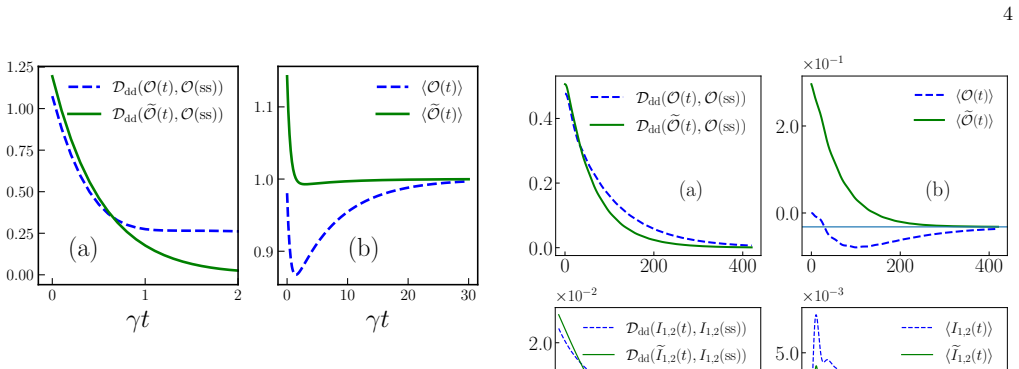
Operators that evolve under the adjoint Liouvillian exhibit a genuine Mpemba effect. General conditions are derived under which this anomalous relaxation can occur, and these are validated for three different open quantum setups. This demonstrates that the effect is not limited to trace-preserving dynamics on states.
What carries the argument
Adjoint Liouvillian dynamics on operators, which governs their time evolution and permits anomalous relaxation ordering.
If this is right
- Conditions derived allow prediction of the effect in various systems.
- Relaxation of observables can be controlled using this framework.
- Scope of the Mpemba effect is broadened to include operator-level phenomena in open systems.
Where Pith is reading between the lines
- This suggests that non-trace-preserving maps in general might support similar anomalous behaviors.
- Experimental measurements of operator expectations could reveal Mpemba-like effects without needing full state tomography.
Load-bearing premise
That the absence of trace preservation in adjoint dynamics does not prevent the anomalous relaxation ordering seen in standard state evolution.
What would settle it
Finding an open quantum system example where operator relaxation under the adjoint Liouvillian fails to show the expected Mpemba ordering despite satisfying the derived conditions would disprove the central claim.
Figures


read the original abstract
The quantum Mpemba effect concerns with anomalous relaxation of quantum states that evolves either under unitary or non-unitary dynamics. In the context of open quantum systems, while most studies focus on quantum states evolving under completely positive trace-presing dynamics described by the Gorini-Kossakowski-Sudarshan-Lindblad (GKSL) master equation, we demonstrate that an analogous effect can arise at the level of operators. In particular, we show that operators that evolves under the adjoint Liouvillian -- despite not being a trace-preserving map -- can still exhibit a genuine Mpemba effect. We derive general conditions under which this phenomenon can occur and validate our predictions for three different open quantum setups. Our results broaden the scope of the Mpemba effect in quantum systems and provide a framework for controlling the relaxation of physically relevant observables.
Editorial analysis
A structured set of objections, weighed in public.
Referee Report
Summary. The paper claims that operators evolving under the adjoint Liouvillian in open quantum systems can exhibit a genuine quantum Mpemba effect—i.e., anomalous relaxation ordering where an initially farther-from-equilibrium operator reaches the steady state faster—despite the adjoint map being unital but not trace-preserving. General conditions for this phenomenon are derived, and the predictions are validated numerically or analytically in three distinct open-system setups.
Significance. If the central claim holds, the result meaningfully extends the Mpemba effect from state evolution under GKSL dynamics to operator evolution, offering a framework for controlling the relaxation of physically relevant observables. The work is conceptually novel in separating the effect from trace preservation, but its impact depends on whether the chosen distance measure yields a robust, non-artifactual signature.
major comments (2)
- [§3] §3 (definition of the Mpemba effect for operators): the manuscript adopts the Hilbert-Schmidt norm to quantify distance to the steady-state operator. Because the adjoint Liouvillian is not trace-preserving, the standard contractivity arguments that guarantee monotonicity of trace distance or relative entropy for states do not apply directly. The paper must explicitly demonstrate that the observed crossing times remain invariant under rescaling or under alternative Schatten norms; otherwise the anomalous ordering could be a metric artifact rather than a genuine extension of the Mpemba phenomenon.
- [§4.2, §5] §4.2 and §5 (validation in the three setups): the reported relaxation curves show crossings, but the manuscript does not provide a quantitative check that the initial operators are prepared at equal 'distance' in a manner independent of the missing trace-preservation constraint. A post-hoc choice of initial conditions or of the cutoff time could artificially produce the reported ordering; an explicit falsification test (e.g., swapping the initial operators while keeping the same norm) should be added.
minor comments (2)
- [§2] Notation for the adjoint Liouvillian L* is introduced without a clear statement of its domain (bounded vs. unbounded operators) and of the precise inner product used to define the Hilbert-Schmidt norm.
- [Figures 2-4] Figure captions for the three setups should explicitly state the system size, the value of the dissipation rate, and the precise initial operators used, to allow reproducibility.
Simulated Author's Rebuttal
We thank the referee for the careful reading of our manuscript and for the constructive major comments. We address each point below and will incorporate revisions to strengthen the presentation of the results.
read point-by-point responses
-
Referee: [§3] §3 (definition of the Mpemba effect for operators): the manuscript adopts the Hilbert-Schmidt norm to quantify distance to the steady-state operator. Because the adjoint Liouvillian is not trace-preserving, the standard contractivity arguments that guarantee monotonicity of trace distance or relative entropy for states do not apply directly. The paper must explicitly demonstrate that the observed crossing times remain invariant under rescaling or under alternative Schatten norms; otherwise the anomalous ordering could be a metric artifact rather than a genuine extension of the Mpemba phenomenon.
Authors: We agree that the choice of distance measure requires careful justification when the map is unital but not trace-preserving. The Hilbert-Schmidt norm is the natural choice here because it arises directly from the vectorization of operators and the associated Frobenius inner product used to define the adjoint Liouvillian. Nevertheless, to rule out a metric artifact, we will add explicit checks in the revised manuscript. These will include (i) rescaling the initial operators while preserving their relative ordering and (ii) repeating the relaxation curves with the trace norm and the operator norm (Schatten 1 and ∞). We will report that the crossing times remain qualitatively unchanged across these choices for all three setups, thereby confirming that the anomalous ordering is robust. revision: yes
-
Referee: [§4.2, §5] §4.2 and §5 (validation in the three setups): the reported relaxation curves show crossings, but the manuscript does not provide a quantitative check that the initial operators are prepared at equal 'distance' in a manner independent of the missing trace-preservation constraint. A post-hoc choice of initial conditions or of the cutoff time could artificially produce the reported ordering; an explicit falsification test (e.g., swapping the initial operators while keeping the same norm) should be added.
Authors: We acknowledge that an explicit falsification test strengthens the claim. In the revised version we will add a dedicated subsection that (i) tabulates the Hilbert-Schmidt distances of the chosen initial operators to the steady-state operator for each setup and (ii) performs the suggested swap: the operator that was initially farther is reassigned as the closer initial condition (and vice versa) while keeping the same norm value. The resulting relaxation curves will be shown to reverse their ordering, demonstrating that the Mpemba effect is not an artifact of post-hoc selection of initial conditions or cutoff times but follows from the dynamics under the adjoint Liouvillian. revision: yes
Circularity Check
No circularity: conditions for adjoint Mpemba effect derived independently from dynamics
full rationale
The paper derives general conditions for the Mpemba effect under adjoint Liouvillian evolution on operators and validates them on three concrete open-system examples. These conditions follow from the structure of the adjoint map and observable relaxation ordering rather than from any fitted parameter, self-referential definition, or load-bearing self-citation. The central claim—that anomalous relaxation ordering persists despite lack of trace preservation—is presented as a direct consequence of the Liouvillian properties and is checked against explicit models, keeping the derivation self-contained.
Axiom & Free-Parameter Ledger
axioms (1)
- domain assumption Operator evolution follows the adjoint action of the Liouvillian superoperator derived from the GKSL master equation.
Lean theorems connected to this paper
-
IndisputableMonolith/Cost/FunctionalEquation.leanwashburn_uniqueness_aczel unclear?
unclearRelation between the paper passage and the cited Recognition theorem.
operators that evolves under the adjoint Liouvillian -- despite not being a trace-preserving map -- can still exhibit a genuine Mpemba effect... mode-bypassing procedure... dressed distance Ddd(O,Oss)=Tr(√(X†X)) with X=√ρss(O−Oss)√ρss
-
IndisputableMonolith/Foundation/ArithmeticFromLogic.leanembed_injective unclear?
unclearRelation between the paper passage and the cited Recognition theorem.
bypassing the slowest decay mode... transformed operator eO=O−Tr[r1O]l1... preserves steady state while enabling faster relaxation
What do these tags mean?
- matches
- The paper's claim is directly supported by a theorem in the formal canon.
- supports
- The theorem supports part of the paper's argument, but the paper may add assumptions or extra steps.
- extends
- The paper goes beyond the formal theorem; the theorem is a base layer rather than the whole result.
- uses
- The paper appears to rely on the theorem as machinery.
- contradicts
- The paper's claim conflicts with a theorem or certificate in the canon.
- unclear
- Pith found a possible connection, but the passage is too broad, indirect, or ambiguous to say the theorem truly supports the claim.
Reference graph
Works this paper leans on
-
[1]
and intermediate dephasing limitγ∼J. Here, we discuss the results in the strong-dephasing limit, and the results for moderate dephasing,γ∼J, are presented in Ref. [65]. In the strong dephasing limit, the coherences in the site basis are strongly suppressed, leading to the evo- lution confined entirely in the population sectorp n = ρn,n(t). The population ...
work page 2023
-
[2]
N. Beato and G. Teza, Relaxation control of open quan- tum systems, Phys. Rev. Lett.136, 070401 (2026)
work page 2026
- [3]
-
[4]
L. F. Santos, F. Borgonovi, and F. M. Izrailev, Chaos and statistical relaxation in quantum systems of interacting particles, Phys. Rev. Lett.108, 094102 (2012)
work page 2012
-
[5]
ˇZnidariˇ c, Relaxation times of dissipative many-body quantum systems, Phys
M. ˇZnidariˇ c, Relaxation times of dissipative many-body quantum systems, Phys. Rev. E92, 042143 (2015)
work page 2015
-
[6]
S. G. Schirmer and A. I. Solomon, Constraints on relax- ation rates forn-level quantum systems, Phys. Rev. A 70, 022107 (2004)
work page 2004
-
[7]
M. van Caspel and V. Gritsev, Symmetry-protected co- herent relaxation of open quantum systems, Phys. Rev. A97, 052106 (2018)
work page 2018
-
[8]
B. Zhao, Y.-A. Chen, X. Zhao, C. Zhu, G. Chiribella, and X. Wang, Power and limitations of distributed quantum state purification, Phys. Rev. Lett.136, 090203 (2026)
work page 2026
-
[9]
C. G. Feyisa, H.-Y. Ku, J. S. You, and H. H. Jen, In- formational mpemba effect for fast state purification in non-hermitian system (2026), arXiv:2604.07926 [quant- ph]
work page internal anchor Pith review Pith/arXiv arXiv 2026
-
[10]
M. Kleinmann, H. Kampermann, T. Meyer, and D. Bruß, Physical purification of quantum states, Phys. Rev. A73, 062309 (2006)
work page 2006
-
[11]
C. Marr, A. Beige, and G. Rempe, Entangled-state preparation via dissipation-assisted adiabatic passages, Phys. Rev. A68, 033817 (2003)
work page 2003
-
[12]
M. J. Kastoryano, F. Reiter, and A. S. Sørensen, Dis- sipative preparation of entanglement in optical cavities, Phys. Rev. Lett.106, 090502 (2011)
work page 2011
-
[13]
H.-P. Breuer and F. Petruccione,The theory of open quantum systems(OUP Oxford, 2002)
work page 2002
- [14]
-
[15]
F. Ares, S. Murciano, and P. Calabrese, Entanglement asymmetry as a probe of symmetry breaking, Nature Communications14, 2036 (2023)
work page 2036
-
[16]
C. Rylands, K. Klobas, F. Ares, P. Calabrese, S. Mur- ciano, and B. Bertini, Microscopic origin of the quantum mpemba effect in integrable systems, Phys. Rev. Lett. 133, 010401 (2024)
work page 2024
-
[17]
S. Yamashika, F. Ares, and P. Calabrese, Entangle- ment asymmetry and quantum mpemba effect in two- dimensional free-fermion systems, Phys. Rev. B110, 085126 (2024)
work page 2024
-
[18]
S. Murciano, F. Ares, I. Klich, and P. Calabrese, Entan- glement asymmetry and quantum mpemba effect in the xy spin chain, Journal of Statistical Mechanics: Theory and Experiment2024, 013103 (2024)
work page 2024
-
[19]
M. Lastres, S. Murciano, F. Ares, and P. Calabrese, En- tanglement asymmetry in the critical xxz spin chain, Journal of Statistical Mechanics: Theory and Experi- ment2025, 013107 (2025)
work page 2025
-
[20]
F. Ares, V. Vitale, and S. Murciano, Quantum mpemba effect in free-fermionic mixed states, Phys. Rev. B111, 104312 (2025)
work page 2025
-
[21]
S. Yamashika, P. Calabrese, and F. Ares, Quenching from superfluid to free bosons in two dimensions: Entan- glement, symmetries, and the quantum mpemba effect, Phys. Rev. A111, 043304 (2025)
work page 2025
- [22]
-
[23]
Y.-R. Zhang, H.-Z. Li, X.-Y. Huang, Y.-J. Zhao, and J.- X. Zhong, Stark many-body localization-induced quan- tum mpemba effect, Entropy28, 10.3390/e28030348 (2026)
-
[24]
H.-Z. Li, C. H. Lee, S. Liu, S.-X. Zhang, and J.-X. Zhong, Quantum mpemba effect in long-ranged u(1)-symmetric random circuits, Phys. Rev. B113, 134310 (2026)
work page 2026
- [25]
- [26]
- [27]
-
[28]
A. K. Chatterjee, S. Takada, and H. Hayakawa, Quantum mpemba effect in a quantum dot with reservoirs, Phys. Rev. Lett.131, 080402 (2023)
work page 2023
- [29]
- [30]
-
[31]
S. Kochsiek, F. Carollo, and I. Lesanovsky, Accelerat- ing the approach of dissipative quantum spin systems towards stationarity through global spin rotations, Phys. Rev. A106, 012207 (2022)
work page 2022
-
[32]
X. Wang and J. Wang, Mpemba effects in nonequilibrium open quantum systems, Phys. Rev. Res.6, 033330 (2024)
work page 2024
-
[33]
A. Nava and R. Egger, Mpemba effects in open nonequi- librium quantum systems, Phys. Rev. Lett.133, 136302 (2024). 7
work page 2024
-
[34]
Pontus-Mpemba effect in cavity quantum electrodynamics
S. Longhi, Pontus-mpemba effect in cavity quantum elec- trodynamics (2026), arXiv:2605.05827 [quant-ph]
work page internal anchor Pith review Pith/arXiv arXiv 2026
-
[35]
D. J. Strachan, A. Purkayastha, and S. R. Clark, Non- markovian quantum mpemba effect, Phys. Rev. Lett. 134, 220403 (2025)
work page 2025
-
[36]
K. Ganguly and B. K. Agarwalla, Measurement in- duced faster symmetry restoration in quantum trajec- tories (2026), arXiv:2601.18458 [cond-mat.stat-mech]
-
[37]
M. Moroder, O. Culhane, K. Zawadzki, and J. Goold, Thermodynamics of the quantum mpemba effect, Phys. Rev. Lett.133, 140404 (2024)
work page 2024
-
[38]
Longhi, Bosonic mpemba effect with non-classical states of light, APL Quantum1, 046110 (2024)
S. Longhi, Bosonic mpemba effect with non-classical states of light, APL Quantum1, 046110 (2024)
work page 2024
- [39]
- [40]
-
[41]
S. Longhi, Quantum pontus–mpemba effect enabled by the liouvillian skin effect, Journal of Physics A: Mathe- matical and Theoretical59, 065304 (2026)
work page 2026
-
[42]
Z. Wei, M. Xu, X.-P. Jiang, H. Hu, and L. Pan, Quantum mpemba effect in dissipative spin chains at criticality, Sci- ence China Physics, Mechanics & Astronomy69, 240315 (2026)
work page 2026
- [43]
-
[44]
P. Chattopadhyay, J. F. G. Santos, and A. Misra, Anomaly to resource: The mpemba effect in quantum thermometry (2026), arXiv:2601.05046 [quant-ph]
-
[45]
P. Solanki, I. Lesanovsky, and G. Perfetto, Universal relaxation speedup in open quantum systems through transient conditional and unconditional resetting (2025), arXiv:2512.10005 [cond-mat.stat-mech]
-
[46]
F. Ares, P. Calabrese, and S. Murciano, The quantum mpemba effects, Nature Reviews Physics7, 451 (2025)
work page 2025
-
[47]
A. Chatterjee, S. Khan, S. Jain, and T. S. Mahesh, Di- rect experimental observation of quantum mpemba ef- fect without bath engineering (2025), arXiv:2509.13451 [quant-ph]
- [48]
-
[49]
S. Aharony Shapira, Y. Shapira, J. Markov, G. Teza, N. Akerman, O. Raz, and R. Ozeri, Inverse mpemba ef- fect demonstrated on a single trapped ion qubit, Phys. Rev. Lett.133, 010403 (2024)
work page 2024
-
[50]
I. Ulˇ cakar, R. Sharipov, G. Lagnese, and Z. Lenarˇ ciˇ c, Conserved quantities enable the quantum mpemba effect in weakly open systems (2025), arXiv:2511.16739 [quant- ph]
-
[51]
M. Alishahiha and M. J. Vasli, On krylov complex- ity as a probe of the quantum mpemba effect (2025), arXiv:2510.14740 [hep-th]
-
[52]
E. B. Mpemba and D. G. Osborne, Cool?, Physics Edu- cation4, 172 (1969)
work page 1969
-
[53]
P. A. Greaney, G. Lani, G. Cicero, and J. C. Grossman, Mpemba-like behavior in carbon nanotube resonators, Metallurgical and Materials Transactions A42, 3907 (2011)
work page 2011
-
[54]
A. Lasanta, F. Vega Reyes, A. Prados, and A. Santos, When the hotter cools more quickly: Mpemba effect in granular fluids, Phys. Rev. Lett.119, 148001 (2017)
work page 2017
-
[55]
C. Hu, J. Li, S. Huang, H. Li, C. Luo, J. Chen, S. Jiang, and L. An, Conformation directed mpemba effect on polylactide crystallization, Crystal Growth & Design18, 5757 (2018)
work page 2018
-
[56]
F. J. Schwarzendahl and H. L¨ owen, Anomalous cooling and overcooling of active colloids, Physical Review Let- ters129, 10.1103/physrevlett.129.138002 (2022)
- [57]
- [58]
-
[59]
M. Vynnycky and S. L. Mitchell, Evaporative cooling and the mpemba effect, Heat and Mass Transfer46, 881 (2010)
work page 2010
-
[60]
L. P. Garc´ ıa-Pintos, N. Linden, A. S. L. Malabarba, A. J. Short, and A. Winter, Equilibration time scales of physi- cally relevant observables, Phys. Rev. X7, 031027 (2017)
work page 2017
-
[61]
A. S. L. Malabarba, L. P. Garc´ ıa-Pintos, N. Linden, T. C. Farrelly, and A. J. Short, Quantum systems equilibrate rapidly for most observables, Phys. Rev. E90, 012121 (2014)
work page 2014
-
[62]
M. G. Alpino, T. Debarba, R. O. Vianna, and A. T. Ces´ ario, A complexity-based approach to quantum ob- servable equilibration, Entropy27, 824 (2025)
work page 2025
- [63]
-
[64]
Schaller,Open quantum systems far from equilibrium, Vol
G. Schaller,Open quantum systems far from equilibrium, Vol. 881 (Springer, 2014)
work page 2014
-
[65]
F. Minganti, A. Biella, N. Bartolo, and C. Ciuti, Spec- tral theory of liouvillians for dissipative phase transitions, Phys. Rev. A98, 042118 (2018)
work page 2018
-
[66]
See Supplementary Material
-
[67]
M. A. Nielsen and I. L. Chuang,Quantum computation and quantum information(Cambridge university press, 2010)
work page 2010
-
[68]
F. Ares, P. Calabrese, and S. Murciano, The quan- tum mpemba effects, Nature Reviews Physics7, 451–460 (2025)
work page 2025
-
[69]
B. Li, Z. Wang, G. Zheng, Y. Wong, and L. Jiang, Opti- mality condition for the petz map, Phys. Rev. Lett.134, 200602 (2025)
work page 2025
-
[70]
A. Gily´ en, S. Lloyd, I. Marvian, Y. Quek, and M. M. Wilde, Quantum algorithm for petz recovery channels and pretty good measurements, Phys. Rev. Lett.128, 220502 (2022)
work page 2022
-
[71]
N. J. Higham, The matrix sign decomposition and its relation to the polar decomposition, Linear Algebra and its Applications212-213, 3 (1994)
work page 1994
-
[72]
N. J. Higham and R. S. Schreiber, Fast polar decompo- sition of an arbitrary matrix, SIAM Journal on Scientific and Statistical Computing11, 648 (1990)
work page 1990
-
[73]
E. B. Davies, Generators of dynamical semigroups, Jour- nal of Functional Analysis34, 421 (1979)
work page 1979
-
[74]
Longhi, Photonic mpemba effect, Opt
S. Longhi, Photonic mpemba effect, Opt. Lett.49, 5188 (2024)
work page 2024
-
[75]
Y. Liang, C. Xie, Z. Guo, P. Huang, W. Huang, Y. Liu, J. Qiu, X. Sun, Z. Wang, X. Yang, J. Zhang, J. Zhang, L. Zhang, J. Chu, W. Guo, J. Jiang, X. Linpeng, S. Liu, 8 J. Niu, Y. Zhou, Y. Zhong, W. Ren, Z. Tao, and D. Yu, Dephasing-assisted diffusive dynamics in super- conducting quantum circuits, Applied Physics Letters 127, 154003 (2025)
work page 2025
-
[76]
Longhi, Dephasing-induced mobility edges in qua- sicrystals, Phys
S. Longhi, Dephasing-induced mobility edges in qua- sicrystals, Phys. Rev. Lett.132, 236301 (2024)
work page 2024
-
[77]
C. Wan, M. Scala, G. W. Morley, A. A. Rahman, H. Ul- bricht, J. Bateman, P. F. Barker, S. Bose, and M. S. Kim, Free nano-object ramsey interferometry for large quantum superpositions, Phys. Rev. Lett.117, 143003 (2016)
work page 2016
-
[78]
A. Asadian, C. Brukner, and P. Rabl, Probing macro- scopic realism via ramsey correlation measurements, Phys. Rev. Lett.112, 190402 (2014). 9 Supplemental Material: Quantum Mpemba effect for operators in open systems I. NA TURE OF TRANSFORMED OPERA TORS UNDER MODE BYP ASSING In this section, we discuss how the mode-bypassing protocol can transform an init...
work page 2014
-
[79]
corresponding to the slowest decay mode (with equal real parts). The associated right eigenmatricesr 1 andr 2 are complex conjugates of each other and are purely off-diagonal, a characteristic feature of the Davies map structure. Therefore, to suppress the contribution of these slowest decaying modes and thereby achieving accelerated relaxation in the ope...
discussion (0)
Sign in with ORCID, Apple, or X to comment. Anyone can read and Pith papers without signing in.