Filling-Sensitive Spectral Complexity from Hilbert-Space Holonomy in Fragmented Non-Hermitian Systems
Pith reviewed 2026-05-20 02:31 UTC · model grok-4.3
The pith
Hilbert-space holonomy restricts complex spectra to the most symmetric sectors in fragmented non-Hermitian systems.
A machine-rendered reading of the paper's core claim, the machinery that carries it, and where it could break.
Core claim
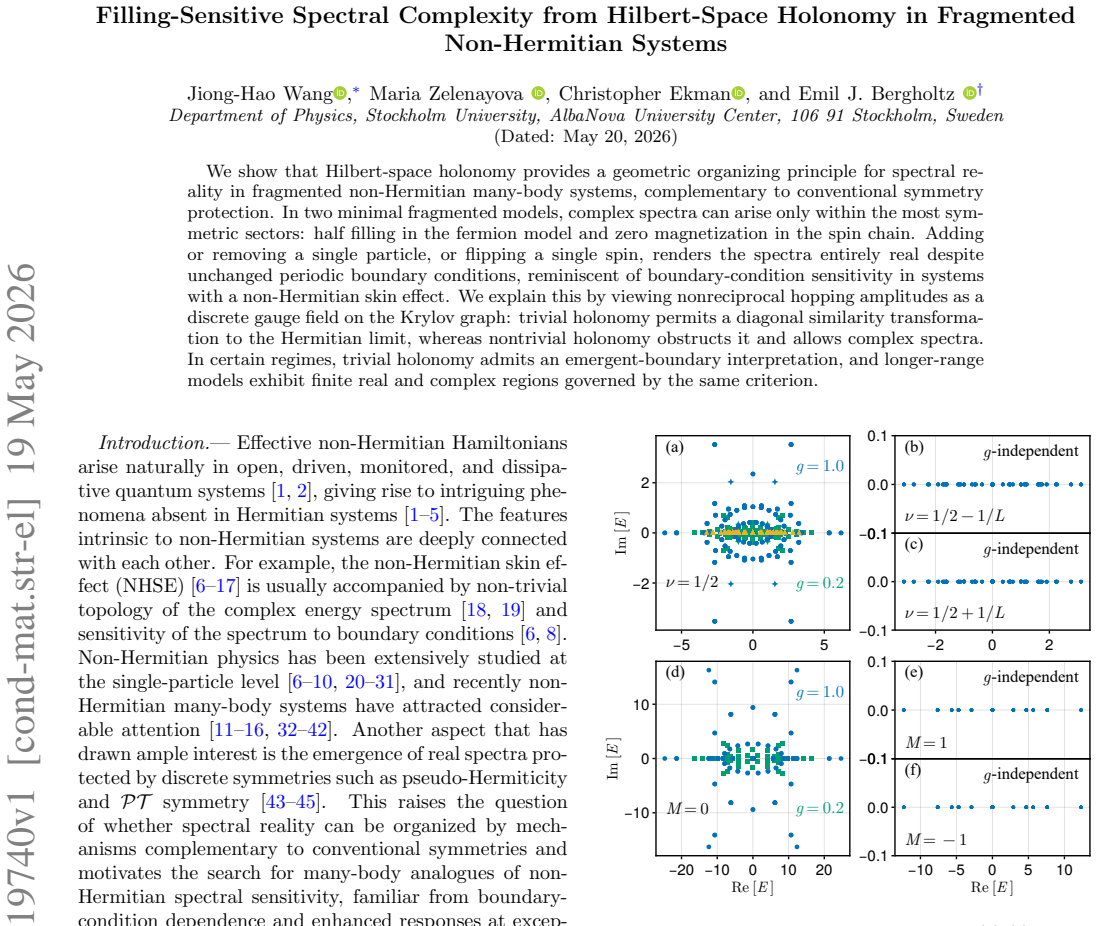
In two minimal fragmented models, complex spectra can arise only within the most symmetric sectors: half filling in the fermion model and zero magnetization in the spin chain. Nonreciprocal hopping amplitudes are viewed as a discrete gauge field on the Krylov graph such that trivial holonomy permits a diagonal similarity transformation to the Hermitian limit while nontrivial holonomy obstructs it and allows complex spectra. In certain regimes, trivial holonomy admits an emergent-boundary interpretation, and longer-range models exhibit finite real and complex regions governed by the same criterion.
What carries the argument
Hilbert-space holonomy induced by nonreciprocal hopping viewed as a discrete gauge field on the Krylov graph, determining whether a similarity transformation to Hermitian form exists.
If this is right
- Complex spectra are possible only in the half-filling sector of the fermion model and the zero-magnetization sector of the spin chain.
- Adding or removing one particle renders all eigenvalues real despite unchanged periodic boundary conditions.
- Flipping a single spin in the chain model produces an entirely real spectrum.
- Longer-range models display finite regions of real and complex spectra still governed by the holonomy criterion.
- Trivial holonomy permits an emergent-boundary interpretation in certain regimes.
Where Pith is reading between the lines
- The filling or magnetization sensitivity offers a route to control spectral properties simply by changing particle number without altering the Hamiltonian form.
- The same gauge-field picture on Krylov graphs could extend to other fragmented non-Hermitian models where subspaces are disconnected.
- The criterion suggests experiments that tune hoppings to move between trivial and nontrivial holonomy sectors and observe the resulting spectral transition.
Load-bearing premise
Nonreciprocal hopping amplitudes can be viewed as a discrete gauge field on the Krylov graph such that trivial holonomy permits a diagonal similarity transformation to the Hermitian limit while nontrivial holonomy obstructs it.
What would settle it
A direct calculation or numerical diagonalization showing complex eigenvalues outside half filling in the fermion model or outside zero magnetization in the spin chain, with the same nonreciprocal terms and boundaries, would falsify the claim.
Figures


read the original abstract
We show that Hilbert-space holonomy provides a geometric organizing principle for spectral reality in fragmented non-Hermitian many-body systems, complementary to conventional symmetry protection. In two minimal fragmented models, complex spectra can arise only within the most symmetric sectors: half filling in the fermion model and zero magnetization in the spin chain. Adding or removing a single particle, or flipping a single spin, renders the spectra entirely real despite unchanged periodic boundary conditions, reminiscent of boundary-condition sensitivity in systems with a non-Hermitian skin effect. We explain this by viewing nonreciprocal hopping amplitudes as a discrete gauge field on the Krylov graph: trivial holonomy permits a diagonal similarity transformation to the Hermitian limit, whereas nontrivial holonomy obstructs it and allows complex spectra. In certain regimes, trivial holonomy admits an emergent-boundary interpretation, and longer-range models exhibit finite real and complex regions governed by the same criterion.
Editorial analysis
A structured set of objections, weighed in public.
Referee Report
Summary. The manuscript claims that Hilbert-space holonomy provides a geometric organizing principle for spectral reality in fragmented non-Hermitian many-body systems, complementary to conventional symmetry protection. In two minimal models, complex spectra arise only in the most symmetric sectors (half filling for fermions, zero magnetization for the spin chain). Nonreciprocal hopping is interpreted as a discrete gauge field on the Krylov graph such that trivial holonomy permits a diagonal similarity transformation rendering fragments Hermitian (real spectra), while nontrivial holonomy obstructs this and permits complex eigenvalues. The filling/magnetization dependence follows from which sectors close nontrivial loops; extensions to longer-range models and emergent-boundary interpretations are discussed.
Significance. If the geometric criterion holds, the work supplies a useful organizing principle that accounts for the observed filling sensitivity of spectral reality in fragmented non-Hermitian systems and links it to gauge consistency on the Krylov graph. This perspective is complementary to symmetry-based arguments and may generalize to other non-Hermitian many-body settings with fragmentation. The internal consistency of the holonomy-to-similarity-transformation link and the direct connection to sector-dependent loop structure are strengths that could stimulate further analytic and numerical studies.
minor comments (3)
- The abstract states that the holonomy-to-similarity link is explanatory, yet the main text would benefit from a short, self-contained derivation or explicit loop-product calculation for at least one filling/magnetization value to make the obstruction to the diagonal transformation fully transparent.
- Notation for the Krylov graph and the discrete gauge field could be introduced with a small diagram or table early in the manuscript to aid readers unfamiliar with the fragmentation literature.
- A brief comparison paragraph with existing non-Hermitian skin-effect literature would help situate the emergent-boundary interpretation mentioned for certain regimes.
Simulated Author's Rebuttal
We thank the referee for the careful reading and positive evaluation of our work. The referee's summary accurately captures the central claim that Hilbert-space holonomy supplies a geometric organizing principle for spectral reality in fragmented non-Hermitian systems, complementary to symmetry protection. We appreciate the recognition of the internal consistency of the holonomy-to-similarity-transformation link and the connection to sector-dependent loop structure on the Krylov graph. We have prepared a revised manuscript addressing the recommendation for minor revision.
Circularity Check
No significant circularity in derivation chain
full rationale
The paper's central organizing principle—that nonreciprocal hopping acts as a discrete gauge field on the Krylov graph, with holonomy controlling the existence of a diagonal similarity transformation to a Hermitian limit—is introduced as a conceptual framework applied to the fragmented sectors of the minimal models. This framework directly accounts for the observed filling/magnetization dependence via graph connectivity and loop products without reducing any claimed prediction or first-principles result to a fitted parameter, self-definition, or self-citation chain. The fragmentation itself, the preservation under similarity transformations, and the sector-specific holonomy follow from the model Hamiltonians and boundary conditions as stated, rendering the derivation self-contained against external benchmarks.
Axiom & Free-Parameter Ledger
axioms (1)
- domain assumption Nonreciprocal hopping amplitudes admit a discrete gauge-field representation on the Krylov graph of the fragmented Hilbert space.
Lean theorems connected to this paper
-
IndisputableMonolith/Foundation/RealityFromDistinction.leanreality_from_one_distinction unclear?
unclearRelation between the paper passage and the cited Recognition theorem.
nonreciprocal hopping amplitudes as a discrete gauge field on the Krylov graph: trivial holonomy permits a diagonal similarity transformation to the Hermitian limit, whereas nontrivial holonomy obstructs it and allows complex spectra
-
IndisputableMonolith/Cost/FunctionalEquation.leanwashburn_uniqueness_aczel unclear?
unclearRelation between the paper passage and the cited Recognition theorem.
every closed loop possesses an equal number of D̂i and D̂†i (ND = ND† ∀ C)
What do these tags mean?
- matches
- The paper's claim is directly supported by a theorem in the formal canon.
- supports
- The theorem supports part of the paper's argument, but the paper may add assumptions or extra steps.
- extends
- The paper goes beyond the formal theorem; the theorem is a base layer rather than the whole result.
- uses
- The paper appears to rely on the theorem as machinery.
- contradicts
- The paper's claim conflicts with a theorem or certificate in the canon.
- unclear
- Pith found a possible connection, but the passage is too broad, indirect, or ambiguous to say the theorem truly supports the claim.
Reference graph
Works this paper leans on
- [1]
-
[2]
E. J. Bergholtz, J. C. Budich, and F. K. Kunst, Ex- ceptional topology of non-Hermitian systems, Rev. Mod. Phys.93, 015005 (2021)
work page 2021
-
[3]
N. Okuma and M. Sato, Non-Hermitian topological phe- nomena: A review, Annu. Rev. Condens. Matter Phys 14, 83 (2023)
work page 2023
-
[4]
K. Ding, C. Fang, and G. Ma, Non-Hermitian topology and exceptional-point geometries, Nat. Rev. Phys.4, 745 (2022)
work page 2022
-
[5]
Xue, Essay: Topological phases and exceptional points in non-Hermitian systems, Phys
P. Xue, Essay: Topological phases and exceptional points in non-Hermitian systems, Phys. Rev. Lett.136, 170001 (2026)
work page 2026
-
[6]
T. E. Lee, Anomalous edge state in a non-Hermitian lat- 6 tice, Phys. Rev. Lett.116, 133903 (2016)
work page 2016
-
[7]
Xiong, Why does bulk boundary correspondence fail in some non-Hermitian topological models, J
Y. Xiong, Why does bulk boundary correspondence fail in some non-Hermitian topological models, J. Phys. Comm. 2, 035043 (2018)
work page 2018
- [8]
-
[9]
F. K. Kunst, E. Edvardsson, J. C. Budich, and E. J. Bergholtz, Biorthogonal bulk–boundary correspondence in non-Hermitian systems, Phys. Rev. Lett.121, 026808 (2018)
work page 2018
-
[10]
V. M. Martinez Alvarez, J. E. Barrios Vargas, and L. E. F. Foa Torres, Non-Hermitian robust edge states in one dimension: Anomalous localization and eigenspace condensation at exceptional points, Phys. Rev. B97, 121401 (2018)
work page 2018
-
[11]
C. H. Lee, Many-body topological and skin states with- out open boundaries, Phys. Rev. B104, 195102 (2021)
work page 2021
-
[12]
F. Alsallom, L. Herviou, O. V. Yazyev, and M. Brzezi´ nska, Fate of the non-Hermitian skin ef- fect in many-body fermionic systems, Phys. Rev. Research4, 033122 (2022)
work page 2022
-
[13]
J. Gliozzi, G. De Tomasi, and T. L. Hughes, Many-body non-Hermitian skin effect for multipoles, Phys. Rev. Lett. 133, 136503 (2024)
work page 2024
-
[14]
K. Shimomura and M. Sato, General criterion for non- Hermitian skin effects and application: Fock space skin effects in many-body systems, Phys. Rev. Lett.133, 136502 (2024)
work page 2024
-
[15]
T. Yoshida, S.-B. Zhang, T. Neupert, and N. Kawakami, Non-Hermitian Mott skin effect, Phys. Rev. Lett.133, 076502 (2024)
work page 2024
-
[16]
Y.-M. Hu, Z. Wang, B. Lian, and Z. Wang, Many-body non-Hermitian skin effect with exact steady states in the dissipative quantum link model, Phys. Rev. Lett.135, 260401 (2025)
work page 2025
-
[17]
Z.-C. Liu, K. Li, and Y. Xu, Dynamical transition due to feedback-induced skin effect, Phys. Rev. Lett.133, 090401 (2024)
work page 2024
- [18]
- [19]
-
[20]
Z. Gong, Y. Ashida, K. Kawabata, K. Takasan, S. Hi- gashikawa, and M. Ueda, Topological phases of non- Hermitian systems, Phys. Rev. X8, 031079 (2018)
work page 2018
-
[21]
K. Kawabata, K. Shiozaki, M. Ueda, and M. Sato, Sym- metry and topology in non-Hermitian physics, Phys. Rev. X9, 041015 (2019)
work page 2019
-
[22]
F. Song, S. Yao, and Z. Wang, Non-Hermitian topological invariants in real space, Phys. Rev. Lett.123, 246801 (2019)
work page 2019
-
[23]
K. Yokomizo and S. Murakami, Non-Bloch band theory of non-Hermitian systems, Phys. Rev. Lett.123, 066404 (2019)
work page 2019
-
[24]
C. C. Wojcik, X.-Q. Sun, T. Bzduˇ sek, and S. Fan, Ho- motopy characterization of non-Hermitian Hamiltonians, Phys. Rev. B101, 205417 (2020)
work page 2020
- [25]
-
[26]
K. Yang, Z. Li, J. L. K. K¨ onig, L. Rødland, M. St˚ alhammar, and E. J. Bergholtz, Homotopy, Sym- metry, and non-Hermitian Band Topology, Rep. Prog. Phys.87, 078002 (2024)
work page 2024
- [27]
-
[28]
M.-M. Cao, K. Li, W.-D. Zhao, W.-X. Guo, B.-X. Qi, X.- Y. Chang, Z.-C. Zhou, Y. Xu, and L.-M. Duan, Probing complex-energy topology via non-Hermitian absorption spectroscopy in a trapped ion simulator, Phys. Rev. Lett. 130, 163001 (2023)
work page 2023
-
[29]
J. Zhang, Y.-J. Wang, S.-Y. Shao, B. Liu, L.-H. Zhang, Z.-Y. Zhang, X. Liu, C. Yu, Q. Li, H.-C. Chen, Y. Ma, T.- Y. Han, Q.-F. Wang, J.-D. Nan, Y.-M. Yin, D.-Y. Zhu, Q.-Q. Fang, D.-S. Ding, and B.-S. Shi, Observation of non-Hermitian topology in cold Rydberg quantum gases (2025), arXiv:2509.26256 [cond-mat]
- [30]
-
[31]
E. Zhao, Z. Wang, C. He, T. F. J. Poon, K. K. Pak, Y.- J. Liu, P. Ren, X.-J. Liu, and G.-B. Jo, Two-dimensional non-Hermitian skin effect in an ultracold Fermi gas, Na- ture637, 565 (2025)
work page 2025
-
[32]
R. Hamazaki, K. Kawabata, and M. Ueda, Non- Hermitian many-body localization, Phys. Rev. Lett.123, 090603 (2019)
work page 2019
-
[33]
A. M. Garc´ ıa-Garc´ ıa, L. S´ a, and J. J. M. Ver- baarschot, Symmetry classification and universality in non-Hermitian many-body quantum chaos by the Sachdev-Ye-Kitaev model, Phys. Rev. X12, 021040 (2022)
work page 2022
-
[34]
Q. Chen, S. A. Chen, and Z. Zhu, Weak ergodicity break- ing in non-Hermitian many-body systems, SciPost Phys. 15, 052 (2023)
work page 2023
-
[35]
E. Lee, H. Lee, and B.-J. Yang, Many-body approach to non-Hermitian physics in fermionic systems, Phys. Rev. B101, 121109 (2020)
work page 2020
-
[36]
K. Yang, S. C. Morampudi, and E. J. Bergholtz, Excep- tional spin liquids from couplings to the environment, Phys. Rev. Lett.126, 077201 (2021)
work page 2021
-
[37]
K. Kawabata, K. Shiozaki, and S. Ryu, Many-body topology of non-Hermitian systems, Phys. Rev. B105, 165137 (2022)
work page 2022
-
[38]
W. N. Faugno and T. Ozawa, Interaction-induced non- Hermitian topological phases from a dynamical gauge field, Phys. Rev. Lett.129, 180401 (2022)
work page 2022
- [39]
-
[40]
Symmetry-Fractionalized Skin Effects in Non-Hermitian Luttinger Liquids
C. Ekman, E. J. Bergholtz, and P. Molignini, Symmetry- fractionalized skin effects in non-Hermitian Luttinger liq- uids (2026), arXiv:2603.28849 [cond-mat]
work page internal anchor Pith review Pith/arXiv arXiv 2026
-
[41]
R. Shen, T. Chen, B. Yang, and C. H. Lee, Observation of the non-Hermitian skin effect and Fermi skin on a digital quantum computer, Nat. Comm.16, 1340 (2025)
work page 2025
- [42]
-
[43]
C. M. Bender and S. Boettcher, Real spectra in non- hermitian hamiltonians havingPTsymmetry, Phys. Rev. 7 Lett.80, 5243 (1998)
work page 1998
-
[44]
A. Mostafazadeh, Pseudo-Hermiticity versus PT symme- try: The necessary condition for the reality of the spec- trum of a non-Hermitian Hamiltonian, J. Math. Phys. 43, 205 (2002)
work page 2002
-
[45]
C. M. Bender and D. W. Hook,PT-symmetric quantum mechanics, Rev. Mod. Phys.96, 045002 (2024)
work page 2024
-
[46]
J. Wiersig, Enhancing the sensitivity of frequency and energy splitting detection by using exceptional points: Application to microcavity sensors for single-particle de- tection, Phys. Rev. Lett.112, 203901 (2014)
work page 2014
- [47]
- [48]
-
[49]
J. C. Budich and E. J. Bergholtz, Non-Hermitian topo- logical sensors, Phys. Rev. Lett.125, 180403 (2020)
work page 2020
-
[50]
P. Sala, T. Rakovszky, R. Verresen, M. Knap, and F. Poll- mann, Ergodicity breaking arising from Hilbert space fragmentation in dipole-conserving Hamiltonians, Phys. Rev. X10, 011047 (2020)
work page 2020
-
[51]
Z.-C. Yang, F. Liu, A. V. Gorshkov, and T. Iadecola, Hilbert-space fragmentation from strict confinement, Phys. Rev. Lett.124, 207602 (2020)
work page 2020
-
[52]
F. Pietracaprina and N. Laflorencie, Hilbert-space frag- mentation, multifractality, and many-body localization, Ann. Phys. Special Issue on Localisation 2020,435, 168502 (2021)
work page 2020
-
[53]
S. Moudgalya, O. I. Motrunich, and D. A. Huse, Hilbert space fragmentation and commutant algebras, Phys. Rev. X12, 011050 (2022)
work page 2022
-
[54]
S. Moudgalya, B. A. Bernevig, and N. Regnault, Quan- tum many-body scars and Hilbert space fragmentation: A review of exact results, Rep. Prog. Phys.85, 086501 (2022)
work page 2022
- [55]
-
[56]
Y.-Y. Wang, Y.-H. Shi, Z.-H. Sun, C.-T. Chen, Z.-A. Wang, K. Zhao, H.-T. Liu, W.-G. Ma, Z. Wang, H. Li, J.-C. Zhang, Y. Liu, C.-L. Deng, T.-M. Li, Y. He, Z.-H. Liu, Z.-Y. Peng, X. Song, G. Xue, H. Yu, K. Huang, Z. Xiang, D. Zheng, K. Xu, and H. Fan, Exploring Hilbert-space fragmentation on a superconducting pro- cessor, PRX Quantum6, 010325 (2025)
work page 2025
- [57]
-
[58]
R. Shen and C. H. Lee, Non-Hermitian skin clusters from strong interactions, Comm. Phys.5, 238 (2022)
work page 2022
-
[59]
Y.-A. Wang and L. Li, Non-Hermitian skin effects in frag- mented Hilbert spaces of one-dimensional fermionic lat- tices, Chin. Phys. Lett.42, 037301 (2025)
work page 2025
-
[60]
Y. Li, P. Sala, and F. Pollmann, Hilbert space fragmen- tation in open quantum systems, Phys. Rev. Research5, 043239 (2023)
work page 2023
- [61]
-
[62]
S. Moudgalya, A. Prem, R. Nandkishore, N. Regnault, and B. A. Bernevig, Thermalization and its absence within Krylov subspaces of a constrained Hamiltonian, in Memorial Volume for Shoucheng Zhang(WORLD SCI- ENTIFIC, 2020) pp. 147–209
work page 2020
-
[63]
E. J. Bergholtz and A. Karlhede, Half-filled lowest Lan- dau level on a thin torus, Phys. Rev. Lett.94, 026802 (2005)
work page 2005
-
[64]
M. Nakamura, Z.-Y. Wang, and E. J. Bergholtz, Exactly solvable fermion chain describing aν= 1/3 fractional quantum Hall state, Phys. Rev. Lett.109, 016401 (2012)
work page 2012
-
[65]
L. W. Tu,Differential Geometry, Graduate Texts in Mathematics, Vol. 275 (Springer International Publish- ing, Cham, 2017)
work page 2017
-
[66]
In the Supplemental Material, we give the details of the proof for the trivial holonomy of the minimal models ex- cept the most symmetric symmetry sectors, and the exis- tence of emergent open boundaries over a range of fillings for the fermionic model
-
[67]
C. Wang and Z.-C. Yang, Freezing transition in the particle-conserving East model, Phys. Rev. B108, 144308 (2023). END MA TTER Analogy to holonomy in differential geometry.— Here, we explain why we use the namediscrete holonomyfor the Hilbert space structure, namely the analogy to the holonomy of continuous manifold in differential geom- etry. In differen...
work page 2023
discussion (0)
Sign in with ORCID, Apple, or X to comment. Anyone can read and Pith papers without signing in.