QuaMoE-DRF: Proactive Beam and Rate Adaptation via Multimodal Dynamic Radio Map Forecasting in ISAC Networks
Pith reviewed 2026-07-02 05:37 UTC · model grok-4.3
The pith
The full multi-BS beam-SINR field suffices for all finite-codebook BS, beam, MCS, goodput and outage decisions.
A machine-rendered reading of the paper's core claim, the machinery that carries it, and where it could break.
Core claim
The full multi-BS beam-SINR field is sufficient for finite-codebook threshold-rate BS, beam, MCS, goodput, and outage decisions. QuaMoE-DRF learns a compact reference-BS local field with BS-level and joint BS-beam supervision plus latent network context, then fuses static geometry, event-like motion observations, structured sensing states, and wireless history through a quality-aware mixture-of-experts module to jointly predict the map channels and the proactive decisions.
What carries the argument
The future beam-SINR field, used as the central sufficient statistic for threshold-rate decisions across base stations and beams.
If this is right
- The complete beam-SINR field alone supports all listed decisions without separate per-task models.
- The compact local-field projection requires BS-level and joint supervision and cannot handle BS association by itself.
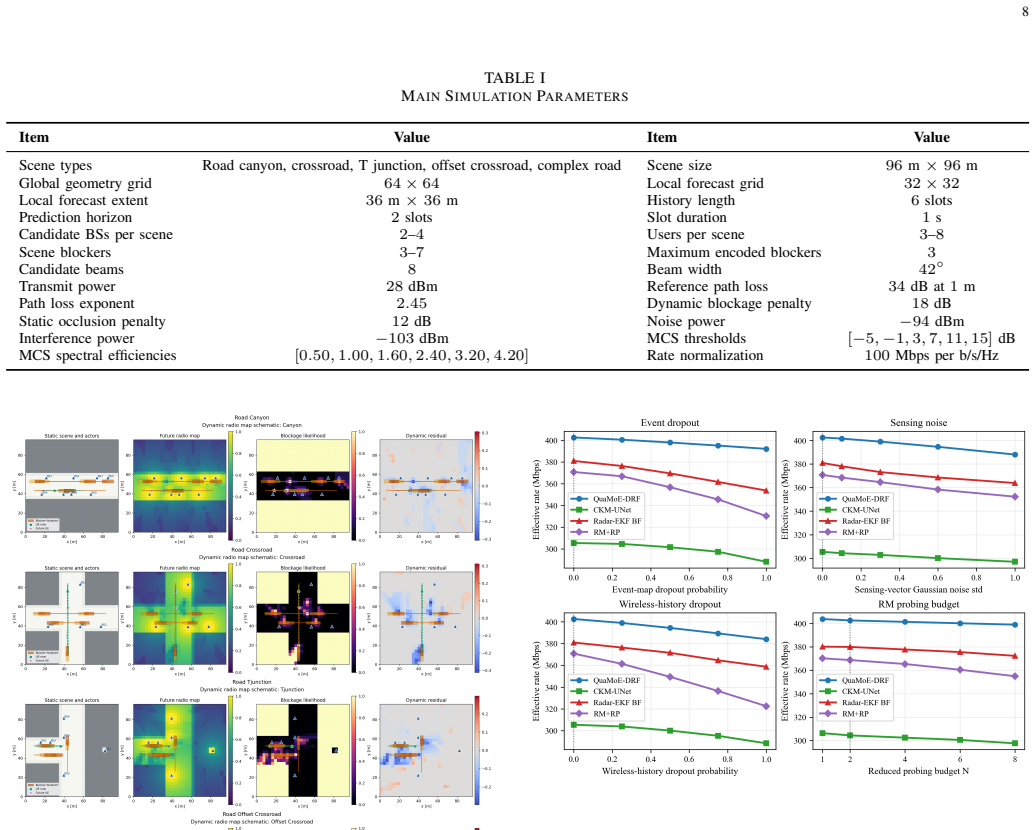
- Proactive forecasting yields 402.5 Mbps effective rate and 0.0417 outage probability on the multi-BS urban benchmark.
- The method improves effective rate by 5.67 percent and reduces outage by 8.35 percent relative to the strongest baseline.
Where Pith is reading between the lines
- If simulator labels are replaced by real measurements the same sufficiency argument could be tested in live networks.
- The separation of reference-BS forecasting from full network association suggests a modular architecture where local fields feed a separate association layer.
Load-bearing premise
Validation labels come from a compact blockage and path-loss simulator rather than full ray tracing or real measurements.
What would settle it
Compare the BS, beam, and MCS decisions produced from the predicted beam-SINR field against decisions derived from full ray-tracing data in the identical dynamic scenario and measure any drop in effective rate or rise in outage.
Figures



read the original abstract
Static radio maps provide location-dependent propagation priors, but they cannot capture short-term blockage caused by moving objects. Direct sensing-assisted beam prediction is also limited because a beam index discards SINR margins, MCS thresholds, BS alternatives, and communication-equivalent neighboring beams. This paper proposes QuaMoE-DRF, a quality-aware multimodal dynamic radio map forecasting framework for proactive beam and rate adaptation in ISAC networks. Its core representation is a future beam-SINR field. We show that the full multi-BS beam-SINR field is sufficient for finite-codebook threshold-rate BS, beam, MCS, goodput, and outage decisions. For tractability, the implemented model learns a compact reference-BS local field, complemented by BS-level supervision, joint BS--beam supervision, and latent network context; we also clarify that this compact projection alone is not sufficient for BS association. QuaMoE-DRF fuses static geometry, event-like motion observations, structured sensing states, and wireless history through a quality-aware mixture-of-experts module motivated by inverse-variance fusion under heteroscedastic modality errors. It jointly predicts communication-oriented map channels and proactive BS, beam, and MCS decisions. On a dynamic multi-BS and multi-UE urban benchmark, QuaMoE-DRF achieves 402.5 Mbps effective rate, 0.0417 outage probability, and 0.1836 map RMSE, improving the effective rate by 5.67% and reducing outage by 8.35% over the strongest completed effective-rate baseline. The current validation uses labels from a compact blockage/path-loss simulator, with ray tracing used only for calibration and sanity checking.
Editorial analysis
A structured set of objections, weighed in public.
Referee Report
Summary. The paper proposes QuaMoE-DRF, a quality-aware multimodal dynamic radio map forecasting framework for proactive beam and rate adaptation in ISAC networks. Its core contribution is the claim that the full multi-BS beam-SINR field is information-theoretically sufficient for finite-codebook threshold-rate decisions on BS association, beam selection, MCS, goodput, and outage; the model learns a compact reference-BS projection augmented by multi-level supervision and fuses static geometry, motion observations, sensing states, and history via a quality-aware MoE module. On a dynamic multi-BS/multi-UE urban benchmark using a compact blockage/path-loss simulator (ray tracing only for calibration), it reports 402.5 Mbps effective rate, 0.0417 outage, 0.1836 map RMSE, with 5.67% rate gain and 8.35% outage reduction over the strongest baseline.
Significance. If the sufficiency result generalizes beyond the simulator, the work could support more robust proactive adaptation in ISAC by treating the beam-SINR field as a sufficient statistic and by introducing inverse-variance-motivated modality fusion. The explicit acknowledgment that the compact projection alone is insufficient for BS association and the joint prediction of map channels plus decisions are constructive elements. However, the current evidence base does not yet establish robustness against unmodeled propagation effects.
major comments (2)
- [Abstract] Abstract: the central claim that 'the full multi-BS beam-SINR field is sufficient for finite-codebook threshold-rate BS, beam, MCS, goodput, and outage decisions' is demonstrated exclusively on labels generated by the same compact blockage/path-loss simulator whose path-loss and blockage rules define the decision thresholds; sufficiency therefore holds by construction inside the generative model and does not address whether the field remains sufficient once diffuse scattering, hardware non-idealities, or dynamic multipath are present.
- [Results] Results section (performance numbers): the reported 402.5 Mbps rate, 0.0417 outage, and 5.67%/8.35% gains are given without error bars, without exact baseline code or hyper-parameter details, and without quantifying how the compact reference-BS projection (explicitly stated as insufficient for BS association) affects the measured gains; this weakens the empirical support for the sufficiency claim.
minor comments (1)
- [Method] The motivation for the quality-aware MoE as inverse-variance fusion under heteroscedastic errors is stated but the precise weighting equations and how modality-specific variances are estimated are not shown in the provided abstract; a short derivation or pseudocode would improve reproducibility.
Simulated Author's Rebuttal
We thank the referee for the constructive feedback on the sufficiency claim and empirical presentation. We address each major comment below, indicating planned revisions where appropriate.
read point-by-point responses
-
Referee: [Abstract] Abstract: the central claim that 'the full multi-BS beam-SINR field is sufficient for finite-codebook threshold-rate BS, beam, MCS, goodput, and outage decisions' is demonstrated exclusively on labels generated by the same compact blockage/path-loss simulator whose path-loss and blockage rules define the decision thresholds; sufficiency therefore holds by construction inside the generative model and does not address whether the field remains sufficient once diffuse scattering, hardware non-idealities, or dynamic multipath are present.
Authors: We agree that the sufficiency result is shown within the generative model of the simulator, where both the beam-SINR labels and the decision thresholds are defined by the same path-loss and blockage rules. The manuscript already notes the simulator-based validation in the abstract and conclusion. We will revise the abstract to explicitly qualify the claim as holding inside this model (e.g., 'We show that, within the generative model, the full multi-BS beam-SINR field is sufficient for finite-codebook threshold-rate decisions...'). This clarification addresses the concern without overstating generalization. revision: yes
-
Referee: [Results] Results section (performance numbers): the reported 402.5 Mbps rate, 0.0417 outage, and 5.67%/8.35% gains are given without error bars, without exact baseline code or hyper-parameter details, and without quantifying how the compact reference-BS projection (explicitly stated as insufficient for BS association) affects the measured gains; this weakens the empirical support for the sufficiency claim.
Authors: We acknowledge these limitations in the current presentation. In the revision we will (i) report error bars as standard deviations over multiple simulation seeds, (ii) expand the experimental setup with additional hyper-parameter details and clearer baseline descriptions, and (iii) add an ablation quantifying the performance impact of the compact reference-BS projection versus the full multi-BS field. Exact baseline source code cannot be embedded in the manuscript but will be noted as available upon request. These changes strengthen the empirical support without altering the core results. revision: partial
- Robustness of the sufficiency result against unmodeled propagation effects (diffuse scattering, hardware non-idealities, dynamic multipath) cannot be established from the current simulator-based experiments and would require new validation data or extended modeling.
Circularity Check
No significant circularity; simulator validation does not reduce claims to self-definition
full rationale
The paper's central sufficiency claim for the multi-BS beam-SINR field is validated using labels from a compact blockage/path-loss simulator, but the reported metrics (effective rate, outage) arise from end-to-end training of the QuaMoE-DRF model on those labels without any quoted reduction of predictions to fitted parameters, self-citations, or definitional equivalence. No load-bearing self-citation chains, ansatz smuggling, or renaming of known results appear in the provided text. The derivation remains self-contained against the simulator benchmark.
Axiom & Free-Parameter Ledger
axioms (1)
- domain assumption Compact blockage/path-loss simulator produces labels sufficiently representative for validation of proactive decisions
invented entities (1)
-
quality-aware mixture-of-experts module
no independent evidence
Reference graph
Works this paper leans on
-
[1]
Framework and overall objectives of the future development of IMT for 2030 and beyond,
ITU-R, “Framework and overall objectives of the future development of IMT for 2030 and beyond,” ITU-R, Rec. ITU-R M.2160-0, Nov. 2023
2030
-
[2]
Integrated sensing and communications: Toward dual- functional wireless networks for 6G and beyond,
F. Liuet al., “Integrated sensing and communications: Toward dual- functional wireless networks for 6G and beyond,”IEEE J. Sel. Areas Commun., vol. 40, no. 6, pp. 1728–1767, 2022
2022
-
[3]
A tutorial on environment-aware communications via channel knowledge map for 6G,
Y . Zenget al., “A tutorial on environment-aware communications via channel knowledge map for 6G,”IEEE Commun. Surveys Tuts., vol. 26, no. 3, pp. 1478–1519, 2024
2024
-
[4]
Millimeter-wave cellular wireless networks: Potentials and challenges,
S. Rangan, T. S. Rappaport, and E. Erkip, “Millimeter-wave cellular wireless networks: Potentials and challenges,”Proc. IEEE, vol. 102, no. 3, pp. 366–385, 2014
2014
-
[5]
Overview of millimeter wave communications for fifth-generation (5G) wireless networks: With a focus on propagation models,
T. S. Rappaportet al., “Overview of millimeter wave communications for fifth-generation (5G) wireless networks: With a focus on propagation models,”IEEE Trans. Antennas Propag., vol. 65, no. 12, pp. 6213–6230, Dec. 2017
2017
-
[6]
Massive MIMO for next generation wireless systems,
E. G. Larsson, O. Edfors, F. Tufvesson, and L. T. Marzetta, “Massive MIMO for next generation wireless systems,”IEEE Commun. Mag., vol. 52, no. 2, pp. 186–195, Feb. 2014
2014
-
[7]
An overview of massive MIMO: Benefits and challenges,
L. Luet al., “An overview of massive MIMO: Benefits and challenges,” IEEE J. Sel. Topics Signal Process., vol. 8, no. 5, pp. 742–758, Oct. 2014
2014
-
[8]
An overview of signal processing techniques for millimeter wave MIMO systems,
R. W. Heathet al., “An overview of signal processing techniques for millimeter wave MIMO systems,”IEEE J. Sel. Topics Signal Process., vol. 10, no. 3, pp. 436–453, 2016
2016
-
[9]
A tutorial on beam management for 3GPP NR at mmWave frequencies,
M. Giordani, M. Polese, M. Mezzavilla, S. Rangan, and M. Zorzi, “A tutorial on beam management for 3GPP NR at mmWave frequencies,” IEEE Commun. Surveys Tuts., vol. 21, no. 1, pp. 173–196, 2019
2019
-
[10]
Initial access in millimeter wave cellular systems,
C. N. Baratiet al., “Initial access in millimeter wave cellular systems,” IEEE Trans. Wireless Commun., vol. 15, no. 12, pp. 7926–7940, 2016
2016
-
[11]
The impact of mobile blockers on millimeter wave cellular systems,
I. K. Jain, R. Kumar, and S. S. Panwar, “The impact of mobile blockers on millimeter wave cellular systems,”IEEE J. Sel. Areas Commun., vol. 37, no. 4, pp. 854–868, Apr. 2019
2019
-
[12]
Millimeter-wave V2V com- munications: Distributed association and beam alignment,
C. Perfecto, J. Del Ser, and M. Bennis, “Millimeter-wave V2V com- munications: Distributed association and beam alignment,”IEEE J. Sel. Areas Commun., vol. 35, no. 9, pp. 2148–2162, Sep. 2017
2017
-
[13]
Machine learning-based handovers for sub-6 GHz and mmWave integrated vehicular networks,
L. Yanet al., “Machine learning-based handovers for sub-6 GHz and mmWave integrated vehicular networks,”IEEE Trans. Wireless Commun., vol. 18, no. 10, pp. 4873–4885, 2019
2019
-
[14]
Learning-based handover in mobile millimeter-wave networks,
S. Khosravi, H. Shokri-Ghadikolaei, and M. Petrova, “Learning-based handover in mobile millimeter-wave networks,”IEEE Trans. Cogn. Commun. Netw., vol. 7, no. 2, pp. 663–674, Jun. 2021
2021
-
[15]
Radar-assisted predictive beamforming for vehicular links: Communication served by sensing,
F. Liu, W. Yuan, C. Masouros, and J. Yuan, “Radar-assisted predictive beamforming for vehicular links: Communication served by sensing,” IEEE Trans. Wireless Commun., vol. 19, no. 11, pp. 7704–7719, 2020
2020
-
[16]
Beam alignment in mmWave V2X communications: A survey,
J. Tanet al., “Beam alignment in mmWave V2X communications: A survey,”IEEE Commun. Surveys Tuts., vol. 26, no. 3, pp. 1676–1709, 2024
2024
-
[17]
Spectrum map and its application in resource management in cognitive radio networks,
S. Debroy, S. Bhattacharjee, and M. Chatterjee, “Spectrum map and its application in resource management in cognitive radio networks,”IEEE Trans. Cogn. Commun. Netw., vol. 1, no. 4, pp. 406–419, 2015
2015
-
[18]
RadioUNet: Fast radio map estimation with convolutional neural networks,
R. Levie, C. Yapar, G. Kutyniok, and G. Caire, “RadioUNet: Fast radio map estimation with convolutional neural networks,”IEEE Trans. Wireless Commun., vol. 20, no. 6, pp. 4001–4015, 2021
2021
-
[19]
Toward environment-aware 6G communications via channel knowledge map,
Y . Zeng and X. Xu, “Toward environment-aware 6G communications via channel knowledge map,”IEEE Wireless Commun., vol. 28, no. 3, pp. 84–91, Jun. 2021
2021
-
[20]
Environment-aware hybrid beamforming by leveraging channel knowledge map,
D. Wu, Y . Zeng, S. Jin, and R. Zhang, “Environment-aware hybrid beamforming by leveraging channel knowledge map,”IEEE Trans. Wireless Commun., vol. 23, no. 5, pp. 4990–5005, 2024
2024
-
[21]
Prototyping and experimental results for environment- aware millimeter wave beam alignment via channel knowledge map,
Z. Daiet al., “Prototyping and experimental results for environment- aware millimeter wave beam alignment via channel knowledge map,” IEEE Trans. Veh. Technol., vol. 73, no. 11, pp. 16805–16816, 2024
2024
-
[22]
Radio map-based beamforming assisted with reduced pilots,
B. Yang, W. Wang, and W. Zhang, “Radio map-based beamforming assisted with reduced pilots,”IEEE Trans. Wireless Commun., vol. 24, no. 10, pp. 8878–8891, 2025
2025
-
[23]
Radiomap inpainting for restricted areas based on propagation priority and depth map,
S. Zhang, T. Yu, B. Choi, F. Ouyang, and Z. Ding, “Radiomap inpainting for restricted areas based on propagation priority and depth map,”IEEE Trans. Wireless Commun., vol. 23, no. 8, pp. 9330–9344, Aug. 2024
2024
-
[24]
Z. Zeng, N. Wei, M. B. Mollah, K. Wang, P. L. Yeoh, F. Xu, Y . Xiu, and Z. Zhang, “Sparse Gain Radio Map Reconstruction With Geometry Priors and Uncertainty-Guided Measurement Selection,”arXiv preprint arXiv:2604.05788, 2026
work page internal anchor Pith review Pith/arXiv arXiv 2026
-
[25]
Z. Zeng, K. Wang, Z. Zhang, and Y . Xiu, “GAC-KAN: An Ultra- Lightweight GNSS Interference Classifier for GenAI-Powered Con- sumer Edge Devices,”arXiv preprint arXiv:2602.11186, 2026
-
[26]
Z. Zeng, Y . Zhao, K. Wang, D. Niyato, Y . Xiu, L. Chen, Z. Zhang, and N. Wei, “PhyG-MoE: A Physics-Guided Mixture-of-Experts Framework for Energy-Efficient GNSS Interference Recognition,”arXiv preprint arXiv:2601.12798, 2026
-
[27]
Z. Zeng, Y . Zhao, K. Wang, D. Niyato, H. Shu, J. Zhao, Y . Huang, Y . Xiu, Z. Zhang, and N. Wei, “SKANet: A Cognitive Dual-Stream Framework With Adaptive Modality Fusion for Robust Compound GNSS Interference Classification,”arXiv preprint arXiv:2601.12791, 2026
-
[28]
Z. Zeng, H. Shu, K. Wang, L. Chen, A. Hussian, Y . Huang, J. Zhao, Y . Xiu, and Z. Zhang, “JSR-GFNet: Jamming-to-Signal Ratio-Aware Dynamic Gating for Interference Classification in Future Cognitive Global Navigation Satellite Systems,”arXiv preprint arXiv:2602.00042, 2026
-
[29]
Diffraction and scattering aware radio map and environment reconstruction using geometry model-assisted deep learning,
W. Chen and J. Chen, “Diffraction and scattering aware radio map and environment reconstruction using geometry model-assisted deep learning,”IEEE Trans. Wireless Commun., vol. 23, no. 12, pp. 19804– 19819, Dec. 2024
2024
-
[30]
Aerial video streaming over 3D cellular networks: An environment and channel knowledge map approach,
C. Zhan, H. Hu, Z. Liu, J. Wang, N. Cheng, and S. Mao, “Aerial video streaming over 3D cellular networks: An environment and channel knowledge map approach,”IEEE Trans. Wireless Commun., vol. 23, no. 2, pp. 1432–1446, Feb. 2024
2024
-
[31]
RME-GAN: A learning framework for radio map estimation based on conditional generative adversarial network,
S. Zhang, A. Wijesinghe, and Z. Ding, “RME-GAN: A learning framework for radio map estimation based on conditional generative adversarial network,”IEEE Internet Things J., vol. 10, no. 20, pp. 18016–18027, Oct. 2023
2023
-
[32]
Denoising diffusion probabilistic model for radio map estimation in generative wireless networks,
X. Luo, Z. Li, Z. Peng, M. Chen, and Y . Liu, “Denoising diffusion probabilistic model for radio map estimation in generative wireless networks,”IEEE Trans. Cogn. Commun. Netw., vol. 11, no. 2, pp. 751– 763, Apr. 2025
2025
-
[33]
Joint radar and communication design: Applications, state-of-the-art, and the road ahead,
F. Liu, C. Masouros, A. Li, H. Sun, and L. Hanzo, “Joint radar and communication design: Applications, state-of-the-art, and the road ahead,”IEEE Trans. Commun., vol. 68, no. 6, pp. 3834–3862, 2020
2020
-
[34]
Enabling joint communication and radar sensing in mobile networks-A survey,
J. A. Zhanget al., “Enabling joint communication and radar sensing in mobile networks-A survey,”IEEE Commun. Surveys Tuts., vol. 24, no. 1, pp. 306–345, 2021
2021
-
[35]
LIDAR data for deep learning-based mmWave beam-selection,
A. Klautau, N. Gonzalez-Prelcic, and R. W. Heath, “LIDAR data for deep learning-based mmWave beam-selection,”IEEE Wireless Commun. Lett., vol. 8, no. 3, pp. 909–912, Jun. 2019
2019
-
[36]
LiDAR aided future beam prediction in real-world millimeter wave V2I communications,
S. Jiang, G. Charan, and A. Alkhateeb, “LiDAR aided future beam prediction in real-world millimeter wave V2I communications,”IEEE Wireless Commun. Lett., vol. 12, no. 2, pp. 212–216, Feb. 2023
2023
-
[37]
Computer vision aided mmWave beam alignment in V2X communications,
W. Xu, F. Gao, X. Tao, J. Zhang, and A. Alkhateeb, “Computer vision aided mmWave beam alignment in V2X communications,”IEEE Trans. Wireless Commun., vol. 22, no. 4, pp. 2699–2714, 2022
2022
-
[38]
DeepSense 6G: A large-scale real-world multi- modal sensing and communication dataset,
A. Alkhateebet al., “DeepSense 6G: A large-scale real-world multi- modal sensing and communication dataset,”IEEE Commun. Mag., vol. 61, no. 9, pp. 122–128, Sep. 2023
2023
-
[39]
Ma- chine learning-based vision-aided beam selection for mmWave multiuser MISO system,
H. Ahn, I. Orikumhi, J. Kang, H. Park, H. Jwa, and S. Lee, “Ma- chine learning-based vision-aided beam selection for mmWave multiuser MISO system,”IEEE Wireless Commun. Lett., vol. 11, no. 6, pp. 1263– 1267, Jun. 2022. 14
2022
-
[40]
Vision-aided 6G wireless communications: Blockage prediction and proactive handoff,
G. Charan, M. Alrabeiah, and A. Alkhateeb, “Vision-aided 6G wireless communications: Blockage prediction and proactive handoff,”IEEE Trans. Veh. Technol., vol. 70, no. 10, pp. 10193–10208, 2021
2021
-
[41]
Camera based mmWave beam prediction: Towards multi-candidate real-world scenarios,
G. Charan, M. Alrabeiah, T. Osman, and A. Alkhateeb, “Camera based mmWave beam prediction: Towards multi-candidate real-world scenarios,”IEEE Trans. Wireless Commun., vol. 23, no. 5, pp. 5109– 5124, 2023
2023
-
[42]
Environment semantics aided wireless communications: A case study of mmWave beam pre- diction and blockage prediction,
Y . Yang, F. Gao, X. Tao, G. Liu, and C. Pan, “Environment semantics aided wireless communications: A case study of mmWave beam pre- diction and blockage prediction,”IEEE J. Sel. Areas Commun., vol. 41, no. 7, pp. 2025–2040, Jul. 2023
2025
-
[43]
Harnessing multimodal sensing for multi-user beamforming in mmWave systems,
K. Patel and R. W. Heath, “Harnessing multimodal sensing for multi-user beamforming in mmWave systems,”IEEE Trans. Wireless Commun., vol. 23, no. 12, pp. 18725–18739, Dec. 2024
2024
-
[44]
Multi-modality sensing in mmWave beamforming for connected vehicles using deep learning,
M. B. Mollah, H. Wang, M. A. Karim, and H. Fang, “Multi-modality sensing in mmWave beamforming for connected vehicles using deep learning,”IEEE Trans. Cogn. Commun. Netw., vol. 12, pp. 327–341, 2026
2026
-
[45]
Cram ´er–Rao bound optimization for joint radar-communication beamforming,
F. Liu, Y .-F. Liu, A. Li, C. Masouros, and Y . C. Eldar, “Cram ´er–Rao bound optimization for joint radar-communication beamforming,”IEEE Trans. Signal Process., vol. 70, pp. 240–253, 2022
2022
-
[46]
MIMO integrated sensing and commu- nication: CRB-rate tradeoff,
H. Hua, T. X. Han, and J. Xu, “MIMO integrated sensing and commu- nication: CRB-rate tradeoff,”IEEE Trans. Wireless Commun., vol. 23, no. 4, pp. 2839–2854, 2024
2024
-
[47]
Fundamental CRB-rate tradeoff in multi-antenna ISAC systems with information multicasting and multi-target sensing,
Z. Ren, Y . Peng, X. Song, Y . Fang, L. Qiu, L. Liu, D. W. K. Ng, and J. Xu, “Fundamental CRB-rate tradeoff in multi-antenna ISAC systems with information multicasting and multi-target sensing,”IEEE Trans. Wireless Commun., vol. 23, no. 4, pp. 3870–3885, 2024
2024
discussion (0)
Sign in with ORCID, Apple, or X to comment. Anyone can read and Pith papers without signing in.