Should Demand Models Incorporate Competitor Prices? Oblivious Learning and Algorithmic Collusion
Pith reviewed 2026-06-28 03:12 UTC · model grok-4.3
The pith
Oblivious sellers converge to competitive prices while informed ones earn more, making all-informed the Nash equilibrium.
A machine-rendered reading of the paper's core claim, the machinery that carries it, and where it could break.
Core claim
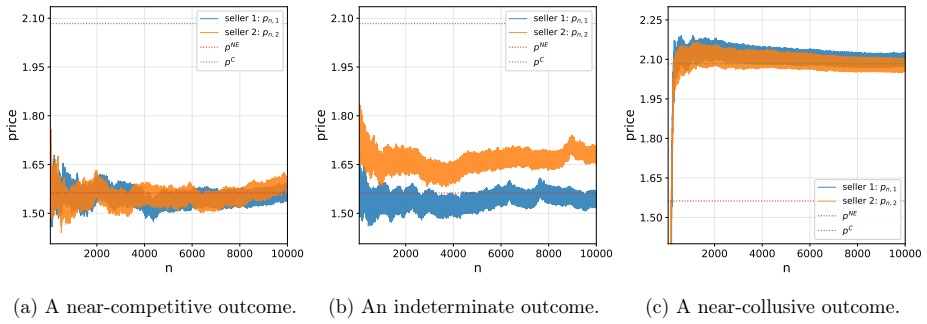
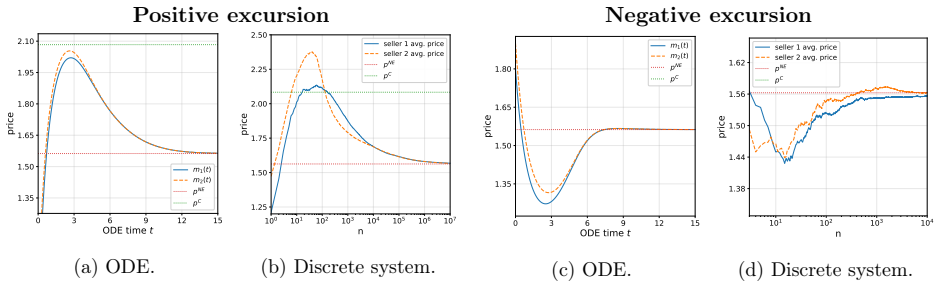
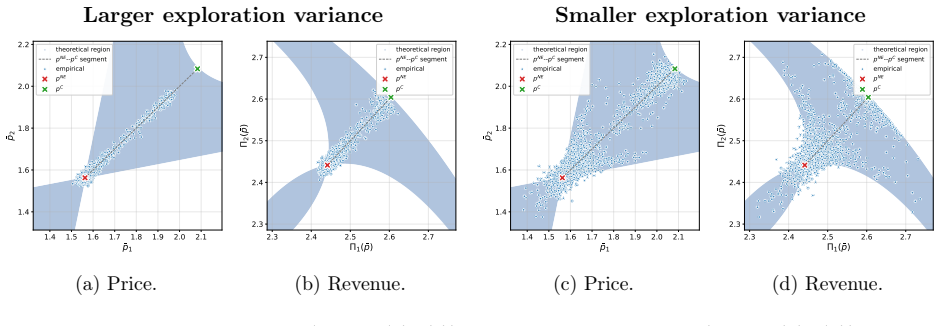
In a stylized competitive market with unknown noisy demand estimated via iterated least squares, oblivious sellers explore more aggressively than a monopolist. When all sellers are oblivious, prices converge to the competitive outcome under sufficient exploration, but a continuum of pseudo-equilibria arises when exploration decays. An excursion phenomenon produces transient collusive patterns that dissipate over time. In mixed markets, informed sellers strictly out-earn oblivious ones, and the unique Nash equilibrium of the modeling choice game is the all-informed market where prices converge efficiently to competition.
What carries the argument
The oblivious versus informed demand modeling choice, where oblivious ignores competitor prices and informed incorporates them, driving the market dynamics and equilibrium analysis.
Load-bearing premise
The analysis assumes a stylized market where demand is estimated solely through iterated least squares and the modeling choice is the sole strategic decision.
What would settle it
If prices in a simulated or real multi-seller market with oblivious algorithms and decaying exploration remain at collusive levels instead of converging to competition, the claim would be falsified.
Figures
read the original abstract
On a platform with many sellers, should a pricing algorithm explicitly model competitors' prices when learning demand? Classical learning arguments suggest an affirmative answer: ignoring competitors induces model misspecification and inefficiency. In contrast, recent work on algorithmic collusion suggests that strategic obliviousness -- deliberately ignoring competitor prices -- may facilitate collusive outcomes and improve profits. We study this modeling choice in a stylized competitive market with unknown noisy demand, in which multiple sellers repeatedly set prices and estimate demand via iterated least squares, and either incorporate competitors' prices into their demand models (informed) or ignore them (oblivious). We first show that, relative to a monopolist, an oblivious seller in a competitive market must explore more aggressively to compensate for the loss of dynamic competitor information. Building on this insight, we characterize market dynamics when all sellers are oblivious and show that prices converge to the competitive outcome under sufficient exploration, while a continuum of pseudo-equilibria arises when exploration decays. Analyzing the resulting price trajectories, we uncover an excursion phenomenon that gives rise to transient collusive patterns that dissipate as learning progresses. In markets with both oblivious and informed sellers, the informed strictly out-earn the oblivious. Read as a strategy game, the modeling choice has a unique Nash equilibrium: the all-informed market, in which prices converge to the competitive outcome efficiently. Overall, our results indicate that collusive patterns are not robust and are not sustained by oblivious modeling; therefore, incorporating competitor information, together with sufficient price exploration, remains a reliable strategy for sellers in competitive markets.
Editorial analysis
A structured set of objections, weighed in public.
Referee Report
Summary. The paper studies whether pricing algorithms in a competitive market with unknown noisy demand should incorporate competitor prices into demand models when learning via iterated least squares. It shows that oblivious sellers require more aggressive exploration than a monopolist; all-oblivious markets converge to the competitive outcome under sufficient exploration but admit a continuum of pseudo-equilibria when exploration decays; an excursion phenomenon produces transient collusive patterns that dissipate; informed sellers strictly out-earn oblivious ones; and the modeling choice game has a unique Nash equilibrium at the all-informed market, which converges efficiently to competitive prices. The overall conclusion is that collusive patterns are not robust and are not sustained by oblivious modeling.
Significance. If the derivations hold, the work supplies a stylized counter-example to concerns about sustained algorithmic collusion via oblivious demand models, instead showing that informed modeling plus exploration is both privately and socially preferable. The characterization of pseudo-equilibria, the excursion phenomenon, and the reduction of the modeling choice to a normal-form game are concrete contributions. The paper ships a clear, falsifiable prediction that collusion dissipates under iterated least squares with decaying but positive exploration.
major comments (2)
- [Abstract; dynamics and Nash sections] The convergence, out-earning, and unique-Nash claims are derived specifically for iterated least squares estimation of (presumably linear) demand in a stationary noisy environment. The manuscript provides no analysis or discussion of whether the same qualitative outcomes (dissipation of pseudo-equilibria, transient excursions, informed dominance) survive under nonparametric estimation, RL-based learners, or non-stationary demand; this assumption is load-bearing for the claim that collusive patterns are not robust.
- [Nash analysis] The result that informed sellers strictly out-earn oblivious ones (and therefore that all-informed is the unique Nash) treats the modeling choice as the sole strategic variable. It is unclear whether this remains the unique equilibrium when sellers can jointly optimize both model specification and exploration schedules; the paper should state the strategy space explicitly.
minor comments (1)
- [Abstract] The abstract states convergence and outperformance results without derivation details, error bounds, or robustness checks; the full manuscript should ensure every convergence claim is accompanied by precise conditions and rates.
Simulated Author's Rebuttal
We thank the referee for the insightful comments. We address each major point below, agreeing where revisions are needed to clarify scope and strategy space, and have updated the manuscript accordingly.
read point-by-point responses
-
Referee: [Abstract; dynamics and Nash sections] The convergence, out-earning, and unique-Nash claims are derived specifically for iterated least squares estimation of (presumably linear) demand in a stationary noisy environment. The manuscript provides no analysis or discussion of whether the same qualitative outcomes (dissipation of pseudo-equilibria, transient excursions, informed dominance) survive under nonparametric estimation, RL-based learners, or non-stationary demand; this assumption is load-bearing for the claim that collusive patterns are not robust.
Authors: We agree that all convergence, out-earning, and Nash results are derived specifically for iterated least squares on linear demand in a stationary noisy environment. The paper does not analyze or claim robustness under nonparametric estimation, RL-based learners, or non-stationary demand. We will add a dedicated limitations subsection (in the conclusion) that explicitly states the scope of the assumptions, notes that the dissipation result is tied to iterated least squares with decaying but positive exploration, and flags extensions to other learners as future work. This addresses the load-bearing nature of the assumption without overstating generality. revision: yes
-
Referee: [Nash analysis] The result that informed sellers strictly out-earn oblivious ones (and therefore that all-informed is the unique Nash) treats the modeling choice as the sole strategic variable. It is unclear whether this remains the unique equilibrium when sellers can jointly optimize both model specification and exploration schedules; the paper should state the strategy space explicitly.
Authors: The strategy space is defined as the binary modeling choice (informed vs. oblivious), with each seller's exploration schedule endogenously determined by its model choice via the least-squares analysis in Sections 3 and 4. We will revise the Nash section (and the opening of Section 5) to state this strategy space explicitly, including a sentence clarifying that independent choice of exploration rates is outside the current game. Under this definition the unique Nash at all-informed remains; a richer game allowing separate exploration optimization would require a different model and is noted as beyond scope. revision: yes
Circularity Check
Derivation chain is self-contained with no circular reductions
full rationale
The paper constructs a stylized competitive market model with unknown noisy demand estimated via iterated least squares, then derives convergence to competitive outcomes, transient excursion phenomena, out-earning results for informed sellers, and a unique Nash equilibrium at all-informed directly from the model dynamics and exploration assumptions. No load-bearing step reduces by construction to a fitted parameter renamed as prediction, a self-definitional loop, or a self-citation chain whose content is unverified within the paper. The analysis remains independent of external benchmarks and does not invoke uniqueness theorems or ansatzes from prior self-work as forcing mechanisms.
Axiom & Free-Parameter Ledger
Reference graph
Works this paper leans on
-
[1]
Dynamic Pricing and Learning: Historical Origins, Current Research, and New Directions , journal =
Arnoud V. Dynamic Pricing and Learning: Historical Origins, Current Research, and New Directions , journal =. 2015 , issn =
2015
-
[2]
Proceedings of the 23rd ACM Conference on Economics and Computation , pages =
Musolff, Leon , title =. Proceedings of the 23rd ACM Conference on Economics and Computation , pages =. 2022 , isbn =
2022
-
[3]
2015 , month = feb, journal =
Learning and Pricing with Models That Do Not Explicitly Incorporate Competition , author =. 2015 , month = feb, journal =
2015
-
[4]
2015 , howpublished=
Pricing Algorithms and Tacit Collusion , author=. 2015 , howpublished=
2015
-
[5]
American Economic Review , volume=
Artificial Intelligence, Algorithmic Pricing, and Collusion , author=. American Economic Review , volume=. 2020 , publisher=
2020
-
[6]
2024 , month =
Amy Klobuchar , title =. 2024 , month =
2024
-
[7]
2024 , month =
Justice Department Sues RealPage for Algorithmic Pricing Scheme that Harms Millions of American Renters , howpublished =. 2024 , month =
2024
-
[8]
2017 , journal =
Algorithms and Collusion: Competition Policy in the Digital Age , author =. 2017 , journal =
2017
-
[9]
101 TFEU , author=
The Misleading Consequences of Comparing Algorithmic and Tacit Collusion: Tackling Algorithmic Concerted Practices Under Art. 101 TFEU , author=. European Papers-A Journal on Law and Integration , volume=. 2021 , publisher=
2021
-
[10]
Available at SSRN 4891033 , year=
Algorithmic Collusion: Where Are We and Where Should We Be Going? , author=. Available at SSRN 4891033 , year=
-
[11]
Available at SSRN 5012923 , year=
A (Mathematical) Definition of Algorithmic Collusion , author=. Available at SSRN 5012923 , year=
-
[12]
Marketing Science , volume=
Frontiers: Algorithmic Collusion: Supra-competitive Prices via Independent Algorithms , author=. Marketing Science , volume=. 2021 , publisher=
2021
-
[13]
ICIS 2024 Proceedings , year =
Douglas, Connor and Provost, Foster and Sundararajan, Arun , title =. ICIS 2024 Proceedings , year =
2024
-
[14]
Operations research , volume=
Dynamic Pricing with an Unknown Demand Model: Asymptotically Optimal Semi-myopic Policies , author=. Operations research , volume=. 2014 , publisher=
2014
-
[15]
arXiv preprint arXiv:2404.00806 , volume=
Algorithmic collusion by large language models , author=. arXiv preprint arXiv:2404.00806 , volume=
-
[16]
European Journal of Operational Research , volume=
Collusion by Mistake: Does Algorithmic Sophistication Drive Supra-competitive Profits? , author=. European Journal of Operational Research , volume=. 2024 , publisher=
2024
-
[17]
Proceedings of the 42nd International Conference on Machine Learning , pages =
Self-Play Q -Learners Can Provably Collude in the Iterated Prisoner's Dilemma , author =. Proceedings of the 42nd International Conference on Machine Learning , pages =. 2025 , editor =
2025
-
[18]
arXiv preprint arXiv:2202.05946 , year=
Artificial intelligence and spontaneous collusion , author=. arXiv preprint arXiv:2202.05946 , year=
-
[19]
Available at SSRN 4498926 , year=
Less than Meets the Eye: Simultaneous Experiments as a Source of Algorithmic Seeming Collusion , author=. Available at SSRN 4498926 , year=
-
[20]
2023 , howpublished=
Reinforcement Learning and Collusion , author=. 2023 , howpublished=
2023
-
[21]
Management Science , volume=
Artificial Intelligence: Can Seemingly Collusive Outcomes Be Avoided? , author=. Management Science , volume=. 2023 , publisher=
2023
-
[22]
American Economic Journal: Microeconomics , volume=
Competition in Pricing Algorithms , author=. American Economic Journal: Microeconomics , volume=. 2023 , publisher=
2023
-
[23]
Business & Information Systems Engineering , year =
Bichler, Martin and Durmann, Julius and Oberlechner, Matthias , title =. Business & Information Systems Engineering , year =
-
[24]
arXiv preprint arXiv:2409.03956 , year=
Algorithmic collusion without threats , author=. arXiv preprint arXiv:2409.03956 , year=
-
[25]
Available at SSRN 4293831 , year=
Algorithmic Collusion and a Folk Theorem from Learning with Bounded Rationality , author=. Available at SSRN 4293831 , year=
-
[26]
Manufacturing & Service Operations Management , volume=
Learning to Collude in a Pricing Duopoly , author=. Manufacturing & Service Operations Management , volume=. 2022 , publisher=
2022
-
[27]
Available at SSRN 3930364 , year=
Algorithmic Collusion in Assortment Games , author=. Available at SSRN 3930364 , year=
-
[28]
Production and Operations Management , volume=
Data-driven Collusion and Competition in a Pricing Duopoly with Multinomial Logit Demand , author=. Production and Operations Management , volume=. 2023 , publisher=
2023
-
[29]
Journal of Political Economy , volume=
Algorithmic Pricing and Competition: Empirical Evidence from the German Retail Gasoline Market , author=. Journal of Political Economy , volume=. 2024 , publisher=
2024
-
[30]
Available at SSRN 3579123 , year=
Dynamic Learning in Strategic Pricing Games , author=. Available at SSRN 3579123 , year=
-
[31]
Available at SSRN 4572453 , year=
Learning to Price under Competition for Multinomial Logit Demand , author=. Available at SSRN 4572453 , year=
-
[32]
Operations Research , volume=
Adaptive Learning in Uncertain and Sequential Competition , author=. Operations Research , volume=. 2026 , publisher=
2026
-
[33]
University of Miami Business School Research Paper , number=
Lego: Optimal online learning under sequential price competition , author=. University of Miami Business School Research Paper , number=
-
[34]
Production and Operations Management , volume=
Competitive Demand Learning: A Noncooperative Pricing Algorithm with Coordinated Price Experimentation , author=. Production and Operations Management , volume=. 2024 , publisher=
2024
-
[35]
2015 , month = may, journal =
Recent Developments in Dynamic Pricing Research: Multiple Products, Competition, and Limited Demand Information , author =. 2015 , month = may, journal =
2015
-
[36]
2015 , month = oct, journal =
Non-Stationary Stochastic Optimization , author =. 2015 , month = oct, journal =
2015
-
[37]
Operations Research , volume=
On Incomplete Learning and Certainty-equivalence Control , author=. Operations Research , volume=. 2018 , publisher=
2018
-
[38]
2023 , series =
Stochastic Approximation: A Dynamical Systems Viewpoint , author =. 2023 , series =
2023
-
[39]
Probability with Martingales , publisher=
Williams, David , year=. Probability with Martingales , publisher=
-
[40]
Freedman's inequality for matrix martingales
Freedman's Inequality for Matrix Martingales , author=. arXiv preprint arXiv:1101.3039 , year=
work page internal anchor Pith review Pith/arXiv arXiv
-
[41]
Freedman , title =
David A. Freedman , title =. The Annals of Probability , number =
-
[42]
Optimizing Methods in Statistics , pages=
A Convergence Theorem for Non Negative Almost Supermartingales and Some Applications , author=. Optimizing Methods in Statistics , pages=. 1971 , publisher=
1971
-
[43]
Operations research , volume=
Dynamic pricing without knowing the demand function: Risk bounds and near-optimal algorithms , author=. Operations research , volume=. 2009 , publisher=
2009
-
[44]
Management Science , volume=
Mostly Exploration-free Algorithms for Contextual Bandits , author=. Management Science , volume=. 2021 , publisher=
2021
-
[45]
Stochastic Systems , volume=
A Linear Response Bandit Problem , author=. Stochastic Systems , volume=. 2013 , publisher=
2013
-
[46]
The RAND Journal of Economics , volume=
Price and Quantity Competition in a Differentiated Duopoly , author=. The RAND Journal of Economics , volume=. 1984 , publisher=
1984
-
[47]
1999 , publisher=
Oligopoly Pricing: Old Ideas and New Tools , author=. 1999 , publisher=
1999
-
[48]
International Journal of Industrial Organization , volume=
Linear Demand Systems for Differentiated Goods: Overview and User's Guide , author=. International Journal of Industrial Organization , volume=. 2020 , doi=
2020
-
[49]
European Economic Review , volume=
Profit-Sharing in a Collusive Industry , author=. European Economic Review , volume=. 1983 , doi=
1983
-
[50]
Collusion and Bargaining in Asymmetric
Fischer, Christian and Normann, Hans-Theo , journal=. Collusion and Bargaining in Asymmetric. 2019 , doi=
2019
-
[51]
Management Science , volume=
Simultaneously Learning and Optimizing Using Controlled Variance Pricing , author=. Management Science , volume=. 2014 , publisher=
2014
-
[52]
Management Science , volume=
On the Surprising Sufficiency of Linear Models for Dynamic Pricing with Demand Learning , author=. Management Science , volume=. 2015 , publisher=
2015
-
[53]
Econometrica: Journal of the Econometric Society , pages=
Rationalizability, learning, and equilibrium in games with strategic complementarities , author=. Econometrica: Journal of the Econometric Society , pages=. 1990 , publisher=
1990
-
[54]
Games and economic Behavior , volume=
Adaptive and sophisticated learning in normal form games , author=. Games and economic Behavior , volume=. 1991 , publisher=
1991
-
[55]
The Annals of Mathematical Statistics , volume=
Limiting behavior of posterior distributions when the model is incorrect , author=. The Annals of Mathematical Statistics , volume=. 1966 , publisher=
1966
-
[56]
Econometrica , volume=
Maximum likelihood estimation of misspecified models , author=. Econometrica , volume=. 1982 , publisher=
1982
-
[57]
2016 , publisher=
Esponda, Ignacio and Pouzo, Demian , journal=. 2016 , publisher=
2016
-
[58]
Management Science , volume=
Dynamic learning and pricing with model misspecification , author=. Management Science , volume=. 2019 , publisher=
2019
-
[59]
Misspecified Estimate-then-Optimize Leads to Supra-Competitive Prices
Misspecified Estimate-then-Optimize Leads to Supra-Competitive Prices , author=. arXiv preprint arXiv:2605.16064 , year=
work page internal anchor Pith review Pith/arXiv arXiv
-
[60]
Conjectural Variations in Competitive Dynamic Pricing: A Learning Foundation via Experimentation Design and Feedback Structure , author=. arXiv preprint arXiv:2602.12888 , year=
work page internal anchor Pith review Pith/arXiv arXiv
-
[61]
Available at SSRN 5958355 , year=
Competition in Pricing Algorithms: Stability, Exploration, and Supracompetitive Outcomes , author=. Available at SSRN 5958355 , year=
discussion (0)
Sign in with ORCID, Apple, or X to comment. Anyone can read and Pith papers without signing in.