REVIEW 5 major objections 4 minor 24 references
A vision–language pipeline can automatically verify whether a patient correctly performs a prescribed physical tabletop exercise, by captioning the patient's actions from video and comparing the caption semantically against the clinician's
Reviewed by Pith at T0; open to challenge. T0 means a machine referee read the full paper against a public rubric. the ladder, T0–T4 →
T0 review · deepseek-v4-flash
2026-08-01 12:22 UTC pith:LHKVCJ72
load-bearing objection The paper's central claim — automated action verification for cognitive remediation — is never actually tested; the experiments only measure caption fluency on a simulated driving environment, so the abstract overstates what is shown. the 5 major comments →
An Interactive Vision Language Platform for Cognitive Remediation in Schizophrenia
The pith
A machine-rendered reading of the paper's core claim, the machinery that carries it, and where it could break.
Core claim
The central claim is that a small vision-language model, fine-tuned in two stages, can produce descriptions of physical therapy actions that are detailed enough for automated correctness checking. Stage 1 anchors video sequences to a structured action taxonomy; Stage 2 refines the model to generate fluid natural-language narratives. Correctness is then decided not by lexical match but by cosine similarity between the generated caption and the clinician's reference description, with a locally run large language model providing an interpretable explanation. The paper reports captioning scores on a 463-sample validation split, including Stage 2 METEOR 51.51 and ROUGE-L 50.20, and interprets the
What carries the argument
The load-bearing component is the fine-tuned Qwen2.5-VL-3B-Instruct video captioning model, adapted first by supervised fine-tuning on structured action labels and then by natural-language refinement using LoRA. Around it, the framework uses Sentence-BERT to compute cosine similarity between the generated caption and the clinician-written reference description (Equation 1), and a locally run LLaMA 3 model to produce an interpretable comparison. The captioning model converts pixel-level video of hand-and-toy movement into the semantic description that the similarity module evaluates.
Load-bearing premise
The evaluation assumes that a model fine-tuned on simulated 3D driving videos transfers to the real camera-monitored tabletop, and that high semantic similarity between a generated caption and the clinician's reference description means the patient actually performed the action correctly.
What would settle it
Deploy the pipeline on the physical tabletop with real patients, have clinicians grade each action as correct or incorrect, and compute the agreement between the automated verdict (caption similarity above a chosen threshold) and the clinician grade; if agreement is near chance or the similarity distributions for correct and incorrect actions overlap heavily, the central claim collapses.
If this is right
- Clinician-defined tabletop exercises can be evaluated automatically, producing per-session reports without continuous supervision.
- The semantic comparison tolerates paraphrastic variation, so different wording of the same action is not falsely penalized.
- Local deployment of the semantic module preserves patient data privacy by avoiding cloud-based APIs.
- The two-stage fine-tuning approach can be extended to any tabletop remediation scenario a clinician chooses to define.
- The 4,634-video dataset provides a reusable benchmark for action verification in cognitive remediation.
Where Pith is reading between the lines
- The paper's evaluation is confined to simulated 3D scenes; the central claim would be materially strengthened by a direct test on the physical camera-monitored tabletop and by measuring agreement with clinician ratings.
- Semantic similarity between caption and reference is used as a proxy for correctness, but the paper does not establish a threshold or validate that high similarity implies the action was performed correctly.
- The same architecture could generalize to other physical rehabilitation or vocational training tasks where correctness is defined by a sequence of object manipulations.
- Because the dataset is synthetic, a natural next step is to collect a small real-patient tabletop corpus and compare automated verdicts against clinician judgments.
Editorial analysis
A structured set of objections, weighed in public.
Referee Report
Summary. The paper proposes an interactive vision–language platform for automated action verification in cognitive remediation for schizophrenia patients. The described system couples a camera-monitored physical tabletop with a fine-tuned Qwen2.5-VL-3B-Instruct model that generates textual descriptions of patient actions; an SBERT-based semantic similarity to a clinician-defined reference and a local LLaMA3 module are intended to produce interpretable accept/reject feedback. To support this, the authors collect a dataset of 4,634 videos (in a simulated 3D driving environment, not the physical tabletop) and evaluate two-stage LoRA fine-tuning via standard captioning metrics (BLEU, ROUGE, METEOR, CIDEr) on a 463-video split. The central claim is that the platform offers a scalable and objective automated verification of patient actions without continuous clinical oversight.
Significance. If the verification function worked as claimed, this would be a valuable contribution to cognitive remediation and human–computer interaction. The paper has strengths: a concrete two-stage fine-tuning recipe, a released dataset (Hugging Face), and attention to privacy via local deployment. However, the reported experiments only measure captioning quality on a simulated surrogate; they never measure the system's accept/reject decisions against ground-truth correctness or clinician judgment. The physical tabletop environment described in Section 3.1 is absent from the evaluation. The central claim is therefore unsupported by the evidence presented.
major comments (5)
- [4.2, Tables 2–3] The paper's central claim is automated action verification, but the evaluation never tests verification. Tables 2 and 3 report BLEU, ROUGE, METEOR, and CIDEr scores for generated captions; these metrics do not measure whether the system can correctly decide that a patient's action matches or deviates from a clinician's instruction. There is no precision/recall, no threshold analysis for Eq. (1), no comparison with human raters, and no end-to-end accuracy. Without such an evaluation, the causal chain from video → caption → similarity → clinical feedback is entirely unsubstantiated.
- [3.1 vs. 4.1] The system is described as a physical camera-monitored tabletop (Section 3.1), but the experimental corpus is recorded in a simulated 3D driving environment and explicitly called a 'representative surrogate' (Section 4.1). No experiment demonstrates that captioning or verification performance transfers from the simulation to the physical setup. The abstract's statement that '4,634 tabletop cognitive remediation video scenarios were collected' is therefore misleading: the videos are simulated, not tabletop. This mismatch is load-bearing because it invalidates the generalization from the reported results to the proposed platform.
- [4.2.1] The evaluation methodology states that 'all model variants encompassing Stage 1, Stage 2, and the pretrained baseline' were evaluated. However, no pretrained baseline results appear in Tables 2 or 3. The absence of a baseline makes it impossible to assess whether the two-stage fine-tuning actually improves over the unmodified Qwen2.5-VL-3B model, which is a necessary control for the paper's claims.
- [4.2.2–4.2.3] Even within the captioning evaluation, the scores largely reflect template reproduction. Stage 1's near-perfect BLEU and CIDEr (e.g., BLEU-4=80.48, CIDEr=699.21) are the expected outcome of training on highly structured annotations; the authors themselves acknowledge this for CIDEr (Section 4.2.2). The comparison of Stage 2 METEOR (51.51) to Qwen2-VL-72B on MSR-VTT (42.3) is not apples-to-apples because the datasets, tasks, model scale, and annotation distributions differ. These results cannot be interpreted as evidence of clinical correctness.
- [3.2.4] The semantic comparison module is never validated. Equation (1) defines cosine similarity, but the paper does not specify the acceptance threshold, does not characterize the distribution of similarity scores for correct vs. incorrect actions, and does not evaluate the LLaMA3 explanations. Since this module is the component that actually performs verification, the absence of any evaluation of it is a fundamental gap.
minor comments (4)
- [Section 2] Typographical errors disrupt readability, e.g., 'irtualrealitysystemsprovideimmersive, personalizeden-vironments' and 'Toaddressthelimitations...'. Please proofread the text.
- [References] Reference [23] is formatted inconsistently: the author list begins with a comma (', Ait Mehdi Nassira, ...'). Please fix the citation style.
- [3.2.1] Section 3.2.1 mentions '17 rehabilitation exercises' but Table 1 lists 15 distinct action rows. Please reconcile the numbers.
- [4.2.3] The MSR-VTT METEOR benchmark comparison should include the exact source and experimental settings; a single number without the evaluation protocol is not informative.
Circularity Check
No circularity: the verification claim is under-supported empirically, but no derivation step reduces to its inputs by construction.
full rationale
The paper's derivation chain is: patient video -> fine-tuned Qwen2.5-VL caption -> SBERT cosine similarity (Eq. 1) -> LLaMA-3 explanation -> accept/reject feedback. None of these steps is defined in terms of the target claim, and no parameter is fitted to the verification outcome. The captioning model is trained on a training split and evaluated on a fixed held-out validation set (463 samples, seed 42, test_size=0.1), so the reported BLEU/ROUGE/METEOR/CIDEr scores are standard held-out captioning metrics, not circular predictions. The semantic comparison module is described (Section 3.2.4) but never validated end-to-end against ground-truth correctness labels or clinician judgments; that is a missing evaluation, not a definitional or fitted-input circularity. The simulated 3D environment is explicitly called a 'representative surrogate' (Section 4.1), and the conclusion admits clinical efficacy is for 'future research' - these are external-validity and evidential limitations, not circular reductions. The one self-citation, reference [23] to the authors' own dataset, documents the data source and is not load-bearing for any mathematical or empirical derivation. Under the required standard (quote a specific reduction or fitted parameter renamed as prediction), no circular step can be exhibited, so the appropriate finding is no significant circularity.
Axiom & Free-Parameter Ledger
free parameters (5)
- LoRA rank =
32
- Stage 1 learning rate =
1e-4
- Stage 2 learning rate =
1e-5
- Epochs =
3
- SBERT acceptance threshold =
not specified
axioms (5)
- domain assumption Cosine similarity of SBERT embeddings measures semantic equivalence between generated captions and clinician reference descriptions.
- domain assumption Semantic equivalence between a generated caption and the reference description implies the patient performed the action correctly.
- domain assumption Captioning performance on simulated 3D virtual driving videos transfers to the physical camera-monitored tabletop setup.
- domain assumption Clinician-written ground-truth descriptions are complete and unambiguous specifications of correct and incorrect behavior.
- standard math Standard cross-entropy next-token objective and LoRA fine-tuning preserve the pretrained visual and linguistic representations of Qwen2.5-VL.
read the original abstract
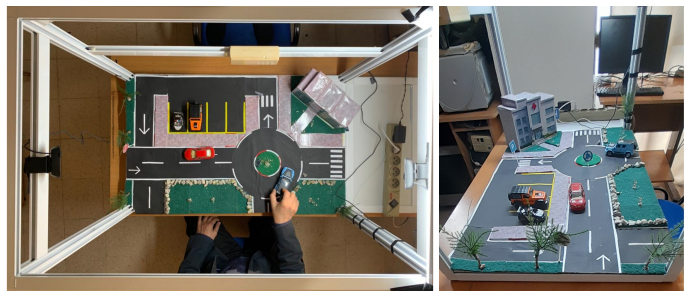
Cognitive remediation tasks often require patients to perform structured actions involving object manipulation and sequential reasoning. For patients diagnosed with schizophrenia, these tasks are crucial for addressing severe cognitive deficits. However, evaluating the correctness of these physical actions generally relies on manual observation by clinicians, which introduces subjectivity and limits the scalability of therapeutic interventions. In this paper, we propose an automated framework based on Vision-Language Models for action verification in cognitive remediation tasks tailored for schizophrenia rehabilitation. The proposed system relies on a camera-monitored tabletop environment composed of structured miniature scenes including roads, a roundabout, a park, and toy vehicles. Patients receive audio instructions describing goal-oriented spatial actions to perform by manipulating a toy vehicle. These interactive physical activities are specifically designed to stimulate targeted cognitive functions, such as sustained attention, motor coordination, spatial navigation, and cognitive flexibility. To verify the correctness of the performed actions without requiring continuous clinical oversight, the system analyzes the video feed tracking the patient's hand and toy movements. A fine-tuned Vision-Language Model interprets the recorded video sequences and generates semantic descriptions of the observed activities, enabling high-level verification of the executed actions with respect to the initial textual instructions. A dedicated dataset of 4634 tabletop cognitive remediation video scenarios was collected to evaluate the proposed approach. Experimental results demonstrate that our specialized framework effectively bridges low-level physical telemetry with high-level clinical feedback, presenting a scalable and objective solution for advanced cognitive rehabilitation.
Figures


Reference graph
Works this paper leans on
-
[1]
et al., A Comprehensive Review of Virtual Reality Technology for Cognitive Rehabilitation in Patients with Neurological Conditions., Appl
Quan, W. et al., A Comprehensive Review of Virtual Reality Technology for Cognitive Rehabilitation in Patients with Neurological Conditions., Appl. Sci. 14(14), 6285, 2024
2024
-
[2]
Majeda M. ElBanna et al., Digital and Intelligent Rehabilitation Technolo- gies in Stroke and Neurological Disorders: A Systematic Review of Artificial Intelligence, Virtual Reality, Gamification, and Emerging Therapeutic Plat- forms in Neurorehabilitation. Bioengineering (Basel), vol. 13(2):195, 2026
2026
-
[3]
et al.Qwen Team, Alibaba Group, Qwen2.5-VL Technical Report
Bai, S. et al.Qwen Team, Alibaba Group, Qwen2.5-VL Technical Report. 2025, https://arxiv.org/abs/2502.13923
Pith/arXiv arXiv 2025
-
[4]
et al., LlamaFactory: Unified Efficient Fine-Tuning of 100+ Lan- guage Models
Zheng, Y. et al., LlamaFactory: Unified Efficient Fine-Tuning of 100+ Lan- guage Models. In Proceedings of the 62nd Annual Meeting of the Association for Computational Linguistics(ACL 2024), System Demonstrations. 2024
2024
-
[5]
Proceedings of the 3rd International Conference on Biological Engineering and Medical Science, 2023
Zheng,Y., Applicationofbraincomputerinterfaceinrehabilitationmedicine. Proceedings of the 3rd International Conference on Biological Engineering and Medical Science, 2023
2023
-
[6]
Zhangyang Qi et al., GPT4Scene: Understand 3D Scenes from Videos with Vision-Language Models,2025, https://arxiv.org/abs/2501.01428
Pith/arXiv arXiv 2025
-
[7]
Helong Huang et al., GraphCoT-VLA: A 3D Spatial-Aware Reasoning Vision-Language-Action Model for Robotic Manipulation with Ambiguous Instructions, Proceedings of the AAAI Conference on Artificial Intelligence, 40(22), 2026. 13
2026
-
[8]
Proceedings of the 41st International Conference on Machine Learning (ICML), 235(61229-61245), 2024
Zhen Haoyu et al., 3D-VLA: A 3D Vision-Language-Action Generative World Model. Proceedings of the 41st International Conference on Machine Learning (ICML), 235(61229-61245), 2024
2024
-
[9]
Xu Hu et al., VideoCLIP: Contrastive Pre-training for Zero-shot Video- Text Understanding, Proceedings of the Conference on Empirical Methods in Natural Language Processing, 2021
2021
-
[10]
Proceedings of the 40th International Conference on Machine Learning
Danny Driess and al., PaLM-E: an embodied multimodal language model. Proceedings of the 40th International Conference on Machine Learning. 2023
2023
-
[11]
Proceedings of The 7th Conference on Robot Learning, PMLR 229:2165-2183, 2023
Brianna Zitkovich and al., RT-2: Vision-Language-Action Models Transfer Web Knowledge to Robotic Control. Proceedings of The 7th Conference on Robot Learning, PMLR 229:2165-2183, 2023
2023
-
[12]
and al., Design and evaluation of AR-based adaptive human- computer interaction cognitive training., International Journal of Human- Computer Studies, 199, 103504, 2025
Man, C. and al., Design and evaluation of AR-based adaptive human- computer interaction cognitive training., International Journal of Human- Computer Studies, 199, 103504, 2025
2025
-
[13]
and Both, A., A comparative analysis of trajectory similarity mea- sures, GIScience and Remote Sensing, 58(5), 643–669, 2021
Tao, Y. and Both, A., A comparative analysis of trajectory similarity mea- sures, GIScience and Remote Sensing, 58(5), 643–669, 2021
2021
-
[14]
Andrea Fiorillo et al., Virtual reality–based cognitive remediation in severe mental illness: Current evidence from a narrative review., Schizophrenia Research: Cognition, 44, 100418, 2026
2026
-
[15]
Gemini: A Family of Highly Capable Multimodal Models,
Gemini Team. Gemini: A Family of Highly Capable Multimodal Models,
-
[16]
GPT-4V(ision) Technical Work and Authors, 2023
OpenAI. GPT-4V(ision) Technical Work and Authors, 2023. https://openai.com/research/gpt-4v-system-card
2023
-
[17]
Video-LLaMA: An Instruction- tuned Audio-Visual Language Model for Video Understanding
Zhang, Hang and Li, Xin and Bing, Lidong. Video-LLaMA: An Instruction- tuned Audio-Visual Language Model for Video Understanding. Proceedings of the 2023 Conference on Empirical Methods in Natural Language Process- ing: System Demonstrations. 2023
2023
-
[18]
Proceedings of the IEEE/CVF Con- ference on Computer Vision and Pattern Recognition (CVPR), 2024
Maaz, Muhammad and Rasheed, Hanoona and Khan, Salman and Khan, Fahad Shahbaz, Video-ChatGPT: Towards Detailed Video Understanding via Large Vision and Language Models. Proceedings of the IEEE/CVF Con- ference on Computer Vision and Pattern Recognition (CVPR), 2024
2024
-
[19]
Proceedings of the 10th Inter- national Workshop on Semantic Evaluation (SemEval-2016)
Agirre, Eneko et al., SemEval-2016 Task 1: Semantic Textual Similarity, Monolingual and Cross-Lingual Evaluation. Proceedings of the 10th Inter- national Workshop on Semantic Evaluation (SemEval-2016). 2016
2016
-
[20]
Reimers, Nils and Gurevych, Iryna. Sentence-BERT: Sentence Embeddings using Siamese BERT-Networks, Proceedings of the 2019 Conference on Em- pirical Methods in Natural Language Processing (EMNLP-IJCNLP), pages 3982-3992, 2019. 14
2019
-
[21]
CIDEr: Consensus-based im- age description evaluation,
R. Vedantam, C. L. Zitnick and D. Parikh, "CIDEr: Consensus-based im- age description evaluation," 2015 IEEE Conference on Computer Vision and Pattern Recognition (CVPR), Boston, MA, USA, 2015, pp. 4566-4575, doi: 10.1109/CVPR.2015.7299087
arXiv 2015
-
[22]
Msr-vtt: A large video description dataset for bridging video and language
Xu, Jun and Mei, Tao and Yao, Ting and Rui, Yong. Msr-vtt: A large video description dataset for bridging video and language. Proceedings of the IEEE/CVF Conference on Computer Vision and Pattern Recognition (CVPR), 2016
2016
-
[23]
Cognitive Remediation Dataset, 2026, Hugging Face, https://huggingface.co/datasets/slarabi/cognitive-remediation 15
, Ait Mehdi Nassira, Temam Milissa, Slimane Larabi. Cognitive Remediation Dataset, 2026, Hugging Face, https://huggingface.co/datasets/slarabi/cognitive-remediation 15
2026
-
[2023]
https://arxiv.org/abs/2312.11805
discussion (0)
Sign in with ORCID, Apple, or X to comment. Anyone can read and Pith papers without signing in.