The leading nuclear-structure electrostatic correction in arbitrary β decays
Pith reviewed 2026-06-27 05:34 UTC · model grok-4.3
The pith
Nuclear beta decay rates receive a leading electrostatic correction from three modifications induced by one-photon exchange.
A machine-rendered reading of the paper's core claim, the machinery that carries it, and where it could break.
Core claim
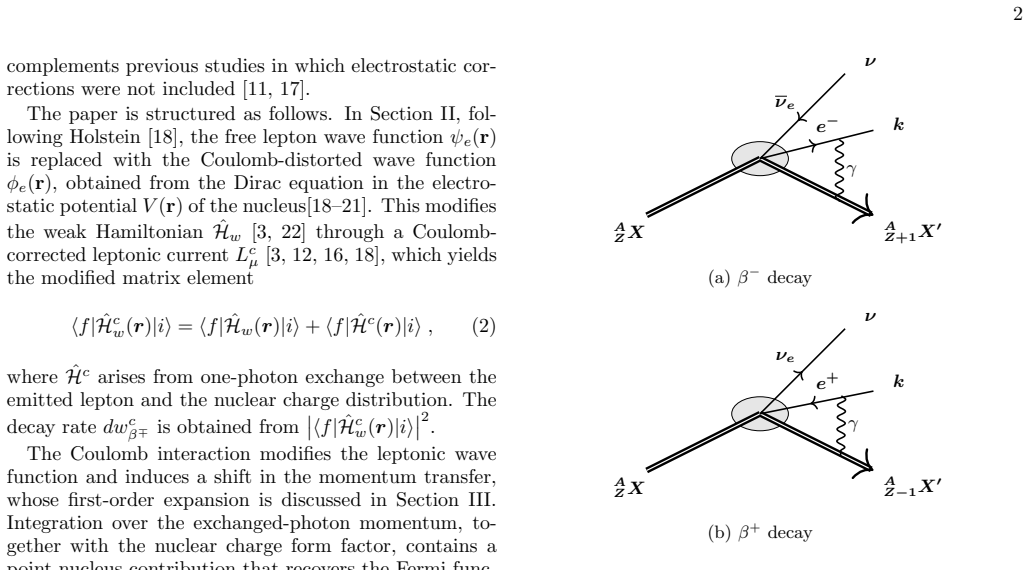
Within this formalism the leading Coulomb correction originates from three modifications of the original weak-only interaction: a modification of the nuclear charge form factor that yields a term similar to the known Fermi function, a shift of the momentum transfer inside the lepton traces, and the identical shift applied inside the nuclear multipole operators.
What carries the argument
One-photon exchange that preserves the full multipole and angular structure of the decay rate before expansion in small nuclear parameters.
If this is right
- The correction remains suppressed to a few per-mills for medium-mass nuclei with typical beta-decay properties.
- Explicit analytic results exist for allowed Gamow-Teller and unique first-forbidden transitions.
- The same three modifications apply uniformly to decays of any angular momentum J.
- The framework supplies model-independent nuclear-structure input for precision beta-decay analyses.
Where Pith is reading between the lines
- The three-modification structure may be used to re-express the traditional Fermi function for forbidden decays in a multipole-consistent way.
- Because the formalism is built on the same multipole operators used in ab initio calculations, it can be inserted directly into existing nuclear-structure codes without additional model assumptions.
- The momentum-shift terms inside lepton traces and multipole operators suggest a route to consistent higher-order electromagnetic corrections in other weak processes.
Load-bearing premise
First-order Coulomb corrections can be obtained from one-photon exchange while keeping the complete multipole and angular structure of the decay rate before any expansion in small parameters.
What would settle it
A high-precision measurement of the beta spectrum shape in a medium-mass nucleus where the calculated few-per-mill correction is subtracted and the residual deviates from zero by more than the experimental uncertainty.
Figures
read the original abstract
We develop a systematic theoretical framework to improve theoretical predictions for nuclear $\beta$ decays of arbitrary angular momentum $J$, leading to a model-independent nuclear-structure electrostatic correction to the Coulomb interaction between the emitted lepton and the nuclear charge distribution, useful for ongoing and future precision searches for physics beyond the Standard Model. The formalism is based on nuclear matrix elements expanded in multipole operators, as commonly used in \emph{ab initio} calculations. First-order Coulomb corrections are derived from one-photon exchange preserving the full multipole and angular structure of the decay rate, and are subsequently expanded in the relevant small parameters of the nuclear problem, suppressing the leading nuclear structure correction to a few per-mills for medium mass nuclei with natural beta decay properties. We show that within this formalism, the leading Coulomb correction originates from three modifications of the original weak-only interaction: a modification of the nuclear charge form factor, which yields a correction similar to the known Fermi function, a shift of the momentum transfer within the lepton traces, and the same shift but inside the nuclear multipole operators. We additionally provide explicit results for allowed Gamow--Teller and unique first-forbidden transitions.
Editorial analysis
A structured set of objections, weighed in public.
Referee Report
Summary. The paper develops a systematic theoretical framework for the leading nuclear-structure electrostatic correction in β decays of arbitrary angular momentum J. It uses multipole operators for nuclear matrix elements (as in ab initio calculations), derives first-order Coulomb corrections from one-photon exchange while preserving the full multipole and angular structure of the decay rate, and then expands in the small parameters of the nuclear problem (qR, lepton momenta). The leading correction is shown to arise from three modifications to the weak-only interaction: a change to the nuclear charge form factor (yielding a correction similar to the Fermi function), a shift of the momentum transfer in the lepton traces, and the same shift inside the nuclear multipole operators. Explicit results are provided for allowed Gamow-Teller and unique first-forbidden transitions, with the correction suppressed to a few per-mills for medium-mass nuclei.
Significance. If the central derivation holds, the work supplies a model-independent electrostatic correction at the per-mil level that is directly relevant to precision β-decay searches for BSM physics. The preservation of the complete multipole and angular structure prior to expansion, followed by a controlled expansion in nuclear small parameters, is a clear methodological strength over ad-hoc approximations. Explicit expressions for Gamow-Teller and unique first-forbidden cases make the result immediately usable in existing nuclear-structure codes. The approach is grounded in the same multipole formalism employed in ab initio calculations, enhancing its compatibility with modern nuclear theory.
major comments (2)
- [§4] §4 (one-photon exchange derivation): The claim that the three modifications constitute the complete leading correction rests on the one-photon exchange preserving the full multipole structure before expansion; however, the manuscript does not provide an explicit bound on the size of the neglected two-photon or higher-order terms for the Z and energy range of interest, which is load-bearing for asserting that the result is the leading nuclear-structure correction.
- [§5.2] §5.2 (explicit GT and UFF results): The suppression of the correction to a few per-mills is stated for medium-mass nuclei with natural β-decay properties, but no numerical evaluation or comparison against the standard Fermi function is given for a concrete transition (e.g., a specific GT decay), leaving the practical improvement unquantified.
minor comments (3)
- [Abstract and §3] The abstract states that the correction is 'suppressing the leading nuclear structure correction to a few per-mills,' but the main text does not define the precise small-parameter counting or quote the numerical coefficient that produces this estimate.
- [§3.1] Notation for the shifted momentum transfer q' is introduced without an explicit equation linking it to the original q in both the lepton and nuclear sectors; a single defining equation would improve clarity.
- [Introduction] The manuscript cites the multipole formalism commonly used in ab initio calculations but does not reference a specific recent review or code (e.g., on nuclear response functions) that would allow readers to implement the correction directly.
Simulated Author's Rebuttal
We thank the referee for the positive assessment of the manuscript and the recommendation for minor revision. We address each major comment below.
read point-by-point responses
-
Referee: [§4] §4 (one-photon exchange derivation): The claim that the three modifications constitute the complete leading correction rests on the one-photon exchange preserving the full multipole structure before expansion; however, the manuscript does not provide an explicit bound on the size of the neglected two-photon or higher-order terms for the Z and energy range of interest, which is load-bearing for asserting that the result is the leading nuclear-structure correction.
Authors: We agree that the manuscript does not supply an explicit numerical bound on two-photon or higher-order electromagnetic contributions for the Z and energies of interest. The derivation isolates the leading nuclear-structure correction arising from one-photon exchange after expansion in the small nuclear parameters (qR, lepton momenta). Two-photon terms enter at an additional factor of α ≈ 1/137 and involve distinct nuclear operators; their contribution to the nuclear-structure correction is therefore parametrically smaller than the one-photon term retained here. In the revised manuscript we will insert a short paragraph clarifying this power counting and the expected relative size of higher-order electromagnetic effects. revision: yes
-
Referee: [§5.2] §5.2 (explicit GT and UFF results): The suppression of the correction to a few per-mills is stated for medium-mass nuclei with natural β-decay properties, but no numerical evaluation or comparison against the standard Fermi function is given for a concrete transition (e.g., a specific GT decay), leaving the practical improvement unquantified.
Authors: The analytic expansion in the small parameters already shows that the correction is suppressed to a few per-mills. To make the practical size more transparent, we will add a brief numerical illustration for one representative allowed Gamow-Teller transition (including a direct comparison with the conventional Fermi function) in the revised version. revision: yes
Circularity Check
Derivation self-contained from one-photon exchange and multipole operators
full rationale
The paper presents a first-principles derivation of first-order Coulomb corrections starting from one-photon exchange that preserves the full multipole and angular structure of the decay rate, followed by expansion in small nuclear parameters (qR, lepton momenta). The leading correction is shown to arise from three explicit modifications (nuclear charge form factor, momentum shift in lepton traces, momentum shift in multipole operators). No load-bearing steps reduce by construction to fitted inputs, self-definitions, or self-citation chains; the abstract and description contain no parameter fitting renamed as prediction and no uniqueness theorems imported from prior author work. The approach is model-independent and expanded from standard multipole operators used in ab initio calculations, making the central claim independent of its inputs.
Axiom & Free-Parameter Ledger
axioms (2)
- domain assumption Nuclear matrix elements can be expanded in multipole operators as commonly used in ab initio calculations
- domain assumption First-order Coulomb corrections can be derived from one-photon exchange while preserving full multipole and angular structure
Reference graph
Works this paper leans on
-
[1]
Langacker, inThe Dawn of the LHC Era(World Sci- entific, 2010) pp
P. Langacker, inThe Dawn of the LHC Era(World Sci- entific, 2010) pp. 3–48
2010
-
[2]
Grossman and Y
Y. Grossman and Y. Nir, The standard model: A uniquely beautiful theory (2022), draft, March 30, 2022
2022
-
[3]
Behrens and W
H. Behrens and W. B¨ uhring,Electron Radial Wave Func- tions and Nuclear Beta-Decay(Oxford University Press, 1982)
1982
-
[4]
Behrens and D
H. Behrens and D. Bogdan, Nuclear Physics A143, 468 (1970)
1970
-
[5]
B¨ uhring and L
W. B¨ uhring and L. Scholz, Nuclear Physics65, 369 (1965)
1965
-
[6]
A. J. Barr, The Oxford Nuclear and Particle Physics Ba- sics (2016), lecture notes, University of Oxford, Decem- ber 7, 2016
2016
-
[7]
Herczeg, Progress in Particle and Nuclear Physics46, 413 (2001)
P. Herczeg, Progress in Particle and Nuclear Physics46, 413 (2001)
2001
-
[8]
Kleesiek, J
M. Kleesiek, J. Behrens, G. Drexlin, K. Eitel, M. Er- hard, J. A. Formaggio, F. Gl¨ uck, S. Groh, M. H¨ otzel, S. Mertens, A. W. P. Poon, C. Weinheimer, and K. Va- lerius, Eur. Phys. J. C79, 204 (2019)
2019
-
[9]
M. Brodeur, N. Buzinsky, M. A. Caprio, V. Cirigliano, J. A. Clark,et al., Nuclearβdecay as a probe for physics beyond the standard model (2023), arXiv:2301.03975 [nucl-ex]
arXiv 2023
-
[10]
A. Falkowski, M. Gonz´ alez-Alonso, and O. Naviliat- Cuncic, Journal of High Energy Physics2021, 10.1007/jhep04(2021)126 (2021)
-
[11]
Glick-Magid and D
A. Glick-Magid and D. Gazit, Journal of Physics G: Nu- clear and Particle Physics49, 105105 (2022)
2022
-
[12]
J. D. Walecka,Theoretical Nuclear and Subnuclear Physics, 2nd ed. (World Scientific, Singapore, 2004)
2004
-
[13]
Morita, Progress of Theoretical Physics Supplement 26, 1 (1963)
M. Morita, Progress of Theoretical Physics Supplement 26, 1 (1963)
1963
-
[14]
Bottino and G
A. Bottino and G. Ciocchetti, Physics Letters B43, 170 (1973)
1973
-
[15]
R. J. Hill and R. Plestid, Physical Review Letters133, 021803 (2024)
2024
-
[16]
Hayen, N
L. Hayen, N. Severijns, K. Bodek, D. Rozpedzik, and X. Mougeot, Reviews of Modern Physics90, 015008 (2018). 11
2018
-
[17]
Glick-Magid and D
A. Glick-Magid and D. Gazit, Physical Review D107, 075031 (2023)
2023
-
[18]
B. R. Holstein, Physical Review C9, 1742 (1974)
1974
-
[19]
Bottino and G
A. Bottino and G. Ciocchetti, Nuclear Physics A178, 593 (1972)
1972
-
[20]
M. E. Peskin and D. V. Schroeder,An Introduction to Quantum Field Theory(Addison-Wesley, Reading, Mas- sachusetts, 1995)
1995
-
[21]
B. R. Holstein, Physical Review C28, 342 (1983)
1983
-
[22]
Bambynek, H
W. Bambynek, H. Behrens, M. H. Chen, B. Crase- mann, M. L. Fitzpatrick, K. W. D. Ledingham, H. Genz, M. Mutterer, and R. L. Intemann, Reviews of Modern Physics49, 77 (1977)
1977
-
[23]
Glick-Magid, Y
A. Glick-Magid, Y. Mishnayot, I. Mukul, M. Hass, S. Vaintraub, G. Ron, and D. Gazit, Phys. Lett. B767, 285 (2017)
2017
-
[24]
T. W. Donnelly and W. C. Haxton, Atomic Data and Nuclear Data Tables23, 103 (1979)
1979
-
[25]
T. W. Donnelly and J. D. Walecka, Nuclear Physics A 274, 368 (1976)
1976
-
[26]
L. H. Ryder,Quantum Field Theory, 2nd ed. (Cambridge University Press, Cambridge, 1996)
1996
-
[27]
J. D. Walecka,Advanced Modern Physics: Theoretical Foundations(World Scientific, 2010)
2010
-
[28]
J. D. Walecka,Electron Scattering for Nuclear and Nucleon Structure, Cambridge Monographs on Particle Physics, Nuclear Physics and Cosmology, Vol. 16 (Cam- bridge University Press, Cambridge, 2001)
2001
-
[29]
Bottino, G
A. Bottino, G. Ciocchetti, and C. W. Kim, Phys. Rev. C 9, 2052 (1974)
2052
-
[30]
M. A. B´ eg, J. Bernstein, and A. Sirlin, Phys. Rev. D6, 2597 (1972)
1972
-
[31]
R. J. Hill and R. Plestid, Phys. Rev. D109, 056006 (2024)
2024
-
[32]
J. L. Armstrong and C. W. Kim, Phys. Rev. C5, 672 (1972)
1972
-
[33]
M. A. Huertas, Effective field theory approach to elec- troweak transitions of nuclei far from stability (2003), arXiv:nucl-th/0301076 [nucl-th]
Pith/arXiv arXiv 2003
-
[34]
Wang, W.-J
M. Wang, W.-J. Huang, F. G. Kondev, G. Audi, and S. Naimi, Chinese Physics C45, 030003 (2021)
2021
-
[35]
Filianin, C
P. Filianin, C. Lyu, M. Door, K. Blaum, S. Eliseev,et al., Physical Review Letters127, 072502 (2021)
2021
-
[36]
Angeli and K
I. Angeli and K. P. Marinova, Atomic Data and Nuclear Data Tables99, 69 (2013)
2013
-
[37]
J. W. Zhao, B.-H. Sun, I. Tanihata, J. Y. Xu, K. Y. Zhang, A. Prochazka, J. H. Zhu, S. Terashima, J. Meng, L. C. He,et al., Physics Letters B858, 139082 (2024)
2024
discussion (0)
Sign in with ORCID, Apple, or X to comment. Anyone can read and Pith papers without signing in.