REVIEW 3 major objections 3 minor 9 references
Resonant Loop Interferometers for High-Frequency Gravitational Waves
T0 review · 3 major / 3 minor · reviewed 2026-08-04 · deepseek-v4-flash
Pith's one-line read Resonant optical loops could push gravitational-wave sensitivity to tens of kilohertz and approach the BBN bound.
desk verdict Novel resonant-loop concept, but the sensitivity calibration is invalid: the closed-loop response vanishes at low frequency, so the claimed reach below the BBN bound is not supported. read the letter →
The pith
A machine-rendered reading of the paper's core claim, the machinery that carries it, and where it could break.
The reading
What carries the argument
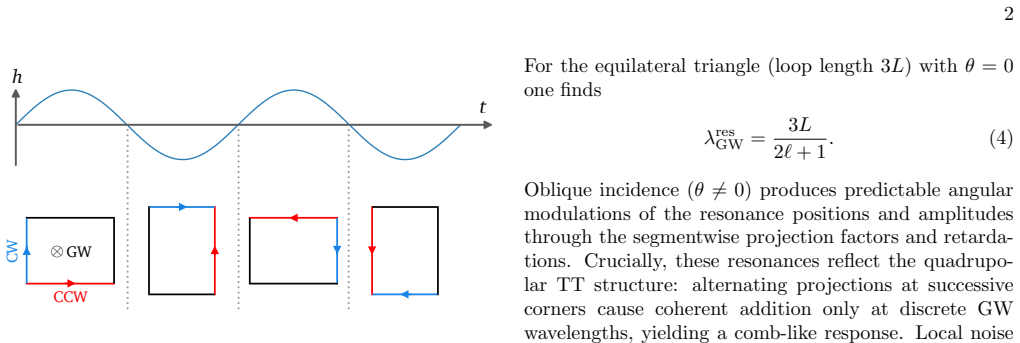
The central object is the closed optical loop — an equilateral triangle or square — operated as a high-finesse ring cavity. The mechanism is coherent accumulation of the gravitational-wave-induced phase shift: at resonance, the alternating sign of the strain projection along successive segments stays synchronized with the wave oscillation, so each round trip adds constructively. The analysis is carried out with closed-form expressions for the phase shift along each segment in transverse-traceless gauge (including retardation and polarization), summed over n loops. The sky-averaged RMS response R_rms smooths angular modulations and is used to compute sensitivity. The absolute calibration is f
What would settle it
Evaluate the full sky-averaged response R_rms(f) for the triangular loop at very low frequency using the appendix formulas (Eqs. 13–14 and 35). If the response does not approach the constant Fabry-Pérot value implied by L_eff = 2nL but instead vanishes as f → 0 (as the vanishing of the uniform-strain response suggests), then the calibration against ET is invalid and the projected sensitivity curves, including the depth of the resonance dips relative to the BBN bound, would need to be re-derived. A table-top experiment with a small ring cavity and a simulated time-varying strain could also test
Extended reading notes
Core claim
The paper's central claim is that a closed-loop optical resonator acts as a resonant gravitational-wave detector: when the gravitational-wave wavelength matches the loop perimeter divided by an odd integer, the phase shifts from each segment add coherently over n round trips, giving a total phase that grows linearly with n (power ∝ n²). The response is peaked at discrete geometric resonances, and the pattern of peaks is predictable from the loop shape and size, so the detector provides a distinctive 'comb' signature that cannot be mimicked by smooth instrumental noise. For a triangular 10 km loop with a realistic finesse of 500 (effective n ≈ 160), the sky-averaged, one-year integrated sensi
Load-bearing premise
The load-bearing assumption is that in the long-wavelength regime (λ_GW ≫ 4nL) the closed loop is equivalent to a Fabry-Pérot interferometer with effective length L_eff = 2nL, which fixes the absolute normalization of the sensitivity curves; the paper's own appendix formulas, however, imply that the loop's response vanishes as the GW frequency goes to zero, so this equivalence is not established.
Editorial extensions
If this is right
- A 10 km triangular loop with finesse 500 reaches below the BBN bound at its first resonances, probing stochastic backgrounds up to tens of kilohertz.
- The predictable resonance comb is a self-identifying signal that stands out from smooth noise, potentially enabling detection of a stochastic background without cross-correlation.
- Sensitivity scales as h_min ∝ n^{-1} T^{-1/2}, with a high-frequency envelope Ω_GW ∝ f^5, so higher finesse and longer observation time directly deepen the resonance dips.
- The square loop with counter-propagating differential readout offers a complementary geometry with similar reach.
- The concept builds on demonstrated ring-cavity technology (finesse O(10³) in existing mode cleaners) and is compatible with ET's 10 km triangular infrastructure.
Reading between the lines
- The calibration against ET rests on the claimed long-wavelength equivalence to a Fabry-Pérot with L_eff = 2nL, but a closed loop's response to a uniform, static strain vanishes; if the low-frequency response does not actually match a Fabry-Pérot, the absolute sensitivity curves — including how far below the BBN bound the dips reach — would shift, even though resonance positions and relative depths
- Because the response is sharply peaked at known frequencies, a search could integrate only in narrow bands around the resonances, improving the effective signal-to-noise beyond the broad-band estimate the paper quotes.
- The angular dependence of the resonance pattern encodes the GW arrival direction and polarization, so a network of two or more loops of different orientations could localize a stochastic background's anisotropy or separate a primordial background from astrophysical foregrounds.
- The paper's use of a single effective round-trip number n ≈ F/π could be refined by folding in the actual cavity finesse distribution; the main effect would be to smooth the off-resonance sensitivity without changing the peak depths.
Editorial analysis
A structured set of objections, weighed in public.
Referee Report
Summary. The manuscript proposes a new gravitational-wave detector concept: a closed optical loop (square or triangular) in which the GW-induced phase is accumulated coherently over many round trips, producing narrow resonant response peaks. The paper derives analytic response formulas for the loop, then calibrates the absolute strain sensitivity by matching to the Einstein Telescope in the long-wavelength regime. For a 10 km triangular loop with finesse F=500 and one year of integration, it projects sensitivity that reaches below the BBN bound at tens of kHz.
Significance. The resonant-loop idea is original and the analytic framework (Eqs. 13-14) provides a useful starting point for studying loop-geometry detectors. The explicit resonance conditions and predicted comb structure are appealing features. However, the quantitative sensitivity projections rest entirely on a long-wavelength Fabry-Perot equivalence that is inconsistent with the closed-loop response derived in the paper itself. As a result, the headline claim of reaching the BBN bound is not supported by the current analysis.
major comments (3)
- [Appendix, Eq. (26)] The displayed CW phase is not the sum of Eq. (25) with the stated P_s values. For the four sides one obtains, per loop m, -sin(4mωL)+2sin((4m+1)ωL)-2sin((4m+2)ωL)+2sin((4m+3)ωL)-sin((4m+4)ωL). The paper's coefficients (1,-2,-1,1,1) are different. This is not a mere typo: the printed numerator has a nonzero first moment in ω, which produces a finite low-frequency limit after the 1/ω prefactor; the correct numerator starts at O(ω^2).
- [Sensitivity and feasibility, long-wavelength calibration] The calibration statement 'In the long-wavelength regime (λ_GW ≫ 4nL), the setup is equivalent to a Fabry-Pérot interferometer with L_eff=2nL' is false. For a constant TT strain, ∮ h_ij e^i e^j ds = 0 around a closed loop; for the square, the x and y sides cancel because h_xx = -h_yy. The round-trip phase is unchanged to first order, and the residual response is suppressed as (ω_GW L)^2 at low frequency. The bracketed note concedes that the CW-CCW differential signal vanishes as ω→0, but the same cancellation also affects the single-direction phase. Therefore matching to ET cannot fix the absolute normalization.
- [Fig. 3 and surrounding sensitivity text] Because the absolute sensitivity is fixed only by the invalid ET matching, and no direct noise model (shot noise, thermal noise, circulating power, optical losses) is provided, the projected resonance dips below the BBN bound are unsupported. The central quantitative claim of the paper depends on this calibration; without it, the sensitivity curves in Fig. 3 have no established normalization.
minor comments (3)
- [Conclusions] The statement that the resonance comb enables detection of a stochastic background without cross-correlation overstates the case. A stochastic GW signal is random, and a single detector still requires a reliable noise model or a known spectral shape to claim detection; the comb structure is only a frequency-dependent response feature.
- [Appendix, Eq. (26)] Even aside from the low-frequency issue, Eq. (26) should be rederived from Eq. (25); the sign pattern is inconsistent with the stated P_s values and the resonance formula Eq. (28) should be checked against the corrected sum.
- [Title page] The affiliation line contains a typo: 'R WTH Aachen University' should presumably read 'RWTH Aachen University'.
Circularity Check
No significant circularity: the response is derived from first principles and the absolute normalization is set by the external ET benchmark, not fitted to the claimed BBN-bound crossing.
full rationale
The paper's derivation chain is self-contained rather than circular. The GW-induced phase shift is obtained by integrating the TT metric perturbation along null segments (Eqs. (1), (10)-(14), (24)-(28)); the resonance conditions are then read off from the resulting trigonometric sums, not imposed. The sky-averaged response R_rms is computed from those expressions, and the absolute strain sensitivity is fixed by calibrating the long-wavelength envelope against the Einstein Telescope sensitivity curve, an external benchmark. No parameter is fitted to the BBN bound or to the target resonance dips, and no load-bearing conclusion is imported from a self-citation: the references are external data sets (ET, PLIS, BBN/Planck limits) and general reviews. The bracketed note in the main text that the CW-CCW differential signal vanishes at low frequency identifies a limitation of one readout mode, but it does not make the single-beam response derivation self-referential. The long-wavelength Fabry-Pérot equivalence L_eff = 2nL used for normalization is an assumption whose correctness can be questioned (and may be inconsistent with the low-frequency behavior of Eq. (26)), but that is a validity/correctness concern, not an instance of a prediction reducing by construction to its inputs. Therefore no circular step is exhibited and the circularity score is 0.
Assumptions & free parameters
free parameters (4)
- Side length L =
10 km
- Finesse F =
500
- Observation time T =
1 year
- Absolute sensitivity normalization =
implicit
assumptions (3)
- domain assumption The GW phase shift is given by the transverse-traceless integral Eq. (1)
- domain assumption The circulating field can be modeled by a single effective round-trip number n ≈ F/π
- ad hoc to paper In the long-wavelength regime the closed-loop response matches a Fabry-Perot with L_eff=2nL
Cite this review
Pith. "Pith review of Resonant Loop Interferometers for High-Frequency Gravitational Waves." pith.science (2026). https://pith.science/paper/LJL743KF
@misc{pith2026251013957,
  author       = {Pith},
  title        = {Pith review of: Resonant Loop Interferometers for High-Frequency Gravitational Waves},
  year         = {2026},
  howpublished = {\url{https://pith.science/paper/LJL743KF}},
  note         = {Machine review of arXiv:2510.13957}
}
abstract
Gravitational waves at kilohertz and higher frequencies offer a unique probe of the early Universe at temperatures well beyond the reach of the cosmic microwave background, corresponding to energy scales $\gtrsim 10^9$GeV. Existing detector concepts fall many orders of magnitude short of the big-bang nucleosynthesis (BBN) bound on the stochastic background in this regime. We propose a new interferometric architecture based on closed optical loops, in which the gravitational-wave-induced phase shift accumulates coherently over many traversals. This produces sharp, narrowband resonances whose predictable comb structure provides a distinct experimental signature. For a folded loop with parameters compatible with the Einstein Telescope infrastructure, and finesse values of order 500, we project sensitivity that approaches and even surpasses the BBN bound up to tens of kilohertz after one year of integration. Such loop interferometers thus open a realistic and distinctive path toward exploring high-frequency stochastic gravitational-wave backgrounds.
Figures


Reference graph
Works this paper leans on
-
[1]
N. Aggarwal et al., Challenges and opportunities of gravitational-wave searches at MHz to GHz frequencies , http://dx.doi.org/10.1007/s41114-021-00032-5 Living Rev. Rel. 24 (2021) 4 , [ http://arxiv.org/abs/2011.12414 2011.12414 ]
arXiv 2021
- [2]
-
[3]
N. Aggarwal et al., Challenges and Opportunities of Gravitational Wave Searches above 10 kHz , http://arxiv.org/abs/2501.11723 2501.11723
-
[4]
A. R. Kaiser and S. T. McWilliams, Sensitivity of present and future detectors across the black-hole binary gravitational wave spectrum , http://dx.doi.org/10.1088/1361-6382/abd4f6 Class. Quant. Grav. 38 (2021) 055009 , [ http://arxiv.org/abs/2010.02135 2010.02135 ]
arXiv 2021
-
[5]
Aasi et al., Advanced LIGO , http://dx.doi.org/10.1088/0264-9381/32/7/074001 Class
LIGO Scientific collaboration, J. Aasi et al., Advanced LIGO , http://dx.doi.org/10.1088/0264-9381/32/7/074001 Class. Quant. Grav. 32 (2015) 074001 , [ http://arxiv.org/abs/1411.4547 1411.4547 ]
arXiv 2015
-
[6]
N. Aggarwal et al., Exploring the sensitivity of gravitational-wave detectors to probe the early Universe with high-frequency sources , http://dx.doi.org/10.1088/1361-6382/ab9175 Class. Quant. Grav. 37 (2020) 195011 , [ http://arxiv.org/abs/2003.07468 2003.07468 ]
arXiv 2020
-
[7]
K. Schmitz, New Sensitivity Curves for Gravitational-Wave Signals from Cosmological Phase Transitions , http://dx.doi.org/10.1007/JHEP01(2021)097 JHEP 01 (2021) 097 , [ http://arxiv.org/abs/2002.04615 2002.04615 ]
arXiv 2021
-
[8]
C. Caprini and D. G. Figueroa, Cosmological Backgrounds of Gravitational Waves , http://dx.doi.org/10.1088/1361-6382/aac608 Class. Quant. Grav. 35 (2018) 163001 , [ http://arxiv.org/abs/1801.04268 1801.04268 ]
arXiv 2018
Show all 9 references
-
[9]
T.-H. Yeh, J. Shelton, K. A. Olive and B. D. Fields, Probing physics beyond the standard model: limits from BBN and the CMB independently and combined , http://dx.doi.org/10.1088/1475-7516/2022/10/046 JCAP 10 (2022) 046 , [ http://arxiv.org/abs/2207.13133 2207.13133 ]
2022 arXiv
Reviewed August 4, 2026 · model on record in the stance chip above.
Discussion (0). Sign in to comment.