New Rotating Black Hole in Electromagnetic Fields: Cosmological Horizon without Cosmological Constant
Pith reviewed 2026-06-26 07:18 UTC · model grok-4.3
The pith
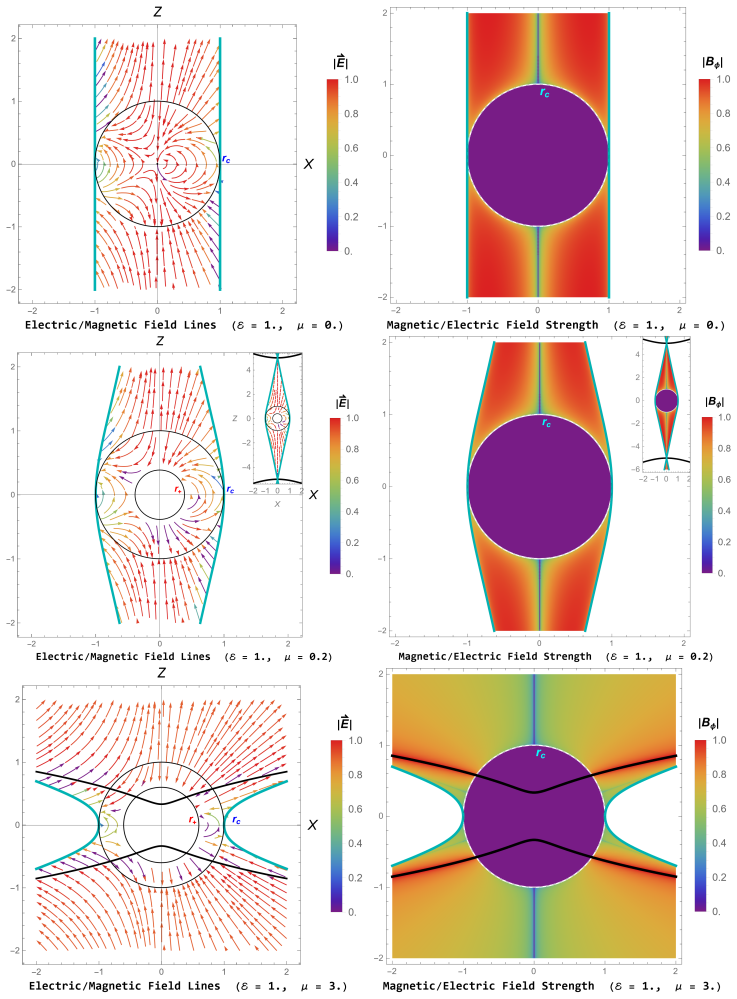
Einstein-Maxwell gravity admits an exact electrovacuum spacetime whose cosmological horizon is generated solely by the electromagnetic stress-energy tensor, together with an embedded rotating Kerr black hole.
A machine-rendered reading of the paper's core claim, the machinery that carries it, and where it could break.
Core claim
The authors obtain a new electrovacuum and related background spacetime that contains a cosmological horizon supported entirely by the electromagnetic field. They further construct an exact solution describing a Kerr black hole in this background. The global structure including horizons and singularities is studied, and the first law of black hole thermodynamics is derived. The emergence of a cosmological horizon in Einstein-Maxwell gravity without invoking a positive cosmological constant is presented as the central result.
What carries the argument
The new electrovacuum metric whose electromagnetic stress-energy tensor alone produces a cosmological horizon.
If this is right
- The cosmological horizon exists without a cosmological constant or dark energy term in the field equations.
- An exact Kerr black hole solution rotates inside this electromagnetic background.
- The first law of black hole thermodynamics holds for the Kerr solution in this spacetime.
- The global structure consists of explicitly describable horizons and singularities.
Where Pith is reading between the lines
- Electromagnetic fields could therefore mimic some observational effects usually attributed to a cosmological constant around black holes.
- The thermodynamic relations may be compared directly with those of de Sitter black holes to isolate differences arising from the electromagnetic origin of the horizon.
- Analogous solutions might be constructed in other gravity theories that include electromagnetic or other matter fields.
- The background could serve as a testbed for numerical simulations of black-hole dynamics in electromagnetically dominated cosmologies.
Load-bearing premise
The Einstein-Maxwell equations admit an exact solution in which the electromagnetic stress-energy tensor produces a cosmological horizon without any cosmological constant term.
What would settle it
Direct substitution of the metric into the Einstein-Maxwell equations yields a nonzero residual unless a cosmological constant is restored.
Figures
read the original abstract
We obtain a new electrovacuum and related background spacetime that contains a cosmological horizon supported entirely by the electromagnetic field. We further construct an exact solution describing a Kerr black hole in this background. We study the global structure including horizons and singularities, and derive the first law of black hole thermodynamics. The emergence of a cosmological horizon in Einstein-Maxwell gravity without invoking a positive cosmological constant or dark energy is tantalizing, and may provide a new avenue for exploring cosmological and astrophysical phenomena related to black holes and the late-time cosmology.
Editorial analysis
A structured set of objections, weighed in public.
Referee Report
Summary. The manuscript claims to construct a new exact electrovacuum solution of the Einstein-Maxwell equations (no cosmological constant) whose electromagnetic stress-energy alone generates a cosmological horizon, together with an embedded exact Kerr black hole in that background; the authors analyze the global causal structure, horizons, singularities, and derive the first law of black-hole thermodynamics.
Significance. If the solution is shown to satisfy the source-free Einstein-Maxwell system with R≡0 while still possessing a causally defined cosmological horizon, the result would be significant: it would supply an explicit example of a de-Sitter-like horizon generated purely by T_{\mu\nu}^{EM} and could open a new route for modeling late-time cosmology without an explicit dark-energy term.
major comments (1)
- [Abstract] Abstract (central claim): the assertion that a cosmological horizon arises 'supported entirely by the electromagnetic field' without a cosmological constant must be checked against the contracted Einstein equation. For any solution of the source-free Einstein-Maxwell system one has R≡0 identically; the manuscript must therefore exhibit the explicit metric, compute its Ricci scalar, and verify that R=0 everywhere while the surface identified as the cosmological horizon still satisfies the standard Killing-horizon and causal-boundary definitions.
minor comments (1)
- The abstract states that the first law is derived; the main text should make the definitions of mass, angular momentum, charge, and horizon area explicit and show the variation explicitly.
Simulated Author's Rebuttal
We thank the referee for their thorough review and valuable feedback on our manuscript. We address the major comment point by point below.
read point-by-point responses
-
Referee: [Abstract] Abstract (central claim): the assertion that a cosmological horizon arises 'supported entirely by the electromagnetic field' without a cosmological constant must be checked against the contracted Einstein equation. For any solution of the source-free Einstein-Maxwell system one has R≡0 identically; the manuscript must therefore exhibit the explicit metric, compute its Ricci scalar, and verify that R=0 everywhere while the surface identified as the cosmological horizon still satisfies the standard Killing-horizon and causal-boundary definitions.
Authors: The manuscript presents an exact solution to the source-free Einstein-Maxwell equations, which by definition satisfies R = 0. To address the referee's request for explicit verification, in the revised version we will include the explicit metric components and the direct computation of the Ricci scalar, confirming that it vanishes identically throughout the spacetime. Additionally, we will provide a detailed analysis confirming that the cosmological horizon is a Killing horizon satisfying the standard definitions of a causal boundary. revision: yes
Circularity Check
No circularity: derivation self-contained against external equations
full rationale
The abstract asserts an exact electrovacuum solution of the source-free Einstein-Maxwell system (no Λ) that produces a cosmological horizon. No derivation steps, metric ansatz, or parameter-fitting procedure are supplied in the visible text. No self-citations are invoked to justify uniqueness or an ansatz, no fitted input is relabeled as a prediction, and no renaming of known results occurs. The central claim therefore reduces only to the standard Einstein-Maxwell equations plus an explicit metric that must be verified by direct substitution; this is an independent, externally falsifiable construction rather than a self-referential loop.
Axiom & Free-Parameter Ledger
Reference graph
Works this paper leans on
-
[1]
Observational Evidence from Supernovae for an Accelerating Universe and a Cosmological Constant
A.G. Riesset al.[Supernova Search Team], “Observational evidence from supernovae for an accelerating universe and a cosmological constant,” Astron. J.116(1998), 1009-1038 doi:10.1086/300499 [arXiv:astro-ph/9805201 [astro-ph]]
work page internal anchor Pith review Pith/arXiv arXiv doi:10.1086/300499 1998
-
[2]
S. Perlmutteret al.[Supernova Cosmology Project], “Measurements of Ω and Λ from 42 High Redshift Supernovae,” Astrophys. J.517(1999), 565-586 doi:10.1086/307221 [arXiv:astro-ph/9812133 [astro-ph]]
work page internal anchor Pith review Pith/arXiv arXiv doi:10.1086/307221 1999
-
[3]
Planck 2018 results. VI. Cosmological parameters
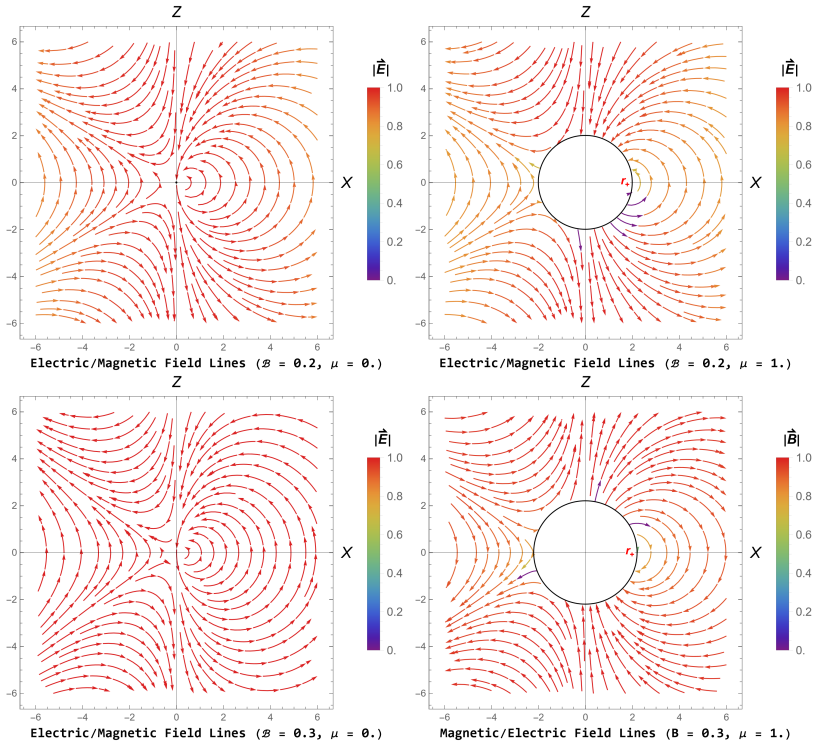
N. Aghanimet al.[Planck], “Planck 2018 results. VI. Cosmological parameters,” Astron. Astrophys.641(2020), A6 [erratum: Astron. Astrophys.652(2021), C4] doi:10.1051/0004-6361/201833910 [arXiv:1807.06209 [astro-ph.CO]]. 10 Figure 2:The top two panels display the field lines of the SM solution, while the bottom two panels show the field lines of the static ...
work page internal anchor Pith review Pith/arXiv arXiv doi:10.1051/0004-6361/201833910 2018
-
[4]
E.J. Copeland, M. Sami and S. Tsujikawa, “Dynamics of dark energy,” Int. J. Mod. Phys. D15(2006), 1753-1936 doi:10.1142/S021827180600942X [arXiv:hep-th/0603057 [hep-th]]
work page internal anchor Pith review Pith/arXiv arXiv doi:10.1142/s021827180600942x 2006
-
[5]
Phenomenology of Broad Emission Lines in Active Galactic Nuclei.ARA&A2000,38, 521–571
J. Frieman, M. Turner and D. Huterer, “Dark energy and the accelerating universe,” Ann. Rev. Astron. Astrophys.46(2008), 385-432 doi:10.1146/annurev.astro. 46.060407.145243 [arXiv:0803.0982 [astro-ph]]
-
[6]
R.R. Caldwell, “A phantom menace?,” Phys. Lett. B545(2002), 23-29 doi:10.1016/ S0370-2693(02)02589-3 [arXiv:astro-ph/9908168 [astro-ph]]
Pith/arXiv arXiv 2002
-
[7]
Demagnetizing KBR and new Ricci-flat rotating metric,
L. Ma and H. L¨ u, “Demagnetizing KBR and new Ricci-flat rotating metric,” [arXiv:2605.13954 [gr-qc]]
-
[8]
Black holes in a magnetic universe,
F.J. Ernst, “Black holes in a magnetic universe,” J. Math. Phys.17, no.1, 54-56 (1976) doi:10.1063/1.522781
-
[9]
Kerr black holes in a magnetic universe,
F.J. Ernst and W.J. Wild, “Kerr black holes in a magnetic universe,” J. Math. Phys.17, no.2, 182 (1976) doi:10.1063/1.522875
-
[10]
Kerr black hole in a uniform Bertotti-Robinson magnetic field: an exact solution,
J. Podolsk´ y and H. Ovcharenko, “Kerr black hole in a uniform Bertotti-Robinson magnetic field: an exact solution,” Phys. Rev. Lett.135, no.18, 181401 (2025) doi:10.1103/rfgv-ybz5 [arXiv:2507.05199 [gr-qc]]
-
[11]
New class of rotating charged black holes with non- aligned electromagnetic field,
H. Ovcharenko and J. Podolsk´ y, “New class of rotating charged black holes with non- aligned electromagnetic field,” Phys. Rev. D112, no.6, 064076 (2025) doi:10.1103/8wkz- th6v [arXiv:2508.04850 [gr-qc]]
-
[12]
Black holes in the external Bertotti-Robinson-Bonnor-Melvin electromag- netic field,
M. Astorino, “Black holes in the external Bertotti-Robinson-Bonnor-Melvin electromag- netic field,” Phys. Rev. D112, no.10, 104077 (2025) doi:10.1103/c5lw-53yd [arXiv:2508. 12908 [gr-qc]]
-
[13]
Static hairy black hole in 4D general relativity,
M. Astorino, “Static hairy black hole in 4D general relativity,” Phys. Rev. D113(2026) no.2, 024047 doi:10.1103/yz86-wc3g [arXiv:2601.16254 [gr-qc]]
-
[14]
H. Ovcharenko and J. Podolsky, “Static black holes in an external uniform electromagnetic field: Reissner-Nordstrom accelerating in Bertotti-Robinson,” [arXiv:2602.15462 [gr-qc]]
-
[15]
J. Barrientos, A. Cisterna, A. D´ ıaz and K. M¨ uller, “From Bertotti-Robinson to vac- uum: new exact solutions in general relativity via Harrison and inversion symmetries,” [arXiv:2602.17581 [gr-qc]]. 12
-
[16]
Thermodynamics of Kerr-Bertotti-Robinson black hole,
L. Hu, R.G. Cai and S.J. Wang, “Thermodynamics of Kerr-Bertotti-Robinson black hole,” [arXiv:2603.18821 [gr-qc]]
-
[17]
Vacuum, ma non troppo: hidden matter distribution in symmetry-transformed electrovacuum spacetimes,
C.A.R. Herdeiro and J.P.A. Novo, “Vacuum, ma non troppo: hidden matter distribution in symmetry-transformed electrovacuum spacetimes,” [arXiv:2605.18967 [gr-qc]]
-
[18]
Supersymmetry of the static Reissner-Nordstr¨ om black hole in Bertotti-Robinson (AdS 2 ×S 2),
A. Di Pinto and A. Vigan` o, “Supersymmetry of the static Reissner-Nordstr¨ om black hole in Bertotti-Robinson (AdS 2 ×S 2),” [arXiv:2606.11101 [hep-th]]
-
[19]
Solar-system bounds on Ricci-flat spindle deformations of Schwarzschild,
Z.X. Yu, H.D. Lyu and S. Li, “Solar-system bounds on Ricci-flat spindle deformations of Schwarzschild,” [arXiv:2606.13325 [gr-qc]]
-
[20]
Ergoregions in Magnetised Black Hole Spacetimes
G.W. Gibbons, A.H. Mujtaba and C.N. Pope, “Ergoregions in magnetised black hole spacetimes,” Class. Quant. Grav.30, no.12, 125008 (2013) doi:10.1088/0264-9381/30/ 12/125008 [arXiv:1301.3927 [gr-qc]]
work page internal anchor Pith review Pith/arXiv arXiv doi:10.1088/0264-9381/30/ 2013
-
[21]
Static magnetic fields in general relativity,
W.B. Bonnor, “Static magnetic fields in general relativity,” Proc. Roy. Soc. Lond. A67, no.3, 225 (1954) doi:10.1088/0370-1298/67/3/305
-
[22]
Pure magnetic and electric geons,
M.A. Melvin, “Pure magnetic and electric geons,” Phys. Lett.8, 65-70 (1964) doi:10.1016/ 0031-9163(64)90801-7
1964
-
[23]
Uniform electromagnetic field in the theory of general relativity,
B. Bertotti, “Uniform electromagnetic field in the theory of general relativity,” Phys. Rev. 116, 1331 (1959) doi:10.1103/PhysRev.116.1331
-
[24]
A solution of the Maxwell-Einstein equations,
I. Robinson, “A solution of the Maxwell-Einstein equations,” Bull. Acad. Pol. Sci. Ser. Sci. Math. Astron. Phys.7, 351-352 (1959)
1959
-
[25]
Thermodynamics of Taub-NUT and Plebanski solutions,
H.S. Liu, H. L¨ u and L. Ma, “Thermodynamics of Taub-NUT and Plebanski solutions,” JHEP10(2022), 174 doi:10.1007/JHEP10(2022)174 [arXiv:2208.05494 [gr-qc]]
-
[26]
Reversible transformations of a charged black hole,
D. Christodoulou and R. Ruffini, “Reversible transformations of a charged black hole,” Phys. Rev. D4, 3552-3555 (1971) doi:10.1103/PhysRevD.4.3552 13
discussion (0)
Sign in with ORCID, Apple, or X to comment. Anyone can read and Pith papers without signing in.