REVIEW 4 major objections 3 minor 37 references
Boost-and-Skip: A Simple Guidance-Free Diffusion for Minority Generation
T0 review · 4 major / 3 minor · reviewed 2026-08-08 · deepseek-v4-flash
Pith's one-line read Variance-boosted initialization and timestep skipping, without any low-density guidance, generate minority samples at quality competitive with guided state-of-the-art while using substantially fewer computations.
desk verdict A genuinely simple guidance-free minority sampler that works; the mechanism is less certain than the method, but the paper deserves a serious referee. read the letter →
The pith
A machine-rendered reading of the paper's core claim, the machinery that carries it, and where it could break.
The reading
What carries the argument
The central object is the discrete reverse VP-SDE update $x_{i-1}=\frac{1}{\sqrt{\alpha_i}}(x_i+(1-\alpha_i)s_\theta(x_i,i))+\sqrt{1-\alpha_i}z$, initiated at $x_{T_{\mathrm{skip}}}\sim\mathcal{N}(0,\gamma^2 I)$ instead of $x_N\sim\mathcal{N}(0,I)$. Two mechanisms carry the argument. First, low-density emphasis: Proposition 3.2 computes the generated Gaussian's covariance as $\hat\Sigma_0=\Sigma_0+\alpha(T_{\mathrm{skip}})^2\Sigma_0^2\Sigma_{T_{\mathrm{skip}}}^{-2}(\hat\Sigma_{T_{\mathrm{skip}}}-\Sigma_{T_{\mathrm{skip}}})$, showing that a variance-boosted initialization inflates the output variance, and Corollary 3.3 gives the range of skip times for which this amplification occurs. Second, rectification through contraction: Proposition 3.4 bounds the expected error between boosted and standard trajectories by $\lambda^{2(N_{\mathrm{skip}}-i)}(B^2+\gamma^2 d)$ with contraction rate $\lambda=\max_j\sqrt{\alpha_j}(1-\bar\alpha_{j-1})/(1-\bar\alpha_j)$, while a further result shows that PF-ODE preserves total-variation distance between trajectories rather than contracting it, which is why stochasticity is necessary.
What would settle it
Measure the denoising error of the pretrained network on inputs $x\sim\mathcal{N}(0,\gamma^2 I)$ at the skipped timestep $T_{\mathrm{skip}}$: if the error does not shrink over the following denoising steps, or if the cFID on a minority-reference set degrades monotonically with $\gamma$, then stochastic contraction is not correcting the boosted noise and the mechanism claimed in Proposition 3.4 fails.
Extended reading notes
Core claim
The paper's central claim is that minority-favored generation emerges from two minimal modifications to an off-the-shelf stochastic diffusion sampler: draw the initial latent from $\mathcal{N}(0,\gamma^2 I)$ with $\gamma>1$ and start denoising at a skipped timestep $T_{\mathrm{skip}}<T$ rather than at the fully noised end. By itself, the boosted initialization has almost no effect because the terminal signal-to-noise ratio is negligible; skipping restores a non-negligible $\alpha(T_{\mathrm{skip}})$ so the low-density-encouraging perturbation propagates into the data distribution. The paper supports this with a Gaussian computation showing that the output covariance is inflated relative to the original, and with a contraction bound showing that the expected error introduced by the boost decays exponentially during stochastic sampling while a probability-flow ODE preserves the initial error. The empirical message is that these two cheap tweaks produce minority samples whose quality and diversity approach guided samplers that require classifiers or backpropagation.
Load-bearing premise
The denoising network, trained only on noise levels of the original forward process, must still denoise out-of-distribution inputs drawn from $\mathcal{N}(0,\gamma^2 I)$ at the skipped timestep, and the theory assumes the score is perfect, so if a real network fails on such inputs the contraction may not save sample quality.
Editorial extensions
If this is right
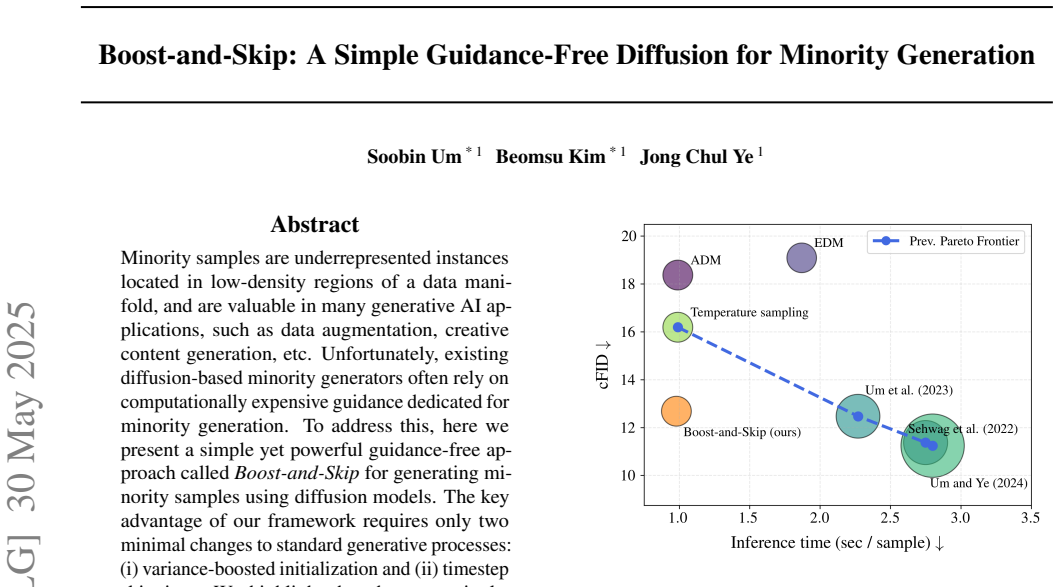
- On ImageNet 64x64, Boost-and-Skip matches the cFID of guided minority samplers while using about 65 percent less wall-clock time and about 4.5 times lower peak memory.
- Without timestep skipping the variance boost has almost no effect, and without variance boosting the skip alone gives limited gains, so the two modifications are synergistic.
- Deterministic samplers such as PF-ODE propagate the boosted initialization error instead of contracting it, so the minority-generation effect depends on stochastic sampling.
- Setting $\gamma<1$ flips the mechanism toward higher-quality, lower-diversity outputs, making Boost-and-Skip a single-parameter control for the quality-diversity tradeoff.
- Augmenting a classification training set with Boost-and-Skip samples improves accuracy and F1 comparably to augmentation with the guided SGMS sampler.
Reading between the lines
- Because the method only changes the initialization and starting step of an existing stochastic sampler, the same two modifications should transfer to latent diffusion and text-to-image backbones; the paper does not test those settings.
- A testable extension is to treat the skip amount as schedule-dependent: the paper's practical threshold $\alpha(T_{\mathrm{skip}})>0.01$ suggests that schedules with larger terminal signal-to-noise ratios need smaller skips, so the optimal $\Delta t$ should scale inversely with the terminal SNR of the noise schedule.
- The $\gamma<1$ results imply a symmetric control: the same mechanism that amplifies low-density features could also concentrate generation near high-density modes, which is the flip side of the impact statement's warning about deliberate suppression of minority features.
Editorial analysis
A structured set of objections, weighed in public.
Referee Report
Summary. The paper proposes Boost-and-Skip, a guidance-free modification of stochastic diffusion sampling for minority generation. Two changes are made to the standard reverse VP-SDE: initialization from N(0, gamma^2 I) with gamma > 1, and skipping Delta_t of the earliest reverse steps so that sampling starts at Tskip < T. The authors motivate the method with a Gaussian-case calculation (Prop. 3.2) showing variance amplification of the generated distribution, a contraction bound for optimal-score trajectories (Prop. 3.4), and a signal-processing interpretation in terms of low-frequency noise. Empirically, they evaluate on CelebA 64x64, LSUN-Bedrooms 256x256, and ImageNet at two resolutions, reporting competitive cFID, sFID, and neighborhood-density metrics against guidance-based minority samplers while reducing inference time and peak memory. They also include a data-augmentation downstream experiment and several ablations of gamma and Delta_t.
Significance. If the mechanism is accepted for real pretrained score networks, the result is practically significant: it replaces backpropagation-based guidance with two sampling-time changes and reports roughly 65% lower wall-clock time and 4.5x lower peak memory on ImageNet 64x64. The paper has clear strengths: the theoretical statements are explicit and parameter-free under their stated Gaussian and optimal-score assumptions, the code is released, the benchmark coverage is broad, and the toy validation in Figure 2 is informative. The central risk is that the real-data mechanism relies on an unmeasured form of out-of-distribution generalization by the score network, and one of the two proposed modifications is not used in the best configuration on LSUN-Bedrooms. These issues are fixable with additional quantitative analysis and a more careful framing.
major comments (4)
- [Sec. 3.3, Prop. 3.4 / Eq. (17)] The contraction guarantee is stated for the optimal score, s_theta = grad log p_i, so Eq. (17) bounds the distance between two trajectories driven by the same optimal score rather than the error of a pretrained score network on OOD inputs from N(0, gamma^2 I) at Tskip. The manuscript acknowledges this in the paragraph following Prop. 3.4, but the supporting evidence is qualitative: norm convergence in Fig. 3b and selected images in Fig. 4. Table 2c shows that the operating window is narrow: with Delta_t = 3, gamma^2 = 4 gives cFID 23.56, while gamma^2 = 9 collapses to cFID 219.21. I would like to see a quantitative measurement of ||s_theta(x, Tskip) - grad log p_Tskip(x)|| for x ~ N(0, gamma^2 I), or an equivalent scalar score-error estimate, together with a measurement of how quickly the boosted marginals rejoin the trained noisy-data manifold. Without this, the central claim that the method works for real pretrained models remains an extrapolation from the optimal-score theory.
- [Sec. 3.3 / Table 2b] The theory is presented as explaining why the two modifications together promote minority features, but skip-only improvements are not accounted for. Proposition 3.2's variance-amplification condition, hat Sigma_Tskip - Sigma_Tskip > 0, holds with gamma = 1 only when the data covariance is below identity, and the paper does not connect that condition to real image data. Table 2b shows that skip-only reduces cFID from 84.98 to 55.15 at Delta_t = 20, which is not a marginal effect and is not predicted by the stated emphasis or contraction arguments. The paper should either explain skip-only through the non-zero terminal SNR mechanism discussed in Section A.4 or qualify the claim that both changes are jointly necessary.
- [Appendix C / Table 1, LSUN-Bedrooms] The selected configuration for LSUN-Bedrooms is (gamma^2, Delta_t) = (7.5, 0), i.e., no timestep skipping is used. This contradicts the paper's central narrative that variance boosting and timestep skipping together are required for minority generation (Section 1, Figure 2) and weakens the generality of the proposed recipe. Please either report the LSUN-Bedrooms ablation with and without skipping or revise the narrative to state explicitly that the skip component is dataset-dependent and can be omitted without changing the method's name to a universal rule.
- [Sec. 3.3, Eq. (17)] The displayed bound has a non-decaying first term, 2C/(1 - lambda^2), which is not multiplied by the contraction factor. Since C = d(1 - alpha_bar_Nskip) increases as Nskip increases, the whole right-hand side does not decrease monotonically with Nskip - i, and the sentence stating that the error term B^2 + gamma^2 d decays exponentially with Nskip refers only to the second summand. The theorem as stated therefore does not, by itself, quantify the rate at which the total error contracts unless lambda is bounded away from 1 and the constant term is shown to be small.
minor comments (3)
- [Appendix B and Section A.2] Several headings and cross-references use 'Theorem' where the main text uses 'Proposition': B.1 refers to Proposition 3.1, B.2 to Proposition 3.2, B.4 to Proposition 3.4, and A.2 recalls 'Theorem 3.3' when the statement is Corollary 3.3. Please correct these labels.
- [Table 2] The ablation table does not state which dataset or how many sampling timesteps are used. The text says ablations use 100 timesteps while final results use 250, but the caption omits this; as a result, the relationship between Table 2 and Table 1 is unclear, and the sharp collapse at gamma^2 = 9 cannot be interpreted against the final choice gamma^2 = 18 for CelebA. Add the dataset, sampler-step count, and other computational details to the caption.
- [Tables 1 and 2] The quantitative tables report no standard deviations, confidence intervals, or number of seeds. Given that several comparisons in Table 1 differ by less than one cFID point, reporting variability (even over a few seeds) would make the claims more robust; at minimum, the manuscript should state the seed and sampling randomness conventions used.
Circularity Check
No significant circularity: the theoretical results are derived under stated optimal-score assumptions, and the empirical claims are benchmarked against external baselines.
full rationale
The paper's derivation chain is not circular. Proposition 3.2 solves the linear VP-SDE with an optimal score for Gaussian data and derives the output mean/covariance formulas (Eqs. 13-14); the variance-amplification condition is a mathematical consequence, not an assumed conclusion. Proposition 3.4 is an application of stochastic contraction theory (Pham; Xu et al.) to compare two optimally-scored trajectories, and it explicitly assumes the optimal score, so it does not smuggle in the empirical minority-generation result. The empirical claims are validated against external benchmarks and baselines, with hyperparameters selected by grid search rather than derived from the target metric. The paper's self-citations appear for baseline methods, metric conventions (e.g., using high-AvgkNN real data for cFID), and prior guidance-based minority samplers, but none of these citations is the load-bearing justification for the proposed mechanism. The acknowledged gap between the optimal-score theory and imperfect learned scores on boosted out-of-distribution initialization is a correctness/robustness limitation, not a circular step, and the paper explicitly discusses and empirically tests it (Figures 3-4, Section 3.3). Accordingly, the central claim retains independent content and the paper is not circular.
Assumptions & free parameters
free parameters (3)
- gamma (variance boost scale) =
gamma^2 = 18.0 (CelebA), 7.5 (LSUN-Bedrooms), 6.5 (ImageNet)
- Delta_t (number of skipped timesteps) =
3 (CelebA, ImageNet), 0 (LSUN-Bedrooms)
- alpha(Tskip) threshold =
0.01 (0.005 for LSUN)
assumptions (4)
- domain assumption Optimal score function: s_theta(x,t)=nabla log p_t(x) in Props. 3.2 and 3.4
- standard math Bounded sample trajectories: ||x_i||_2 < B, as in Xu et al. (2023)
- domain assumption Data distribution is Gaussian in Prop. 3.2 (p0 = N(mu0, Sigma0))
- domain assumption Minority samples are the low-density regions of the data manifold, i.e., p_theta(x)<epsilon
Cite this review
Pith. "Pith review of Boost-and-Skip: A Simple Guidance-Free Diffusion for Minority Generation." pith.science (2026). https://pith.science/paper/LJRNA6NJ
@misc{pith2026250206516,
  author       = {Pith},
  title        = {Pith review of: Boost-and-Skip: A Simple Guidance-Free Diffusion for Minority Generation},
  year         = {2026},
  howpublished = {\url{https://pith.science/paper/LJRNA6NJ}},
  note         = {Machine review of arXiv:2502.06516}
}
read the original abstract
Minority samples are underrepresented instances located in low-density regions of a data manifold, and are valuable in many generative AI applications, such as data augmentation, creative content generation, etc. Unfortunately, existing diffusion-based minority generators often rely on computationally expensive guidance dedicated for minority generation. To address this, here we present a simple yet powerful guidance-free approach called Boost-and-Skip for generating minority samples using diffusion models. The key advantage of our framework requires only two minimal changes to standard generative processes: (i) variance-boosted initialization and (ii) timestep skipping. We highlight that these seemingly-trivial modifications are supported by solid theoretical and empirical evidence, thereby effectively promoting emergence of underrepresented minority features. Our comprehensive experiments demonstrate that Boost-and-Skip greatly enhances the capability of generating minority samples, even rivaling guidance-based state-of-the-art approaches while requiring significantly fewer computations. Code is available at https://github.com/soobin-um/BnS.
Figures


Figures from the paper (8 more)


Reference graph
Works this paper leans on
-
[1]
This allows us to examine the quality-diversity tradeoff from a broader perspective, specif- ically within the ground-truth data manifold of CelebA. As shown in Table 6, using γ <1.0 improves sample quality at the expense of diver- sity, demonstrating that Boost-and-Skip serves as a control mechanism not only for diversity but also for quality. Another ke...
work page 2022
-
[4]
The StyleGAN results were obtained via the pretrained model 3https://github.com/ermongroup/fairgen 4https://github.com/ajbrock/BigGAN-PyTorch 22 Boost-and-Skip: A Simple Guidance-Free Diffusion for Minority Generation offered by Karras et al. (2019)5. The ADM (Dhariwal & Nichol,
work page 2019
-
[8]
This suggests that the enhanced minority generation is primarily driven by the amplification of low-frequency components. γ2 Prec↑Rec↑Den↑Cov↑ 1.0 0.8510.6271.2900.940 0.8 0.874 0.588 1.384 0.938 0.60.8810.5861.4950.936 0.5 0.879 0.565 1.478 0.926 Table 6:Quality-enhancing effect of Boost-and- Skip on CelebA.“Den” and “Cov” denote Den- sity and Coverage (...
-
[11]
Nichol, A., Dhariwal, P., Ramesh, A., Shyam, P., Mishkin, P., McGrew, B., Sutskever, I., and Chen, M. Glide: Towards photorealistic image generation and editing with text-guided diffusion models.arXiv preprint arXiv:2112.10741,
-
[15]
Sadat, S., Buhmann, J., Bradely, D., Hilliges, O., and Weber, R. M. Cads: Unleashing the diversity of diffusion models through condition-annealed sampling.arXiv preprint arXiv:2310.17347,
-
[16]
Samuel, D., Ben-Ari, R., Raviv, S., Darshan, N., and Chechik, G. It is all about where you start: Text-to- image generation with seed selection.arXiv preprint arXiv:2304.14530,
-
[17]
Serr`a, J., ´Alvarez, D., G´omez, V ., Slizovskaia, O., N´u˜nez, J. F., and Luque, J. Input complexity and out-of- distribution detection with likelihood-based generative models.arXiv preprint arXiv:1909.11480,
arXiv 1909
-
[18]
P., Kumar, A., Er- mon, S., and Poole, B
Song, Y ., Sohl-Dickstein, J., Kingma, D. P., Kumar, A., Er- mon, S., and Poole, B. Score-based generative modeling through stochastic differential equations.arXiv preprint arXiv:2011.13456,
arXiv 2011
Show all 37 references
-
[19]
and Ye, J
10 Boost-and-Skip: A Simple Guidance-Free Diffusion for Minority Generation Um, S. and Ye, J. C. Minorityprompt: Text to minority image generation via prompt optimization.arXiv preprint arXiv:2410.07838, 2024a. Um, S. and Ye, J. C. Self-guided generation of minor- ity samples ...
-
[20]
Lsun: Construction of a large-scale image dataset using deep learning with humans in the loop.arXiv preprint arXiv:1506.03365,
Yu, F., Seff, A., Zhang, Y ., Song, S., Funkhouser, T., and Xiao, J. Lsun: Construction of a large-scale image dataset using deep learning with humans in the loop.arXiv preprint arXiv:1506.03365,
-
[21]
Zhang, C., Zhang, C., Zheng, S., Zhang, M., Qamar, M., Bae, S.-H., and Kweon, I. S. A survey on audio diffusion models: Text to speech synthesis and enhancement in generative ai.arXiv preprint arXiv:2303.13336,
-
[22]
11 Boost-and-Skip: A Simple Guidance-Free Diffusion for Minority Generation A
URL http: //jmlr.org/papers/v20/19-011.html. 11 Boost-and-Skip: A Simple Guidance-Free Diffusion for Minority Generation A. Additional Discussions, Ablations, and Analyses A.1. Related work Figure 6:Low-density emphasis impact of Boost-and- Skip.We visualize ˆσ2 0 (i.e., the s...
2023
-
[23]
associated with Eq. (10): dx= − 1 2 β(t)x− 1 2 β(t)sθ(x, t) dt.(19) The following proposition characterizes the density of generated samples ˆpODE when going through the above ODE under the same settings as Theorem 3.2: Proposition A.1.Consider the same data distribution p0 an...
2023
-
[26]
The covariance ˆΣs of ˆys is governed by the ODE d ˆΣs/ds=E[− 1 2 β(T−s)(2Σ −1 T−s −I) ˆys(ˆys − ˆµs)⊤](81) +E[− 1 2 β(T−s)( ˆys − ˆµs)y⊤ s (2Σ−1 T−s −I)] +β(T−s)(82) =E[− 1 2 β(T−s)(2Σ −1 T−s −I)( ˆys − ˆµs)(ˆys − ˆµs)⊤](83) +E[− 1 2 β(T−s)( ˆys − ˆµs)(ˆys − ˆµs)⊤(2Σ−1 T−s −I...
2023
-
[27]
diag( α(T−s)√ (λn−1)α(T−s) 2+1 − α(T)√ (λn−1)α(T) 2+1 )Q⊤µ0 (140) =α(T−s)µ 0 −α(T)Σ 1/2 T−s Σ−1/2 T µ0 (141) =µ T−s −Σ 1/2 T−s Σ−1/2 T µT .(142) Settings=T=T skip in Eq. (136), ˆx0 = ˆyTskip =µ Tskip−Tskip +Σ 1/2 Tskip−TskipΣ−1/2 Tskip (ˆy0 −µ Tskip)(143) =µ 0 +Σ 1/2 0 Σ−1/2 T...
2023
-
[29]
were obtained from the checkpoint offered by Rombach et al. (2022)7. For the EDM (Karras et al.,
2022
-
[30]
The DiT (Peebles & Xie,
baseline, we used the checkpoint given in the official project page of (Karras et al., 2022)8. The DiT (Peebles & Xie,
2022
-
[31]
The implementation of Sehwag et al
do not provide the official codebase, so we implemented by ourselves based upon the pseudocode provided in the manuscript (Sadat et al., 2023). The implementation of Sehwag et al. (2022) is based upon the descriptions provided in their original paper, employing the same pretra...
2022
-
[32]
Bald”; (ii) “Eyeglasses
as described in Um et al. (2023). In the additional CelebA baseline with classifier guidance targeting minority annotations (i.e., ADM-ML in Table 1), we respected the same settings outlined in Um et al. (2023); Um & Ye (2024b). In particular, the classifier was trained to pre...
2023
-
[33]
The number of nearest neighbors for calculating AvgkNN and LOF was set to 5 and 20, respectively, as these are commonly used values in practice
for the generated samples, we used the PyOD implementation (Zhao et al., 2019)11. The number of nearest neighbors for calculating AvgkNN and LOF was set to 5 and 20, respectively, as these are commonly used values in practice. Following the approach in Sehwag et al. (2022); Um...
2022
-
[34]
The results for Improved Precision & Recall (Kynk¨a¨anniemi et al.,
was computed based on the official PyTorch FID code (Heusel et al., 2017)14 with modifications to utilize spatial features (i.e., the first 7 channels from the intermediate mixed 6/conv feature maps), rather than the standard pool 3 inception features. The results for Improved...
2017
-
[35]
AvgkNN” refers to Average k-Nearest Neighbor, and “LOF
were obtained with k= 5 using the official codebase from Han et al. (2022). To evaluate the proximity to low-likelihood instances at the data tail, we used the least probable instances as baseline real data for computing the quality metrics. Specifically for CelebA, we selecte...
2022
-
[36]
(2023) (c) Boost-and-Skip (ours) Figure 9: Samples comparison on LSUN-Bedrooms256×256
(b) Um et al. (2023) (c) Boost-and-Skip (ours) Figure 9: Samples comparison on LSUN-Bedrooms256×256. 27 Boost-and-Skip: A Simple Guidance-Free Diffusion for Minority Generation (a) ADM (Dhariwal & Nichol,
2023
-
[37]
Siberian husky
(b) Sehwag et al. (2022) (c) Boost-and-Skip (ours) Figure 10: Samples comparison on ImageNet64×64. Generated samples from five classes are exhibited: (i) “Siberian husky” (top row); (ii) “water tower” (second row); (iii) “street sign” (third row); (iv) “ice cream” (fourth row)...
2022
-
[1910]
Class-balancing diffusion models.arXiv preprint arXiv:2305.00562,
Qin, Y ., Zheng, H., Yao, J., Zhou, M., and Zhang, Y . Class-balancing diffusion models.arXiv preprint arXiv:2305.00562,
-
[1985]
Investigating the adversarial robustness of density esti- mation using the probability flow ode.arXiv preprint arXiv:2310.07084,
Arvinte, M., Cornelius, C., Martin, J., and Himayat, N. Investigating the adversarial robustness of density esti- mation using the probability flow ode.arXiv preprint arXiv:2310.07084,
-
[2000]
Large scale gan training for high fidelity natural image synthesis.arXiv preprint arXiv:1809.11096,
Brock, A., Donahue, J., and Simonyan, K. Large scale gan training for high fidelity natural image synthesis.arXiv preprint arXiv:1809.11096,
-
[2009]
and Leffler, M
Plancherel, M. and Leffler, M. Contribution `a l’´etude de la repr´esentation d’une fonction arbitraire par des int´egrales d´efinies.Rendiconti del Circolo Matematico di Palermo (1884-1940), 30(1):289–335,
1940
-
[2014]
Rarity score: A new metric to evaluate the uncommonness of synthesized images.arXiv preprint arXiv:2206.08549,
Han, J., Choi, H., Choi, Y ., Kim, J., Ha, J.-W., and Choi, J. Rarity score: A new metric to evaluate the uncommonness of synthesized images.arXiv preprint arXiv:2206.08549,
-
[2015]
Procreate, don\’t reproduce! propulsive energy diffusion for creative generation.arXiv preprint arXiv:2408.02226,
Lu, J., Teehan, R., and Ren, M. Procreate, don\’t reproduce! propulsive energy diffusion for creative generation.arXiv preprint arXiv:2408.02226,
-
[2017]
and Salimans, T
Ho, J. and Salimans, T. Classifier-free diffusion guidance. arXiv preprint arXiv:2207.12598,
-
[2019]
and Xie, S
Peebles, W. and Xie, S. Scalable diffusion models with transformers.arXiv preprint arXiv:2212.09748,
-
[2020]
Nash, C., Menick, J., Dieleman, S., and Battaglia, P. W. Generating images with sparse representations.arXiv preprint arXiv:2103.03841,
-
[2021]
V os: Learning what you don’t know by virtual outlier synthesis.arXiv preprint arXiv:2202.01197,
Du, X., Wang, Z., Cai, M., and Li, Y . V os: Learning what you don’t know by virtual outlier synthesis.arXiv preprint arXiv:2202.01197,
-
[2022]
Particle guidance: non-iid diverse sampling with diffu- sion models.arXiv preprint arXiv:2310.13102,
Corso, G., Xu, Y ., De Bortoli, V ., Barzilay, R., and Jaakkola, T. Particle guidance: non-iid diverse sampling with diffu- sion models.arXiv preprint arXiv:2310.13102,
-
[2023]
M., Kriegel, H.-P., Ng, R
Breunig, M. M., Kriegel, H.-P., Ng, R. T., and Sander, J. Lof: identifying density-based local outliers. InProceedings of the 2000 ACM SIGMOD international conference on Management of data, pp. 93–104,
2000
-
[2024]
A., Soltanaghaei, E., Rowe, A., Namkung, H., Liu, Z., Kim, D., et al
Lin, Z., Liang, H., Fanti, G., Sekar, V ., Sharma, R. A., Soltanaghaei, E., Rowe, A., Namkung, H., Liu, Z., Kim, D., et al. Raregan: Generating samples for rare classes. arXiv preprint arXiv:2203.10674,
Reviewed August 8, 2026 · model on record in the stance chip above.
Discussion (0). Continue with ORCID to comment.