REVIEW 3 major objections 4 minor 5 cited by
The Baby Universe is Fine and the CFT Knows It: On Holography for Closed Universes
T0 review · 3 major / 4 minor · reviewed 2026-08-06 · deepseek-v4-flash
Pith's one-line read A proposed SWAP test does not refute a semiclassical closed universe in AdS/CFT: the test reduces to an ordinary boundary swap, which detects only the external observer's one-dimensional view, not the physics inside.
desk verdict A creative and mostly honest defense of semiclassical baby universes, but its refutation of the SWAP test rests on an operator identification that is asserted rather than proved. read the letter →
The pith
A machine-rendered reading of the paper's core claim, the machinery that carries it, and where it could break.
The reading
What carries the argument
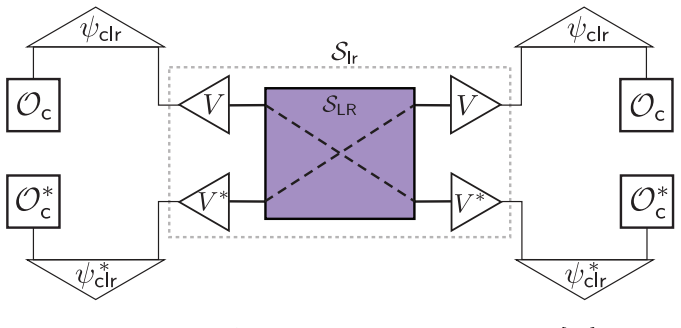
The load-bearing object is the holographic encoding map $W = \frac{1}{\sqrt{|lr|}} V \langle O_c | \mathrm{MAX}_{Ob\,lr}\rangle$, which carries states of the closed universe's degrees of freedom $M$ into the two boundary CFTs by leveraging fixed entangled pairs between the universe ($Ob$) and the AdS gases ($lr$); the tensor-network model of this map, built from two MERA codes glued at the shell radius, makes the universe's geometry explicit and motivates the dictionary between the final state and CFT data. Two further mechanisms carry the central argument. First, the identification of the causal-wedge SWAP with the boundary SWAP on the low-energy subspace neutralizes the swap test, because a pure state always returns unit purity and both candidate bulk descriptions are consistent with it. Second, the ETH-based ensemble of heavy shell operators, with Gaussian statistics $O_I O_J^* = f_I \delta_{IJ}$, supplies the averaging over final states that reproduces the gravitational path integral's wormhole contributions and recovers ordinary EFT as a maximally ignorant (completely depolarized) description of the final state.
What would settle it
Take the partially entangled thermal states of Section 5.3, form two copies, and compute the expectation value of the causal-wedge SWAP defined by bulk reconstruction, comparing it with the boundary SWAP restricted to the low-energy subspace: the paper's argument requires the difference to be no larger than $\mathrm{e}^{-S_2}$-type corrections. A direct gravitational computation that returns a value below unity, or any saddle in which the closed universes are not swapped along with the AdS regions, would refute the identification and leave the semiclassical baby universe exposed to the original objection.
Extended reading notes
Core claim
On the paper's own terms, the discovery is that the one-dimensionality of the closed-universe Hilbert space, long cited as evidence against semiclassicality, is instead a statement about the external CFT observer: every closed universe is indistinguishable from the outside, exactly as an isolated quantum lab is. The authors argue that the causal-wedge SWAP operator used in the recent test is, through the ordinary holographic dictionary, just the boundary SWAP restricted to the low-energy sector, so the test returns unit purity in both the description with and the description without the closed universe. Semiclassical physics inside the universe is therefore never in question; what changes with entanglement is which CFT questions bulk EFT answers. When the bulk entanglement is large, the closed universe is encoded approximately isometrically, like a black hole interior after the Page time; when it vanishes, the map degenerates to a projection onto the shell state $|O_c\rangle$, which the paper interprets as a final state projection obeying the dictionary $\Psi^O_I = O_I$ between the final-state wavefunction and light-light CFT matrix elements of the heavy shell operator. The paper is explicit that in the pure initial/final-state regime the decoherence functional is rank one, so ordinary measurement probabilities are not recovered there, a subtlety it lays out without fully resolving.
Load-bearing premise
The entire refutation of the swap test hangs on one operator identification: that the causal-wedge SWAP, mapped to the boundary by the ordinary holographic dictionary, is the plain boundary SWAP on the low-energy CFT subspace (the paper's own wording is 'it seems clear'); if it were a genuinely different operator, the one-dimensional result could indeed indict the closed-universe description.
Editorial extensions
If this is right
- The criticized swap test gives unit purity in both the closed-universe and the no-universe descriptions, so it rules out neither; the two-description puzzle is back to being open.
- When bulk entanglement is large, the closed universe is effectively isometrically encoded in the CFT and sits in the entanglement wedge, so entanglement-wedge reconstruction and island-type reasoning apply to it.
- The one-dimensional Hilbert space seen from the outside is compatible with rich local physics inside: decoherence, observers, and even a hidden quantum computer in the universe behave semiclassically.
- The closed universe's final state is fixed by CFT heavy-operator data and is quasi-random because the CFT is chaotic, which is what keeps the final-state projection invisible to local observers.
- Conventional EFT without any projection is just the maximally ignorant average over final states, and it can be probed by coarse-grained CFT experiments, such as the geodesic two-point function that reconstructs the universe's metric.
Reading between the lines
- Extrapolating the dictionary: if the mapping $\Psi^O_I = O_I$ generalizes beyond point-like shells, the quantum structure of cosmological and black-hole singularities would be encoded in heavy-operator statistics of the dual theory, a testable implication for other singularity geometries.
- The system-clock ground-state model suggests a generic principle: any closed quantum system with both initial and final constraints should show a time-reversal-symmetric Schr\"odinger's-cat ground state, something toy-model simulations could look for directly.
- Because the ETH average acts as a completely depolarizing channel on the final state, the paper's framework implies that 'projection-free' EFT is a one-shot information-theoretic limit of the microscopic description, not a fundamental starting point.
- The paper leaves topology change inside the closed universe as an open question; if CFT statistics could capture it, the coarse-grained dictionary would extend beyond the semiclassical approximation and connect to the evaporating-black-hole Page curve inside the universe.
Editorial analysis
A structured set of objections, weighed in public.
Referee Report
Summary. The paper revisits the random-entanglement construction of [6] of a big-bang/big-crunch closed universe in AdS/CFT. It maps out regimes of holographic encoding as a function of closed-universe volume and bulk entanglement, and argues that the SWAP test of [60] cannot distinguish the semiclassical description with a closed universe from an alternative boundary-equivalent description: the causal-wedge SWAP is claimed to coincide with the boundary SWAP, giving unit purity in both cases. The paper then proposes that in the zero-entanglement limit the one-dimensional closed-universe Hilbert space is an external-observer artifact, introduces a final-state-projection dictionary (4.6) between the closed-universe final state and light-light-heavy CFT matrix elements, models the arrow of time with a system-clock Hamiltonian, and shows how statistical averaging over the ETH ensemble of heavy operators recovers conventional bulk QFT and gives a CFT protocol for probing closed-universe geometry.
Significance. If the central operator identification were established, the paper's refutation of [60] would be significant, and the reconstruction protocol in Section 5.3 gives a concrete, falsifiable procedure for extracting closed-universe data from CFT experiments. Strengths include the explicit parameter-space analysis in AdS5 x S5, the detailed tensor-network model, and the unusually candid discussion of the unresolved pure-state decoherence problem in Section 6. The dictionary (4.6) and the arrow-of-time model are more exploratory; the paper itself presents them as proposals rather than as derived consequences.
major comments (3)
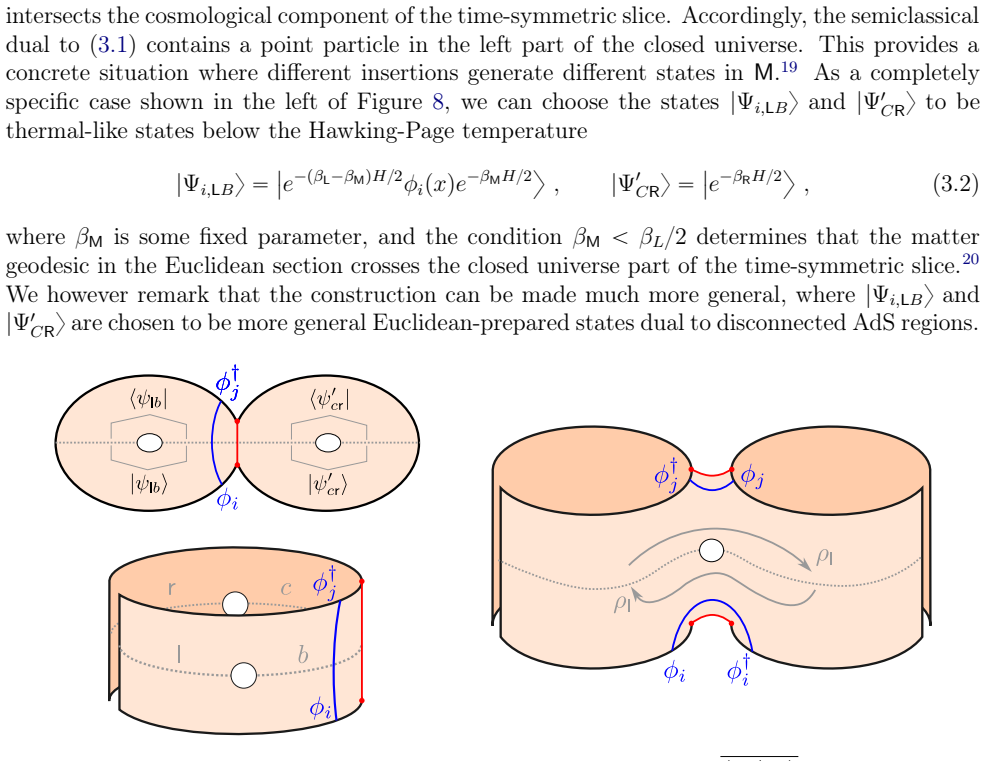
- [Section 3.2.2 / footnote 28] The refutation of the EG SWAP test rests on the assertion that the causal-wedge SWAP operator, mapped through the holographic dictionary, is a boundary SWAP restricted to the low-energy sector. This is stated as 'it seems clear' in footnote 28 and is not derived. The action of this operator is decisive: if the causal-wedge SWAP instead acts nontrivially on states whose closed-universe component enters through the non-isometric map W of Eq. (2.12), the claimed unit expectation value need not follow. The tensor-network illustration in Fig. 10 assumes the point at issue by placing the closed universe inside the entanglement wedge of the lr fields. Please prove this operator identity on the relevant code subspace using the explicit map W, or state precisely the conditions under which it holds. Without this, the paper has not refuted the EG conclusion.
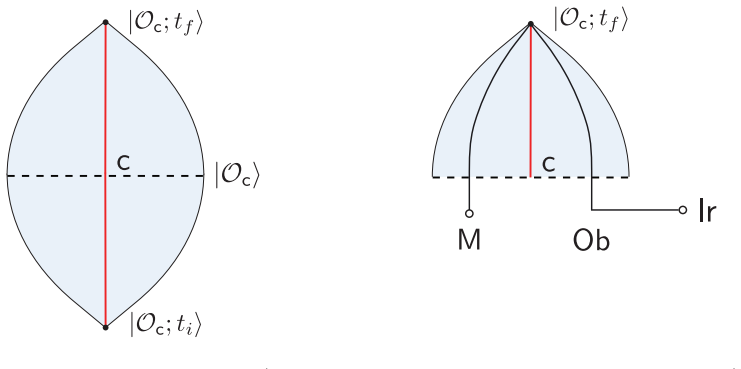
- [Section 4.3, Eq. (4.6)] The dictionary (4.6) is definitional: Eq. (4.4) defines |O_c> = V^dagger |O>, so Psi_I^O = <psi_I|O_c> = <psi_I|V^dagger|O> = <Psi_I|O> = O_I. The statement that 'the CFT uniquely determines the final state' is therefore built into the construction rather than being a substantive holographic consequence. If the dictionary is meant as a definition of what the final state is, please say so explicitly and separate it from the physical claim that a final-state projection occurs in the closed universe. If it is meant as a substantive relation, the paper needs an independent bulk characterization of |O_c>, for example through Appendix C, that does not already contain V^dagger|O>.
- [Section 6, final decoherence-functional paragraph] The paper concedes that with pure initial and final states the decoherence functional is rank one and standard measurement probabilities are not recovered, and that this conclusion is unchanged for subsystems. This is a serious gap for the intrinsic description of Section 4.2, which presents the final-state projection as the physical interpretation of the holographic map at zero entanglement. The listed possible resolutions (subsystem consistent histories, averaging over final states, or declaring that observers do not see the projection) are alternatives rather than a developed derivation. Please either provide a concrete derivation of local probabilities in the presence of the projection or substantially weaken the claim that Section 4 gives a sensible intrinsic description of the closed universe.
minor comments (4)
- [Section 2.5] The notation S(lr) is used for the entropy of the AdS gases before the distinction between the von Neumann entropy and the second Rényi entropy S_2 has been fixed; please define the entropy measure used in Eqs. (2.19) through (2.21).
- [Section 4.4] The exact numerical verification of the ground-state structure of H_SC is described only verbally; please include the values of T, D_S, and the parameters used, and ideally the code or data, so that the claim is reproducible.
- [Eq. (2.17)] The elliptic-integral expression for |lambda - 1| uses K and E without defining the elliptic parameter convention; please add a definition to avoid ambiguity.
- [Section 5.3] The protocol averages the numerator and denominator separately and then takes the ratio; please explain why the ratio of averages is the object that should be compared with the gravitational geodesic computation, rather than the average of the ratio, which the preceding 'many independent draws' description suggests.
Circularity Check
The final-state dictionary (4.6) equates the bulk final state with CFT matrix elements by definition, and the EG refutation leans on the authors' own tensor-network encoding; the central refutation is otherwise an asserted operator identification rather than a derivation.
-
self definitional
[Section 4.3, Eq. (4.6), with Eqs. (4.3)-(4.4)]
"The intrinsic closed universe-to-CFT dictionary suggested by (4.3) is thus: final state wavefunction ↔ CFT light-light matrix elements of O; Ψ_I^O = O_I."
Equation (4.3) defines O_I = ⟨ψ_I|O_c⟩ and Eq. (4.4) defines |O_c⟩ = V^†|O⟩. Substitution makes Ψ_I^O = O_I an identity. Therefore the paper's claim that “the CFT uniquely determines the microscopic structure of the final state” is true by construction: the final state is defined as the holographic preimage of the CFT operator data. The dictionary restates the definition of |O_c⟩ rather than providing an independent prediction.
-
self citation load bearing
[Section 3.2.2, paragraph around Figure 10]
"From another point of view, the closed universe is in the entanglement wedge of the bulk fields in the lr AdS regions and hence it is swapped when they are."
The unit-SWAP conclusion requires that the closed universe lies in the lr entanglement wedge and is therefore swapped by the lr SWAP. That wedge fact is exactly what the EG test is designed to decide, and the only support offered in this passage is the authors' own tensor-network model ([6], refined in this paper). The refutation thus assumes the contested encoding relation; if the wedge fact is the point at issue, the argument reduces to re-asserting the authors' prior construction.
full rationale
The paper contains substantial independent content: the replica computations for overlaps, the coarse-grained and partial SWAP discussions, the ETH averaging that recovers QFT in the closed universe, and the explicit geodesic-length observable in Sec. 5.3 are concrete calculations within a stated model and do not reduce to their inputs. However, two load-bearing steps are circular or question-begging. First, the proposed dictionary (4.6) defines the closed-universe final state via |O_c⟩ = V^†|O⟩ and then “derives” Ψ_I^O = O_I using Eq. (4.3); by construction this is an identity, so the advertised result that CFT data determines the final state is a restatement of the definition. Second, the refutation of the EG SWAP test in Sec. 3.2.2 assumes that the closed universe is in the entanglement wedge of the lr fields, supported by the authors' own tensor-network model [6]; the asserted equivalence of the causal-wedge SWAP with the boundary SWAP (footnote 28, “it seems clear it indeed is”) is a load-bearing gap rather than a demonstrated reduction. These issues make the paper partially circular, but they do not erase the independent replica and coarse-graining results, so the score is 6 rather than higher.
Assumptions & free parameters
free parameters (5)
- system-clock couplings g_init, g_final =
set to 1 in numerics
- clock size T =
unspecified
- rank-one projector P0 =
|ψ0><ψ0|
- ETH ensemble variance sigma^2 =
not fixed
- code subspace dimension d_c =
arbitrary
assumptions (7)
- domain assumption Heavy shell operator matrix elements O_I obey Gaussian random statistics (4.7)-(4.8).
- domain assumption The MERA/TMERA tensor network of Appendix A faithfully represents the CFT state and the closed universe geometry.
- domain assumption The causal wedge SWAP of [60] coincides with the boundary SWAP on the low-energy subspace.
- domain assumption The Euclidean gravitational path integral computes statistical moments over heavy operators, not individual microstate amplitudes.
- ad hoc to paper The holographic map implements a final state projection in the closed universe.
- ad hoc to paper The system-clock Hamiltonian (4.10)-(4.13) with a GOE system Hamiltonian and time-reversal symmetry models the emergence of the arrow of time.
- ad hoc to paper The dictionary (4.6), equating the final state wavefunction coefficients with CFT matrix elements, is physically valid for the actual closed universe.
invented entities (1)
-
Final state projection |Oc>
Cite this review
Pith. "Pith review of The Baby Universe is Fine and the CFT Knows It: On Holography for Closed Universes." pith.science (2026). https://pith.science/paper/LKDQC77U
@misc{pith2026250710649,
  author       = {Pith},
  title        = {Pith review of: The Baby Universe is Fine and the CFT Knows It: On Holography for Closed Universes},
  year         = {2026},
  howpublished = {\url{https://pith.science/paper/LKDQC77U}},
  note         = {Machine review of arXiv:2507.10649}
}
read the original abstract
Big bang/big crunch closed universes can be realized in AdS/CFT, even though they lack asymptotically AdS boundaries. With enough bulk entanglement, the bulk Hilbert space of a closed universe can be holographically encoded in the CFT. We clarify the relation of this encoding to observer-clone proposals and refute recent arguments about the breakdown of semiclassical physics in such spaces. In the limit of no bulk entanglement, the holographic encoding breaks down. The oft-cited one-dimensional nature of the closed universe Hilbert space represents the limitation of the external (CFT) Hilbert space to access the quantum information in the closed universe, similar to the limitations imposed on observers outside a perfectly isolated quantum lab. We advocate that the CFT nevertheless continues to determine the physical properties of the closed universe in this regime, showing how to interpret this relationship in terms of a final state projection in the closed universe. We provide a dictionary between the final state wavefunction and CFT data. We propose a model of the emergence of an arrow of time in the universe with a given initial or final state projection. Finally, we show that the conventional EFT in the closed universe, without any projection, can be recovered as a maximally ignorant description of the final state. This conventional EFT is encoded in CFT data, and it can be probed by computing coarse-grained observables. We provide an example of one such observable. Taken together, these results amount to a clean bill of health for baby universes born of AdS/CFT.
Figures


Figures from the paper (20 more)







Forward citations
Cited by 5 Pith papers
-
Elastic stiffness of three-dimensional black holes and wormholes from Liouville line defects
Shape and mass-density deformations of thin-shell AdS3 black holes and wormholes have stiffness kernels equal to two-point functions of defect-local displacement and mass-density operators, computed from linearized Li...
-
A Menagerie of Wormholes and Cosmologies in the Gravitational Path Integral
The paper identifies a variety of Euclidean saddle solutions including wormholes and oscillatory configurations in Einstein-Scalar-Maxwell models, demonstrates how oscillations are controlled by lifting flat potential...
-
Magic and Wormholes in the Sachdev-Ye-Kitaev Model
In the large-N SYK model, thermal Majorana-string expectation values are Gaussian random variables for q≥4 (computed via replica path integrals) and non-Gaussian for q=2; the chaotic variance is matched by a heavy-par...
-
Baby Universes from Thermal Pure States in SYK
A JT-gravity baby universe is constructed with a microscopic dual given by a low-temperature thermal pure state of two coupled SYK models, and its bulk entanglement to the AdS region is O(N) below the phase transition.
-
Junctions, strings, clocks and gravitational memory in three dimensional dS space
Transient closed-string fluctuations in dS3 are shown order by order to be encoded in gravitational junction shifts at I±, with the monotonic time shift forming an emergent clock.
Reference graph
Works this paper leans on
-
[6]
Cosmology from random entanglement
S. Antonini, M. Sasieta, B. Swingle, “Cosmology from random entanglement” JHEP11 (2023) 188, arXiv:2307.14416 [hep-th]
arXiv 2023
-
[60]
Further Evidence Against a Semiclassical Baby Universe in AdS/CFT
N. Engelhardt, E. Gesteau, “Further Evidence Against a Semiclassical Baby Universe in AdS/CFT ” arXiv:2504.14586 [hep-th]
-
[1]
L. Susskind, “The World as a hologram” J. Math. Phys.36 (1995) 6377–6396, arXiv:hep-th/9409089
arXiv 1995
-
[2]
Dimensional reduction in quantum gravity
G. ’t Hooft, “Dimensional reduction in quantum gravity” Conf. Proc. C930308 (1993) 284–296, arXiv:gr-qc/9310026
arXiv 1993
-
[3]
The Large N limit of superconformal field theories and supergravity
J. M. Maldacena, “The Large N limit of superconformal field theories and supergravity” Adv. Theor. Math. Phys.2 (1998) 231–252, arXiv:hep-th/9711200
arXiv 1998
-
[4]
Anti-de Sitter space and holography
E. Witten, “Anti-de Sitter space and holography” Adv. Theor. Math. Phys.2 (1998) 253–291, arXiv:hep-th/9802150
arXiv 1998
-
[5]
Large N field theories, string theory and gravity
O. Aharony, S. S. Gubser, J. M. Maldacena, H. Ooguri, Y. Oz, “Large N field theories, string theory and gravity” Phys. Rept.323 (2000) 183–386, arXiv:hep-th/9905111
arXiv 2000
-
[7]
A. Strominger, “The dS / CFT correspondence” JHEP10 (2001) 034, arXiv:hep-th/0106113
arXiv 2001
Show all 145 references
-
[8]
The dS/dS correspondence
M. Alishahiha, A. Karch, E. Silverstein, D. Tong, “The dS/dS correspondence” AIP Conf. Proc.743 no. 1, (2004) 393–409,arXiv:hep-th/0407125
2004 arXiv
-
[9]
De Sitter Holography and Entanglement Entropy
X. Dong, E. Silverstein, G. Torroba, “De Sitter Holography and Entanglement Entropy” JHEP 07 (2018) 050, arXiv:1804.08623 [hep-th]
2018 arXiv
-
[10]
dS/dS and T T
V. Gorbenko, E. Silverstein, G. Torroba, “dS/dS and T T ” JHEP03 (2019) 085, arXiv:1811.07965 [hep-th]
2019 arXiv
-
[11]
De Sitter microstates from TT + Λ2 and the Hawking-Page transition
E. Coleman, E. A. Mazenc, V. Shyam, E. Silverstein, R. M. Soni, G. Torroba, S. Yang, “De Sitter microstates from TT + Λ2 and the Hawking-Page transition” JHEP07 (2022) 140, arXiv:2110.14670 [hep-th]
2022 arXiv
-
[12]
Black Holes Hint Towards De Sitter-Matrix Theory
L. Susskind, “Black Holes Hint Towards De Sitter-Matrix Theory” arXiv:2109.01322 [hep-th]
-
[13]
De Sitter Holography: Fluctuations, Anomalous Symmetry, and Wormholes
L. Susskind, “De Sitter Holography: Fluctuations, Anomalous Symmetry, and Wormholes ” Universe7 no. 12, (2021) 464,arXiv:2106.03964 [hep-th]
2021 arXiv
-
[14]
Entanglement and Chaos in De Sitter Space Holography: An SYK Example
L. Susskind, “Entanglement and Chaos in De Sitter Space Holography: An SYK Example ” JHAP1 no. 1, (2021) 1–22,arXiv:2109.14104 [hep-th]
2021 arXiv
-
[15]
Entanglement in De Sitter space
E. Shaghoulian, L. Susskind, “Entanglement in De Sitter space” JHEP08 (2022) 198, arXiv:2201.03603 [hep-th]
2022 arXiv
-
[16]
Holography for Cosmology
P. McFadden, K. Skenderis, “Holography for Cosmology” Phys. Rev. D81 (2010) 021301, arXiv:0907.5542 [hep-th] . 60
2010 arXiv
-
[17]
Constraining holographic cosmology using Planck data
N. Afshordi, E. Gould, K. Skenderis, “Constraining holographic cosmology using Planck data ” Phys. Rev. D95 no. 12, (2017) 123505,arXiv:1703.05385 [astro-ph.CO]
2017 arXiv
-
[18]
Solution of the cosmological constant problem within holographic cosmology
H. Nastase, “Solution of the cosmological constant problem within holographic cosmology” Phys. Lett. B801 (2020) 135168, arXiv:1812.07597 [hep-th]
2020 arXiv
-
[19]
Holography for the very early Universe and the classic puzzles of Hot Big Bang cosmology
H. Nastase, K. Skenderis, “Holography for the very early Universe and the classic puzzles of Hot Big Bang cosmology” Phys. Rev. D101 no. 2, (2020) 021901,arXiv:1904.05821 [hep-th]
2020 arXiv
-
[20]
Wormholes in AdS
J. Maldacena, L. Maoz, “Wormholes in AdS” Journal of High Energy Physics2004 no. 02, (Feb., 2004) 053–053
2004
-
[21]
Answering a basic objection to bang / crunch holography
B. McInnes, “Answering a basic objection to bang / crunch holography” JHEP10 (2004) 018, arXiv:hep-th/0407189
2004 arXiv
-
[22]
Pre-inflationary spacetime in string cosmology
B. McInnes, “Pre-inflationary spacetime in string cosmology” Nucl. Phys. B748 (2006) 309–332, arXiv:hep-th/0511227
2006 arXiv
-
[23]
Inflation in AdS/CFT
B. Freivogel, V. E. Hubeny, A. Maloney, R. C. Myers, M. Rangamani, S. Shenker, “Inflation in AdS/CFT” JHEP03 (2006) 007, arXiv:hep-th/0510046
2006 arXiv
-
[24]
Holographic Signatures of Cosmological Singularities
N. Engelhardt, T. Hertog, G. T. Horowitz, “Holographic Signatures of Cosmological Singularities ” Phys. Rev. Lett.113 (2014) 121602, arXiv:1404.2309 [hep-th]
2014 arXiv
-
[25]
Black hole microstate cosmology
S. Cooper, M. Rozali, B. Swingle, M. Van Raamsdonk, C. Waddell, D. Wakeham, “Black hole microstate cosmology” Journal of High Energy Physics2019 no. 7, (July, 2019)
2019
-
[26]
Cosmology at the end of the world
S. Antonini, B. Swingle, “Cosmology at the end of the world” Nature Phys.16 no. 8, (2020) 881–886, arXiv:1907.06667 [hep-th]
2020 arXiv
-
[27]
Bra-ket wormholes in gravitationally prepared states
Y. Chen, V. Gorbenko, J. Maldacena, “Bra-ket wormholes in gravitationally prepared states ” JHEP02 (2021) 009, arXiv:2007.16091 [hep-th]
2021 arXiv
-
[28]
Comments on wormholes, ensembles, and cosmology
M. Van Raamsdonk, “Comments on wormholes, ensembles, and cosmology” JHEP12 (2021) 156, arXiv:2008.02259 [hep-th]
2021 arXiv
-
[29]
Cosmology from confinement?
M. Van Raamsdonk, “Cosmology from confinement?” JHEP 03 (2022) 039, arXiv:2102.05057 [hep-th]
2022 arXiv
-
[30]
Cosmology from the vacuum
S. Antonini, P. Simidzija, B. Swingle, M. Van Raamsdonk, “Cosmology from the vacuum ” Class. Quant. Grav.41 no. 4, (2024) 045008,arXiv:2203.11220 [hep-th]
2024 arXiv
-
[31]
Accelerating cosmology fromΛă 0 gravitational effective field theory
S. Antonini, P. Simidzija, B. Swingle, M. Van Raamsdonk, C. Waddell, “Accelerating cosmology fromΛă 0 gravitational effective field theory” JHEP05 (2023) 203, arXiv:2212.00050 [hep-th]
2023 arXiv
-
[32]
Constraints on cosmologies inside black holes
S. Fallows, S. F. Ross, “Constraints on cosmologies inside black holes” JHEP05 (2022) 094, arXiv:2203.02523 [hep-th] . 61
2022 arXiv
-
[33]
Accelerating Cosmology from a Holographic Wormhole
S. Antonini, P. Simidzija, B. Swingle, M. Van Raamsdonk, “Accelerating Cosmology from a Holographic Wormhole” Phys. Rev. Lett.130 no. 22, (2023) 221601, arXiv:2206.14821 [hep-th]
2023 arXiv
-
[34]
Cosmologies inside hyperbolic black holes
S. F. Ross, “Cosmologies inside hyperbolic black holes” JHEP11 (2022) 168, arXiv:2209.11620 [hep-th]
2022 arXiv
-
[35]
Possible hints of decreasing dark energy from supernova data
M. Van Raamsdonk, C. Waddell, “Possible hints of decreasing dark energy from supernova data” arXiv:2305.04946 [astro-ph.CO]
-
[36]
Bubbles of cosmology in AdS/CFT
A. Sahu, P. Simidzija, M. V. Raamsdonk, “Bubbles of cosmology in AdS/CFT” 2023. https://arxiv.org/abs/2306.13143
2023 arXiv
-
[37]
The Page curve for reflected entropy
C. Akers, T. Faulkner, S. Lin, P. Rath, “The Page curve for reflected entropy” JHEP06 (2022) 089, arXiv:2201.11730 [hep-th]
2022 arXiv
-
[38]
Inflationary Cosmology from Anti-de Sitter Wormholes
P. Betzios, O. Papadoulaki, “Inflationary Cosmology from Anti-de Sitter Wormholes” Phys. Rev. Lett.133 no. 2, (2024) 021501,arXiv:2403.17046 [hep-th]
2024 arXiv
-
[39]
Magnetic anti–de Sitter wormholes as seeds for Higgs inflation
P. Betzios, I. D. Gialamas, O. Papadoulaki, “Magnetic anti–de Sitter wormholes as seeds for Higgs inflation” Phys. Rev. D111 no. 12, (2025) 123542,arXiv:2412.03639 [hep-th]
2025 arXiv
-
[40]
Cosmology inside a black hole: adding matter on the brane
J. L. F. Barbón, A. K. Patra, J. F. Pedraza, S. F. Ross, “Cosmology inside a black hole: adding matter on the brane” arXiv:2504.16997 [hep-th]
-
[41]
Quintessential Maldacena-Maoz Cosmologies
B. McInnes, “Quintessential Maldacena-Maoz Cosmologies” Journal of High Energy Physics 2004 no. 04, (Apr., 2004) 036–036
2004
-
[42]
Microscopic Origin of the Entropy of Black Holes in General Relativity
V. Balasubramanian, A. Lawrence, J. M. Magan, M. Sasieta, “Microscopic Origin of the Entropy of Black Holes in General Relativity” Phys. Rev. X14 no. 1, (2024) 011024, arXiv:2212.02447 [hep-th]
2024 arXiv
-
[43]
Closed universes in two dimensional gravity
M. Usatyuk, Z.-Y. Wang, Y. Zhao, “Closed universes in two dimensional gravity” SciPost Phys.17 no. 2, (2024) 051,arXiv:2402.00098 [hep-th]
2024 arXiv
-
[44]
Closed universes, factorization, and ensemble averaging
M. Usatyuk, Y. Zhao, “Closed universes, factorization, and ensemble averaging” JHEP 02 (2025) 052, arXiv:2403.13047 [hep-th]
2025 arXiv
-
[45]
Cosmology with non-conformal holographic matter
M. Van Raamsdonk, R. Zibakhsh, “Cosmology with non-conformal holographic matter” arXiv:2409.03914 [hep-th]
-
[46]
Holographic black hole cosmologies
A. Sahu, M. V. Raamsdonk, “Holographic black hole cosmologies” 2024. https://arxiv.org/abs/2411.14673
2024 arXiv
-
[47]
Ordinary wormholes
A. Maloney, V. Meruliya, M. Van Raamsdonk, “Ordinary wormholes” arXiv:2503.12227 [hep-th]
-
[48]
Comments on the no boundary wavefunction and slow roll inflation
J. Maldacena, “Comments on the no boundary wavefunction and slow roll inflation” arXiv:2403.10510 [hep-th] . 62
-
[49]
The no boundary density matrix
V. Ivo, Y.-Z. Li, J. Maldacena, “The no boundary density matrix” JHEP02 (2025) 124, arXiv:2409.14218 [hep-th]
2025 arXiv
-
[50]
Real observers solving imaginary problems
J. Maldacena, “Real observers solving imaginary problems” arXiv:2412.14014 [hep-th]
-
[51]
A new observable for holographic cosmology
J. Chakravarty, A. Maloney, K. Namjou, S. F. Ross, “A new observable for holographic cosmology” 2024. https://arxiv.org/abs/2407.04781
2024 arXiv
-
[52]
Quantum mechanics and observers for gravity in a closed universe
D. Harlow, M. Usatyuk, Y. Zhao, “Quantum mechanics and observers for gravity in a closed universe” arXiv:2501.02359 [hep-th]
-
[53]
The gravitational path integral from an observer’s point of view
A. I. Abdalla, S. Antonini, L. V. Iliesiu, A. Levine, “The gravitational path integral from an observer’s point of view” arXiv:2501.02632 [hep-th]
-
[54]
On observers in holographic maps
C. Akers, G. Bueller, O. DeWolfe, K. Higginbotham, J. Reinking, R. Rodriguez, “On observers in holographic maps” JHEP05 (2025) 201, arXiv:2503.09681 [hep-th]
2025 arXiv
-
[55]
Observers seeing gravitational Hilbert spaces: abstract sources for an abstract path integral
H. Z. Chen, “Observers seeing gravitational Hilbert spaces: abstract sources for an abstract path integral” arXiv:2505.15892 [hep-th]
-
[56]
Nonperturbative Quantum Gravity in a Closed Lorentzian Universe
Y. Nomura, T. Ugajin, “Nonperturbative Quantum Gravity in a Closed Lorentzian Universe ” arXiv:2505.20390 [hep-th]
-
[57]
Absolute entropy and the observer’s no-boundary state
A. Blommaert, J. Kudler-Flam, E. Y. Urbach, “Absolute entropy and the observer’s no-boundary state” arXiv:2505.14771 [hep-th]
-
[58]
Observer complementarity for black holes and holography
N. Engelhardt, E. Gesteau, D. Harlow, “Observer complementarity for black holes and holography” 2025. https://arxiv.org/abs/2507.06046
2025 arXiv
-
[59]
On tests for baby universes in AdS/CFT
K. Higginbotham, “On tests for baby universes in AdS/CFT” 2025. https://arxiv.org/abs/2507.05337
2025 arXiv
-
[61]
Do holographic CFT states have unique semiclassical bulk duals?
S. Antonini, P. Rath, “Do holographic CFT states have unique semiclassical bulk duals?” arXiv:2408.02720 [hep-th]
-
[63]
Thermal Multi-scale Entanglement Renormalization Ansatz for Variational Gibbs State Preparation
T. J. Sewell, C. D. White, B. Swingle, “Thermal Multi-scale Entanglement Renormalization Ansatz for Variational Gibbs State Preparation” 2022. https://arxiv.org/abs/2210.16419
2022 arXiv
-
[64]
Entanglement Wedge Reconstruction and the Information Paradox
G. Penington, “Entanglement Wedge Reconstruction and the Information Paradox” JHEP 09 (2020) 002, arXiv:1905.08255 [hep-th]
2020 arXiv
-
[65]
The entropy of bulk quantum fields and the entanglement wedge of an evaporating black hole
A. Almheiri, N. Engelhardt, D. Marolf, H. Maxfield, “The entropy of bulk quantum fields and the entanglement wedge of an evaporating black hole” JHEP12 (2019) 063, arXiv:1905.08762 [hep-th] . 63
2019 arXiv
-
[66]
Replica wormholes and the black hole interior
G. Penington, S. H. Shenker, D. Stanford, Z. Yang, “Replica wormholes and the black hole interior” JHEP03 (2022) 205, arXiv:1911.11977 [hep-th]
2022 arXiv
-
[67]
Replica Wormholes and the Entropy of Hawking Radiation
A. Almheiri, T. Hartman, J. Maldacena, E. Shaghoulian, A. Tajdini, “Replica Wormholes and the Entropy of Hawking Radiation” JHEP05 (2020) 013, arXiv:1911.12333 [hep-th]
2020 arXiv
-
[68]
The black hole interior from non-isometric codes and complexity
C. Akers, N. Engelhardt, D. Harlow, G. Penington, S. Vardhan, “The black hole interior from non-isometric codes and complexity” JHEP06 (2024) 155, arXiv:2207.06536 [hep-th]
2024 arXiv
-
[69]
Gravity/ensemble duality
R. Bousso, E. Wildenhain, “Gravity/ensemble duality” Phys. Rev. D102 no. 6, (2020) 066005, arXiv:2006.16289 [hep-th]
2020 arXiv
-
[70]
Wormholes without averaging
P. Saad, S. H. Shenker, D. Stanford, S. Yao, “Wormholes without averaging” 2021. https://arxiv.org/abs/2103.16754
2021 arXiv
-
[71]
Microcanonical path integrals and the holography of small black hole interiors
D. Marolf, “Microcanonical path integrals and the holography of small black hole interiors ” Journal of High Energy Physics2018 no. 9, (Sept., 2018)
2018
-
[72]
Expanding the Black Hole Interior: Partially Entangled Thermal States in SYK
A. Goel, H. T. Lam, G. J. Turiaci, H. Verlinde, “Expanding the Black Hole Interior: Partially Entangled Thermal States in SYK” JHEP02 (2019) 156, arXiv:1807.03916 [hep-th]
2019 arXiv
-
[73]
Pure states in the SYK model and nearly-AdS2 gravity
I. Kourkoulou, J. Maldacena, “Pure states in the SYK model and nearly-AdS2 gravity ” arXiv:1707.02325 [hep-th]
-
[74]
Coarse graining pure states in AdS/CFT
J. Chandra, T. Hartman, “Coarse graining pure states in AdS/CFT” arXiv:2206.03414 [hep-th]
-
[75]
Looking at supersymmetric black holes for a very long time
H. W. Lin, J. Maldacena, L. Rozenberg, J. Shan, “Looking at supersymmetric black holes for a very long time” SciPost Phys.14 no. 5, (2023) 128,arXiv:2207.00408 [hep-th]
2023 arXiv
-
[76]
Wormholes from heavy operator statistics in AdS/CFT
M. Sasieta, “Wormholes from heavy operator statistics in AdS/CFT” JHEP03 (2023) 158, arXiv:2211.11794 [hep-th]
2023 arXiv
-
[77]
Microscopic origin of the entropy of astrophysical black holes
V. Balasubramanian, A. Lawrence, J. M. Magan, M. Sasieta, “Microscopic origin of the entropy of astrophysical black holes” arXiv:2212.08623 [hep-th]
-
[78]
Constructing all BPS black hole microstates from the gravitational path integral
J. Boruch, L. V. Iliesiu, C. Yan, “Constructing all BPS black hole microstates from the gravitational path integral” JHEP09 (2024) 058, arXiv:2307.13051 [hep-th]
2024 arXiv
-
[79]
Universal construction of black hole microstates
A. Climent, R. Emparan, J. M. Magan, M. Sasieta, A. Vilar López, “Universal construction of black hole microstates” Phys. Rev. D109 no. 8, (2024) 086024, arXiv:2401.08775 [hep-th]
2024 arXiv
-
[80]
A Note on Black Hole Entropy and Wormhole Instabilities
J. L. F. Barbon, E. Velasco-Aja, “A Note on Black Hole Entropy and Wormhole Instabilities ” arXiv:2502.00769 [hep-th]
-
[81]
JT gravity as a matrix integral
P. Saad, S. H. Shenker, D. Stanford, “JT gravity as a matrix integral” arXiv:1903.11115 [hep-th] . 64
1903 arXiv
-
[82]
Late Time Correlation Functions, Baby Universes, and ETH in JT Gravity
P. Saad, “Late Time Correlation Functions, Baby Universes, and ETH in JT Gravity” arXiv:1910.10311 [hep-th]
1910 arXiv
-
[83]
Eigenstate Thermalization and Disorder Averaging in Gravity
J. Pollack, M. Rozali, J. Sully, D. Wakeham, “Eigenstate Thermalization and Disorder Averaging in Gravity” Phys. Rev. Lett.125 no. 2, (2020) 021601,arXiv:2002.02971 [hep-th]
2020 arXiv
-
[84]
Random statistics of OPE coefficients and Euclidean wormholes
A. Belin, J. de Boer, “Random statistics of OPE coefficients and Euclidean wormholes” Class. Quant. Grav.38 no. 16, (2021) 164001,arXiv:2006.05499 [hep-th]
2021 arXiv
-
[85]
More quantum noise from wormholes
D. Stanford, “More quantum noise from wormholes” arXiv:2008.08570 [hep-th]
2008 arXiv
-
[86]
Semiclassical 3D gravity as an average of large-c CFTs
J. Chandra, S. Collier, T. Hartman, A. Maloney, “Semiclassical 3D gravity as an average of large-c CFTs” JHEP12 (2022) 069, arXiv:2203.06511 [hep-th]
2022 arXiv
-
[87]
A principle of maximum ignorance for semiclassical gravity
J. de Boer, D. Liska, B. Post, M. Sasieta, “A principle of maximum ignorance for semiclassical gravity” JHEP2024 (2024) 003, arXiv:2311.08132 [hep-th]
2024 arXiv
-
[88]
Correlation function of thin-shell operators
B. Chen, Y. Liu, B. Yu, “Correlation function of thin-shell operators” JHEP08 (2024) 082, arXiv:2404.11423 [hep-th]
2024 arXiv
-
[89]
Statistics of three-dimensional black holes from Liouville line defects
J. Chandra, T. Hartman, V. Meruliya, “Statistics of three-dimensional black holes from Liouville line defects” JHEP11 (2024) 090, arXiv:2404.15183 [hep-th]
2024 arXiv
-
[90]
Non-conformal Line Defect (Shell Operator) in AdS3/CFT2: Spinning and Higher Point Correlators
Y. Liu, B. Yu, “Non-conformal Line Defect (Shell Operator) in AdS3/CFT2: Spinning and Higher Point Correlators” arXiv:2506.12711 [hep-th]
-
[91]
Comments on black holes in string theory
G. T. Horowitz, “Comments on black holes in string theory” Class. Quant. Grav.17 (2000) 1107–1116, arXiv:hep-th/9910082
2000 arXiv
-
[92]
A Correspondence principle for black holes and strings
G. T. Horowitz, J. Polchinski, “A Correspondence principle for black holes and strings” Phys. Rev. D55 (1997) 6189–6197, arXiv:hep-th/9612146
1997 arXiv
-
[93]
Selfgravitating fundamental strings
G. T. Horowitz, J. Polchinski, “Selfgravitating fundamental strings” Phys. Rev. D57 (1998) 2557–2563, arXiv:hep-th/9707170
1998 arXiv
-
[94]
Touring the Hagedorn ridge
J. L. F. Barbon, E. Rabinovici, “Touring the Hagedorn ridge” inFrom Fields to Strings: Circumnavigating Theoretical Physics: A Conference in Tribute to Ian Kogan, pp. 1973–2008. 8, 2004.arXiv:hep-th/0407236
1973 arXiv
-
[95]
Non-isometry, state dependence and holography
S. Antonini, V. Balasubramanian, N. Bao, C. Cao, W. Chemissany, “Non-isometry, state dependence and holography” JHEP02 (2025) 150, arXiv:2411.07296 [hep-th]
2025 arXiv
-
[96]
Distribution of eigenvalues for some sets of random matrices
V. A. Marchenko, L. A. Pastur, “Distribution of eigenvalues for some sets of random matrices ” Matematicheskii Sbornik114 no. 4, (1967) 507–536
1967
-
[97]
Quantum minimal surfaces from quantum error correction
C. Akers, G. Penington, “Quantum minimal surfaces from quantum error correction” SciPost Phys.12 no. 5, (2022) 157,arXiv:2109.14618 [hep-th]
2022 arXiv
-
[98]
Non-isometric quantum error correction in gravity
A. Kar, “Non-isometric quantum error correction in gravity” JHEP02 (2023) 195, arXiv:2210.13476 [hep-th] . 65
2023 arXiv
-
[99]
The Wave Mechanics ofα-Ray Tracks
N. F. Mott, “The Wave Mechanics ofα-Ray Tracks” Proceedings of the Royal Society of London. Series A, Containing Papers of a Mathematical and Physical Character126 no. 800, (Dec., 1929) 79–84
1929
-
[100]
The Emergence of classical properties through interaction with the environment
E. Joos, H. D. Zeh, “The Emergence of classical properties through interaction with the environment ” Z. Phys. B59 (1985) 223–243
1985
-
[101]
Pointer basis of quantum apparatus: Into what mixture does the wave packet collapse?
W. H. Zurek, “Pointer basis of quantum apparatus: Into what mixture does the wave packet collapse? ” Phys. Rev. D24 (Sep, 1981) 1516–1525
1981
-
[102]
EFT Beyond the Horizon: Stochastic Inflation and How Primordial Quantum Fluctuations Go Classical
C. P. Burgess, R. Holman, G. Tasinato, M. Williams, “EFT Beyond the Horizon: Stochastic Inflation and How Primordial Quantum Fluctuations Go Classical” 2014. https://arxiv.org/abs/1408.5002
2014 arXiv
-
[103]
The entanglement wedge of unknown couplings
A. Almheiri, H. W. Lin, “The entanglement wedge of unknown couplings” JHEP08 (2022) 062, arXiv:2111.06298 [hep-th]
2022 arXiv
-
[104]
The Black hole final state
G. T. Horowitz, J. M. Maldacena, “The Black hole final state” JHEP02 (2004) 008, arXiv:hep-th/0310281
2004 arXiv
-
[105]
Comment on ‘The Black hole final state’
D. Gottesman, J. Preskill, “Comment on ‘The Black hole final state’” JHEP03 (2004) 026, arXiv:hep-th/0311269
2004 arXiv
-
[106]
Measurements without Probabilities in the Final State Proposal
R. Bousso, D. Stanford, “Measurements without Probabilities in the Final State Proposal ” Phys. Rev. D89 no. 4, (2014) 044038,arXiv:1310.7457 [hep-th]
2014 arXiv
-
[107]
Measurements with probabilities in the final state proposal
A. Almheiri, “Measurements with probabilities in the final state proposal” arXiv:2505.23664 [hep-th]
-
[108]
On the nature of ensembles from gravitational path integrals
D. Marolf, “On the nature of ensembles from gravitational path integrals” J. Phys. A58 no. 3, (2025) 035204,arXiv:2407.04625 [hep-th]
2025 arXiv
-
[109]
Cobordism Classes and the Swampland
J. McNamara, C. Vafa, “Cobordism Classes and the Swampland” arXiv:1909.10355 [hep-th]
1909 arXiv
-
[110]
Baby Universes, Holography, and the Swampland
J. McNamara, C. Vafa, “Baby Universes, Holography, and the Swampland” arXiv:2004.06738 [hep-th]
2004 arXiv
-
[111]
Transcending the ensemble: baby universes, spacetime wormholes, and the order and disorder of black hole information
D. Marolf, H. Maxfield, “Transcending the ensemble: baby universes, spacetime wormholes, and the order and disorder of black hole information” JHEP08 (2020) 044, arXiv:2002.08950 [hep-th]
2020 arXiv
-
[112]
Black holes as red herrings: Topological fluctuations and the loss of quantum coherence
S. Coleman, “Black holes as red herrings: Topological fluctuations and the loss of quantum coherence” Nuclear Physics B307 no. 4, (1988) 867–882
1988
-
[113]
Loss of incoherence and determination of coupling constants in quantum gravity
S. B. Giddings, A. Strominger, “Loss of incoherence and determination of coupling constants in quantum gravity” Nuclear Physics B307 no. 4, (1988) 854–866
1988
-
[114]
Observations of Hawking radiation: the Page curve and baby universes
D. Marolf, H. Maxfield, “Observations of Hawking radiation: the Page curve and baby universes ” JHEP04 (2021) 272, arXiv:2010.06602 [hep-th] . 66
2021 arXiv
-
[115]
Comments on wormholes and factorization
P. Saad, S. H. Shenker, S. Yao, “Comments on wormholes and factorization” JHEP10 (2024) 076, arXiv:2107.13130 [hep-th]
2024 arXiv
-
[116]
Unitarity of black hole evaporation in final-state projection models
S. Lloyd, J. Preskill, “Unitarity of black hole evaporation in final-state projection models” JHEP 08 (2014) 126, arXiv:1308.4209 [hep-th]
2014 arXiv
-
[117]
From path integrals to tensor networks for the AdS/CFT correspondence
M. Miyaji, T. Takayanagi, K. Watanabe, “From path integrals to tensor networks for the AdS/CFT correspondence” Phys. Rev. D95 no. 6, (2017) 066004,arXiv:1609.04645 [hep-th]
2017 arXiv
-
[118]
Toward random tensor networks and holographic codes in CFT
J. Chandra, T. Hartman, “Toward random tensor networks and holographic codes in CFT ” JHEP05 (2023) 109, arXiv:2302.02446 [hep-th]
2023 arXiv
-
[119]
It from ETH: Multi-interval Entanglement and Replica Wormholes from Large-c BCFT Ensemble
H. Geng, L.-Y. Hung, Y. Jiang, “It from ETH: Multi-interval Entanglement and Replica Wormholes from Large-c BCFT Ensemble” arXiv:2505.20385 [hep-th]
-
[120]
Quantum statistical mechanics in a closed system
J. M. Deutsch, “Quantum statistical mechanics in a closed system” Phys. Rev. A43 (Feb, 1991) 2046–2049
1991
-
[121]
Chaos and quantum thermalization
M. Srednicki, “Chaos and quantum thermalization” Phys. Rev. E50 (Aug, 1994) 888–901
1994
-
[122]
Universal dynamics of heavy operators in CFT2
S. Collier, A. Maloney, H. Maxfield, I. Tsiares, “Universal dynamics of heavy operators in CFT2 ” JHEP07 (2020) 074, arXiv:1912.00222 [hep-th]
2020 arXiv
-
[123]
Eigenstate thermalization hypothesis and out of time order correlators
L. Foini, J. Kurchan, “Eigenstate thermalization hypothesis and out of time order correlators” Phys. Rev. E99 no. 4, (2019) 042139,arXiv:1803.10658 [cond-mat.stat-mech]
2019 arXiv
-
[124]
Non-Gaussianities in the statistical distribution of heavy OPE coefficients and wormholes
A. Belin, J. de Boer, D. Liska, “Non-Gaussianities in the statistical distribution of heavy OPE coefficients and wormholes” JHEP06 (2022) 116, arXiv:2110.14649 [hep-th]
2022 arXiv
-
[125]
Multiboundary wormholes and OPE statistics
J. de Boer, D. Liska, B. Post, “Multiboundary wormholes and OPE statistics” JHEP10 (2024) 207, arXiv:2405.13111 [hep-th]
2024 arXiv
-
[126]
Average entropy of a subsystem
D. N. Page, “Average entropy of a subsystem” Phys. Rev. Lett.71 (1993) 1291–1294, arXiv:gr-qc/9305007
1993 arXiv
-
[127]
Canonical Typicality
S. Goldstein, J. L. Lebowitz, R. Tumulka, N. Zanghi, “Canonical Typicality” Phys. Rev. Lett. 96 (2006) 050403, arXiv:cond-mat/0511091
2006 arXiv
-
[128]
Entanglement and the foundations of statistical mechanics
S. Popescu, A. J. Short, A. Winter, “Entanglement and the foundations of statistical mechanics ” Nature Physics2 no. 11, (Oct., 2006) 754–758
2006
-
[129]
Evolution without evolution: Dynamics described by stationary observables
D. N. Page, W. K. Wootters, “Evolution without evolution: Dynamics described by stationary observables” Phys. Rev. D27 (Jun, 1983) 2885–2892
1983
-
[130]
Will entropy decrease if the Universe recollapses?
D. N. Page, “Will entropy decrease if the Universe recollapses?” Phys. Rev. D32 (Nov,
-
[131]
Reference frames, superselection rules, and quantum information
S. D. Bartlett, T. Rudolph, R. W. Spekkens, “Reference frames, superselection rules, and quantum information” Reviews of Modern Physics79 no. 2, (Apr., 2007) 555–609. 67
2007
-
[132]
Trinity of relational quantum dynamics
P. A. Höhn, A. R. Smith, M. P. Lock, “Trinity of relational quantum dynamics” Physical Review D104 no. 6, (Sept., 2021)
2021
-
[133]
A. Y. Kitaev, A. Shen, M. N. Vyalyi,Classical and Quantum Computation. American Mathematical Society, USA, 2002
2002
-
[134]
Origin of time asymmetry
S. W. Hawking, R. Laflamme, G. W. Lyons, “Origin of time asymmetry” Physical Review D47 no. 12, (June, 1993) 5342–5356
1993
-
[135]
A modular toolkit for bulk reconstruction
T. Faulkner, M. Li, H. Wang, “A modular toolkit for bulk reconstruction” JHEP04 (2019) 119, arXiv:1806.10560 [hep-th]
2019 arXiv
-
[136]
Can one hear the shape of a wormhole?
S. Antonini, P. Simidzija, B. Swingle, M. Van Raamsdonk, “Can one hear the shape of a wormhole? ” JHEP 09 (2022) 241, arXiv:2207.02225 [hep-th]
2022 arXiv
-
[137]
Extracting Spacetimes using the AdS/CFT Conjecture: Part II
S. Bilson, “Extracting Spacetimes using the AdS/CFT Conjecture: Part II” JHEP02 (2011) 050, arXiv:1012.1812 [hep-th]
2011 arXiv
-
[138]
Work in progress
A. Abdalla, S. Antonini, L. Iliesiu, A. Levine, “Work in progress”
-
[139]
Arrows of Time and Initial and Final Conditions in the Quantum Mechanics of Closed Systems Like the Universe
J. B. Hartle, “Arrows of Time and Initial and Final Conditions in the Quantum Mechanics of Closed Systems Like the Universe” 2020. https://arxiv.org/abs/2002.07093
2020 arXiv
-
[140]
The Information Theoretic Interpretation of the Length of a Curve
B. Czech, P. Hayden, N. Lashkari, B. Swingle, “The Information Theoretic Interpretation of the Length of a Curve” JHEP06 (2015) 157, arXiv:1410.1540 [hep-th]
2015 arXiv
-
[141]
One-shot holography
C. Akers, A. Levine, G. Penington, E. Wildenhain, “One-shot holography” SciPost Physics 16 no. 6, (June, 2024)
2024
-
[142]
Holograms in our world
R. Bousso, G. Penington, “Holograms in our world” Phys. Rev. D108 no. 4, (2023) 046007, arXiv:2302.07892 [hep-th]
2023 arXiv
-
[143]
Discrete Max-Focusing
R. Bousso, E. Tabor, “Discrete Max-Focusing” JHEP06 (2025) 240, arXiv:2410.18192 [hep-th]
2025 arXiv
-
[144]
Inside the Hologram: Reconstructing the bulk observer’s experience
D. L. Jafferis, L. Lamprou, “Inside the Hologram: Reconstructing the bulk observer’s experience” 2021. https://arxiv.org/abs/2009.04476
2021 arXiv
-
[145]
Seeing behind black hole horizons in SYK
P. Gao, L. Lamprou, “Seeing behind black hole horizons in SYK” Journal of High Energy Physics 2022 no. 6, (June, 2022)
2022
-
[146]
On black hole interior reconstruction, singularities and the emergence of time
J. de Boer, D. L. Jafferis, L. Lamprou, “On black hole interior reconstruction, singularities and the emergence of time” 2022. https://arxiv.org/abs/2211.16512. 68
2022 arXiv
Reviewed August 6, 2026 · model on record in the stance chip above.
Discussion (0). Sign in to comment.