REVIEW 4 major objections 5 minor 14 references
A chain of particles meant to model a solid keeps a nonzero 'zero-point energy' after cooling, scaling approximately as (ξN)^{2/3} with cooling rate ξ and particle number N.
Reviewed by Pith at T0; open to challenge. T0 means a machine referee read the full paper against a public rubric. the ladder, T0–T4 →
T0 review · deepseek-v4-flash
2026-08-02 03:33 UTC pith:LKMFGCDV
load-bearing objection A new numerical scaling law for residual energy in cooled FPU chains, E0 ~ (ξN)^{2/3}, is worth taking seriously, but the stopping-time definition of E0 needs a plateau test before the exponents can be trusted. the 4 major comments →
Cooling rate and glassy behavior in the Fermi--Pasta--Ulam system
The pith
A machine-rendered reading of the paper's core claim, the machinery that carries it, and where it could break.
Core claim
The central claim is that a finite cooling rate prevents a Fermi–Pasta–Ulam chain from fully thermalizing with its thermostat: below a stochasticity threshold, the specific energy u remains larger than the temperature T, and the difference persists as T→0. Defining the residual value E0 as the specific energy at the lowest temperature reached, the paper finds numerical power laws E0∼N^0.61 at fixed cooling rate and E0∼ξ^0.66 at fixed size, and suggests the combined law E0∼(ξN)^{2/3}. The authors state this as a possible law suggested by computations, not a proven result.
What carries the argument
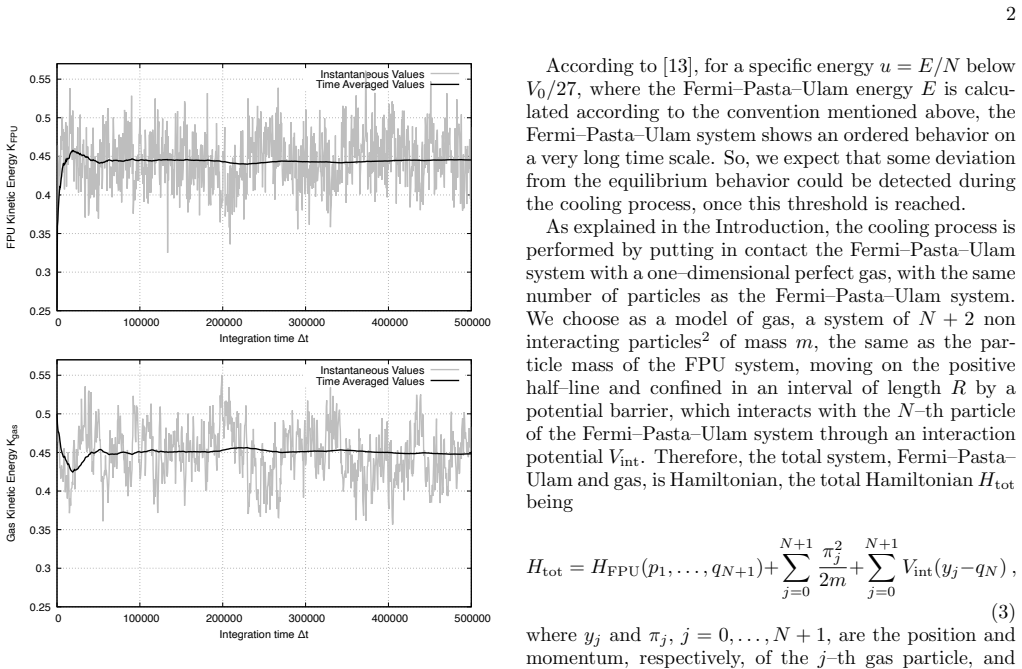
The FPU chain with Lennard-Jones nearest-neighbor interactions is coupled to a one-dimensional ideal gas that acts as a thermostat. Cooling is implemented in discrete steps: gas velocities are rescaled by η=√(T_new/T_old), followed by an equilibration interval Δt; the cooling rate is ξ=ΔT/Δt. Averages are taken over 128 orbits, using both a moving-average and a bin-average procedure. The quantity carrying the argument is the difference between the mechanically measured FPU specific energy and the equilibrium expectation u=T, whose low-temperature plateau defines E0.
Load-bearing premise
The entire law rests on treating the specific energy at the lowest temperature reached in the 90-step cooling protocol as the true zero-temperature residual energy; if that energy would continue to drop with longer equilibration or further cooling, the measured exponents are artifacts of the stopping point.
What would settle it
Cool the same system to a lower final temperature (more steps, same ξ) or hold it at the lowest temperature for increasing times; if E0 continues to decrease toward u=T rather than reaching a plateau, the scaling law fails. Alternatively, test the combined law E0∼(ξN)^{2/3} by varying N and ξ while keeping the product ξN fixed — if the residual energy does not stay constant, the factorization into a single variable is wrong.
If this is right
- If E0∼(ξN)^{2/3} holds, the residual energy per particle grows with system size, so the effect does not vanish in the thermodynamic limit unless ξ decays faster than 1/N.
- A real solid coupled to a cooling gas could retain a measurable zero-point energy even at very low temperatures, affecting its thermodynamic response.
- The 2/3 exponent links the size dependence and rate dependence, suggesting a single control parameter ξN for the glassy freezing.
- The phenomenon provides a purely Hamiltonian, deterministic mechanism for glass-like behavior, without invoking disorder or activation barriers.
Where Pith is reading between the lines
- The product ξN suggests a per-particle cooling budget; a direct test would be to check whether data for different N and ξ collapse onto a single curve when plotted against ξN.
- The exponent 2/3, if confirmed, may reflect the u^{-2} divergence of the FPU thermalization time; a simple balance between cooling lag and thermalization rate might predict an exponent and could be checked analytically.
- One could test whether the same scaling appears for other anharmonic potentials or for other thermostat models; if it is universal, it would strengthen the analogy with supercooled liquids.
- The protocol's dependence on the fixed temperature decrement ΔT=0.05 (above threshold) deserves scrutiny; varying ΔT separately from Δt could reveal whether E0 depends on the full path of the cooling schedule and not just on ξ.
Editorial analysis
A structured set of objections, weighed in public.
Referee Report
Summary. The manuscript reports numerical simulations of the cooling of a Fermi--Pasta--Ulam (FPU) chain coupled to an ideal-gas thermostat whose temperature is lowered at rate ξ. The authors find that, below the stochastic threshold T≈V0/27, the FPU specific energy u lies above the equilibrium value u=T and appears to approach a nonzero residual value E0 at the lowest temperatures reached. They then study E0 as a function of particle number N and cooling rate ξ, reporting power laws E0 ∼ N^{0.61} and E0 ∼ ξ^{0.66}, which they combine into the scaling law E0 ∼ (ξN)^{2/3} [Eq. (6)]. On this basis they argue that the residual energy survives in the thermodynamic limit unless the cooling rate vanishes faster than 1/N.
Significance. If the claimed scaling were established, it would provide a simple, concrete prediction for a glassy residual energy in a Hamiltonian model, and it would make a nontrivial connection between cooling rate, system size, and the breakdown of thermalization. The numerical setup is carefully described, including a Hamiltonian gas thermostat, symplectic integration, and two averaging procedures (moving average and bin average) over 128 orbits. However, the central quantitative claim rests on (i) the identification of E0 with the value of u at the end of a fixed 90-step cooling protocol without a demonstrated plateau, and (ii) power-law fits to very few points, without error bars or a joint fit. These issues must be resolved before the scaling law can be considered supported.
major comments (4)
- [Section III, definition of E0] The load-bearing assumption is that the value of u at the lowest temperature of the 90-step cooling run equals the T→0 residual energy. The manuscript only states that individual orbits 'seem' to have vanishing slope at the lowest temperatures, with no quantitative plateau test, no runs with longer equilibration at fixed T, and no extrapolation to T=0. Since the paper's own cited results [8–11] imply thermalization times growing at least as u^{−2}, the final steps of the protocol may terminate before u stops decreasing. If u would continue to drop with longer equilibration, every E0 in Figs. 5–6 is a stopping-time artifact and the exponents in Eq. (6) are not physical. This must be tested directly, e.g. by comparing E0 for different kmax and by holding the temperature fixed at the lowest value for several equilibration times.
- [Section III, Eq. (6)] Equation (6) is obtained by declaring the two fitted exponents 0.61 and 0.66 equal. The authors state that both exponents have an accuracy of 0.01, but the difference 0.05 is five times that claimed accuracy. No statistical test is provided for the equality of the two exponents, and no combined fit of E0 against ξN is shown. To support Eq. (6), the authors should fit E0 as a function of ξN over the full data set (all N and ξ jointly) and show a collapse of the data, e.g. E0/(ξN)^{2/3} versus a relevant variable.
- [Figures 5 and 6; Section III] The power-law exponents are estimated from only three data points in each figure (N+2 = 100, 178, 316 for Fig. 5 and ξ = 4×10^{−7}, 1.265×10^{−6}, 4×10^{−6} for Fig. 6), with no error bars on E0 and no description of the fitting procedure. The claimed accuracy of 0.01 is therefore not substantiated. The authors should provide error estimates from the 128 orbits and the two averaging methods, and ideally additional intermediate system sizes and cooling rates. Without these, the exponents and hence Eq. (6) have unknown statistical uncertainty.
- [Section II, definition of ξ] The cooling protocol does not implement a single uniform cooling rate: above a threshold the temperature is decreased by a fixed ΔT = 0.05 per step, while below the threshold the target temperature is 3/4 of the current temperature, so the rate ΔT/Δt is not constant over the run. The manuscript defines ξ = ΔT/Δt but does not specify at what stage or how ξ is computed for the data in Figs. 4 and 6. Since the ξ-dependence is one of the two pillars of Eq. (6), the cooling schedule and the effective ξ must be defined precisely, and the sensitivity of E0 to the threshold and to the two-regime protocol should be examined.
minor comments (5)
- [Section II, Eq. (1)] There is a typo 'whit' in the equation line; also the notation for the number of particles is inconsistent: the text says 'N+2 points, the first and last kept fixed' but Eq. (1) uses j=0,...,N+1 with q0 and qN+1 fixed, so there are N+1 moving particles and N+2 total sites. Please clarify the counting.
- [Section III, Fig. 3 caption] The caption lists N+2 = 100, 178, 316, but the text refers to these as 'the size of the FPU system'; it would help to state N explicitly as well.
- [Section III, Fig. 6] The caption says 'Cooling rate is rescaled by a factor 10^{-7}', but the x-axis labels do not show the rescaling explicitly. Please make the axis labels self-explanatory.
- [Section III] The term 'zero-point energy' may be confused with quantum zero-point energy; 'residual energy' or 'trapped energy' would be less ambiguous.
- [Section II] The interaction potential Vint in Eq. (4) is said to be chosen 'by trial and error' to ensure thermalization; this is plausible, but the values V1=100 and α=50 should be reported with units and a brief justification of their effect on the thermostat properties.
Circularity Check
No significant circularity: Eq. (6) is a direct empirical fit, and the prior self-citations are contextual rather than load-bearing.
full rationale
The central result E0 ∼ (ξN)^{2/3} is obtained by plotting measured values of E0 (defined as the specific energy at the lowest simulated temperature) against N and ξ in log-log coordinates and fitting power laws. This is a data-reduction procedure, not a derivation from premises that already contain the scaling. No parameter is fitted to a subset and then used to predict the same quantity; the two exponents 0.61 and 0.66 are independent fits and the 2/3 law is presented as an approximate combined summary. The only potentially circular elements are self-citations ([3]–[8], [12]) used for context or interpretation. In particular, [12] (Carati and Galgani) is invoked as an idea that the numerical result 'could be seen as a confirmation of', but Eq. (6) does not depend on the validity of [12]; the scaling law is computed directly from the simulations. The possible absence of a plateau test for E0 at the lowest temperature is an empirical/correctness concern about whether E0 is the true T→0 residual energy, not a circularity: the definition of E0 as the lowest-temperature value is explicit and does not presuppose the claimed scaling. Therefore no load-bearing circular step was identified.
Axiom & Free-Parameter Ledger
free parameters (5)
- N-exponent a =
0.61 ± 0.01
- ξ-exponent b =
0.66 ± 0.01
- gas-FPU interaction parameters V1, α =
V1 = 100 V0, α = 50
- Cooling-switch threshold =
not stated
- Averaging window split =
3/5 Δt equilibration, 2/5 Δt average
axioms (6)
- standard math Verlet integration with τ = 0.0025 conserves total energy to better than 0.01% and is accurate enough for the simulated timescales.
- domain assumption Below specific energy V0/27 the FPU chain exhibits ordered, non-thermalizing behavior.
- domain assumption The one-dimensional gas with interaction Vint(r) = V1 e^{−α(r/σ)^2}/(r/σ), V1=100, α=50, thermalizes with the FPU chain at high temperature on accessible timescales.
- domain assumption Averages over 128 orbits and over 2/5 Δt of each cooling step are representative of the ensemble behavior.
- ad hoc to paper The value of u at the lowest simulated temperature is a valid approximation to the T→0 limit E0.
- ad hoc to paper The two fitted exponents 0.61 and 0.66 are equal enough to justify the combined law E0 ∼ (ξN)^{2/3}.
invented entities (1)
-
Zero-point energy E0
no independent evidence
read the original abstract
In this work, we numerically studied the cooling process of a Fermi--Pasta--Ulam system, which occurs when the FPU system is placed in contact with a gas whose temperature $T$ is reduced with a certain cooling rate $\xi$. It was found that the existence of a weak stochastic threshold has a significant impact on the cooling process, because below such a stochastic threshold the specific FPU energy is larger than its temperature, i.e., the FPU system falls out of equilibrium. The difference remains finite in the limit $T \to 0$, so that the FPU system maintains a residual amount of energy $E_0$ at vanishing temperature. Our numerical simulations reveal that this energy exhibits a power--law dependence on both the system size and the cooling rate, scaling approximately as $E_{0} \sim (\xi N)^{2/3}$.
Figures


Reference graph
Works this paper leans on
-
[1]
M. D. Ediger, C. A. Angell, and S. R. Nagel, Supercooled liquids and glasses, J. Phys. Chem.100, 13200 (1996)
1996
-
[2]
J. F. Douglas, Q. L. Yuan, J. Zhang, H. Zhang, and W. S. 6 Xu, A dynamical system approach to relaxation in glass- forming liquids, Soft Matter20, 9140 (2024)
2024
-
[3]
Carati, An averaging theorem for hamiltonian dynam- ical systems in the thermodynamic limit, J
A. Carati, An averaging theorem for hamiltonian dynam- ical systems in the thermodynamic limit, J. Stat. Phys. 128, 1057 (2007)
2007
-
[4]
Maiocchi and A
A. Maiocchi and A. Carati, Relaxation times for hamil- tonian systems, Commun. Math. Phys.297, 427 (2010)
2010
-
[5]
Carati and A
A. Carati and A. Maiocchi, Exponentially long stabil- ity times for a nonlinear lattice in the thermodynamical limit, Commun. Math. Phys.314, 129 (2012)
2012
-
[6]
Giorgilli, S
A. Giorgilli, S. Paleari, and T. Penati, An extensive adi- abatic invariant for the Klein-Gordon model in the ther- modynamic limit, Ann. Henri Poincar´ e16, 897 (2015)
2015
-
[7]
Maiocchi, Freezing of the optical-branch energy in a diatomic FPU chain, Commun
A. Maiocchi, Freezing of the optical-branch energy in a diatomic FPU chain, Commun. Math. Phys.372, 91 (2019)
2019
-
[8]
Maiocchi, D
A. Maiocchi, D. Bambusi, and A. Carati, An averaging theorem for FPU in the thermodynamic limit, J. Stat. Phys.155, 300 (2014)
2014
-
[9]
Benettin, H
G. Benettin, H. Christodoulidi, and A. Ponno, The Fermi-Pasta-Ulam problem and its underlying integrable dynamics, J. Stat. Phys.152, 195 (2013)
2013
-
[10]
W. Fu, Y. Zhang, and H. Zhao, Nonintegrability and thermalization of one-dimensional diatomic lattices, Phys. Rev. E100, 052102 (2019)
2019
-
[11]
W. Lin, W. Fu, Z. Wang, Y. Zhang, and H. Zhao, Uni- versality classes of thermalization and energy diffusion, Phys. Rev. E111, 024122 (2025)
2025
-
[12]
Carati and L
A. Carati and L. Galgani, On the specific heat of the Fermi-Pasta-Ulam systems, J. Stat. Phys.94, 859 (1999)
1999
-
[13]
Bocchieri, A
P. Bocchieri, A. Scotti, B. Bearzi, and A. Loinger, Anhar- monic chain with Lennard-Jones interaction, Phys. Rev. 140, A1194 (1965)
1965
-
[105]
infinite time
As will appear more clear in the next Section, the specific energy of the FPU system is lower thanT, the value expected for a linear system, which means that the non linear contributions are relevant at this temperature. After equilibration, we start the cooling process. This process is simulated by a sequence of discrete steps. In each step, we decrease ...
discussion (0)
Sign in with ORCID, Apple, or X to comment. Anyone can read and Pith papers without signing in.