REVIEW 4 major objections 4 minor 39 references
Aligning Linguistic Words and Visual Semantic Units for Image Captioning
T0 review · 4 major / 4 minor · reviewed 2026-08-14 · deepseek-v4-flash
Pith's one-line read Representing images as graphs of visual semantic units—objects, attributes, and their interactions—and aligning each generated word to those units improves image captioning, lifting CIDEr from 120.1 to 128.6 on the MS-COCO Karpathy split.
desk verdict Competent, incremental captioning paper with a genuinely different graph representation; the claimed SOTA improvement is inflated by a baseline mismatch, but the controlled gain is still real. read the letter →
The pith
A machine-rendered reading of the paper's core claim, the machinery that carries it, and where it could break.
The reading
What carries the argument
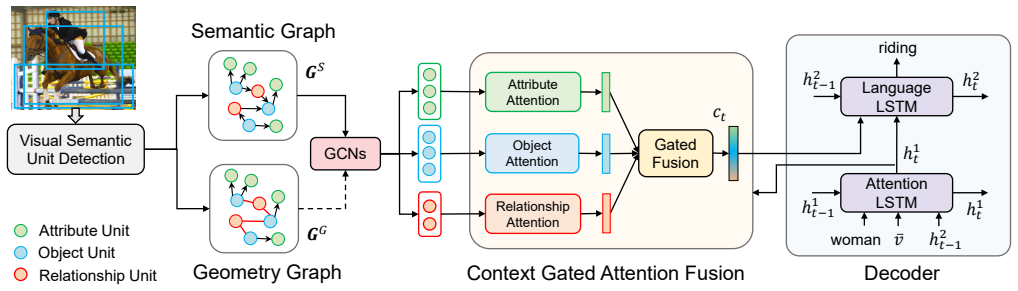
The central object is the visual semantic unit (VSU), defined as an object, an instance attribute, or a semantic or geometric interaction between two objects, with each unit becoming a node in a semantic graph and a geometry graph. Relationships are represented as nodes rather than edges, which gives every relationship an instance-specific embedding produced by a graph convolutional network that aggregates the subject unit, the relationship's own features, and the object unit. The context gated attention module (CGA) then computes three separate soft attentions over the object, attribute, and relationship units, derives category-level gating weights from the decoder state and the three attention outputs, and forms the context vector by concatenating the gated per-category contexts, with relationship contexts drawn from both graphs. This machinery turns the intuition that words align to visual components into a differentiable captioning decoder.
What would settle it
A capacity-matched control that replaces the learned unit embeddings with random embeddings of the same shape—keeping graph structure and training schedule—would settle the claim: if CIDEr on the Karpathy split stays near 128.6, the semantic content of the units is not what drives the gain.
Extended reading notes
Core claim
The paper's central claim is that explicit, instance-specific representations of visual semantic units—not objects alone—carry the information captions need. It detects objects, instance attributes, and pairwise relationships, then treats relationships as nodes rather than edges in two graphs, a semantic graph and a geometry graph, so each relationship gets its own embedding computed from the subject and object embeddings plus its own features. A context gated attention module takes the decoder state, runs separate soft attentions over object, attribute, and relationship units, computes per-category gating weights, and fuses the gated contexts, including separate relationship contexts from the two graphs. With this design, the model obtains 128.6 CIDEr on the Karpathy test split and 123.1/125.5 (c5/c40) on the official COCO evaluation server, exceeding its baseline and matching the best comparable models on other metrics. The paper also argues the improvement is not merely added capacity, since a parameter-matched multi-attention variant of the baseline performs worse.
Load-bearing premise
The load-bearing premise is that the object, attribute, and relationship recognition systems trained on Visual Genome work accurately enough on MS-COCO for the graph and the word-unit alignment to receive meaningful inputs; the paper reports no error analysis of these systems on COCO.
Editorial extensions
If this is right
- The full model reaches 128.6 CIDEr on the MS-COCO Karpathy split, compared with 120.1 reported for Up-Down and 122.8 for the authors' base implementation, an 8.5-point gain over the published baseline.
- Representing relationships as nodes gives each relationship an instance-specific representation that the decoder can attend to directly; the ablation that adds semantic relationship units on top of objects and attributes outperforms objects and attributes alone, and the full model beats using either graph alone.
- The context gated attention learns per-word category tendencies: in the qualitative examples, verbs receive the highest relationship weights, adjectives the highest attribute weights, and nouns the highest object weights, matching the hypothesized word-unit alignment.
- All three fused content cues are load-bearing: removing visual appearance cues drops CIDEr to 111.9, and removing semantic embeddings or geometry cues also hurts, indicating the combined node features matter.
- Combining the semantic and geometry graphs improves over either graph individually (128.6 vs. 127.2 for each), showing that semantic and geometric interactions provide complementary captioning evidence.
Reading between the lines
- Editorial inference: the same graph-plus-alignment recipe should transfer to other vision-language tasks that need word-region correspondence, such as referring expression comprehension and visual question answering, where the category gate could act as a soft type constraint on attention.
- Editorial inference: because the paper reports no error analysis of the transferred detectors, a fair test of the mechanism would run the same model with oracle visual semantic units from ground-truth scene graphs; if CIDEr does not improve further, the gain is capped by detection quality rather than by alignment.
- Editorial inference: the hand-set geometry thresholds (r2 < 0.2 and r4 < 0.5) control the number of relationship units per image, and the paper shows CIDEr varies with that number, so a learned or adaptive connectivity rule may remove this sensitivity and add further gains.
- Editorial inference: the per-word gating weights are a ready-made diagnostic; visualizing them on failure cases could reveal systematic misalignment, such as verbs attending to object units, and motivate losses that penalize category mismatch.
Signed reviews
Editorial analysis
A structured set of objections, weighed in public.
Referee Report
Summary. The paper proposes an image captioning model, VSUA, that represents an image as semantic and geometry graphs whose nodes are visual semantic units (objects, attributes, and interactions). Graph convolutional networks produce context-aware embeddings for the nodes, and a context gated attention module hierarchically aligns each generated word with one of the three VSU categories before decoding. On the MS-COCO Karpathy split, the full model reports CIDEr 128.6 against an implemented Up-Down baseline of 122.8 and against the published Up-Down number of 120.1; competitive results are also reported on the online test server. The paper claims a new state-of-the-art CIDEr on the Karpathy split.
Significance. If the central claim holds, the paper makes a useful contribution: explicitly representing images with VSU-based graphs (including relationships as nodes) and aligning words to VSU categories via a learned gate is a plausible and well-motivated mechanism for improving captioning. The ablations in Table 1 support the contribution of each VSU type and of the gated attention, and the capacity-control experiment in Section 4.3(d) is a good check against a purely parameter-count explanation. The release of code is also a strength. However, the headline claim of a new state of the art is weakened by the inconsistency between the implemented baseline (CIDEr 122.8 in Table 1) and the published Up-Down number (CIDEr 120.1 in Table 3), by the absence of variance estimates for the 1.0 CIDEr margin over GCN-LSTM, and by an unresolved notation error in the geometry-graph construction. These issues are addressable in revision.
major comments (4)
- [Introduction; Section 4.4 (Table 3) vs Section 4.3 (Table 1)] The paper claims in the introduction an absolute 8.5 point improvement over Up-Down, and in Section 4.4 states that relative to the Up-Down baseline CIDEr goes from 120.1 to 128.6. However, Table 1 defines Base as the authors' implementation of Up-Down and reports CIDEr 122.8. The controlled comparison in the ablations is therefore 128.6 - 122.8 = 5.8 CIDEr, not 8.5. The authors need to explain why their implementation of Up-Down is 2.7 CIDEr higher than the published number; if any difference exists in detector checkpoint, number of boxes, training schedule, or evaluation details, then the Table 3 comparison to the published Up-Down is not a controlled ablation and the headline gain is inflated.
- [Section 4.4 (Table 3)] The claimed state of the art rests on a 1.0 CIDEr margin over GCN-LSTM (128.6 vs 127.6), but no variance, number of runs, or significance information is provided. CIDEr on the Karpathy split is known to have run-to-run variability of this order of magnitude. The paper should report results over multiple seeds or provide some other statistical support before claiming a new state of the art.
- [Section 3.2 (Eq. 3); Section 4.2; Section 4.3(e)] The geometry graph construction is specified inconsistently. Equation 3 defines r2 as a vector of box-size ratios and r3 as the IoU, but Section 4.2 states that two objects interact if 'r2 < 0.2 and r4 < 0.5, where r2 and r4 are the IoU and relative distance in Eqn. 3', and Section 4.3(e) repeats 'r2 means IoU'. The intended condition is unclear; a natural reading would be r3 < 0.2 and r4 < 0.5. This must be corrected because the geometry graph is a core component of the proposed method and the current description is not reproducible.
- [Section 4.2] The VSU detectors (Faster R-CNN for objects, an MLP attribute classifier, and MOTIFNET for relationships) are trained on Visual Genome and applied to MS-COCO without any reporting of detection accuracy or error analysis on the target domain. If these detectors frequently miss or mislabel objects, attributes, or relations, the constructed graphs are noisy and the CIDEr gain may be attributable to added capacity rather than to genuine word-unit alignment. The capacity-control experiment in Section 4.3(d) addresses decoder capacity but not detector noise. Please provide a characterization of detector performance on MS-COCO, or an ablation with ground-truth VSUs if available, to support the interpretation that the alignment mechanism is the source of the improvement.
minor comments (4)
- [Section 4.3(e)] The text says 'We have introduced in Section 4.1' when referring to the geometry graph construction, but that construction is described in Section 4.2.
- [Section 4.3(c)] The text says the cues are removed 'from the computation process of foi (Eqn. 5)', but the object feature f_oi is defined in Eq. 4; Eq. 5 defines the attribute feature f_ai.
- [Section 3.4] The sentence 'with our context gated attention module injected in the middle it' should read 'injected in the middle of it'.
- [Figure 4] The x-axis label 'average number of relationship units' would be clearer as 'average number of relationship units per image'.
Circularity Check
No significant circularity: the VSU graph and gated attention are learned architectures evaluated on held-out data; the only issues are baseline inconsistency and a definition typo, which are correctness concerns, not circularity.
full rationale
The paper makes no formal derivation or first-principles prediction claims; it proposes an encoder-decoder architecture with graph-structured visual semantic units and a context gated attention module. The VSUs are produced by externally trained detectors (Faster R-CNN for objects, an MLP attribute classifier, and MOTIFNET for relationships), and the gating and attention weights are learned parameters optimized on MS-COCO training captions and evaluated on the held-out Karpathy test split and the online test server. No fitted parameter is renamed as a prediction, no quantity is defined in terms of the target result, and no load-bearing step depends on the authors' own prior work (MSCap [8] is cited only in related work as an example of style captioning). The closest issues are not circularity: Table 1 reports its own Up-Down implementation Base at 122.8 CIDEr, while Table 3 lists Up-Down at 120.1 and claims an 8.5-point improvement (the controlled ablation gain is 128.6 - 122.8 = 5.8), and Sec. 4.2/4.3 use r2 inconsistently (Eq. 3 defines r2 as box-size ratio, but Sec. 4.3(e) says r2 means IoU). These are correctness, reproducibility, or presentation concerns, not circular reasoning. The empirical comparison is self-contained against external benchmarks, so the circularity score is 0.
Assumptions & free parameters
free parameters (6)
- Geometry graph edge thresholds =
r2 < 0.2 and r4 < 0.5 (as stated; Equation 3 defines r3 as IoU)
- Top-Na attributes per object =
Na = 3
- Feature projection and GCN output dimension =
1000
- Decoder hidden and attention dimensions =
LSTM 1000, attention 512
- Embedding dimensions =
word 1000; object, attribute, relationship 128
- Beam size =
3
assumptions (4)
- domain assumption Words in a caption can be aligned to visual semantic units, and the three-way object, attribute, and relationship split is sufficient.
- domain assumption Pre-trained Visual Genome detectors transfer to MS-COCO with acceptable accuracy.
- domain assumption GCN compositions in Equations 8 to 10 learn embeddings that improve caption generation.
- domain assumption CIDEr is a valid training objective and evaluation metric.
invented entities (1)
-
Visual semantic units (VSUs)
Cite this review
Pith. "Pith review of Aligning Linguistic Words and Visual Semantic Units for Image Captioning." pith.science (2026). https://pith.science/paper/LL2ASMUS
@misc{pith2026190802127,
  author       = {Pith},
  title        = {Pith review of: Aligning Linguistic Words and Visual Semantic Units for Image Captioning},
  year         = {2026},
  howpublished = {\url{https://pith.science/paper/LL2ASMUS}},
  note         = {Machine review of arXiv:1908.02127}
}
read the original abstract
Image captioning attempts to generate a sentence composed of several linguistic words, which are used to describe objects, attributes, and interactions in an image, denoted as visual semantic units in this paper. Based on this view, we propose to explicitly model the object interactions in semantics and geometry based on Graph Convolutional Networks (GCNs), and fully exploit the alignment between linguistic words and visual semantic units for image captioning. Particularly, we construct a semantic graph and a geometry graph, where each node corresponds to a visual semantic unit, i.e., an object, an attribute, or a semantic (geometrical) interaction between two objects. Accordingly, the semantic (geometrical) context-aware embeddings for each unit are obtained through the corresponding GCN learning processers. At each time step, a context gated attention module takes as inputs the embeddings of the visual semantic units and hierarchically align the current word with these units by first deciding which type of visual semantic unit (object, attribute, or interaction) the current word is about, and then finding the most correlated visual semantic units under this type. Extensive experiments are conducted on the challenging MS-COCO image captioning dataset, and superior results are reported when comparing to state-of-the-art approaches.
Figures


Figures from the paper (3 more)


Reference graph
Works this paper leans on
-
[1]
Peter Anderson, Basura Fernando, Mark Johnson, and Stephen Gould. 2016. SPICE: Semantic Propositional Image Caption Evaluation. (2016), 382–398
work page 2016
-
[2]
Peter Anderson, Xiaodong He, Chris Buehler, Damien Teney, Mark Johnson, Stephen Gould, and Lei Zhang. 2017. Bottom-up and top-down attention for image captioning and vqa. arXiv preprint arXiv:1707.07998 (2017)
arXiv 2017
-
[3]
Joost Bastings, Ivan Titov, Wilker Aziz, Diego Marcheggiani, and Khalil Sima’an
-
[4]
Xinlei Chen, Li-Jia Li, Li Fei-Fei, and Abhinav Gupta. 2018. Iterative visual reasoning beyond convolutions. InProceedings of the IEEE Conference on Computer Vision and Pattern Recognition . 7239–7248
work page 2018
-
[5]
Srivastava, Li Deng, Piotr DollÂĺÂćr, Jianfeng Gao, Xiaodong He, Margaret Mitchell, and John C
Hao Fang, Saurabh Gupta, Forrest Iandola, Rupesh K. Srivastava, Li Deng, Piotr DollÂĺÂćr, Jianfeng Gao, Xiaodong He, Margaret Mitchell, and John C. Platt
-
[6]
Justin Gilmer, Samuel S Schoenholz, Patrick F Riley, Oriol Vinyals, and George E Dahl. 2017. Neural message passing for quantum chemistry. In Proceedings of the 34th International Conference on Machine Learning-Volume 70 . JMLR. org, 1263–1272
work page 2017
-
[7]
Jiuxiang Gu, Jianfei Cai, Gang Wang, and Tsuhan Chen. 2017. Stack-captioning: Coarse-to-fine learning for image captioning. arXiv preprint arXiv:1709.03376 (2017)
work page Pith review arXiv 2017
-
[8]
Longteng Guo, Jing Liu, Peng Yao, Jiangwei Li, and Hanqing Lu. 2019. MSCap: Multi-Style Image Captioning With Unpaired Stylized Text. In Proceedings of the IEEE Conference on Computer Vision and Pattern Recognition . 4204–4213
work page 2019
Show all 39 references
-
[9]
Kaiming He, Xiangyu Zhang, Shaoqing Ren, and Jian Sun. 2016. Deep Residual Learning for Image Recognition. computer vision and pattern recognition (2016), 770–778
2016
-
[10]
Sepp Hochreiter and Jürgen Schmidhuber. 1997. Long short-term memory.Neural computation 9, 8 (1997), 1735–1780
1997
-
[11]
Justin Johnson, Ranjay Krishna, Michael Stark, Li-Jia Li, David Shamma, Michael Bernstein, and Li Fei-Fei. 2015. Image retrieval using scene graphs. InProceedings of the IEEE conference on computer vision and pattern recognition . 3668–3678
2015
-
[12]
Andrej Karpathy and Li Feifei. 2015. Deep visual-semantic alignments for generat- ing image descriptions. computer vision and pattern recognition (2015), 3128–3137
2015
-
[13]
Diederik Kingma and Jimmy Ba. 2014. Adam: A method for stochastic optimiza- tion. arXiv preprint arXiv:1412.6980 (2014)
2014 arXiv
-
[14]
Thomas N Kipf and Max Welling. 2016. Semi-supervised classification with graph convolutional networks. arXiv preprint arXiv:1609.02907 (2016)
2016 arXiv
-
[15]
Ranjay Krishna, Yuke Zhu, Oliver Groth, Justin Johnson, Kenji Hata, Joshua Kravitz, Stephanie Chen, Yannis Kalantidis, Li-Jia Li, David A Shamma, et al
-
[16]
Tsungyi Lin, Michael Maire, Serge J Belongie, James Hays, Pietro Perona, Deva Ramanan, Piotr Dollar, and C Lawrence Zitnick. 2014. Microsoft COCO: Common Objects in Context. european conference on computer vision (2014), 740–755
2014
-
[17]
Daqing Liu, Zheng-Jun Zha, Hanwang Zhang, Yongdong Zhang, and Feng Wu
-
[18]
International Journal of Computer Vision 123, 1 (2017), 32–73
Visual genome: Connecting language and vision using crowdsourced dense image annotations. International Journal of Computer Vision 123, 1 (2017), 32–73
2017
-
[19]
Ruotian Luo, Brian Price, Scott Cohen, and Gregory Shakhnarovich. 2018. Dis- criminability objective for training descriptive captions. In Proceedings of the IEEE Conference on Computer Vision and Pattern Recognition . 6964–6974
2018
-
[20]
Varun K Nagaraja, Vlad I Morariu, and Larry S Davis. 2016. Modeling context between objects for referring expression understanding. In European Conference on Computer Vision. Springer, 792–807
2016
-
[21]
Shaoqing Ren, Kaiming He, Ross Girshick, and Jian Sun. 2015. Faster r-cnn: Towards real-time object detection with region proposal networks. In Advances in neural information processing systems . 91–99
2015
-
[22]
Jiasen Lu, Caiming Xiong, Devi Parikh, and Richard Socher. 2017. Knowing when to look: Adaptive attention via a visual sentinel for image captioning. In Proceedings of the IEEE Conference on Computer Vision and Pattern Recognition (CVPR), Vol. 6
2017
-
[23]
Damien Teney, Lingqiao Liu, and Anton van den Hengel. 2017. Graph-structured representations for visual question answering. In Proceedings of the IEEE Confer- ence on Computer Vision and Pattern Recognition . 1–9
2017
-
[24]
Oriol Vinyals, Alexander Toshev, Samy Bengio, and Dumitru Erhan. 2015. Show and tell: A neural image caption generator. InComputer Vision and Pattern Recog- nition (CVPR), 2015 IEEE Conference on . IEEE, 3156–3164
2015
-
[25]
Oriol Vinyals, Alexander Toshev, Samy Bengio, and Dumitru Erhan. 2017. Show and tell: Lessons learned from the 2015 mscoco image captioning challenge. IEEE transactions on pattern analysis and machine intelligence 39, 4 (2017), 652–663
2017
-
[26]
Steven J Rennie, Etienne Marcheret, Youssef Mroueh, Jarret Ross, and Vaibhava Goel. 2017. Self-critical Sequence Training for Image Captioning. computer vision and pattern recognition (2017)
2017
-
[27]
Kelvin Xu, Jimmy Lei Ba, Ryan Kiros, Kyunghyun Cho, Aaron C Courville, Ruslan Salakhudinov, Rich Zemel, and Yoshua Bengio. 2015. Show, Attend and Tell: Neural Image Caption Generation with Visual Attention. international conference on machine learning (2015), 2048–2057
2015
-
[28]
Jianwei Yang, Jiasen Lu, Stefan Lee, Dhruv Batra, and Devi Parikh. 2018. Graph r-cnn for scene graph generation. In Proceedings of the European Conference on Computer Vision (ECCV). 670–685
2018
-
[29]
Xu Yang, Kaihua Tang, Hanwang Zhang, and Jianfei Cai. 2019. Auto-encoding scene graphs for image captioning. In Proceedings of the IEEE Conference on Computer Vision and Pattern Recognition . 10685–10694. 8
2019
-
[30]
Danfei Xu, Yuke Zhu, Christopher B Choy, and Li Fei-Fei. 2017. Scene graph generation by iterative message passing. In Proceedings of the IEEE Conference on Computer Vision and Pattern Recognition . 5410–5419
2017
-
[31]
Ting Yao, Yingwei Pan, Yehao Li, and Tao Mei. 2018. Exploring visual relationship for image captioning. In Proceedings of the European Conference on Computer Vision (ECCV). 684–699
2018
-
[32]
Ting Yao, Yingwei Pan, Yehao Li, Zhaofan Qiu, and Tao Mei. 2016. Boosting Image Captioning with Attributes. (2016)
2016
-
[33]
Quanzeng You, Hailin Jin, Zhaowen Wang, Chen Fang, and Jiebo Luo. 2016. Image Captioning with Semantic Attention. (2016), 4651–4659
2016
-
[34]
Zhilin Yang, Ye Yuan, Yuexin Wu, Ruslan Salakhutdinov, and William W Cohen
-
[39]
Rowan Zellers, Mark Yatskar, Sam Thomson, and Yejin Choi. 2018. Neural motifs: Scene graph parsing with global context. In Proceedings of the IEEE Conference on Computer Vision and Pattern Recognition . 5831–5840. 9
2018
-
[2014]
(2014), 1473–1482
From captions to visual concepts and back. (2014), 1473–1482
2014
-
[2016]
Review Networks for Caption Generation. (2016)
2016
-
[2017]
arXiv preprint arXiv:1704.04675 (2017)
Graph convolutional encoders for syntax-aware neural machine translation. arXiv preprint arXiv:1704.04675 (2017)
2017 arXiv
-
[2018]
In 2018 ACM Multimedia Conference on Multimedia Conference
Context-Aware Visual Policy Network for Sequence-Level Image Cap- tioning. In 2018 ACM Multimedia Conference on Multimedia Conference . ACM, 1416–1424
2018
Reviewed August 14, 2026 · model on record in the stance chip above.
Discussion (0). Continue with ORCID to comment.