REVIEW 4 major objections 5 minor 2 cited by
Automatic Evaluation Metrics for Artificially Generated Scientific Research
T0 review · 4 major / 5 minor · reviewed 2026-08-07 · deepseek-v4-flash
Pith's one-line read A simple title-and-abstract score predictor agrees with human reviewers more often than LLM-based reviewers do, the paper claims.
desk verdict A well-built empirical study of score prediction on human papers whose headline promise about AI-generated research outruns the evidence. read the letter →
The pith
A machine-rendered reading of the paper's core claim, the machinery that carries it, and where it could break.
The reading
What carries the argument
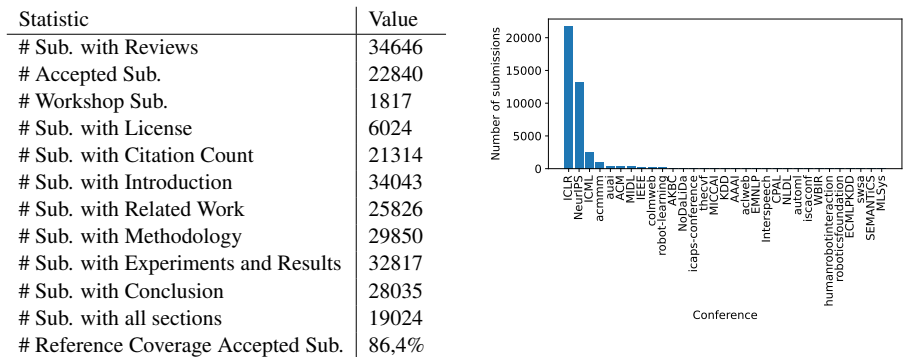
The load-bearing object is a learned score function $f_\theta$ that maps fixed text embeddings to a scalar quality score, trained with a pairwise ranking objective and an $\ell^1$ regression objective. Different parts of a paper are embedded separately, such as title and abstract, research hypothesis, or individual sections, and when context is used the paper embedding is combined with embeddings of its references through a one-layer Transformer. The data pipeline matters as much as the model: PDFs are parsed and classified into sections, each submission is annotated with a research hypothesis by a prompted language model, and citation counts are gathered from a scholarly database. The hypothesis is that these quality scores are predictable enough from content alone to serve as evaluation metrics.
What would settle it
Run the same title-and-abstract score predictor on a set of machine-generated papers whose later citation counts or human review scores are known; if its pairwise accuracy drops near chance while human-review consistency stays stable, the transfer claim is falsified.
Extended reading notes
Core claim
The central discovery, on the paper's own terms, is that a simple score-prediction model trained on text embeddings can rank papers by later citation impact above random and can agree with human review scores more reliably than LLM judges, while still falling short of a second human reviewer. Review-score prediction is harder than citation prediction, and predicting scores from a research hypothesis alone is harder than predicting them from the full paper. The paper also reports that citation counts and review scores correlate only weakly, meaning the two metrics capture different aspects of what makes research influential or well received.
Load-bearing premise
The evaluation metrics are meant for AI-generated papers, but every experiment measures human-written submissions, so the paper assumes that ranking accuracy transfers across that gap.
Editorial extensions
If this is right
- Citation-count prediction from title and abstract is viable: pairwise comparison accuracy reaches about 66.5% on a computational-linguistics corpus and about 65% on ICLR submissions, so content alone carries a usable ranking signal.
- Research-hypothesis-only prediction beats random but is markedly worse than title-and-abstract prediction, so evaluating idea-generation systems on hypotheses alone will lose signal.
- Review score prediction across venues is near random; only venue-specific models reach about 60% pairwise accuracy, implying review scores need standardization before they can serve as a general metric.
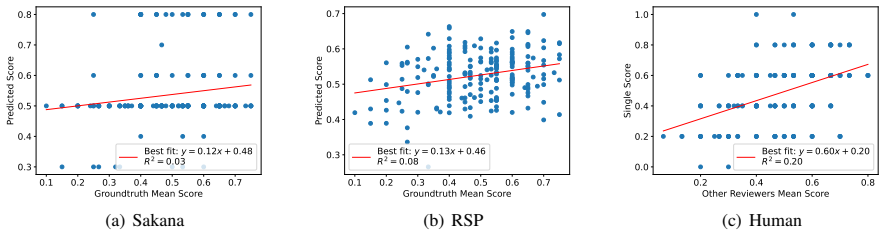
- A simple title-and-abstract model (correlation about 0.33 with human review scores) outperforms an LLM-based reviewer (about 0.16) but not a second human reviewer (about 0.41), so content-based scoring is the cheaper of the available automated options.
Reading between the lines
- The transfer from human to AI-generated papers is the paper's load-bearing bet; since all experiments use human submissions, the reported accuracies are an upper-bound estimate until the predictor is tested on generated text.
- The near-random cross-venue review-score predictions suggest that review-score normalization rather than model capacity is the binding constraint; normalizing per venue before training could be a direct extension.
- A combined target that mixes citation and review signals might be more stable than either alone, since the two correlate only weakly.
- The research-hypothesis results imply that judging idea-generation systems purely on their hypotheses forfeits most of the signal available in the full paper.
Editorial analysis
A structured set of objections, weighed in public.
Referee Report
Summary. The paper proposes automatic evaluation metrics for AI-generated scientific research, specifically citation count prediction and review score prediction, trained on content-only representations (titles, abstracts, hypotheses) of papers. The authors build a large unified OpenReview dataset enriched with citations, references, and GPT-annotated research hypotheses, and report three main findings: citation count prediction is more viable than review score prediction; predicting scores from the research hypothesis is more difficult than from the full paper; and a simple title-and-abstract prediction model outperforms LLM-based reviewers, though it falls short of human-level consistency. The paper also analyzes correlations between citations and review scores and provides qualitative Shapley-value analyses.
Significance. If the central claim were established, the paper would offer a cheap, content-based evaluation method for AI-generated research and a substantial new resource (the unified OpenReview dataset with hypothesis annotations). The release of code and dataset, the use of multiple random seeds, and the documented training details are concrete strengths. However, the headline application to AI-generated scientific content is never tested: every experiment trains and evaluates on human-written OpenReview papers. The comparison with LLM reviewers also lacks variance or significance testing. These gaps are load-bearing for the stated purpose, so the contribution is currently more a reproducible study of citation/review-score predictability on human papers than a validated evaluation metric for AI-generated research.
major comments (4)
- [§1, §5.3, Abstract] The central claim that citation count prediction and review score prediction serve as automatic evaluation metrics for AI-generated scientific research is untested. All experiments (Section 5.2, Table 2, Table 3, Figure 3; Section 5.3, Table 5) train, validate, and test exclusively on human-written OpenReview submissions (ACL-OCL, ICLR, NeurIPS). The paper itself cites Si et al. (2024) and Lu et al. (2024) for the observation that LLM-generated scientific text differs lexically and structurally, but no experiment or analysis addresses the distribution shift from human to AI-generated papers or hypotheses. The Limitations section concedes that citation and review scores are imperfect proxies but does not mention this transfer problem. For the headline conclusion to hold, the authors need to test the trained predictors on AI-generated papers or hypotheses (for example, papers produced by the AI Scientist) or else substantially scale back the claimed scope.
- [§5.3, Table 5] The claim that the simple prediction model "outperforms LLM-based reviewers" is not supported with statistical evidence. The LLM reviewer results (accuracy 0.548, 0.552; Spearman 0.145, 0.064) are point estimates from a single run, while the RSP results are reported as mean±std over five seeds. On a subsample of 200 papers, the observed differences may be within noise. Please provide multiple runs of the LLM reviewer (varying prompts or sampling), confidence intervals, and a paired significance test (e.g., bootstrap or McNemar) before drawing this conclusion.
- [§3, Eq. (1)] The pairwise comparison loss is written as L(d1,d2;θ)=x log y − (1−x) log(1−y). This is not the standard cross-entropy loss: it lacks the overall minus sign, so minimizing it does not correspond to maximizing the Bernoulli likelihood and the objective can be driven to negative infinity. The correct loss should be −[x log y + (1−x) log(1−y)] (or equivalently x log(1/y)+(1−x) log(1/(1−y))). Please correct the equation and ensure the implementation matches the corrected form.
- [Abstract, §5.2, Table 2, Figure 3] The finding "predicting scores is more difficult purely from the research hypothesis than from the full paper" is not supported by the reported experiments. Table 2 compares Hypothesis against Title+Abstract, Introduction, Related Work, Methodology, Experiments & Results, and Conclusion, but never against the full paper as a single input representation. Figure 3 shows a "Full Paper" context, but only with Title+Abstract as the paper representation, and Hypothesis is not included in that comparison. The claim should be reworded to "than from the title and abstract" or the missing full-paper condition with hypothesis input should be added.
minor comments (5)
- [Appendix D] The section classifier accuracy on OpenReview is reported as "0.93 ± 0.1"; given the mean of 0.93, a standard deviation of 0.1 seems too large and is likely a typo for 0.01. Please check and correct.
- [Appendix F] The heading "Additional resutls" contains a typo; it should be "Additional results".
- [Figure 7] The schematic of the review object lists "Repoducibility", which should be "Reproducibility".
- [Table 3] For the "All" dataset, the review score prediction results are statistically indistinguishable from random (accuracy ≈ 0.50, ρs ≈ 0.00–0.01), yet the table bolds a "best" model based on Spearman correlation. Consider adding a note or significance indicator to prevent overinterpretation of near-zero correlations.
- [General] The model name "SPECTER2" is spelled inconsistently as "SPECTER2", "Specter2", and "Specter 2" in different places; please unify the notation.
Circularity Check
No significant circularity: the predictions are supervised against external human labels and the reported comparisons are independent of the paper's own construction choices.
full rationale
The paper trains citation-count and review-score predictors on human-written OpenReview and ACL-OCL papers with labels obtained from external sources: citation counts from Semantic Scholar and review scores from OpenReview reviews. The target labels are therefore not defined in terms of the model inputs (title/abstract, sections, hypothesis, references), and no fitted parameter is renamed as a prediction. The GPT-3.5-generated research hypotheses serve only as alternative input representations for the predictors; they are not used as ground-truth quality scores, so the central comparisons (citation vs. review prediction, title/abstract vs. hypothesis, RSP vs. LLM reviewers, RSP vs. human consistency) are evaluated against held-out external human labels. No load-bearing self-citation was found: the SPECTER2 embeddings and the LLM-reviewer baselines come from external prior work, and the paper's own dataset releases are resources rather than arguments that determine the conclusions. The main weakness, namely that all experiments use human-written papers while the stated application is AI-generated research, is a distribution-shift validity concern and not a circularity, because the reported numbers measure prediction of external labels and would remain meaningful if the transfer assumption held. No circular step can be exhibited by quoting a reduction of a prediction to its inputs, so the correct finding is no significant circularity.
Assumptions & free parameters
free parameters (4)
- Model hyperparameters (learning rate, dropout, hidden size, epochs) =
lr=5e-5, dropout=0.3, hidden=256 (no-context); context model hidden=1024; grid-searched on validation
- LDA topic count =
13
- LLM comparison subsample size =
200
- Review score normalization mapping =
manual venue field mapping to [0,1]
assumptions (4)
- domain assumption Review scores and citation counts are valid proxies for scientific quality.
- domain assumption Predictors trained on human-written OpenReview papers transfer to AI-generated scientific content.
- domain assumption GPT-3.5 research hypothesis annotations accurately capture each paper's hypothesis.
- domain assumption GROBID parsing and the trained section classifier correctly extract and label paper sections.
Cite this review
Pith. "Pith review of Automatic Evaluation Metrics for Artificially Generated Scientific Research." pith.science (2026). https://pith.science/paper/LMVHOUR4
@misc{pith2026250305712,
  author       = {Pith},
  title        = {Pith review of: Automatic Evaluation Metrics for Artificially Generated Scientific Research},
  year         = {2026},
  howpublished = {\url{https://pith.science/paper/LMVHOUR4}},
  note         = {Machine review of arXiv:2503.05712}
}
read the original abstract
Foundation models are increasingly used in scientific research, but evaluating AI-generated scientific work remains challenging. While expert reviews are costly, large language models (LLMs) as proxy reviewers have proven to be unreliable. To address this, we investigate two automatic evaluation metrics, specifically citation count prediction and review score prediction. We parse all papers of OpenReview and augment each submission with its citation count, reference, and research hypothesis. Our findings reveal that citation count prediction is more viable than review score prediction, and predicting scores is more difficult purely from the research hypothesis than from the full paper. Furthermore, we show that a simple prediction model based solely on title and abstract outperforms LLM-based reviewers, though it still falls short of human-level consistency.
Figures


Figures from the paper (10 more)




Forward citations
Cited by 2 Pith papers
-
How Far Are AI Scientists from Changing the World?
This survey proposes a four-level capability framework for AI Scientist systems and, using an AI reviewer, finds that current systems produce papers rated well below normal scientific standards.
-
AI4Research: A Survey of Artificial Intelligence for Scientific Research
A survey that organizes AI-for-research work into five tasks, comprehension, survey, discovery, writing, and peer review, and compiles associated tools and benchmarks.
Reference graph
Works this paper leans on
-
[1]
Jinheon Baek, Sujay Kumar Jauhar, Silviu Cucerzan, and Sung Ju Hwang. 2024. https://doi.org/10.48550/ARXIV.2404.07738 Researchagent: Iterative research idea generation over scientific literature with large language models . CoRR, abs/2404.07738
-
[2]
Xiaomei Bai, Fuli Zhang, and Ivan Lee. 2019. https://doi.org/10.1016/J.JOI.2019.01.010 Predicting the citations of scholarly paper . J. Informetrics, 13(1):407--418
-
[3]
Prabhat Kumar Bharti, Shashi Ranjan, Tirthankar Ghosal, Mayank Agrawal, and Asif Ekbal. 2021. https://doi.org/10.1007/978-3-030-91669-5\_33 Peerassist: Leveraging on paper-review interactions to predict peer review decisions . In Towards Open and Trustworthy Digital Societies - 23rd International Conference on Asia-Pacific Digital Libraries, ICADL 2021, V...
-
[4]
Steven Bird. 2006. https://doi.org/10.3115/1225403.1225421 NLTK: the natural language toolkit . In ACL 2006, 21st International Conference on Computational Linguistics and 44th Annual Meeting of the Association for Computational Linguistics, Proceedings of the Conference, Sydney, Australia, 17-21 July 2006 . The Association for Computer Linguistics
-
[5]
David M. Blei, Andrew Y. Ng, and Michael I. Jordan. 2003. Latent dirichlet allocation. J. Mach. Learn. Res., 3(null):993–1022
work page 2003
-
[6]
Boiko, Robert MacKnight, Ben Kline, and Gabe Gomes
Daniil A. Boiko, Robert MacKnight, Ben Kline, and Gabe Gomes. 2023. https://doi.org/10.1038/S41586-023-06792-0 Autonomous chemical research with large language models . Nat., 624(7992):570--578
-
[7]
Bran, Sam Cox, Oliver Schilter, Carlo Baldassari, Andrew D
Andres M. Bran, Sam Cox, Oliver Schilter, Carlo Baldassari, Andrew D. White, and Philippe Schwaller. 2024. https://doi.org/10.1038/S42256-024-00832-8 Augmenting large language models with chemistry tools . Nat. Mac. Intell., 6(5):525--535
-
[8]
Mike D'Arcy, Tom Hope, Larry Birnbaum, and Doug Downey. 2024. https://doi.org/10.48550/ARXIV.2401.04259 MARG: multi-agent review generation for scientific papers . CoRR, abs/2401.04259
Show all 53 references
- [9]
-
[10]
Danny Driess, Fei Xia, Mehdi S. M. Sajjadi, Corey Lynch, Aakanksha Chowdhery, Brian Ichter, Ayzaan Wahid, Jonathan Tompson, Quan Vuong, Tianhe Yu, Wenlong Huang, Yevgen Chebotar, Pierre Sermanet, Daniel Duckworth, Sergey Levine, Vincent Vanhoucke, Karol Hausman, Marc Toussaint...
2023
-
[11]
Nils Dycke, Ilia Kuznetsov, and Iryna Gurevych. 2023. https://doi.org/10.18653/V1/2023.ACL-LONG.277 Nlpeer: A unified resource for the computational study of peer review . In Proceedings of the 61st Annual Meeting of the Association for Computational Linguistics (Volume 1: Lon...
2023 doi
-
[12]
Patrick Esser, Sumith Kulal, Andreas Blattmann, Rahim Entezari, Jonas M \" u ller, Harry Saini, Yam Levi, Dominik Lorenz, Axel Sauer, Frederic Boesel, Dustin Podell, Tim Dockhorn, Zion English, and Robin Rombach. 2024. https://openreview.net/forum?id=FPnUhsQJ5B Scaling rectifi...
2024
-
[13]
Gustavo L \' u cius Fernandes and Pedro O. S. Vaz de Melo. 2024. https://doi.org/10.1007/S00799-023-00382-1 Enhancing the examination of obstacles in an automated peer review system . Int. J. Digit. Libr., 25(2):341--364
2024 doi
-
[14]
Fu and Constantin F
Lawrence D. Fu and Constantin F. Aliferis. 2008. https://knowledge.amia.org/amia-55142-a2008a-1.625176/t-001-1.626020/f-001-1.626021/a-045-1.626429/a-046-1.626426 Models for predicting and explaining citation count of biomedical articles . In AMIA 2008, American Medical Inform...
2008
-
[15]
Martin Funkquist, Ilia Kuznetsov, Yufang Hou, and Iryna Gurevych. 2023. https://doi.org/10.18653/V1/2023.EMNLP-MAIN.455 Citebench: A benchmark for scientific citation text generation . In Proceedings of the 2023 Conference on Empirical Methods in Natural Language Processing, E...
2023 doi
-
[16]
Tianyu Gao, Howard Yen, Jiatong Yu, and Danqi Chen. 2023. https://doi.org/10.18653/V1/2023.EMNLP-MAIN.398 Enabling large language models to generate text with citations . In Proceedings of the 2023 Conference on Empirical Methods in Natural Language Processing, EMNLP 2023, Sin...
2023 doi
-
[17]
Jun Hirako, Ryohei Sasano, and Koichi Takeda. 2023. https://doi.org/10.18653/V1/2023.FINDINGS-EACL.84 Realistic citation count prediction task for newly published papers . In Findings of the Association for Computational Linguistics: EACL 2023, Dubrovnik, Croatia, May 2-6, 202...
2023 doi
- [18]
-
[19]
Alfonso Ib \' a \ n ez, Pedro Larra \ n aga, and Concha Bielza. 2009. https://doi.org/10.1093/BIOINFORMATICS/BTP585 Predicting citation count of Bioinformatics papers within four years of publication . Bioinform., 25(24):3303--3309
2009 doi
-
[20]
Shah, and Fei Fang
Steven Jecmen, Minji Yoon, Vincent Conitzer, Nihar B. Shah, and Fei Fang. 2023. https://doi.org/10.1145/3543507.3583424 A dataset on malicious paper bidding in peer review . In Proceedings of the ACM Web Conference 2023, WWW 2023, Austin, TX, USA, 30 April 2023 - 4 May 2023 , ...
2023
- [21]
-
[22]
Hovy, and Roy Schwartz
Dongyeop Kang, Waleed Ammar, Bhavana Dalvi, Madeleine van Zuylen, Sebastian Kohlmeier, Eduard H. Hovy, and Roy Schwartz. 2018. https://doi.org/10.18653/V1/N18-1149 A dataset of peer reviews (peerread): Collection, insights and NLP applications . In Proceedings of the 2018 Conf...
2018 doi
-
[23]
Mina Lee, Percy Liang, and Qian Yang. 2022. https://doi.org/10.1145/3491102.3502030 Coauthor: Designing a human-ai collaborative writing dataset for exploring language model capabilities . In CHI '22: CHI Conference on Human Factors in Computing Systems, New Orleans, LA, USA, ...
2022
-
[24]
Ruochen Li, Teerth Patel, Qingyun Wang, and Xinya Du. 2024. https://doi.org/10.48550/ARXIV.2408.14033 Mlr-copilot: Autonomous machine learning research based on large language models agents . CoRR, abs/2408.14033
2024 doi
-
[25]
Siqing Li, Wayne Xin Zhao, Eddy Jing Yin, and Ji - Rong Wen. 2019. https://doi.org/10.18653/V1/D19-1497 A neural citation count prediction model based on peer review text . In Proceedings of the 2019 Conference on Empirical Methods in Natural Language Processing and the 9th In...
2019 doi
- [26]
- [27]
-
[28]
Lundberg and Su - In Lee
Scott M. Lundberg and Su - In Lee. 2017. https://proceedings.neurips.cc/paper/2017/hash/8a20a8621978632d76c43dfd28b67767-Abstract.html A unified approach to interpreting model predictions . In Advances in Neural Information Processing Systems 30: Annual Conference on Neural In...
2017
-
[29]
Mendoza, Wojciech Kusa, Alaa El - Ebshihy, Ronin Wu, David Pride, Petr Knoth, Drahomira Herrmannova, Florina Piroi, Gabriella Pasi, and Allan Hanbury
\' O scar E. Mendoza, Wojciech Kusa, Alaa El - Ebshihy, Ronin Wu, David Pride, Petr Knoth, Drahomira Herrmannova, Florina Piroi, Gabriella Pasi, and Allan Hanbury. 2022. https://aclanthology.org/2022.sdp-1.31 Benchmark for research theme classification of scholarly documents ....
2022
-
[30]
Panitan Muangkammuen, Fumiyo Fukumoto, Jiyi Li, and Yoshimi Suzuki. 2022. https://doi.org/10.18653/V1/2022.FINDINGS-EMNLP.164 Exploiting labeled and unlabeled data via transformer fine-tuning for peer-review score prediction . In Findings of the Association for Computational L...
2022 doi
-
[31]
Panitan Muangkammuen, Fumiyo Fukumoto, Jiyi Li, and Yoshimi Suzuki. 2023. Intermediate-task transfer learning for peer review score prediction. In Proceedings of the 13th International Joint Conference on Natural Language Processing and the 3rd Conference of the Asia-Pacific C...
2023
-
[32]
Vinod Nair and Geoffrey E. Hinton. 2010. https://icml.cc/Conferences/2010/papers/432.pdf Rectified linear units improve restricted boltzmann machines . In Proceedings of the 27th International Conference on Machine Learning (ICML-10), June 21-24, 2010, Haifa, Israel, pages 807...
2010
- [33]
-
[34]
Guilliermo Owen. 1977. Values of games with a priori unions. In Mathematical economics and game theory: Essays in honor of Oskar Morgenstern, pages 76--88. Springer
1977
-
[35]
Barbara Plank and Reinard van Dalen. 2019. https://ceur-ws.org/Vol-2414/paper12.pdf Citetracked: A longitudinal dataset of peer reviews and citations . In Proceedings of the 4th Joint Workshop on Bibliometric-enhanced Information Retrieval and Natural Language Processing for D...
2019
- [36]
-
[37]
Radim R eh u r ek and Petr Sojka. 2010. Software Framework for Topic Modelling with Large Corpora . In Proceedings of the LREC 2010 Workshop on New Challenges for NLP Frameworks , pages 45--50, Valletta, Malta. ELRA. http://is.muni.cz/publication/884893/en
2010
-
[38]
Shaurya Rohatgi, Yanxia Qin, Benjamin Aw, Niranjana Unnithan, and Min - Yen Kan. 2023. https://doi.org/10.18653/V1/2023.EMNLP-MAIN.640 The ACL OCL corpus: Advancing open science in computational linguistics . In Proceedings of the 2023 Conference on Empirical Methods in Natura...
2023 doi
- [39]
-
[40]
Amanpreet Singh, Mike D'Arcy, Arman Cohan, Doug Downey, and Sergey Feldman. 2023. https://doi.org/10.18653/V1/2023.EMNLP-MAIN.338 Scirepeval: A multi-format benchmark for scientific document representations . In Proceedings of the 2023 Conference on Empirical Methods in Natura...
2023 doi
-
[41]
Hinton, Alex Krizhevsky, Ilya Sutskever, and Ruslan Salakhutdinov
Nitish Srivastava, Geoffrey E. Hinton, Alex Krizhevsky, Ilya Sutskever, and Ruslan Salakhutdinov. 2014. https://doi.org/10.5555/2627435.2670313 Dropout: a simple way to prevent neural networks from overfitting . J. Mach. Learn. Res., 15(1):1929--1958
2014
-
[42]
Moritz Staudinger, Wojciech Kusa, Florina Piroi, and Allan Hanbury. 2024. An analysis of tasks and datasets in peer reviewing. In Proceedings of the Fourth Workshop on Scholarly Document Processing (SDP 2024), pages 257--268
2024
-
[43]
Thomas van Dongen, Gideon Maillette de Buy Wenniger, and Lambert Schomaker. 2020. https://doi.org/10.18653/V1/2020.SDP-1.17 Schubert: Scholarly document chunks with bert-encoding boost citation count prediction . In Proceedings of the First Workshop on Scholarly Document Proce...
2020 doi
-
[44]
Gomez, Lukasz Kaiser, and Illia Polosukhin
Ashish Vaswani, Noam Shazeer, Niki Parmar, Jakob Uszkoreit, Llion Jones, Aidan N. Gomez, Lukasz Kaiser, and Illia Polosukhin. 2017. https://proceedings.neurips.cc/paper/2017/hash/3f5ee243547dee91fbd053c1c4a845aa-Abstract.html Attention is all you need . In Advances in Neural I...
2017
-
[45]
Gang Wang, Qi Peng, Yanfeng Zhang, and Mingyang Zhang. 2021 a . https://doi.org/10.1007/978-3-030-85896-4\_6 What have we learned from openreview? In Web and Big Data - 5th International Joint Conference, APWeb-WAIM 2021, Guangzhou, China, August 23-25, 2021, Proceedings, Part...
2021 doi
-
[46]
Kehan Wang, Wenxuan Shi, Junsong Bai, Xiaoping Zhao, and Liying Zhang. 2021 b . https://doi.org/10.1007/S11192-021-04026-6 Prediction and application of article potential citations based on nonlinear citation-forecasting combined model . Scientometrics, 126(8):6533--6550
2021 doi
-
[47]
Qingyun Wang, Doug Downey, Heng Ji, and Tom Hope. 2024. https://doi.org/10.18653/V1/2024.ACL-LONG.18 Scimon: Scientific inspiration machines optimized for novelty . In Proceedings of the 62nd Annual Meeting of the Association for Computational Linguistics (Volume 1: Long Paper...
2024 doi
-
[48]
Zonglin Yang, Xinya Du, Junxian Li, Jie Zheng, Soujanya Poria, and Erik Cambria. 2024. https://doi.org/10.18653/V1/2024.FINDINGS-ACL.804 Large language models for automated open-domain scientific hypotheses discovery . In Findings of the Association for Computational Linguisti...
2024 doi
-
[49]
Weizhe Yuan, Pengfei Liu, and Graham Neubig. 2022. https://doi.org/10.1613/JAIR.1.12862 Can we automate scientific reviewing? J. Artif. Intell. Res., 75:171--212
2022 doi
-
[50]
Fang Zhang and Shengli Wu. 2024. https://doi.org/10.1007/S11192-024-05086-0 Predicting citation impact of academic papers across research areas using multiple models and early citations . Scientometrics, 129(7):4137--4166
2024 doi
-
[51]
Ruiyang Zhou, Lu Chen, and Kai Yu. 2024. https://aclanthology.org/2024.lrec-main.816 Is LLM a reliable reviewer? A comprehensive evaluation of LLM on automatic paper reviewing tasks . In Proceedings of the 2024 Joint International Conference on Computational Linguistics, Langu...
2024
-
[52]
online" 'onlinestring :=
ENTRY address archivePrefix author booktitle chapter edition editor eid eprint eprinttype howpublished institution journal key month note number organization pages publisher school series title type volume year doi pubmed url lastchecked label extra.label sort.label short.list...
-
[53]
write newline
" write newline "" before.all 'output.state := FUNCTION n.dashify 't := "" t empty not t #1 #1 substring "-" = t #1 #2 substring "--" = not "--" * t #2 global.max substring 't := t #1 #1 substring "-" = "-" * t #2 global.max substring 't := while if t #1 #1 substring * t #2 gl...
Reviewed August 7, 2026 · model on record in the stance chip above.
Discussion (0). Continue with ORCID to comment.