REVIEW 4 major objections 6 minor 33 references
By conditioning the reranker on teacher reasoning traces instead of making it generate them, TabRank reports large out-of-distribution gains on table reranking.
Reviewed by Pith at T0; open to challenge. T0 means a machine referee read the full paper against a public rubric. the ladder, T0–T4 →
T0 review · deepseek-v4-flash
2026-08-01 03:11 UTC pith:LMXJZ7OS
load-bearing objection Solid empirical gains and a genuinely useful dataset, but the paper's central 'conditioning on teacher reasoning' mechanism is not what is evaluated at test time — the model generates its own reasoning. the 4 major comments →
TabRank: Chain-of-Thought Distillation for Table Re-Rankers
The pith
A machine-rendered reading of the paper's core claim, the machinery that carries it, and where it could break.
Core claim
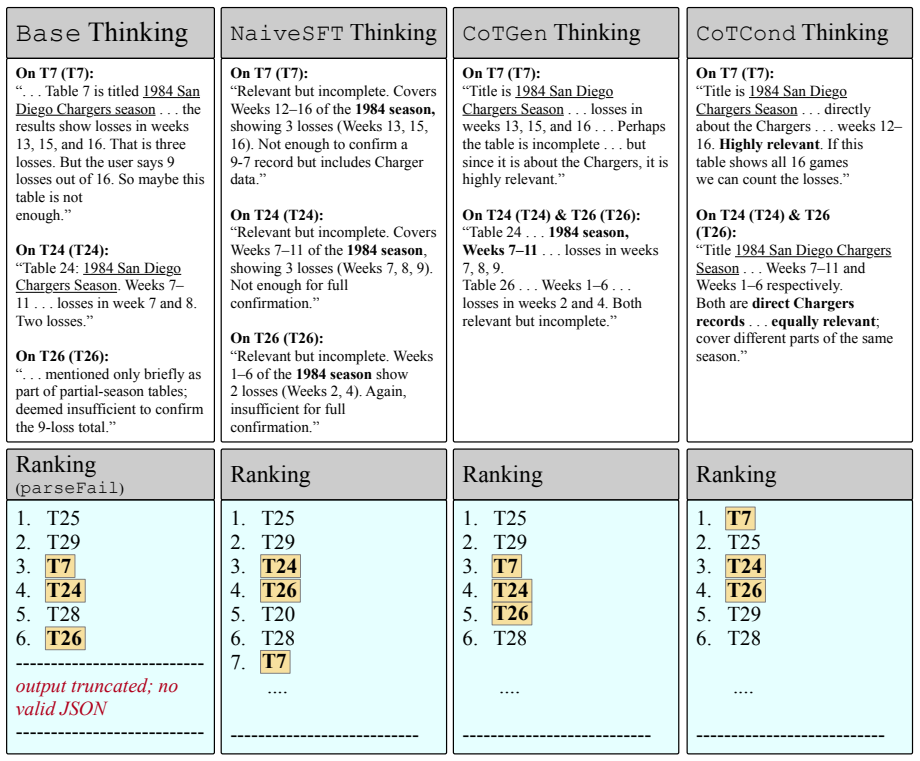
CoTCond ('conditional reasoning distillation') treats the teacher's reasoning trace as contextual input r in the prompt x = [q; T; r] and optimizes only the log-likelihood of the final ranking tokens, L = -log p(σ | q, T, r, σ<t). Standard CoT distillation, by contrast, trains the student to autoregressively reproduce the whole reasoning trace. The paper's central discovery is that this single design choice — conditioning instead of imitation — yields consistent out-of-distribution gains: Accuracy@10 rises 30.5% on HybridQA, 15.2% on SQA, 13.1% on TAT-QA, and 52.9% on TabFact relative to the base reranker. The authors further find that the gains come mostly from eliminating duplicate, empty,
What carries the argument
The machinery is the conditional reasoning distillation objective (Eq. 4): the teacher-generated reasoning trace r is concatenated into the input, and the reranker is trained to maximize the log-likelihood of the final ranking given q, T, and r. The loss is masked so reasoning tokens contribute no gradient. This makes reasoning a conditioning context rather than an imitation target, which the paper argues preserves the structural guidance of reasoning while avoiding overfitting to teacher phraseology and reducing the generation length at inference.
Load-bearing premise
The central claim rests on the untested assumption that the reasoning traces the model produces at inference play the same role as the teacher traces it was conditioned on in training; if self-generated reasoning behaves differently, the experiments do not isolate the proposed mechanism.
What would settle it
Run CoTCond at inference under three conditions: (a) self-generated reasoning, (b) the teacher's actual trace inserted into the prompt, and (c) a random or empty trace. If condition (c) preserves most of the Accuracy@10 gain, the attributed mechanism — conditioning on reasoning content — is falsified; the gain would instead come from something incidental like token budget or decoding regularization.
If this is right
- CoTCond beats CoTGen on every reported metric across the four benchmarks, so imitating teacher reasoning token-by-token is not the best way to distill it for reranking.
- The single-table-trained model transfers to multi-table retrieval without architectural changes, suggesting the conditioning formulation generalizes beyond its training distribution.
- Most of the accuracy gain comes from suppressing structural failures such as duplicate, empty, and unparseable outputs rather than from fine reordering.
- Reasoning supervision can be made cheaper: CoTCond uses fewer tokens than CoTGen while scoring higher.
- The released dataset of 6,728 teacher reasoning traces makes the distillation pipeline reproducible and reusable.
Where Pith is reading between the lines
- The paper leaves the train/inference mismatch untested: CoTCond is trained with teacher reasoning in the prompt, but at inference the model must generate its own reasoning. A control that swaps in teacher traces, random traces, or no traces at inference would reveal whether the mechanism is really conditional reasoning or just the presence of extra tokens.
- The out-of-distribution framing would be stronger with an overlap audit between the Wikipedia-derived training data and the four evaluation benchmarks; without it, part of the reported gain could come from leakage.
- Because CoTCond cuts parse failures and duplicates so sharply, a natural extension is to pair it with constrained decoding or a JSON schema decoder; if the gap over CoTGen persists, the benefit is not just decoding regularization.
Editorial analysis
A structured set of objections, weighed in public.
Referee Report
Summary. The paper proposes TabRank, a framework for training compact listwise table rerankers using reasoning distillation. A teacher model (DeepSeek-R1) generates chain-of-thought traces and final rankings on NQ-Tables training queries; the released data contains 6,728 such traces. The authors compare three distillation strategies: Naive SFT (ranking-loss only), CoTGen (full CoT generation, loss on reasoning and ranking tokens), and CoTCond (teacher reasoning prepended to the input, loss only on ranking tokens). On four Multi-Table QA benchmark subsets (HybridQA, SQA, TAT-QA, TabFact), CoTCond consistently outperforms the base Qwen3-8B reranker, Naive SFT, and CoTGen, with Accuracy@10 gains of 30.5%, 15.2%, 13.1%, and 52.9% respectively. The paper also reports that CoTCond generalizes to multi-table retrieval despite single-table training and that reasoning supervision primarily eliminates structural failures (duplicate/malformed outputs). Code, data, and models are released.
Significance. If the central claim holds, the paper makes a useful empirical contribution: it introduces conditional reasoning distillation as an alternative to trace-generation distillation for reranking, releases a reasoning-trace dataset for table retrieval, and demonstrates large gains on table reranking benchmarks. The paper is also commendable for releasing code, data, and models, and for including an error analysis that goes beyond aggregate metrics. However, the claimed mechanism — that conditioning on teacher reasoning during training is what drives the out-of-distribution gains — is not actually tested as cleanly as the paper implies, because at inference the model must generate its own reasoning tokens rather than receiving the teacher trace. This mismatch, together with the absence of error bars or an overlap audit for the 'out-of-distribution' claim, leaves the central mechanism under-supported.
major comments (4)
- [§5 (Eq. 4), §7, Figure 3, Table 1] The central claim is that conditioning the student on the teacher's reasoning trace r during training (Eq. 4) drives the OOD gains. However, at inference r is unavailable; Figure 3 shows CoTCond generating its own reasoning before outputting the ranking, and Table 1's Avg Tokens column confirms nontrivial self-generated text. This means the CoTCond-vs-NaiveSFT comparison conflates two variables: (i) training-time conditioning on teacher r, and (ii) the presence of self-generated prefatory reasoning at inference. The paper never ablates this mismatch. To support the stated mechanism, please add experiments that, at inference, suppress self-generated reasoning (e.g., a 'no thinking' variant), use the teacher trace as an oracle condition, and train a Naive SFT model that also generates a free-form preamble at inference to control for extra test-time compute. Without this, the paper's attrib
- [§7, Table 1] The paper labels HybridQA, SQA, TabFact, and TAT-QA as 'out-of-distribution', but the base model is trained on NQ-Tables, which is also Wikipedia-derived. HybridQA, SQA, and TabFact share this provenance, and no overlap audit is reported to show that their query–table pairs are disjoint from NQ-Tables training data. If there is table or query overlap, the OOD framing and the magnitude of the gains are inflated. Please report overlap statistics (e.g., exact table overlap, query overlap, or nearest-neighbor overlap) or restrict the OOD claim to TAT-QA, which is clearly a different domain.
- [Table 1, §7] All results are reported as point estimates with no error bars, multiple seeds, or significance tests. SQA has only 148 queries, and several reported differences are small (e.g., SQA Recall@10: 0.8446 for CoTGen vs 0.8840 for CoTCond; TAT-QA Accuracy@10: 0.4144 vs 0.4282). Given the paper's headline claims of 'significant' improvements, please provide at least a bootstrap or permutation test, or report standard deviations over at least three training seeds. This is necessary to establish that the observed margins are not within run-to-run noise.
- [§8] The error analysis concludes that 'most improvements from reasoning distillation come from eliminating structural failures rather than refining fine-grained ranking order.' This interpretation is based on observed category counts, but it is not tested against a controlled comparison. To support the claim, compute metrics on the subset of queries where the base model already produces a valid parse, or condition on parse success. Otherwise, it is possible that CoTCond also improves ordering within valid outputs, and the stated conclusion overreaches.
minor comments (6)
- [§1] The opening paragraph contains a dangling sentence fragment: '... signals important for effective table retrieval. that has received relatively limited attention in existing reranking literature.' Please rephrase.
- [Throughout] The dataset name is written inconsistently: 'TaTQA' appears in the introduction contributions list, while 'TAT-QA' is used elsewhere. Use one consistent form.
- [Table 1 caption] The caption says 'MultiTableQA dataset' while the abstract and text use 'Multi-Table QA Benchmark'. Align the nomenclature.
- [§4.2] The text states the final dataset has 'an average of 20.06 candidate tables', yet §4.1 says the number of tables per sample is uniformly sampled between 10 and 20. Please clarify how the average exceeds the stated upper bound (e.g., if filtering or merging changes the distribution).
- [§7, evaluation protocol] The paper does not specify the inference-time prompt and decoding settings for the rerankers (temperature, max tokens, JSON parsing procedure, handling of malformed output). This is important for reproducibility, especially given the 'Avg Tokens' and 'Fails' statistics; please add an appendix section describing the exact inference pipeline.
- [Figure 1] The figure uses icons (slash and checkmark) that may not render in all PDF viewers. Consider replacing them with explicit text labels such as 'no loss' and 'loss' to ensure clarity.
Circularity Check
No circular derivation: CoTCond's reported gains are evaluated against external gold labels, not against the teacher outputs that produced its training data; the only self-referential feature is a train/inference design choice, not a reduction.
full rationale
I walked the paper's derivation chain from data generation (Section 4) through the three distillation objectives (Section 5) to the OOD evaluation (Section 7). No load-bearing step reduces to its own inputs. The teacher-generated reasoning traces and final rankings are used as training supervision, but the reported Acc@10, Recall@K, and nDCG@K values in Table 1 are computed against gold relevance labels in HybridQA, SQA, TAT-QA, and TabFact, not against the teacher's rankings. Consequently, CoTCond's improvements are not fitted-input-called-prediction: the evaluation targets are external and not produced by the model's training procedure. The paper has no uniqueness theorem imported from the authors' prior work, no ansatz smuggled in via self-citation, and no load-bearing self-citation at all; the cited works (DeepSeek-R1, Rank1, Rank-R1, NQ-Tables, etc.) are external. The train/inference mismatch noted in the reader's take (teacher reasoning trace at training, self-generated reasoning tokens at inference, Figure 3 and Table 1's Avg Tokens) is a real experimental-validity concern about whether the mechanism is isolated, but it is not circularity in the required sense: the model is not predicting the teacher trace, and the metric is not defined in terms of the training labels. Similarly, the paper's own error analysis says the improvements 'stem from eliminating structural failures rather than from marginal reordering gains'; this reframes the contribution but does not make any reported number equal by construction to an input. The unverified absence of table overlap between NQ-Tables and the Wikipedia-derived evaluation sets is a data-hygiene concern, not a circularity. Under the stated rubric, the appropriate finding is no significant circularity.
Axiom & Free-Parameter Ledger
free parameters (5)
- Teacher sampling temperature =
0.7
- Minimum candidate count filter =
9
- Maximum token filter =
25000
- Candidate list size per training sample =
10-20 (uniform)
- Learning rate for LoRA fine-tuning =
5e-5
axioms (5)
- domain assumption DeepSeek-R1 teacher reasoning traces and final rankings are a reliable supervision signal for table reranking.
- domain assumption The four Multi-Table QA subsets (HybridQA, SQA, TabFact, TAT-QA) provide valid relevance labels and faithful OOD test settings for a model trained on NQ-Tables.
- domain assumption Single-table supervision on NQ-Tables transfers to multi-table retrieval.
- domain assumption RRF fusion of BM25, SPLADE-V3, and all-mpnet-base-v2 yields candidate sets suitable for training and evaluation.
- domain assumption Filtering out malformed teacher outputs does not bias the training distribution.
Cite this review
Pith. "Pith review of TabRank: Chain-of-Thought Distillation for Table Re-Rankers." pith.science (2026). https://pith.science/paper/LMXJZ7OS
@misc{pith2026260725182,
  author       = {Pith},
  title        = {Pith review of: TabRank: Chain-of-Thought Distillation for Table Re-Rankers},
  year         = {2026},
  howpublished = {\url{https://pith.science/paper/LMXJZ7OS}},
  note         = {Machine review of arXiv:2607.25182}
}
read the original abstract
The ability to retrieve relevant tables for answering questions is a key task for structured information retrieval. Multi-stage retrieval systems rely heavily on rerankers to refine candidate lists produced by efficient first-stage retrievers. As a result, neural rerankers and LLM-based reranking methods have become increasingly important due to their superior capacity for semantic understanding and reasoning compared to conventional sparse or dense retrieval models. Recently, Large Reasoning Models (LRMs) equipped with explicit chain-of-thought (CoT) reasoning have shown strong improvements in ranking quality in unstructured passage retrieval. In this work, we present TabRank, a framework for training reasoning rerankers for Tabular Retrieval. We first present a comprehensive dataset of 6728 reasoning traces for tabular reranking on the Natural Questions Tables dataset. We then explore two variants of training a compact reasoning model on these reasoning traces: explicit CoT distillation and conditioning the student reranker on the teacher's reasoning trace within the prompt. We stress-test TabRank on several out-of-distribution generalization settings on diverse domains and multi-table scenarios. Our approach significantly improves performance across a variety of table retrieval datasets, increasing Acc@10 by 30.5% on HybridQA, 15.2% on SQA, 52.9% on TabFact, and 13.1% on TATQA subsets of the Multi-Table QA Benchmark compared to the base model. Notably, TabRank generalizes effectively to multi-table reasoning. Our code, data and models are available at https://github.com/AdarshSingh7647/TabRanker
Figures



Reference graph
Works this paper leans on
-
[1]
Aho and Jeffrey D
Alfred V. Aho and Jeffrey D. Ullman , title =. 1972
1972
-
[2]
Publications Manual , year = "1983", publisher =
1983
-
[3]
Ashok K. Chandra and Dexter C. Kozen and Larry J. Stockmeyer , year = "1981", title =. doi:10.1145/322234.322243
arXiv 1981
-
[4]
Scalable training of
Andrew, Galen and Gao, Jianfeng , booktitle=. Scalable training of. 2007 , url=
2007
-
[5]
Dan Gusfield , title =. 1997
1997
-
[6]
Tetreault , title =
Mohammad Sadegh Rasooli and Joel R. Tetreault , title =. Computing Research Repository , volume =. 2015 , url =
2015
-
[7]
A Framework for Learning Predictive Structures from Multiple Tasks and Unlabeled Data , Volume =
Ando, Rie Kubota and Zhang, Tong , Issn =. A Framework for Learning Predictive Structures from Multiple Tasks and Unlabeled Data , Volume =. Journal of Machine Learning Research , Month = dec, Numpages =. 2005 , url=
2005
-
[8]
and Tukey, John W
Cooley, James W. and Tukey, John W. , journal=. An algorithm for the machine calculation of complex. 1965 , url=
1965
-
[9]
Nature , volume=
DeepSeek-R1 incentivizes reasoning in LLMs through reinforcement learning , author=. Nature , volume=. 2025 , publisher=
2025
-
[10]
Improve Student ' s Reasoning Generalizability through Cascading Decomposed C o T s Distillation
Dai, Chengwei and Li, Kun and Zhou, Wei and Hu, Songlin. Improve Student ' s Reasoning Generalizability through Cascading Decomposed C o T s Distillation. Proceedings of the 2024 Conference on Empirical Methods in Natural Language Processing. 2024. doi:10.18653/v1/2024.emnlp-main.875
-
[11]
arXiv preprint arXiv:2510.08985 , year=
Rethinking Reasoning in Document Ranking: Why Chain-of-Thought Falls Short , author=. arXiv preprint arXiv:2510.08985 , year=
-
[12]
Document Ranking with a Pretrained Sequence-to-Sequence Model
Nogueira, Rodrigo and Jiang, Zhiying and Pradeep, Ronak and Lin, Jimmy. Document Ranking with a Pretrained Sequence-to-Sequence Model. Findings of the Association for Computational Linguistics: EMNLP 2020. 2020. doi:10.18653/v1/2020.findings-emnlp.63
-
[13]
Proceedings of the 46th international ACM SIGIR conference on research and development in information retrieval , pages=
Rankt5: Fine-tuning t5 for text ranking with ranking losses , author=. Proceedings of the 46th international ACM SIGIR conference on research and development in information retrieval , pages=
-
[14]
Proceedings of the 2023 conference on empirical methods in natural language processing , pages=
Is ChatGPT good at search? investigating large language models as re-ranking agents , author=. Proceedings of the 2023 conference on empirical methods in natural language processing , pages=
2023
-
[15]
arXiv preprint arXiv:2309.15088 , year=
Rankvicuna: Zero-shot listwise document reranking with open-source large language models , author=. arXiv preprint arXiv:2309.15088 , year=
-
[16]
arXiv preprint arXiv:2312.02724 , year=
Rankzephyr: Effective and robust zero-shot listwise reranking is a breeze! , author=. arXiv preprint arXiv:2312.02724 , year=
-
[17]
Proceedings of the 47th International ACM SIGIR Conference on Research and Development in Information Retrieval , pages=
Fine-tuning llama for multi-stage text retrieval , author=. Proceedings of the 47th International ACM SIGIR Conference on Research and Development in Information Retrieval , pages=
-
[18]
Proceedings of the 2024 Conference on Empirical Methods in Natural Language Processing , pages=
FIRST: Faster improved listwise reranking with single token decoding , author=. Proceedings of the 2024 Conference on Empirical Methods in Natural Language Processing , pages=
2024
-
[19]
arXiv preprint arXiv:2412.16720 , year=
Openai o1 system card , author=. arXiv preprint arXiv:2412.16720 , year=
-
[20]
arXiv preprint arXiv:2501.12948 , year=
Deepseek-r1: Incentivizing reasoning capability in llms via reinforcement learning , author=. arXiv preprint arXiv:2501.12948 , year=
-
[21]
arXiv preprint arXiv:2502.18418 , year=
Rank1: Test-time compute for reranking in information retrieval , author=. arXiv preprint arXiv:2502.18418 , year=
-
[22]
arXiv preprint arXiv:2504.20595 , year=
Reasonir: Training retrievers for reasoning tasks , author=. arXiv preprint arXiv:2504.20595 , year=
-
[23]
arXiv preprint arXiv:2508.07050 , year=
Reasonrank: Empowering passage ranking with strong reasoning ability , author=. arXiv preprint arXiv:2508.07050 , year=
-
[24]
arXiv preprint arXiv:2503.06034 , year=
Rank-r1: Enhancing reasoning in llm-based document rerankers via reinforcement learning , author=. arXiv preprint arXiv:2503.06034 , year=
-
[25]
arXiv preprint arXiv:2505.14984 , year=
CRAFT: Training-Free Cascaded Retrieval for Tabular QA , author=. arXiv preprint arXiv:2505.14984 , year=
-
[26]
Proceedings of the 2021 Conference of the North American Chapter of the Association for Computational Linguistics: Human Language Technologies , pages=
Open domain question answering over tables via dense retrieval , author=. Proceedings of the 2021 Conference of the North American Chapter of the Association for Computational Linguistics: Human Language Technologies , pages=
2021
-
[27]
Don't" Overthink" Passage Reranking: Is Reasoning Truly Necessary? , author=. arXiv preprint arXiv:2505.16886 , year=
-
[28]
arXiv preprint arXiv:2504.01346 , year=
RAG over Tables: Hierarchical Memory Index, Multi-Stage Retrieval, and Benchmarking , author=. arXiv preprint arXiv:2504.01346 , year=
-
[29]
arXiv e-prints , pages=
GTR: graph-table-rag for cross-table question answering , author=. arXiv e-prints , pages=
-
[30]
2024 , eprint=
SPLADE-v3: New baselines for SPLADE , author=. 2024 , eprint=
2024
-
[31]
Proceedings of the 34th International Conference on Neural Information Processing Systems , articleno =
Song, Kaitao and Tan, Xu and Qin, Tao and Lu, Jianfeng and Liu, Tie-Yan , title =. Proceedings of the 34th International Conference on Neural Information Processing Systems , articleno =. 2020 , isbn =
2020
-
[32]
Open Domain Question Answering over Tables via Dense Retrieval
Herzig, Jonathan and M. Open Domain Question Answering over Tables via Dense Retrieval. Proceedings of the 2021 Conference of the North American Chapter of the Association for Computational Linguistics: Human Language Technologies. 2021. doi:10.18653/v1/2021.naacl-main.43
-
[33]
2025 , eprint=
Qwen3 Technical Report , author=. 2025 , eprint=
2025
discussion (0)
Sign in with ORCID, Apple, or X to comment. Anyone can read and Pith papers without signing in.