REVIEW 4 major objections 6 minor 63 references
ScanFocus claims that decoupling spatio-temporal video grounding into a coarse global scan and a dense local boundary-focus stage, driven by the Semantic-Guided Temporal Aggregator, recovers the high-frequency boundary cues that low-rate do
Reviewed by Pith at T0; open to challenge. T0 means a machine referee read the full paper against a public rubric. the ladder, T0–T4 →
A coarse-to-fine video-grounding framework improves temporal boundary accuracy by densely re-examining frames around coarse start/end predictions, achieving SOTA on HC-STVGv1/v2 and VidSTG.
T0 review reviewed 2026-08-02 challenge →
load-bearing objection A solid, well-ablated coarse-to-fine STVG paper with a real but unmeasured assumption about how close the coarse stage needs to be; worth a serious referee. the 4 major comments →
ScanFocus: A Coarse-to-Fine Framework for Spatio-Temporal Video Grounding
The pith
A machine-rendered reading of the paper's core claim, the machinery that carries it, and where it could break.
The reading
Core claim
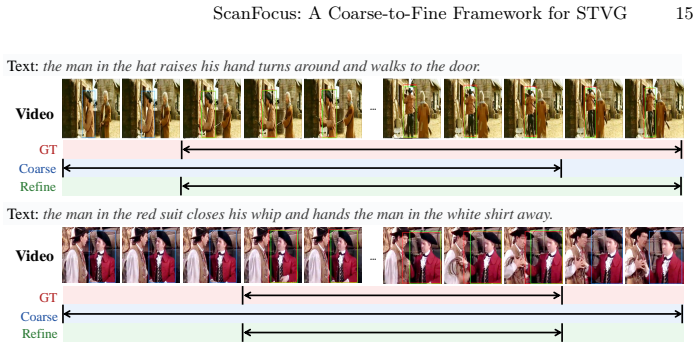
ScanFocus claims that a coarse-to-fine decomposition of spatio-temporal video grounding—first a sparse global scan that produces a rough temporal interval, then a local boundary-focus stage that densely samples frames around that interval and explicitly models inter-frame dependencies—recovers the high-frequency boundary cues lost to standard low-rate temporal subsampling, and that this recovery is what drives precise start/end timestamp regression. The central evidence is a set of benchmark results: on HC-STVGv1, the method reaches m_tIoU 55.5, m_vIoU 41.8, vIoU@0.3 67.5, and vIoU@0.5 42.2, surpassing the previous best (TA-STVG) by 4.4 and 5.4 points on vIoU@0.3 and vIoU@0.5 respectively; c
What carries the argument
The key machinery is the local boundary-focus stage built around the Semantic-Guided Temporal Aggregator (SGTA). Given a coarse predicted interval, the method densely samples Nw=8 frames at twice the coarse frame rate in two windows centered on the predicted start and end. SGTA then: (1) uses the coarse bounding-box sequence, temporally interpolated to the window length, as a spatial prior for RoI pooling on the appearance features; (2) modulates the motion features by the object-aligned appearance features (Hadamard product) and injects the text features as a bias; and (3) flattens the resulting semantic-guided motion tokens into a sequence and passes them through stacked temporal self-atte
Load-bearing premise
The refinement stage can only fix boundaries if the true start and end frames fall inside the dense sampling windows centered on the coarse predictions; if the coarse interval is off by more than about half a window, the refinement never sees the true boundary, and the paper does not measure how often that happens.
What would settle it
Compute the fraction of ground-truth start and end timestamps that lie within the Nw=8 dense windows (sampled at twice the coarse rate) around the model's coarse predictions. If that recall is significantly below 100%—say, under 90%—then the refinement stage is provably unable to recover those missed boundaries, and the gain attributed to SGTA would overstate the recoverable improvement. A complementary experiment: feed the refine stage with coarse intervals artificially perturbed by increasing offsets (0, 2, 4, 6, 8 frames) and measure how quickly precision degrades; the degradation curve rev
If this is right
- If the decoupling claim holds, temporal boundary precision in spatio-temporal video grounding can be improved without paying the full cost of dense global processing, since the dense computation is confined to small windows around coarse boundaries.
- The oracle experiment implies that the spatial grounding branch is already near-saturated; further gains on these benchmarks are most likely to come from better temporal boundary modeling, not better object detection.
- The SGTA design—semantic guidance via RoI pooling on interpolated coarse boxes plus temporal self-attention on flattened tokens—offers a reusable template for other video tasks that need fine temporal boundaries, such as action localization or moment retrieval.
- Replacing the heavy MDETR-style tri-modal fusion with a general pre-trained vision-language encoder plus a lightweight deformable fusion reduces computational cost while improving accuracy, suggesting that decoupling perception and fusion can be beneficial beyond this task.
- The reported gains are largest on strict temporal-spatial overlap thresholds (vIoU@0.3 and vIoU@0.5), indicating that the method specifically improves boundary sharpness rather than just coarse region agreement.
Where Pith is reading between the lines
- The paper's fixed window size (Nw=8 at twice the coarse rate) implies a hard reach: any true boundary more than half a window away from the coarse prediction is invisible to the refinement stage. A natural testable consequence is that the method's gains should concentrate on clips where the coarse prediction is already within a few frames of the true boundary; if that recall is low, the reported m
- The same coarse-to-fine recipe could be applied in an iterative or cascaded manner (refine the refined boundaries again), or with adaptive window sizes based on coarse confidence, which the paper does not explore.
- Because the refinement stage reuses the coarse features and only adds lightweight modules, the approach suggests that the bottleneck in many video-language tasks may be temporal granularity rather than model capacity; a cheaper fix for existing systems might be to add a similar boundary-refinement head rather than retrain the whole model.
- If the oracle gap is as large as reported (vIoU@0.3 jumps to 94% with ground-truth timestamps), then even a perfect temporal-refinement module would still leave substantial room before spatial grounding becomes the limiting factor; the paper's framing implies that future work should focus on boundary regression accuracy, perhaps with explicit uncertainty estimation.
Editorial analysis
A structured set of objections, weighed in public.
Referee Report
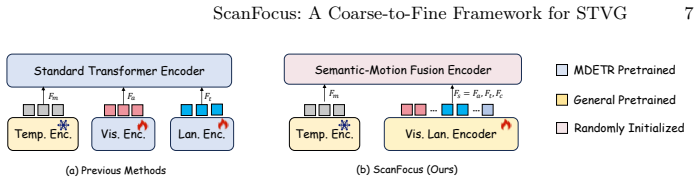
Summary. ScanFocus proposes a two-stage coarse-to-fine framework for spatio-temporal video grounding (STVG). A global stage uniformly samples T_c=64 frames at a low rate, fuses BEiT-3 appearance/text features with VideoMAE motion features via a lightweight deformable semantic-motion fusion encoder, and generates coarse spatial tubes and a coarse temporal interval with dual DETR-style decoders. A local refinement stage then densely samples N_w=8 frames at twice the coarse rate around each predicted boundary, applies the Semantic-Guided Temporal Aggregator (SGTA) to model short-term inter-frame dependencies, and regresses refined start/end timestamps. The paper reports state-of-the-art numbers on HC-STVGv1, HC-STVGv2, and VidSTG, an oracle experiment attributing most remaining error to temporal localization, and ablations over components, window size, SGTA design, and fusion mechanism.
Significance. If the reported results are reproducible, ScanFocus is a solid contribution to STVG: it targets a real limitation of low-frame-rate global modeling, provides a clean architecture that decouples global context from local boundary precision, and reports consistent gains across three benchmarks. The oracle analysis in Fig. 2 is a valuable diagnostic, and the component ablations in Tables 4–7 generally support the design choices; the efficiency gain in Table 7 is also a concrete plus. The main risk is that the refinement stage's central assumption—that coarse boundaries fall within ±1.75 coarse sampling intervals—is not validated. Without a hit-rate analysis, the mechanism claimed to recover high-frequency cues is not actually demonstrated.
major comments (4)
- [Sec. 3.4 (Dense Boundary Sampling)] The refinement windows sample N_w=8 frames at f_r=2·f_c centered on the predicted coarse boundaries. The largest boundary offset that can possibly be recovered is therefore (N_w−1)/(2·f_r)=7/(4·f_c)≈1.75 coarse frame intervals. The paper never reports the distribution of coarse-boundary errors, the fraction of GT boundaries that fall inside the sampled windows, or whether refine-stage training windows are centered on predicted or GT coarse boundaries. Without this, the 2.8-point tIoU improvement in Table 4 (50.9→53.7) and the SOTA claim remain consistent with refinement helping only samples with already-accurate coarse predictions; GT-centered training would additionally create a train/test mismatch. Please report coarse-interval recall / window hit-rate and the exact training window centering.
- [Sec. 4.3, Tables 4–6] Tables 4–6 report single runs with no error bars, standard deviations, or significance tests. Some of the claims rest on small differences: Full SGTA vs w/o SG is 0.6 tIoU and vs w/o TA is 0.9 tIoU in Table 6. Moreover, ablations are run at 224×224, while the main comparisons in Tables 1–3 use 384×384 and a different backbone than prior methods, so the apparent SOTA margin may partly reflect the choice of BEiT-3/VideoMAE rather than the coarse-to-fine design. Please report multi-seed statistics and a same-backbone, same-resolution baseline (e.g., the coarse global stage without refinement) in the main results.
- [Sec. 4.1 (Implementation)] Sec. 4.1 states that detailed network configurations and loss weights are provided in the Supplementary Material, but no supplementary document is included with arXiv v1, and the paper also refers to it for the other datasets' oracle experiments (Sec. 4.1, Fig. 2 caption). Without specifying the number of encoder/decoder layers, attention heads, loss weights λ_box/λ_tmp/λ_ref/λ_act, learning rates, and training iterations, the experiments are not reproducible. The refine-stage training protocol is especially important because it determines whether the model sees predicted or GT windows during training.
- [Sec. 3.3 (Feature Extraction)] Motion features are defined as F_m ∈ R^{T×N_m×C_m} with T the original video length, while the coarse input consists of only T_c uniformly sampled frames. If VideoMAE is applied to the full T frames, the claimed computational savings from sparse sampling are negated; if it is applied to the sampled frames, the notation is inconsistent and the alignment between F_m and F_a (which has T_c frames) needs to be stated precisely. The same issue affects the complexity analysis in Table 7, which reports GFLOPs but not the temporal resolution used for motion extraction.
minor comments (6)
- [Sec. 3.4] First sentence: 'motion details that suppressed by' should be 'that are suppressed by'.
- [Eq. (5)] The projections φ_a and φ_t are not dimensionally specified; please give the output dimensions of φ_a(F_ps^a) and φ_t(F_rs^t), or state that all features are projected to a common channel C.
- [Fig. 3] The dense-boundary-sampling region contains many unreadable small labels (e.g., 'cc_132509', '1424', the list of numbers); please enlarge fonts and remove irrelevant tokens.
- [Sec. 4.3] 'For brevity, tiou and viou are used to represent m_tIoU and m_vIoU'—define these abbreviations at first use and use consistent capitalization.
- [Sec. 4.1] Inputs are resized to 384×384 for main results but ablations use 224×224. Please clarify whether the GFLOPs in Tables 5 and 7 correspond to the 224×224 or 384×384 setting.
- [References] Reference [46] has a typo ('Protege'); reference [55] contains a stray '(7)' in the arXiv ID. Please verify the official bibliographic details.
Circularity Check
No significant circularity: benchmark claims are empirical; refinement stage is not definitionally tied to coarse outputs.
full rationale
ScanFocus's central claim is an empirical SOTA result on HC-STVGv1/v2 and VidSTG, not a derivation. The coarse-to-fine refinement uses the coarse interval only to center dense windows (Sec. 3.4); the refine decoder independently regresses start/end probabilities (Eq. 8) and can output timestamps different from the coarse ones, so the prediction is not forced by construction. The only self-citation by overlapping authors is ref. [12] (GC3VG), cited in a list of visual-grounding works (Sec. 2.2) and not used to justify the framework, its equations, or the choice of coarse-to-fine structure; it is therefore not load-bearing. Hyperparameter selection of Nw=8 on HC-STVGv1 (Table 5) is benchmark tuning, not a fitted-parameter-called-prediction. The oracle experiment (Fig. 2) uses GT timestamps as an analysis of the spatial/temporal bottleneck, not as a claimed prediction. The unvalidated recoverable-range assumption for the dense windows is a correctness risk, not circularity.
Axiom & Free-Parameter Ledger
free parameters (4)
- Nw (refine window size) =
8
- kr (refine density factor) =
2
- Tc (coarse frame count) =
64
- Loss weights lambda_box, lambda_tmp, lambda_ref, lambda_act =
not given in paper
axioms (5)
- domain assumption BEiT-3's unified vision-language pretraining provides features already aligned across visual and textual modalities (Sec. 3.3).
- domain assumption Frozen VideoMAE motion features adequately encode motion for STVG (Sec. 3.3).
- domain assumption Coarse predicted boundary windows cover the true boundaries often enough (Sec. 3.4).
- domain assumption Deformable attention in Eq. (2) with learnable offsets preserves the information needed for temporal boundary localization (Sec. 3.3).
- domain assumption Benchmark splits and reported baselines are directly comparable (Sec. 4.1).
Cite this review
Pith. "Pith review of ScanFocus: A Coarse-to-Fine Framework for Spatio-Temporal Video Grounding." pith.science (2026). https://pith.science/paper/LNIWPIZJ
@misc{pith2026260713421,
  author       = {Pith},
  title        = {Pith review of: ScanFocus: A Coarse-to-Fine Framework for Spatio-Temporal Video Grounding},
  year         = {2026},
  howpublished = {\url{https://pith.science/paper/LNIWPIZJ}},
  note         = {Machine review of arXiv:2607.13421}
}
read the original abstract
Spatio-Temporal Video Grounding (STVG) aims to retrieve the visual trajectory of a specific object from a video stream as described by a natural language expression. However, most advanced methods struggle to balance global context modeling with precise boundary localization. Due to the prohibitive computational costs of processing long videos, these approaches typically resort to low-rate temporal downsampling and implicit motion modeling. This inevitably suppresses high-frequency boundary cues and neglects the explicit inter-frame dependencies required for precise boundary delineation. To address these limitations, we present \textbf{ScanFocus}, a novel coarse-to-fine framework that decouples the STVG task into a global spatio-temporal scan and a local boundary focus. Specifically, we utilize a unified vision-language fusion encoder combined with a lightweight Deformable Semantic-Motion Fusion module to efficiently align multimodal features and generate coarse proposals. To recover the suppressed fine-grained details, we introduce the Semantic-Guided Temporal Aggregator (SGTA) in the refinement stage. By densely sampling around coarse boundaries, SGTA explicitly models short-term temporal interactions under semantic guidance, capturing rapid motion changes for precise timestamp regression. Extensive experiments on three widely used benchmarks demonstrate the performance superiority of our proposed method over previous approaches. Code will be released at https://github.com/TenMinutes209/ScanFocus.
Figures



Reference graph
Works this paper leans on
-
[1]
arXiv preprint arXiv:2303.08774 (2023)
Achiam, J., Adler, S., Agarwal, S., Ahmad, L., Akkaya, I., Aleman, F.L., Almeida, D., Altenschmidt, J., Altman, S., Anadkat, S., et al.: Gpt-4 technical report. arXiv preprint arXiv:2303.08774 (2023)
Pith/arXiv arXiv 2023
-
[2]
In: ICCV
Anne Hendricks, L., Wang, O., Shechtman, E., Sivic, J., Darrell, T., Russell, B.: Lo- calizing moments in video with natural language. In: ICCV. pp. 5803–5812 (2017)
2017
-
[3]
In: ICCV
Antol, S., Agrawal, A., Lu, J., Mitchell, M., Batra, D., Zitnick, C.L., Parikh, D.: Vqa: Visual question answering. In: ICCV. pp. 2425–2433 (2015)
2015
-
[4]
arXiv preprint arXiv:2511.21631 (2025)
Bai, S., Cai, Y., Chen, R., Chen, K., Chen, X., Cheng, Z., Deng, L., Ding, W., Gao, C., Ge, C., et al.: Qwen3-vl technical report. arXiv preprint arXiv:2511.21631 (2025)
Pith/arXiv arXiv 2025
-
[5]
arXiv preprint arXiv:2106.08254 (2021)
Bao, H., Dong, L., Piao, S., Wei, F.: Beit: Bert pre-training of image transformers. arXiv preprint arXiv:2106.08254 (2021)
Pith/arXiv arXiv 2021
-
[6]
In: ICCV
Barrios, W., Soldan, M., Ceballos-Arroyo, A.M., Heilbron, F.C., Ghanem, B.: Lo- calizing moments in long video via multimodal guidance. In: ICCV. pp. 13667– 13678 (2023)
2023
-
[7]
In: ECCV
Cao, M., Yang, T., Weng, J., Zhang, C., Wang, J., Zou, Y.: Locvtp: Video-text pre-training for temporal localization. In: ECCV. pp. 38–56. Springer (2022)
2022
-
[8]
In: WACV
Cao, Z., Zhang, B., Du, H., Yu, X., Li, X., Wang, S.: Flashvtg: Feature layering and adaptive score handling network for video temporal grounding. In: WACV. pp. 9226–9236. IEEE (2025)
2025
-
[9]
In: ECCV
Carion, N., Massa, F., Synnaeve, G., Usunier, N., Kirillov, A., Zagoruyko, S.: End- to-end object detection with transformers. In: ECCV. pp. 213–229. Springer (2020)
2020
-
[10]
Chen et al
Chen, W., Chen, L., Wu, Y.: An efficient and effective transformer decoder-based frameworkformulti-taskvisualgrounding.In:ECCV.pp.125–141.Springer(2024) 16 K. Chen et al
2024
-
[11]
NeurIPS34, 28442–28453 (2021)
Chen, Y.W., Tsai, Y.H., Yang, M.H.: End-to-end multi-modal video temporal grounding. NeurIPS34, 28442–28453 (2021)
2021
-
[12]
TCSVT (2025)
Dai,M.,Chen,K.,Cheng,W.,Zhuang,J.,Feng,Z.,Zhu,P.,Yang,W.:Gc3vg:Gen- eralized multi-task visual grounding with coarse-to-fine consistency constraints. TCSVT (2025)
2025
-
[13]
TPAMI (2025)
Dai, M., Cheng, W., Liu, J.J., Yang, L., Feng, Z., Yang, W., Wang, J.: Improving generalized visual grounding with instance-aware joint learning. TPAMI (2025)
2025
-
[14]
In: ICCV
Dai, M., Cheng, W., Liu, J.j., Yang, S., Cai, W., Sun, Y., Yang, W.: Deris: Decou- pling perception and cognition for enhanced referring image segmentation through loopback synergy. In: ICCV. pp. 19936–19946 (2025)
2025
-
[15]
NeurIPS37, 121670–121698 (2024)
Dai, M., Yang, L., Xu, Y., Feng, Z., Yang, W.: Simvg: A simple framework for visual grounding with decoupled multi-modal fusion. NeurIPS37, 121670–121698 (2024)
2024
-
[16]
arXiv preprint arXiv:2510.09274 (2025)
Dai, M., Yang, S., Duan, B., Yang, W., Wang, J.: Momentseg: Moment-centric sampling for enhanced video pixel understanding. arXiv preprint arXiv:2510.09274 (2025)
arXiv 2025
-
[17]
In: ICCV
Gao, J., Sun, C., Yang, Z., Nevatia, R.: Tall: Temporal activity localization via language query. In: ICCV. pp. 5267–5275 (2017)
2017
-
[18]
In: CVPR
Gu, X., Chen, G., Wang, Y., Zhang, L., Luo, T., Wen, L.: Text with knowledge graph augmented transformer for video captioning. In: CVPR. pp. 18941–18951 (2023)
2023
-
[19]
In: CVPR
Gu, X., Fan, H., Huang, Y., Luo, T., Zhang, L.: Context-guided spatio-temporal video grounding. In: CVPR. pp. 18330–18339 (2024)
2024
-
[20]
arXiv preprint arXiv:2502.11168 (2025)
Gu, X., Shen, Y., Luo, C., Luo, T., Huang, Y., Lin, Y., Fan, H., Zhang, L.: Knowing your target: Target-aware transformer makes better spatio-temporal video ground- ing. arXiv preprint arXiv:2502.11168 (2025)
Pith/arXiv arXiv 2025
-
[21]
arXiv preprint arXiv:2511.21375 (2025)
Gu, X., Zhang, H., Fan, Q., Niu, J., Zhang, Z., Zhang, L., Chen, G., Chen, F., Wen, L., Zhu, S.: Thinking with bounding boxes: Enhancing spatio-temporal video grounding via reinforcement fine-tuning. arXiv preprint arXiv:2511.21375 (2025)
arXiv 2025
-
[22]
arXiv preprint arXiv:2501.12948 (2025)
Guo, D., Yang, D., Zhang, H., Song, J., Wang, P., Zhu, Q., Xu, R., Zhang, R., Ma, S., Bi, X., et al.: Deepseek-r1: Incentivizing reasoning capability in llms via reinforcement learning. arXiv preprint arXiv:2501.12948 (2025)
Pith/arXiv arXiv 2025
-
[23]
Guo, D., Wu, F., Zhu, F., Leng, F., Shi, G., Chen, H., Fan, H., Wang, J., Jiang, J., Wang, J., et al.: Seed1. 5-vl technical report. arXiv preprint arXiv:2505.07062 (2025)
Pith/arXiv arXiv 2025
-
[24]
In: ECCV
Hao, J., Sun, H., Ren, P., Wang, J., Qi, Q., Liao, J.: Can shuffling video benefit temporal bias problem: A novel training framework for temporal grounding. In: ECCV. pp. 130–147. Springer (2022)
2022
-
[25]
In: CVPR
Jiang, H., Misra, I., Rohrbach, M., Learned-Miller, E., Chen, X.: In defense of grid features for visual question answering. In: CVPR. pp. 10267–10276 (2020)
2020
-
[26]
NeurIPS35, 29192–29204 (2022)
Jin, Y., Yuan, Z., Mu, Y., et al.: Embracing consistency: A one-stage approach for spatio-temporal video grounding. NeurIPS35, 29192–29204 (2022)
2022
-
[27]
In: ICCV
Kamath, A., Singh, M., LeCun, Y., Synnaeve, G., Misra, I., Carion, N.: Mdetr- modulated detection for end-to-end multi-modal understanding. In: ICCV. pp. 1780–1790 (2021)
2021
-
[28]
In: ECCV
Kang, W., Liu, G., Shah, M., Yan, Y.: Segvg: Transferring object bounding box to segmentation for visual grounding. In: ECCV. pp. 57–75. Springer (2024)
2024
-
[29]
NeurIPS34, 11846–11858 (2021) ScanFocus: A Coarse-to-Fine Framework for STVG 17
Lei, J., Berg, T.L., Bansal, M.: Detecting moments and highlights in videos via natural language queries. NeurIPS34, 11846–11858 (2021) ScanFocus: A Coarse-to-Fine Framework for STVG 17
2021
-
[30]
In: CVPR
Li, H., Chen, J., Wei, Z., Huang, S., Hui, T., Gao, J., Wei, X., Liu, S.: Llava-st: A multimodal large language model for fine-grained spatial-temporal understanding. In: CVPR. pp. 8592–8603 (2025)
2025
-
[31]
IEEE transactions on medical imaging43(1), 96–107 (2023)
Li, Z., Li, Y., Li, Q., Wang, P., Guo, D., Lu, L., Jin, D., Zhang, Y., Hong, Q.: Lvit: language meets vision transformer in medical image segmentation. IEEE transactions on medical imaging43(1), 96–107 (2023)
2023
-
[32]
In: ICCV
Lin, K.Q., Zhang, P., Chen, J., Pramanick, S., Gao, D., Wang, A.J., Yan, R., Shou, M.Z.: Univtg: Towards unified video-language temporal grounding. In: ICCV. pp. 2794–2804 (2023)
2023
-
[33]
In: CVPR
Lin, Z., Tan, C., Hu, J.F., Jin, Z., Ye, T., Zheng, W.S.: Collaborative static and dynamic vision-language streams for spatio-temporal video grounding. In: CVPR. pp. 23100–23109 (2023)
2023
-
[34]
In: ECCV
Liu, Y., He, J., Li, W., Kim, J., Wei, D., Pfister, H., Chen, C.W.: r 2-tuning: Efficient image-to-video transfer learning for video temporal grounding. In: ECCV. pp. 421–438. Springer (2024)
2024
-
[35]
arXiv preprint arXiv:2311.08835 (2023)
Moon, W., Hyun, S., Lee, S., Heo, J.P.: Correlation-guided query-dependency cal- ibration for video temporal grounding. arXiv preprint arXiv:2311.08835 (2023)
Pith/arXiv arXiv 2023
-
[36]
In: CVPR
Moon, W., Hyun, S., Park, S., Park, D., Heo, J.P.: Query-dependent video repre- sentation for moment retrieval and highlight detection. In: CVPR. pp. 23023–23033 (2023)
2023
-
[37]
In: CVPR
Mun, J., Cho, M., Han, B.: Local-global video-text interactions for temporal grounding. In: CVPR. pp. 10810–10819 (2020)
2020
-
[38]
In: CVPR
Ren, Z., Huang, Z., Wei, Y., Zhao, Y., Fu, D., Feng, J., Jin, X.: Pixellm: Pixel reasoning with large multimodal model. In: CVPR. pp. 26374–26383 (2024)
2024
-
[39]
In: ICCV
Shen,Y.,Gu,X.,Xu,K.,Fan,H.,Wen,L.,Zhang,L.:Accurateandfastcompressed video captioning. In: ICCV. pp. 15558–15567 (2023)
2023
-
[40]
In: ICCV
Su, R., Yu, Q., Xu, D.: Stvgbert: A visual-linguistic transformer based framework for spatio-temporal video grounding. In: ICCV. pp. 1533–1542 (2021)
2021
-
[41]
arXiv preprint arXiv:2106.10634 (2021)
Tan, C., Lin, Z., Hu, J.F., Li, X., Zheng, W.S.: Augmented 2d-tan: A two- stage approach for human-centric spatio-temporal video grounding. arXiv preprint arXiv:2106.10634 (2021)
Pith/arXiv arXiv 2021
-
[42]
TCSVT32(12), 8238–8249 (2021)
Tang, Z., Liao, Y., Liu, S., Li, G., Jin, X., Jiang, H., Yu, Q., Xu, D.: Human- centric spatio-temporal video grounding with visual transformers. TCSVT32(12), 8238–8249 (2021)
2021
-
[43]
NeurIPS35, 10078–10093 (2022)
Tong, Z., Song, Y., Wang, J., Wang, L.: Videomae: Masked autoencoders are data- efficient learners for self-supervised video pre-training. NeurIPS35, 10078–10093 (2022)
2022
-
[44]
NeurIPS30(2017)
Vaswani,A.,Shazeer,N.,Parmar,N.,Uszkoreit,J.,Jones,L.,Gomez,A.N.,Kaiser, Ł., Polosukhin, I.: Attention is all you need. NeurIPS30(2017)
2017
-
[45]
arXiv preprint arXiv:2503.13983 (2025)
Wang,J.,Zhang,Z.,Liu,Z.,Li,Y.,Ge,J.,Xie,H.,Zhang,Y.:Spacevllm:Endowing multimodal large language model with spatio-temporal video grounding capability. arXiv preprint arXiv:2503.13983 (2025)
Pith/arXiv arXiv 2025
-
[46]
In: CVPR
Wang, L., Mittal, G., Sajeev, S., Yu, Y., Hall, M., Boddeti, V.N., Chen, M.: Protege: Untrimmed pretraining for video temporal grounding by video tempo- ral grounding. In: CVPR. pp. 6575–6585 (2023)
2023
-
[47]
In: ACMMM
Wang, W., Liu, J., Su, Y., Nie, W.: Efficient spatio-temporal video grounding with semantic-guided feature decomposition. In: ACMMM. pp. 4867–4876 (2023)
2023
-
[48]
In: CVPR
Wang, W., Bao, H., Dong, L., Bjorck, J., Peng, Z., Liu, Q., Aggarwal, K., Mo- hammed, O.K., Singhal, S., Som, S., et al.: Image as a foreign language: Beit pre- training for vision and vision-language tasks. In: CVPR. pp. 19175–19186 (2023) 18 K. Chen et al
2023
-
[49]
In: AAAI
Wang, Z., Wang, L., Wu, T., Li, T., Wu, G.: Negative sample matters: A renais- sance of metric learning for temporal grounding. In: AAAI. vol. 36, pp. 2613–2623 (2022)
2022
-
[50]
In: CVPR
Wasim, S.T., Naseer, M., Khan, S., Yang, M.H., Khan, F.S.: Videogrounding-dino: Towards open-vocabulary spatio-temporal video grounding. In: CVPR. pp. 18909– 18918 (2024)
2024
-
[51]
In: ECCV
Weng, Y., Han, M., He, H., Chang, X., Zhuang, B.: Longvlm: Efficient long video understanding via large language models. In: ECCV. pp. 453–470. Springer (2024)
2024
-
[52]
In: AAAI
Xu, H., He, K., Plummer, B.A., Sigal, L., Sclaroff, S., Saenko, K.: Multilevel lan- guage and vision integration for text-to-clip retrieval. In: AAAI. vol. 33, pp. 9062– 9069 (2019)
2019
-
[53]
In: CVPR
Yang, A., Miech, A., Sivic, J., Laptev, I., Schmid, C.: Tubedetr: Spatio-temporal video grounding with transformers. In: CVPR. pp. 16442–16453 (2022)
2022
-
[54]
In: CVPR
You, Q., Jin, H., Wang, Z., Fang, C., Luo, J.: Image captioning with semantic attention. In: CVPR. pp. 4651–4659 (2016)
2016
-
[55]
arXiv preprint arXiv:2106.071663(7) (2021)
Yu, Y., Wang, X., Hu, W., Luo, X., Li, C.: 2rd place solutions in the hc-stvg track of person in context challenge 2021. arXiv preprint arXiv:2106.071663(7) (2021)
Pith/arXiv arXiv 2021
-
[56]
In: AAAI
Zhang, S., Peng, H., Fu, J., Luo, J.: Learning 2d temporal adjacent networks for moment localization with natural language. In: AAAI. vol. 34, pp. 12870–12877 (2020)
2020
-
[57]
In: CVPR
Zhang, Y., Chen, X., Jia, J., Liu, S., Ding, K.: Text-visual prompting for efficient 2d temporal video grounding. In: CVPR. pp. 14794–14804 (2023)
2023
-
[58]
arXiv preprint arXiv:2008.06941 (2020)
Zhang, Z., Zhao, Z., Lin, Z., Huai, B., Yuan, N.J.: Object-aware multi- branch relation networks for spatio-temporal video grounding. arXiv preprint arXiv:2008.06941 (2020)
Pith/arXiv arXiv 2008
-
[59]
In: CVPR
Zhang, Z., Zhao, Z., Zhao, Y., Wang, Q., Liu, H., Gao, L.: Where does it exist: Spatio-temporal video grounding for multi-form sentences. In: CVPR. pp. 10668– 10677 (2020)
2020
-
[60]
arXiv preprint arXiv:2602.13313 (2026)
Zhao, H., Ong, Y.S., Zhou, J.T.: Agentic spatio-temporal grounding via collabo- rative reasoning. arXiv preprint arXiv:2602.13313 (2026)
arXiv 2026
-
[61]
In: ECCV
Zhu, C., Zhou, Y., Shen, Y., Luo, G., Pan, X., Lin, M., Chen, C., Cao, L., Sun, X., Ji, R.: Seqtr: A simple yet universal network for visual grounding. In: ECCV. pp. 598–615. Springer (2022)
2022
-
[62]
arXiv preprint arXiv:2504.10479 (2025)
Zhu, J., Wang, W., Chen, Z., Liu, Z., Ye, S., Gu, L., Tian, H., Duan, Y., Su, W., Shao, J., et al.: Internvl3: Exploring advanced training and test-time recipes for open-source multimodal models. arXiv preprint arXiv:2504.10479 (2025)
Pith/arXiv arXiv 2025
-
[63]
arXiv preprint arXiv:2010.04159 (2020)
Zhu, X., Su, W., Lu, L., Li, B., Wang, X., Dai, J.: Deformable detr: Deformable transformers for end-to-end object detection. arXiv preprint arXiv:2010.04159 (2020)
Pith/arXiv arXiv 2010
This paper was first reviewed by deepseek-v4-flash on August 2, 2026.
discussion (0)
Sign in with ORCID, Apple, or X to comment. Anyone can read and Pith papers without signing in.