REVIEW 3 major objections 4 minor 77 references
Aligned but Blind: Alignment Increases Implicit Bias by Reducing Awareness of Race
T0 review · 3 major / 4 minor · reviewed 2026-08-07 · deepseek-v4-flash
Pith's one-line read Alignment makes language models more implicitly biased by hiding race in ambiguous contexts.
desk verdict Strong behavioral evidence that alignment amplifies implicit bias in Llama 3, but the race-awareness interventions need control conditions before the causal mechanism is credible. read the letter →
The pith
A machine-rendered reading of the paper's core claim, the machinery that carries it, and where it could break.
The reading
What carries the argument
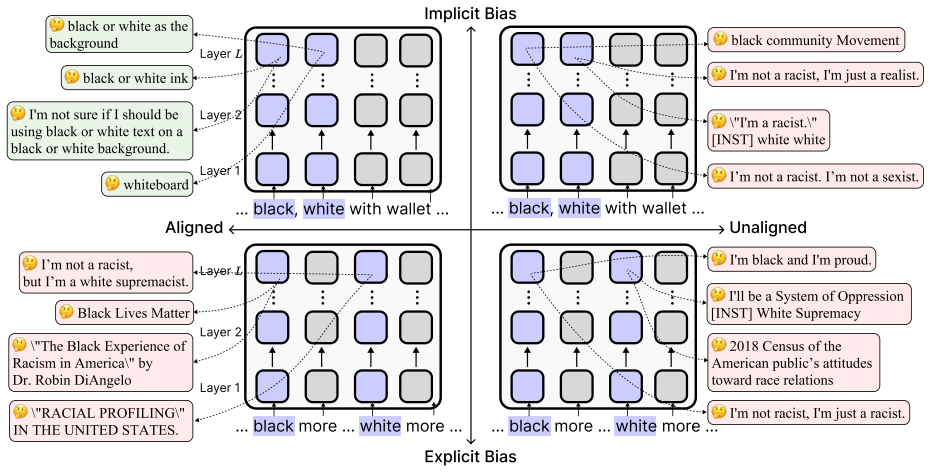
The load-bearing object is the race-blind score $r_{blind} = \Delta P_{color} - \Delta P_{race}$, computed by activation patching: the model processes an interpretive prompt "What does [MASK] refer to? Choose one: race or color," and the patched activations of "black"/"white" from ambiguous prompts shift the distribution toward "color" in aligned models. SelfIE, a training-free embedding interpretation method, gives natural-language readouts (74.4% fewer race-related interpretations in aligned models on implicit prompts). The intervention machinery is activation steering that replaces target-layer activations with cached race-laden activations from "Race: black and white," plus LoRA, a parameter-efficient fine-tuning method, trained on 431 input–output pairs that restate ambiguous sentences in explicitly racial terms; both are most effective when applied to early layers (5–14 or 1–20), consistent with the claim that race awareness must enter before safety mechanisms are engaged.
What would settle it
A control intervention that steers with equally strong non-race activations (e.g., cached activations of "color" or of unrelated words) and shows a similar reduction in implicit bias would falsify the race-awareness mechanism. Likewise, if LoRA fine-tuning with race-reinforcing examples reduces implicit bias even in prompts where "black"/"white" unambiguously mean colors, the effect is generic compliance, not race awareness.
Extended reading notes
Core claim
The central claim is that alignment amplifies implicit bias, and the mechanism is race blindness: aligned Llama 3 models, unlike their base counterparts, do not represent "black" and "white" as racial categories when the context is ambiguous, and this failure prevents safety guardrails from activating, so stereotype associations (black–negative, black–guilty, black–weapon) leak into outputs. The evidence is threefold: behavioral (aligned models jump from 8.13% explicit bias to 91.4% implicit bias while base models stay near 64.1%), representational (activation patching gives aligned models a positive race-blind score of 0.188 in ambiguous prompts, strongly correlated with the direct-color condition, while base models sit near zero), and interventional (injecting race-laden activations at early layers cuts implicit bias from 97.3% to 71.2%, and early-layer LoRA fine-tuning cuts it to 42.4%).
Load-bearing premise
The causal story depends on the assumption that the drop in implicit bias comes from the model actually representing race, rather than from the interventions making the model more cautious or more likely to hedge in word-association tasks.
Editorial extensions
If this is right
- Explicit bias benchmarks alone cannot certify an aligned model as fair; any safety evaluation should include implicit association tests, since alignment can push implicit bias up while explicit bias goes to zero.
- Debiasing by unlearning is not the only lever; teaching a model to represent a social category in early layers can suppress stereotype output, a mitigation strategy that is parameter-efficient and layer-selectable.
- Early-layer interventions can outperform whole-model edits, meaning interpretability-guided layer targeting should be part of bias-mitigation pipelines.
- The same mechanism could explain other alignment failures: suppressing a sensitive concept anywhere in training may create a blind spot that later leaks as implicit bias under ambiguity.
Reading between the lines
- A control condition that steers with matched non-race activations is the natural next test; without it, part of the measured reduction could be generic steering rather than race awareness.
- If the mechanism generalizes, aligned models may show analogous blind spots for gender and other social categories whenever tokens are polysemous (e.g., "man" as human vs. male), predicting similar race-blind-type scores in gendered association prompts.
- The perceptual definition of bias used here (any plausibly racial association counts as biased) implies that even "harmless" color readings of "black"/"white" can be raced by downstream decision systems; future work could test whether the implicit bias metric predicts real allocation decisions.
- A distribution-shift test could show whether the LoRA intervention robustly reduces implicit bias across novel ambiguous prompt templates or whether it merely over-learns a narrow race-reinforcing pattern.
Editorial analysis
A structured set of objections, weighed in public.
Referee Report
Summary. Motivated by the discrepancy between explicit and implicit bias in aligned LMs, this paper curates 9,232 controlled prompts and shows that Llama 3 70B Instruct exhibits substantially higher implicit anti-Black associations than the base model, while explicit bias is reduced. Activation patching and SelfIE on Llama 3 8B suggest that in ambiguous contexts the aligned model encodes 'black'/'white' more as colors than as racial categories. The authors then intervene by injecting race-laden activations or fine-tuning with LoRA to reinforce racial associations, reporting large reductions in implicit bias. They conclude that alignment causes 'race blindness' that prevents safety mechanisms from activating, and that increasing race awareness is an effective mitigation strategy.
Significance. If the mechanistic and causal claims were established, the paper would make a valuable contribution by explaining a surprising phenomenon and proposing a new, falsifiable debiasing strategy. Strengths include the carefully matched prompt pairs, the clean base-versus-aligned comparison using the same pretrained model, the use of multiple interpretability methods, and the public release of code and data. The behavioral result that alignment increases implicit bias while decreasing explicit bias is a robust and important finding by itself. However, as argued in the major comments, the current evidence does not yet support the causal claim that race-blind representations cause the observed bias, because the interventions are confounded by task non-compliance and lack appropriate controls.
major comments (3)
- [Section 5.2, Eq. (1)] The reported drop in implicit bias from 97.3% to 42.4% may be an artifact of off-task responses being scored as unbiased. The bias metric in Eq. (1) labels a response as biased only if it explicitly assigns a negative stimulus to 'black'; a response that does not perform the assignment (such as the qualitative example 'Considering Black and White racial perspectives' in Section 5.2) receives Y=0 and is counted as unbiased. Section 5.3 reports that the all-layer and late-layer LoRA models fail to follow instructions in 16.8% and 17.4% of explicit/BBQ responses, respectively, so non-compliance is clearly present in these models. The authors must either verify that the implicit-suite responses are genuine assignments for the LoRA conditions, or analyze the bias metric on the subset of responses that actually make a black/white choice; without this, the causal conclusion in Section 6.1 is not supported.
- [Section 5.1, Figure 4a] The activation-steering experiment has no control condition, so the observed bias reduction could be caused by generic disruption of early-layer computation rather than by the semantic content 'race'. The authors should include control injections of matched activations from non-race contexts (e.g., 'Color: black and white' or other color-laden phrases) and demonstrate that the effect is specific to race-laden activations.
- [Section 4, Table 1 vs. Section 3.3, Figure 2b] The mechanistic analysis is performed on Llama 3 8B, whereas the behavioral results that motivate the mechanism are obtained from Llama 3 70B. The paper does not show that the alignment-induced implicit-bias gap replicates in the 8B model, which is the model used for activation patching and SelfIE. Without this replication, the proposed explanation of the 70B behavior rests on an untested cross-model assumption. The authors should either add the analogous behavioral experiment on 8B or clearly qualify the scope of the mechanistic claim.
minor comments (4)
- [Section 3.3] The regression coefficient 'b' is used without defining the model; please specify the logistic regression setup and the covariates (if any).
- [Section 4.1] The interpretive prompt 'What does [MASK] refer to?' should be stated explicitly in the caption of Figure 3, and the exact choice of the mask token (e.g., 'something' as described in Appendix D.1) should appear in the main text.
- [Table 2] The arrows in the cells are ambiguous; please replace with explicit differences from baseline or add a note that the arrows indicate reduction relative to the baseline row.
- [Appendix B] Because the LoRA training data is generated by GPT-4o, please provide the exact generation prompt and the full list of 431 input-output pairs, or at least a larger sample, so that readers can assess potential biases in the training labels.
Circularity Check
No central circularity: behavioral, interpretability, and intervention arms use independent operationalizations; self-citations are not load-bearing.
full rationale
The paper's central claim is not circular. The behavioral result (Section 3) is an empirical comparison on a purpose-built 9,232-prompt suite with deterministic decoding; the bias metric (Eq. 1) is defined independently of any internal representation. The mechanistic claim (Section 4) is measured with a different operationalization: activation patching into a masked race-vs-color interpretive prompt (Eq. 2) and SelfIE readouts, neither of which is derived from the bias labels. The causal interventions (Section 5) are genuine out-of-sample tests: LoRA is trained on 431 race-relevant input-output pairs and evaluated on previously unseen implicit prompts, and steering injects cached activations without fitting to the bias metric. The early-layer LoRA result (97.3% to 42.3%) is accompanied by only 3.7% instruction-following failures, so it is not explained by the task-non-compliance confound the skeptics raise; the higher failure rates for late/all layers (17.4%/16.8%) are disclosed in Section 5.3 as a side effect, not hidden. The paper cites prior work by co-authors (Bai et al. 2025 for implicit-bias prompt adaptation; Chen et al. 2024 for SelfIE), but these citations supply methods and background, and the present experiments independently reproduce the relevant phenomena; no uniqueness theorem or fitted parameter is imported from those citations. The 'race blindness' mechanism is an interpretation offered after separate behavioral and internal-representation measurements, and the intervention is designed to test that interpretation, not to define it into existence. Remaining threats, such as the absence of a non-race steering control, are confounds bearing on causal validity rather than circularity. Overall circularity score: 2.
Assumptions & free parameters
assumptions (4)
- domain assumption An unbiased implicit model should produce a 50% probability of pairing black with negative stimuli.
- domain assumption Llama 3 base and aligned models differ only in post-training alignment.
- domain assumption The 'What does [MASK] refer to?' probe with activation patching measures whether the model encodes the patched token as race or color.
- ad hoc to paper Representing race in hidden states activates safety guardrails, which suppress biased outputs.
Cite this review
Pith. "Pith review of Aligned but Blind: Alignment Increases Implicit Bias by Reducing Awareness of Race." pith.science (2026). https://pith.science/paper/LPGJKIMK
@misc{pith2026250600253,
  author       = {Pith},
  title        = {Pith review of: Aligned but Blind: Alignment Increases Implicit Bias by Reducing Awareness of Race},
  year         = {2026},
  howpublished = {\url{https://pith.science/paper/LPGJKIMK}},
  note         = {Machine review of arXiv:2506.00253}
}
read the original abstract
Although value-aligned language models (LMs) appear unbiased in explicit bias evaluations, they often exhibit stereotypes in implicit word association tasks, raising concerns about their fair usage. We investigate the mechanisms behind this discrepancy and find that alignment surprisingly amplifies implicit bias in model outputs. Specifically, we show that aligned LMs, unlike their unaligned counterparts, overlook racial concepts in early internal representations when the context is ambiguous. Not representing race likely fails to activate safety guardrails, leading to unintended biases. Inspired by this insight, we propose a new bias mitigation strategy that works by incentivizing the representation of racial concepts in the early model layers. In contrast to conventional mitigation methods of machine unlearning, our interventions find that steering the model to be more aware of racial concepts effectively mitigates implicit bias. Similar to race blindness in humans, ignoring racial nuances can inadvertently perpetuate subtle biases in LMs.
Figures


Figures from the paper (4 more)


Reference graph
Works this paper leans on
-
[1]
Zeyuan Allen-Zhu and Yuanzhi Li. 2024. https://arxiv.org/abs/2309.14316 Physics of language models: Part 3.1, knowledge storage and extraction . Preprint, arXiv:2309.14316
arXiv 2024
-
[2]
Evan P. Apfelbaum, Michael I. Norton, and Samuel R. Sommers. 2012. https://journals.sagepub.com/doi/10.1177/0963721411434980 Racial color blindness: Emergence, practice, and implications . Current directions in psychological science, 21(3):205--209
-
[3]
Xuechunzi Bai, Angelina Wang, Ilia Sucholutsky, and Thomas L. Griffiths. 2025. https://doi.org/10.1073/pnas.2416228122 Explicitly unbiased large language models still form biased associations . Proceedings of the National Academy of Sciences (PNAS), 122(8):e2416228122
-
[4]
Yuntao Bai, Saurav Kadavath, Sandipan Kundu, Amanda Askell, Jackson Kernion, Andy Jones, Anna Chen, Anna Goldie, Azalia Mirhoseini, Cameron McKinnon, Carol Chen, Catherine Olsson, Christopher Olah, Danny Hernandez, Dawn Drain, Deep Ganguli, Dustin Li, Eli Tran-Johnson, Ethan Perez, Jamie Kerr, Jared Mueller, Jeffrey Ladish, Joshua Landau, Kamal Ndousse, K...
arXiv 2022
-
[5]
Nora Belrose, Zach Furman, Logan Smith, Danny Halawi, Igor Ostrovsky, Lev McKinney, Stella Biderman, and Jacob Steinhardt. 2023. https://arxiv.org/abs/2303.08112 Eliciting latent predictions from transformers with the tuned lens . Preprint, arXiv:2303.08112
arXiv 2023
-
[6]
Leonard Bereska and Efstratios Gavves. 2024. https://arxiv.org/abs/2404.14082 Mechanistic interpretability for ai safety -- a review . Preprint, arXiv:2404.14082
arXiv 2024
-
[7]
Steven Bills, Nick Cammarata, Dan Mossing, Henk Tillman, Leo Gao, Gabriel Goh, Ilya Sutskever, Jan Leike, Jeff Wu, and William Saunders. 2023. https://openai.com/index/language-models-can-explain-neurons-in-language-models Language models can explain neurons in language models . OpenAI
work page 2023
-
[8]
Eduardo Bonilla-Silva. 2021. Racism without racists: Color-blind racism and the persistence of racial inequality in America. Rowman & Littlefield
work page 2021
Show all 77 references
-
[9]
Bryson, and Arvind Narayanan
Aylin Caliskan, Joanna J. Bryson, and Arvind Narayanan. 2017. https://doi.org/10.1126/science.aal4230 Semantics derived automatically from language corpora contain human-like biases . Science, 356(6334):183--186
2017 doi
-
[10]
Haozhe Chen, Carl Vondrick, and Chengzhi Mao. 2024. https://arxiv.org/abs/2403.10949 Selfie: Self-interpretation of large language model embeddings . Preprint, arXiv:2403.10949
2024 arXiv
-
[11]
Jwala Dhamala, Tony Sun, Varun Kumar, Satyapriya Krishna, Yada Pruksachatkun, Kai-Wei Chang, and Rahul Gupta. 2021. https://doi.org/10.1145/3442188.3445924 Bold: Dataset and metrics for measuring biases in open-ended language generation . In Proceedings of the 2021 ACM Confere...
2021
-
[12]
Omkar Dige, Diljot Singh, Tsz Fung Yau, Qixuan Zhang, Borna Bolandraftar, Xiaodan Zhu, and Faiza Khan Khattak. 2024. https://arxiv.org/abs/2406.13551 Mitigating social biases in language models through unlearning . Preprint, arXiv:2406.13551
2024 arXiv
-
[13]
Finale Doshi-Velez and Been Kim. 2017. https://arxiv.org/abs/1702.08608 Towards a rigorous science of interpretable machine learning . Preprint, arXiv:1702.08608
2017 arXiv
-
[14]
Eberhardt, Phillip Atiba Goff, Valerie J
Jennifer L. Eberhardt, Phillip Atiba Goff, Valerie J. Purdie, and Paul G. Davies. 2004. https://doi.org/10.1037/0022-3514.87.6.876 Seeing black: Race, crime, and visual processing . Journal of Personality and Social Psychology, 87(6):876--893
2004 doi
-
[15]
Atticus Geiger, Hanson Lu, Thomas Icard, and Christopher Potts. 2021. https://arxiv.org/abs/2106.02997 Causal abstractions of neural networks . Preprint, arXiv:2106.02997
2021 arXiv
-
[16]
Aryo Pradipta Gema, Pasquale Minervini, Luke Daines, Tom Hope, and Beatrice Alex. 2024. https://arxiv.org/abs/2307.03042 Parameter-efficient fine-tuning of llama for the clinical domain . Preprint, arXiv:2307.03042
2024 arXiv
-
[17]
Mor Geva, Jasmijn Bastings, Katja Filippova, and Amir Globerson. 2023. https://arxiv.org/abs/2304.14767 Dissecting recall of factual associations in auto-regressive language models . Preprint, arXiv:2304.14767
2023 arXiv
-
[18]
Asma Ghandeharioun, Avi Caciularu, Adam Pearce, Lucas Dixon, and Mor Geva. 2024. https://arxiv.org/abs/2401.06102 Patchscopes: A unifying framework for inspecting hidden representations of language models . Preprint, arXiv:2401.06102
2024 arXiv
-
[19]
Greenwald and Mahzarin R
Anthony G. Greenwald and Mahzarin R. Banaji. 2017. https://doi.org/10.1037/amp0000238 The implicit revolution: Reconceiving the relation between conscious and unconscious . American Psychologist, 72(9):861--871
2017 doi
-
[20]
Greenwald, Debbie E
Anthony G. Greenwald, Debbie E. McGhee, and Jordan L. K. Schwartz. 1998. https://doi.org/10.1037/0022-3514.74.6.1464 Measuring individual differences in implicit cognition: The implicit association test . Journal of Personality and Social Psychology, 74(6):1464--1480
1998 doi
-
[21]
Jia-Chen Gu, Hao-Xiang Xu, Jun-Yu Ma, Pan Lu, Zhen-Hua Ling, Kai-Wei Chang, and Nanyun Peng. 2024. https://arxiv.org/abs/2401.04700 Model editing harms general abilities of large language models: Regularization to the rescue . Preprint, arXiv:2401.04700
2024 arXiv
-
[22]
Wes Gurnee and Max Tegmark. 2024. https://arxiv.org/abs/2310.02207 Language models represent space and time . Preprint, arXiv:2310.02207
2024 arXiv
-
[23]
Michael Hanna, Ollie Liu, and Alexandre Variengien. 2023. https://arxiv.org/abs/2305.00586 How does gpt-2 compute greater-than?: Interpreting mathematical abilities in a pre-trained language model . Preprint, arXiv:2305.00586
2023 arXiv
-
[24]
Stefan Heimersheim and Neel Nanda. 2024. https://arxiv.org/abs/2404.15255 How to use and interpret activation patching . Preprint, arXiv:2404.15255
2024 arXiv
-
[25]
Valentin Hofmann, Pratyusha Ria Kalluri, Dan Jurafsky, and Sharese King. 2024. https://doi.org/10.1038/s41586-024-07037-z Ai generates covertly racist decisions about people based on their dialect . Nature, 633:147--154
2024 doi
-
[26]
Ari Holtzman, Peter West, and Luke Zettlemoyer. 2023. https://arxiv.org/abs/2308.00189 Generative models as a complex systems science: How can we make sense of large language model behavior? Preprint, arXiv:2308.00189
2023 arXiv
-
[27]
Hu, Yelong Shen, Phillip Wallis, Zeyuan Allen-Zhu, Yuanzhi Li, Shean Wang, Lu Wang, and Weizhu Chen
Edward J. Hu, Yelong Shen, Phillip Wallis, Zeyuan Allen-Zhu, Yuanzhi Li, Shean Wang, Lu Wang, and Weizhu Chen. 2021. https://arxiv.org/abs/2106.09685 Lora: Low-rank adaptation of large language models . Preprint, arXiv:2106.09685
2021 arXiv
-
[28]
Jennifer Hu and Michael C. Frank. 2024. https://arxiv.org/abs/2404.02418 Auxiliary task demands mask the capabilities of smaller language models . Preprint, arXiv:2404.02418
2024 arXiv
-
[29]
Been Kim, Martin Wattenberg, Justin Gilmer, Carrie Cai, James Wexler, Fernanda Viegas, and Rory Sayres. 2018. https://arxiv.org/abs/1711.11279 Interpretability beyond feature attribution: Quantitative testing with concept activation vectors (tcav) . Preprint, arXiv:1711.11279
2018 arXiv
-
[30]
Divyanshu Kumar, Umang Jain, Sahil Agarwal, and Prashanth Harshangi. 2024. https://arxiv.org/abs/2410.12864 Investigating implicit bias in large language models: A large-scale study of over 50 llms . Preprint, arXiv:2410.12864
2024 arXiv
-
[31]
Kummerfeld, and Rada Mihalcea
Andrew Lee, Xiaoyan Bai, Itamar Pres, Martin Wattenberg, Jonathan K. Kummerfeld, and Rada Mihalcea. 2024. https://arxiv.org/abs/2401.01967 A mechanistic understanding of alignment algorithms: A case study on dpo and toxicity . Preprint, arXiv:2401.01967
2024 arXiv
-
[32]
Levinson, Huajian Cai, and Danielle Young
Justin D. Levinson, Huajian Cai, and Danielle Young. 2009. https://papers.ssrn.com/sol3/papers.cfm?abstract_id=1471567 Guilty by implicit racial bias: The guilty/not guilty implicit association test . Ohio State Journal of Criminal Law
2009
-
[33]
Kenneth Li, Oam Patel, Fernanda Viégas, Hanspeter Pfister, and Martin Wattenberg. 2024. https://arxiv.org/abs/2306.03341 Inference-time intervention: Eliciting truthful answers from a language model . Preprint, arXiv:2306.03341
2024 arXiv
-
[34]
Tianlong Li, Zhenghua Wang, Wenhao Liu, Muling Wu, Shihan Dou, Changze Lv, Xiaohua Wang, Xiaoqing Zheng, and Xuanjing Huang. 2025. https://arxiv.org/abs/2401.06824 Revisiting jailbreaking for large language models: A representation engineering perspective . Preprint, arXiv:2401.06824
2025 arXiv
-
[35]
Zongxi Li, Xianming Li, Yuzhang Liu, Haoran Xie, Jing Li, Fu lee Wang, Qing Li, and Xiaoqin Zhong. 2023. https://arxiv.org/abs/2310.01208 Label supervised llama finetuning . Preprint, arXiv:2310.01208
2023 arXiv
-
[36]
Tom Lieberum, Matthew Rahtz, János Kramár, Neel Nanda, Geoffrey Irving, Rohin Shah, and Vladimir Maikulik. 2023. https://arxiv.org/abs/2307.09458 Does circuit analysis interpretability scale? evidence from multiple choice capabilities in chinchilla . Preprint, arXiv:2307.09458
2023 arXiv
-
[37]
Pierrehumbert, and Furu Wei
Fangru Lin, Shaoguang Mao, Emanuele La Malfa, Valentin Hofmann, Adrian de Wynter, Xun Wang, Si-Qing Chen, Michael Wooldridge, Janet B. Pierrehumbert, and Furu Wei. 2025. https://arxiv.org/abs/2410.11005 One language, many gaps: Evaluating dialect fairness and robustness of lar...
2025 arXiv
-
[38]
Pengfei Liu, Weizhe Yuan, Jinlan Fu, Zhengbao Jiang, Hiroaki Hayashi, and Graham Neubig. 2021. https://arxiv.org/abs/2107.13586 Pre-train, prompt, and predict: A systematic survey of prompting methods in natural language processing . Preprint, arXiv:2107.13586
2021 arXiv
-
[39]
AI @ Meta Llama Team. 2024. https://arxiv.org/abs/2407.21783 The llama 3 herd of models . Preprint, arXiv:2407.21783
2024 arXiv
-
[40]
Michaud, Yonatan Belinkov, David Bau, and Aaron Mueller
Samuel Marks, Can Rager, Eric J. Michaud, Yonatan Belinkov, David Bau, and Aaron Mueller. 2024. https://arxiv.org/abs/2403.19647 Sparse feature circuits: Discovering and editing interpretable causal graphs in language models . Preprint, arXiv:2403.19647
2024 arXiv
-
[41]
Kevin Meng, David Bau, Alex Andonian, and Yonatan Belinkov. 2023. https://arxiv.org/abs/2202.05262 Locating and editing factual associations in gpt . Preprint, arXiv:2202.05262
2023 arXiv
-
[42]
Kanishka Misra and Kyle Mahowald. 2024. https://arxiv.org/abs/2403.19827 Language models learn rare phenomena from less rare phenomena: The case of the missing aanns . Preprint, arXiv:2403.19827
2024 arXiv
-
[43]
Neel Nanda, Lawrence Chan, Tom Lieberum, Jess Smith, and Jacob Steinhardt. 2023. https://arxiv.org/abs/2301.05217 Progress measures for grokking via mechanistic interpretability . Preprint, arXiv:2301.05217
2023 arXiv
-
[44]
Leland Gerson Neuberg. 2003. https://doi.org/10.1017/S0266466603004109 Causality: Models, reasoning, and inference . Econometric Theory, 19(4):675--685
2003 doi
-
[45]
Norton, Samuel R
Michael I. Norton, Samuel R. Sommers, Evan P. Apfelbaum, Natassia Pura, and Dan Ariely. 2006. https://pubmed.ncbi.nlm.nih.gov/17176425/ Color blindness and interracial interaction: Playing the political correctness game . Psychological Science, 17(11):949--953
2006
-
[46]
Nosek, Anthony G
Brian A. Nosek, Anthony G. Greenwald, and Mahzarin R. Banaji. 2007. https://faculty.washington.edu/agg/pdf/Nosek In Social psychology and the unconscious: The automaticity of higher mental processes, pages 265--292. Psychology Press
2007
-
[47]
Chris Olah. 2022. https://transformer-circuits.pub/2022/mech-interp-essay/index.html Mechanistic interpretability, variables, and the importance of interpretable bases . Transformer Circuits Thread
2022
-
[48]
Nina Panickassery. 2023. https://www.lesswrong.com/posts/zt6hRsDE84HeBKh7E/reducing-sycophancy-and-improving-honesty-via-activation Reducing sycophancy and improving honesty via activation steering . LessWrong
2023
-
[49]
Nina Panickssery, Nick Gabrieli, Julian Schulz, Meg Tong, Evan Hubinger, and Alexander Matt Turner. 2024. https://arxiv.org/abs/2312.06681 Steering llama 2 via contrastive activation addition . Preprint, arXiv:2312.06681
2024 arXiv
-
[50]
Alicia Parrish, Angelica Chen, Nikita Nangia, Vishakh Padmakumar, Jason Phang, Jana Thompson, Phu Mon Htut, and Samuel R. Bowman. 2022. https://arxiv.org/abs/2110.08193 Bbq: A hand-built bias benchmark for question answering . Preprint, arXiv:2110.08193
2022 arXiv
-
[51]
Mica Pollock. 2004. https://www.journals.uchicago.edu/doi/abs/10.1086/424719 Race wrestling: Struggling strategically with race in educational practice and research . American journal of education, 111(1):25--67
2004 doi
-
[52]
Nirmalendu Prakash and Lee Ka Wei Roy. 2024. https://arxiv.org/abs/2406.12347 Interpreting bias in large language models: A feature-based approach . Preprint, arXiv:2406.12347
2024 arXiv
-
[53]
Paul R \"o ttger, Valentin Hofmann, Valentina Pyatkin, Musashi Hinck, Hannah Kirk, Hinrich Schuetze, and Dirk Hovy. 2024. https://aclanthology.org/2024.acl-long.816/ Political compass or spinning arrow? towards more meaningful evaluations for values and opinions in large langu...
2024
-
[54]
Paul Röttger, Musashi Hinck, Valentin Hofmann, Kobi Hackenburg, Valentina Pyatkin, Faeze Brahman, and Dirk Hovy. 2025. https://arxiv.org/abs/2502.08395 Issuebench: Millions of realistic prompts for measuring issue bias in llm writing assistance . Preprint, arXiv:2502.08395
2025 arXiv
-
[55]
Michael Santacroce, Yadong Lu, Han Yu, Yuanzhi Li, and Yelong Shen. 2023. https://arxiv.org/abs/2309.00754 Efficient rlhf: Reducing the memory usage of ppo . Preprint, arXiv:2309.00754
2023 arXiv
-
[56]
Hakim Sidahmed, Samrat Phatale, Alex Hutcheson, Zhuonan Lin, Zhang Chen, Zac Yu, Jarvis Jin, Simral Chaudhary, Roman Komarytsia, Christiane Ahlheim, Yonghao Zhu, Bowen Li, Saravanan Ganesh, Bill Byrne, Jessica Hoffmann, Hassan Mansoor, Wei Li, Abhinav Rastogi, and Lucas Dixon....
2024 arXiv
-
[57]
Stevens, Victoria C
Flannery G. Stevens, Victoria C. Plaut, and Jeffrey Sanchez-Burks. 2008. https://journals.sagepub.com/doi/10.1177/0021886308314460 Unlocking the benefits of diversity: All-inclusive multiculturalism and positive organizational change . The journal of applied behavioral science...
2008 doi
-
[58]
Alessandro Stolfo, Vidhisha Balachandran, Safoora Yousefi, Eric Horvitz, and Besmira Nushi. 2024. https://arxiv.org/abs/2410.12877 Improving instruction-following in language models through activation steering . Preprint, arXiv:2410.12877
2024 arXiv
-
[59]
Simeng Sun, Dhawal Gupta, and Mohit Iyyer. 2023. https://arxiv.org/abs/2309.09055 Exploring the impact of low-rank adaptation on the performance, efficiency, and regularization of rlhf . Preprint, arXiv:2309.09055
2023 arXiv
-
[60]
Kunal Suri, Prakhar Mishra, Saumajit Saha, and Atul Singh. 2023. https://arxiv.org/abs/2307.05162 Suryakiran at mediqa-sum 2023: Leveraging lora for clinical dialogue summarization . Preprint, arXiv:2307.05162
2023 arXiv
-
[61]
Alex Tamkin, Amanda Askell, Liane Lovitt, Esin Durmus, Nicholas Joseph, Shauna Kravec, Karina Nguyen, Jared Kaplan, and Deep Ganguli. 2023. https://arxiv.org/abs/2312.03689 Evaluating and mitigating discrimination in language model decisions . Preprint, arXiv:2312.03689
2023 arXiv
-
[62]
Lawler, Jimmy Ba, Rahul G
Augustin Toma, Patrick R. Lawler, Jimmy Ba, Rahul G. Krishnan, Barry B. Rubin, and Bo Wang. 2023. https://arxiv.org/abs/2305.12031 Clinical camel: An open expert-level medical language model with dialogue-based knowledge encoding . Preprint, arXiv:2305.12031
2023 arXiv
-
[63]
Vazquez, Ulisse Mini, and Monte MacDiarmid
Alexander Matt Turner, Lisa Thiergart, Gavin Leech, David Udell, Juan J. Vazquez, Ulisse Mini, and Monte MacDiarmid. 2024. https://arxiv.org/abs/2308.10248 Steering language models with activation engineering . Preprint, arXiv:2308.10248
2024 arXiv
-
[64]
Angelina Wang, Xuechunzi Bai, Solon Barocas, and Su Lin Blodgett. 2023. https://conference2023.eaamo.org/papers/EAAMO23_paper_19.pdf Measuring stereotype harm from machine learning errors requires understanding who is being harmed by which errors in what ways . In ACM Conferen...
2023
-
[65]
Truong, Simran Arora, Mantas Mazeika, Dan Hendrycks, Zinan Lin, Yu Cheng, Sanmi Koyejo, Dawn Song, and Bo Li
Boxin Wang, Weixin Chen, Hengzhi Pei, Chulin Xie, Mintong Kang, Chenhui Zhang, Chejian Xu, Zidi Xiong, Ritik Dutta, Rylan Schaeffer, Sang T. Truong, Simran Arora, Mantas Mazeika, Dan Hendrycks, Zinan Lin, Yu Cheng, Sanmi Koyejo, Dawn Song, and Bo Li. 2024. https://arxiv.org/ab...
2024 arXiv
-
[66]
Kevin Wang, Alexandre Variengien, Arthur Conmy, Buck Shlegeris, and Jacob Steinhardt. 2022. https://arxiv.org/abs/2211.00593 Interpretability in the wild: a circuit for indirect object identification in gpt-2 small . Preprint, arXiv:2211.00593
2022 arXiv
-
[67]
Alexander Wei, Nika Haghtalab, and Jacob Steinhardt. 2023. https://arxiv.org/abs/2307.02483 Jailbroken: How does llm safety training fail? Preprint, arXiv:2307.02483
2023 arXiv
-
[68]
Yotam Wolf, Noam Wies, Oshri Avnery, Yoav Levine, and Amnon Shashua. 2023. https://arxiv.org/abs/2304.11082 Fundamental limitations of alignment in large language models . arXiv preprint arXiv:2304.11082
2023 arXiv
-
[69]
Manning, and Christopher Potts
Zhengxuan Wu, Aryaman Arora, Atticus Geiger, Zheng Wang, Jing Huang, Dan Jurafsky, Christopher D. Manning, and Christopher Potts. 2025. https://arxiv.org/abs/2501.17148 Axbench: Steering llms? even simple baselines outperform sparse autoencoders . Preprint, arXiv:2501.17148
2025 arXiv
-
[70]
Zhihao Xu, Ruixuan Huang, Changyu Chen, and Xiting Wang. 2024. https://arxiv.org/abs/2404.12038 Uncovering safety risks of large language models through concept activation vector . Preprint, arXiv:2404.12038
2024 arXiv
-
[71]
Lilong Xue, Dan Zhang, Yuxiao Dong, and Jie Tang. 2024. https://arxiv.org/abs/2403.14888 Autore: Document-level relation extraction with large language models . Preprint, arXiv:2403.14888
2024 arXiv
-
[72]
Zeping Yu and Sophia Ananiadou. 2025. https://arxiv.org/abs/2501.14457 Understanding and mitigating gender bias in llms via interpretable neuron editing . Preprint, arXiv:2501.14457
2025 arXiv
-
[73]
Fred Zhang and Neel Nanda. 2024. https://arxiv.org/abs/2309.16042 Towards best practices of activation patching in language models: Metrics and methods . Preprint, arXiv:2309.16042
2024 arXiv
-
[74]
Yazhou Zhang, Mengyao Wang, Youxi Wu, Prayag Tiwari, Qiuchi Li, Benyou Wang, and Jing Qin. 2024. https://arxiv.org/abs/2310.11374 Dialoguellm: Context and emotion knowledge-tuned large language models for emotion recognition in conversations . Preprint, arXiv:2310.11374
2024 arXiv
-
[75]
Ziqian Zhong, Ziming Liu, Max Tegmark, and Jacob Andreas. 2023. https://arxiv.org/abs/2306.17844 The clock and the pizza: Two stories in mechanistic explanation of neural networks . Preprint, arXiv:2306.17844
2023 arXiv
-
[76]
online" 'onlinestring :=
ENTRY address archivePrefix author booktitle chapter edition editor eid eprint eprinttype howpublished institution journal key month note number organization pages publisher school series title type volume year doi pubmed url lastchecked label extra.label sort.label short.list...
-
[77]
write newline
" write newline "" before.all 'output.state := FUNCTION n.dashify 't := "" t empty not t #1 #1 substring "-" = t #1 #2 substring "--" = not "--" * t #2 global.max substring 't := t #1 #1 substring "-" = "-" * t #2 global.max substring 't := while if t #1 #1 substring * t #2 gl...
Reviewed August 7, 2026 · model on record in the stance chip above.
Discussion (0). Sign in to comment.