Polarized Nuclear DVCS at the EIC
Pith reviewed 2026-06-27 10:26 UTC · model grok-4.3
The pith
EIC data enable precise differential measurements of the unpolarized Compton form factor for helium-3 via DVCS.
A machine-rendered reading of the paper's core claim, the machinery that carries it, and where it could break.
Core claim
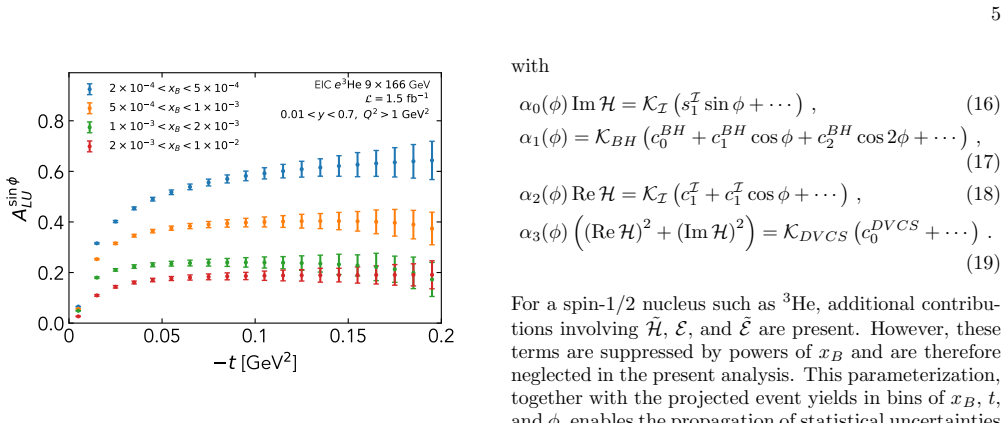
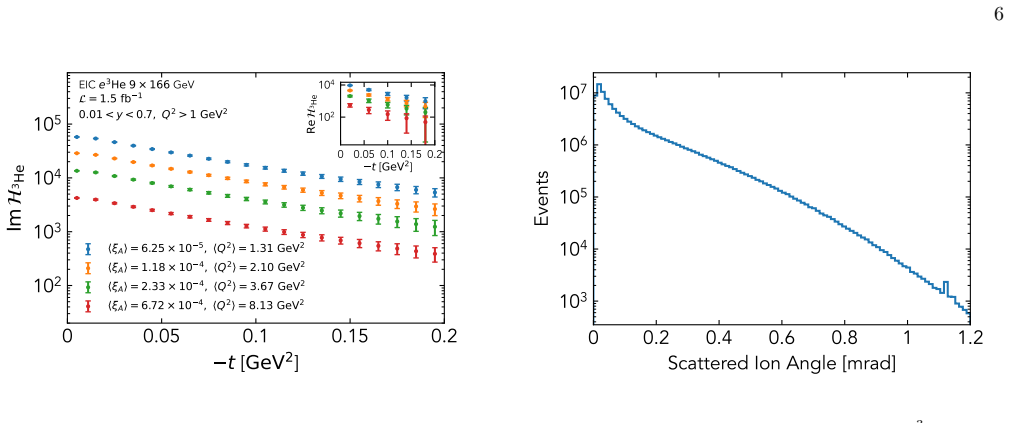
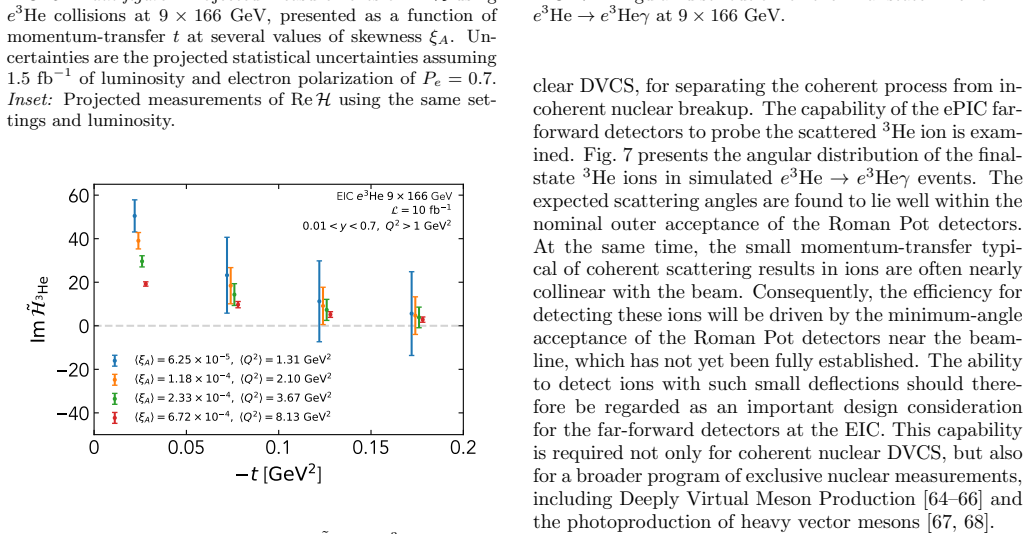
A model for coherent DVCS on polarized ³He is developed and applied to simulations of 9×166-GeV e³He collisions at the EIC. Early EIC data enable precise differential measurements of the unpolarized CFF H_³He and provide significant constraints on its real and imaginary components. By contrast, meaningful constraints on the polarized CFF tilde H_³He require substantially larger integrated luminosities. The kinematics of the recoil ³He nucleus are examined along with the far-forward detector capabilities required to tag the intact nucleus.
What carries the argument
Model for coherent DVCS on polarized ³He, used to estimate statistical precision for beam-spin asymmetries and extraction of the Compton form factors H_³He and tilde H_³He.
If this is right
- Precise differential measurements of the unpolarized CFF H_³He become possible with early EIC data.
- Significant constraints on the real and imaginary components of H_³He can be obtained from those measurements.
- Meaningful constraints on the polarized CFF tilde H_³He require substantially larger integrated luminosities.
- Far-forward detector capabilities at the EIC are required to tag the intact recoil nucleus and perform fully exclusive measurements.
Where Pith is reading between the lines
- If the estimates hold, studies of nuclear generalized parton distributions could begin with light nuclei at moderate luminosities.
- The approach could be extended to other light polarized nuclei to test models of nuclear spin structure.
- Detector designs at the EIC should prioritize far-forward acceptance to enable coherent nuclear DVCS studies.
Load-bearing premise
The developed model for coherent DVCS on polarized ³He is sufficiently accurate to produce reliable statistical precision estimates at EIC kinematics.
What would settle it
EIC measurements of beam-spin asymmetries in coherent DVCS on ³He that fail to achieve the predicted statistical precision or constraints on the real and imaginary components of H_³He.
Figures
read the original abstract
The Electron-Ion Collider (EIC) will enable a series of measurements at unprecedented energies and luminosities, providing new opportunities to investigate the microscopic structure of nucleons and nuclei at small $x_B$. Exclusive processes such as Deeply Virtual Compton Scattering (DVCS) offer unique access to the three-dimensional structure of hadrons through Generalized Parton Distributions (GPDs), while polarized electron and ion beams further enable detailed studies of spin-dependent structure. A model for coherent DVCS on polarized $^3$Heis developed and applied to simulations of for $9\times166$-GeV $e^3$He collisions at the EIC. Using this framework, the statistical precision achievable is estimated for measurements of beam-spin asymmetries and for the extraction of the Compton Form Factors (CFFs) $\mathcal H_{^3\mathrm{He}}$ and $\tilde{\mathcal H}_{^3\mathrm{He}}$. Early EIC data are found to enable precise differential measurements of the unpolarized CFF $\mathcal H_{^3\mathrm{He}}$ and to provide significant constraints on its real and imaginary components. By contrast, meaningful constraints on the polarized CFF $\tilde{\mathcal H}_{^3\mathrm{He}}$ require substantially larger integrated luminosities. The kinematics of the recoil $^3$He nucleus are also examined, and the far-forward detector capabilities at the EIC required to tag the intact nucleus and perform fully exclusive measurements of coherent nuclear DVCS are discussed.
Editorial analysis
A structured set of objections, weighed in public.
Referee Report
Summary. The manuscript develops a model for coherent DVCS on polarized ³He and applies it to Monte Carlo simulations of 9×166 GeV e³He collisions at the EIC. It estimates statistical precisions on beam-spin asymmetries and extracts constraints on the Compton form factors ℋ_{³He} and ilde{ℋ}_{³He}, concluding that early EIC data enable precise differential measurements of the unpolarized CFF and significant constraints on its real and imaginary parts, while the polarized CFF requires substantially larger luminosities. Recoil ³He kinematics and far-forward detector requirements for exclusive measurements are also discussed.
Significance. If the underlying model holds, the projections would usefully inform the EIC nuclear physics program by quantifying the luminosity needed to access nuclear GPDs via polarized DVCS on ³He and by highlighting detector needs for tagging the intact recoil nucleus.
major comments (1)
- [Model development and simulation framework] The central claim that early EIC data enable precise differential measurements of ℋ_{³He} and constraints on its real/imaginary components rests entirely on statistical uncertainties extracted from simulations that employ the developed model. No validation of the model against existing coherent DVCS data on ³He (or other light nuclei), no comparison of predicted cross sections or asymmetries to data, and no quantification of systematic uncertainties from the impulse approximation or neglected final-state interactions are provided; any bias in the model magnitude or kinematic dependence would rescale the reported precisions and undermine the luminosity requirements stated for the polarized CFF.
minor comments (1)
- [Abstract] The abstract contains the typographical error 'polarized $^3$Heis' (should be 'polarized $^3$He').
Simulated Author's Rebuttal
We thank the referee for the careful review and constructive feedback. We respond to the single major comment below.
read point-by-point responses
-
Referee: [Model development and simulation framework] The central claim that early EIC data enable precise differential measurements of ℋ_{³He} and constraints on its real/imaginary components rests entirely on statistical uncertainties extracted from simulations that employ the developed model. No validation of the model against existing coherent DVCS data on ³He (or other light nuclei), no comparison of predicted cross sections or asymmetries to data, and no quantification of systematic uncertainties from the impulse approximation or neglected final-state interactions are provided; any bias in the model magnitude or kinematic dependence would rescale the reported precisions and undermine the luminosity requirements stated for the polarized CFF.
Authors: We agree that the reported precisions are purely statistical and that the manuscript contains no validation or comparison to existing coherent DVCS data on ³He, as no such polarized data exist at present. The model is built in the impulse approximation by folding nucleon GPDs with the ³He wave function; we will revise the text to state this explicitly, to note the absence of direct validation, and to clarify that all quoted uncertainties are statistical only. We further note that the relative luminosity needed to constrain the polarized CFF versus the unpolarized CFF is set by the expected asymmetry magnitudes, which are less sensitive to overall normalization than the absolute cross section; the main conclusion on luminosity requirements is therefore robust to a uniform rescaling. We do not quantify systematics from final-state interactions, as that lies beyond the scope of the present projection study. revision: yes
Circularity Check
No circularity; forward model simulation yields independent projections
full rationale
The paper develops a model for coherent DVCS on polarized ³He and applies it to Monte Carlo simulations of 9×166 GeV e³He collisions to estimate statistical uncertainties on beam-spin asymmetries and CFF extractions. The strongest claim (precise differential access to unpolarized CFF ℋ_³He and constraints on its real/imaginary parts from early EIC data) follows directly from propagating the constructed model through detector response and luminosity assumptions; no parameter is fitted to the target EIC observables and then re-labeled as a prediction. No self-citation chain, uniqueness theorem, or ansatz imported from prior author work is invoked to close the derivation. The steps remain self-contained forward simulation against external EIC performance benchmarks.
Axiom & Free-Parameter Ledger
Reference graph
Works this paper leans on
-
[1]
M¨ ueller, D
D. M¨ ueller, D. Robaschik, B. Geyer, F.-M. Dittes, and J. Hoˇ rejˇ si, Fortschr. Phys.42, 101 (1994)
1994
-
[2]
Ji, Phys
X.-D. Ji, Phys. Rev. Lett78, 610 (1997)
1997
-
[3]
Ji, Phys
X.-D. Ji, Phys. Rev. D55, 7114 (1997)
1997
-
[4]
Radyushkin, Phys
A. Radyushkin, Phys. Lett. B385, 333 (1996)
1996
-
[5]
Radyushkin, Phys
A. Radyushkin, Phys. Rev. D56, 5524 (1997)
1997
-
[6]
Diehl, Physics Reports388, 41–277 (2003)
M. Diehl, Physics Reports388, 41–277 (2003)
2003
-
[7]
A. Aktaset al.(H1), Eur. Phys. J. C44, 1 (2005), arXiv:hep-ex/0505061
Pith/arXiv arXiv 2005
-
[8]
F. D. Aaronet al.(H1), Phys. Lett. B681, 391 (2009), arXiv:0907.5289 [hep-ex]
Pith/arXiv arXiv 2009
-
[9]
Chekanovet al.(ZEUS Collaboration), JHEP05, 108 (2009)
S. Chekanovet al.(ZEUS Collaboration), JHEP05, 108 (2009)
2009
-
[10]
Airapetianet al.(HERMES), Phys
A. Airapetianet al.(HERMES), Phys. Rev. Lett.87, 182001 (2001), arXiv:hep-ex/0106068
Pith/arXiv arXiv 2001
-
[11]
Airapetianet al.(HERMES), Phys
A. Airapetianet al.(HERMES), Phys. Rev. D75, 011103 (2007), arXiv:hep-ex/0605108
Pith/arXiv arXiv 2007
-
[12]
Airapetianet al.(HERMES), JHEP06, 066, arXiv:0802.2499 [hep-ex]
A. Airapetianet al.(HERMES), JHEP06, 066, arXiv:0802.2499 [hep-ex]
-
[13]
Airapetianet al.(HERMES), JHEP11, 083, arXiv:0909.3587 [hep-ex]
A. Airapetianet al.(HERMES), JHEP11, 083, arXiv:0909.3587 [hep-ex]
-
[14]
Airapetianet al.(HERMES), JHEP06, 019, arXiv:1004.0177 [hep-ex]
A. Airapetianet al.(HERMES), JHEP06, 019, arXiv:1004.0177 [hep-ex]
-
[15]
Airapetianet al.(HERMES), Phys
A. Airapetianet al.(HERMES), Phys. Lett. B704, 15 (2011), arXiv:1106.2990 [hep-ex]
Pith/arXiv arXiv 2011
-
[16]
Airapetianet al.(HERMES), JHEP07, 032, arXiv:1203.6287 [hep-ex]
A. Airapetianet al.(HERMES), JHEP07, 032, arXiv:1203.6287 [hep-ex]
-
[17]
Stepanyanet al.(CLAS Collaboration), Phys
S. Stepanyanet al.(CLAS Collaboration), Phys. Rev. Lett.87, 182002 (2001)
2001
-
[18]
Chenet al.(CLAS Collaboration), Phys
S. Chenet al.(CLAS Collaboration), Phys. Rev. Lett. 97, 072002 (2006)
2006
-
[19]
F. X. Girodet al.(CLAS Collaboration), Phys. Rev. Lett. 100, 162002 (2008)
2008
-
[20]
Gavalianet al.(CLAS Collaboration), Phys
G. Gavalianet al.(CLAS Collaboration), Phys. Rev. C 80, 035206 (2009)
2009
-
[21]
Pisanoet al.(CLAS Collaboration), Phys
S. Pisanoet al.(CLAS Collaboration), Phys. Rev. D91, 052014 (2015)
2015
-
[22]
C. M. Camachoet al.(JLab Hall A Collaboration), Phys. Rev. Lett.97, 262002 (2006)
2006
-
[23]
H. S. Joet al.(CLAS Collaboration), Phys. Rev. Lett. 115, 212003 (2015)
2015
-
[24]
Defurneet al.(JLab Hall A Collaboration), Phys
M. Defurneet al.(JLab Hall A Collaboration), Phys. Rev. C92, 055202 (2015)
2015
-
[25]
Defurneet al.(JLab Hall A Collaboration), Nat
M. Defurneet al.(JLab Hall A Collaboration), Nat. Commun.8, 1408 (2017)
2017
-
[26]
Georgeset al.(JLab Hall A Collaboration), Phys
F. Georgeset al.(JLab Hall A Collaboration), Phys. Rev. Lett.128, 252002 (2022)
2022
-
[27]
Benali, C
M. Benali, C. Desnault, M. Mazouz, Z. Ahmed, H. Al- bataineh,et al., Nature Phys.16, 191 (2020)
2020
-
[28]
Akhunzyanovet al.(COMPASS), Phys
R. Akhunzyanovet al.(COMPASS), Phys. Lett. B793, 188 (2019), [Erratum: Phys.Lett.B 800, 135129 (2020)], arXiv:1802.02739 [hep-ex]
arXiv 2019
-
[29]
Gautheronet al.(COMPASS Collaboration), COMPASS-II Proposal, CERN/SPSC-2010-014, SPSC- P340 (2010)
F. Gautheronet al.(COMPASS Collaboration), COMPASS-II Proposal, CERN/SPSC-2010-014, SPSC- P340 (2010)
2010
-
[30]
Hattawyet al., Physical Review Letters119, 10.1103/physrevlett.119.202004 (2017)
M. Hattawyet al., Physical Review Letters119, 10.1103/physrevlett.119.202004 (2017)
-
[31]
Airapetianet al.(HERMES Collaboration), Phys
A. Airapetianet al.(HERMES Collaboration), Phys. Rev. C81, 035202 (2010)
2010
-
[32]
Aubertet al., Phys
J. Aubertet al., Phys. Lett. B123, 275 (1983)
1983
-
[33]
R. G. Arnoldet al., Phys. Rev. Lett.52, 727 (1984)
1984
-
[34]
Ashmanet al., Phys
J. Ashmanet al., Phys. Lett. B202, 603 (1988)
1988
-
[35]
Arneodoet al., Nucl
M. Arneodoet al., Nucl. Phys. B333, 1 (1990)
1990
-
[36]
Gomezet al., Phys
J. Gomezet al., Phys. Rev. D49, 4348 (1994)
1994
-
[37]
Seelyet al., Phys
J. Seelyet al., Phys. Rev. Lett.103, 202301 (2009)
2009
-
[38]
Henet al., Rev
O. Henet al., Rev. Mod. Phys.89, 045002 (2017)
2017
-
[39]
Schmookleret al.(CLAS Collaboration), Nature566, 354 (2019)
B. Schmookleret al.(CLAS Collaboration), Nature566, 354 (2019)
2019
-
[40]
Abdul Khaleket al., Nuclear Physics A1026, 122447 (2022)
R. Abdul Khaleket al., Nuclear Physics A1026, 122447 (2022)
2022
-
[41]
Bylinkinet al., Nuclear Instruments and Methods in Physics Research Section A: Accelerators, Spectrome- ters, Detectors and Associated Equipment1052, 168238 (2023)
A. Bylinkinet al., Nuclear Instruments and Methods in Physics Research Section A: Accelerators, Spectrome- ters, Detectors and Associated Equipment1052, 168238 (2023)
2023
-
[42]
J. K. Adkinset al., Nucl. Instrum. Meth. A1073, 170240 (2025), arXiv:2209.02580 [physics.ins-det]
arXiv 2025
-
[43]
Adamet al.(ATHENA), JINST17(10), P10019, arXiv:2210.09048 [physics.ins-det]
J. Adamet al.(ATHENA), JINST17(10), P10019, arXiv:2210.09048 [physics.ins-det]
-
[44]
E. C. Aschenaueret al., Phys. Rev. D112, 036010 (2025)
2025
-
[45]
M. Bo¨ eret al., Three-dimensional imaging of hadrons with hard exclusive reactions: advances in experi- ment, theory, phenomenology, and lattice QCD (2025), 8 arXiv:2512.15064 [hep-ph]
arXiv 2025
-
[46]
M. Vanderhaeghen, P. A. M. Guichon, and M. Guidal, Physical Review D60, 10.1103/physrevd.60.094017 (1999)
-
[47]
Belitsky, D
A. Belitsky, D. M¨ uller, and A. Kirchner, Nuclear Physics B629, 323–392 (2002)
2002
-
[48]
Boffi and B
S. Boffi and B. Pasquini, La Rivista del Nuovo Cimento 30, 387–448 (2008)
2008
-
[49]
Kirchner and D
A. Kirchner and D. M¨ uller, The European Physical Jour- nal C32, 347–375 (2003)
2003
-
[50]
A. V. Belitsky, D. M¨ uller, A. Kirchner, and A. Sch¨ afer, Physical Review D64, 10.1103/physrevd.64.116002 (2001)
-
[51]
Bacchetta, U
A. Bacchetta, U. D’Alesio, M. Diehl, and C. A. Miller, Phys. Rev. D70, 117504 (2004)
2004
-
[52]
A. V. Belitsky and D. M¨ uller, Phys. Rev. D82, 074010 (2010)
2010
-
[53]
R. B. Wiringa, Phys. Rev. C43, 1585 (1991)
1991
-
[54]
S. K. Barcus,Extraction and Parametrization of Iso- baric Trinucleon Elastic Cross Sections and Form Fac- tors, Ph.D. thesis, William-Mary Coll. (2019)
2019
-
[56]
S. Scopetta, Physical Review C79, 10.1103/phys- revc.79.025207 (2009)
-
[57]
F. Bissey, V. Guzey, M. Strikman, and A. Thomas, Phys- ical Review C65, 10.1103/physrevc.65.064317 (2002)
-
[58]
Kumeriˇ cki and D
K. Kumeriˇ cki and D. M¨ uller, Nuclear Physics B841, 1–58 (2010)
2010
-
[59]
Calero Diaz and D
L. Calero Diaz and D. Keller, Phys. Rev. D112, 096001 (2025)
2025
-
[60]
R. B. Wiringa, R. Schiavilla, S. C. Pieper, and J. Carlson, Phys. Rev. C89, 024305 (2014)
2014
-
[61]
C. Ciofi degli Atti and L. P. Kaptari, Physical Review Letters95, 10.1103/physrevlett.95.052502 (2005)
-
[62]
I. Vitev, T. Goldman, M. B. Johnson, and J. W. Qiu, Physical Review D74, 10.1103/physrevd.74.054010 (2006)
-
[63]
Atoianet al.(EPIOS Scientific Consortium), Phys
G. Atoianet al.(EPIOS Scientific Consortium), Phys. Rev. C113, 060501 (2026)
2026
-
[64]
Lomnitz and S
M. Lomnitz and S. Klein, Phys. Rev. C99, 015203 (2019)
2019
-
[65]
N. Devi, J. Seger, M. Kim, and S. R. Klein, Phys. Rev. C113, 015207 (2026)
2026
-
[66]
Kesler, A
M. Kesler, A. I. Sheikh, R. Ma, Z. Tu, T. Ullrich, and Z. Xu, Physics Letters B879, 140585 (2026)
2026
-
[67]
W. Chang, E.-C. Aschenauer, M. D. Baker, A. Jentsch, J.-H. Lee, Z. Tu, Z. Yin, and L. Zheng, Phys. Rev. D 104, 114030 (2021), arXiv:2108.01694 [nucl-ex]
arXiv 2021
-
[68]
O. Gryniuk, S. Joosten, Z.-E. Meziani, and M. Van- derhaeghen, Phys. Rev. D102, 014016 (2020), arXiv:2005.09293 [hep-ph]
arXiv 2020
discussion (0)
Sign in with ORCID, Apple, or X to comment. Anyone can read and Pith papers without signing in.