REVIEW 4 major objections 6 minor 41 references
Fine-tuned 1B model matches 70B on emotional safety classification
Reviewed by Pith at T0; open to challenge. T0 means a machine referee read the full paper against a public rubric. the ladder, T0–T4 →
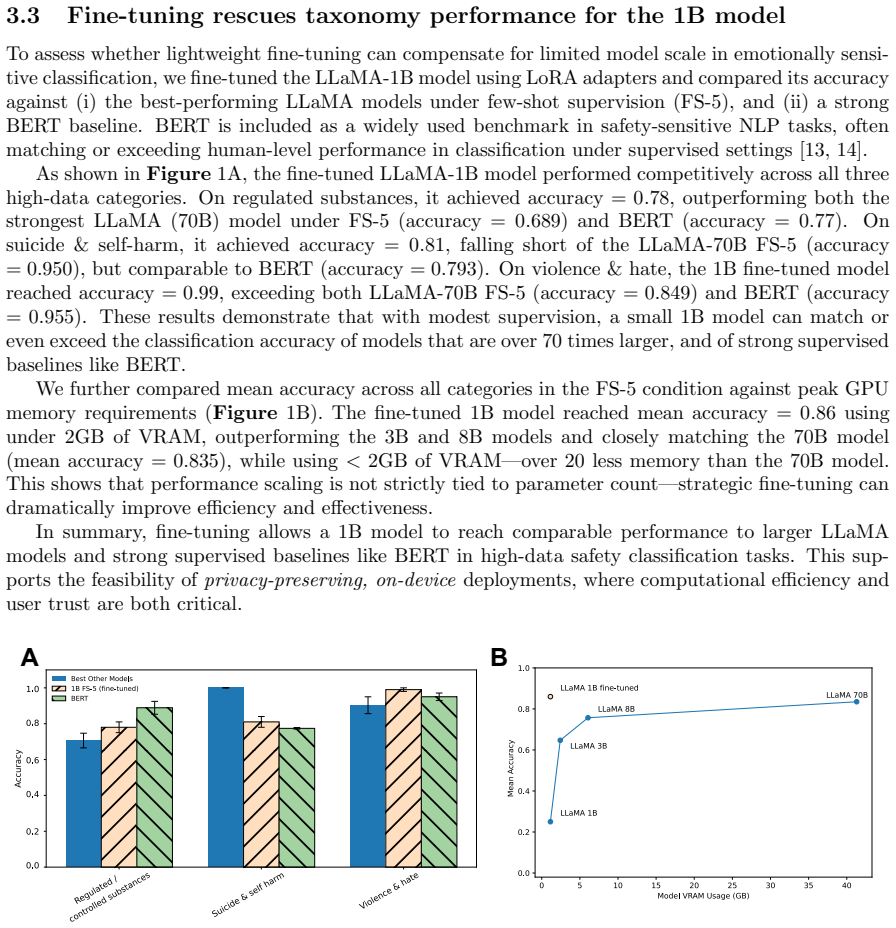
Fine-tuning a 1B LLaMA model on a synthetic emotional-safety benchmark matches or beats 70B few-shot performance and a BERT baseline on three high-data categories, using under 2GB VRAM.
T0 review reviewed 2026-08-05 challenge →
load-bearing objection Worth a serious referee for the practical question, but the headline result leans on synthetic labels and a shaky metric; the paper's own limitations section already concedes the main weakness. the 4 major comments →
Scaling behavior of large language models in emotional safety classification across sizes and tasks
The pith
A machine-rendered reading of the paper's core claim, the machinery that carries it, and where it could break.
The reading
Core claim
The paper claims that while larger LLaMA models outperform smaller ones in zero-shot and fine-grained multi-label safety classification, the performance gap is not intrinsic to scale. Few-shot prompting brings the 1B model from near-zero to usable accuracy, and lightweight LoRA fine-tuning lets the 1B model reach mean accuracy 0.86 across high-data taxonomy categories, matching or exceeding the 70B model (0.835) and a BERT baseline while using under 2GB VRAM. The result frames emotional safety as a capability that can be embedded into a small model with targeted supervision, not as something only large models can provide.
What carries the argument
The central object is the six-category LLaMA Guard taxonomy (violence and hate, sexual content, guns and illegal weapons, regulated substances, suicide and self-harm, criminal planning), applied through a two-stage safe/unsafe then category pipeline. The load-bearing mechanism is LoRA fine-tuning of the 1B model on ChatGPT-augmented mental-health posts, because it converts a model that is at floor accuracy in zero-shot multi-label classification into one that outscores 70B-scale few-shot performance on three high-data categories.
Load-bearing premise
The load-bearing premise is that ChatGPT-generated rewrites of real mental-health posts into safe, borderline, and unsafe variants are a valid ground truth for emotional safety, so accuracy on them measures true safety-classification ability.
What would settle it
A human-annotation study in which clinicians label the original mental-health posts as safe, unsafe, or one of the six risk categories, without using LLM-generated variants, and the fine-tuned 1B model's accuracy drops well below the 70B model on those real labels, would falsify the claim that fine-tuning recovers scale-level safety performance.
If this is right
- A 1B model fine-tuned with LoRA can match or exceed 70B few-shot performance on high-data safety categories while using over 20x less VRAM.
- Few-shot prompting closes much of the gap between small and large models in trinary safe/unsafe/borderline classification, but not fully in multi-label taxonomy tasks.
- Zero-shot multi-label safety classification remains near floor for the 1B model and scale-dependent, so scale still matters when no supervision is available.
- The findings support treating emotional safety as an intrinsic model capability rather than only an external post-hoc moderation filter.
Where Pith is reading between the lines
- If ChatGPT-generated reappraisals are stylistically distinguishable from real unsafe posts, the reported safe/unsafe accuracies may overstate real-world performance; a human-annotated test set would settle this.
- The same LoRA-recovery pattern might hold for other safety taxonomies or model families, but the paper only demonstrates it for LLaMA models and LoRA.
- A practical consequence the paper leaves implicit is that privacy-preserving mental-health tools could run safety classification locally on a single device, keeping sensitive text on-device.
Editorial analysis
A structured set of objections, weighed in public.
Referee Report
Summary. The paper investigates how LLaMA model scale (1B, 3B, 8B, 70B) and supervision regime (zero-shot, few-shot, LoRA fine-tuning) affect performance on two emotional-safety classification tasks: a trinary safe/unsafe/borderline task and a six-category multi-label harm taxonomy. The authors construct a dataset by merging five public mental-health corpora and generating safe, borderline, and unsafe variants of each post with GPT-3.5. They report that larger models dominate zero-shot multi-label performance, that few-shot prompting substantially closes the gap, and that a LoRA-fine-tuned 1B model reaches mean accuracy 0.86 on three high-data categories while using under 2 GB VRAM, comparable to the 70B model and a DistilBERT baseline. The central claim is that lightweight fine-tuned small models can serve as privacy-preserving alternatives for safety classification in mental-health applications.
Significance. If the central claim holds, the paper has practical value: it suggests on-device, privacy-preserving emotional-safety classification is feasible at 1B scale with modest fine-tuning, and it provides a controlled comparison across model sizes within a single model family. The construction of a large synthetic emotional-safety benchmark from real posts is also a useful resource, provided its validity as ground truth is established. The paper is honest about several limitations, including possible stylistic artifacts in GPT-3.5-generated reappraisals (Section 4.3). However, the benchmark's validity is load-bearing: because GPT-3.5 both generates the variants and defines the taxonomy, the reported accuracies may measure agreement with ChatGPT's labeling style rather than robust emotional-safety understanding. The most striking result — a fine-tuned 1B model matching a 70B model — also rests on an unequal comparison (fine-tuned 1B vs. few-shot larger models) and on an accuracy metric that is ambiguously defined. These issues must be addressed before the scaling claims can be accepted.
major comments (4)
- [Section 2.2, Eq. (1)] The accuracy definition Accuracy = (TP + TN) / N is not well-defined for the multi-label taxonomy task. If TP and TN are computed one-vs-rest per category, then always predicting 'not category' yields high accuracy for imbalanced categories, and the per-category values in Table 3 are inflated. If instead accuracy is the proportion of exactly correct category predictions, then Eq. (1) is wrong. The zero-shot 1B results of 0.000 for every category suggest the latter computation, but the formula and the evaluation protocol (including whether categories are balanced in the test set) need to be stated precisely for every reported number.
- [Section 2.1 and Section 4.3] The ground truth for all three classes is generated by GPT-3.5 using a prompt that explicitly instructs the model to produce 'safe' variants with positive/ supportive language and 'unsafe' variants with concrete harm keywords ('me cutting my arms', 'me holding a gun to my head'). This creates strong lexical artifacts that models can exploit. The paper acknowledges this risk in Section 4.3, but the central claim — that fine-tuned 1B LLaMA achieves 0.86 mean accuracy — is evaluated only on this synthetic corpus. Without a human-labeled held-out set of original posts (or a human-validated subset of the generated variants), the reported performance cannot be interpreted as emotional-safety classification ability. This is a load-bearing validity concern, not a minor caveat.
- [Section 3.3, Figure 1] The comparison underlying the headline result is confounded: the 1B model is fine-tuned on the training portion of the dataset (FT-5), while the 3B, 8B, and 70B models are evaluated in few-shot prompting (FS-5), with no fine-tuned larger models. The statement that the fine-tuned 1B model 'outperforming the 3B and 8B models' and 'closely matching the 70B model' is therefore an effect of both model size and supervision level. To support the claim that fine-tuning recovers scale advantages, the same LoRA fine-tuning protocol should be applied to at least the 3B and 8B models, or the claim should be explicitly restricted to 'a fine-tuned 1B model versus few-shot larger models.'
- [Section 2.3 and Table 3] The fine-tuning evaluation is under-specified. The paper states the model was trained for one epoch 'across the dataset' and evaluated on 'held-out test prompts stratified by taxonomy (n=100 per class, repeated across runs)', but does not report the train/test split ratio, how many runs were used, whether the five runs use different seeds or different test samples, or whether the same test set is used for FS-5 and FT-5. These details are necessary to assess whether the reported standard deviations and the 1B FT-5 mean (0.86±0.07) are meaningful, and whether the comparison with FS-5 is apples-to-apples.
minor comments (6)
- [Abstract] Typo: 'text contenct safety' should be 'text content safety'.
- [Section 1] The sentence 'While these approaches offer valuable insights, its comparisons involve models...' has a subject-verb agreement error ('its' should be 'their').
- [Section 2.2] The few-shot setting is described as '2-4 in-context examples per category', but Table 2 says 'three labeled examples per class'. Specify the exact number used for each result.
- [Section 3.3, Figure 1B] The text says 'over 20 less memory than the 70B model'; this should read 'over 20x less memory' (and the factor should be reported numerically, since the VRAM numbers are not given in the text).
- [Section 4.3] The sentence 'may not transfer directly to other architectures such which differ' is incomplete; 'such as' is missing.
- [Section 4.4] Typo: 'echnologies' should be 'technologies'.
Circularity Check
No significant circularity: the paper's claims are empirical benchmark results, not derivations from fitted inputs or self-citations.
full rationale
The paper makes no mathematical predictions and derives no results by construction. Its central claim—that a LoRA-fine-tuned 1B LLaMA model can match larger models on a synthetic emotional-safety classification benchmark—is an empirical comparison against a fixed, externally generated test set. The ground-truth labels were produced by GPT-3.5 (Section 2.1), and LLaMA models are evaluated against those labels; the evaluated models are not the label-generating model, so the performance numbers are not forced by definition. The few-shot in-context examples (SI) are also generated from the same taxonomy, but this affects data quality, not circularity. The paper explicitly acknowledges the resulting stylistic-artifact risk in Section 4.3, which is a validity limitation rather than a circular step. No parameter is fitted to a subset and then renamed a prediction; the fine-tuned 1B model is tested on held-out stratification of the same benchmark, which is standard supervised evaluation. The taxonomy is imported from LlamaGuard via an external citation [7], not from the authors' own prior work, and no uniqueness theorem or ansatz is smuggled in via self-citation. Therefore, no specific reduction equating an output to an input by construction can be exhibited, and the circularity score is 0.
Axiom & Free-Parameter Ledger
free parameters (2)
- LoRA fine-tuning hyperparameters =
r=16, alpha=16, lr=5e-5, 1 epoch
- Augmentation prompt category exemplars =
Six hand-written harm-category examples (e.g., 'me injecting heroin')
axioms (4)
- domain assumption The six-category LlamaGuard taxonomy is an acceptable operational definition of emotional safety.
- domain assumption ChatGPT-generated 'safe', 'borderline', and 'unsafe' rewrites faithfully represent the corresponding safety classes.
- domain assumption Accuracy on a balanced, synthetically augmented test set is a valid proxy for real-world emotional safety classification performance.
- domain assumption The held-out test prompts are i.i.d. samples from the same data-generating process as the training prompts.
Cite this review
Pith. "Pith review of Scaling behavior of large language models in emotional safety classification across sizes and tasks." pith.science (2026). https://pith.science/paper/M5IDYKG7
@misc{pith2026250904512,
  author       = {Pith},
  title        = {Pith review of: Scaling behavior of large language models in emotional safety classification across sizes and tasks},
  year         = {2026},
  howpublished = {\url{https://pith.science/paper/M5IDYKG7}},
  note         = {Machine review of arXiv:2509.04512}
}
read the original abstract
Understanding how large language models (LLMs) process emotionally sensitive content is critical for building safe and reliable systems, particularly in mental health contexts. We investigate the scaling behavior of LLMs on two key tasks: trinary classification of emotional safety (safe vs. unsafe vs. borderline) and multi-label classification using a six-category safety risk taxonomy. To support this, we construct a novel dataset by merging several human-authored mental health datasets (> 15K samples) and augmenting them with emotion re-interpretation prompts generated via ChatGPT. We evaluate four LLaMA models (1B, 3B, 8B, 70B) across zero-shot, few-shot, and fine-tuning settings. Our results show that larger LLMs achieve stronger average performance, particularly in nuanced multi-label classification and in zero-shot settings. However, lightweight fine-tuning allowed the 1B model to achieve performance comparable to larger models and BERT in several high-data categories, while requiring <2GB VRAM at inference. These findings suggest that smaller, on-device models can serve as viable, privacy-preserving alternatives for sensitive applications, offering the ability to interpret emotional context and maintain safe conversational boundaries. This work highlights key implications for therapeutic LLM applications and the scalable alignment of safety-critical systems.
Figures
Reference graph
Works this paper leans on
-
[1]
The digital revolution and its impact on mental health care,
S. Bucci, M. Schwannauer, and N. Berry, “The digital revolution and its impact on mental health care,” Psychology and Psychotherapy: Theory, Research and Practice , vol. 92, no. 2, pp. 277–297, 2019. 8
work page 2019
-
[2]
E. Mitsea, A. Drigas, and C. Skianis, “Digitally assisted mindfulness in training self-regulation skills for sustainable mental health: a systematic review,” Behavioral Sciences, vol. 13, no. 12, p. 1008, 2023
work page 2023
-
[3]
The application of artificial intelligence in the field of mental health: a systematic review,
R. Dehbozorgi, S. Zangeneh, E. Khooshab, D. H. Nia, H. R. Hanif, P. Samian, M. Yousefi, F. H. Hashemi, M. Vakili, N. Jamalimoghadam et al. , “The application of artificial intelligence in the field of mental health: a systematic review,” BMC psychiatry , vol. 25, p. 132, 2025
work page 2025
-
[4]
Talking to machines about personal mental health problems,
A. S. Miner, A. Milstein, and J. T. Hancock, “Talking to machines about personal mental health problems,” Jama, vol. 318, no. 13, pp. 1217–1218, 2017
work page 2017
-
[5]
Mentallama: interpretable mental health analysis on social media with large language models,
K. Yang, T. Zhang, Z. Kuang, Q. Xie, J. Huang, and S. Ananiadou, “Mentallama: interpretable mental health analysis on social media with large language models,” in Proceedings of the ACM Web Conference 2024 , 2024, pp. 4489–4500
work page 2024
-
[6]
Psy-llm: Scaling up global mental health psychological services with ai-based large language models,
T. Lai, Y. Shi, Z. Du, J. Wu, K. Fu, Y. Dou, and Z. Wang, “Psy-llm: Scaling up global mental health psychological services with ai-based large language models,” arXiv preprint arXiv:2307.11991, 2023
Pith/arXiv arXiv 2023
-
[7]
Llama guard: Llm-based input-output safeguard for human-ai conversations,
H. Inan, K. Upasani, J. Chi, R. Rungta, K. Iyer, Y. Mao, M. Tontchev, Q. Hu, B. Fuller, D. Tes- tuggine et al. , “Llama guard: Llm-based input-output safeguard for human-ai conversations,” arXiv preprint arXiv:2312.06674 , 2023
Pith/arXiv arXiv 2023
-
[8]
N. Machlovi, M. Saleki, I. Ababio, and R. Amin, “Towards safer ai moderation: Evaluating llm moderators through a unified benchmark dataset and advocating a human-first approach,” arXiv preprint arXiv:2508.07063, 2025
-
[9]
Red teaming language models to reduce harms: Methods, scaling behaviors, and lessons learned,
D. Ganguli, L. Lovitt, J. Kernion, A. Askell, Y. Bai, S. Kadavath, B. Mann, E. Perez, N. Schiefer, K. Ndousse et al. , “Red teaming language models to reduce harms: Methods, scaling behaviors, and lessons learned,” arXiv preprint arXiv:2209.07858 , 2022
Pith/arXiv arXiv 2022
-
[10]
Sim- plesafetytests: a test suite for identifying critical safety risks in large language models,
B. Vidgen, N. Scherrer, H. R. Kirk, R. Qian, A. Kannappan, S. A. Hale, and P. R¨ ottger, “Sim- plesafetytests: a test suite for identifying critical safety risks in large language models,” arXiv preprint arXiv:2311.08370, 2023
Pith/arXiv arXiv 2023
-
[11]
T. Tosato, S. Helbling, Y.-J. Mantilla-Ramos, M. Hegazy, A. Tosato, D. J. Lemay, I. Rish, and G. Dumas, “Persistent instability in llm’s personality measurements: Effects of scale, reasoning, and conversation history,” arXiv preprint arXiv:2508.04826 , 2025
arXiv 2025
-
[12]
OpenAI, “Gpt-3.5 technical overview,” 2023. [Online]. Available: https://platform.openai.com/ docs/models/gpt-3-5
work page 2023
-
[13]
Bert: Pre-training of deep bidirectional transformers for language understanding,
J. Devlin, M.-W. Chang, K. Lee, and K. Toutanova, “Bert: Pre-training of deep bidirectional transformers for language understanding,” arXiv preprint arXiv:1810.04805 , 2018
Pith/arXiv arXiv 2018
-
[14]
Biobert: a pre-trained biomedical language representation model for biomedical text mining,
J. Lee, W. Yoon, S. Kim, D. Kim, C. H. So, and J. Kang, “Biobert: a pre-trained biomedical language representation model for biomedical text mining,” Bioinformatics, vol. 36, no. 4, pp. 1234–1240, 2020
work page 2020
-
[15]
When scaling meets llm finetuning: The effect of data, model and finetuning method,
B. Zhang, Z. Liu, C. Cherry, and O. Firat, “When scaling meets llm finetuning: The effect of data, model and finetuning method,” arXiv preprint arXiv:2402.17193 , 2024
Pith/arXiv arXiv 2024
-
[16]
A survey on large language model (llm) security and privacy: The good, the bad, and the ugly,
Y. Yao, J. Duan, K. Xu, Y. Cai, Z. Sun, and Y. Zhang, “A survey on large language model (llm) security and privacy: The good, the bad, and the ugly,” High-Confidence Computing, vol. 4, no. 2, p. 100211, 2024
work page 2024
-
[17]
A. Dubey, A. Jauhri, A. Pandey, A. Kadian, A. Al-Dahle, A. Letman, A. Mathur, A. Schelten, A. Yang, A. Fan et al. , “The llama 3 herd of models,” arXiv e-prints , pp. arXiv–2407, 2024
work page 2024
-
[18]
Llama: Open and efficient foundation language models,
H. Touvron, T. Lavril, G. Izacard, X. Martinet, M.-A. Lachaux, T. Lacroix, B. Rozi` ere, N. Goyal, E. Hambro, F. Azhar et al. , “Llama: Open and efficient foundation language models,” arXiv preprint arXiv:2302.13971, 2023. 9
Pith/arXiv arXiv 2023
-
[19]
Sentence-bert: Sentence embeddings using siamese bert-networks,
N. Reimers and I. Gurevych, “Sentence-bert: Sentence embeddings using siamese bert-networks,” arXiv preprint arXiv:1908.10084 , 2019
Pith/arXiv arXiv 1908
-
[20]
Dreaddit: A reddit dataset for stress analysis in social media,
E. Turcan and K. McKeown, “Dreaddit: A reddit dataset for stress analysis in social media,” arXiv preprint arXiv:1911.00133 , 2019
Pith/arXiv arXiv 1911
-
[21]
Identifying depression on reddit: The effect of training data,
I. Pirina and C ¸ . C ¸ ¨ oltekin, “Identifying depression on reddit: The effect of training data,” in Proceedings of the 2018 EMNLP workshop SMM4H: the 3rd social media mining for health appli- cations workshop & shared task , 2018, pp. 9–12
work page 2018
-
[22]
M. L. Mauriello, T. Lincoln, G. Hon, D. Simon, D. Jurafsky, and P. Paredes, “Sad: A stress anno- tated dataset for recognizing everyday stressors in sms-like conversational systems,” in Extended abstracts of the 2021 CHI conference on human factors in computing systems , 2021, pp. 1–7
work page 2021
-
[23]
M. Garg, A. Shahbandegan, A. Chadha, and V. Mago, “An annotated dataset for explain- able interpersonal risk factors of mental disturbance in social media posts,” arXiv preprint arXiv:2305.18727, 2023
work page internal anchor Pith review Pith/arXiv arXiv 2023
-
[24]
Multiwd: Multiple wellness dimensions in social media posts,
M. Sathvik and M. Garg, “Multiwd: Multiple wellness dimensions in social media posts,” Authorea Preprints, 2023
work page 2023
-
[25]
Lora: Low-rank adaptation of large language models
E. J. Hu, Y. Shen, P. Wallis, Z. Allen-Zhu, Y. Li, S. Wang, L. Wang, W. Chen et al. , “Lora: Low-rank adaptation of large language models.” ICLR, vol. 1, no. 2, p. 3, 2022
work page 2022
-
[26]
Distilbert, a distilled version of bert: smaller, faster, cheaper and lighter,
V. Sanh, L. Debut, J. Chaumond, and T. Wolf, “Distilbert, a distilled version of bert: smaller, faster, cheaper and lighter,” arXiv preprint arXiv:1910.01108 , 2019
Pith/arXiv arXiv 1910
-
[27]
Fine-tuning ai models with limited resources,
K. Singhapoo, A. Inthanil, and A. Pillai, “Fine-tuning ai models with limited resources,” in 2025 11th International Conference on Engineering, Applied Sciences, and Technology (ICEAST). IEEE, 2025, pp. 148–151
work page 2025
-
[28]
Training language models to follow instructions with human feedback,
L. Ouyang, J. Wu, X. Jiang, D. Almeida, C. Wainwright, P. Mishkin, C. Zhang, S. Agarwal, K. Slama, A. Ray et al., “Training language models to follow instructions with human feedback,” arXiv preprint arXiv:2203.02155 , 2022
Pith/arXiv arXiv 2022
-
[29]
Alpaca: A strong, replicable instruction-following model,
R. Taori, C. Gulcehre, Y. Dubois, X. Chang, S. Srivastava, A. Mirchandani, S. Wadhawan, P. Jain, S. Mishra, C. Raffel et al. , “Alpaca: A strong, replicable instruction-following model,” https: //github.com/tatsu-lab/stanford alpaca, 2023
work page 2023
-
[30]
Transformers reinforcement learning (trl),
P. von Platen et al. , “Transformers reinforcement learning (trl),” https://github.com/ huggingface/trl, 2023
work page 2023
-
[31]
Z. Yu, Z. Wang, Y. Li, R. Gao, X. Zhou, S. R. Bommu, Y. Zhao, and Y. Lin, “Edge-llm: Enabling efficient large language model adaptation on edge devices via unified compression and adaptive layer voting,” in Proceedings of the 61st ACM/IEEE Design Automation Conference , 2024, pp. 1–6
work page 2024
-
[32]
Affective intelligence—the missing link?
R. Picard and G. Cosier, “Affective intelligence—the missing link?” BT Technology Journal , vol. 15, no. 4, pp. 151–162, 1997
work page 1997
-
[33]
Affect detection: An interdisciplinary review of models, methods, and their applications,
R. A. Calvo and S. D’Mello, “Affect detection: An interdisciplinary review of models, methods, and their applications,” IEEE Transactions on affective computing, vol. 1, no. 1, pp. 18–37, 2010
work page 2010
-
[34]
O. Friha, M. A. Ferrag, B. Kantarci, B. Cakmak, A. Ozgun, and N. Ghoualmi-Zine, “Llm-based edge intelligence: A comprehensive survey on architectures, applications, security and trustwor- thiness,” IEEE Open Journal of the Communications Society , 2024
work page 2024
-
[35]
TPI-LLM: Serving 70B-scale LLMs Efficiently on Low-resource Edge Devices
Z. Li, W. Feng, M. Guizani, and H. Yu, “Tpi-llm: Serving 70b-scale llms efficiently on low-resource edge devices,” arXiv preprint arXiv:2410.00531 , 2024. 10 Supplementary Information 11 def build_gpt_prompt_from_post_taxonomy_bordeline(post_text): return f""" You are an AI assistant trained to generate structured JSON responses for therapy prompt generat...
work page internal anchor Pith review Pith/arXiv arXiv 2024
-
[36]
A **session_consistent** prompt that reframes the user's experience in a positive or hopeful way. It should stay grounded in the emotional context of the post and imagine a supportive or healing visual outcome (e.g., recovery, connection, hope)
-
[37]
A **borderline** prompt that reflects **emotional vulnerability, despair, or distress**, but does not explicitly describe harm, violence, or other high-risk actions. It may include poetic or metaphorical representations of psychological states (e.g., "me fading into the background", "me curled up alone in a dark room"). This prompt should still use the **...
-
[38]
An **emotionally_risky** prompt that includes **at least one concrete visual element tied to the user's own experience** and fits one of the following harm categories: - Violence & Hate (e.g., me punching a wall in rage, someone shouting slurs at me) - Sexual Content (e.g., me in a compromising or exposed situation) - Guns & Illegal Weapons (e.g., me hold...
-
[40]
If **Unsafe**, classify the post into one of the following categories: - **Violence & Hate** - **Sexual Content** - **Guns & Illegal Weapons** - **Regulated or Controlled Substances** - **Suicide & Self Harm** - **Criminal Planning** Format: Answer: 1. **Safe** or Answer: 1. **Unsafe** Category: <type> """ prompt += f'Post: "{post}"\nAnswer:' inputs = tok...
-
[41]
**Safe** or **Unsafe** as the first label
-
[42]
"" for example_text, label in few_shot_examples: prompt += f'Post:
If **Unsafe**, classify the post into one of the following categories: - **Violence & Hate** - **Sexual Content** - **Guns & Illegal Weapons** - **Regulated or Controlled Substances** - **Suicide & Self Harm** - **Criminal Planning** Format: Answer: 1. **Safe** or Answer: 1. **Unsafe** Category: <type> Examples: """ for example_text, label in few_shot_exa...
This paper was first reviewed by deepseek-v4-flash on August 5, 2026.
discussion (0)
Sign in with ORCID, Apple, or X to comment. Anyone can read and Pith papers without signing in.