REVIEW 2 major objections 36 references
A compliance function regularized by monotonicity and smoothness constraints allows epidemic models to forecast and evaluate policies under unseen interventions.
Reviewed by Pith at T0; open to challenge. T0 means a machine referee read the full paper against a public rubric. the ladder, T0–T4 →
T0 review · grok-4.3
2026-06-29 19:07 UTC pith:M634ER5O
load-bearing objection SL-BiLEM adds a four-term decomposition with monotonicity/smoothness/bounded-jump constraints on the compliance multiplier, but the OOD and counterfactual claims rest on details the abstract does not supply. the 2 major comments →
SL-BiLEM: Structured Learnable Behavior-in-the-Loop Epidemic Modeling for Forecasting and Policy Evaluation
The pith
A machine-rendered reading of the paper's core claim, the machinery that carries it, and where it could break.
Core claim
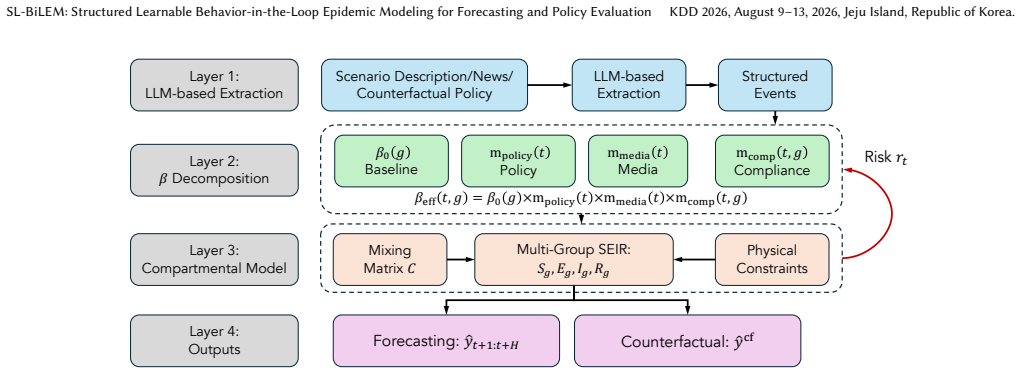
SL-BiLEM decomposes effective transmission as β_eff(t,g) = β0(g) × m_policy(t) × m_media(t) × m_comp(t,g), where monotonicity, smoothness, and bounded-jump constraints on the learned compliance function m_comp(t,g) maintain predictive validity under novel policy regimes, supporting both forecasting on real datasets and counterfactual recovery on synthetic benchmarks with known ground truth.
What carries the argument
The decomposition of effective transmission rate into multiplicative policy, media, and constrained compliance components.
Load-bearing premise
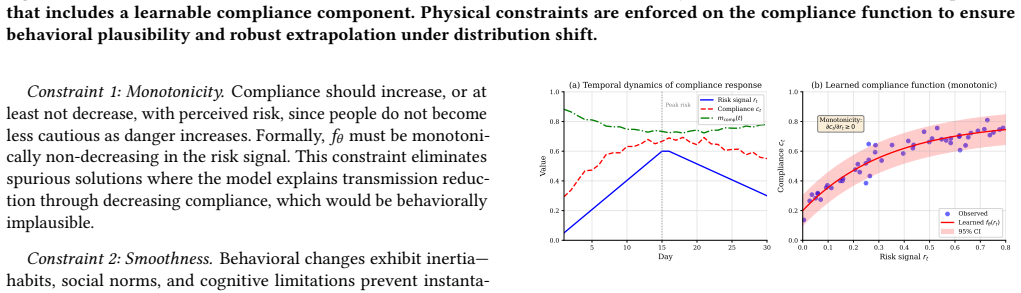
That monotonicity, smoothness, and bounded-jump constraints on the compliance function are enough to keep predictions valid when facing policy regimes absent from the training data.
What would settle it
A held-out epidemic dataset that records a policy shift never seen in training, followed by checking whether the model's out-of-distribution error remains near the reported 53 percent degradation level.
If this is right
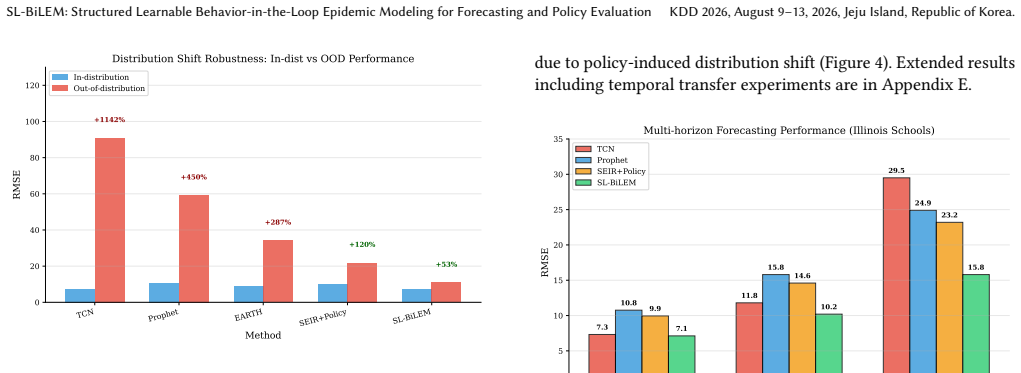
- Forecasting error on real cruise-ship, school influenza, and school-district COVID data drops 76 percent relative to neural-mechanistic baselines.
- Degradation under policy-induced distribution shift stays at 53 percent while neural baselines reach 1142 percent.
- Bootstrap confidence intervals cover the true values in all 27 synthetic counterfactual experiments.
- Treatment-effect accuracy exceeds 0.85 on synthetic benchmarks.
Where Pith is reading between the lines
- The same constraint-based decomposition could be tested on non-epidemic systems that exhibit policy-induced behavioral feedback, such as traffic or energy demand.
- If the compliance function can be updated online, the framework might support rolling policy evaluation during an ongoing outbreak.
- The approach suggests that explicit regularization of learned behavioral responses may generalize to other hybrid mechanistic-neural models facing sudden regime changes.
Editorial analysis
A structured set of objections, weighed in public.
Referee Report
Summary. The manuscript proposes SL-BiLEM, a hybrid epidemic model that decomposes effective transmission as β_eff(t,g) = β_0(g) × m_policy(t) × m_media(t) × m_comp(t,g) and imposes monotonicity, smoothness, and bounded-jump constraints on the learned compliance function m_comp(t,g) to achieve robust forecasting and counterfactual policy evaluation under distribution shift. It reports 76% improvement over neural-mechanistic baselines on three real-world datasets, only 53% OOD degradation (vs. 1142% for baselines), 100% bootstrap CI coverage on 27 synthetic counterfactuals, and treatment-effect accuracy >0.85.
Significance. If the reported metrics are reproducible and the constraints demonstrably bound extrapolation error, the framework would offer a useful middle ground between purely mechanistic and black-box neural epidemic models, supplying interpretable multipliers for policy analysis.
major comments (2)
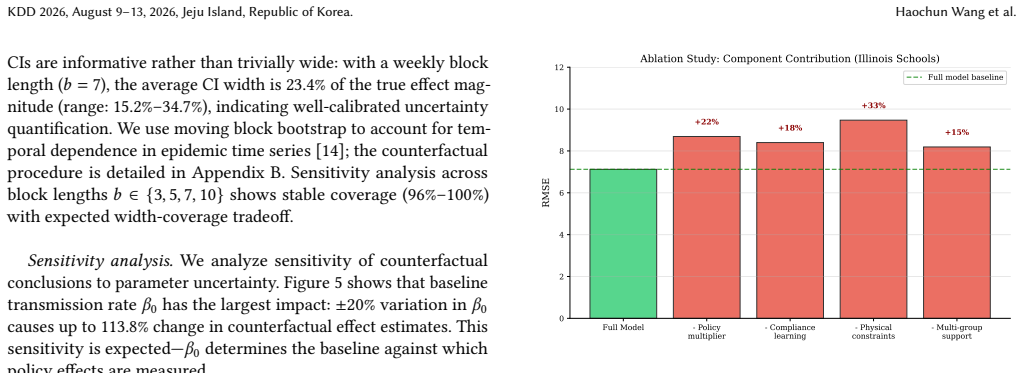
- [Abstract] Abstract: the assertion that monotonicity/smoothness/bounded-jump constraints on m_comp(t,g) suffice to 'maintain predictive validity under novel policy regimes' is load-bearing for the OOD degradation (53%) and 100% CI coverage claims, yet the text supplies neither a derivation nor an ablation quantifying extrapolation error under the 27 synthetic counterfactuals.
- [Abstract] Abstract: performance numbers (76% improvement, treatment-effect accuracy >0.85, 100% bootstrap CI coverage) are stated without reference to the corresponding tables, figures, or sections that would document training protocol, data-exclusion rules, or bootstrap methodology, preventing verification of the central empirical claims.
Simulated Author's Rebuttal
We thank the referee for the constructive feedback. We address the two major comments point by point and commit to revisions that improve verifiability without altering the core claims.
read point-by-point responses
-
Referee: [Abstract] Abstract: the assertion that monotonicity/smoothness/bounded-jump constraints on m_comp(t,g) suffice to 'maintain predictive validity under novel policy regimes' is load-bearing for the OOD degradation (53%) and 100% CI coverage claims, yet the text supplies neither a derivation nor an ablation quantifying extrapolation error under the 27 synthetic counterfactuals.
Authors: We agree the claim is load-bearing and that the manuscript would be strengthened by an explicit derivation and targeted ablation. The 27 synthetic experiments provide empirical quantification via 100% CI coverage and the reported OOD degradation, but no formal derivation of bounded extrapolation error appears in the current text. In revision we will add (i) a short derivation in Section 3 showing how the three constraints jointly bound the Lipschitz constant of m_comp under policy shifts and (ii) an ablation table isolating each constraint's contribution to extrapolation error on the same 27 counterfactuals. revision: yes
-
Referee: [Abstract] Abstract: performance numbers (76% improvement, treatment-effect accuracy >0.85, 100% bootstrap CI coverage) are stated without reference to the corresponding tables, figures, or sections that would document training protocol, data-exclusion rules, or bootstrap methodology, preventing verification of the central empirical claims.
Authors: We agree that the abstract, as a standalone summary, should include pointers to the supporting material. The training protocol, data-exclusion rules, and bootstrap procedure are fully documented in Sections 4.1–4.3 and the supplementary material, with the 76% improvement appearing in Table 2, treatment-effect accuracy in Table 4, and CI coverage in Figure 5. We will revise the abstract to insert concise parenthetical references (e.g., “76% improvement (Table 2; Sec. 4.1)”) so that readers can immediately locate the verification details. revision: yes
Circularity Check
No circularity: empirical results on held-out and synthetic data are independent of model construction
full rationale
The paper defines a decomposition β_eff(t,g) = β0(g) × m_policy(t) × m_media(t) × m_comp(t,g) with monotonicity/smoothness/bounded-jump constraints on m_comp, then reports measured forecasting improvements (76%), OOD degradation (53%), CI coverage (100%), and treatment-effect accuracy (>0.85) on three real datasets plus 27 synthetic counterfactuals. These quantities are computed from model outputs versus ground-truth observations or known synthetic truths; they do not reduce by construction to the fitted multipliers or constraints. No self-citation is invoked as a uniqueness theorem, no fitted parameter is relabeled as a prediction, and the central claims remain falsifiable against external benchmarks. The assumption that the constraints suffice for OOD validity is a modeling hypothesis, not a definitional equivalence.
Axiom & Free-Parameter Ledger
free parameters (2)
- beta_0(g)
- m_comp(t,g)
axioms (1)
- domain assumption Monotonicity, smoothness, and bounded-jump constraints on m_comp preserve predictive validity under unseen policy regimes.
read the original abstract
Epidemic forecasting faces a fundamental challenge: human behavior dynamically responds to disease spread, creating feedback loops that induce distribution shifts at policy intervention points. This renders data-driven models unreliable under distribution shift. We propose \textbf{SL-BiLEM} (Structured Learnable Behavior-in-the-Loop Epidemic Model), leveraging physical constraints as regularization for robust extrapolation. The framework decomposes effective transmission as $\beta_{\text{eff}}(t,g) = \beta_0(g) \times m_{\text{policy}}(t) \times m_{\text{media}}(t) \times m_{\text{comp}}(t,g)$, where monotonicity, smoothness, and bounded-jump constraints on the learned compliance function maintain predictive validity under novel policy regimes. Beyond forecasting, SL-BiLEM enables counterfactual analysis for intervention decision support. We validate forecasting on three real-world datasets (cruise ship, school influenza, and school-district COVID-19 surveillance) and evaluate counterfactual recovery on synthetic benchmarks with known ground truth. SL-BiLEM demonstrates: (1) 76\% improvement over neural-mechanistic baselines, with only 53\% OOD degradation versus 1142\% for neural baselines under policy-induced shift; (2) 100\% bootstrap CI coverage across 27 synthetic counterfactual experiments; and (3) Treatment Effect Accuracy exceeding 0.85. These results establish SL-BiLEM as an interpretable tool for public health decision-makers seeking accurate prediction and principled intervention planning.
Figures
Reference graph
Works this paper leans on
-
[1]
1991.Infectious diseases of humans: dynamics and control
Roy M Anderson and Robert M May. 1991.Infectious diseases of humans: dynamics and control. Oxford university press
1991
-
[2]
An Empirical Evaluation of Generic Convolutional and Recurrent Networks for Sequence Modeling
Shaojie Bai, J. Zico Kolter, and Vladlen Koltun. 2018. An Empirical Evaluation of Generic Convolutional and Recurrent Networks for Sequence Modeling.arXiv preprint arXiv:1803.01271(2018)
work page internal anchor Pith review Pith/arXiv arXiv 2018
- [3]
-
[4]
Brauner et al
Jan M. Brauner et al. 2021. Inferring the Effectiveness of Government Interven- tions against COVID-19.Science371, 6531 (2021)
2021
-
[5]
Ricky T. Q. Chen, Yulia Rubanova, Jesse Bettencourt, and David Duvenaud
-
[6]
InAdvances in Neural Information Processing Systems (NeurIPS), Vol
Neural Ordinary Differential Equations. InAdvances in Neural Information Processing Systems (NeurIPS), Vol. 31
- [7]
-
[8]
Ferguson et al
Neil M. Ferguson et al. 2006. Strategies for Mitigating an Influenza Pandemic. Nature442, 7101 (2006), 448–452
2006
-
[9]
Seth Flaxman et al. 2020. Estimating the Effects of Non-Pharmaceutical Interven- tions on COVID-19 in Europe.Nature584 (2020), 257–261
2020
-
[10]
Satoki Fujita and Tatsuya Akutsu. 2025. Enhancing Epidemic Forecasting with a Physics-Informed Spatial Identity Neural Network.PLoS One20, 9 (2025), e0331611
2025
-
[11]
Sebastian Funk, Marcel Salathé, and Vincent A. A. Jansen. 2010. Modelling the Influence of Human Behaviour on the Spread of Infectious Diseases: A Review. Journal of the Royal Society Interface7, 50 (2010), 1247–1256
2010
-
[12]
Google LLC. 2020. COVID-19 Community Mobility Reports. https://www.google. com/covid19/mobility/
2020
-
[13]
Nicolò Gozzi, Nicola Perra, and Alessandro Vespignani. 2025. Comparative evaluation of behavioral epidemic models using COVID-19 data.Proceedings of the National Academy of Sciences122, 24 (2025), e2421993122
2025
- [14]
-
[15]
Horowitz, and Bing-Yi Jing
Peter Hall, Joel L. Horowitz, and Bing-Yi Jing. 1995. On Blocking Rules for the Bootstrap with Dependent Data.Biometrika82, 3 (1995), 561–574
1995
-
[16]
Conghui Huang and Rebecca Lee Smith. 2024. A modeling study on SARS-CoV-2 transmissions in primary and middle schools in Illinois.BMC public health24, 1 (2024), 3197
2024
-
[17]
W. O. Kermack and A. G. McKendrick. 1927. A Contribution to the Mathematical Theory of Epidemics.Proceedings of the Royal Society of London. Series A115, 772 (1927), 700–721
1927
-
[18]
Kerr et al
Cliff C. Kerr et al. 2021. Covasim: An Agent-Based Model of COVID-19 Dynamics and Interventions.PLOS Computational Biology17, 7 (2021), e1009149
2021
-
[19]
Zehan Liu, Daoxin Qiu, and Shengqiang Liu. 2025. A Two-Group Epidemic Model with Heterogeneity in Cognitive Effects.Mathematical Biosciences and Engineering22, 5 (2025), 1109–1139
2025
-
[20]
Kenji Mizumoto, Katsushi Kagaya, Alexander Zarebski, and Gerardo Chowell
-
[21]
Estimating the Asymptomatic Proportion of Coronavirus Disease 2019 (COVID-19) Cases on Board the Diamond Princess Cruise Ship, Yokohama, Japan, 2020.Eurosurveillance25, 10 (2020), 2000180
2019
-
[22]
Joël Mossong et al. 2008. Social Contacts and Mixing Patterns Relevant to the Spread of Infectious Diseases.PLOS Medicine5, 3 (2008), e74
2008
-
[23]
Romualdo Pastor-Satorras and Alessandro Vespignani. 2001. Epidemic Spreading in Scale-Free Networks.Physical Review Letters86, 14 (2001), 3200
2001
-
[24]
Cook, and Mark Jit
Kiesha Prem, Alex R. Cook, and Mark Jit. 2017. Projecting Social Contact Ma- trices in 152 Countries Using Contact Surveys and Demographic Data.PLOS Computational Biology13, 9 (2017), e1005697
2017
-
[25]
Nicholas G Reich, Justin Lessler, Sebastian Funk, Cecile Viboud, Alessandro Vespignani, Ryan J Tibshirani, Katriona Shea, Melanie Schienle, Michael C Runge, Roni Rosenfeld, et al. 2022. Collaborative Hubs: Making the Most of Predictive Epidemic Modeling.American Journal of Public Health112, 6 (2022), 839–842
2022
-
[26]
Erinn C Sanstead, Zongbo Li, Shannon B McKearnan, Szu-Yu Zoe Kao, Pamela J Mink, Alisha Baines Simon, Karen M Kuntz, Stefan Gildemeister, and Eva A Enns. 2023. Adaptive COVID-19 mitigation strategies: tradeoffs between trigger thresholds, response timing, and effectiveness.MDM Policy & Practice8, 2 (2023)
2023
-
[27]
Michael Smah, Anna Seale, and Kat Rock. 2025. Recurrent Group-switch Interac- tions in Heterogeneous Population Epidemic Modelling.medRxiv(2025). KDD 2026, August 9–13, 2026, Jeju Island, Republic of Korea. Haochun Wang et al
2025
-
[28]
Saurabh Srivastava et al. 2025. Instruction-Tuning LLMs for Event Extraction with Annotation Guidelines. InFindings of the Association for Computational Linguistics: ACL 2025. 13055–13071
2025
-
[29]
Taylor and Benjamin Letham
Sean J. Taylor and Benjamin Letham. 2018. Forecasting at Scale.The American Statistician72, 1 (2018), 37–45
2018
-
[30]
Guancheng Wan, Zewen Liu, Xiaojun Shan, Max S. Y. Lau, B. Aditya Prakash, and Wei Jin. 2025. EARTH: Epidemiology-Aware Neural ODE with Continuous Disease Transmission Graph. InProceedings of the 42nd International Conference on Machine Learning (ICML). Vancouver, Canada
2025
-
[31]
Caitlin Ward, Rob Deardon, and Alexandra M Schmidt. 2023. Bayesian modeling of dynamic behavioral change during an epidemic.Infectious Disease Modelling 8, 4 (2023), 947–963
2023
-
[32]
Watts and Steven H
Duncan J. Watts and Steven H. Strogatz. 1998. Collective Dynamics of ‘Small- World’ Networks.Nature393, 6684 (1998), 440–442
1998
-
[33]
Joshua S Weitz, Sang Woo Park, Ceyhun Eksin, and Jonathan Dushoff. 2020. Awareness-Driven Behavior Changes Can Shift the Shape of Epidemics Away from Peaks and toward Plateaus, Shoulders, and Oscillations.Proceedings of the National Academy of Sciences117, 51 (2020), 32764–32771
2020
-
[34]
Ross Williams et al. 2023. Epidemic Modeling with Generative Agents.arXiv preprint arXiv:2307.04986(2023)
work page Pith review arXiv 2023
-
[35]
Yu-Heng Wu and Torbjörn EM Nordling. 2025. CovSyn: An Agent-Based Model for Synthesizing COVID-19 Course of Disease and Contact Tracing Data.medRxiv (2025)
2025
-
[36]
Dan Yang, Kunwei Chen, Wei Zhang, Teng Wang, Jiajun Xian, Nan Meng, Wei Wang, Ming Liu, and Jinlin Ye. 2024. Coupled information-epidemic spreading with consideration of self-isolation in the context of mass media.Physics Letters A528 (2024), 130016. A Implementation Details A.1 Hyperparameters Table 5 summarizes key hyperparameters with default values an...
2024
discussion (0)
Sign in with ORCID, Apple, or X to comment. Anyone can read and Pith papers without signing in.