REVIEW 3 major objections 5 minor 3 cited by
Nonlinearities in Kerr Black Hole Ringdown from the Penrose Limit
T0 review · 3 major / 5 minor · reviewed 2026-08-06 · deepseek-v4-flash
Pith's one-line read The paper derives a fully analytic, spin-dependent formula for the amplitude and phase of quadratic quasi-normal modes in Kerr ringdown, in the eikonal limit, using the Penrose limit around the photon ring.
desk verdict A clean but uncontrolled spin-dependent extension of the Schwarzschild Penrose-limit calculation; the frequency-detuning issue in Eq. (59) is real and needs fixing before the spin dependence can be trusted. read the letter →
The pith
A machine-rendered reading of the paper's core claim, the machinery that carries it, and where it could break.
The reading
What carries the argument
The engine is the Penrose limit taken along the equatorial circular null geodesic of Kerr. Around that geodesic the metric becomes the plane-wave metric $ds^2 = 2\,du\,dv + \alpha^2(x_1^2-x_2^2)\,du^2 + dx_1^2 + dx_2^2$, with $\alpha$ encoding the black hole spin through $\alpha^2 = 12M\Delta/[r_0^3(r_0-M)^2]$, equivalently $\alpha^2=(b_0^2-a^2)/r_0^4$. On this background the linear perturbation separates into harmonic-oscillator equations in the transverse coordinates, giving the eikonal quasi-normal-mode frequency $p_v=\ell/b_0$ and damping set by $\alpha$; the second-order perturbation is then solved as a sourced version of the same equations. The pp-wave solution is matched to the eikonal Teukolsky solution through WKB principal functions, and the resulting ratio is projected onto spin-weighted spheroidal harmonics through the overlap integral $C_\ell$. The nonlinear input is the assumption, taken from the peaked structure of the second-order Teukolsky source, that the source is localized exactly at the light ring.
What would settle it
Numerically solve the second-order Teukolsky equation for Kerr with a source whose radial profile is a narrow but finite shell centered on the photon ring, and compare the quadratic quasi-normal-mode amplitude ratio for, say, $\ell_1=\ell_2=10$ and $a/M=0.9$ with Eq. (63); if the ratio moves by more than the retained $\alpha^4/\omega^4$ correction as the shell width is varied, the localization assumption is disproved.
Extended reading notes
Core claim
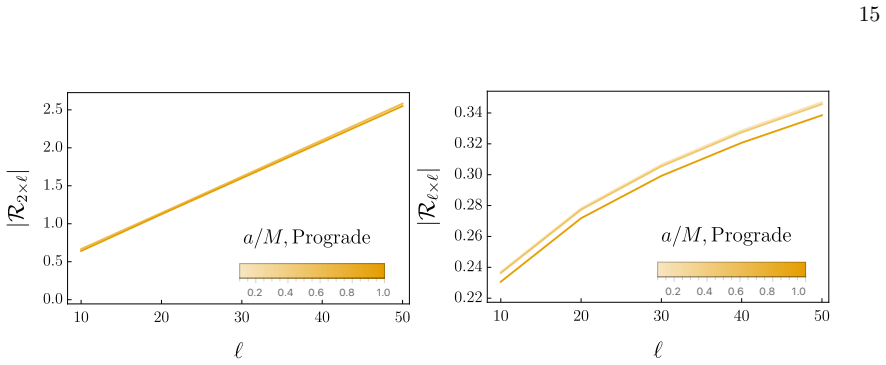
The central result is the eikonal-limit amplitude ratio for the quadratic quasi-normal mode produced by two linear modes with angular momenta $\ell_1$ and $\ell_2$ on a Kerr background. The paper obtains $$R_{\ell_1\times\ell_2} = \left[\frac{\$ell_1^{3}$\ell_2+\ell_1\$ell_2^{3}$ - i\sigma_{\ell_1,\ell_2}(\ell_1+\ell_2)^4 + i(\$alpha^{4}$/\$omega^{4}$)}{8\ell_1\ell_2(\ell_1+\ell_2)^2}\right]\frac{C_{\ell_1+\ell_2}}{C_{\ell_1}C_{\ell_2}},$$ where $\sigma_{\ell_1,\ell_2}=1$ for $\ell_1\neq\ell_2$ and $1/2$ for equal modes, $\alpha$ is the Penrose-limit frequency scale, $\omega\simeq\ell/b_0$, and $C_\ell$ projects the WKB angular phase onto spin-weighted spheroidal harmonics. Spin enters through $\alpha$, the impact parameter $b_0$, the photon-ring radius $r_0$, and the overlap integrals $C_\ell$. The paper reports that for $\ell_1=\ell_2=\ell$ the amplitude grows as $\ell^{1/4}$, that for a $2\times\ell$ mode it grows roughly as $0.08\ell$ (compared with a numerical result of roughly $0.11\ell$), that the phase approaches $\exp(-2i\pi/5)$ at large $\ell$, and that the prograde orbit responds much more strongly to spin than the retrograde orbit.
Load-bearing premise
The calculation assumes the nonlinear source is localized exactly at the light ring and that only the spin-dependent $\alpha$ term needs to be kept beyond leading order; if the source has finite radial width, the predicted spin dependence changes.
Editorial extensions
If this is right
- Equation (63) gives a closed-form amplitude and phase for the quadratic quasi-normal mode at any $\ell_1,\ell_2$ in the eikonal limit, with the spin dependence carried by $\alpha$, $b_0$, and the overlap integrals $C_\ell$.
- For equal modes $\ell_1=\ell_2=\ell$, the predicted amplitude scales as $\ell^{1/4}$ and is only mildly spin-dependent, while the phase settles near $\exp(-2i\pi/5)$ for large $\ell$.
- For a $2\times\ell$ combination, the predicted ratio grows roughly as $0.08\ell$, in reasonable agreement with the numerical value of about $0.11\ell$ even though $\ell=2$ lies outside the eikonal regime.
- The prograde orbit is much more sensitive to spin than the retrograde orbit because its impact parameter shrinks sharply as $a/M\to 1$, so the spin dependence of the ratio is mostly a photon-ring effect.
- If the symmetry assumption $A_{++}=A_{--}$ is relaxed, the nonlinear ratio becomes dependent on the initial excitation amplitudes of the two polarizations, as the paper shows by keeping distinct amplitudes for the two mirror modes.
Reading between the lines
- A natural next step the paper does not take is to use Eq. (63) as the large-$\ell$ anchor for a resummed or next-to-leading-order prediction at $\ell=2$, the multipole most relevant for current detectors.
- Because $\alpha$, $b_0$, and $r_0$ are all photon-ring quantities, the result implies that the spin dependence of quadratic ringdown is fixed by the photon-ring geometry; a numerical experiment that altered the photon ring while keeping the quasi-normal-mode spectrum fixed would sharply test that localization.
- The same machinery could be pushed to subleading overtones or to the difference-frequency $g_\pm$ modes, yielding analytic predictions for the full nonlinear peak structure rather than just the sum-frequency peak.
- The mild spin dependence found for the retrograde orbit and the stronger dependence for the prograde orbit suggest future detectors might use the ratio's spin trend, rather than its absolute value, as a cleaner probe of black-hole spin during ringdown.
Editorial analysis
A structured set of objections, weighed in public.
Referee Report
Summary. The paper extends to Kerr black holes a Penrose-limit computation of quadratic quasi-normal-mode (QNM) amplitudes that was previously developed for Schwarzschild. The authors take the Penrose limit around equatorial circular null geodesics, solve the linear and second-order Einstein equations in the resulting pp-wave background, match the Weyl scalar Psi_4 to eikonal Teukolsky solutions, and obtain an analytic formula, Eq. (63), for the ratio R_{ell1 x ell2} of the quadratic amplitude to the product of linear amplitudes. The formula contains a subleading i alpha^4/omega^4 term that is meant to encode black-hole spin, together with spin dependence through b0 and the overlap integrals C_ell. The paper plots the ratio as a function of spin and compares the 2 x ell slope with the numerical result ~0.11 ell of Ref. [27].
Significance. If correct, Eq. (63) is the first fully analytic, parameter-free prediction of the spin dependence of quadratic QNM amplitudes in the eikonal limit, a result of direct relevance for ringdown tests with third-generation detectors. The paper's strengths are its self-contained algebraic derivation, the absence of fitted parameters, and the explicit statement of the main assumptions (source localization at the light ring, equal ++/-- amplitudes, retention of a subleading alpha term). The central caveat is that the spin-dependent term is kept at an order below the controlled eikonal approximation, so the quantitative spin dependence is not yet established to the accuracy claimed.
major comments (3)
- [Sec. VI, Eq. (59), and Appendix B] Equation (59) identifies the sum of two linear QNM frequencies with the free nonlinear QNM frequency at leading order, but the paper's own Penrose spectrum, Eq. (B13) with (B14), gives the fundamental QNM as omega_{ell,ell,0} = ell/b0 + i omega_prec/2 + omega_prec/2 (up to the sign convention in the exponential). The sum of two fundamentals therefore has damping omega_prec, whereas the total mode has damping omega_prec/2. This detuning is O(1) in units of M, i.e., O(1/ell) relative to the real part. Because the second-order amplitude is controlled by the Green's-function denominator omega_1 + omega_2 - omega_{ell1+ell2} (equivalently, in the pp-wave variables, by p_u^{src} - p_u^{free}), this O(1) detuning changes the prefactor at the same relative order as the neglected finite-source-width corrections. The retained i alpha^4/omega^4 term in Eq. (63) is O(ell^{-4}) relative to the leading terms, which is far below the controlled order. The authors should either compute the detuning factor explicitly or demonstrate that it cancels in the ratio; as it stands, the spin dependence attributed to the light-ring term is not quantitatively established.
- [Sec. V B and Sec. VI] The assumption that the nonlinear source is localized exactly at the light ring is load-bearing for the final ratio. The WKB turning points in x_1 and x_2 scale as 1/sqrt(ell), so finite-source-width corrections are expected at O(1/ell) in the eikonal expansion. The paper acknowledges the localization assumption qualitatively but does not quantify the error. The comparison with the 0.11 ell numerical result of Ref. [27] in Sec. VI is made at ell = 2, which is outside the eikonal regime, so it cannot validate the controlled-order claim. The authors should provide an estimate of the finite-width correction, or explicitly restrict the prediction to leading order in ell and withdraw the quantitative comparison at ell = 2.
- [Eq. (40)] The identity S ~ sum_{ell1,ell2} h_{ell1} h_{ell2} = sum_{ell1>=ell2} sigma_{ell1,ell2} h_{ell1} h_{ell2}, with sigma = 1/2 for ell1=ell2 and sigma = 1 otherwise, appears algebraically incorrect. For unordered pairs, the correct coefficients relative to the ordered double sum are 1 for equal indices and 2 for unequal indices (or one should keep the ordered sum). Since sigma enters linearly in Eq. (58) and hence in Eq. (63), this changes the normalization of the predicted ratio by a factor of two. Please check whether this is a typo in the definition of sigma or whether a different summation convention is intended, and correct it explicitly.
minor comments (5)
- [Appendix A, Eq. (A2)] In the expression for S_u2, the first line contains two terms both written with e^{f_-}; from the pattern of S_u1, S_11, and S_22, one of them should presumably be e^{f_+}. Please check and correct this typo.
- [Eq. (59)] The notation omega_{ell1,ell1,0} is confusing; in the standard notation of Eq. (C1) the second index is the azimuthal number m, so for the modes considered here one would write omega_{ell1,m=ell1,n=0} or define the notation explicitly.
- [Fig. 2 caption] The word "adimensional" should be "dimensionless".
- [Eqs. (60)-(61)] The notation for the ratio R_{ell1 x ell2} and for the amplitudes A_{ell1 x ell2}^{ell1+ell2} and A_{ell_i ell_i} is not fully defined; in particular, the connection between the A_ell appearing in Eq. (60) and the A_{ell m} in the TT expansion of Eq. (61) should be stated more explicitly.
- [Sec. VI, Fig. 3 discussion] The statement that the phase stabilizes around exp(-2i pi/5) would be more informative if accompanied by a numerical fit or an analytic estimate; otherwise it is difficult for the reader to assess the convergence in ell.
Circularity Check
No circular reduction: Eq. (63) is a new computation with no fitted parameters; self-citations are methodological, and the acknowledged order-of-limits issues are accuracy caveats, not circularity.
full rationale
The derivation chain that produces Eq. (63) is self-contained: the linearized solution on the pp-wave Penrose-limit background is obtained in Sec. IV A, the sourced second-order equation is solved in Sec. V A, the second-order Weyl scalar is given in Eq. (56), and the matching to the eikonal Teukolsky solution is carried out in App. C. The amplitude c1 cancels in the ratio, and the spin enters only through explicitly computed quantities α(a), b0(a), and the projections C_ell; no parameter is fitted to the predicted amplitude ratio. The citations to the authors' earlier work [44] support the method and the localization assumption, but the localization assumption is also attributed to external references [56, 57] and is explicitly labelled an assumption, so it is not a circular reduction. The paper itself flags the two genuine weaknesses: retaining the α^4 term is inconsistent with leading-order control in ell, and Eq. (59) is only a leading-order frequency-sum approximation. A skeptic may worry that the frequency detuning between the sum of two fundamentals and the total fundamental is O(1/ell) relative to the real frequency, which would compromise the quantitative spin dependence, but that is a controlled-order/accuracy objection, not a demonstration that the predicted ratio is equivalent by definition to the input. No self-definitional, fitted-input, renaming, or imported-uniqueness step is present.
Assumptions & free parameters
assumptions (8)
- domain assumption Large-ell eikonal limit with m=ell and omega=ell/b0, keeping only leading order in ell for the free wave.
- domain assumption Equatorial orbits only, Carter constant C=0.
- standard math QNM boundary conditions in the pp-wave background select purely outgoing (x1) and decaying (x2) solutions, fixing pu = alpha[i(n1+1/2)-(n2+1/2)] with n_i in N.
- domain assumption The nonlinear source is localized exactly at the light ring and the nonlinear wave propagates freely after exit.
- ad hoc to paper Equal amplitudes for the ++ and -- (mirror) polarization modes.
- ad hoc to paper Retention of the subleading alpha^4/omega^4 term in the final ratio while dropping other subleading terms.
- domain assumption Leading-order WKB matching between the pp-wave and eikonal Teukolsky solutions, with the angular part projected onto spin-weighted spheroidal harmonics (approximated as scalar for R_{ell x ell}).
- domain assumption The g-plus-minus (difference-frequency) source terms are neglected, keeping only f-plus-minus (sum-frequency) terms.
Cite this review
Pith. "Pith review of Nonlinearities in Kerr Black Hole Ringdown from the Penrose Limit." pith.science (2026). https://pith.science/paper/M75DWZI6
@misc{pith2026250701919,
  author       = {Pith},
  title        = {Pith review of: Nonlinearities in Kerr Black Hole Ringdown from the Penrose Limit},
  year         = {2026},
  howpublished = {\url{https://pith.science/paper/M75DWZI6}},
  note         = {Machine review of arXiv:2507.01919}
}
read the original abstract
We provide a fully analytical approach to calculate the nonlinearities of the gravitational waves in the ringdown of a Kerr black hole in the eikonal limit. The corresponding quasi-normal modes are associated to the orbits of a closed circular null geodesic and the problem can be analyzed by taking the Penrose limit around it. We calculate analytically the amplitude and the phase of the quadratic quasi-normal modes as well as its dependence on the black hole spin.
Figures


Forward citations
Cited by 3 Pith papers
-
Perturbations of Plane Waves and Quadratic Quasinormal Modes on the Lightring
Second-order gravitational perturbations on plane waves are solved with a GHP master equation and tensor harmonics, yielding quadratic quasinormal mode ratios and selection rules.
-
Black Hole Mergers as the Fastest Photon Ring Scramblers
Merger remnant mass and spin are claimed to maximize the average Lyapunov exponent of the photon shell of an effective Kerr black hole, matching numerical relativity fits within a few percent for q ≲ 20.
-
The Nonlinear Tails in Black Hole Ringdown: the Scattering Perspective
Nonlinear ringdown tails in the transverse-traceless gauge decay as t^{-(2ℓ+1)}, and this paper rederives that law from in-in scattering diagrams.
Reference graph
Works this paper leans on
- [27]
-
[1]
(19) With the null frame built, the Hij(u) in Eq
uµ, (18) 5 while for e(2)µ we have simply e(2)µ = (0, 0, r0, 0) . (19) With the null frame built, the Hij(u) in Eq. (11) turns out to be Hij(u) = Hij = α2 0 0 −α2 , α 2 = 12M ∆ r3 0(r0 − M )2 , (20) and therefore the metric in Eq. (11) is explicitly written as ds2 pp = 2dudv + α2(x2 1 − x2 2)du2 + dx2 1 + dx2
-
[2]
(21) It is immediate to check that the Penrose limit of the Schwarzschild black hole is recovered in the a → 0 limit, with [43, 44, 52] α2 = 1 3M 2 , (22) and the tetrad basis becomes nµdxµ = a→0 1 6 (dt + 3 √ 3M ϕ), (23) e(1) µ dxµ = a→0 √ 3dr, e (2) µ dxµ = a→0 3M dθ. (24) We can remark how all the calculations done in the Penrose limit are “independent...
-
[3]
R. Abbott et al. (LIGO Scientific, VIRGO, KAGRA), (2021), arXiv:2112.06861 [gr-qc]
arXiv 2021
-
[4]
PBHs in the Era of GW Astronomy
Finally, to write the amplitude correctly we need to project the phase exp(iSθ(θ)) onto the correspondent spin-weighted spheroidal harmonic7. The nonlinear ratio is therefore Rℓ1×ℓ2 = ℓ3 1ℓ2 + ℓ1ℓ3 2 − iσℓ1,ℓ2(ℓ1 + ℓ2)4 + i(α4/ω4) 8ℓ1ℓ2(ℓ1 + ℓ2)2 Cℓ1+ℓ2 Cℓ1Cℓ2 , (63) with Cℓ = 2π Z π 0 −2Sℓℓ(θ) eiS(ℓ) θ (θ) sin θ dθ. (64) The dependence in m of −2Sℓm(θ) i...
-
[5]
⇐ ⇒ Ψ4|eik = cℓe−iωℓteiℓϕeiS(ℓ) r (r)eiS(ℓ) θ (θ). (C29) It can be checked that the frequency at large ℓ at leading order is just ωℓ = pv = ℓ b0 = E, (C30) where E is the conserved energy of the null geodesic. Finally the angular part eiS(ℓ) θ (θ)eilϕ can be projected onto spin-weighted spheroidal harmonics, to extract the overall constant and compare the...
-
[6]
Berti et al., (2025), arXiv:2505.23895 [gr-qc]
E. Berti et al., (2025), arXiv:2505.23895 [gr-qc]
arXiv 2025
-
[7]
R. Abbott et al. (LIGO Scientific, Virgo), Phys. Rev. D 103, 122002 (2021), arXiv:2010.14529 [gr-qc]
arXiv 2021
Show all 65 references
-
[8]
Siegel, M
H. Siegel, M. Isi, and W. M. Farr, Phys. Rev. D 108, 064008 (2023), arXiv:2307.11975 [gr-qc]
2023 arXiv
-
[9]
C. D. Capano, M. Cabero, J. Westerweck, J. Abedi, S. Kastha, A. H. Nitz, Y.-F. Wang, A. B. Nielsen, and B. Krishnan, Phys. Rev. Lett. 131, 221402 (2023), arXiv:2105.05238 [gr-qc]
2023 arXiv
-
[10]
Finch and C
E. Finch and C. J. Moore, Phys. Rev. D 106, 043005 (2022), arXiv:2205.07809 [gr-qc]
2022 arXiv
- [11]
-
[12]
Cotesta, G
R. Cotesta, G. Carullo, E. Berti, and V. Cardoso, Phys. Rev. Lett. 129, 111102 (2022), arXiv:2201.00822 [gr-qc]
2022 arXiv
-
[13]
London, D
L. London, D. Shoemaker, and J. Healy, Phys. Rev. D 90, 124032 (2014), [Erratum: Phys.Rev.D 94, 069902 (2016)], arXiv:1404.3197 [gr-qc]
2014 arXiv
-
[14]
Berti, V
E. Berti, V. Cardoso, and C. M. Will, Phys. Rev. D 73, 064030 (2006), arXiv:gr-qc/0512160
2006 arXiv
-
[15]
Ota and C
I. Ota and C. Chirenti, Phys. Rev. D 101, 104005 (2020), arXiv:1911.00440 [gr-qc]
2020 arXiv
-
[16]
Bhagwat, X
S. Bhagwat, X. J. Forteza, P. Pani, and V. Ferrari, Phys. Rev. D 101, 044033 (2020), arXiv:1910.08708 [gr-qc]
2020 arXiv
-
[17]
Pitte, Q
C. Pitte, Q. Baghi, M. Besan¸ con, and A. Petiteau, Phys. Rev. D 110, 104003 (2024), arXiv:2406.14552 [gr-qc]
2024 arXiv
-
[18]
M. H.-Y. Cheung, E. Berti, V. Baibhav, and R. Cotesta, Phys. Rev. D 109, 044069 (2024), [Erratum: Phys.Rev.D 110, 049902 (2024)], arXiv:2310.04489 [gr-qc]
2024 arXiv
-
[19]
Mitman et al., Phys
K. Mitman et al., Phys. Rev. Lett. 130, 081402 (2023), arXiv:2208.07380 [gr-qc]
2023 arXiv
-
[20]
M. H.-Y. Cheung et al., Phys. Rev. Lett. 130, 081401 (2023), arXiv:2208.07374 [gr-qc]. 25
2023 arXiv
-
[21]
S. Ma, K. Mitman, L. Sun, N. Deppe, F. H´ ebert, L. E. Kidder, J. Moxon, W. Throwe, N. L. Vu, and Y. Chen, Phys. Rev. D 106, 084036 (2022), arXiv:2207.10870 [gr-qc]
2022 arXiv
-
[22]
Redondo-Yuste, G
J. Redondo-Yuste, G. Carullo, J. L. Ripley, E. Berti, and V. Cardoso, Phys. Rev. D 109, L101503 (2024), arXiv:2308.14796 [gr-qc]
2024 arXiv
-
[23]
Bourg, R
P. Bourg, R. Panosso Macedo, A. Spiers, B. Leather, B. Bonga, and A. Pound, (2024), arXiv:2405.10270 [gr-qc]
2024 arXiv
-
[24]
Zhu et al., Phys
H. Zhu et al., Phys. Rev. D 109, 104050 (2024), arXiv:2401.00805 [gr-qc]
2024 arXiv
-
[25]
Kehagias, D
A. Kehagias, D. Perrone, A. Riotto, and F. Riva, Phys. Rev. D 108, L021501 (2023), arXiv:2301.09345 [gr-qc]
2023 arXiv
-
[26]
Perrone, T
D. Perrone, T. Barreira, A. Kehagias, and A. Riotto, Nucl. Phys. B 999, 116432 (2024), arXiv:2308.15886 [gr-qc]
2024 arXiv
-
[28]
Quadratic quasinormal modes at null infinity on a schwarzschild spacetime,
P. Bourg, R. P. Macedo, A. Spiers, B. Leather, B. B´ eatrice, and A. Pound, “Quadratic quasinormal modes at null infinity on a schwarzschild spacetime,” (2025), arXiv:2503.07432 [gr-qc]
2025 arXiv
-
[29]
Bucciotti, L
B. Bucciotti, L. Juliano, A. Kuntz, and E. Trincherini, (2024), arXiv:2405.06012 [gr-qc]
2024 arXiv
- [30]
-
[31]
Kehagias and A
A. Kehagias and A. Riotto, Phys. Rev. D 111, L041506 (2025), arXiv:2411.07980 [gr-qc]
2025 arXiv
-
[32]
Bucciotti, V
B. Bucciotti, V. Cardoso, A. Kuntz, D. Pere˜ niguez, and J. Redondo-Yuste, (2025), arXiv:2501.17950 [gr-qc]
2025 arXiv
-
[33]
Lagos, T
M. Lagos, T. Andrade, J. Rafecas-Ventosa, and L. Hui, Phys. Rev. D 111, 024018 (2025), arXiv:2411.02264 [gr-qc]
2025 arXiv
-
[34]
Ben Achour and H
J. Ben Achour and H. Roussille, JCAP 07, 085 (2024), arXiv:2406.08159 [gr-qc]
2024 arXiv
- [35]
-
[36]
S. Ling, S. Shah, and S. S. C. Wong, (2025), arXiv:2503.19967 [gr-qc]
2025 arXiv
- [37]
-
[38]
R. A. Isaacson, Phys. Rev. 166, 1263 (1968)
1968
-
[39]
S. Yi, A. Kuntz, E. Barausse, E. Berti, M. H.-Y. Cheung, K. Kritos, and A. Maselli, Physical Review D 109 (2024), 10.1103/physrevd.109.124029
2024 doi
-
[40]
Y. Qiu, X. J. Forteza, and P. Mourier, Phys. Rev. D 109, 064075 (2024)
2024
-
[41]
On the detectability and resolvability of quasi-normal modes with space-based gravitational wave detectors,
C. Shi, Q. Zhang, and J. Mei, “On the detectability and resolvability of quasi-normal modes with space-based gravitational wave detectors,” (2024), arXiv:2407.13110 [gr-qc]
2024 arXiv
-
[42]
Ferrari and B
V. Ferrari and B. Mashhoon, Phys. Rev. D 30, 295 (1984)
1984
-
[43]
Fransen, Class
K. Fransen, Class. Quant. Grav. 40, 205004 (2023), arXiv:2301.06999 [gr-qc]
2023 arXiv
-
[44]
overtone
we focused on perturbations written in terms of Weyl scalars, however it is easier to study the metric perturbation directly and construct the Weyl scalars afterward. This choice allows us to write the source in a more compact form and better control the contributions coming f...
-
[45]
Cardoso, A
V. Cardoso, A. S. Miranda, E. Berti, H. Witek, and V. T. Zanchin, Physical Review D 79 (2009), 10.1103/physrevd.79.064016
2009 doi
-
[46]
S. R. Dolan, Physical Review D 82 (2010), 10.1103/physrevd.82.104003. 26
2010 doi
-
[47]
S. R. Dolan, International Journal of Modern Physics D 27, 1843010 (2018)
2018
-
[48]
Hadar, D
S. Hadar, D. Kapec, A. Lupsasca, and A. Strominger, Class. Quant. Grav. 39, 215001 (2022), arXiv:2205.05064 [gr-qc]
2022 arXiv
- [49]
-
[50]
Chandrasekhar, The mathematical theory of black holes(1985)
S. Chandrasekhar, The mathematical theory of black holes(1985)
1985
-
[51]
Teo, General Relativity and Gravitation 53 (2021), 10.1007/s10714-020-02782-z
E. Teo, General Relativity and Gravitation 53 (2021), 10.1007/s10714-020-02782-z
2021 doi
-
[52]
Teo, Gen
E. Teo, Gen. Rel. Grav. 35, 1909 (2003)
2003
-
[53]
C. W. Misner, K. S. Thorne, and J. A. Wheeler, Gravitation (W. H. Freeman, San Francisco, 1973)
1973
-
[54]
Carter, Phys
B. Carter, Phys. Rev. 174, 1559 (1968)
1968
-
[55]
Penrose, Rev
R. Penrose, Rev. Mod. Phys. 37, 215 (1965)
1965
-
[56]
Igata, H
T. Igata, H. Ishihara, and Y. Yasunishi, Physical Review D 100 (2019), 10.1103/physrevd.100.044058
2019 doi
-
[57]
Blau and M
M. Blau and M. O’Loughlin, Nucl. Phys. B 654, 135 (2003), arXiv:hep-th/0212135
2003 arXiv
-
[58]
Loutrel, J
N. Loutrel, J. L. Ripley, E. Giorgi, and F. Pretorius, Phys. Rev. D 103, 104017 (2021), arXiv:2008.11770 [gr-qc]
2021 arXiv
-
[59]
J. L. Ripley, N. Loutrel, E. Giorgi, and F. Pretorius, Phys. Rev. D 103, 104018 (2021), arXiv:2010.00162 [gr-qc]
2021 arXiv
-
[60]
Adamo, E
T. Adamo, E. Casali, L. Mason, and S. Nekovar, Class. Quant. Grav. 35, 015004 (2018), arXiv:1706.08925 [hep-th]
2018 arXiv
-
[61]
Bucciotti, L
B. Bucciotti, L. Juliano, A. Kuntz, and E. Trincherini, JHEP 09, 119 (2024), arXiv:2406.14611 [hep-th]
2024 arXiv
-
[62]
Nakano and K
H. Nakano and K. Ioka, Phys. Rev. D 76, 084007 (2007), arXiv:0708.0450 [gr-qc]
2007 arXiv
- [63]
-
[64]
Brizuela, J
D. Brizuela, J. M. Mart ´ ın-Garc ´ ıa, and M. Tiglio, Physical Review D 80 (2009), 10.1103/phys- revd.80.024021
2009 doi
-
[65]
H. Yang, D. A. Nichols, F. Zhang, A. Zimmerman, Z. Zhang, and Y. Chen, Physical Review D 86 (2012), 10.1103/physrevd.86.104006
2012 doi
Reviewed August 6, 2026 · model on record in the stance chip above.
Discussion (0). Sign in to comment.