REVIEW 4 major objections 5 minor 12 references
Teach Old SAEs New Domain Tricks with Boosting
T0 review · 4 major / 5 minor · reviewed 2026-08-06 · deepseek-v4-flash
Pith's one-line read A small residual SAE trained on a frozen SAE's reconstruction errors adds domain-specific features to LLM interpretability by simple addition during inference, improving domain explained variance and cross-entropy while leaving general…
desk verdict SAE Boost is a clean, practical residual-learning trick for adapting SAEs to new domains; the experiments are solid, but the missing mismatched-residual control leaves the 'complementary domain features' interpretation underdetermined. read the letter →
The pith
A machine-rendered reading of the paper's core claim, the machinery that carries it, and where it could break.
The reading
What carries the argument
The load-bearing object is a residual SAE, called SAE Boost: a sparse autoencoder trained with the usual reconstruction-plus-sparsity loss but with the target replaced by the residual $e = x - \hat{x}$ of a frozen base SAE, and with the decoder bias removed so it contributes only when domain features are detected. The identity carrying the argument is the additive decomposition $x = \hat{x} + e$; at inference it extends to $x \approx \hat{x} + \sum_{i=1}^N \hat{e}^{(i)}$ for $N$ domain-specific residual SAEs. This turns domain adaptation into a sum of modular corrections rather than a change to the base features.
What would settle it
Train a residual SAE on residuals computed from the same domain activations after shuffling the token order within each activation, so any learned structure is destroyed; if the shuffled residual SAE still improves domain explained variance when added to the base SAE, the improvement is not caused by capturing meaningful domain residuals. A complementary check is to compare SAE Boost against a single SAE with the same total dictionary size trained directly on the domain data: if the larger single SAE matches or beats the boosted model, the residual decomposition itself is not the source of the gain.
Extended reading notes
Core claim
The central claim is that a general SAE's feature blindness can be repaired additively rather than by retraining. For a frozen base SAE with reconstruction $\hat{x}$ of an activation $x$, the paper defines the residual $e = x - \hat{x}$ and trains a second, smaller sparse autoencoder to map $x$ to an approximation $\hat{e}$ of $e$, using the standard SAE loss $\|e - \hat{e}\|_2^2 + \lambda L_{reg}$. Inference then uses $x \approx \hat{x} + \hat{e}$, and when several domain-specific residual SAEs are trained, their corrections are simply summed: $x \approx \hat{x} + \sum_i \hat{e}^{(i)}$. Because the residual SAE has no decoder bias and is trained only on domain residuals, the paper argues it learns complementary, not competing, features; it reports higher explained variance, lower LLM cross-entropy on chemistry, Russian, and UN-debates data, along with under one percent general-domain change, and it shows the learned features are interpretable domain concepts.
Load-bearing premise
The load-bearing assumption is that the reconstruction error $e = x - \hat{x}$ of the base SAE on domain text is a learnable, sparse structure rather than noise, and that the residual SAE's features do not collide with the base features during additive combination.
Editorial extensions
If this is right
- Domain-specific SAE interpretability can be added on demand: one trains only a small residual SAE on the target domain's reconstruction errors, leaving the base SAE frozen.
- Multiple domain-specific residual SAEs can be combined by summing their outputs during inference, so corrections for chemistry, law, languages, or other corpora can be stacked without retraining the general model.
- Because the residual SAE uses five active features against the base SAE's fifty, the added compute and sparsity overhead are small.
- The method improves both reconstruction quality and LLM cross-entropy, meaning the recovered residual features carry information the language model actually uses for next-token prediction.
- The reported under-one-percent change in general-domain explained variance means the base SAE's existing features are not displaced, so the technique is compatible with continued use of pretrained SAEs.
Reading between the lines
- Inference: the same residual trick could be applied iteratively, training a third SAE on the residual of the combined two-model output, turning the approach into a genuine boosting sequence whose later stages capture ever rarer features; the paper only demonstrates one residual stage.
- Inference: the low cosine similarity between residual and base features suggests a testable stopping rule, namely to train a residual SAE until the maximum-cosine-similarity distribution stabilizes, as a signal that it has converged to complementary rather than redundant features.
- Inference: because the combined model is a sum, each domain-specific residual SAE can be ablated independently, giving a way to attribute which features drive the domain cross-entropy gain and to measure interference directly.
Editorial analysis
A structured set of objections, weighed in public.
Referee Report
Summary. The paper proposes SAE Boost, a residual learning method for adapting pretrained sparse autoencoders (SAEs) to specialized domains. A secondary residual SAE is trained, on domain-specific activations, to reconstruct the reconstruction error of a frozen base SAE; at inference the two SAE outputs are summed. Experiments on Qwen-2.5-7B and Llama-3.1-8B report improvements in explained variance and LLM cross-entropy on Chemistry, Russian, and UN Debates data, with small changes in general-domain performance. The paper also compares against Extended SAE, SAE Stitching, and full fine-tuning, and provides feature-level interpretability analyses.
Significance. If the central claims hold, the method is a useful and inexpensive tool for domain-targeted SAE enhancement: it is modular, requires no retraining of the base SAE, and the additive inference scheme is simple. The paper's strongest evidence is that a converged residual SAE can be added with little measured change in general-domain EV, and that 1024 residual features lead to notable EV and LLM-CE gains on several domains. The interpretability analysis (Tables 10 and 11) is a genuine attempt to show that the residual features are semantically meaningful. However, several load-bearing empirical claims are not fully supported: there is no control separating domain-matched residual structure from generic additive capacity, baseline comparisons omit the downstream LLM-CE metric, and the paper's own appendix contradicts the claim that SAE Boost has the best domain EV in all domains. These issues affect the interpretation of the method rather than the internal consistency of the training objective.
major comments (4)
- [Section 4.2.3, Tables 3, 6, 7] The statement that SAE Boost 'achieves the best domain-specific performance' (Section 4.2.3) is contradicted by the paper's own appendix: Table 6 shows Extended SAE reaches 0.726 Chemistry EV versus 0.716 for SAE Boost, and Table 7 shows Extended SAE reaches 0.741 Russian EV versus 0.725 for SAE Boost. The claim should be revised to per-domain comparisons, and the abstract's general superiority claim should be tempered. This is load-bearing because the method's advantage over Extended SAE currently rests on sparsity and general-domain EV, not on universally higher domain EV.
- [Section 3.1 and Section 4.2.1, Tables 1 and 3] The experiments lack a mismatched-residual control. Because the residual SAE is trained and evaluated on the same domain and its objective is to minimize ||e - e_hat||^2, the combined reconstruction's EV improvement is partly by construction; any residual model fit to the training-domain residuals would improve combined EV on that domain. Since the residual encoder takes x (not e) and batch-topk forces k=5 active features on every input, there is no domain gate, so a residual trained on a different domain or on shuffled residuals would still emit nonzero corrections. A control that trains the residual on Chemistry or on shuffled residuals and evaluates it on UN Debates is necessary to support the interpretation that the gains come from domain-specific complementary features rather than from a generic additive capacity increase.
- [Tables 3, 6, and 7] The baseline comparisons omit LLM cross-entropy. The method is motivated by downstream LLM performance, and Table 1 shows large LLM-CE improvements relative to the no-adaptation baseline, but Tables 3, 6, and 7 report only EV and L0 for Extended SAE, SAE Stitching, and full fine-tuning. Without LLM CE at matched sparsity, the claim that SAE Boost is the best balance of domain adaptation and general preservation is incomplete, especially for Chemistry and Russian where Extended SAE has higher domain EV.
- [Section 4.2.5 and Table 2] The claim that incorporating a residual SAE has 'minimal impact' on general performance is conditional on sufficient training. Section 4.2.5 reports that residual SAEs trained on fewer than 100M tokens reduce general EV by up to 31%, and Figure 4 shows a steep training curve. Since Table 2 reports only fully trained 1B-token residuals, the paper should state this condition prominently and provide the training-duration threshold more precisely, or the 'without interfering' claim will be overstated. In addition, all experiments appear to be single runs without error bars, so the small differences in Table 2 (e.g., -0.28%, +0.60%) cannot be distinguished from noise.
minor comments (5)
- [Throughout] The base-model names are inconsistent: the paper uses 'Qwen' versus 'Qwen-2.5-7B-Base' and 'LLama' versus 'Llama Scope' (e.g., Table 2 caption). Please standardize.
- [Section 4.2.6 and Appendix A.4] The sentence 'To support our interpretability claims. While Figure 4 provides anecdotal support...' is grammatically incomplete and should be rewritten; Table 10's evaluation should also state the number of runs used to compute the reported standard deviations.
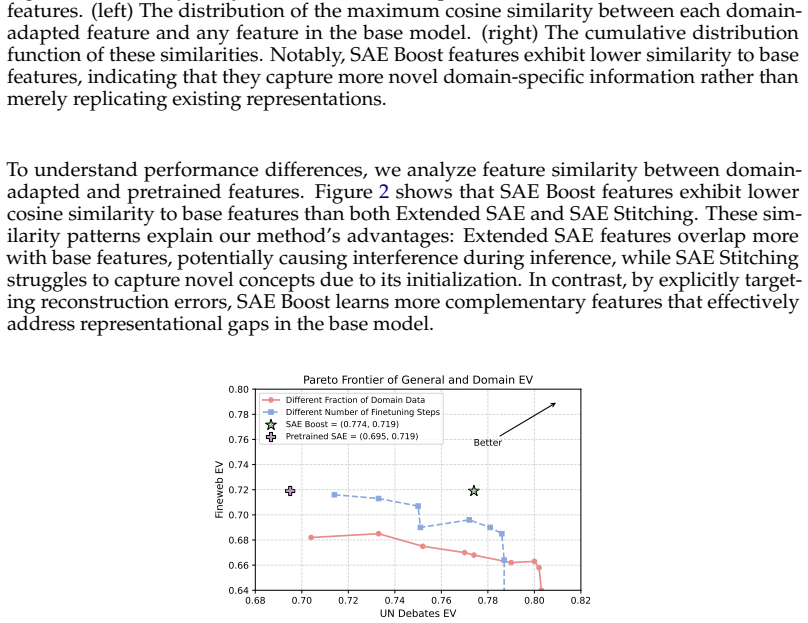
- [Figure 3] The Pareto-frontier figure does not specify what the other plotted points correspond to (e.g., which baselines or mixtures); a legend or caption entry is needed for reproducibility.
- [Section 3.1] The residual SAE is described as having no decoder bias 'to ensure it contributes only when meaningful domain-specific features are detected,' but this mechanism is not empirically isolated from simply reducing the model's capacity; a short ablation showing the effect of including the decoder bias would clarify the claim.
- [References] Reference formatting is inconsistent (e.g., 'Henderson*' with an asterisk, and some entries use arXiv identifiers without a URL). Please align with the venue's style.
Circularity Check
No significant circularity; the domain EV gain is aligned with the training objective, but held-out LLM CE, general-domain EV, and interpretability provide independent support.
-
fitted input called prediction
[Section 3.1 (residual training objective), Section 3.2 (combined inference x ≈ x̂ + ê), Section 4.2.1 (Table 1 domain EV claims)]
"We train the residual SAE on domain-specific data, taking the reconstruction error of the pretrained SAE as the training target. The loss function remains the standard SAE objective L = ∥e − ˆe∥2 2 + λ Lreg"
Domain EV is algebraically the same objective being minimized: with the combined reconstruction x ≈ x̂ + ê, EV = 1 − ||e − ê||² / ||x − x̄||², while the residual SAE is trained with L = ||e − ê||² + λLreg on the same domain distribution. A successful fit therefore mechanically raises the reported domain EV in Table 1 for any residual model, without independently confirming that the learned ê contains domain-specific features distinct from base features. This is partial and non-load-bearing: held-out LLM CE, general-domain EV, and baseline comparisons are not optimized by L and provide independent support.
full rationale
The paper's derivation chain is self-contained: the residual SAE is defined by the paper's own equations, and the reference list contains no works by the present authors, so no self-citation or imported uniqueness theorem is load-bearing. The only metric/objective overlap is domain explained variance, which is the reconstruction term minimized by the residual SAE; the paper reports it on held-out domain test sets, and the central claim is additionally supported by downstream LLM cross-entropy (not optimized by L), general-domain EV non-interference, matched-capacity baselines, and quantitative interpretability analysis. The absence of a mismatched-residual control is a validity concern about distinguishing domain-specific structure from generic additive capacity, not a circularity. Overall: no significant circularity; score 2 reflects the partial alignment of the domain EV metric with the training objective.
Assumptions & free parameters
free parameters (5)
- k (number of active features) for residual SAE =
5
- residual SAE dictionary size =
1024
- sparsity penalty coefficient lambda =
not reported
- number of training tokens per domain =
1B
- jumpReLU threshold =
determined on training data
assumptions (4)
- domain assumption The base SAE provides a competent reconstruction of general-domain activations.
- domain assumption The residual error e = x - x_hat is approximately sparse and learnable by a small SAE.
- domain assumption Base and residual SAE outputs can be summed without correcting for interactions.
- domain assumption Evaluation on held-out domain data is representative of the domain.
Cite this review
Pith. "Pith review of Teach Old SAEs New Domain Tricks with Boosting." pith.science (2026). https://pith.science/paper/MBJ6M2H7
@misc{pith2026250712990,
  author       = {Pith},
  title        = {Pith review of: Teach Old SAEs New Domain Tricks with Boosting},
  year         = {2026},
  howpublished = {\url{https://pith.science/paper/MBJ6M2H7}},
  note         = {Machine review of arXiv:2507.12990}
}
read the original abstract
Sparse Autoencoders have emerged as powerful tools for interpreting the internal representations of Large Language Models, yet they often fail to capture domain-specific features not prevalent in their training corpora. This paper introduces a residual learning approach that addresses this feature blindness without requiring complete retraining. We propose training a secondary SAE specifically to model the reconstruction error of a pretrained SAE on domain-specific texts, effectively capturing features missed by the primary model. By summing the outputs of both models during inference, we demonstrate significant improvements in both LLM cross-entropy and explained variance metrics across multiple specialized domains. Our experiments show that this method efficiently incorporates new domain knowledge into existing SAEs while maintaining their performance on general tasks. This approach enables researchers to selectively enhance SAE interpretability for specific domains of interest, opening new possibilities for targeted mechanistic interpretability of LLMs.
Figures


Figures from the paper (3 more)


Reference graph
Works this paper leans on
-
[3]
Llama scope: Extracting millions of features from llama-3.1-8b with sparse autoencoders
10 Published as a conference paper at COLM 2025 Zhengfu He, Wentao Shu, Xuyang Ge, Lingjie Chen, Junxuan Wang, Yunhua Zhou, Frances Liu, Qipeng Guo, Xuanjing Huang, Zuxuan Wu, et al. Llama scope: Extracting millions of features from llama-3.1-8b with sparse autoencoders. arXiv preprint arXiv:2410.20526,
arXiv 2025
-
[6]
Chris Olah, Alexander Mordvintsev, and Ludwig Schubert
URL https://arxiv.org/abs/2411.00743. Chris Olah, Alexander Mordvintsev, and Ludwig Schubert. Feature visualization. Distill, 2 (11):e7,
-
[8]
URL https://arxiv.org/abs/2406.17557. Lewis Smith, Senthooran Rajamanoharan, Arthur Conmy, Callum McDougall, Tom Lieberum, J ´anos Kram ´ar, Rohin Shah, and Neel Nanda. Negative results for saes on downstream tasks and deprioritising sae research (gdm mech interp team progress up- date 2),
-
[9]
URL https://arxiv.org/abs/2407.21783. Adly Templeton, Tom Conerly, Jonathan Marcus, Jack Lindsey, Trenton Bricken, Brian Chen, Adam Pearce, Craig Citro, Emmanuel Ameisen, Andy Jones, et al. Scaling monosemantic- ity: Extracting interpretable features from claude 3 sonnet. Technical report, Anthropic,
-
[10]
An Yang, Baosong Yang, Beichen Zhang, Binyuan Hui, Bo Zheng, Bowen Yu, Chengyuan Li, Dayiheng Liu, Fei Huang, Haoran Wei, Huan Lin, Jian Yang, Jianhong Tu, Jianwei Zhang, Jianxin Yang, Jiaxi Yang, Jingren Zhou, Junyang Lin, Kai Dang, Keming Lu, Keqin Bao, Kexin Yang, Le Yu, Mei Li, Mingfeng Xue, Pei Zhang, Qin Zhu, Rui Men, Runji Lin, Tianhao Li, Tingyu X...
-
[11]
11 Published as a conference paper at COLM 2025 A Additional Experimental Results A.1 Cross-Lingual Domain Performance Table 5 presents additional cross-lingual domain performance results, which demonstrate the effectiveness of our residual SAE approach across various languages. Language Pretrain EV ↑ Pretrain L0 Residual EV ↑ Residual L0 Russian 0.455 57...
work page 2024
-
[12]
SAE Boost consistently outperforms base SAE which indicates presence of interpretable domain-specific features. A.5 Domain-Specific Features Analysis To ensure that SAE Boost discovers domain-specific features not represented in the base SAE, we selected five features from our method and compared them to the top three most 13 Published as a conference pap...
work page 2025
-
[1997]
Automatically interpreting millions of features in large language models
Gonc ¸alo Paulo, Alex Mallen, Caden Juang, and Nora Belrose. Automatically interpreting millions of features in large language models. arXiv preprint arXiv: 2410.13928 ,
Show all 12 references
-
[2022]
Irina Higgins, Loic Matthey, Arka Pal, Christopher Burgess, Xavier Glorot, Matthew Botvinick, Shakir Mohamed, and Alexander Lerchner
URL https://arxiv.org/abs/2207.00220. Irina Higgins, Loic Matthey, Arka Pal, Christopher Burgess, Xavier Glorot, Matthew Botvinick, Shakir Mohamed, and Alexander Lerchner. beta-VAE: Learning basic vi- sual concepts with a constrained variational framework. In International Con...
-
[2023]
Scaling and evaluating sparse autoencoders
Leo Gao, Tom Dupr´e la Tour, Henk Tillman, Gabriel Goh, Rajan Troll, Alec Radford, Ilya Sutskever, Jan Leike, and Jeffrey Wu. Scaling and evaluating sparse autoencoders. arXiv preprint arXiv:2406.04093,
-
[2024]
Hoagy Cunningham, Aidan Ewart, Logan Riggs, Robert Huben, and Lee Sharkey
URL https://arxiv.org/abs/2412.06410. Hoagy Cunningham, Aidan Ewart, Logan Riggs, Robert Huben, and Lee Sharkey. Sparse autoencoders find highly interpretable features in language models. arXiv preprint arXiv:2309.08600,
-
[2025]
Guohao Li, Hasan Abed Al Kader Hammoud, Hani Itani, Dmitrii Khizbullin, and Bernard Ghanem
URL https://arxiv.org/abs/2502.04878. Guohao Li, Hasan Abed Al Kader Hammoud, Hani Itani, Dmitrii Khizbullin, and Bernard Ghanem. Camel: Communicative agents for ”mind” exploration of large scale language model society,
Reviewed August 6, 2026 · model on record in the stance chip above.
Discussion (0). Sign in to comment.