REVIEW 3 major objections 4 minor 299 references
Two principal components capture all detectable coherent spectroscopic variability in the brown dwarf SIMP 0136, one tracking temperature and the other cloud vertical structure.
Reviewed by Pith at T0; open to challenge. T0 means a machine referee read the full paper against a public rubric. the ladder, T0–T4 →
T0 review · deepseek-v4-flash
2026-08-01 00:33 UTC pith:MDIULYK4
load-bearing objection Solid, useful PCA study; the two-component claim holds, but the spatial interpretation is over-sold because intra-rotation evolution is never tested. the 3 major comments →
The JWST weather report: Unravelling the atmospheric variability of isolated worlds using principal component analysis
The pith
A machine-rendered reading of the paper's core claim, the machinery that carries it, and where it could break.
Core claim
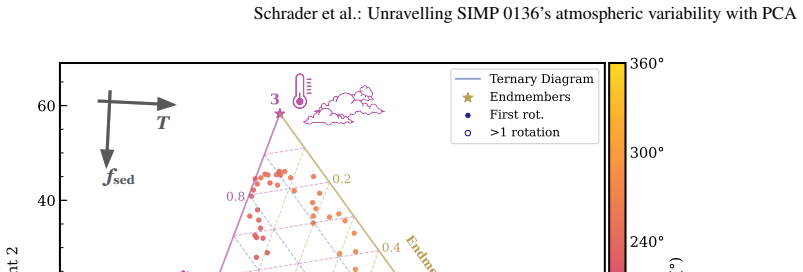
After subtracting the first two principal components from the mean-subtracted, noise-whitened spectra, the residuals match the propagated noise floor (RMS 0.36% vs 0.37%, reduced chi-squared 0.97), so the authors conclude there is no additional coherent spectroscopic variability. Projecting Sonora Diamondback forward models into the principal-component plane shows PC1 aligns with effective-temperature variations and PC2 with the cloud sedimentation parameter fsed (vertical cloud extent); phase-resolved retrievals projected into the same plane confirm the Teff/PC1 correspondence and reveal a cloud-muted, phase-dependent CO2 trend. The two-dimensional locus implies a three-endmember triangular
What carries the argument
The central machinery is a noise-weighted principal component analysis: spectra are mean-subtracted, divided by per-wavelength uncertainty, and decomposed by singular value decomposition to yield eigenspectra and time-dependent scores. The principal-component plane (PC1–PC2) becomes the interpretative space; a shrink-wrapped triangular simplex defines three endmember spectra; forward-model projections and phase-resolved retrievals give physical labels to the axes; and a Fourier decomposition of the endmember contribution curves with an equator-on visibility kernel converts rotational phases into longitudinal surface maps.
Load-bearing premise
The atmosphere is treated as fixed during the 2.4-hour rotation, so every change in the spectrum is assigned to a static longitudinal pattern rotating into view; if cloud and temperature structures evolve within a rotation, the endmember weights and longitudinal maps would mix spatial structure with temporal evolution.
What would settle it
A second, higher-cadence rotation of SIMP 0136 with comparable signal-to-noise that, after subtracting two principal components trained on the first rotation, shows residuals above the noise floor with coherent phase structure—or a phase-resolved retrieval that detects cloud or temperature evolution on timescales shorter than the rotation period—would break the static-map interpretation.
If this is right
- Wavelength-dependent phase lags reported in earlier multi-band monitoring (for example, about 180 degrees between near- and mid-infrared bands) are reinterpreted as different projections of the same two low-dimensional modes, not as a single atmospheric structure viewed with a wavelength-dependent delay.
- A single rotation provides a complete longitudinal snapshot but not the evolution; comparing with a NIRISS epoch taken 33.6 hours earlier shows the same two physical drivers persist while their detailed spectral fingerprints evolve.
- The method is proposed as a computationally efficient, assumption-light first step for JWST time-series spectroscopy, identifying dominant variability drivers and selecting phases for detailed retrieval analyses.
- The same two data-driven principal components reconstruct about 80% of the variance across the self-consistent forward-model grid, indicating that the physics distinguishing neighbouring models also drives the observed time variability.
Where Pith is reading between the lines
- If the low-dimensionality result holds for other brown dwarfs, time-resolved spectra could be placed in a common principal-component space, enabling cross-object weather classification without full atmospheric retrievals.
- The static-atmosphere assumption is untested within a single rotation; a second, higher-cadence rotation with comparable signal-to-noise could reveal whether intra-rotation evolution contaminates endmember weights, changing the interpretation from purely spatial to mixed spatial-temporal structure.
- The cloud-muted CO2 trend suggests a testable prediction: in phases with thicker clouds, chemical or thermal signatures should be suppressed; freeing all cloud parameters in a retrieval across those phases could confirm whether cloud opacity alone accounts for the phase-dependent CO2 behaviour.
- Long-baseline monitoring in principal-component space could distinguish a stable, repeating trajectory from a shifting locus; the paper sketches this experiment but does not determine which regime SIMP 0136 currently occupies.
Editorial analysis
A structured set of objections, weighed in public.
Referee Report
Summary. The paper applies a noise-weighted principal component analysis (PCA) to one rotation of JWST/NIRSpec PRISM time-series spectroscopy of the planetary-mass brown dwarf SIMP 0136. The central claim is that the spectroscopic variability is intrinsically two-dimensional: after subtracting the first two principal components, residual spectra reach the propagated noise floor (RMS 0.36% vs. 0.37%, reduced χ²=0.97, lag-1 correlation dropping from 0.74 to 0.08). The authors interpret PC1 as temperature-like broadband variability and PC2 as variability tied to vertical cloud structure, based on projections of Sonora Diamondback forward models and phase-resolved petitRADTRANS retrievals into the same PC plane. They further construct three spectral endmembers as the vertices of a minimum-area triangle enclosing the data locus, derive time-dependent barycentric weights, and invert these into longitudinal maps using a Fourier visibility-kernel approach. A comparison with a NIRISS/SOSS epoch 37 h earlier indicates that the same two physical drivers persist while the detailed spectral fingerprints evolve.
Significance. If the central claims hold, the paper demonstrates a computationally efficient, model-agnostic framework for identifying the dominant physical drivers in JWST time-resolved spectroscopy of substellar atmospheres. The quantitative residual analysis is a strong point: the two-PC truncation is supported by noise-floor comparison and a sharp drop in residual autocorrelation. The physical interpretation is cross-checked against two independent external datasets (Sonora Diamondback models and phase-resolved retrievals), which substantially reduces the circularity of deriving PCA axes from the data themselves. The authors are also appropriately cautious in several places: they acknowledge that endmembers are conservative estimates not to be read as pure surface spectra, that odd Fourier harmonics lie in the null space of the equator-on kernel, and that the model grid is too coarse to resolve the observed PCP locus. The main weakness is that the spatial interpretation — that variability arises from changing visibility of stationary longitudinal structures — depends on an untested assumption of atmospheric stasis over the 2.4 h rotation.
major comments (3)
- [Sections 6.2 and 9, Eq. (8)] The inference of longitudinal maps and the conclusion that SIMP 0136's variability arises from 'spatially distinct atmospheric regions rotating in and out of view' assumes a static atmosphere over the 2.4 h rotation. The paper demonstrates epoch-to-epoch evolution (Section 7.2) but does not test for intra-rotation evolution. Because the dataset spans ~1.2 rotations (Section 2: 2.9 h, P=2.41 h), there is a ~0.5 h (72°) phase overlap between the beginning and end of the time series. A phase-closure test — comparing spectra at the same rotational phase at the start and end — is not reported. If temperature/cloud structures evolve on timescales shorter than the rotation period, the endmember contribution weights and the Fourier-inverted maps mix spatial structure with temporal evolution, and the Section 9 conclusion would not follow. I recommend either performing this test (e.g., computing t
- [Section 5.1 and Abstract] The claim that two PCs 'imply' three distinct atmospheric states is presented as a logical consequence, but in a two-dimensional PC plane any set of points can be enclosed by a triangle; the minimum-area shrink-wrap always has three vertices. The number 'three' is therefore a modeling choice, not an independently detected property. The physical interpretation of the vertices as distinct atmospheric states rests on qualitative alignment with Sonora Diamondback model trends and Morley+2014 perturbation spectra, but the triangle itself is constructed from the data and cannot falsify the three-state hypothesis. I suggest clarifying that the three-endmember description is a conservative representation (as the text partly does), and ideally testing whether a larger simplex or a continuous loop model is statistically preferred, e.g. via model comparison on the PCP trajectory.
- [Section 3, residual test] The key dimensionality claim — that two PCs reduce residuals to the noise floor — is evaluated on the same data used to derive the PCA basis. Because PCA minimizes variance, this comparison is mildly circular; a third coherent component could in principle be absorbed into the first two PCs if the basis is overfit to the same realization. The lag-1 correlation statistic helps, but it is also computed on the in-sample residuals. I recommend a split-half cross-validation: train the PCA on the first half of the rotation and compute residual RMS and lag-1 correlation on the second half (or vice versa). This would make the 'no additional coherent variability' conclusion more robust.
minor comments (4)
- [Section 1 vs. Section 9] The time separation between the NIRSpec and NIRISS epochs is given as 37.5 h (Section 1), 37 h (Section 7.2), and 33.6 h or 13.9±0.5 rotations (Section 9). These are inconsistent; 37.5 h / 2.41 h ≈ 15.6 rotations, not 13.9. Please reconcile.
- [Section 1] The citation 'Kotten et al., (accepted, AAS)' appears in the text but is not present in the reference list. Please add the full reference.
- [Section 4.1 / Fig. 3] The statement that 'Teff varies primarily along PC1' and 'fsed varies primarily along PC2' is based on visual inspection of the model projections. A quantitative measure (e.g., the angle between the PC axes and the best-fit direction of the Teff and fsed gradients in the PCP, or the correlation coefficient of each parameter with PC1/PC2) would strengthen the interpretation.
- [Section 6.4] The longitudinal maps are presented after applying the kernel correction but without showing the raw contribution curves with phase uncertainty in the main text (Fig. 8 left). Consider adding the 1σ spread of the contribution curves to the figure so readers can assess the significance of the inferred longitudinal peaks.
Circularity Check
Three-endmember 'atmospheric states' are a barycentric reparameterization of the 2-D PCA projection; the PC1/PC2 physical labeling is independently anchored to forward models and retrievals, so circularity is partial.
specific steps
-
self definitional
[Section 5 and Section 6.1 (also Abstract)]
"To interpret the structure of the variability in the PCP, we first note that the two-dimensional space implies that each of the reconstructed spectra in the PCP can be described as a mixture of at least three distinct spectral surface types, which we refer to as spectral endmembers. ... We approximated each observation as a linear combination of the three endmembers."
The endmembers are defined as the vertices of the minimum-area triangle that encloses the data in the PCP (Section 5.1). For any point inside a triangle, barycentric coordinates are unique and reconstruct that point exactly. Therefore the statement that the observed spectra are 'described as evolving linear combinations of these states' is a mathematical identity of the simplex representation, not an empirical finding. The 'three distinct atmospheric states' and their 'relative contributions' are a re-labelling of the 2-D PCA coordinates: the vertices are constructed from the same PC projections, and the mixture fractions are just barycentric coordinates. Calling the vertices 'atmospheric states' and the weights 'relative contributions' adds a physical interpretation that is not itself der
full rationale
The core dimensionality claim—that two PCs reduce the residual spectra to the noise floor—is data-driven and checked against the propagated noise, so it is not circular. The physical labelling of PC1 as temperature-like and PC2 as cloud-vertical-structure is anchored by projecting external Sonora Diamondback forward models into the data-derived PCA basis; those models are not used to build the PCA basis, so the alignment of Teff with PC1 and fsed with PC2 is an independent consistency check. The retrieval projections from Nasedkin et al. (2025) are another cross-check on the same data, and although they share data and authors, they are a distinct fitting framework and not used to define the PCs. The principal circularity is the endmember construction: the three 'atmospheric states' are vertices of a shrink-wrapped triangle enclosing the data in the PCP, and the 'mixture weights' are barycentric coordinates, so the finding that spectra are mixtures of three states is a reparameterization of the 2-D PCA projection rather than an independent empirical result. The paper is transparent about the conservative nature of the endmembers and about the disk-integrated ambiguity, but the abstract and conclusions present the three-state mixture as an implication of the PCA dimensionality. The spatial interpretation ('changing visibility of spatially distinct regions') additionally relies on an assumption of a static atmosphere over the single rotation, which is not tested against intra-rotation evolution; this is a limitation/assumption rather than a circularity. Overall, the central PCA basis and its physical interpretation have independent content, so the circularity is partial rather than total.
Axiom & Free-Parameter Ledger
free parameters (3)
- Model scaling factor for Sonora grid projection
- PCA truncation order K =
2
- Fourier truncation jmax for longitudinal maps =
4
axioms (6)
- domain assumption PCA linearity: time-variable spectra are linear combinations of fixed orthogonal modes
- domain assumption Limb/visibility kernel: longitude-to-flux mapping uses the equator-on cosine kernel, making odd j>1 harmonics null
- domain assumption Static atmosphere within the observed rotation
- domain assumption Sonora Diamondback grid adequacy: 1D radiative-convective equilibrium models with Teff, fsed, and [M/H] capture the physically relevant spectral variability
- ad hoc to paper Convex simplex representation: a minimum-area triangle enclosing the PC-plane data represents three distinct atmospheric endmembers
- domain assumption Noise model: propagated per-wavelength uncertainties are independent and Gaussian, and the median uncertainty is a valid whitening scale
invented entities (1)
-
Three spectral endmembers (atmospheric extreme states)
no independent evidence
read the original abstract
Brown dwarf variability directly probes atmospheric dynamics beyond the Solar System, and recent JWST time-resolved spectroscopy has opened a new window into these processes. Principal component analysis (PCA) offers a data-driven framework to identify the dominant, independent patterns of spectral variability of variable targets without relying on prior atmospheric assumptions. SIMP 0136 is a young, T2.5, brown dwarf at the planetary-mass boundary, making it an ideal analogue for directly imaged exoplanets. We analysed one rotation of JWST/NIRSpec PRISM time-series spectroscopy to investigate the drivers of its variability using PCA. Two principal components are sufficient to reduce the residual spectra to the propagated noise floor, indicating that they capture the detectable coherent spectroscopic variability. The leading principal component captures broadband variability consistent with temperature changes, while the second traces chromatic variability linked to vertical cloud structure. The dominance of two components implies that the spectra can be described as mixtures of three distinct atmospheric states, whose relative contributions we mapped as a function of rotational phase. The observed spectra are described as evolving linear combinations of these states, indicating that the variability arises from the changing visibility of spatially distinct atmospheric regions. By projecting Sonora Diamondback forward models into the same principal component space, we found that the principal components capture a large fraction of the model variance, demonstrating that the same physical processes that govern SIMP-0136's observed variability also capture much of the model grid's variation. Our results establish PCA as a computationally efficient, physically interpretable framework for analysing JWST time-resolved spectroscopy of substellar atmospheres.
Figures




Reference graph
Works this paper leans on
-
[1]
SpectRes: A Fast Spectral Resampling Tool in Python. arXiv e-prints , keywords =. doi:10.48550/arXiv.1705.05165 , archivePrefix =. 1705.05165 , primaryClass =
-
[2]
An Overview of the Instrument Suite for the Deep Impact Mission. , keywords =. doi:10.1007/s11214-005-3390-8 , adsurl =
-
[3]
IEEE transactions on automatic control , volume=
A new look at the statistical model identification , author=. IEEE transactions on automatic control , volume=. 1974 , publisher=
1974
-
[4]
exocartographer: A Bayesian Framework for Mapping Exoplanets in Reflected Light. , keywords =. doi:10.3847/1538-3881/aad775 , archivePrefix =. 1802.06805 , primaryClass =
-
[5]
Astrometric Accelerations as Dynamical Beacons: A Giant Planet Imaged inside the Debris Disk of the Young Star AF Lep. , keywords =. doi:10.3847/2041-8213/acd6f6 , archivePrefix =. 2302.05420 , primaryClass =
Pith/arXiv arXiv 2041
-
[6]
The Sonora Substellar Atmosphere Models. III. Diamondback: Atmospheric Properties, Spectra, and Evolution for Warm Cloudy Substellar Objects , author=. 2024 , eprint=
2024
-
[7]
Cowan, Nicolas B. and Fujii, Yuka , year=. Mapping Exoplanets , ISBN=. doi:10.1007/978-3-319-55333-7_147 , booktitle=
-
[8]
Light curves of stars and exoplanets: estimating inclination, obliquity and albedo. , keywords =. doi:10.1093/mnras/stt1191 , archivePrefix =. 1304.6398 , primaryClass =
-
[9]
The JWST weather report: Retrieving temperature variations, auroral heating, and static cloud coverage on SIMP-0136. , keywords =. doi:10.1051/0004-6361/202555370 , archivePrefix =. 2507.07772 , primaryClass =
-
[10]
Mapping Atmospheric Features of the Planetary-mass Brown Dwarf SIMP 0136 with JWST NIRISS. , keywords =. doi:10.3847/1538-4357/ae046d , archivePrefix =. 2509.00149 , primaryClass =
-
[11]
Precipitating Condensation Clouds in Substellar Atmospheres. , keywords =. doi:10.1086/321540 , archivePrefix =. astro-ph/0103423 , primaryClass =
-
[12]
Cowan, Nicolas B. and Strait, Talia E. , year=. DETERMINING REFLECTANCE SPECTRA OF SURFACES AND CLOUDS ON EXOPLANETS , volume=. ApJ , publisher=. doi:10.1088/2041-8205/765/1/l17 , number=
-
[13]
Bushouse, Howard and Eisenhamer, Jonathan and Dencheva, Nadia and Davies, James and Greenfield, Perry and Morrison, Jane and Hodge, Phil and Simon, Bernie and Grumm, David and Droettboom, Michael and Slavich, Edward and Sosey, Megan and Pauly, Tyler and Miller, Todd and Jedrzejewski, Robert and Hack, Warren and Davis, David and Crawford, Steven and Law, D...
-
[14]
Cloud and chemistry connections in directly imaged sub-Jupiter exoplanets
Dynamically coupled kinetic chemistry in brown dwarf atmospheres - II. Cloud and chemistry connections in directly imaged sub-Jupiter exoplanets. , keywords =. doi:10.1093/mnras/stae537 , archivePrefix =. 2311.16722 , primaryClass =
-
[15]
The JWST weather report from the nearest brown dwarfs II: consistent variability mechanisms over 7 months revealed by 1 14 m NIRSpec + MIRI monitoring of WISE 1049AB. , keywords =. doi:10.1093/mnras/staf737 , archivePrefix =. 2505.00794 , primaryClass =
-
[16]
Large-amplitude Variability Driven by Giant Dust Storms on a Planetary-mass Companion. arXiv e-prints , keywords =. doi:10.48550/arXiv.2511.23163 , archivePrefix =. 2511.23163 , primaryClass =
-
[17]
Neglected Clouds in T and Y Dwarf Atmospheres. , keywords =. doi:10.1088/0004-637X/756/2/172 , archivePrefix =. 1206.4313 , primaryClass =
-
[18]
Alien Maps of an Ocean-bearing World. , keywords =. doi:10.1088/0004-637X/700/2/915 , archivePrefix =. 0905.3742 , primaryClass =
-
[19]
Resolved Near-infrared Spectroscopy of WISE J104915.57-531906.1AB: A Flux-reversal Binary at the L dwarf/T Dwarf Transition. , keywords =. doi:10.1088/0004-637X/772/2/129 , archivePrefix =. 1303.7283 , primaryClass =
-
[20]
The Sonora Substellar Atmosphere Models. V. A Correction to the Disequilibrium Abundance of CO _ 2 for Sonora Elf Owl. Research Notes of the American Astronomical Society , keywords =. doi:10.3847/2515-5172/add407 , archivePrefix =. 2505.03994 , primaryClass =
-
[21]
A Tale of Two Molecules: The Underprediction of CO _ 2 and Overprediction of PH _ 3 in Late T and Y Dwarf Atmospheric Models. , keywords =. doi:10.3847/1538-4357/ad6759 , archivePrefix =. 2407.15950 , primaryClass =
-
[22]
and Apai, Dániel and Kataria, Tiffany and Morley, Caroline V
Zhou, Yifan and Bowler, Brendan P. and Apai, Dániel and Kataria, Tiffany and Morley, Caroline V. and Bryan, Marta L. and Skemer, Andrew J. and Benneke, Björn , title =. AJ , abstract =. 2022 , month =. doi:10.3847/1538-3881/ac9905 , url =
-
[23]
Fuda, Nguyen and Apai, Dániel and Nardiello, Domenico and Tan, Xianyu and Karalidi, Theodora and Bedin, Luigi Rolly , title =. ApJ , abstract =. 2024 , month =. doi:10.3847/1538-4357/ad2c84 , url =
-
[24]
Methane, Carbon Monoxide, and Ammonia in Brown Dwarfs and Self-Luminous Giant Planets. , keywords =. doi:10.1088/0004-637X/797/1/41 , archivePrefix =. 1408.6283 , primaryClass =
-
[25]
Atmospheric Chemistry in Giant Planets, Brown Dwarfs, and Low-Mass Dwarf Stars. II. Sulfur and Phosphorus. , keywords =. doi:10.1086/506245 , archivePrefix =. astro-ph/0511136 , primaryClass =
-
[26]
Jolliffe, Ian T. and Cadima, Jorge , title =. Philosophical Transactions of the Royal Society A: Mathematical, Physical and Engineering Sciences , volume =. 2016 , month =. doi:10.1098/rsta.2015.0202 , url =
arXiv 2016
-
[27]
J. Renwick Beattie and Francis W. L. Esmonde-White , title =. Applied Spectroscopy , volume =. 2021 , doi =. https://doi.org/10.1177/0003702820987847 , abstract =
-
[28]
Halko, N. and Martinsson, P. G. and Tropp, J. A. , title =. SIAM Review , volume =. 2011 , doi =. https://doi.org/10.1137/090771806 , abstract =
-
[29]
Rotational Variability of Earth's Polar Regions: Implications for Detecting Snowball Planets. , keywords =. doi:10.1088/0004-637X/731/1/76 , archivePrefix =. 1102.4345 , primaryClass =
-
[30]
Cowan, Nicolas B. and Fuentes, Pablo A. and Haggard, Hal M. , title =. MNRAS , volume =. 2013 , month =. doi:10.1093/mnras/stt1191 , url =
-
[31]
and Ferruit, P
Jakobsen, P. and Ferruit, P. and Alves de Oliveira, C. and Arribas, S. and Bagnasco, G. and Barho, R. and Beck, T. L. and Birkmann, S. and Böker, T. and Bunker, A. J. and Charlot, S. and de Jong, P. and de Marchi, G. and Ehrenwinkler, R. and Falcolini, M. and Fels, R. and Franx, M. and Franz, D. and Funke, M. and Giardino, G. and Gnata, X. and Holota, W. ...
-
[32]
Inverting Phase Functions to Map Exoplanets. , keywords =. doi:10.1086/588553 , archivePrefix =. 0803.3622 , primaryClass =
-
[33]
Hallinan, G. and Littlefair, S. P. and Cotter, G. and Bourke, S. and Harding, L. K. and Pineda, J. S. and Butler, R. P. and Golden, A. and Basri, G. and Doyle, J. G. and Kao, M. M. and Berdyugina, S. V. and Kuznetsov, A. and Rupen, M. P. and Antonova, A. , number =. 2015 , journal =. doi:10.1038/nature14619 , issn =
-
[34]
Zhang, Xi and Showman, Adam P. , title =. ApJL , abstract =. 2014 , month =. doi:10.1088/2041-8205/788/1/L6 , url =
-
[35]
Chemical enrichment of giant planets and discs due to pebble drift , volume =. , author =. 2017 , pages =. doi:10.1093/mnras/stx1103 , abstract =
-
[36]
Modeling of exoplanet atmospheres
-
[37]
Toward Robust Atmospheric Retrieval on Cloudy L Dwarfs: the Impact of Thermal and Abundance Profile Assumptions. , keywords =. doi:10.3847/1538-4357/acbb07 , archivePrefix =. 2301.08258 , primaryClass =
-
[38]
New constraints on the. , author =. 2019 , pages =. doi:10.1093/mnras/stz3117 , abstract =
-
[39]
Rasmussen, Carl Edward and Williams, Christopher K. I. , month = nov, year =. Gaussian
-
[40]
Journal of the Optical Society of America A , author =
Optimal method for exoplanet detection by angular differential imaging , volume =. Journal of the Optical Society of America A , author =. 2009 , pages =. doi:10.1364/JOSAA.26.001326 , number =
-
[41]
, author =. 2019 , keywords =. doi:10.1093/mnras/stz1350 , number =
-
[42]
Atmospheric Retrieval Analysis of the Directly Imaged Exoplanet HR 8799b. , keywords =. doi:10.1088/0004-637X/778/2/97 , archivePrefix =. 1307.1404 , primaryClass =
-
[43]
Detection and. , author =. 2012 , keywords =. doi:10.1088/2041-8205/755/2/L28 , number =
-
[44]
Gomez Gonzalez, C. A. and Absil, O. and Absil, P. -A. and Van Droogenbroeck, M. and Mawet, D. and Surdej, J. , month = may, year =. Low-rank plus sparse decomposition for exoplanet detection in direct-imaging. doi:10.1051/0004-6361/201527387 , journal =
-
[45]
Flasseur, Olivier and Denis, Lo\". Exoplanet detection in angular differential imaging by statistical learning of the nonstationary patch covariances. 2018 , keywords =. doi:10.1051/0004-6361/201832745 , journal =
-
[46]
Gomez Gonzalez, C. A. and Absil, O. and Van Droogenbroeck, M. , month = may, year =. Supervised detection of exoplanets in high-contrast imaging sequences , volume =. doi:10.1051/0004-6361/201731961 , journal =
-
[47]
and Gomez-Gonzalez, C
Cantalloube, F. and Gomez-Gonzalez, C. and Absil, O. and Cantero, C. and Bacher, R. and Bonse, M. J. and Bottom, M. and Dahlqvist, C. -H. and Desgrange, C. and Flasseur, O. and Fuhrmann, T. and Henning, Th. and Jensen-Clem, R. and Kenworthy, M. and Mawet, D. and Mesa, D. and Meshkat, T. and Mouillet, D. and Müller, A. and Nasedkin, E. and Pairet, B. and P...
-
[48]
Separating extended disc features from the protoplanet in. , author =. 2019 , keywords =. doi:10.1093/mnras/stz1232 , number =
-
[49]
Experimental Astronomy , author =
Apodized. Experimental Astronomy , author =. 2011 , keywords =. doi:10.1007/s10686-011-9220-y , number =
-
[50]
Experimental Astronomy , author =
Apodized. Experimental Astronomy , author =. 2011 , keywords =. doi:10.1007/s10686-011-9219-4 , number =
-
[51]
PACO ASDI: an algorithm for exoplanet detection and characterization in direct imaging with integral field spectrographs. , keywords =. doi:10.1051/0004-6361/201937239 , adsurl =
-
[52]
Claudi, R. U. and Turatto, M. and Antichi, J. and Gratton, R. and Scuderi, S. and Cascone, E. and Mesa, D. and Desidera, S. and Baruffolo, A. and Berton, A. and Bagnara, P. and Giro, E. and Bruno, P. and Fantinel, D. and Beuzit, J.-L. and Puget, P. and Dohlen, K. , editor =. The integral field spectrograph of. 2006 , note =. doi:10.1117/12.671949 , booktitle =
-
[53]
arXiv e-prints , author =
Pushing the. arXiv e-prints , author =. 2019 , keywords =
2019
-
[54]
Marois, Christian and Correia, Carlos and Véran, Jean-Pierre and Currie, Thayne , editor =. 2014 , keywords =. doi:10.1017/S1743921313007813 , booktitle =
-
[55]
A. , author =. 2007 , keywords =. doi:10.1086/513180 , number =
-
[56]
and Véran, Jean-Pierre and Poyneer, Lisa A
Maire, Jérôme and Gagné, Jonathan and Lafrenière, David and Doyon, René and Graham, James R. and Véran, Jean-Pierre and Poyneer, Lisa A. , editor =. Preserving the photometric integrity of companions in high-contrast imaging observations using locally optimized combination of images , volume =. 2012 , pages =. doi:10.1117/12.926247 , booktitle =
-
[57]
Samland, M. and Bouwman, J. and Hogg, D. W. and Brandner, W. and Henning, T. and Janson, M. , month = feb, year =. doi:10.1051/0004-6361/201937308 , journal =
-
[58]
Gebhard, Timothy D. and Bonse, Markus J. and Quanz, Sascha P. and Schölkopf, Bernhard , month = oct, year =. Half-sibling regression meets exoplanet imaging:. doi:10.1051/0004-6361/202142529 , journal =
-
[59]
Dahlqvist, C. -H. and Louppe, G. and Absil, O. , month = feb, year =. Improving the. doi:10.1051/0004-6361/202039597 , journal =
-
[60]
Dahlqvist, C. -H. and Cantalloube, F. and Absil, O. , month = jan, year =. Regime-switching model detection map for direct exoplanet detection in. doi:10.1051/0004-6361/201936421 , journal =
-
[61]
L-band Integral Field Spectroscopy of the HR 8799 Planetary System. , keywords =. doi:10.3847/1538-3881/ac5d52 , archivePrefix =. 2203.08165 , primaryClass =
-
[62]
Direct exoplanet detection and characterization using the ANDROMEDA method: Performance on VLT/NaCo data. , keywords =. doi:10.1051/0004-6361/201425571 , archivePrefix =. 1508.06406 , primaryClass =
-
[63]
Giant planet companion to. , author =. 2005 , keywords =. doi:10.1051/0004-6361:200500116 , number =
-
[64]
and Fontanive, C
Vigan, A. and Fontanive, C. and Meyer, M. and Biller, B. and Bonavita, M. and Feldt, M. and Desidera, S. and Marleau, G. -D. and Emsenhuber, A. and Galicher, R. and Rice, K. and Forgan, D. and Mordasini, C. and Gratton, R. and Le Coroller, H. and Maire, A. -L. and Cantalloube, F. and Chauvin, G. and Cheetham, A. and Hagelberg, J. and Lagrange, A. -M. and ...
-
[65]
and Gratton, R
Langlois, M. and Gratton, R. and Lagrange, A. -M. and Delorme, P. and Boccaletti, A. and Bonnefoy, M. and Maire, A. -L. and Mesa, D. and Chauvin, G. and Desidera, S. and Vigan, A. and Cheetham, A. and Hagelberg, J. and Feldt, M. and Meyer, M. and Rubini, P. and Le Coroller, H. and Cantalloube, F. and Biller, B. and Bonavita, M. and Bhowmik, T. and Brandne...
-
[66]
and Chauvin, G
Desidera, S. and Chauvin, G. and Bonavita, M. and Messina, S. and LeCoroller, H. and Schmidt, T. and Gratton, R. and Lazzoni, C. and Meyer, M. and Schlieder, J. and Cheetham, A. and Hagelberg, J. and Bonnefoy, M. and Feldt, M. and Lagrange, A. -M. and Langlois, M. and Vigan, A. and Tan, T. G. and Hambsch, F. -J. and Millward, M. and Alcalá, J. and Benatti...
-
[67]
The. , author =. 2019 , keywords =. doi:10.3847/1538-3881/ab16e9 , number =
-
[68]
Gomez Gonzalez, C. and Absil, O. and Wertz, O. , month = may, year =. Vortex. doi:10.5281/zenodo.57916 , booktitle =
-
[69]
Angular. , author =. 2006 , keywords =. doi:10.1086/500401 , number =
doi:10.1086/500401 2006
-
[70]
A Detailed Characterization of HR 8799's Debris Disk with ALMA in Band 7. , keywords =. doi:10.3847/1538-3881/abf4e0 , archivePrefix =. 2104.02088 , primaryClass =
-
[71]
The. , author =. 2009 , keywords =. doi:10.1088/0004-637X/705/1/314 , number =
-
[72]
doi:10.1117/1.JATIS.2.2.025003 , journal =
Sauvage, Jean-Francois and Fusco, Thierry and Petit, Cyril and Costille, Anne and Mouillet, David and Beuzit, Jean-Luc and Dohlen, Kjetil and Kasper, Markus and Suarez, Marcos and Soenke, Christian and Baruffolo, Andrea and Salasnich, Bernardo and Rochat, Sylvain and Fedrigo, Enrico and Baudoz, Pierre and Hugot, Emmanuel and Sevin, Arnaud and Perret, Deni...
-
[73]
Sauvage, J. -F. and Fusco, T. and Petit, C. and Meimon, S. and Fedrigo, E. and Suarez Valles, M. and Kasper, M. and Hubin, N. and Beuzit, J. -L. and Charton, J. and Costille, A. and Rabou, P., . and Mouillet, D. and Baudoz, P. and Buey, T. and Sevin, A. and Wildi, F. and Dohlen, K. , editor =. 2010 , pages =. doi:10.1117/12.856942 , booktitle =
-
[74]
Petit, C. and Sauvage, J. -F. and Fusco, T. and Sevin, A. and Suarez, M. and Costille, A. and Vigan, A. and Soenke, C. and Perret, D. and Rochat, S. and Barufolo, A. and Salasnich, B. and Beuzit, J. -L. and Dohlen, K. and Mouillet, D. and Puget, P. and Wildi, F. and Kasper, M. and Conan, J. -M. and Kulcsár, C. and Raynaud, H. -F. , editor =. 2014 , pages ...
-
[75]
Constraining the. , author =. 2021 , keywords =. doi:10.3847/1538-3881/abdb2d , number =
-
[76]
Keck/NIRC2 L'-band Imaging of Jovian-mass Accreting Protoplanets around PDS 70. , keywords =. doi:10.3847/1538-3881/ab8aef , archivePrefix =. 2004.09597 , primaryClass =
Pith/arXiv arXiv 2004
-
[77]
VLTI/GRAVITY Observations and Characterization of the Brown Dwarf Companion HD 72946 B. , keywords =. doi:10.3847/1538-4357/acf761 , archivePrefix =. 2309.04403 , primaryClass =
-
[78]
Methods for Incorporating Model Uncertainty into Exoplanet Atmospheric Analysis. arXiv e-prints , keywords =. doi:10.48550/arXiv.2310.03713 , archivePrefix =. 2310.03713 , primaryClass =
-
[79]
Direct. ApJ , author =. 2013 , keywords =. doi:10.1088/2041-8205/778/1/L4 , abstract =
-
[80]
Detection and. , author =. 2016 , keywords =. doi:10.3847/0004-637X/824/2/117 , number =
discussion (0)
Sign in with ORCID, Apple, or X to comment. Anyone can read and Pith papers without signing in.