REVIEW 4 major objections 6 minor 18 references
A structured contract, not a longer prompt, is what lifts LLM-based HLS design reliability, with hardware-in-the-loop feedback carrying the workflow from kernel code to board-level closure.
Reviewed by Pith at T0; open to challenge. T0 means a machine referee read the full paper against a public rubric. the ladder, T0–T4 →
A contract-aligned multi-agent workflow with hardware-in-the-loop feedback raises HLS-Eval testbench pass@1 from 64.0% to 70.4% and enables a dual-bitstream PQC accelerator with 4x faster runtime.
T0 review reviewed 2026-08-01 challenge →
load-bearing objection A solid, honest workflow paper whose central HLS-Eval gain is plausible but statistically under-supported; the PQC case is a real board-level demonstration and the open-source artifact earns it a referee. the 4 major comments →
ContractHIL-HLS: Contract-Aligned Multi-Agent Workflow with Hardware-in-the-Loop Feedback for HLS Design
The pith
A machine-rendered reading of the paper's core claim, the machinery that carries it, and where it could break.
The reading
Core claim
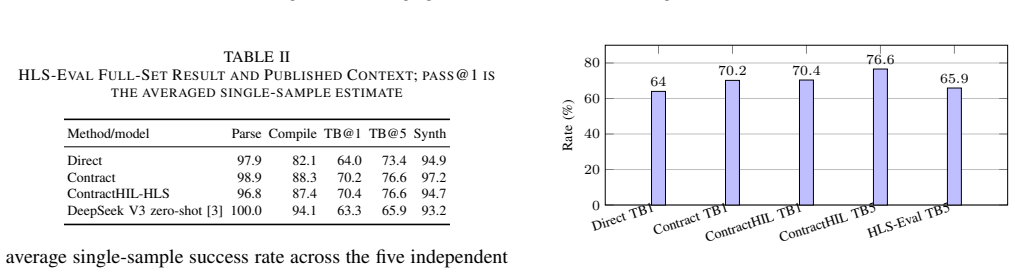
The paper claims that converting a natural-language design request into a structured contract — named fields for interface, constraints, validation, and rollback — before code generation is the largest single lever for reliable LLM-based high-level synthesis, and that feeding synthesis, implementation, and board-measured evidence back into the loop extends the workflow from kernel code to system-level closure. On 94 tasks, the contract alone raises the estimated single-sample testbench pass rate from 64.0% to 70.2%; adding the HTML handoff and hardware-feedback loop reaches 70.4% pass@1 and 76.6% pass@5. In a board-tested post-quantum-cryptography secure-message accelerator, the hardware loo
What carries the argument
The central artifact is the structured contract C = ⟨R, I, F, H, K, O, V, B⟩ — role/platform, public interface, functional intent, hard constraints, compatibility, optimization intent, validation evidence, and rollback policy. The Contract Agent lowers natural language into this contract, the HTML Agent renders it as persistent, inspectable HTML that downstream agents and scripts can parse, and the Hardware-in-the-Loop Agent implements from that artifact, using EDA and board measurements to keep or roll back each candidate. This turns tool output into first-class workflow state and makes design decisions traceable.
Load-bearing premise
The central quantitative claim assumes that pass@1 estimated from five independent samples per task on 94 tasks is a stable measure, and that the single model endpoint used across the three regimes is representative; if those deltas are sampling noise, the contract-alignment claim is not established.
What would settle it
Re-run the 94-task comparison with larger sample counts (e.g., 50 per task) or a different underlying model; if the 64.0% to 70.2% testbench gap shrinks to statistical noise, the claim fails. On the board side, re-measure the two-bitstream PQC flow on a different FPGA; if the runtime reduction does not reproduce, the hardware-in-the-loop decision evidence is anecdotal.
If this is right
- If true, contract fields (interface, constraints, validation, rollback) are the actionable lever: they preserve design intent even when the underlying model changes.
- Hardware-in-the-loop feedback can drive design-level decisions, such as partitioning a monolithic bitstream into two images, that are invisible to kernel-only benchmarks.
- Rollback rules make tool and board measurements first-class workflow state, so a regression cannot silently become the next context prefix.
- The workflow does not rescue tasks where the model lacks the algorithmic capability (the machsuite family stays at 0%), so gains are bounded by the base model's competence.
Where Pith is reading between the lines
- Extending beyond the paper: the same contract artifact could be applied to RTL or software generation, where interface and rollback rules are equally valuable for preserving intent.
- The reported pass@1 gains are measured against one unstated model endpoint; testing across several models would reveal whether the contract effect is model-dependent or general.
- The dual-bitstream decision suggests a broader design pattern: use measured resource and timing pressure to split a system across FPGA images, with the contract recording the split rationale for audit.
- The HTML contract could serve as a machine-readable audit trail for hardware trust and verification, beyond its role in prompt alignment.
Editorial analysis
A structured set of objections, weighed in public.
Referee Report
Summary. The paper proposes ContractHIL-HLS, a three-agent workflow for LLM-based high-level synthesis: a Contract Agent normalizes natural-language requirements into a structured contract, an HTML Agent renders the contract as a persistent HTML artifact, and a Hardware-in-the-Loop Agent generates and revises HLS code using EDA and board-level feedback. The central quantitative claim is evaluated on 94 locally executable HLS-Eval tasks, comparing a Direct prompt baseline, Contract (contract fields only), and the full ContractHIL-HLS flow. The reported results are a testbench pass@1 improvement from 64.0% (Direct) to 70.2% (Contract) and 70.4% (full flow), with pass@5 at 76.6%. A separate board-level PQC (ML-KEM/ML-DSA) case study reports a two-bitstream organization that reduces average text runtime from 207.3 ms to 52.4 ms while maintaining positive routed timing slack and decrypted-message verification. The authors frame HLS-Eval as evidence for contract alignment and the PQC study as a hardware-in-the-loop system demonstration.
Significance. If the central claim holds, the paper makes a useful contribution: it demonstrates that a structured, persistent contract can improve LLM-based HLS reliability beyond prompt-level repetition, and it provides a rare example of a board-tested workflow that uses hardware measurements to drive design decisions. The evaluation is honest in several respects: negative results (machsuite 0/17) are reported, the stage ablation cleanly separates the contract contribution from the HTML/hardware-loop contribution, and the PQC dual-EDP calculation is deliberately conservative. The open-sourced repository and reproducible harness are strengths. However, the main quantitative claim currently lacks statistical support and the model is not identified, which limits the strength of the conclusion that can be drawn.
major comments (4)
- [§IV.A, Table II] The paper's central quantitative claim — that the structured contract raises testbench pass@1 from 64.0% to 70.2% — is reported without any uncertainty quantification. The 94 tasks are sampled five times each; since pass/fail outcomes are strongly clustered by task (e.g., machsuite remains 0/17 and the chstone gain moves a small number of tasks), the effective sample size is closer to 94 than 470. A pooled two-proportion test is borderline (z≈2.0) and would likely lose significance under task-level clustering or multiple-comparison correction. Please report paired bootstrap CIs, a McNemar-style test on per-task outcomes, or per-task pass rates, and state the model endpoint explicitly (also see next comment). Without this, 'contract alignment improves HLS reliability' is not established.
- [§IV.A] The model is only described as 'same model endpoint'. Neither the model name/version nor sampling parameters are given. Since the effect size and its generalizability are model-dependent, and since the HLS-Eval paper shows large variance across models, please disclose the model (and version, temperature, top-p, seeds) in the text or repository. This is necessary for the result to be independently assessed.
- [§IV.C, Table IV] The category-level table shows that the aggregate gain is concentrated in a small number of tasks: chstone (n=20) moves from 80.0 to 95.0 (roughly three tasks at the per-task level), polybench from 92.9 to 96.4 (one task), pp4fpga from 66.7 to 100.0 (one task), and rosetta from 87.5 to 100.0 (one task); machsuite is unchanged at 0/17. The current text says 'HLS-Eval supports the contract-alignment claim' but the distribution of the effect tempers this. Report per-task counts and/or a paired test; if the effect is driven by a handful of tasks, say so explicitly and discuss implications for the claimed generality.
- [§V, Table V] The PQC case study is a single non-replicated system demonstration. The 207.3 ms → 52.4 ms runtime reduction and EDP improvement are based on one flow; no run-to-run variance, synthesis seed variance, or measurement uncertainty is reported. As an existence proof this is acceptable, but the manuscript should clearly label it as a single-case demonstration and avoid wording that implies a stable effect size. Also clarify how many independent board runs and message repetitions the 'six-message average' represents beyond the 100 repetitions per message mentioned in the equation.
minor comments (6)
- [§VI] The Introduction says Section VI 'concludes with limitations and future directions', but the Conclusion contains no limitations paragraph. Add a brief limitations subsection or fix the roadmap sentence.
- [§IV.A] The definition of pass@1 is ambiguous: 'average single-sample success rate across the five independent samples' could mean the mean of per-task sample pass rates or the pooled proportion of all 470 samples. Please define precisely (e.g., pass@1 = (1/N) Σ_i (1/k) Σ_j 1[task i, sample j passes]) and report the underlying counts.
- [Table III] The Token column would benefit from a definition (average tokens per task? total?). Also, the claim that Contract is shorter than Direct because it replaces repeated instructions is plausible but should be tied to a clear unit.
- [Table II] The DeepSeek V3 row is described as 'published context', not a controlled comparison. This is appropriately hedged, but consider moving it to a separate table or clearly separating it visually to avoid reader confusion.
- [Table V] The 'Dual system' column reports 'both non-negative' for WNS; include the actual two WNS values (0.769 and 0.171 ns) in the table or text for completeness.
- [Abstract] The phrase 'retained dual-bitstream organization' is unclear on first reading. Consider 'the selected two-bitstream organization' or 'the adopted dual-bitstream organization'.
Circularity Check
No significant circularity: the reported comparisons are empirical evaluations against an external benchmark and a board-level case study, not derivations from the paper's own inputs.
full rationale
The paper's central claims are empirical rather than definitional. Direct, Contract, and ContractHIL-HLS are three prompt/workflow regimes evaluated against the external HLS-Eval benchmark using independent scripts for parse, compile, testbench, and synthesis; the reported pass@1 and pass@5 rates are measured outcomes, not quantities defined by the contract. The contract fields are prompt-design interventions, and the paper explicitly tests whether they change testbench pass rates, so the evaluation does not reduce to the contract by construction. The PQC case study is a board-level measurement with an explicit conservative EDP formulation; it is presented as a single deployment demonstration, not as a derived prediction. There are no load-bearing self-citations: references are to external benchmarks and prior work, and no uniqueness or ansatz is imported from the authors' own prior publications. The paper also discloses its own limitations, including the machsuite 0/17 negative result and the single-case nature of the PQC demonstration, which further indicates that the workflow's gains are not asserted as inevitable consequences of its definitions. Statistical concerns about sampling noise and the unnamed model endpoint are correctness/evidence weaknesses, not circularity.
Axiom & Free-Parameter Ledger
axioms (5)
- standard math Five independent samples per task yield an unbiased single-sample pass-rate estimate (pass@1).
- domain assumption The 94-task locally executable HLS-Eval subset is representative of the HLS-Eval benchmark for workflow comparison.
- domain assumption The same, unnamed LLM endpoint is stable and identical across Direct/Contract/ContractHIL-HLS runs.
- domain assumption Routed Vivado timing/power reports and board runtime measurements are accurate for comparing design organizations.
- domain assumption Receiver-side decrypted-message verification is sufficient evidence of functional correctness for the PQC secure-message flow.
Cite this review
Pith. "Pith review of ContractHIL-HLS: Contract-Aligned Multi-Agent Workflow with Hardware-in-the-Loop Feedback for HLS Design." pith.science (2026). https://pith.science/paper/MFLSWPOU
@misc{pith2026260725283,
  author       = {Pith},
  title        = {Pith review of: ContractHIL-HLS: Contract-Aligned Multi-Agent Workflow with Hardware-in-the-Loop Feedback for HLS Design},
  year         = {2026},
  howpublished = {\url{https://pith.science/paper/MFLSWPOU}},
  note         = {Machine review of arXiv:2607.25283}
}
read the original abstract
This paper presents ContractHIL-HLS, a contract-aligned multi-agent workflow for practical high-level synthesis (HLS) engineering. The workflow makes three contributions. First, it introduces a structured contract as the semantic-alignment and task-execution artifact that translates natural language requirements into explicit interfaces, constraints, validation checks, and rollback rules. Second, it incorporates hardware information into the feedback loop by feeding HLS, Vivado, PYNQ runtime, power, and failure evidence back into generation, thereby extending LLM-assisted HLS from kernel code toward system- and board-level closure. Third, it decomposes agents by semantic lowering and execution tasks rather than by conversational roles: a Contract Agent lowers natural language into the contract, an HTML Agent renders the contract as persistent structured HTML, and a Hardware-in-the-Loop Agent implements and revises the design with measured evidence. We evaluate ContractHIL-HLS in two parts. On 94 locally executable HLS-Eval tasks, the structured contract provides the largest small design gain, improving the estimated single-sample testbench pass rate from 64.0% to 70.2%; the full flow reaches 70.4% pass@1 and 76.6% pass@5. Because HLS-Eval does not exercise board-level design, we also validate ContractHIL-HLS on a board tested ML-KEM/ML-DSA post-quantum cryptography (PQC) secure-message accelerator, where the retained dual-bitstream organization reduces six-message average text runtime from 207.3 ms to 52.4 ms with positive routed WNS on both images while preserving decrypted-message verification. We open-source our work at BJUT-CS316-LAB/ContractHIL-HLS (https://github.com/BJUT-CS316-LAB/ContractHIL-HLS).
Figures



Reference graph
Works this paper leans on
-
[1]
Chip-Chat: Challenges and Opportunities in Conversational Hardware Design,
J. Blocklove, S. Garg, R. Karriet al., “Chip-Chat: Challenges and Opportunities in Conversational Hardware Design,” inProc. ACM/IEEE 5th Workshop on Machine Learning for CAD (MLCAD), 2023, pp. 1–6
2023
-
[2]
RTLLM: An Open-Source Benchmark for Design RTL Generation with Large Language Model,
Y . Lu, S. Liu, Q. Zhanget al., “RTLLM: An Open-Source Benchmark for Design RTL Generation with Large Language Model,” inProc. 29th Asia and South Pacific Design Automation Conf. (ASP-DAC), 2024, pp. 722–727
2024
-
[3]
HLS-Eval: A Benchmark and Framework for Evaluating LLMs on High-Level Synthesis Design Tasks,
S. Abi-Karam and C. Hao, “HLS-Eval: A Benchmark and Framework for Evaluating LLMs on High-Level Synthesis Design Tasks,” inProc. IEEE Int. Conf. LLM-Aided Design (ICLAD), 2025, pp. 219–226
2025
-
[4]
A Survey on Large Language Model Based Autonomous Agents,
L. Wang, C. Ma, X. Fenget al., “A Survey on Large Language Model Based Autonomous Agents,”Frontiers of Computer Science, vol. 18, art. 186345, 2024
2024
-
[5]
A Survey on LLM-Based Multi-Agent Systems: Workflow, Infrastructure, and Challenges,
X. Li, S. Wang, S. Zenget al., “A Survey on LLM-Based Multi-Agent Systems: Workflow, Infrastructure, and Challenges,”Vicinagearth, vol. 1, art. 9, 2024
2024
-
[6]
HLStrans: Dataset for C-to-HLS Hardware Code Synthesis,
Q. Zou, N. Chen, Y . Chenet al., “HLStrans: Dataset for C-to-HLS Hardware Code Synthesis,” arXiv:2507.04315, 2025
arXiv 2025
-
[7]
SAGE-HLS: Syntax- Aware AST-Guided LLM for High-Level Synthesis Code Generation,
M. Z. S. Khan, N. Mashnoor, M. Akyashet al., “SAGE-HLS: Syntax- Aware AST-Guided LLM for High-Level Synthesis Code Generation,” inProc. IEEE 43rd Int. Conf. Computer Design (ICCD), 2025, pp. 574– 581
2025
-
[8]
KyberMat: Efficient Accelerator for Matrix-Vector Polynomial Multiplication in CRYSTALS-Kyber Scheme via NTT and Polyphase Decomposition,
W. Tan, Y . Lao, and K. K. Parhi, “KyberMat: Efficient Accelerator for Matrix-Vector Polynomial Multiplication in CRYSTALS-Kyber Scheme via NTT and Polyphase Decomposition,” inProc. IEEE/ACM Int. Conf. Computer-Aided Design (ICCAD), 2023, pp. 1–9
2023
-
[9]
CRYPHTOR: A Memory- Unified NTT-Based Hardware Accelerator for Post-Quantum CRYS- TALS Algorithms,
S. Di Matteo, I. Sarno, and S. Saponara, “CRYPHTOR: A Memory- Unified NTT-Based Hardware Accelerator for Post-Quantum CRYS- TALS Algorithms,”IEEE Access, vol. 12, pp. 25501–25511, 2024
2024
-
[10]
VerilogEval: Evaluating Large Language Models for Verilog Code Generation,
M. Liu, N. Pinckney, B. Khailanyet al., “VerilogEval: Evaluating Large Language Models for Verilog Code Generation,” inProc. IEEE/ACM Int. Conf. Computer-Aided Design (ICCAD), 2023, pp. 1–8
2023
-
[11]
VeriGen: A Large Language Model for Verilog Code Generation,
S. Thakur, B. Ahmad, H. Pearceet al., “VeriGen: A Large Language Model for Verilog Code Generation,”ACM Trans. Design Automation of Electronic Systems, vol. 29, no. 3, pp. 1–31, 2024
2024
-
[12]
ChipGPT: How Far Are We from Natural Language Hardware Design,
K. Chang, Y . Wang, H. Renet al., “ChipGPT: How Far Are We from Natural Language Hardware Design,” arXiv:2305.14019, 2023
arXiv 2023
-
[13]
ChipNeMo: Domain-Adapted LLMs for Chip Design,
M. Liu, T.-D. Ene, R. Kirbyet al., “ChipNeMo: Domain-Adapted LLMs for Chip Design,” arXiv:2311.00176, 2023
Pith/arXiv arXiv 2023
-
[14]
FIPS 203: Module- Lattice-Based Key-Encapsulation Mechanism Standard,
National Institute of Standards and Technology, “FIPS 203: Module- Lattice-Based Key-Encapsulation Mechanism Standard,” 2024. [Online]. Available: https://csrc.nist.gov/pubs/fips/203/final
2024
-
[15]
FIPS 204: Module- Lattice-Based Digital Signature Standard,
National Institute of Standards and Technology, “FIPS 204: Module- Lattice-Based Digital Signature Standard,” 2024. [Online]. Available: https://csrc.nist.gov/pubs/fips/204/final
2024
-
[16]
KiD: A Hardware Design Frame- work Targeting Unified NTT Multiplication for CRYSTALS-Kyber and CRYSTALS-Dilithium on FPGA,
S. Mandal and D. Basu Roy, “KiD: A Hardware Design Frame- work Targeting Unified NTT Multiplication for CRYSTALS-Kyber and CRYSTALS-Dilithium on FPGA,” inProc. 2024 37th Int. Conf. VLSI Design and 2024 23rd Int. Conf. Embedded Systems (VLSID), 2024, pp. 455–460
2024
-
[17]
R. Sattel, C. Spang, C. Heinzet al., “PQC-HA: A Framework for Prototyping and In-Hardware Evaluation of Post-Quantum Cryptography Hardware Accelerators,” arXiv:2308.06621, 2023
Pith/arXiv arXiv 2023
-
[18]
A Prompt Pattern Catalog to Enhance Prompt Engineering with ChatGPT,
J. White, Q. Fu, S. Hayset al., “A Prompt Pattern Catalog to Enhance Prompt Engineering with ChatGPT,” inProc. 30th Conf. Pattern Lan- guages of Programs (PLoP), 2023
2023
This paper was first reviewed by deepseek-v4-flash on August 1, 2026.
discussion (0)
Sign in with ORCID, Apple, or X to comment. Anyone can read and Pith papers without signing in.