REVIEW 3 major objections 5 minor 24 references
TestAgent: An Adaptive and Intelligent Expert for Human Assessment
T0 review · 3 major / 5 minor · reviewed 2026-08-07 · deepseek-v4-flash
Pith's one-line read A conversational LLM agent can run adaptive tests, matching accuracy with 20% fewer questions.
desk verdict A genuinely new integration, but the central accuracy and efficiency claims rest on a circular GPT-4 benchmark and are not supported. read the letter →
The pith
A machine-rendered reading of the paper's core claim, the machinery that carries it, and where it could break.
The reading
What carries the argument
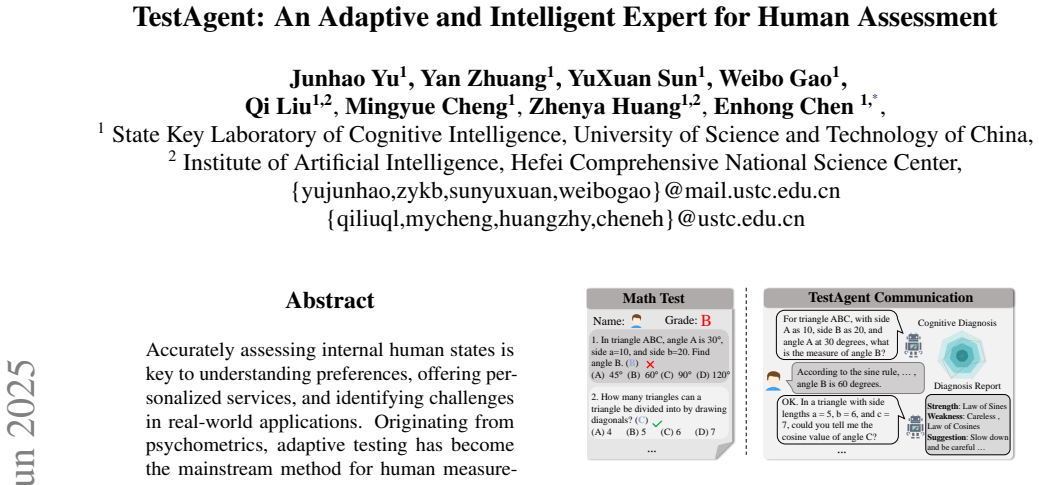
The load-bearing machinery is a closed loop that keeps the classical adaptive-testing core intact while wrapping it in LLM modules. At each step, a question picked by a Fisher-information, KL-information, or MAAT selector is rewritten as a natural-language query; the LLM summarizes the test-taker's answer into a graded label; an Autonomous Feedback Mechanism checks the label for domain relevance, response alignment, and logical coherence and generates a similar rephrased question if the check fails; and Anomaly Management detects guessing, misleading, and overconfidence patterns, using the current IRT ability estimate to decide whether a response is plausible. The cleaned label updates the ability $\theta$ via an IRT graded-response model, and the loop repeats. A separate classifier maps the final $\theta$ to text labels, and a fine-tuned ChatGLM2-6B model turns labels, response records, and expert-written reports into a personalized diagnosis report. All training data, including question features $\beta$ and interaction records, come from GPT-4 playing scripted test-taker roles.
What would settle it
Run the MBTI, MATH, and SCL-90 protocols with real human participants whose true scores are known from a gold-standard instrument, and compare TestAgent's question count and ability error to the paper's synthetic numbers; if real answer patterns differ, the 20% reduction and the ACC/AUC gains will not reproduce.
Extended reading notes
Core claim
On the paper's own terms, the central claim is that a large language model can serve as the front end of an adaptive testing system, converting every item into a conversational prompt, interpreting free-text replies into graded labels, detecting and repairing guessing, misleading, and overconfident answers, and still letting the traditional cognitive-diagnosis and question-selection machinery do the scoring. The reported evidence is that on MBTI, MATH, and SCL-90 datasets, TestAgent achieves slightly higher ACC and AUC than FSI, KLI, and MAAT baselines at most test lengths, with the largest relative gains at step 5, and that in a simulation of ability estimation it reaches the same mean-squared-error level as baselines with roughly 20% fewer questions. It also claims, based on 50 volunteers, that testers prefer the conversational format on accuracy, fluency, speed, and interaction, with paired t-tests reported significant on all four dimensions.
Load-bearing premise
The whole accuracy and efficiency result depends on GPT-4 role-playing test-takers producing responses that are faithful to real human guessing, noise, and evasiveness, since both the training records and the reported ability-estimation experiments come from that same synthetic process.
Editorial extensions
If this is right
- TestAgent can be layered on top of existing CAT selection algorithms and IRT diagnosis models, so a deployed system could gain conversational questioning and anomaly handling without rebuilding its psychometric engine.
- Because the same GPT-4-simulated data pipeline produces question banks for MBTI, MATH, and SCL-90, the framework is presented as domain-generic: new assessments need a question bank, interaction simulation, and expert reports, not new algorithm design.
- The 20% question reduction implies shorter tests for equal precision, which matters for repeated measurement settings such as classroom progress checks or longitudinal mental-health screening.
- If real testers behave like the simulated ones, the diagnosis-report module gives end users an interpretable output rather than a raw ability score, reducing reliance on human expert interpretation.
Reading between the lines
- The most direct extension is to measure the sim-to-real gap: if human free-text answers are noisier than GPT-4 role-play, the reported 20% saving will shrink, and the anomaly modules would need to be stress-tested against that extra noise.
- The same autonomous-feedback and anomaly-management prompts could be reused in any LLM-delivered questionnaire, including clinical intake or hiring screens, independent of the IRT scoring loop.
- The classifier's report quality is bounded by the source scales: for MBTI that means the long-standing validity debates about the Myers-Briggs types transfer to whatever advice TestAgent generates.
- A fair comparison with an interviewer-led test or self-assessment, not only algorithmic CAT baselines, would clarify how much of the reported preference comes from conversation rather than from adaptive selection.
Editorial analysis
A structured set of objections, weighed in public.
Referee Report
Summary. The paper proposes TestAgent, a large language model (LLM)-powered conversational agent for adaptive testing. TestAgent converts fixed-format test questions into natural language dialogue, uses LLM-based modules for response labeling and anomaly management, couples a classical IRT-style cognitive diagnosis model with standard adaptive question selection, and generates interpretable diagnosis reports. Experiments are reported on three datasets (MBTI personality, MATH education, SCL-90 mental health), with claims of higher accuracy, 20% fewer questions for the same ability-estimation error, and user preference over traditional tests.
Significance. If the empirical claims were well supported, TestAgent would be a notable contribution as an early integration of LLM interaction with adaptive testing, with potential benefits in engagement and interpretability. The paper is commendably explicit about limitations, including a 34% hallucination rate in LLM summaries and a 12% false-negative rate. However, the central evaluation is undermined by a circular benchmark and by unsupported statistical significance claims. The accuracy gains in Table 1 are small and often within one standard deviation, the ability-estimation benchmark uses a ground truth generated by the same GPT-4 simulation pipeline that produces the training data, and the reported LLM error rates are not propagated into the headline numbers. As a result, the paper's key claims of superior accuracy and 20% higher efficiency are not currently established by the evidence presented.
major comments (3)
- [Section 3.3 and Algorithm 1 (Appendix D)] The 20% fewer questions claim rests on a circular benchmark. The true ability θ0 is approximated by feedback from the test-taker answering all questions in the question bank, and Algorithm 1 shows that all such feedback is generated by GPT-4 playing roles. The IRT question features β in Section 2.3 are fit on these same GPT-4 records. Consequently, the MSE advantage in Figure 5 measures agreement with a latent variable manufactured by GPT-4, not with a human-validated construct. Any component that shares GPT-4's rating tendencies—such as TestAgent's LLM summarizer and anomaly modules—is favored by construction. A human ground-truth criterion for θ0, or at least an external validation set, is required before the efficiency claim can be accepted.
- [Table 1 and Section 3.2] The caption of Table 1 states that bold text indicates statistically significant superiority over the best baseline, but no significance test is described or reported for these accuracy comparisons. The observed differences are often small relative to the reported standard deviations (e.g., MBTI ACC@5: TestAgent+MAAT 60.21 ± 2.04 vs. MAAT 59.60 ± 1.95). Without a clearly defined testing procedure (e.g., paired tests across cross-validation folds, with p-values or confidence intervals), the claim of statistically significant superiority is unsupported. Please either provide the full statistical testing details or remove the significance language from the table caption and the text.
- [Section 5 (Limitations)] The Limitations section reports a 34% hallucination rate in LLM responses and summaries and a 12% false-negative rate in model-based indicators. These error rates directly affect the quality of the training data and the labels used in both the accuracy experiments and the ability-estimation simulation. The reported accuracy and efficiency numbers do not account for these errors. If a third of the interaction records used to train the IRT model and evaluate ability estimation are corrupted by hallucinated labels, the headline results may be artifacts of the simulation pipeline. The manuscript should include a sensitivity analysis that filters or corrects such cases, or a human-annotated test set to measure the impact of these LLM errors on downstream ability estimates.
minor comments (5)
- [Table 1] Several entries use a comma as a decimal separator (e.g., "61,98" in the KLI AUC@5 row for MBTI, "71,20" in TestAgent+KLI ACC@50 for MATH, "1,23" in TestAgent+FSI AUC@20 for MATH). These should be standardized to periods.
- [Section 2.3] The explanation of the graded response model is internally confusing: "the probability of scoring less than m points can be calculated as the difference between the probability of scoring less than m points or more and the probability of scoring less than m + 1 points or more." It should read "the probability of scoring exactly m is the difference between the probability of scoring at least m and the probability of scoring at least m+1."
- [Appendix B.3 and Table 8, Table 14] There are typos in the appendix: "V olunteers" in the demographic table heading, "Feedkback" in Table 8's title, and "False Nagetive" in Table 14. These should be corrected.
- [Section 3.3] The sentence "It performs best on dataset SCL-90, reaching a similar level as others by step 15" is ambiguous; if TestAgent performs best, it should have a lower error, not a similar level. Please clarify whether the intended meaning is that the gap narrows after step 15 or that the error is already low.
- [Section 3.1 and Appendix B.2] The MATH dataset is described as a private dataset with no details on its provenance, item selection, or test-taker population. Including availability and a full description would improve reproducibility.
Circularity Check
The headline 20%-fewer-questions efficiency claim is evaluated against a 'true ability' θ0 that is manufactured by the same GPT-4 role-play pipeline used to train the cognitive diagnosis model and to produce TestAgent's labels.
-
self definitional
[Section 3.3 (Simulation of Ability Estimation), Appendix D Algorithm 1, and Section 2.3 (Universal Data Infrastructure)]
"Since the true ability θ0 is unknown, we approximated it by feedback from the test-taker answering all questions in the question bank (Bi et al., 2020; Cheng, 2009). ... [Algorithm 1:] The large language model G plays different roles to answer questions Q, generating responses Y. ... [Section 2.3:] We leverage the capabilities of GPT-4 to simulate test-takers with different abilities."
The evaluation target θ0 is not an independent human ground truth. Section 3.3 defines θ0 as feedback from 'the test-taker answering all questions in the question bank,' but in this paper the only test-taker data are produced by Algorithm 1, where GPT-4 plays roles and generates all responses Y. The same GPT-4-generated records are used in Section 2.3 to fit the IRT question features β and train the cognitive diagnosis model, and they are also the source of the labels that TestAgent's LLM-based summarization and anomaly modules consume. The MSE E[||θt−θ0||^2] and the derived '20% fewer questions' claim therefore measure how quickly an estimator converges to a latent variable manufactured by the same generative process that supplies the training data and the system's own labels.
full rationale
The central quantitative claim in the abstract — 'more accurate results with 20% fewer questions than state-of-the-art baselines' — rests on Figure 5, which plots E[||θt−θ0||^2] against test step. Section 3.3 states that θ0 is approximated by the test-taker's feedback on all questions, and Appendix D's Algorithm 1 shows that all such feedback is generated by GPT-4 playing roles. Section 2.3 explicitly says GPT-4 is used to simulate test-takers and that the cognitive diagnosis model is trained on those records. Thus the training data, the labels summarized by the LLM modules, and the evaluation target all arise from the same GPT-4 role-play process. This is not a case of a benign external benchmark: the 'true ability' is defined by the same generator the system is built to emulate, so the reported efficiency gain is partly a measure of how well the model tracks a GPT-4-manufactured latent trait. The paper's own Limitations section reports a 34% hallucination rate and a 12% false-negative rate in the LLM modules, and these errors are not propagated into the quantitative accuracy or efficiency numbers, which further weakens the independent grounding of the headline claim. The human-volunteer study in Section 3.4 provides genuinely external evidence for user-experience dimensions (fluency, speed, interaction), but it does not validate the 20% accuracy/efficiency claim against a human criterion. Because the central efficiency claim reduces, by the paper's own construction of θ0, to agreement with the same GPT-4 simulation used for training and labeling, the circularity score is 6 rather than 0. This is a partial circularity: the system architecture and much of the qualitative user-experience evaluation have independent content, but the headline accuracy-efficiency result is not independently grounded.
Assumptions & free parameters
free parameters (5)
- IRT item threshold parameters beta_i^(m) =
not reported per item
- Test-taker ability theta =
not reported
- MBTI-to-type classifier g =
trained weights
- LoRA fine-tuning hyperparameters =
r=8, alpha=32, dropout=0.1, learning rate 2e-6, 10 epochs
- Anomaly detection criteria =
not specified
assumptions (5)
- domain assumption A test-taker's ability theta is constant throughout the test.
- ad hoc to paper GPT-4-simulated responses are a reliable proxy for real test-takers.
- domain assumption The graded response IRT model adequately captures response behavior in all three domains.
- domain assumption The true ability theta_0 is well approximated by responses to all questions in the bank.
- ad hoc to paper LLM-extracted labels from free-text responses match expert labels.
Cite this review
Pith. "Pith review of TestAgent: An Adaptive and Intelligent Expert for Human Assessment." pith.science (2026). https://pith.science/paper/MGQOLKS5
@misc{pith2026250603032,
  author       = {Pith},
  title        = {Pith review of: TestAgent: An Adaptive and Intelligent Expert for Human Assessment},
  year         = {2026},
  howpublished = {\url{https://pith.science/paper/MGQOLKS5}},
  note         = {Machine review of arXiv:2506.03032}
}
read the original abstract
Accurately assessing internal human states is key to understanding preferences, offering personalized services, and identifying challenges in real-world applications. Originating from psychometrics, adaptive testing has become the mainstream method for human measurement and has now been widely applied in education, healthcare, sports, and sociology. It customizes assessments by selecting the fewest test questions . However, current adaptive testing methods face several challenges. The mechanized nature of most algorithms leads to guessing behavior and difficulties with open-ended questions. Additionally, subjective assessments suffer from noisy response data and coarse-grained test outputs, further limiting their effectiveness. To move closer to an ideal adaptive testing process, we propose TestAgent, a large language model (LLM)-powered agent designed to enhance adaptive testing through interactive engagement. This is the first application of LLMs in adaptive testing. TestAgent supports personalized question selection, captures test-takers' responses and anomalies, and provides precise outcomes through dynamic, conversational interactions. Experiments on psychological, educational, and lifestyle assessments show our approach achieves more accurate results with 20% fewer questions than state-of-the-art baselines, and testers preferred it in speed, smoothness, and other dimensions.
Figures


Figures from the paper (7 more)


Reference graph
Works this paper leans on
-
[1]
Domain Verification:The MBTI test re- quires 4 dimensions: (I/E), (N/S), (T/F), (J/P)
-
[2]
Data Integration:Generate MBTI data using GPT-4 to simulate interaction data
-
[3]
Cognitive Diagnosis Training:Train a cog- nitive diagnosis model using the simulated interaction data. TestAgent Planning:
-
[4]
Cognitive Diagnosis:Diagnose based on re- sponse records to obtain ability vectors
-
[5]
Adaptive Question Selection:Select ques- tions adaptively from the question bank
-
[6]
Repeat Testing:Repeat Steps 1–5 until the test is complete. Report Generation:
-
[9]
Symbolic cognitive diagnosis via hybrid op- timization for intelligent education systems. InPro- ceedings of the 38th AAAI Conference on Artificial In- telligence, pages 14928–14936, Vancouver, Canada. Randy Stein and Alexander B. Swan. 2019. Evaluating the validity of myers-briggs type indicator theory: A teaching tool and window into intuitive psychol- ...
arXiv 2019
-
[10]
InPro- ceedings of the AAAI Conference on Artificial Intelli- gence, volume 38, pages 19368–19376
Zhongjing: Enhancing the chinese medical capabilities of large language model through expert feedback and real-world multi-turn dialogue. InPro- ceedings of the AAAI Conference on Artificial Intelli- gence, volume 38, pages 19368–19376. Shunyu Yao, Howard Chen, John Yang, and Karthik Narasimhan. 2022. Webshop: Towards scalable real- world web interaction ...
work page 2022
Show all 24 references
-
[11]
Based on per- sonality test classification and relevant dialogues, analyze the character traits and provide the corre- sponding diagnostic report
Understanding and improving fairness in cog- nitive diagnosis.Science China Information Sci- ences, 67(5):152106. Lixi Zhu, Xiaowen Huang, and Jitao Sang. 2024. How reliable is your simulator? analysis on the limitations of current llm-based user simulators for conversa- tiona...
2024
-
[15]
Question Generation:Generate questions in a conversational format from the question bank for the tester
-
[16]
Tester Response:Tester responds to the ques- tions
-
[17]
Autonomous Feedback System and Anomaly Management:Analyze responses, and if anomalies in labels are detected, generate new questions and return to Step 2
-
[21]
Neural Architecture:Pass diagnosis model interaction records to a trained neural network to obtain a label (e.g., INTJ)
-
[22]
Expert Analysis:Combine expert analysis with neural network results for fine-tuning
-
[23]
F Prompt This includes the segments mentioned in the main text
Diagnosis Report:Output a diagnosis report based on the test results. F Prompt This includes the segments mentioned in the main text. These segments include tag judgment, Auto Feedback Mechanism, Anomaly manage- ment, problem transformation, and other methods. The table below ...
-
[24]
What is Newton’s third law?
Unrelated responses (Return ‘False‘): - Question: ‘"What is Newton’s third law?"‘ - Response: ‘"I like eating pizza."‘ 2. Difficult-to-judge responses (Return ‘False‘): - Question: ‘"Explain the process of cell division."‘ - Response: ‘"I don’t know how to explain it."‘ 3. Log...
-
[92]
Geunwoo Kim, Pierre Baldi, and Stephen McAleer
Springer International Publishing, Cham. Geunwoo Kim, Pierre Baldi, and Stephen McAleer
-
[2003]
Educational Measurement: Issues and Practice, 22(3):37–51
Using multidimensional item response the- ory to evaluate educational and psychological tests. Educational Measurement: Issues and Practice, 22(3):37–51. Mohammad Rafayet Ali, Seyedeh Zahra Razavi, Raina Langevin, Abdullah Al Mamun, Benjamin Kane, Reza Rawassizadeh, Lenhart K....
2020
-
[2017]
Dual-objective item selection criteria in cogni- tive diagnostic computerized adaptive testing.Jour- nal of Educational Measurement, 54(2):165–183. Alan S. Kaufman, Dowon Choi, Hansika Kapoor, and James C. Kaufman. 2022.A Brief History of IQ Testing: Fixed vs. Malleable Intell...
2022
-
[2020]
In 2020 IEEE International Conference on Data Mining (ICDM), pages 42–51
Quality meets diversity: A model-agnostic framework for computerized adaptive testing. In 2020 IEEE International Conference on Data Mining (ICDM), pages 42–51. IEEE. Andrew P Bradley. 1997. The use of the area under the roc curve in the evaluation of machine learning algorith...
2020
-
[2021]
InProceedings of the 44th international ACM SIGIR conference on research and development in information retrieval, pages 501–510
Rcd: Relation map driven cognitive diagnosis for intelligent education systems. InProceedings of the 44th international ACM SIGIR conference on research and development in information retrieval, pages 501–510. Aritra Ghosh and Andrew Lan. 2021. Bobcat: Bilevel optimization-bas...
-
[2022]
Wanyong Feng, Aritra Ghosh, Stephen Sireci, and An- drew S Lan
Human-level play in the game of diplomacy by combining language models with strategic reason- ing.Science, 378(6624):1067–1074. Wanyong Feng, Aritra Ghosh, Stephen Sireci, and An- drew S Lan. 2023. Balancing test accuracy and se- curity in computerized adaptive testing. InInte...
2023
-
[2023]
Hua-Hua Chang
Chateval: Towards better llm-based evaluators through multi-agent debate.ArXiv, abs/2308.07201. Hua-Hua Chang. 2015. Psychometrics behind comput- erized adaptive testing.Psychometrika, 80:1–20. Hua-Hua Chang and Zhiliang Ying. 1996. A global in- formation approach to computeri...
2015 arXiv
-
[2024]
Advances in Neural Information Processing Systems, 36
Language models can solve computer tasks. Advances in Neural Information Processing Systems, 36. Yehuda Koren, Robert Bell, and Chris V olinsky. 2009. Matrix factorization techniques for recommender sys- tems.Computer, 42(8):30–37. Anita Krishnakumar. 2007. Active learning lit...
2009
Reviewed August 7, 2026 · model on record in the stance chip above.
Discussion (0). Sign in to comment.