REVIEW 4 major objections 4 minor 47 references
Queuing for Civility: Regulating Emotions and Reducing Toxicity in Digital Discourse
T0 review · 4 major / 4 minor · reviewed 2026-08-05 · deepseek-v4-flash
Pith's one-line read This paper claims that combining a graph-based emotion board with a comment queue can reduce online toxicity by 12% and anger spread by 15%, while holding only 4% of comments.
desk verdict A clear, testable queue design is buried under empirical claims the paper's own simulation cannot support; worth a referee, not a citation. read the letter →
The pith
A machine-rendered reading of the paper's core claim, the machinery that carries it, and where it could break.
The reading
What carries the argument
The load-bearing object is the conversation graph with its emotion board at the root, plus the adaptive comment queue. The graph assigns each comment an emotion and intensity from the NRC lexicon and computes influence from reply count, distance to root, PageRank, and emotion intensity; the emotion board aggregates these into percentages. The queue holds comments that push anger or fear past dynamic thresholds, re-evaluates them as new comments arrive, and either releases them when emotional balance is restored or prompts revision or suspension. Dynamic thresholds, a sliding window over recent comments, and weighted allowances for positive and underrepresented emotions keep the queue from st
What would settle it
Run a randomized controlled field test on a live comment platform: for comments flagged by the emotion board, randomly assign authors to immediate publication, queue with a reflection prompt, or queue without a prompt. If the prompted-and-queued group's subsequent comments show no larger drop in toxicity or anger than the immediate group, the central claim that self-reflection and delay reduce toxicity is falsified. A complementary simulation check: recompute the reported reductions while randomly holding the same 4% of comments instead of targeting high-influence ones; if random holds achieve
Extended reading notes
Core claim
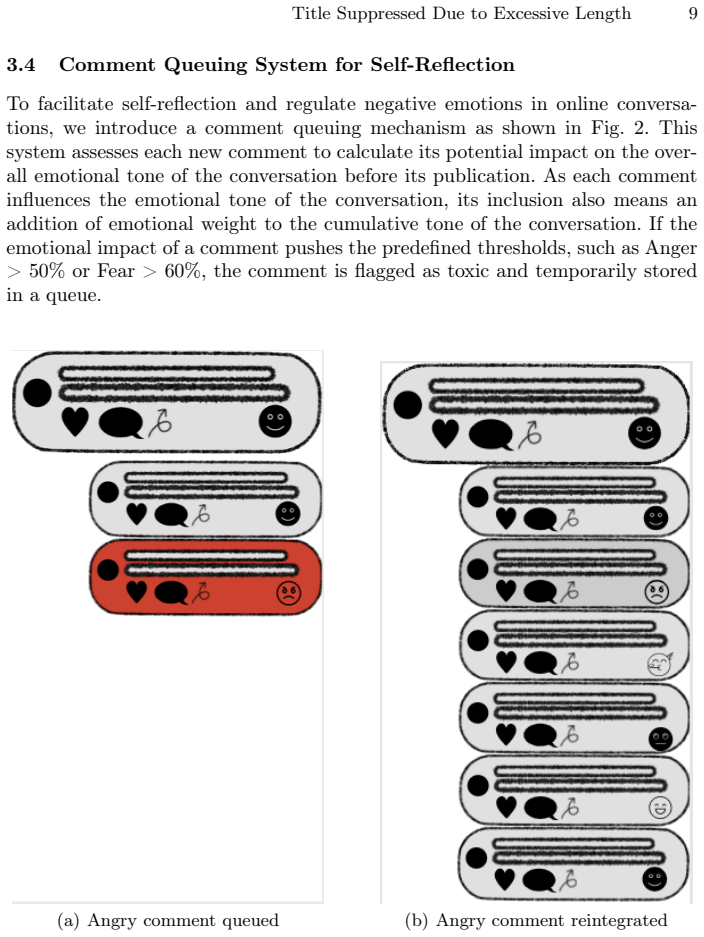
The central claim is that emotion regulation can be operationalized as a graph-computational problem. Each conversation is modeled as a directed acyclic graph whose root is the original post; comments are nodes scored for emotion and intensity using the NRC lexicon, and each node's influence is computed from number of replies, distance from root, PageRank, and emotional intensity. The root's emotion board tracks the percentage contribution of each emotion. A comment whose addition would push anger above 50% or fear above 60% is temporarily queued; it is re-evaluated after each new comment and can be reintegrated when subsequent positive or balancing comments reduce the threat. The paper repo
Load-bearing premise
The reported reductions assume that deactivating influential nodes in a conversation graph is equivalent to a real user noticing their emotional impact and choosing to self-reflect or revise; no participant in the study actually made that choice.
Editorial extensions
If this is right
- Conversation context matters for moderation: scoring a comment by its position, replies, and PageRank can identify toxicity that text-only detectors miss.
- A short, adaptive delay can reduce anger propagation with little conversational cost, since only about 4% of comments are held.
- Dynamic thresholds let moderation intensity track conversation heat, so active threads do not stall and calm threads stay strict.
- Combining self-reflection prompts with delayed publication gives platforms a proactive alternative to post-hoc deletion.
- Emotion-targeted holding of anger and fear can shift a conversation's emotional balance toward positive emotions, as the emotion-board comparisons show.
Reading between the lines
- I would expect the reported 12% and 15% effects to shrink or shift in a live deployment, because the simulation assumes a held or removed node is equivalent to a human author deciding to self-reflect; a test with real authors editing after a prompt is the natural next step.
- An ablation that queues only the highest-influence nodes would reveal whether the benefit comes from a few central comments or from the breadth of holds; that result could justify lower hold rates than 4%.
- The graph influence score could be turned into a pre-publication preview, such as 'this comment will raise anger by X percent,' which might reduce the need for actual holds—an application the paper gestures at but does not test.
- Because the emotion board reacts to contextual balance, the framework could be repurposed to amplify underrepresented emotions like joy and trust in polarized conversations, not just suppress anger.
Signed reviews
Editorial analysis
A structured set of objections, weighed in public.
Referee Report
Summary. The paper proposes a graph-based framework (eImpact) that detects emotions in Twitter/Reddit conversations and uses a comment-queuing mechanism to delay comments that would push conversational anger/fear above thresholds. The intended psychological mechanism is that the delay induces self-reflection and emotion regulation, reducing toxicity. The authors report that eImpact reduces hate speech by 10% versus 7% for Google's Perspective API, that the queuing mechanism reduces the spread of anger/fear by 15%, and that only 4% of comments are held for about 47 seconds on average.
Significance. If the quantitative claims were valid, the work would address an important gap in online moderation: moving from post-hoc content removal to real-time, context-sensitive emotion regulation. The framework is creative, uses real social media data, and the comparison to Perspective API is a reasonable starting point. However, the evidence presented is not a measurement of human emotion regulation: it is a graph manipulation simulation in which nodes are deactivated or queued. The reported reductions are partly arithmetic consequences of the queuing rule. The inconsistency between the abstract's 12% and the body's 10% further erodes confidence. The potential significance is real, but the current manuscript does not establish it.
major comments (4)
- [Abstract vs. Section 3.5 and Table 1] The abstract and introduction state a 12% toxicity reduction (e.g., 'reduced toxicity by 12%', '12% reduction in the spread of hate speech and anger'), while Section 3.5 and Table 1 report that the eImpact framework achieved a 10% reduction, with Perspective API at 7%. The paper does not explain which number is the measured result, or why the abstract differs from the body. This discrepancy directly affects the headline quantitative claim and must be resolved before the manuscript can be considered reliable.
- [Section 3.5 and Section 4.1] The central causal claim — that promoting self-reflection reduces toxicity — is not tested. The experimental evaluation in Section 3.5 is described as 'deactivating influential nodes or restricting responses once they reach the toxicity threshold.' No user ever reflected on, revised, or even experienced the queue; the word 'revision' appears only as a design proposal in Section 3.4, and Section 4.1 explicitly defers 'real-time emotional feedback through user interviews and surveys' to future work. Thus the reported reductions measure the effect of node removal/queuing in a graph, not the effect of the emotion-regulation intervention that the paper argues is responsible.
- [Section 3.4 and Section 4] The reported 15% reduction in the spread of anger and fear is largely an arithmetic consequence of the queue rule: Section 3.4 states that comments are flagged and queued when they push Anger > 50% or Fear > 60%, and the results in Section 4 are computed on the resulting graph. Since queued comments cannot contribute to the emotion board until thresholds drop, measuring 'spread of anger and fear' on the output of the same rule does not provide independent evidence for emotion regulation. The manuscript also provides no error bars, statistical tests, or sensitivity analyses for the 15%, 10%, 4%, or 47-second figures, so the precision of these claims is unclear.
- [Section 3.4] The adaptive threshold mechanism is not specified precisely enough to be reproduced. The text says thresholds are 'determined using several parameters' and 'adjusted dynamically through an algorithm' but does not give the algorithm, the weighting of the parameters, or the exact rule for the sliding window (beyond '100 recent comments'), the weighted allowances for positive emotions, or the active/non-active distinction. Since the central results depend on these thresholds, the lack of specification is a load-bearing reproducibility gap.
minor comments (4)
- [Section 5] The acknowledgement line 'We are grateful to Amity University for accepting our work as a keynote paper' is unclear and appears out of place. It may confuse readers about the venue of this submission.
- [References] Reference [45] is the authors' prior conference paper and appears to be the basis for the framework and much of the experimental setup. The manuscript should clearly state what is new in this submission relative to [45], especially in the results and discussion.
- [Figures 5--7] The figures are described in the text but lack captions that specify the exact experimental condition, number of conversations, and whether values are means over conversations. Figure 5's histogram would benefit from error bars or confidence bands, and Figure 7's y-axis ('cumulative emotional impact') is never formally defined.
- [Section 3.2] The emotion classification method is described as using the NRC lexicon and Emojinal embeddings, but the details of how text and emojis are combined into a single 0.1--1.0 intensity score are not given. A brief formula or algorithmic description would improve readability.
Circularity Check
Headline reductions are arithmetic consequences of the queue threshold and node-deactivation rules, not observed self-reflection.
-
self definitional
[Section 3.4 (Comment Queuing System) and Section 4 (Results and Discussion)]
"If the emotional impact of a comment pushes the predefined thresholds, such as Anger > 50% or Fear > 60%, the comment is flagged as toxic and temporarily stored in a queue. ... When the queue is used, emotions are always within threshold limits and not dominated by specific emotions. Overall, when the queue was employed, we observed an average reduction of 15% in the spread of anger and fear compared to conversations where comments were posted immediately."
The with-queue conversation is generated by the rule that holds any comment pushing Anger>50% or Fear>60%. Measuring 'spread of anger' in that generated graph therefore measures the queue rule itself: those emotions are constrained to stay below the thresholds by construction. The paper even states that 'emotions are always within threshold limits' with the queue. Since no user is observed pausing, reflecting, or revising, the 15% 'decrease' is not a prediction about emotion regulation; it is the direct, definitional output of the admission rule. This is the paper's central quantitative claim, so the circularity is load-bearing.
-
fitted input called prediction
[Section 3.5 (Experimental Setup) and Table 1]
"Our analysis focused on mitigating hate speech and polarisation by deactivating influential nodes or restricting responses once they reach the toxicity threshold. Our findings revealed that, while the Perspective API reduced hate speech by 7%, the eImpact framework achieved a 10% reduction."
The eImpact 'reduction' is computed by deactivating the very nodes the framework itself labels influential and toxic, or by restricting responses that reach its toxicity threshold. A graph with those nodes removed cannot contain the toxicity the detector is counting, so the 10% figure is a restatement of the deactivation rule rather than an independent estimate of self-reflection's effect. The psychological mechanism named in the paper—users reflecting and revising—is never manipulated or measured; deactivation and threshold-based restriction are the actual intervention. Thus the result reduces to its own input rule (the abstract's 12% figure is the same construction restated).
full rationale
The paper contains two intertwined reductions. First, the headline '15% reduction in the spread of anger and fear' is definitional: the queue's reported effect is produced by holding exactly the comments that exceed Anger>50% or Fear>60%, then measuring the emotion board of the resulting graph. Second, the '10% (abstract 12%) toxicity reduction' is obtained by deactivating the framework's own influential-toxic nodes and counting the remaining toxicity; this is a simulation of a moderation rule, not evidence for the self-reflection-based causal story. The paper itself concedes in Section 4.1 that real-time emotional feedback via user interviews and surveys is future work. Self-citation to [45] provides the eImpact framework and its prior comparison, but that is a normal incremental-citation pattern and is not the main problem here. The numbers may be internally inconsistent (12% vs 10%), which is a correctness concern but not itself circularity. The central claims reduce to the operation of the implemented rules, so the circularity score is high; the framework's graph metrics and the Perspective API comparison retain some independent algorithmic content, which is why the score is 8 rather than 10.
Assumptions & free parameters
free parameters (4)
- Anger and fear queue thresholds =
Anger > 50%, Fear > 60%
- Sliding window size =
100 recent comments
- Influence score weights =
not specified
- Threshold adjustment parameters =
not specified
assumptions (5)
- domain assumption The NRC lexicon and emoji vector mapping assign valid emotion and intensity scores to text in social media posts.
- domain assumption PageRank, reply count, distance from root, and emotion intensity measure a comment's emotional influence on a conversation.
- domain assumption The root node's emotion board represents the emotional state of the entire conversation.
- ad hoc to paper Simulated node removal or queuing is a valid proxy for real users engaging in self-reflection.
- domain assumption The Perspective API toxicity score is an appropriate external baseline for measuring toxicity reduction.
Cite this review
Pith. "Pith review of Queuing for Civility: Regulating Emotions and Reducing Toxicity in Digital Discourse." pith.science (2026). https://pith.science/paper/MGXCO26U
@misc{pith2026250900696,
  author       = {Pith},
  title        = {Pith review of: Queuing for Civility: Regulating Emotions and Reducing Toxicity in Digital Discourse},
  year         = {2026},
  howpublished = {\url{https://pith.science/paper/MGXCO26U}},
  note         = {Machine review of arXiv:2509.00696}
}
read the original abstract
The pervasiveness of online toxicity, including hate speech and trolling, disrupts digital interactions and online well-being. Previous research has mainly focused on post-hoc moderation, overlooking the real-time emotional dynamics of online conversations and the impact of users' emotions on others. This paper presents a graph-based framework to identify the need for emotion regulation within online conversations. This framework promotes self-reflection to manage emotional responses and encourage responsible behaviour in real time. Additionally, a comment queuing mechanism is proposed to address intentional trolls who exploit emotions to inflame conversations. This mechanism introduces a delay in publishing comments, giving users time to self-regulate before further engaging in the conversation and helping maintain emotional balance. Analysis of social media data from Twitter and Reddit demonstrates that the graph-based framework reduced toxicity by 12%, while the comment queuing mechanism decreased the spread of anger by 15%, with only 4% of comments being temporarily held on average. These findings indicate that combining real-time emotion regulation with delayed moderation can significantly improve well-being in online environments.
Figures


Figures from the paper (4 more)


Reference graph
Works this paper leans on
-
[1]
In: UK Workshop on Computational Intelligence
Barry, E., Jameel, S., Raza, H.: Emojional: Emoji embeddings. In: UK Workshop on Computational Intelligence. pp. 312–324. Springer (2021) Title Suppressed Due to Excessive Length 17
work page 2021
-
[2]
Person- ality and individual Differences67, 97–102 (2014)
Buckels, E.E., Trapnell, P.D., Paulhus, D.L.: Trolls just want to have fun. Person- ality and individual Differences67, 97–102 (2014)
work page 2014
-
[3]
ACM Transactions on Computer-Human Interaction (TOCHI)29(4), 1–26 (2022)
Chandrasekharan, E., Jhaver, S., Bruckman, A., Gilbert, E.: Quarantined! exam- ining the effects of a community-wide moderation intervention on reddit. ACM Transactions on Computer-Human Interaction (TOCHI)29(4), 1–26 (2022)
work page 2022
-
[4]
Proceedings of the ACM on human-computer interaction1(CSCW), 1–22 (2017)
Chandrasekharan, E., Pavalanathan, U., Srinivasan, A., Glynn, A., Eisenstein, J., Gilbert,E.:Youcan’tstayhere:Theefficacyofreddit’s2015banexaminedthrough hate speech. Proceedings of the ACM on human-computer interaction1(CSCW), 1–22 (2017)
work page 2017
-
[5]
Cheng, J., Bernstein, M., Danescu-Niculescu-Mizil, C., Leskovec, J.: Anyone can become a troll: Causes of trolling behavior in online discussions. In: Proceedings of the 2017 ACM conference on computer supported cooperative work and social computing. pp. 1217–1230 (2017)
work page 2017
-
[6]
Media and communication9(1), 195–208 (2021)
Frischlich, L., Schatto-Eckrodt, T., Boberg, S., Wintterlin, F.: Roots of incivility: How personality, media use, and online experiences shape uncivil participation. Media and communication9(1), 195–208 (2021)
work page 2021
-
[7]
Gillespie, T.: Custodians of the Internet: Platforms, content moderation, and the hidden decisions that shape social media. Yale University Press (2018)
work page 2018
-
[8]
Big Data & Society 7(2), 2053951720943234 (2020)
Gillespie, T.: Content moderation, ai, and the question of scale. Big Data & Society 7(2), 2053951720943234 (2020)
work page 2020
Show all 47 references
-
[9]
Management Science62(1), 180–196 (2016)
Goel, S., Anderson, A., Hofman, J., Watts, D.J.: The structural virality of online diffusion. Management Science62(1), 180–196 (2016)
2016
-
[10]
Social Network Analysis and Mining12(1), 129 (2022)
Gongane, V.U., Munot, M.V., Anuse, A.D.: Detection and moderation of detri- mental content on social media platforms: current status and future directions. Social Network Analysis and Mining12(1), 129 (2022)
2022
-
[11]
Google: Perspective API.https://www.perspectiveapi.com/ (2021), [Online; ac- cessed 19-Dec-2022]
2021
-
[12]
Big Data & Society 7(1), 2053951719897945 (2020)
Gorwa, R., Binns, R., Katzenbach, C.: Algorithmic content moderation: Technical and political challenges in the automation of platform governance. Big Data & Society 7(1), 2053951719897945 (2020)
2020
-
[13]
https://www.grammarly.com (2024), accessed: 2024-06- 20
Grammarly: Grammarly. https://www.grammarly.com (2024), accessed: 2024-06- 20
2024
-
[14]
Handbook of emotions3(3), 497–513 (2008)
Gross, J.J.: Emotion regulation. Handbook of emotions3(3), 497–513 (2008)
2008
-
[15]
Gross, J.J.: Emotion regulation: conceptual and empirical foundations. (2014)
2014
-
[16]
Psychological inquiry 26(1), 1–26 (2015)
Gross, J.J.: Emotion regulation: Current status and future prospects. Psychological inquiry 26(1), 1–26 (2015)
2015
-
[17]
Psychological science25(8), 1571–1580 (2014)
Grossmann, I., Kross, E.: Exploring solomon’s paradox: Self-distancing eliminates the self-other asymmetry in wise reasoning about close relationships in younger and older adults. Psychological science25(8), 1571–1580 (2014)
2014
-
[18]
In: Handbook of self-regulation of learning and performance, pp
Hadwin, A., Järvelä, S., Miller, M.: Self-regulation, co-regulation, and shared reg- ulation in collaborative learning environments. In: Handbook of self-regulation of learning and performance, pp. 83–106. Routledge (2017)
2017
-
[19]
Problem solving for teaching and learning pp
Hadwin, A.F., Davis, S.K., Bakhtiar, A., Winne, P.H.: Academic challenges as opportunities to learn to self-regulate learning. Problem solving for teaching and learning pp. 34–47 (2019)
2019
-
[20]
NeuroImage50(2), 734–741 (2010)
Herwig, U., Kaffenberger, T., Jäncke, L., Brühl, A.B.: Self-related awareness and emotion regulation. NeuroImage50(2), 734–741 (2010)
2010
-
[21]
In: CHI Conference on Human Factors in Computing Systems Extended Abstracts
Hossain, E., Wadley, G., Berthouze, N., Cox, A.: Motivational and situational as- pects of active and passive social media breaks may explain the difference between recovery and procrastination. In: CHI Conference on Human Factors in Computing Systems Extended Abstracts. pp. 1...
2022
-
[22]
The international encyclopedia of gen- der, media, and communication116 (2020)
Jane, E.A.: Online abuse and harassment. The international encyclopedia of gen- der, media, and communication116 (2020)
2020
-
[23]
In: Proceedings of the 25th Interna- tional Academic Mindtrek Conference
Kiskola, J., Olsson, T., Syrjämäki, A.H., Rantasila, A., Ilves, M., Isokoski, P., Surakka, V.: Online survey on novel designs for supporting self-reflection and emo- tion regulation in online news commenting. In: Proceedings of the 25th Interna- tional Academic Mindtrek Confer...
2022
-
[24]
Kiskola, J., Olsson, T., Väätäjä, H., H. Syrjämäki, A., Rantasila, A., Isokoski, P., Ilves, M., Surakka, V.: Applying critical voice in design of user interfaces for supporting self-reflection and emotion regulation in online news commenting. In: Proceedings of the 2021 CHI co...
2021
-
[25]
Proceedings of the ACM on Human-Computer Interaction 4(CSCW2), 1–25 (2020)
Kou, Y., Gui, X.: Emotion regulation in esports gaming: a qualitative study of league of legends. Proceedings of the ACM on Human-Computer Interaction 4(CSCW2), 1–25 (2020)
2020
-
[26]
In: Proceedings of the 26th International Conference on World Wide Web Companion
Kumar, S., Cheng, J., Leskovec, J.: Antisocial behavior on the web: Characteriza- tion and detection. In: Proceedings of the 26th International Conference on World Wide Web Companion. pp. 947–950 (2017)
2017
-
[27]
Lukoff, K., Yu, C., Kientz, J., Hiniker, A.: What makes smartphone use meaningful or meaningless? Proceedings of the ACM on Interactive, Mobile, Wearable and Ubiquitous Technologies2(1), 1–26 (2018)
2018
-
[28]
IEEE Transactions on Af- fective Computing (2021)
Luo, Ruikun, N.D., Yang, X.J.: Behavioral and physiological signals-based deep multimodal approach for mobile emotion recognition. IEEE Transactions on Af- fective Computing (2021)
2021
-
[29]
arXiv preprint arXiv:2210.13770 (2022)
Maarouf, A., Pröllochs, N., Feuerriegel, S.: The virality of hate speech on social media. arXiv preprint arXiv:2210.13770 (2022)
2022 arXiv
-
[30]
arXiv preprint arXiv:1803.08022 (2018)
Manikonda, L., Beigi, G., Liu, H., Kambhampati, S.: Twitter for sparking a move- ment, reddit for sharing the moment:# metoo through the lens of social media. arXiv preprint arXiv:1803.08022 (2018)
2018 arXiv
-
[31]
Emotion20(1), 1 (2020)
McRae, K., Gross, J.J.: Emotion regulation. Emotion20(1), 1 (2020)
2020
-
[32]
National Research Council, Canada 2, 234 (2013)
Mohammad, S.M., Turney, P.D.: Nrc emotion lexicon. National Research Council, Canada 2, 234 (2013)
2013
-
[33]
Trends in cognitive sciences 9(5), 242–249 (2005)
Ochsner, K.N., Gross, J.J.: The cognitive control of emotion. Trends in cognitive sciences 9(5), 242–249 (2005)
2005
-
[34]
Proceedings of the ACM on Human-Computer Interaction 6(CSCW2), 1–29 (2022)
Park, J.S., Seering, J., Bernstein, M.S.: Measuring the prevalence of anti-social behavior in online communities. Proceedings of the ACM on Human-Computer Interaction 6(CSCW2), 1–29 (2022)
2022
-
[35]
Mit Press (2015)
Phillips, W.: This is why we can’t have nice things: Mapping the relationship between online trolling and mainstream culture. Mit Press (2015)
2015
-
[36]
Proceed- ings of the ACM on Interactive, Mobile, Wearable and Ubiquitous Technologies 4(4), 1–32 (2020)
Ruensuk, M., Cheon, E., Hong, H., Oakley, I.: How do you feel online: Exploiting smartphone sensors to detect transitory emotions during social media use. Proceed- ings of the ACM on Interactive, Mobile, Wearable and Ubiquitous Technologies 4(4), 1–32 (2020)
2020
-
[37]
In: Proceedings of the Web Conference 2021
Saveski, M., Roy, B., Roy, D.: The structure of toxic conversations on twitter. In: Proceedings of the Web Conference 2021. pp. 1086–1097 (2021)
2021
-
[38]
HCI-E MSc Final Project Report 2020 (2020)
Shen, K., Cox, A.: Video games as a tool for digital emotion regulation. HCI-E MSc Final Project Report 2020 (2020)
2020
-
[39]
arXiv preprint arXiv:2204.00118 (2022) Title Suppressed Due to Excessive Length 19
Slovak, P., Antle, A.N., Theofanopoulou, N., Roquet, C.D., Gross, J.J., Isbister, K.: Designing for emotion regulation interventions: an agenda for hci theory and research. arXiv preprint arXiv:2204.00118 (2022) Title Suppressed Due to Excessive Length 19
2022 arXiv
-
[40]
In: CHI Conference on Human Factors in Computing Systems
Smith, W., Wadley, G., Webber, S., Tag, B., Kostakos, V., Koval, P., Gross, J.J.: Digital emotion regulation in everyday life. In: CHI Conference on Human Factors in Computing Systems. pp. 1–15 (2022)
2022
-
[41]
In: Proceedings of the ACM Web Conference 2022
Solovev, K., Pröllochs, N.: Moral emotions shape the virality of covid-19 misinfor- mation on social media. In: Proceedings of the ACM Web Conference 2022. pp. 3706–3717 (2022)
2022
-
[42]
it’s common and a part of being a content creator
Thomas, K., Kelley, P.G., Consolvo, S., Samermit, P., Bursztein, E.: “it’s common and a part of being a content creator”: Understanding how creators experience and cope with hate and harassment online. In: CHI Conference on Human Factors in Computing Systems. pp. 1–15 (2022)
2022
-
[43]
Emotion Review10(2), 116–124 (2018)
Torre, J.B., Lieberman, M.D.: Putting feelings into words: Affect labeling as im- plicit emotion regulation. Emotion Review10(2), 116–124 (2018)
2018
-
[44]
Proceedings of the ACM on Human- computer Interaction 6(CSCW2), 1–28 (2022)
Trujillo, A., Cresci, S.: Make reddit great again: assessing community effects of moderation interventions on r/the_donald. Proceedings of the ACM on Human- computer Interaction 6(CSCW2), 1–28 (2022)
2022
-
[45]
In: 2023 IEEE Engineer- ing Informatics
Verma, A., Islam, S., Moghaddam, V., Anwar, A.: Encouraging emotion regula- tion in social media conversations through self-reflection. In: 2023 IEEE Engineer- ing Informatics. pp. 1–8 (2023).https://doi.org/10.1109/IEEECONF58110.2023. 10520471
2023
-
[46]
Current Directions in Psychological Science29(4), 412–418 (2020)
Wadley, G., Smith, W., Koval, P., Gross, J.J.: Digital emotion regulation. Current Directions in Psychological Science29(4), 412–418 (2020)
2020
-
[47]
Proceedings of the Content Analysis in the WEB 2(0), 1–7 (2009)
Yin, D., Xue, Z., Hong, L., Davison, B.D., Kontostathis, A., Edwards, L., et al.: Detection of harassment on web 2.0. Proceedings of the Content Analysis in the WEB 2(0), 1–7 (2009)
2009
Reviewed August 5, 2026 · model on record in the stance chip above.
Discussion (0). Continue with ORCID to comment.