REVIEW 3 major objections 8 minor 68 references
Superconducting single-layer T-graphene and novel synthesis routes
T0 review · 3 major / 8 minor · reviewed 2026-08-14 · deepseek-v4-flash
Pith's one-line read The paper predicts that a single carbon sheet called T-graphene is an intrinsic superconductor at about 20.8 K.
desk verdict Solid computational prediction of a new 2D carbon superconductor, but the headline Tc needs a q-mesh convergence check before I'd trust the number. read the letter →
The pith
A machine-rendered reading of the paper's core claim, the machinery that carries it, and where it could break.
The reading
What carries the argument
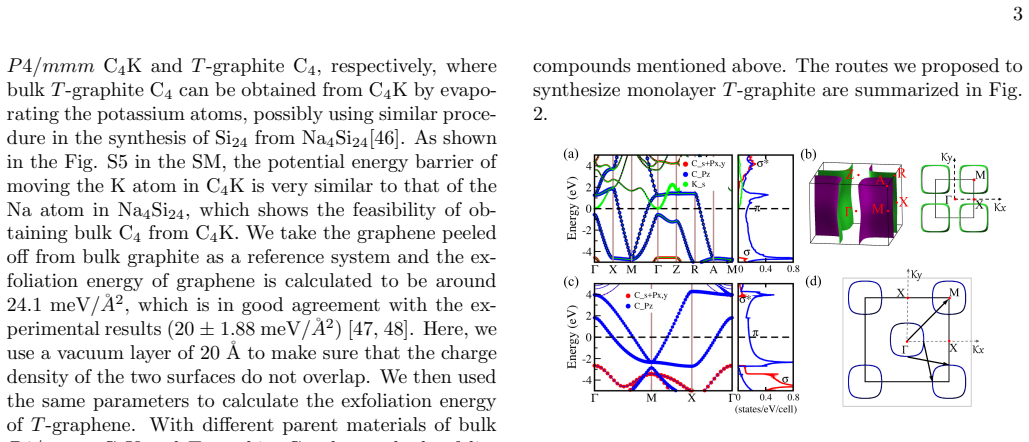
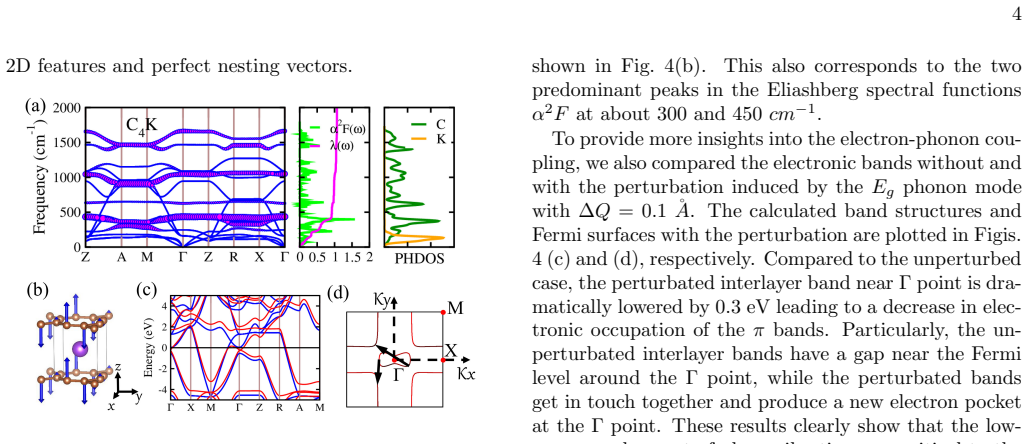
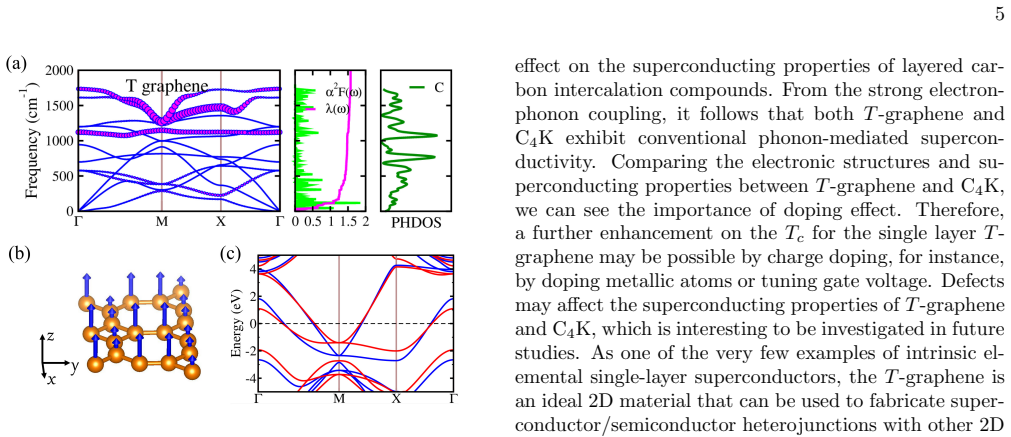
The load-bearing mechanism is the electron-phonon coupling of the low-frequency out-of-plane carbon vibrations, computed with density-functional perturbation theory and converted to a $T_c$ estimate through the Allen-Dynes modified McMillan equation with a screened Coulomb parameter $\mu^*=0.1$. In T-graphene, almost 78% of the total coupling constant $\lambda$ comes from the three low-frequency acoustic modes with $\omega \le 175$ cm$^{-1}$, and the softest of these has the largest phonon linewidth and the highest peak in the Eliashberg spectral function. In C$_4$K, the analogous out-of-plane $E_g$ mode is the key pairing channel, and the cylinder-like, nested Fermi surfaces of both systems give the 2D electronic character that sustains the coupling.
What would settle it
Recompute the electron-phonon coupling for T-graphene and C$_4$K with $\mu^*$ swept over the range 0.1 to 0.15, or solve the full Migdal-Eliashberg equations, and check whether $T_c$ stays in the 20-30 K range; alternatively, synthesize C$_4$K above 11.5 GPa, quench it, and look for a superconducting transition near 30 K, then exfoliate and look for the monolayer transition near 20 K.
Extended reading notes
Core claim
On the paper's own terms, the central discovery is that T-graphene, the planar carbon sheet with 4- and 8-membered rings, is a phonon-mediated superconductor in its undoped elemental form, with electron-phonon coupling constant $\lambda\approx 1.23$ and an Allen-Dynes $T_c$ of about 20.8 K. In C$_4$K, potassium intercalation pushes the Fermi level up, increases occupation of the $\pi$ bands, and raises the calculated $T_c$ to about 30.4 K. The pairing is carried by low-frequency out-of-plane carbon vibrations: in T-graphene the softest acoustic mode (the $A_1$ mode at about 160 cm$^{-1}$) dominates the electron-phonon spectral function, while in C$_4$K the out-of-plane $E_g$ mode and potassium-related vibrations produce the main coupling peaks near 300 and 450 cm$^{-1}$.
Load-bearing premise
The headline $T_c$ values rest on setting the screened Coulomb parameter $\mu^*=0.1$ in the Allen-Dynes equation, and the paper gives no sensitivity analysis; if the true $\mu^*$ for these 2D carbon systems is higher, the estimated $T_c$ would fall, possibly below the claimed regime.
Editorial extensions
If this is right
- A freestanding T-graphene monolayer would join borophene as one of very few intrinsic elemental single-layer superconductors, without charge doping, strain, or a twist between layers.
- The layered compound C$_4$K would set a new ambient-pressure record for carbon-based layered superconductors, with $T_c$ more than an order of magnitude above that of C$_8$K.
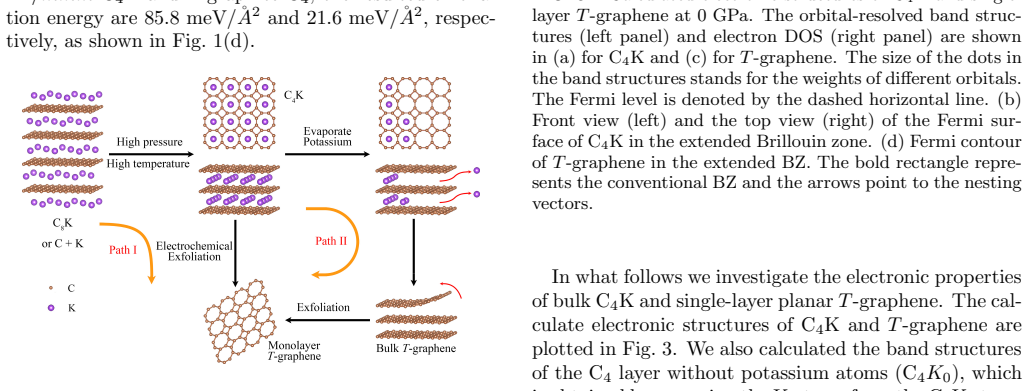
- The proposed route makes T-graphene a practical building block: high-pressure synthesis of C$_4$K, quenching, potassium evaporation to C$_4$, then exfoliation, with exfoliation energies below the thresholds used for known 2D materials.
- Because higher $\pi$-band occupation correlates with higher $T_c$, charge doping of T-graphene by metallic atoms or gate voltage is expected to raise its transition temperature beyond 20.8 K.
Reading between the lines
- A direct testable extension would be a systematic sweep of electron filling per carbon atom, which the paper's mechanism suggests should tune $T_c$ smoothly; identifying the filling that maximizes $\lambda$ would give a simpler synthesis target than the full C$_4$K route.
- Substrate effects could cut either way: a substrate that softens the out-of-plane acoustic mode would raise $T_c$, while one that stiffens it would suppress superconductivity, so the measured value on a given support may differ substantially from the freestanding prediction.
- The specific 20.8 K and 30.4 K numbers are less secure than the qualitative claim that this carbon lattice superconducts, since $\mu^*$ is fixed at 0.1 without a sensitivity check; the discovery would still stand if a fuller Eliashberg treatment changed the numbers by a few kelvin.
Signed reviews
Editorial analysis
A structured set of objections, weighed in public.
Referee Report
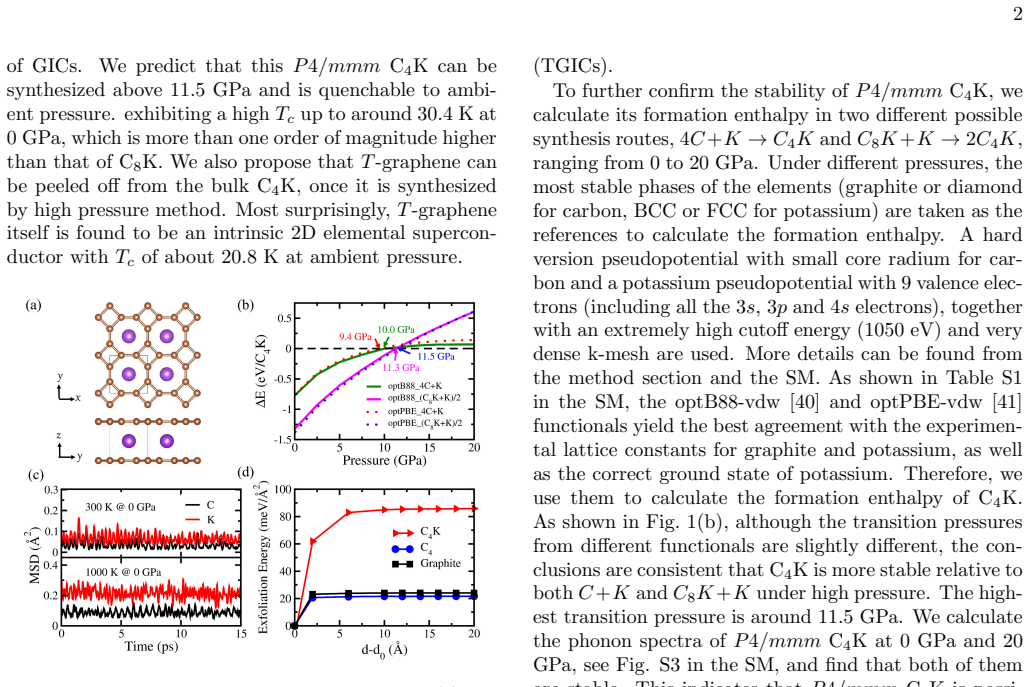
Summary. This manuscript predicts, using a machine-learning-accelerated crystal-structure search and first-principles density-functional calculations, that a planar single-layer carbon sheet with four- and eight-membered rings (T-graphene) is an intrinsic elemental superconductor with a critical temperature of about 20.8 K at 0 GPa. It further predicts a potassium-intercalated compound C4K (P4/mmm) that becomes thermodynamically stable above roughly 11.5 GPa, is quenchable to ambient pressure, and has a calculated Tc of about 30.4 K, which would be the highest among known layered carbon-based superconductors if confirmed. The authors propose two synthesis routes to single-layer T-graphene: electrochemical exfoliation from C4K, or evaporation of potassium from C4K to form bulk T-graphite C4 followed by mechanical exfoliation. The stability claims are supported by formation-enthalpy calculations with two vdW functionals benchmarked against graphite and potassium, phonon spectra at 0 and 20 GPa, AIMD simulations up to 1000 K, and exfoliation-energy calculations benchmarked against graphene. Superconducting parameters are obtained from DFPT electron-phonon coupling and the Allen-Dynes modified McMillan equation with a fixed screened Coulomb parameter μ* = 0.1.
Significance. If the predictions hold, this would be the first intrinsic single-layer elemental carbon superconductor and would add a concrete high-pressure synthesis route to a 2D superconductor, making the paper of substantial interest to the 2D-materials and superconductivity communities. The workflow has genuine strengths: the formation enthalpies are computed with two independent vdW functionals that are calibrated against measured lattice constants and phase stability of graphite and potassium; the exfoliation energy of graphene (24.1 meV/Ų) reproduces the experimental value; the C4K compound is checked by phonons at two pressures and by AIMD at 300 and 1000 K; and the Tc values are derived from first-principles λ and ω_log rather than fitted to target data, with μ* = 0.1 as the only semi-empirical input. The principal weaknesses are the absence of convergence tests for the electron-phonon quantities and the lack of sensitivity analysis for μ*, both of which bear directly on the headline Tc values.
major comments (3)
- [Methods (EPC paragraph), Fig. 5(a)] The electron-phonon calculation for single-layer T-graphene uses an 8×8×1 q-point mesh for the dynamical matrix and a 32×32×2 k-mesh for the linewidth integration, and no convergence test of λ, ω_log, or Tc versus q-mesh is reported. The paper states that 78.3% of λ ≈ 1.23 comes from three acoustic modes below 175 cm⁻¹, and since λ = 2∫α²F(ω)/ω dω and the Allen-Dynes formula weight the low-frequency region heavily, the result is particularly sensitive to the q-point sampling near the zone center. In a free-standing 2D sheet the out-of-plane ZA branch has quadratic dispersion, so its α²F contribution is concentrated at small q and can be severely undersampled by an 8×8×1 mesh. This is the most load-bearing uncertainty for the headline claim Tc ≈ 20.8 K; the authors should report λ, ω_log, and Tc for at least two finer q-meshes (for example 16×16×1 and 24×24×1, with correspondingly denser k-meshes) and demonstrate that the acoustic contribution is converged. The same request applies, with less urgency, to C4K, for which only an 8×8×8 q-mesh is used.
- [Page 4, Allen-Dynes modified McMillan equation paragraph] The Tc values of both T-graphene (around 20.8 K) and C4K (around 30.4 K) are quoted for a single value of the screened Coulomb parameter μ* = 0.1, with no sensitivity analysis. For λ ≈ 1.23 the Allen-Dynes formula has a strong nonlinear dependence on μ*, and modest changes in μ* translate into shifts of several kelvin; the abstract's phrasing 'Tc up to around 20.8 K' implies an upper bound that the present data do not establish. The authors should report Tc for a small set of μ* values (for example 0.10, 0.12, and 0.15) for both systems and discuss the resulting uncertainty, or justify a narrower range from the materials in question.
- [Page 3, exfoliation paragraph] The proposed electrochemical exfoliation route from C4K rests on an extrapolation from graphite intercalation compounds, but the computed exfoliation energy of T-graphene from C4K is 85.8 meV/Ų, which is above the 30–35 meV/Ų 'easily exfoliable' range cited by the authors themselves and 3.5 times the computed graphene value of 24.1 meV/Ų. While 85.8 meV/Ų is below the generic 130 meV/Ų threshold for 'potentially exfoliable', the statement that T-graphene 'can very likely be exfoliated from bulk C4K' is stronger than this number supports. The authors should discuss what the higher exfoliation energy implies for the electrochemical route and temper the claim accordingly, or provide additional evidence (for example, the effect of intercalation on the interlayer binding).
minor comments (8)
- [Abstract and conclusions] The claim that C4K 'sets a new record for layered carbon-based superconductors' refers to a calculated value; it should be rephrased as 'the highest predicted Tc among layered carbon-based superconductors' to avoid confusion with experimental records.
- [Pages 2 and 7] The phrases 'haven been widely used' and 'monolayerT -graphite' are typos for 'have been widely used' and 'monolayer T-graphene'.
- [Page 3] The phrase 'The calculate electronic structures' should read 'The calculated electronic structures'.
- [Page 4] The phrase 'Figis. 4 (c) and (d)' should read 'Figs. 4(c) and (d)'.
- [Page 4] The word 'perturbated' appears three times and should be 'perturbed'.
- [Methods] The name 'NoseHoover' should be 'Nosé–Hoover', and 'core radium' should be 'core radius'.
- [Table I caption] The method used to compute the charge transfer (presumably Bader analysis) is not stated and should be specified in the caption.
- [Throughout] The manuscript references many Supplemental Material items (Fig. S1–S10 and Table S1) that were not available in the reviewed version; the authors should ensure the SM is complete and explicitly include the EPC convergence tests requested above in the main text or SM.
Circularity Check
No significant circularity: the Tc predictions follow from first-principles DFPT electron-phonon coupling and the standard Allen-Dynes formula, with only the conventional μ*=0.1 parameter as an external input.
full rationale
The central predictions (Tc≈20.8 K for single-layer T-graphene and ≈30.4 K for C4K) are obtained from ab initio DFPT calculations of the electron-phonon coupling (λ) and logarithmic average frequency (ω_log), inserted into the Allen-Dynes modified McMillan equation with a fixed, commonly used screened Coulomb parameter μ*=0.1. λ and ω_log are first-principles outputs, not parameters fitted to the target Tc, and no experimental superconducting temperature of T-graphene or C4K is used as input. The only self-citation is the machine-learning-accelerated structure-search method [42], which is used to propose C4K as a candidate; however, the existence and stability of that candidate are independently tested through formation enthalpies, phonon spectra, AIMD simulations, and exfoliation energies, including a benchmark against graphite's measured exfoliation energy (calculated 24.1 vs experimental 20±1.88 meV/Ų). The superconductivity claim does not reduce to the structure-search method, no equation defines an output in terms of the target quantity, no fitted parameter is renamed as a prediction, and no author-imported uniqueness theorem is invoked. The concerns about q-mesh convergence and μ*-sensitivity are accuracy/robustness issues rather than circularity.
Assumptions & free parameters
free parameters (1)
- screened Coulomb pseudopotential mu-star =
0.1
assumptions (4)
- domain assumption DFT with the PBE exchange-correlation functional and vdW corrections provides accurate electronic structure, phonons, and electron-phonon coupling for these carbon systems.
- domain assumption The Allen-Dynes modified McMillan equation with mu-star = 0.1 gives reliable Tc estimates for phonon-mediated superconductors.
- domain assumption A 20 angstrom vacuum layer is sufficient to decouple periodic images in the 2D T-graphene calculations.
- domain assumption The crystal structure search at 20 GPa with system sizes up to 18 atoms per cell finds all relevant competing phases in the C-K system.
Cite this review
Pith. "Pith review of Superconducting single-layer T-graphene and novel synthesis routes." pith.science (2026). https://pith.science/paper/MJEGAQQE
@misc{pith2026190801302,
  author       = {Pith},
  title        = {Pith review of: Superconducting single-layer T-graphene and novel synthesis routes},
  year         = {2026},
  howpublished = {\url{https://pith.science/paper/MJEGAQQE}},
  note         = {Machine review of arXiv:1908.01302}
}
read the original abstract
Single-layer superconductors are ideal materials for fabricating superconducting nano devices. However, up to date, very few single-layer elemental superconductors have been predicted and especially no one has been successfully synthesized yet. Here, using crystal structure search techniques and ab initio calculations, we predict that a single-layer planar carbon sheet with 4- and 8-membered rings called T-graphene is a new intrinsic elemental superconductor with superconducting critical temperature (Tc) up to around 20.8 K. More importantly, we propose a synthesis route to obtain such a single-layer T-graphene, that is, a T-graphene potassium intercalation compound (C4K with P4/mmm symmetry) is firstly synthesized at high pressure (>11.5GPa) and then quenched to ambient condition; and finally, the single-layer T-graphene can be either exfoliated using the electrochemical method from the bulk C4K, or peeled off from bulk T-graphite C4, where C4 can be obtained from C4K by evaporating the K atoms. Interestingly, we find that the calculated Tc of C4K is about 30.4K at 0GPa, which sets a new record for layered carbon-based superconductors. The present findings add a new class of carbon based superconductors. In particular, once the single-layer T-graphene is synthesized, it can pave the way for fabricating superconducting devices together with other 2D materials using the layer-by-layer growth techniques.
Figures
Figures from the paper (2 more)
Reference graph
Works this paper leans on
- [1]
-
[2]
W. Qing-Yan, L. Zhi, Z. Wen-Hao, Z. Zuo-Cheng, Z. Jin- Song, L. Wei, D. Hao, O. Yun-Bo, D. Peng, C. Kai, et al., Chin. Phys. Lett. 29, 037402 (2012)
work page 2012
-
[3]
J. M. Lu, O. Zheliuk, I. Leermakers, N. F. Q. Yuan, U. Zeitler, K. T. Law, and J. T. Ye, Science 350, 1353 (2015)
2015
-
[4]
X. Xi, Z. Wang, W. Zhao, J.-H. Park, K. T. Law, H. Berger, L. Forr, J. Shan, and K. F. Mak, Nat. Phys. 12, 139 (2015)
work page 2015
-
[5]
C. Si, Z. Liu, W. Duan, and F. Liu, Phys. Rev. Lett. 111, 196802 (2013)
work page 2013
-
[6]
B. M. Ludbrook, G. Levy, P. Nigge, M. Zonno, M. Schnei- der, D. J. Dvorak, C. N. Veenstra, S. Zhdanovich, D. Wong, P. Dosanjh, et al., Proc. Natl. Acad. Sci. USA 112, 11795 (2015)
work page 2015
-
[7]
Y. Cao, V. Fatemi, S. Fang, K. Watanabe, T. Taniguchi, E. Kaxiras, and P. Jarillo-Herrero, Nature 556, 43 (2018)
2018
-
[8]
E. S. Penev, A. Kutana, and B. I. Yakobson, Nano Lett. 16, 2522 (2016)
work page 2016
Show all 68 references
-
[9]
Y. Zhao, S. Zeng, and J. Ni, Phys. Rev. B 93, 014502 (2016)
2016
-
[10]
H. W. Kroto, J. R. Heath, S. C. O’Brien, R. F. Curl, and R. E. Smalley, Nature 318, 162 (1985)
1985
-
[11]
Iijima, Nature 354, 56 (1991)
S. Iijima, Nature 354, 56 (1991)
1991
-
[12]
K. S. Novoselov, A. K. Geim, S. V. Morozov, D. Jiang, M. I. Katsnelson, I. V. Grigorieva, S. V. Dubonos, and A. A. Firsov, Nature 438, 197 (2005)
2005
-
[13]
Q. Li, Y. Ma, A. R. Oganov, H. Wang, H. Wang, Y. Xu, T. Cui, H.-K. Mao, and G. Zou, Phys. Rev. Lett. 102, 175506 (2009)
2009
-
[14]
Zhou, G.-R
X.-F. Zhou, G.-R. Qian, X. Dong, L. Zhang, Y. Tian, and H.-T. Wang, Phys. Rev. B 82, 134126 (2010)
2010
-
[15]
Y. Li, L. Xu, H. Liu, and Y. Li, Chem. Soc. Rev. 43, 2572 (2014)
2014
-
[16]
Huang, D
Q. Huang, D. Yu, B. Xu, W. Hu, Y. Ma, Y. Wang, Z. Zhao, B. Wen, J. He, Z. Liu, et al., Nature 510, 250 (2014)
2014
-
[17]
Zhang, J
S. Zhang, J. Zhou, Q. Wang, X. Chen, Y. Kawazoe, and P. Jena, Proc. Natl. Acad. Sci. USA 112, 2372 (2015)
2015
-
[18]
X. Yang, M. Yao, X. Wu, S. Liu, S. Chen, K. Yang, R. Liu, T. Cui, B. Sundqvist, and B. Liu, Phys. Rev. Lett. 118, 245701 (2017)
2017
-
[19]
Terrones, M
H. Terrones, M. Terrones, E. Hern´ andez, N. Grobert, J.- C. Charlier, and P. M. Ajayan, Phys. Rev. Lett. 84, 1716 (2000)
2000
-
[20]
Y. Liu, G. Wang, Q. Huang, L. Guo, and X. Chen, Phys. Rev. Lett. 108, 225505 (2012)
2012
-
[21]
Majidi, Theor
R. Majidi, Theor. Chem. Acc. 136, 109 (2017)
2017
-
[22]
Sheng, H.-J
X.-L. Sheng, H.-J. Cui, F. Ye, Q.-B. Yan, Q.-R. Zheng, and G. Su, J. Appl. Phys. 112, 074315 (2012)
2012
-
[23]
Since C8K is one of the easiest to fabricate in alkali carbon compounds[23], intense efforts have been taken to the study on its superconducting properties [29, 30]
studied, with Tc being usually less than 1 K. Since C8K is one of the easiest to fabricate in alkali carbon compounds[23], intense efforts have been taken to the study on its superconducting properties [29, 30]. With pressure, the Tc of C 8K increases to 1.7 K at 1.5 GPa [31]. ...
-
[24]
A. Y. Ganin, Y. Takabayashi, P. Jeglic, D. Arcon, A. Po- tocnik, P. J. Baker, Y. Ohishi, M. T. McDonald, M. D. Tzirakis, A. McLennan, et al., Nature 466, 221 (2010)
2010
-
[25]
N. B. Hannay, T. H. Geballe, B. T. Matthias, K. Andres, P. Schmidt, and D. MacNair, Phys. Rev. Lett. 14, 225 (1965)
1965
-
[26]
E. A. Ekimov, V. A. Sidorov, E. D. Bauer, N. N. Mel’nik, N. J. Curro, J. D. Thompson, and S. M. Stishov, Nature 428, 542 (2004)
2004
-
[27]
Z. K. Tang, L. Zhang, N. Wang, X. X. Zhang, G. H. Wen, G. D. Li, J. N. Wang, C. T. Chan, and P. Sheng, Science 292, 2462 (2001)
2001
-
[28]
Nagamatsu, N
J. Nagamatsu, N. Nakagawa, T. Muranaka, Y. Zenitani, and J. Akimitsu, Nature 410, 63 (2001)
2001
-
[29]
K. Xia, M. Ma, C. Liu, H. Gao, Q. Chen, J. He, J. Sun, H.-T. Wang, Y. Tian, and D. Xing, Mater. Today Phys. 3, 76 (2017)
2017
-
[30]
Z. H. Pan, J. Camacho, M. H. Upton, A. V. Fedorov, C. A. Howard, M. Ellerby, and T. Valla, Phys. Rev. Lett. 106, 187002 (2011)
2011
-
[31]
Gr¨ uneis, C
A. Gr¨ uneis, C. Attaccalite, A. Rubio, D. V. Vyalikh, S. L. Molodtsov, J. Fink, R. Follath, W. Eberhardt, B. B¨ uchner, and T. Pichler, Phys. Rev. B 79, 205106 (2009)
2009
-
[32]
T. E. Weller, M. Ellerby, S. S. Saxena, R. P. Smith, and N. T. Skipper, Nat. Phys. 1, 39 (2005)
2005
-
[33]
vertical
have the highest Tc at ambient pressure. And C 6Ca exhibitsTc = 15.1 K at high pressure of 7.5 GPa [34]. In addition to the bulk GICs, superconductivity in doped graphene with lithium[35], potassium [36] and Calcium [37], etc has been studied theoretically and experimen- tally...
1908 arXiv
-
[34]
R. P. Smith, A. Kusmartseva, Y. T. C. Ko, S. S. Saxena, A. Akrap, L. Forr´ o, M. Laad, T. E. Weller, M. Ellerby, and N. T. Skipper, Phys. Rev. B 74, 024505 (2006)
2006
-
[35]
Emery, C
N. Emery, C. H´ erold, M. d’Astuto, V. Garcia, C. Bellin, J. F. Marˆ ech´ e, P. Lagrange, and G. Loupias, Phys. Rev. Lett. 95, 087003 (2005)
2005
-
[36]
Gauzzi, S
A. Gauzzi, S. Takashima, N. Takeshita, C. Terakura, H. Takagi, N. Emery, C. H´ erold, P. Lagrange, and G. Loupias, Phys. Rev. Lett. 98, 067002 (2007)
2007
-
[37]
Profeta, M
G. Profeta, M. Calandra, and F. Mauri, Nat. Phys. 8, 131 (2012). 7
2012
-
[38]
M. Xue, G. Chen, H. Yang, Y. Zhu, D. Wang, J. He, and T. Cao, J. Am. Chem. Soc. 134, 6536 (2012)
2012
-
[39]
Chapman, Y
J. Chapman, Y. Su, C. A. Howard, D. Kundys, A. N. Grigorenko, F. Guinea, A. K. Geim, I. V. Grigorieva, and R. R. Nair, Sci. Rep. 6, 23254 (2016)
2016
-
[40]
Zhang, A
W. Zhang, A. R. Oganov, A. F. Goncharov, Q. Zhu, S. E. Boulfelfel, A. O. Lyakhov, E. Stavrou, M. Somayazulu, V. B. Prakapenka, and Z. Konˆ opkov´ a, Science342, 1502 (2013)
2013
-
[41]
Zhang, Y
L. Zhang, Y. Wang, J. Lv, and Y. Ma, Nat. Rev. Mater. 2, 17005 (2017)
2017
-
[42]
Klimeˇ s, D
J. Klimeˇ s, D. R. Bowler, and A. Michaelides, J. Phys.: Cond. Matt. 22, 022201 (2009)
2009
-
[43]
Klimeˇ s, D
J. Klimeˇ s, D. R. Bowler, and A. Michaelides, Phys. Rev. B 83, 195131 (2011)
2011
-
[44]
K. Xia, H. Gao, C. Liu, J. Yuan, J. Sun, H.-T. Wang, and D. Xing, Sci. Bull. 63, 817 (2018)
2018
-
[45]
Salamat, R
A. Salamat, R. A. Fischer, R. Briggs, M. I. McMahon, and S. Petitgirard, Coord. Chem. Rev. 277, 15 (2014)
2014
-
[46]
K. S. Novoselov, A. K. Geim, S. V. Morozov, D. Jiang, Y. Zhang, S. V. Dubonos, I. V. Grigorieva, and A. A. Firsov, Science 306, 666 (2004)
2004
-
[47]
H. Liu, A. T. Neal, Z. Zhu, Z. Luo, X. Xu, D. Tomnek, and P. D. Ye, ACS Nano 8, 4033 (2014)
2014
-
[48]
D. Y. Kim, S. Stefanoski, O. O. Kurakevych, and T. A. Strobel, Nat. Mater. 14, 169 (2015)
2015
-
[49]
Zacharia, H
R. Zacharia, H. Ulbricht, and T. Hertel, Phys. Rev. B 69, 155406 (2004)
2004
-
[50]
Ziambaras, J
E. Ziambaras, J. Kleis, E. Schr¨ oder, and P. Hyldgaard, Phys. Rev. B 76, 155425 (2007)
2007
-
[51]
Mounet, M
N. Mounet, M. Gibertini, P. Schwaller, D. Campi, A. Merkys, A. Marrazzo, T. Sohier, I. E. Castelli, A. Ce- pellotti, G. Pizzi, et al., Nat. Nanotechnol. 13, 246 (2018)
2018
-
[52]
J.-W. Lee, M. Kim, W. Na, S. M. Hong, and C. M. Koo, Carbon 91, 527 (2015), ISSN 0008-6223
2015
-
[53]
Bharath, E
G. Bharath, E. Alhseinat, N. Ponpandian, M. A. Khan, M. R. Siddiqui, F. Ahmed, and E. H. Alsharaeh, Separa- tion and Purification Technology 188, 206 (2017), ISSN 1383-5866
2017
-
[54]
Thomas, E
D.-G. Thomas, E. Kavak, N. Hashemi, R. Montazami, and N. Hashemi, C 4, 42 (2018)
2018
-
[55]
Damascelli, Z
A. Damascelli, Z. Hussain, and Z.-X. Shen, Rev. Mod. Phys. 75, 473 (2003)
2003
-
[56]
Kuroki, S
K. Kuroki, S. Onari, R. Arita, H. Usui, Y. Tanaka, H. Kontani, and H. Aoki, Phys. Rev. Lett. 101, 087004 (2008)
2008
-
[57]
P. B. Allen and R. C. Dynes, Phys. Rev. B12, 905 (1975)
1975
-
[58]
S. He, J. He, W. Zhang, L. Zhao, D. Liu, X. Liu, D. Mou, Y.-B. Ou, Q.-Y. Wang, Z. Li, et al., Nat. Mater. 12, 605 (2013)
2013
-
[59]
Kresse and J
G. Kresse and J. Furthmller, Comput. Mater. Sci. 6, 15 (1996)
1996
-
[60]
J. P. Perdew, K. Burke, and M. Ernzerhof, Phys. Rev. Lett. 77, 3865 (1996)
1996
-
[61]
H. J. Monkhorst and J. D. Pack, Phys. Rev. B 13, 5188 (1976)
1976
-
[62]
Grimme, J
S. Grimme, J. Comput. Chem. 27, 1787 (2006)
2006
-
[63]
Grimme, J
S. Grimme, J. Antony, S. Ehrlich, and H. Krieg, J. Chem. Phys. 132, 154104 (2010)
2010
-
[64]
M. Dion, H. Rydberg, E. Schr¨ oder, D. C. Langreth, and B. I. Lundqvist, Phys. Rev. Lett. 92, 246401 (2004)
2004
-
[65]
Rom´ an-P´ erez and J
G. Rom´ an-P´ erez and J. M. Soler, Phys. Rev. Lett.103, 096102 (2009)
2009
-
[66]
K. Lee, E. D. Murray, L. Kong, B. I. Lundqvist, and D. C. Langreth, Phys. Rev. B 82, 081101 (2010)
2010
-
[67]
W. G. Hoover, Phys. Rev. A 31, 1695 (1985)
1985
-
[68]
Giannozzi, S
P. Giannozzi, S. Baroni, N. Bonini, M. Calandra, R. Car, C. Cavazzoni, D. Ceresoli, G. L. Chiarotti, M. Cococ- cioni, I. Dabo, et al., J. Phys.: Condens. Matter 21, 395502 (2009)
2009
Reviewed August 14, 2026 · model on record in the stance chip above.
Discussion (0). Continue with ORCID to comment.