REVIEW 3 major objections 6 minor 1 cited by
Mahalanobis++: Improving OOD Detection via Feature Normalization
T0 review · 3 major / 6 minor · reviewed 2026-08-07 · deepseek-v4-flash
Pith's one-line read L2-normalizing pre-logit features before the Mahalanobis score makes OOD detection consistently stronger across 44 ImageNet models.
desk verdict Simple post-hoc fix that works on 41 of 44 models, but 'consistent' and 'all considered cases' are overstatements that need aligning with the paper's own tables. read the letter →
The pith
A machine-rendered reading of the paper's core claim, the machinery that carries it, and where it could break.
The reading
What carries the argument
The machinery is the pre-logit feature vector $\phi(x)$, the Mahalanobis distance $d_{\mathrm{Maha}}(x,\hat{\mu}_c)=(\phi(x)-\hat{\mu}_c)^T\hat{\Sigma}^{-1}(\phi(x)-\hat{\mu}_c)$ to the class mean $\hat{\mu}_c$, and the replacement of $\phi(x)$ by $\hat{\phi}(x)=\phi(x)/\|\phi(x)\|_2$ in every step: class-mean estimation, shared-covariance estimation, and scoring. This projects all features onto the unit sphere and discards scale information. The paper motivates the replacement with a concentration lemma showing that truly Gaussian high-dimensional features have concentrated norms, with QQ plots and a variance-alignment score showing that real features are heavy-tailed and class-dependent, and with a documented correlation between feature norm and the unnormalized Mahalanobis score that normalization breaks.
What would settle it
On a model whose feature norms still correlate with the Mahalanobis++ score after normalization, compute the rank correlation between original feature norm and the normalized OOD score over in- and out-of-distribution test sets; the paper's mechanism predicts near-zero correlation, so a large residual correlation would falsify the claim that normalization decouples the score from feature scale.
Extended reading notes
Core claim
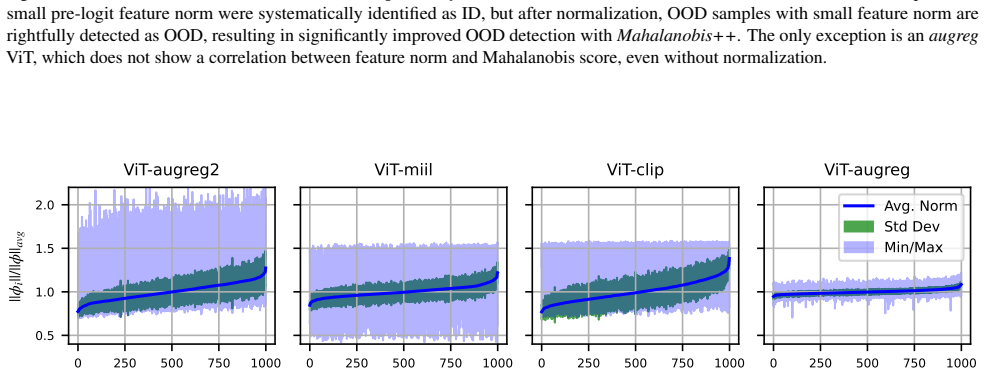
The paper's central claim is that L2-normalizing pre-logit features before computing the Mahalanobis distance makes a brittle OOD detector consistently strong, because the normalization makes the empirical feature distribution better satisfy the class-conditional Gaussian model with shared covariance that the Mahalanobis score implicitly assumes. Evidence is the 44-model ImageNet study and CIFAR experiments: Mahalanobis++ improves FPR over unnormalized Mahalanobis in 41 of 44 models, with average gains of 7.6 FPR points on the five-dataset OpenOOD suite and 10.9 points on the cleaned NINCO dataset. The only models that do not benefit are those whose feature norms are already tightly concentrated—notably two augreg-trained ViTs—which is consistent with the explanation rather than a refutation of it.
Load-bearing premise
Normalizing away each sample's feature length removes only harmless scale information while preserving the directional pattern that separates classes; if a model carries its OOD signal in the feature norm itself, this fix can backfire.
Editorial extensions
If this is right
- Mahalanobis++ outperforms the conventional Mahalanobis distance in 41 of 44 ImageNet models and beats the strongest previous post-hoc baseline, ViM, by about 7 average FPR points.
- Because it is post-hoc and hyperparameter-free, the method applies directly to any frozen pretrained classifier, including models whose pretraining data or procedure is not publicly available.
- Normalization repairs the known brittleness of Mahalanobis-based detectors on far-OOD noise distributions: for several representative models the number of failed unit tests drops from 10-14 to 0.
- The gain is largest on NINCO, where contamination with in-distribution images is removed, with an average improvement of 10.9 FPR points and a new best FPR of 18.4%.
- On CIFAR100 the recipe improves Mahalanobis in every tested model, but by smaller margins, consistent with weaker norm pathology at smaller scale.
Reading between the lines
- The pre-training feature-norm diagnostics could serve as an OOD-data-free early check: a model whose class norms are spread or correlated with the Mahalanobis score is a candidate for normalization, while a model like the augreg ViT is not.
- Any distance- or norm-based OOD score may inherit the same scale confound, so L2 normalization is likely to help other post-hoc detectors, not only the Mahalanobis family; the paper compares against but does not make this claim.
- Because well-behaved features in this paper come from a specific augmentation-and-regularization recipe whose mechanism is left unexplained, the results hint that training schemes could deliberately induce norm-regulated features and make post-hoc OOD detection uniformly reliable.
Editorial analysis
A structured set of objections, weighed in public.
Referee Report
Summary. The paper proposes Mahalanobis++, a post-hoc OOD detection method that applies l2-normalization to pre-logit features before estimating and using the Mahalanobis distance. The authors argue that feature norm variations violate the Gaussian shared-covariance assumption of the Mahalanobis score, and that projecting features onto the unit sphere reduces this violation and decouples the score from feature norm. They evaluate the method on 44 ImageNet checkpoints and several CIFAR models, reporting an average FPR improvement of 7.6 points over standard Mahalanobis on OpenOOD datasets, 10.9 points on the cleaned NINCO subset, and state-of-the-art average performance relative to a broad set of baselines. The paper also claims that normalization remedies the brittleness of Mahalanobis-based detectors on noise unit tests.
Significance. If the empirical claims are properly qualified, this is a practically valuable contribution: the method is simple, adds no fitted parameters, and is applicable to any pretrained model. The evidence base is unusually strong for a post-hoc OOD paper—44 diverse checkpoints, five OOD datasets, multiple architectures, and three complementary diagnostic analyses (norm distributions, QQ plots, variance-alignment scores). The hypothesis was formed on one model and validated on held-out checkpoints, and code is provided, which increases confidence and reproducibility. The main weakness is that the abstract and several central statements overgeneralize: the paper's own results show three models where normalization degrades FPR, and the full unit-test table shows many models still fail a substantial number of noise tests. These overclaims, if corrected, do not undermine the core averaged improvement but they do require a revised, conditional formulation of the method's benefits.
major comments (3)
- [Abstract, §4, Table 4] The claim that l2-normalization 'improves the conventional Mahalanobis distance-based approaches significantly and consistently' is contradicted by the paper's own Table 4: three models (ViT-B16-In21k-augreg, ViT-L16-In21k-augreg, ResNet50) show worse FPR after normalization (25.7→28.3, 21.0→23.9, 49.5→52.0). Appendix D attributes these exceptions to already well-behaved feature norms, which implies the benefit is conditional on the degree of norm variance. The abstract, Section 4, and conclusion should state this boundary explicitly rather than claiming consistency.
- [§5, Table 5, Appendix Table 17] The main text states that normalization 'remedies the brittleness' of Mahalanobis-based detectors and Table 5 highlights three models with perfect 0/17 unit-test outcomes, but the full results in Table 17 show that many models still fail a substantial number of unit tests after normalization (e.g., ConvNeXt-B: 15, DeiT3-B16: 15, DeiT3-L16: 8, DeiT3-S16-In21k: 11, Mixer-B16-In21k: 10), and for ResNet101 and ResNet50 the failure count increases from 0 to 1. The robustness claim should be rephrased as 'reduces the number of failures for most models' and the full distribution of failure counts should be summarized in the main text.
- [§3.3, Figure 10, §4] The paper treats feature norm as a pure confounder, but Figure 10 shows that for several models (e.g., ViT-B16-orig, ViT-B16-miil, ViT-B16-clip) natural OOD samples from NINCO have larger feature norms than ID samples, meaning the norm carries class-discriminative signal that l2-normalization discards. The diagnostic evidence for the confounder claim is built primarily on SwinV2 and models with small OOD norms; it does not establish that discarding the norm is always safe. The paper should explicitly state that normalization is beneficial when the norm-OOD-score correlation is confounded (as in Figure 5) and should report conditions under which it helps, e.g., using the variance-alignment metric of Table 7 or the norm overlap of Figure 10 as a predictor.
minor comments (6)
- [Abstract] There is a typo: 'safety-critial' should be 'safety-critical'.
- [§3.1] The reference 'Lee et al. (2018a)' for the Gaussian assumption should likely be 'Lee et al. (2018b)', since the cited 2018a paper is about confidence calibration rather than the Mahalanobis framework.
- [§4] The subsection 'Improved normality' claims that normalization makes features 'more aligned with a normal distribution,' but after l2-normalization the features lie on the unit sphere, which cannot be multivariate Gaussian. The QQ-plot evidence on centered, standardized coordinates is an indirect diagnostic; the text should not literally assert that normalized features are better modeled as a shared-covariance Gaussian.
- [Table 5] The criteria for selecting the three reported models (ConvNeXtV2, SwinV2, ViT-CLIP) should be stated; without this, the selection appears arbitrary and potentially cherry-picked relative to the full results in Table 17.
- [§5, ImageNet] The sentence 'In 30/44 cases, the best performing method is Mahalanobis++ (in 6/44 cases it is relative Mahalanobis++)' should clarify what happens in the remaining 8 cases, e.g., whether they are ties or another method.
- [Figure 6] The vertical line labeled 'True sample norm' is unclear; the caption should describe that this marks the unmodified feature norm of the OOD samples.
Circularity Check
No significant circularity: the normalization transform is fixed and parameter-free, and the claimed improvements are measured against external OOD benchmarks.
full rationale
The central claim is an empirical comparison, not a derivation from its own inputs. The method (Eq. 6) is a fixed, hyperparameter-free L2-normalization applied to pre-logit features before computing class means and a shared covariance matrix (Eqs. 1-2). No parameter is fitted to OOD detection outcomes, and the threshold is set by fixing TPR=95% on in-distribution data, so the reported FPR values are not forced by construction. Lemma 3.1 and Eq. 5 are derived from first principles in the appendix and serve only as motivation; they do not encode the FPR improvements. The 44 checkpoints are publicly available pretrained models, and the evaluation uses the external OpenOOD and NINCO benchmarks. The paper self-cites Bitterwolf et al. (2023) for the NINCO benchmark and unit tests, and Mueller & Hein (2024) for related training-hyperparameter analysis, but these citations are data/benchmark sources and pointers to prior work, not load-bearing premises that reduce the central result to a self-citation. The abstract's wording 'consistently' is somewhat overstated given that three models degrade (Table 4), but this is a correctness/scope caveat rather than circularity. Overall, the claimed improvement over unnormalized Mahalanobis distance is a measured, externally grounded result.
Assumptions & free parameters
assumptions (4)
- domain assumption Pre-logit features follow a class-conditional Gaussian distribution with a shared covariance matrix (Lee et al., 2018).
- ad hoc to paper L2-normalization preserves the directional information needed for OOD discrimination and discards only the confounding norm.
- domain assumption Sample covariance estimated on the training set is a reliable proxy for the true shared covariance in high dimension.
- standard math Chebyshev's inequality and standard high-dimensional concentration and spherical moment computations.
Cite this review
Pith. "Pith review of Mahalanobis++: Improving OOD Detection via Feature Normalization." pith.science (2026). https://pith.science/paper/MJL3D2NZ
@misc{pith2026250518032,
  author       = {Pith},
  title        = {Pith review of: Mahalanobis++: Improving OOD Detection via Feature Normalization},
  year         = {2026},
  howpublished = {\url{https://pith.science/paper/MJL3D2NZ}},
  note         = {Machine review of arXiv:2505.18032}
}
abstract
Detecting out-of-distribution (OOD) examples is an important task for deploying reliable machine learning models in safety-critial applications. While post-hoc methods based on the Mahalanobis distance applied to pre-logit features are among the most effective for ImageNet-scale OOD detection, their performance varies significantly across models. We connect this inconsistency to strong variations in feature norms, indicating severe violations of the Gaussian assumption underlying the Mahalanobis distance estimation. We show that simple $\ell_2$-normalization of the features mitigates this problem effectively, aligning better with the premise of normally distributed data with shared covariance matrix. Extensive experiments on 44 models across diverse architectures and pretraining schemes show that $\ell_2$-normalization improves the conventional Mahalanobis distance-based approaches significantly and consistently, and outperforms other recently proposed OOD detection methods.
Figures


Figures from the paper (9 more)




Forward citations
Cited by 1 Pith paper
-
Fine-Grained Open-Set Fault Diagnosis via Metric-Guided Time-Frequency Configuration Selection and Class-Specific Autoencoders
A pipeline that screens STFT settings by Silhouette score, trains one autoencoder per severity class, and rejects via latent-box plus reconstruction-error checks reports H-scores of 0.9924 (CWRU) and 0.9509 (PU) for f...
Reference graph
Works this paper leans on
-
[1]
write newline
" write newline "" before.all 'output.state := FUNCTION n.dashify 't := "" t empty not t #1 #1 substring "-" = t #1 #2 substring "--" = not "--" * t #2 global.max substring 't := t #1 #1 substring "-" = "-" * t #2 global.max substring 't := while if t #1 #1 substring * t #2 global.max substring 't := if while FUNCTION format.date year duplicate empty "emp...
-
[2]
B., Belkhir, N., Popescu, S., Manzanera, A., and Franchi, G
Ammar, M. B., Belkhir, N., Popescu, S., Manzanera, A., and Franchi, G. NECO : NE ural collapse based out-of-distribution detection. In The Twelfth International Conference on Learning Representations, 2024. URL https://openreview.net/forum?id=9ROuKblmi7
2024
-
[3]
Anthony, H. and Kamnitsas, K. On the use of mahalanobis distance for out-of-distribution detection with neural networks for medical imaging. In Uncertainty for Safe Utilization of Machine Learning in Medical Imaging, pp.\ 136--146. Springer Nature Switzerland, 2023. doi:10.1007/978-3-031-44336-7_14. URL https://doi.org/10.1007
-
[4]
In or out? fixing imagenet out-of-distribution detection evaluation
Bitterwolf, J., Mueller, M., and Hein, M. In or out? fixing imagenet out-of-distribution detection evaluation. In ICML, 2023. URL https://proceedings.mlr.press/v202/bitterwolf23a.html
work page 2023
-
[5]
Describing textures in the wild
Cimpoi, M., Maji, S., Kokkinos, I., Mohamed, S., and Vedaldi, A. Describing textures in the wild. In CVPR, 2014
2014
-
[6]
Extremely simple activation shaping for out-of-distribution detection
Djurisic, A., Bozanic, N., Ashok, A., and Liu, R. Extremely simple activation shaping for out-of-distribution detection. In The Eleventh International Conference on Learning Representations, 2023. URL https://openreview.net/forum?id=ndYXTEL6cZz
work page 2023
-
[7]
A framework for benchmarking class-out-of-distribution detection and its application to imagenet
Galil, I., Dabbah, M., and El-Yaniv, R. A framework for benchmarking class-out-of-distribution detection and its application to imagenet. In The Eleventh International Conference on Learning Representations, 2023. URL https://openreview.net/forum?id=Iuubb9W6Jtk
work page 2023
-
[8]
Gia, T. L. and Ahn, J. Understanding normalization in contrastive representation learning and out-of-distribution detection. ArXiv, abs/2312.15288, 2023. URL https://api.semanticscholar.org/CorpusID:266550859
work page Pith review arXiv 2023
Show all 56 references
-
[9]
Haas, J., Yolland, W., and Rabus, B. T. Linking neural collapse and l2 normalization with improved out-of-distribution detection in deep neural networks. Transactions on Machine Learning Research, 2023. ISSN 2835-8856. URL https://openreview.net/forum?id=fjkN5Ur2d6
2023
-
[10]
Haas, J., Yolland, W., and Rabus, B. T. Exploring simple, high quality out-of-distribution detection with l2 normalization. Transactions on Machine Learning Research, 2024. ISSN 2835-8856. URL https://openreview.net/forum?id=daX2UkLMS0
2024
-
[11]
Why ReLU networks yield high-confidence predictions far away from the training data and how to mitigate the problem
Hein, M., Andriushchenko, M., and Bitterwolf, J. Why ReLU networks yield high-confidence predictions far away from the training data and how to mitigate the problem. In CVPR, 2019
2019
-
[12]
and Gimpel, K
Hendrycks, D. and Gimpel, K. A baseline for detecting misclassified and out-of-distribution examples in neural networks. In ICLR, 2017. URL https://openreview.net/forum?id=Hkg4TI9xl
2017
-
[13]
Scaling out-of-distribution detection for real-world settings
Hendrycks, D., Basart, S., Mazeika, M., Zou, A., Kwon, J., Mostajabi, M., Steinhardt, J., and Song, D. Scaling out-of-distribution detection for real-world settings. In ICML, 2022
2022
-
[14]
Oodformer: Out-of-distribution detection transformer, 07 2021
Koner, R., Sinhamahapatra, P., Roscher, K., Günnemann, S., and Tresp, V. Oodformer: Out-of-distribution detection transformer, 07 2021
2021
-
[15]
Openimages: A public dataset for large-scale multi-label and multi-class image classification
Krasin, I., Duerig, T., Alldrin, N., Ferrari, V., Abu-El-Haija, S., Kuznetsova, A., Rom, H., Uijlings, J., Popov, S., Kamali, S., Malloci, M., Pont-Tuset, J., Veit, A., Belongie, S., Gomes, V., Gupta, A., Sun, C., Chechik, G., Cai, D., Feng, Z., Narayanan, D., and Murphy, K. O...
2017
-
[16]
Learning multiple layers of features from tiny images
Krizhevsky, A. Learning multiple layers of features from tiny images. Technical report, 2009
2009
-
[17]
and Yang, X
Le, Y. and Yang, X. S. Tiny imagenet visual recognition challenge. 2015. URL https://api.semanticscholar.org/CorpusID:16664790
2015
-
[18]
Gradient-based learning applied to document recognition
LeCun, Y., Bottou, L., Bengio, Y., and Haffner, P. Gradient-based learning applied to document recognition. Proceedings of the IEEE, 86 0 (11): 0 2278--2324, 1998. doi:10.1109/5.726791
1998 doi
-
[19]
Training confidence-calibrated classifiers for detecting out-of-distribution samples
Lee, K., Lee, H., Lee, K., and Shin, J. Training confidence-calibrated classifiers for detecting out-of-distribution samples. In ICLR, 2018 a
2018
-
[20]
A simple unified framework for detecting out-of-distribution samples and adversarial attacks
Lee, K., Lee, K., Lee, H., and Shin, J. A simple unified framework for detecting out-of-distribution samples and adversarial attacks. In NeurIPS, 2018 b
2018
-
[21]
and Qin, Y
Liu, L. and Qin, Y. Fast decision boundary based out-of-distribution detector. ICML, 2024
2024
-
[22]
Sphereface: Deep hypersphere embedding for face recognition, 2018
Liu, W., Wen, Y., Yu, Z., Li, M., Raj, B., and Song, L. Sphereface: Deep hypersphere embedding for face recognition, 2018. URL https://arxiv.org/abs/1704.08063
2018 arXiv
-
[23]
Energy-based out-of-distribution detection
Liu, W., Wang, X., Owens, J., and Li, Y. Energy-based out-of-distribution detection. Advances in Neural Information Processing Systems, 2020
2020
-
[24]
Gen: Pushing the limits of softmax-based out-of-distribution detection
Liu, X., Lochman, Y., and Christopher, Z. Gen: Pushing the limits of softmax-based out-of-distribution detection. In Proceedings of the IEEE/CVF Conference on Computer Vision and Pattern Recognition, 2023
2023
-
[25]
Swin transformer v2: Scaling up capacity and resolution
Liu, Z., Hu, H., Lin, Y., Yao, Z., Xie, Z., Wei, Y., Ning, J., Cao, Y., Zhang, Z., Dong, L., Wei, F., and Guo, B. Swin transformer v2: Scaling up capacity and resolution. In CVPR, 2022. URL https://arxiv.org/abs/2111.09883
2022 arXiv
-
[26]
Delving into out-of-distribution detection with vision-language representations
Ming, Y., Cai, Z., Gu, J., Sun, Y., Li, W., and Li, Y. Delving into out-of-distribution detection with vision-language representations. In NeurIPS, 2022. URL https://openreview.net/forum?id=KnCS9390Va
2022
-
[27]
How to exploit hyperspherical embeddings for out-of-distribution detection? In The Eleventh International Conference on Learning Representations, 2023
Ming, Y., Sun, Y., Dia, O., and Li, Y. How to exploit hyperspherical embeddings for out-of-distribution detection? In The Eleventh International Conference on Learning Representations, 2023. URL https://openreview.net/forum?id=aEFaE0W5pAd
2023
-
[28]
and Hein, M
Mueller, M. and Hein, M. How to train your vit for ood detection, 2024. URL https://arxiv.org/abs/2405.17447
2024 arXiv
-
[29]
H., and Gal, Y
Mukhoti, J., Kirsch, A., van Amersfoort, J., Torr, P. H., and Gal, Y. Deep deterministic uncertainty: A new simple baseline. In Proceedings of the IEEE/CVF Conference on Computer Vision and Pattern Recognition (CVPR), pp.\ 24384--24394, June 2023
2023
-
[30]
Netzer, Y., Wang, T., Coates, A., Bissacco, A., Wu, B., and Ng, A. Y. Reading digits in natural images with unsupervised feature learning. NIPS Workshop on Deep Learning and Unsupervised Feature Learning, 2011
2011
-
[31]
G., and Teoh, A
Park, J., Jung, Y. G., and Teoh, A. B. J. Nearest neighbor guidance for out-of-distribution detection. In Proceedings of the IEEE/CVF International Conference on Computer Vision, pp.\ 1686--1695, 2023 a
2023
-
[32]
C., Yoon, J., and Jin Teoh, A
Park, J., Long Chai, J. C., Yoon, J., and Jin Teoh, A. B. Understanding the Feature Norm for Out-of-Distribution Detection . In 2023 IEEE/CVF International Conference on Computer Vision (ICCV), 2023 b . URL https://doi.ieeecomputersociety.org/10.1109/ICCV51070.2023.00150
2023
-
[33]
W., Hallacy, C., Ramesh, A., Goh, G., Agarwal, S., Sastry, G., Askell, A., Mishkin, P., Clark, J., Krueger, G., and Sutskever, I
Radford, A., Kim, J. W., Hallacy, C., Ramesh, A., Goh, G., Agarwal, S., Sastry, G., Askell, A., Mishkin, P., Clark, J., Krueger, G., and Sutskever, I. Learning transferable visual models from natural language supervision. In ICML, 2021
2021
-
[34]
K., Stoyanov, D., and Bhattarai, B
Regmi, S., Panthi, B., Dotel, S., Gyawali, P. K., Stoyanov, D., and Bhattarai, B. T2fnorm: Train-time feature normalization for ood detection in image classification. In Proceedings of the IEEE/CVF Conference on Computer Vision and Pattern Recognition (CVPR) Workshops, pp.\ 15...
2024
-
[35]
G., Padhy, S., and Lakshminarayanan, B
Ren, J., Fort, S., Liu, J., Roy, A. G., Padhy, S., and Lakshminarayanan, B. A simple fix to mahalanobis distance for improving near-ood detection, 2021. URL https://arxiv.org/abs/2106.09022
2021 arXiv
-
[36]
Spreading vectors for similarity search
Sablayrolles, A., Douze, M., Schmid, C., and J \'e gou, H. Spreading vectors for similarity search. arXiv: Machine Learning, 2018. URL https://api.semanticscholar.org/CorpusID:62841605
2018
-
[37]
Ssd: A unified framework for self-supervised outlier detection
Sehwag, V., Chiang, M., and Mittal, P. Ssd: A unified framework for self-supervised outlier detection. In International Conference on Learning Representations, 2021. URL https://openreview.net/forum?id=v5gjXpmR8J
2021
-
[38]
P., Kolesnikov, A., Zhai, X., Wightman, R., Uszkoreit, J., and Beyer, L
Steiner, A. P., Kolesnikov, A., Zhai, X., Wightman, R., Uszkoreit, J., and Beyer, L. How to train your vit? data, augmentation, and regularization in vision transformers. TMLR, 2022. URL https://openreview.net/forum?id=4nPswr1KcP
2022
-
[39]
React: Out-of-distribution detection with rectified activations
Sun, Y., Guo, C., and Li, Y. React: Out-of-distribution detection with rectified activations. NeurIPS, 2021
2021
-
[40]
Out-of-distribution detection with deep nearest neighbors
Sun, Y., Ming, Y., Zhu, X., and Li, Y. Out-of-distribution detection with deep nearest neighbors. ICML, 2022
2022
-
[41]
Csi: Novelty detection via contrastive learning on distributionally shifted instances
Tack, J., Mo, S., Jeong, J., and Shin, J. Csi: Novelty detection via contrastive learning on distributionally shifted instances. In NeurIPS, 2020
2020
-
[42]
Hyperparameter-free out-of-distribution detection using cosine similarity
Techapanurak, E., Suganuma, M., and Okatani, T. Hyperparameter-free out-of-distribution detection using cosine similarity. In Proceedings of the Asian Conference on Computer Vision, 2020
2020
-
[43]
Deit iii: Revenge of the vit
Touvron, H., Cord, M., and Jegou, H. Deit iii: Revenge of the vit. ECCV, 2022
2022
-
[44]
The inaturalist species classification and detection dataset
Van Horn, G., Mac Aodha, O., Song, Y., Cui, Y., Sun, C., Shepard, A., Adam, H., Perona, P., and Belongie, S. The inaturalist species classification and detection dataset. In CVPR, 2018
2018
-
[45]
Open-set recognition: a good closed-set classifier is all you need? In International Conference on Learning Representations, 2022
Vaze, S., Han, K., Vedaldi, A., and Zisserman, A. Open-set recognition: a good closed-set classifier is all you need? In International Conference on Learning Representations, 2022
2022
-
[46]
Vim: Out-of-distribution with virtual-logit matching
Wang, H., Li, Z., Feng, L., and Zhang, W. Vim: Out-of-distribution with virtual-logit matching. In CVPR, 2022
2022
-
[47]
Mitigating neural network overconfidence with logit normalization
Wei, H., Xie, R., Cheng, H., Feng, L., An, B., and Li, Y. Mitigating neural network overconfidence with logit normalization. 2022
2022
-
[48]
Pytorch image models
Wightman, R. Pytorch image models. https://github.com/rwightman/pytorch-image-models, 2019
2019
-
[49]
Wilk, M. B. and Gnanadesikan, R. Probability plotting methods for the analysis for the analysis of data. Biometrika, 55 0 (1): 0 1--17, 03 1968. ISSN 0006-3444. doi:10.1093/biomet/55.1.1. URL https://doi.org/10.1093/biomet/55.1.1
1968 doi
-
[50]
S., and Xie, S
Woo, S., Debnath, S., Hu, R., Chen, X., Liu, Z., Kweon, I. S., and Xie, S. Convnext v2: Co-designing and scaling convnets with masked autoencoders. arXiv preprint arXiv:2301.00808, 2023
2023 arXiv
-
[51]
Openood: Benchmarking generalized out-of-distribution detection
Yang, J., Wang, P., Zou, D., Zhou, Z., Ding, K., Peng, W., Wang, H., Chen, G., Li, B., Sun, Y., et al. Openood: Benchmarking generalized out-of-distribution detection. arXiv preprint arXiv:2210.07242, 2022
2022 arXiv
-
[52]
Neural collapse with normalized features: A geometric analysis over the riemannian manifold
Yaras, C., Wang, P., Zhu, Z., Balzano, L., and Qu, Q. Neural collapse with normalized features: A geometric analysis over the riemannian manifold. In Oh, A. H., Agarwal, A., Belgrave, D., and Cho, K. (eds.), Advances in Neural Information Processing Systems, 2022. URL https://...
2022
-
[53]
Yu, C., Zhu, X., Lei, Z., and Li, S. Z. Out-of-distribution detection for reliable face recognition. IEEE Signal Processing Letters, 27: 0 710--714, 2020. doi:10.1109/LSP.2020.2988140
2020
-
[54]
Anomaly detection for high-dimensional space using deep hypersphere fused with probability approach
Zheng, J., Li, J., Liu, C., Wang, J., Li, J., and Liu, H. Anomaly detection for high-dimensional space using deep hypersphere fused with probability approach. Complex & Intelligent Systems, 8 0 (5): 0 4205--4220, Oct 2022. ISSN 2198-6053. doi:10.1007/s40747-022-00695-9. URL ht...
2022 doi
-
[55]
Places: A 10 million image database for scene recognition
Zhou, B., Lapedriza, A., Khosla, A., Oliva, A., and Torralba, A. Places: A 10 million image database for scene recognition. IEEE transactions on pattern analysis and machine intelligence, 40 0 (6): 0 1452--1464, 2017
2017
-
[56]
M., and Ou, W
Zhou, C., Po, L. M., and Ou, W. Angular deep supervised vector quantization for image retrieval. IEEE Transactions on Neural Networks and Learning Systems, 33 0 (4): 0 1638--1649, 2022. doi:10.1109/TNNLS.2020.3043103
2022
Reviewed August 7, 2026 · model on record in the stance chip above.
Discussion (0). Sign in to comment.