A Non-Negativity Iterative Approach to Image Deconvolution for SKA
Pith reviewed 2026-06-25 20:21 UTC · model grok-4.3
The pith
A non-negativity iterative algorithm reconstructs radio interferometric images comparably to CLEAN without training or priors.
A machine-rendered reading of the paper's core claim, the machinery that carries it, and where it could break.
Core claim
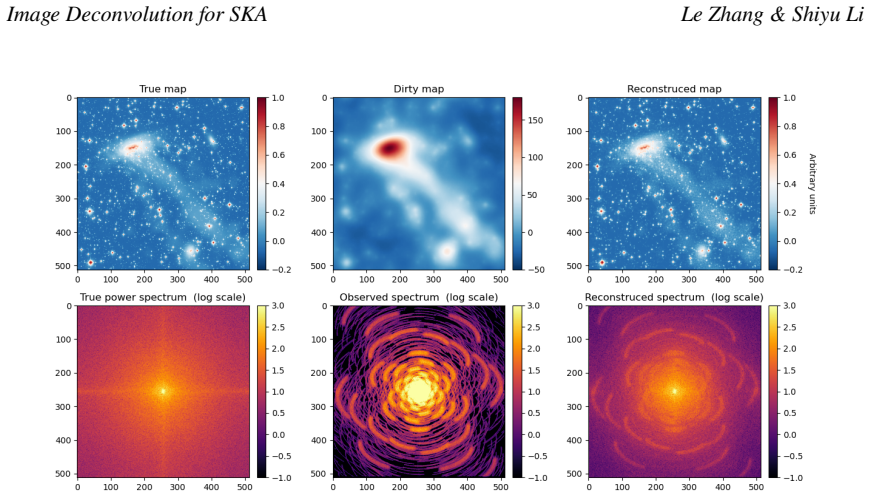
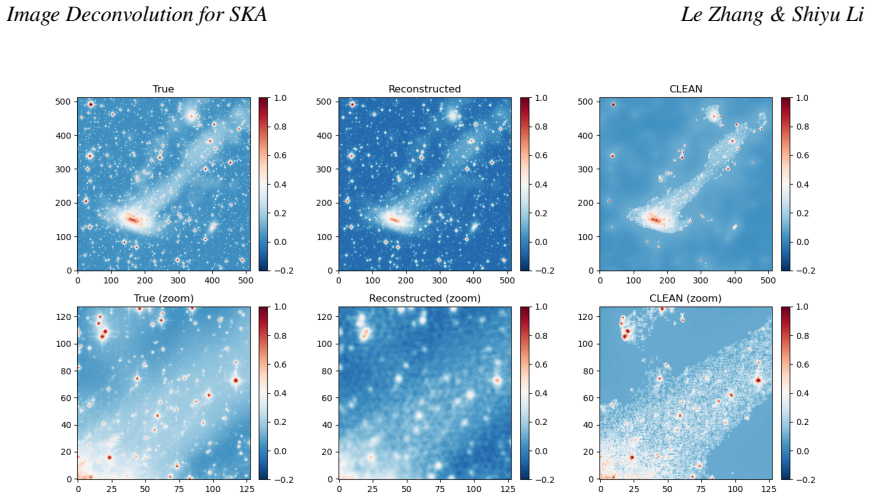
The algorithm enables rapid and efficient image reconstruction in an iterative manner based on the assumption of non-negative source fluxes, without requiring prior knowledge or training, and yields a good reconstruction compared to CLEAN for point sources and extended galaxies using realistic SKA-Low PSF with incomplete uv-coverage in noise-free simulations.
What carries the argument
Non-negativity iterative deconvolution algorithm that enforces positive fluxes iteratively and computes in linear time with pixel count.
If this is right
- It processes a 512x512 image in 1-2 seconds on a standard laptop.
- It works without any training data or prior knowledge of the sources.
- It shows promise for SKA and VLBI observations with sparse uv-coverage.
- Comparison demonstrates good reconstruction for both point sources and extended galaxy images.
Where Pith is reading between the lines
- The method could be adapted for noisy real-world data by adding a noise handling step.
- Similar non-negativity constraints might improve deconvolution in other sparse imaging fields like medical tomography.
- Real-time applications in ongoing observations become feasible due to the speed.
- Testing on actual SKA data would confirm if noise-free results translate.
Load-bearing premise
Source fluxes are strictly non-negative and noise-free simulations represent real observations adequately.
What would settle it
Applying the algorithm to noisy SKA observations and observing if reconstruction quality drops below CLEAN levels would test the claim.
Figures
read the original abstract
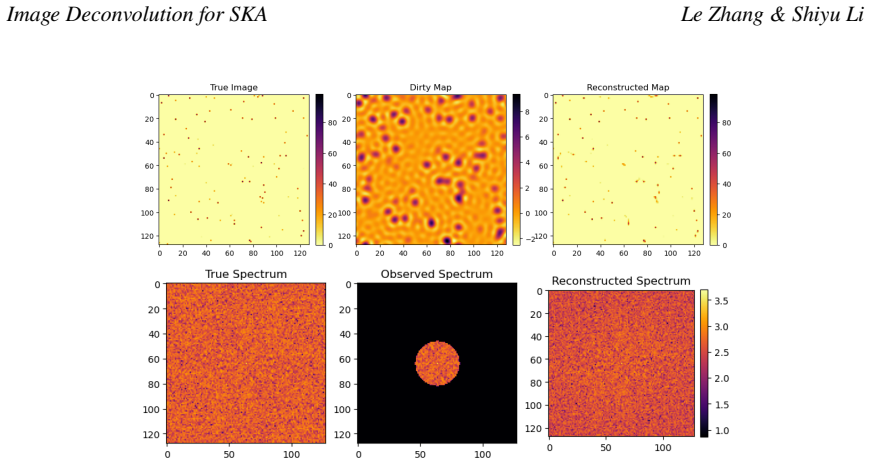
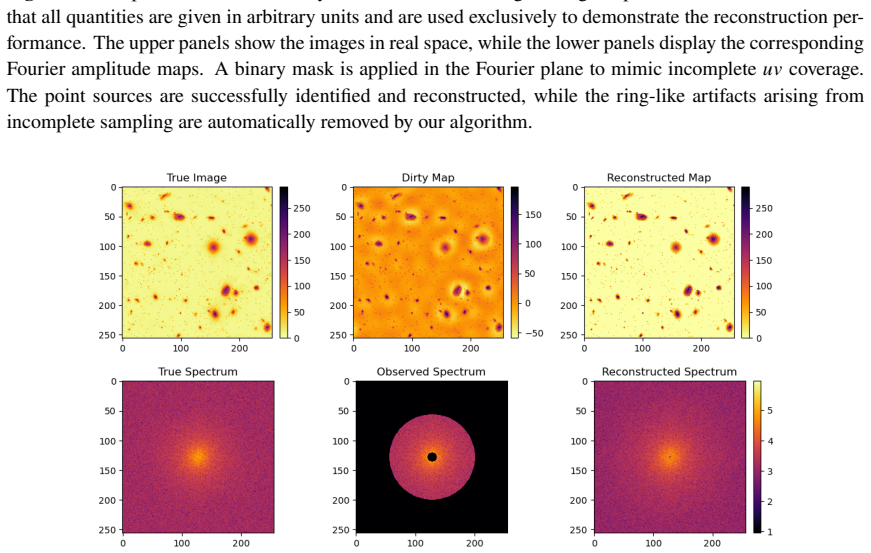
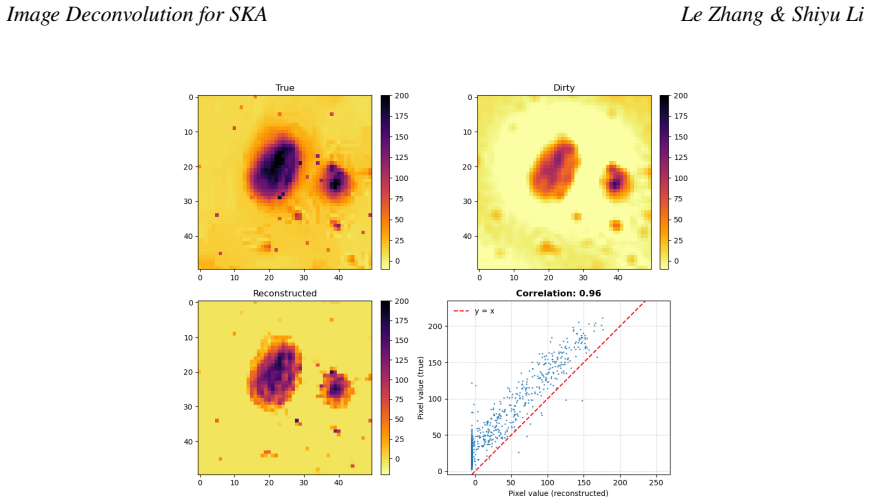
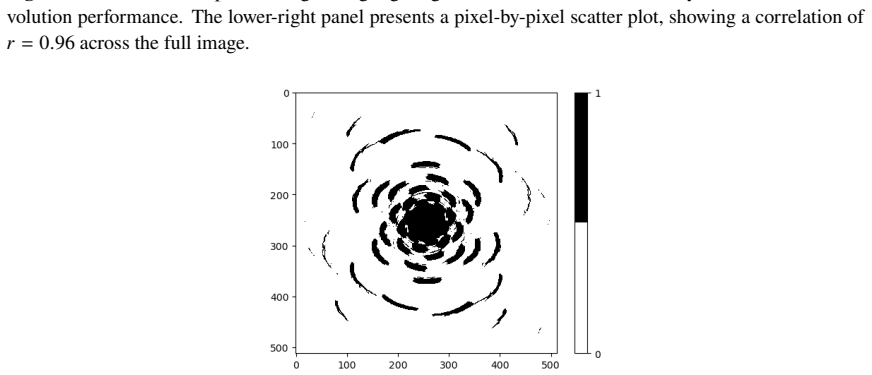
We introduce a novel algorithm for image deconvolution applicable to interferometric radio observations, based on the assumption of non-negative source fluxes. The method enables rapid and efficient image reconstruction in an iterative manner, without requiring prior knowledge or training. Its computational cost scales linearly with the number of pixels: for example, a $512\times 512$ image can be processed in about 1-2 seconds on a standard laptop. We validate the algorithm using both point sources and an extended galaxy image, incorporating a realistic SKA-Low PSF with incomplete $uv$-coverage, though tests are conducted in noise-free simulations. Comparison with the CLEAN method demonstrates that our approach yields a good reconstruction, showing particular promise for the SKA and VLBI observations with sparse $uv$-coverage.
Editorial analysis
A structured set of objections, weighed in public.
Referee Report
Summary. The manuscript introduces a non-negativity iterative deconvolution algorithm for radio interferometric imaging aimed at SKA and VLBI applications. It claims linear scaling in the number of pixels (e.g., 1-2 seconds for a 512x512 image), no requirement for priors or training, and superior reconstruction quality relative to CLEAN for both point sources and extended galaxies when using a realistic SKA-Low PSF with incomplete uv-coverage; all reported tests are performed on noise-free simulated data.
Significance. A computationally efficient, assumption-driven deconvolution method with linear scaling would be valuable for high-volume SKA imaging pipelines if it proves robust. The noise-free validation, however, leaves the practical significance uncertain because real observations include thermal noise that can violate the strict non-negativity premise used to derive the update rule.
major comments (2)
- [Abstract] Abstract and validation section: performance claims rest exclusively on noise-free simulations; no quantitative metrics (e.g., RMS residual, dynamic range, or flux recovery statistics), error bars, or failure-mode analysis are provided, and no tests inject SKA-Low thermal noise levels into the visibilities before imaging. This directly undermines the central claim that the method “yields a good reconstruction” compared with CLEAN under realistic conditions.
- [Method] Method derivation and update rule: the algorithm enforces strict non-negativity at each iteration and derives the update from the assumption that source fluxes are non-negative. When realistic noise produces negative pixel values, this enforcement may introduce bias or instability; the manuscript provides no analysis or modified procedure for handling such cases.
minor comments (2)
- [Abstract] The abstract states that tests use “a realistic SKA-Low PSF with incomplete uv-coverage” but does not specify the exact uv-coverage fraction, frequency, or integration time; these parameters should be stated explicitly to allow reproducibility.
- [Results] No comparison is made to other modern deconvolution methods (e.g., multi-scale CLEAN, sparsity-based approaches) beyond the basic CLEAN algorithm; a broader baseline would strengthen the evaluation.
Simulated Author's Rebuttal
We thank the referee for their constructive comments, which highlight important aspects of validation and applicability. We address each major comment below and commit to revisions that strengthen the manuscript without altering its core claims.
read point-by-point responses
-
Referee: [Abstract] Abstract and validation section: performance claims rest exclusively on noise-free simulations; no quantitative metrics (e.g., RMS residual, dynamic range, or flux recovery statistics), error bars, or failure-mode analysis are provided, and no tests inject SKA-Low thermal noise levels into the visibilities before imaging. This directly undermines the central claim that the method “yields a good reconstruction” compared with CLEAN under realistic conditions.
Authors: We acknowledge that all presented results use noise-free simulations, as explicitly noted in the abstract. This was chosen to demonstrate the algorithm's behavior and linear scaling under the non-negativity assumption in isolation. We agree that quantitative metrics (RMS residual, dynamic range, flux recovery) and noise-injected tests are needed to support claims for realistic SKA conditions. In the revised manuscript we will add these metrics with error bars, include failure-mode analysis, and perform additional simulations injecting realistic SKA-Low thermal noise levels into the visibilities before imaging and deconvolution. revision: yes
-
Referee: [Method] Method derivation and update rule: the algorithm enforces strict non-negativity at each iteration and derives the update from the assumption that source fluxes are non-negative. When realistic noise produces negative pixel values, this enforcement may introduce bias or instability; the manuscript provides no analysis or modified procedure for handling such cases.
Authors: The update rule is derived directly from the non-negativity constraint on source fluxes, which is physically motivated for radio sources. The current manuscript does not analyze or modify the procedure for cases where noise produces negative pixels. We will add an explicit discussion of this limitation in the revised version and introduce a practical handling strategy (e.g., a relaxed non-negativity threshold or clipping step) together with tests on noisy data to assess bias and stability. revision: yes
Circularity Check
No significant circularity; empirical validation of iterative algorithm
full rationale
The paper presents a non-negativity-constrained iterative deconvolution method whose core claim is empirical performance (good reconstruction vs CLEAN on point sources and extended galaxies) in noise-free SKA-Low simulations. No equations, derivation steps, fitted parameters, or self-citations appear in the abstract or description; the algorithm is introduced directly from the non-negativity assumption without any reduction of a 'prediction' back to its inputs. The validation is a direct comparison on simulated data rather than a mathematical result that could be circular by construction. This is the normal case of an algorithmic paper whose central content is independent of any self-referential loop.
Axiom & Free-Parameter Ledger
axioms (1)
- domain assumption Source fluxes are non-negative
Reference graph
Works this paper leans on
-
[1]
Bonaldi, A. and others. Square Kilometre Array Science Data Challenge 3a: foreground removal for an EoR experiment. Mon. Not. Roy. Astron. Soc. 2025. doi:10.1093/mnras/staf1466. arXiv:2503.11740
-
[2]
in preparation , year =
Li, Shiyu and Zhang, Le and others , title =. in preparation , year =
-
[3]
SIAM Journal on Imaging Sciences , volume =
Beck, Amir and Teboulle, Marc , title =. SIAM Journal on Imaging Sciences , volume =. 2009 , doi =
2009
-
[4]
2023 , doi =
Bingying Zhao and Jerome Mertz , title =. 2023 , doi =. https://www.biorxiv.org/content/early/2023/07/24/2023.07.24.550382.full.pdf , journal =
2023
-
[5]
Laine and Hannah S
Romain F. Laine and Hannah S. Heil and Simao Coelho and Jonathon Nixon-Abell and Ang. High-fidelity 3D live-cell nanoscopy through data-driven enhanced super-resolution radial fluctuation , elocation-id =. 2022 , doi =. https://www.biorxiv.org/content/early/2022/04/08/2022.04.07.487490.full.pdf , journal =
2022
-
[6]
Nature Communications , year = 2016, month = aug, volume =
Fast live-cell conventional fluorophore nanoscopy with ImageJ through super-resolution radial fluctuations. Nature Communications , year = 2016, month = aug, volume =. doi:10.1038/ncomms12471 , adsurl =
-
[7]
Nature Communications , year = 2022, month = dec, volume =
Extending resolution within a single imaging frame. Nature Communications , year = 2022, month = dec, volume =. doi:10.1038/s41467-022-34693-9 , adsurl =
-
[8]
, journal=
Pratt, W.K. , journal=. Generalized Wiener Filtering Computation Techniques , year=
-
[9]
, year = 1974, month = jun, volume =
An iterative technique for the rectification of observed distributions. , year = 1974, month = jun, volume =. doi:10.1086/111605 , adsurl =
-
[10]
Journal of the Optical Society of America (1917-1983) , year = 1972, month = jan, volume =
Bayesian-Based Iterative Method of Image Restoration. Journal of the Optical Society of America (1917-1983) , year = 1972, month = jan, volume =
1917
-
[11]
A Generalized Unsharp Masking Algorithm , year=
Deng, Guang , journal=. A Generalized Unsharp Masking Algorithm , year=
-
[12]
IEEE Transactions on Image Processing , keywords =
Unsharp Mask Guided Filtering. IEEE Transactions on Image Processing , keywords =. doi:10.1109/TIP.2021.3106812 , archivePrefix =. 2106.01428 , primaryClass =
-
[13]
AAS Photo Bulletin , year = 1977, month = jan, volume =
Unsharp masking. AAS Photo Bulletin , year = 1977, month = jan, volume =
1977
-
[14]
and Girard, J
Jiang, M. and Girard, J. N. and Starck, J.-L. and Corbel, S. and Tasse, C. , booktitle=. Compressed sensing and radio interferometry , year=
-
[15]
Photo-Realistic Single Image Super-Resolution Using a Generative Adversarial Network
Photo-Realistic Single Image Super-Resolution Using a Generative Adversarial Network. arXiv e-prints , keywords =. doi:10.48550/arXiv.1609.04802 , archivePrefix =. 1609.04802 , primaryClass =
work page internal anchor Pith review Pith/arXiv arXiv doi:10.48550/arxiv.1609.04802
-
[16]
Geophysics , year = 2024, month = mar, volume =
Image-domain seismic inversion by deblurring with invertible recurrent inference machines. Geophysics , year = 2024, month = mar, volume =. doi:10.1190/geo2022-0780.1 , adsurl =
-
[17]
Astronomy and Computing , keywords =
A proof-of-concept neural network for inferring parameters of a black hole from partial interferometric images of its shadow. Astronomy and Computing , keywords =. doi:10.1016/j.ascom.2021.100467 , archivePrefix =. 2311.16227 , primaryClass =
-
[18]
Deep learning-based imaging in radio interferometry. , keywords =. doi:10.1051/0004-6361/202142113 , archivePrefix =. 2203.11757 , primaryClass =
-
[19]
A Conditional Denoising Diffusion Probabilistic Model for Radio Interferometric Image Reconstruction. arXiv e-prints , keywords =. doi:10.48550/arXiv.2305.09121 , archivePrefix =. 2305.09121 , primaryClass =
-
[20]
Deep Learning for Single Image Super-Resolution: A Brief Review
Deep Learning for Single Image Super-Resolution: A Brief Review. arXiv e-prints , keywords =. doi:10.48550/arXiv.1808.03344 , archivePrefix =. 1808.03344 , primaryClass =
work page internal anchor Pith review Pith/arXiv arXiv doi:10.48550/arxiv.1808.03344
-
[21]
Data-driven Reconstruction of Gravitationally Lensed Galaxies Using Recurrent Inference Machines. , keywords =. doi:10.3847/1538-4357/ab35d7 , archivePrefix =. 1901.01359 , primaryClass =
-
[22]
Analyzing interferometric observations of strong gravitational lenses with recurrent and convolutional neural networks. arXiv e-prints , keywords =. doi:10.48550/arXiv.1808.00011 , archivePrefix =. 1808.00011 , primaryClass =
work page internal anchor Pith review Pith/arXiv arXiv doi:10.48550/arxiv.1808.00011
-
[23]
The adaptive-loop-gain adaptive-scale CLEAN deconvolution of radio interferometric images
The adaptive-loop-gain adaptive-scale CLEAN deconvolution of radio interferometric images. , keywords =. doi:10.1007/s10509-016-2746-8 , archivePrefix =. 1604.01563 , primaryClass =
work page internal anchor Pith review Pith/arXiv arXiv doi:10.1007/s10509-016-2746-8
-
[24]
Research in Astronomy and Astrophysics , keywords =
Map Reconstruction of Radio Observations with Conditional Invertible Neural Networks. Research in Astronomy and Astrophysics , keywords =. doi:10.1088/1674-4527/acd0ee , archivePrefix =. 2306.09217 , primaryClass =
-
[25]
WSClean: an implementation of a fast, generic wide-field imager for radio astronomy
WSCLEAN: an implementation of a fast, generic wide-field imager for radio astronomy. , keywords =. doi:10.1093/mnras/stu1368 , archivePrefix =. 1407.1943 , primaryClass =
work page internal anchor Pith review Pith/arXiv arXiv doi:10.1093/mnras/stu1368 1943
-
[26]
CASA, the Common Astronomy Software Applications for Radio Astronomy
Bean, Ben and others. CASA, Common Astronomy Software Applications for Radio Astronomy. Publ. Astron. Soc. Pac. 2022. doi:10.1088/1538-3873/ac9642. arXiv:2210.02276
work page internal anchor Pith review Pith/arXiv arXiv doi:10.1088/1538-3873/ac9642 2022
-
[27]
Uncertainty quantification for radio interferometric imaging: I. proximal MCMC methods
Uncertainty quantification for radio interferometric imaging - I. Proximal MCMC methods. , keywords =. doi:10.1093/mnras/sty2004 , archivePrefix =. 1711.04818 , primaryClass =
work page internal anchor Pith review Pith/arXiv arXiv doi:10.1093/mnras/sty2004
-
[28]
Parallel faceted imaging in radio interferometry via proximal splitting (Faceted HyperSARA): I. Algorithm and simulations. , keywords =. doi:10.1093/mnras/stac1521 , archivePrefix =. 2003.07358 , primaryClass =
-
[29]
Polca SARA - full polarization, direction-dependent calibration, and sparse imaging for radio interferometry. , keywords =. doi:10.1093/mnras/stz3555 , archivePrefix =. 1904.00663 , primaryClass =
-
[30]
Robust sparse image reconstruction of radio interferometric observations with purify
Robust sparse image reconstruction of radio interferometric observations with PURIFY. , keywords =. doi:10.1093/mnras/stx2237 , archivePrefix =. 1610.02400 , primaryClass =
work page internal anchor Pith review Pith/arXiv arXiv doi:10.1093/mnras/stx2237
-
[31]
Non-convex optimization for self-calibration of direction-dependent effects in radio interferometric imaging. , keywords =. doi:10.1093/mnras/stx1267 , archivePrefix =. 1701.03689 , primaryClass =
work page internal anchor Pith review Pith/arXiv arXiv doi:10.1093/mnras/stx1267
-
[32]
An accelerated splitting algorithm for radio-interferometric imaging: when natural and uniform weighting meet. , keywords =. doi:10.1093/mnras/stx755 , archivePrefix =. 1701.01748 , primaryClass =
work page internal anchor Pith review Pith/arXiv arXiv doi:10.1093/mnras/stx755
-
[33]
Scalable splitting algorithms for big-data interferometric imaging in the SKA era
Scalable splitting algorithms for big-data interferometric imaging in the SKA era. , keywords =. doi:10.1093/mnras/stw1859 , archivePrefix =. 1601.04026 , primaryClass =
work page internal anchor Pith review Pith/arXiv arXiv doi:10.1093/mnras/stw1859
-
[34]
LOFAR Sparse Image Reconstruction
LOFAR sparse image reconstruction. , keywords =. doi:10.1051/0004-6361/201424504 , archivePrefix =. 1406.7242 , primaryClass =
work page internal anchor Pith review Pith/arXiv arXiv doi:10.1051/0004-6361/201424504
-
[35]
MORESANE: MOdel REconstruction by Synthesis-ANalysis Estimators. A sparse deconvolution algorithm for radio interferometric imaging. , keywords =. doi:10.1051/0004-6361/201424602 , archivePrefix =. 1412.5387 , primaryClass =
work page internal anchor Pith review Pith/arXiv arXiv doi:10.1051/0004-6361/201424602
-
[36]
The application of compressive sampling to radio astronomy. I. Deconvolution. , keywords =. doi:10.1051/0004-6361/201015045 , archivePrefix =. 1106.1711 , primaryClass =
work page internal anchor Pith review Pith/arXiv arXiv doi:10.1051/0004-6361/201015045
-
[37]
Compressed sensing imaging techniques for radio interferometry. , keywords =. doi:10.1111/j.1365-2966.2009.14665.x , archivePrefix =. 0812.4933 , primaryClass =
-
[38]
Probabilistic image reconstruction for radio interferometers
Probabilistic image reconstruction for radio interferometers. , keywords =. doi:10.1093/mnras/stt2244 , archivePrefix =. 1309.1469 , primaryClass =
work page internal anchor Pith review Pith/arXiv arXiv doi:10.1093/mnras/stt2244
-
[39]
Optimal Image Reconstruction in Radio Interferometry
Optimal Image Reconstruction in Radio Interferometry. , keywords =. doi:10.1086/498571 , archivePrefix =. astro-ph/0604331 , primaryClass =
work page internal anchor Pith review Pith/arXiv arXiv doi:10.1086/498571
-
[40]
, keywords =
A simple maximum entropy deconvolution algorithm. , keywords =
-
[41]
Image reconstruction from incomplete and noisy data. , keywords =. doi:10.1038/272686a0 , adsurl =
-
[42]
, year = 1974, month = jun, volume =
Maximum Entropy Spectral Analysis. , year = 1974, month = jun, volume =
1974
-
[43]
, keywords =
An efficient implementation of the algorithm 'CLEAN'. , keywords =
-
[44]
doi:10.1007/978-3-319-44431-4 , adsurl =
Interferometry and Synthesis in Radio Astronomy, 3rd Edition. doi:10.1007/978-3-319-44431-4 , adsurl =
-
[45]
A multi-scale multi-frequency deconvolution algorithm for synthesis imaging in radio interferometry
A multi-scale multi-frequency deconvolution algorithm for synthesis imaging in radio interferometry. , keywords =. doi:10.1051/0004-6361/201117104 , archivePrefix =. 1106.2745 , primaryClass =
work page internal anchor Pith review Pith/arXiv arXiv doi:10.1051/0004-6361/201117104
-
[46]
IEEE Journal of Selected Topics in Signal Processing , keywords =
The Noncoplanar Baselines Effect in Radio Interferometry: The W-Projection Algorithm. IEEE Journal of Selected Topics in Signal Processing , keywords =. doi:10.1109/JSTSP.2008.2005290 , archivePrefix =. 0807.4161 , primaryClass =
-
[47]
Scale sensitive deconvolution of interferometric images. I. Adaptive Scale Pixel (Asp) decomposition. , keywords =. doi:10.1051/0004-6361:20040354 , archivePrefix =. astro-ph/0407225 , primaryClass =
work page internal anchor Pith review Pith/arXiv arXiv doi:10.1051/0004-6361:20040354
-
[48]
Global fringe search techniques for VLBI. , keywords =. doi:10.1086/113360 , adsurl =
-
[49]
, year = 1978, month = apr, volume =
Mathematical-statistical Description of the Iterative Beam Removing Technique (Method CLEAN). , year = 1978, month = apr, volume =
1978
-
[50]
, year = 1974, month = jun, volume =
Aperture Synthesis with a Non-Regular Distribution of Interferometer Baselines. , year = 1974, month = jun, volume =
1974
-
[51]
The Tianlai project: a 21cm cosmology experiment
The Tianlai Project: a 21CM Cosmology Experiment. International Journal of Modern Physics Conference Series , year = 2012, series =. doi:10.1142/S2010194512006459 , archivePrefix =. 1212.6278 , primaryClass =
work page internal anchor Pith review Pith/arXiv arXiv doi:10.1142/s2010194512006459 2012
-
[52]
2016, in MeerKAT Science: On the Pathway to the SKA, 1, doi: 10.22323/1.277.0001
The MeerKAT Radio Telescope. MeerKAT Science: On the Pathway to the SKA , year = 2016, month = jan, eid =. doi:10.22323/1.277.0001 , adsurl =
-
[53]
van Haarlem, M. P. and others. LOFAR: The LOw-Frequency ARray. Astron. Astrophys. 2013. doi:10.1051/0004-6361/201220873. arXiv:1305.3550
work page internal anchor Pith review Pith/arXiv arXiv doi:10.1051/0004-6361/201220873 2013
-
[54]
Radio Continuum Surveys with Square Kilometre Array Pathfinders
Radio Continuum Surveys with Square Kilometre Array Pathfinders. , keywords =. doi:10.1017/pas.2012.020 , archivePrefix =. 1210.7521 , primaryClass =
work page internal anchor Pith review Pith/arXiv arXiv doi:10.1017/pas.2012.020 2012
-
[55]
Calibration and imaging challenges at low radio frequencies: An overview of the state of the art
Calibration and Imaging Challenges at Low Radio Frequencies: A Review of the State of the Art. The Low-Frequency Radio Universe , year = 2009, editor =. doi:10.48550/arXiv.0906.0537 , archivePrefix =. 0906.0537 , primaryClass =
work page internal anchor Pith review Pith/arXiv arXiv doi:10.48550/arxiv.0906.0537 2009
-
[56]
The Five-Hundred-Meter Aperture Spherical Radio Telescope (FAST) Project
The Five-Hundred Aperture Spherical Radio Telescope (fast) Project. International Journal of Modern Physics D , keywords =. doi:10.1142/S0218271811019335 , archivePrefix =. 1105.3794 , primaryClass =
work page internal anchor Pith review Pith/arXiv arXiv doi:10.1142/s0218271811019335
-
[57]
Lonsdale, Colin J. and others. The Murchison Widefield Array: Design Overview. IEEE Proc. 2009. doi:10.1109/JPROC.2009.2017564. arXiv:0903.1828
-
[58]
The Precision Array for Probing the Epoch of Reionization: 8 Station Results
The Precision Array for Probing the Epoch of Re-ionization: Eight Station Results. , keywords =. doi:10.1088/0004-6256/139/4/1468 , archivePrefix =. 0904.2334 , primaryClass =
work page internal anchor Pith review Pith/arXiv arXiv doi:10.1088/0004-6256/139/4/1468
-
[59]
Weltman, A. and others. Fundamental physics with the Square Kilometre Array. Publ. Astron. Soc. Austral. 2020. doi:10.1017/pasa.2019.42. arXiv:1810.02680
discussion (0)
Sign in with ORCID, Apple, or X to comment. Anyone can read and Pith papers without signing in.