REVIEW 4 major objections 5 minor 71 references
A new analytic model pins down the exact condition under which AI replaces a human worker: AI wins when its risk-adjusted effective cost is lower than the human's. From that simple inequality, the paper derives abrupt workforce transitions,
Reviewed by Pith at T0; open to challenge. T0 means a machine referee read the full paper against a public rubric. the ladder, T0–T4 →
T0 review · deepseek-v4-flash
2026-08-01 09:23 UTC pith:MMC7VEQZ
load-bearing objection Repackaged first-order condition; the organizational flattening and middle-management predictions do not follow from the stated model because its normalization makes a single cheapest agent optimal, and the calibration quietly switches to headcount-scaled costs. the 4 major comments →
The Human-AI Substitution Principle: When will you be replaced by AI in your organization?
The pith
A machine-rendered reading of the paper's core claim, the machinery that carries it, and where it could break.
Core claim
The paper claims that the decision to replace a human employee with AI reduces to a local, risk-adjusted cost comparison: substitution occurs if and only if the AI agent's effective cost, including reliability, compliance, and reputational risk, is strictly less than the human's effective cost. This condition is derived inside a hierarchical model where human compensation rises steeply with skill and depth, while AI costs scale more slowly with capability, creating an asymmetry that makes the threshold non-trivial. The same framework yields a threshold skill level µ* separating protected workers from vulnerable ones, a single-crossing condition under which middle-management roles face the hi
What carries the argument
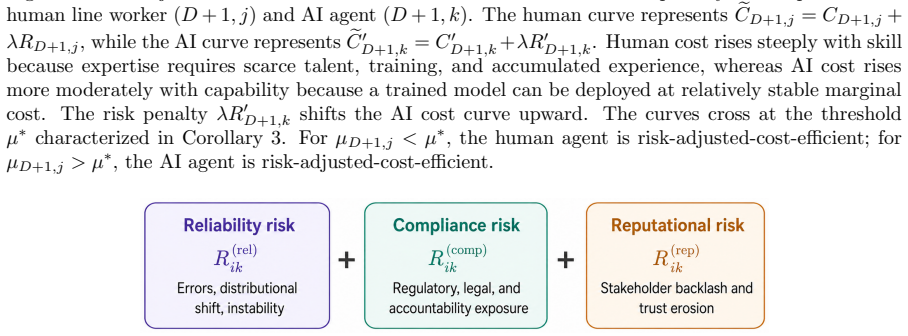
The Human–AI Task Allocation (HAT) model, a linear risk-adjusted cost minimization over a simplex of task allocations. The core mechanism is the Human–AI Cost Asymmetry Assumption: AI capability costs grow no faster than human skill costs, AI baseline cost falls with deployment scale, and AI coordination escalates no faster than human coordination. The substitution condition is then a direct comparison of risk-adjusted effective costs, C'_ik + λR'_ik < C_ij + λR_ij, with AI risk decomposed into reliability, compliance, and reputational components.
Load-bearing premise
The organizational predictions, especially flattening, rest on the layer-redundancy condition: whenever AI reduces the cost of higher-level coordination, at least one management layer can be removed without raising total AI-enabled cost—an external assumption that already presumes the flattening it is used to prove.
What would settle it
Observe actual firms before and after AI deployment in managerial coordination roles. If, controlling for scale, the number of hierarchical layers does not shrink or spans of control do not widen when AI's risk-adjusted cost drops below that of middle managers, the flattening theorem fails. Similarly, if workforce transitions are smooth and continuous rather than clustered around cost-threshold crossings, the threshold substitution rule is contradicted.
If this is right
- Organizations will replace workers abruptly, in discrete jumps, once the risk-adjusted cost gap crosses zero—so automation will look sudden rather than gradual.
- AI availability can reduce optimal organizational depth: firms should become flatter with fewer managerial layers and wider spans of control.
- Middle-management roles can become the most vulnerable subset, not top executives or line workers, when coordination cost pressure is high but top-level accountability constraints are strong.
- Hybrid human–AI organizations can persist endogenously: high compliance, reliability, or reputational risk can keep human workers cost-competitive even when AI has lower nominal cost.
- Highly skilled workers are not categorically safe; whether skill protects or exposes depends on the slope of human wage growth relative to AI capability cost, an explicitly measurable quantity.
Where Pith is reading between the lines
- The model implies a practical monitoring tool for managers: track the gap between human and AI risk-adjusted cost per role, and expect sudden restructuring when the sign flips—rather than treating automation as a smooth trend.
- Because the substitution condition depends on risk weights that vary by industry, the same AI capability will produce very different adoption patterns across sectors; regulatory certification events should be a strong predictor of discontinuous adoption spikes.
- The framework suggests a testable extension: in firms where AI coordination costs do not stay below human coordination costs (i.e., where the asymmetry assumption fails), hierarchy depth should not shrink and middle-management vulnerability should not appear.
- If the layer-redundancy assumption fails—if removing a managerial layer after AI substitution actually raises total cost—then the flattening prediction reverses, and AI-adopting firms would preserve depth rather than flatten.
Editorial analysis
A structured set of objections, weighed in public.
Referee Report
Summary. The paper proposes a formal optimization model (HAT) for allocating tasks between human and AI agents in hierarchical organizations, assuming that human skill costs rise more steeply than AI capability costs (Assumption 1). It derives a substitution condition based on risk-adjusted costs (Theorem 5), together with results claiming threshold substitution, organizational flattening, middle-management vulnerability, hybrid organizations, and strategic adaptation. A calibrated example illustrates parameter measurement. The paper is transparent about its scope and limitations.
Significance. If the organizational results were valid, the framework would provide a unified analytical account of AI-driven organizational change with testable implications for flattening, middle-management exposure, and hybrid structures. The paper also contributes a useful parameter-measurement mapping and a calibrated numerical example. However, the formal derivations of the key organizational predictions are currently not supported: the unit-sum normalization reduces the unconstrained optimum to a single-agent extreme point, and the main structural theorems rely on assumptions that do not follow from the model's primitives.
major comments (4)
- [§3.5 Eq.(12)–(13), §4.2.3 Theorem 6, §5.7] The unit-sum constraint (13) makes the unconstrained optimum a single-agent extreme point (Theorem 6). Since C_i in (3) strictly increases with level, the optimizer never employs managerial layers; depth enters only through the D-multiplier in line-worker cost (2)/(6). Therefore Theorem 4's flattening and Corollary 1's span widening are not consequences of the stated primitives. The §5.7 calibration is internally inconsistent: it computes flattening savings as e_3·(C̃_3−C̃'_3)=16·$103.9k, but (13) permits only one unit of total q, so the saving is at most one agent's cost. The paper's own limitation 4 (§5.8) concedes that real firms need multiple agents, but the model has no coverage/capacity constraint. Either reinterpret q as staffing weights with Σq equal to headcount, or add explicit capacity constraints and rederive the organizational results.
- [§4.2.1 Theorem 4, premise 3] The 'layer-redundancy condition' asserts C^(AI)(D−1) ≤ C^(AI)(D) whenever AI substitution reduces higher-level coordination costs. This is not derived from Assumption 1 or the cost functions; it is a monotonicity property of the AI-enabled cost in depth that essentially contains the flattening conclusion. The proof's iterative reduction from any D>D* depends entirely on this condition, so Theorem 4 is conditional on an assumption as strong as its claim. To be load-bearing, the condition must be shown to follow from primitives (e.g., r'_0≤r_0 and span structure) or replaced by a derived comparative static.
- [§4.3.1 Corollary 2, §5.7] Middle-management vulnerability relies on an unmodeled substitution-feasibility profile F(i) and a single-crossing assumption. F(i) is not a primitive of the HAT model; it appears only in Figure 4 and the proof as a generic factor, and the theorem does not characterize when the single-crossing condition holds. In the §5.7 calibration, F=(0.50,0.80,1.00,0.55,0.25) is assigned arbitrarily, so the intermediate peak at level 3 is imposed by construction. The result should be reframed as an illustrative mechanism, not a model-derived prediction.
- [§4.2.2 Theorem 5] The Human-AI Substitution Principle is an identity obtained by differentiating the linear objective (23). The proof uses only the definitions C̃_ij=C_ij+λR_ij and C̃'_ik=C'_ik+λR'_ik; Assumption 1 is not invoked in the statement or proof, yet the abstract and contributions describe the principle as 'grounded in the formal asymmetry assumption.' The non-tautological content resides entirely in Assumption 1 and the cost functions. As stated, the theorem merely says that a cost-minimizer chooses the cheaper option. The paper should state this explicitly and demote Theorem 5 to a definition or observation, with the substantive economic content carried by Assumption 1.
minor comments (5)
- [Notation] The notation Min$ and Min$′ is visually confusing and easily misread as a currency amount; consider using M_h and M_a or similar.
- [Figure 1] Figure 1 is referenced in the introduction but the figure itself is not embedded in the provided text; please ensure it is included in the final version.
- [§5.8 limitation 4] Limitation 4 concedes that extreme-point results are 'benchmark structural tendencies' because real firms require multiple agents. This caveat should be carried into the main text when Theorem 4 and Corollary 1 are presented, not left only to the limitations section.
- [Theorem 3 proof] The proof of (20) states 'For any a>1' and then handles 0<a≤1 in a separate sentence; consider rewording to avoid the appearance of a gap.
- [Theorem 15] The contest-success function in Theorem 15 is a standard logit form; please cite the relevant contest literature (e.g., Tullock 1980; Skaperdas 1996) for the functional form.
Circularity Check
Core substitution condition is a definitional identity; flattening and middle-management predictions are forced by assumptions that encode the conclusions.
specific steps
-
self definitional
[Theorem 5, Section 4.2.2 (Eq. 23)]
"Consider a perturbation q_ij → q_ij −δ, q'_ik → q'_ik +δ for δ>0. Then ΔC=δ( C̃'_ik − C̃_ij). Hence, cost decreases if and only if C̃'_ik < C̃_ij, i.e., C'_ik + λR'_ik < C_ij + λR_ij. ... The non-tautological content follows from Assumption 1: human and AI costs are not arbitrary comparable constants, but structurally distinct functions."
The 'Human–AI Substitution Principle' is the sign of the cost difference in a linear objective by construction. Once total cost is defined as Equation (12) and the allocation must sum to 1, transferring δ of a task from a human to an AI changes cost by δ(C̃'_ik − C̃_ij); 'substitute iff AI is cheaper' is exactly the definition of cost minimization, not a derived economic condition. The proof of Theorem 5 never invokes Assumption 1, and the statement that the asymmetry gives 'non-tautological content' is asserted, not shown.
-
self definitional
[Theorem 4, Section 4.2.1, Layer-redundancy condition]
"Layer-redundancy condition: for any depth D > D*, whenever AI substitution strictly reduces the risk-adjusted cost of higher-level coordination roles at depth D, at least one managerial layer can be removed without increasing the minimum AI-enabled risk-adjusted cost. Equivalently, for such depths, C^(AI)(D−1) ≤ C^(AI)(D)"
The flattening conclusion D^(AI)* ≤ D* is not derived from the cost primitives; it is assumed in the layer-redundancy condition. The theorem states that a layer can be removed whenever doing so does not increase cost, and then 'proves' that depth decreases by repeatedly applying this assumption. This is the conclusion restated as a premise. With Σq=1 and Theorem 6's extreme-point optimality, the unconstrained optimum would already discard all costly managerial layers, so the layer-redundancy condition is the only mechanism making depth matter.
-
fitted input called prediction
[Corollary 2 and Section 5.7 calibrated example]
"To illustrate the single-crossing condition in Corollary 2, let S(i) = C̃_i − C̃'_i denote the cost-based substitution pressure and let F(i)∈[0,1] denote substitution feasibility at level i. Then L(i)=S(i)F(i) ... Let F(5)=0.50, F(4)=0.80, F(3)=1.00, F(2)=0.55, F(1)=0.25. Then the weighted substitution likelihoods are: L(5)=30.3, L(4)=65.8, L(3)=103.9, L(2)=72.4, L(1)=43.4. Thus ... substitution likelihood peaks at level 3"
Middle-management vulnerability is an unmodeled feasibility profile F(i) assigned arbitrary values in the calibration rather than derived from the model's primitives. The single-crossing condition is imposed by setting F to peak at middle levels, so the resulting prediction that middle managers are most vulnerable is an artifact of the chosen input. The paper's own Corollary 2 is conditional: it states that IF feasibility constraints moderate top-level substitution, THEN an intermediate peak exists; the claimed prediction is therefore not generated by the HAT cost structure itself.
full rationale
The paper's central theorem, the Human–AI Substitution Principle (Theorem 5), is a definitional identity: for a linear cost objective over an allocation simplex, cost decreases under a human-to-AI transfer exactly when the AI's risk-adjusted cost is lower. The proof is a one-line calculation using the definition of total cost and does not use Assumption 1, despite the prose claiming the asymmetry supplies the substantive content. This makes the headline principle true by construction. The major organizational predictions then inherit this circularity in different ways. Theorem 4's flattening result is driven by a layer-redundancy condition that directly assumes C^(AI)(D−1) ≤ C^(AI)(D), i.e., that removing a layer does not raise cost; this is the conclusion, not a derived consequence of cost minimization. Corollary 2's middle-management vulnerability is explicitly conditional on a single-crossing substitution-feasibility profile F(i), and the calibration assigns F values by hand to produce a peak at level 3, so the 'prediction' is fitted rather than derived. Some components remain independent: Theorem 6's extreme-point optimality is a standard linear-programming fact, and Theorem 15 is a separate contest-theoretic extension. But the paper's advertised contribution — a precise substitution condition grounded in the asymmetry assumption and organizational flattening/middle-management findings derived from it — reduces to definition and assumed conclusions. A score of 7 reflects this partial but substantial circularity.
Axiom & Free-Parameter Ledger
free parameters (7)
- Δ$' (marginal AI capability cost) =
$0.5k/year in calibration
- r0' (AI coordination cost multiplier) =
0.02 in calibration
- λ (organizational risk sensitivity) =
1.5 in calibration
- ω1, ω2, ω3 (AI risk weights) =
0.3, 0.5, 0.2 baseline; 0.3, 0.8, 0.2 high-compliance
- T_k, n_k, M'_k (AI training/deployment/operational costs) =
$500k, 256, $8k
- R_ij and R'_ik (human and AI risk levels) =
$5k human, $20k AI at line level; escalating at higher levels
- F(i) substitution feasibility profile =
0.50, 0.80, 1.00, 0.55, 0.25 across levels
axioms (7)
- domain assumption Assumption 1: Δ$' ≤ Δ$, T_k/n_k → 0, r0' ≤ r0 (Human-AI Cost Asymmetry)
- ad hoc to paper Layer-redundancy condition in Theorem 4
- ad hoc to paper Single-crossing feasibility profile F(i) in Corollary 2
- standard math Linearity of objective and simplex constraints
- standard math Compactness/quasiconcavity and fixed-point theorem for the Nash equilibrium (Theorem 15)
- domain assumption Tree-shaped hierarchy with product-of-spans (equation 1)
- domain assumption Separable single-task abstraction
invented entities (1)
-
F(i) substitution feasibility profile
no independent evidence
Cite this review
Pith. "Pith review of The Human-AI Substitution Principle: When will you be replaced by AI in your organization?." pith.science (2026). https://pith.science/paper/MMC7VEQZ
@misc{pith2026260720781,
  author       = {Pith},
  title        = {Pith review of: The Human-AI Substitution Principle: When will you be replaced by AI in your organization?},
  year         = {2026},
  howpublished = {\url{https://pith.science/paper/MMC7VEQZ}},
  note         = {Machine review of arXiv:2607.20781}
}
read the original abstract
Artificial Intelligence (AI) is rapidly transforming organizations, raising a fundamental organizational and economic question: when will a human employee be replaced by AI? We present an analytical model for studying Human--AI Task Allocation (HAT) in hierarchical organizations. A central feature of the HAT model is that it formally encodes the economic asymmetry between human skill acquisition and AI capability scaling. The HAT model allows us to derive how risk-adjusted costs, skills, organizational depth, deployment scale, strategic adaptation, and risk jointly determine when, where, why, and under what structural conditions human--AI replacement occurs. A key result is the Human--AI Substitution Principle, which provides a precise condition --- grounded in the formal asymmetry assumption --- under which AI replaces human labor. Building on this result, we show that AI adoption can produce abrupt workforce transitions, hybrid human--AI organizations, including cases where risk heterogeneity sustains human and AI roles without requiring a minimum-human-fraction constraint, and flatter managerial hierarchies with wider spans of control. The HAT model identifies structural conditions under which middle-management roles exhibit elevated vulnerability to automation, and shows that the vulnerability of highly skilled workers depends on a skill threshold shaped by organizational depth, baseline costs, and risk differentials. More broadly, the paper connects automation economics, organizational design, AI governance, and workforce planning into a unified theory of AI-driven organizational transformation.
Figures




Reference graph
Works this paper leans on
-
[1]
International Journal of Organizational Analysis , publisher =
Gibson, Linda K and Finnie, Bruce and Stuart, Jeffrey L , title =. International Journal of Organizational Analysis , publisher =. 2015 , doi =
2015
-
[2]
Technological forecasting and social change , publisher =
Frey, Carl Benedikt and Osborne, Michael A , title =. Technological forecasting and social change , publisher =. 2017 , doi =
2017
-
[3]
American Economic Review , volume =
Acemoglu, Daron and Restrepo, Pascual , title =. American Economic Review , volume =. 2018 , doi =
2018
-
[4]
Journal of Economic Perspectives , volume =
Acemoglu, Daron and Restrepo, Pascual , title =. Journal of Economic Perspectives , volume =. 2019 , doi =
2019
-
[5]
Journal of Political Economy , volume =
Garicano, Luis , title =. Journal of Political Economy , volume =. 2000 , doi =
2000
-
[6]
AEA Papers and Proceedings , volume =
Brynjolfsson, Erik and Mitchell, Tom and Rock, Daniel , title =. AEA Papers and Proceedings , volume =. 2018 , doi =
2018
-
[7]
Journal of Economic Perspectives , volume =
Agrawal, Ajay and Gans, Joshua and Goldfarb, Avi , title =. Journal of Economic Perspectives , volume =. 2019 , doi =
2019
-
[8]
and Levy, Frank and Murnane, Richard J
Autor, David H. and Levy, Frank and Murnane, Richard J. , title =. Quarterly Journal of Economics , volume =. 2003 , doi =
2003
-
[9]
American Economic Review:
Goos, Maarten and Manning, Alan and Salomons, Anna , title =. American Economic Review:. 2009 , doi =
2009
-
[10]
Handbook of Labor Economics , publisher =
Acemoglu, Daron and Autor, David , title =. Handbook of Labor Economics , publisher =. 2011 , doi =
2011
-
[11]
and Dorn, David , title =
Autor, David H. and Dorn, David , title =. American Economic Review , volume =. 2013 , doi =
2013
-
[12]
Journal of Political Economy , volume =
Caliendo, Lorenzo and Mion, Giordano and Opromolla, Luca David and Rossi-Hansberg, Esteban , title =. Journal of Political Economy , volume =. 2020 , doi =
2020
-
[13]
Bell Journal of Economics , volume =
Rosen, Sherwin , title =. Bell Journal of Economics , volume =. 1982 , doi =
1982
-
[14]
, title =
Lucas, Robert E. , title =. Bell Journal of Economics , volume =. 1978 , doi =
1978
-
[15]
Quarterly Journal of Economics , volume =
Gabaix, Xavier and Landier, Augustin , title =. Quarterly Journal of Economics , volume =. 2008 , doi =
2008
-
[16]
Management Science , volume =
Bloom, Nicholas and Garicano, Luis and Sadun, Raffaella and Van Reenen, John , title =. Management Science , volume =. 2014 , doi =
2014
-
[17]
and Brynjolfsson, Erik and Hitt, Lorin M
Bresnahan, Timothy F. and Brynjolfsson, Erik and Hitt, Lorin M. , title =. Quarterly Journal of Economics , volume =. 2002 , doi =
2002
-
[18]
and Hodson, James , title =
Babina, Tania and Fedyk, Anastassia and He, Alex X. and Hodson, James , title =. Journal of Financial Economics , volume =. 2024 , doi =
2024
-
[19]
National Bureau of Economic Research Working Paper No
Autor, David , title =. National Bureau of Economic Research Working Paper No. 30074 , year =
-
[20]
Science , volume =
Noy, Shakked and Zhang, Whitney , title =. Science , volume =. 2023 , doi =
2023
-
[21]
Journal of Political Economy , volume =
Acemoglu, Daron and Restrepo, Pascual , title =. Journal of Political Economy , volume =. 2020 , doi =
2020
-
[22]
Cambridge Journal of Regions, Economy and Society , volume =
Acemoglu, Daron and Restrepo, Pascual , title =. Cambridge Journal of Regions, Economy and Society , volume =. 2020 , doi =
2020
-
[23]
Review of Economic Studies , volume =
Llull, Joan , title =. Review of Economic Studies , volume =. 2018 , doi =
2018
-
[24]
and Rosen, Sherwin , title =
Lazear, Edward P. and Rosen, Sherwin , title =. Journal of Political Economy , volume =. 1981 , doi =
1981
-
[25]
American Economic Review , volume =
Dixit, Avinash , title =. American Economic Review , volume =. 1987 , url =
1987
-
[26]
, title =
Autor, David H. , title =. Journal of Economic Perspectives , volume =. 2015 , doi =
2015
-
[27]
Working Paper, Stanford University , year =
Webb, Michael , title =. Working Paper, Stanford University , year =
-
[28]
and Raj, Manav and Seamans, Robert , title =
Felten, Edward W. and Raj, Manav and Seamans, Robert , title =. Strategic Management Journal , volume =. 2021 , doi =
2021
-
[29]
Journal of Labor Economics , volume =
Acemoglu, Daron and Autor, David and Hazell, Jonathon and Restrepo, Pascual , title =. Journal of Labor Economics , volume =. 2022 , doi =
2022
-
[30]
, title =
Williamson, Oliver E. , title =. Journal of Political Economy , volume =. 1967 , doi =
1967
-
[31]
Journal of Economic Literature , volume =
Radner, Roy , title =. Journal of Economic Literature , volume =. 1992 , doi =
1992
-
[32]
Quarterly Journal of Economics , volume =
Bolton, Patrick and Dewatripont, Mathias , title =. Quarterly Journal of Economics , volume =. 1994 , doi =
1994
-
[33]
and Henderson, Rebecca and Stern, Scott , title =
Cockburn, Iain M. and Henderson, Rebecca and Stern, Scott , title =. National Bureau of Economic Research Working Paper No. 24449 , year =
-
[34]
Journal of Economic Literature , volume =
Goldfarb, Avi and Tucker, Catherine , title =. Journal of Economic Literature , volume =. 2019 , doi =
2019
-
[35]
arXiv preprint arXiv:1702.08608 , year =
Doshi-Velez, Finale and Kim, Been , title =. arXiv preprint arXiv:1702.08608 , year =
-
[36]
Minds and Machines , volume =
Floridi, Luciano and Cowls, Josh and Beltrametti, Monica and Chatila, Raja and Chazerand, Patrice and Dignum, Virginia and Luetge, Christoph and Madelin, Robert and Pagallo, Ugo and Rossi, Francesca and Schafer, Burkhard and Valcke, Peggy and Vayena, Effy , title =. Minds and Machines , volume =. 2018 , doi =
2018
-
[37]
arXiv preprint arXiv:2310.00828 , year =
Banerjee, Bonny and Pahune, Saurabh , title =. arXiv preprint arXiv:2310.00828 , year =
-
[38]
and Simmons, Joseph P
Dietvorst, Berkeley J. and Simmons, Joseph P. and Massey, Cade , title =. Journal of Experimental Psychology: General , volume =. 2015 , doi =
2015
-
[39]
and Simmons, Joseph P
Dietvorst, Berkeley J. and Simmons, Joseph P. and Massey, Cade , title =. Management Science , volume =. 2018 , doi =
2018
-
[40]
and Minson, Julia A
Logg, Jennifer M. and Minson, Julia A. and Moore, Don A. , title =. Organizational Behavior and Human Decision Processes , volume =. 2019 , doi =
2019
-
[41]
and See, Katrina A
Lee, John D. and See, Katrina A. , title =. Human Factors , volume =. 2004 , doi =
2004
-
[42]
Management Science , year =
Bastani, Hamsa and Bastani, Osbert and Sinchaisri, Wichinpong Park , title =. Management Science , year =
-
[43]
Proceedings of the ACM on Human--Computer Interaction , volume =
Vaccaro, Kristen and Karahalios, Karrie and Sandvig, Christian , title =. Proceedings of the ACM on Human--Computer Interaction , volume =. 2019 , doi =
2019
-
[44]
, title =
Galbraith, Jay R. , title =. 1974 , url =
1974
-
[45]
and Nadler, David A
Tushman, Michael L. and Nadler, David A. , title =. Academy of Management Review , volume =. 1978 , doi =
1978
-
[46]
, title =
Simon, Herbert A. , title =. 1947 , url =
1947
-
[47]
and Simon, Herbert A
March, James G. and Simon, Herbert A. , title =. 1958 , url =
1958
-
[48]
1988 , url =
Abbott, Andrew , title =. 1988 , url =
1988
-
[49]
and Powell, Walter W
DiMaggio, Paul J. and Powell, Walter W. , title =. American Sociological Review , volume =. 1983 , doi =
1983
-
[50]
Richard , title =
Scott, W. Richard , title =. 2008 , url =
2008
-
[51]
and Dukerich, Janet M
Dutton, Jane E. and Dukerich, Janet M. and Harquail, Celia V. , title =. Administrative Science Quarterly , volume =. 1994 , doi =
1994
-
[52]
Academy of Management Review , volume =
Raisch, Sebastian and Krakowski, Sebastian , title =. Academy of Management Review , volume =. 2021 , doi =
2021
-
[53]
2023 , url =
The Flattening:. 2023 , url =
2023
-
[54]
American Economic Review , volume =
Lemieux, Thomas , title =. American Economic Review , volume =. 2006 , doi =
2006
-
[55]
1974 , url =
Mincer, Jacob , title =. 1974 , url =
1974
-
[56]
Advances in Neural Information Processing Systems , volume =
Hoffmann, Jordan and Borgeaud, Sebastian and Mensch, Arthur and Buchatskaya, Elena and Cai, Trevor and Rutherford, Eliza and Casas, Diego de Las and Hendricks, Lisa Anne and Welbl, Johannes and Clark, Aidan and others , title =. Advances in Neural Information Processing Systems , volume =. 2022 , doi =
2022
-
[57]
Trends in the Cost of Large Language Model Inference , year =
-
[58]
2021 , url =
Product Market Regulation 2021 , journal =. 2021 , url =
2021
-
[59]
arXiv preprint arXiv:2302.06590 , year =
Peng, Sida and Kalliamvakou, Eirini and Cihon, Peter and Demirer, Mert , title =. arXiv preprint arXiv:2302.06590 , year =
-
[60]
The Quarterly Journal of Economics , publisher =
Garicano, Luis and Rossi-Hansberg, Esteban , title =. The Quarterly Journal of Economics , publisher =. 2006 , doi =
2006
-
[61]
2025 , howpublished =
Cottier, Ben and Snodin, Ben and Owen, David and Adamczewski, Tom , title =. 2025 , howpublished =
2025
-
[62]
2024 , howpublished =
Cottier, Ben and Rahman, Robi , title =. 2024 , howpublished =
2024
-
[63]
arXiv preprint arXiv:2405.21015 , year =
Cottier, Ben and Rahman, Robi and Fattorini, Loredana and Maslej, Nestor and Besiroglu, Tamay and Owen, David , title =. arXiv preprint arXiv:2405.21015 , year =
-
[64]
arXiv preprint arXiv:2506.00532 , year =
Xu, Fasheng and Hou, Jing and Chen, Wei and Xie, Karen , title =. arXiv preprint arXiv:2506.00532 , year =
-
[65]
Ethics and Information Technology , volume =
Matthias, Andreas , title =. Ethics and Information Technology , volume =. 2004 , doi =
2004
-
[66]
Philosophy & Technology , volume =
Santoni de Sio, Filippo and Mecacci, Giulio , title =. Philosophy & Technology , volume =. 2021 , doi =
2021
-
[67]
, title =
Glicksberg, Irving L. , title =. Proceedings of the American Mathematical Society , volume =. 1952 , doi =
1952
-
[68]
Proceedings of the National Academy of Sciences of the United States of America , volume =
Debreu, Gerard , title =. Proceedings of the National Academy of Sciences of the United States of America , volume =. 1952 , doi =
1952
-
[69]
Proceedings of the National Academy of Sciences of the United States of America , volume =
Fan, Ky , title =. Proceedings of the National Academy of Sciences of the United States of America , volume =. 1952 , doi =
1952
-
[70]
and Lifshitz, Hila and Kellogg, Katherine C
Dell'Acqua, Fabrizio and McFowland, Edward and Mollick, Ethan R. and Lifshitz, Hila and Kellogg, Katherine C. and Rajendran, Saran and Krayer, Lisa and Candelon, Fran. Navigating the Jagged Technological Frontier:. Organization Science , volume =. 2026 , doi =
2026
-
[71]
Science , volume =
Eloundou, Tyna and Manning, Sam and Mishkin, Pamela and Rock, Daniel , title =. Science , volume =. 2024 , doi =
2024
discussion (0)
Sign in with ORCID, Apple, or X to comment. Anyone can read and Pith papers without signing in.