Scalar diquarks in the QCD vacuum
Pith reviewed 2026-06-26 07:57 UTC · model grok-4.3
The pith
Low-energy constants for scalar diquarks and mesons emerge directly from the renormalization group flow of two-flavor QCD.
A machine-rendered reading of the paper's core claim, the machinery that carries it, and where it could break.
Core claim
In the dynamical hadronization technique within the functional renormalization group approach to two-flavor QCD, the low-energy constants relevant for effective models, including effective masses and coupling strengths, naturally emerge from the underlying renormalization group flow without introducing free parameters beyond those of QCD itself. The authors determine a set of QCD low-energy constants which can be used to fix the free parameters of models of dense quark matter with a two-flavor color superconducting phase, in particular supplying previously unknown properties of the scalar diquark.
What carries the argument
dynamical hadronization technique within the functional renormalization group approach to two-flavor QCD, which converts the fundamental quark-gluon flow into composite meson and diquark degrees of freedom
If this is right
- The computed scalar-diquark mass and coupling fix the interaction strength in two-flavor color-superconducting models.
- The same constants constrain the location and strength of the color-superconducting phase in the QCD phase diagram at finite density.
- Real-time properties of the pion, sigma meson and scalar diquark become available for transport calculations in dense quark matter.
- Models of neutron-star interiors gain a parameter-free link between the QCD vacuum and the superconducting phase.
Where Pith is reading between the lines
- Extending the same flow to three flavors would supply the additional constants needed for color-flavor-locked phases.
- The real-time spectral functions obtained here could be used to estimate viscosities or conductivities inside a color-superconducting core.
- If the constants remain stable under modest changes in the truncation, they could serve as a benchmark for other non-perturbative methods such as Dyson-Schwinger equations.
Load-bearing premise
The dynamical hadronization technique captures the full transition from fundamental two-flavor QCD to its low-energy sector in vacuum without additional assumptions or parameters.
What would settle it
A lattice QCD computation of the scalar diquark mass or its coupling to quarks at zero density, performed with two dynamical flavors, that deviates significantly from the values obtained from the renormalization-group flow.
Figures




read the original abstract
While QCD fundamentally only depends on the values of the strong coupling and the quark masses, it exhibits a rich nonperturbative structure at low energies, where composite fields emerge as the relevant degrees of freedom. In this work, we present a first-principles framework that captures the transition from fundamental QCD to its low-energy sector in vacuum. It builds on the dynamical hadronization technique within the functional renormalization group approach to two-flavor QCD. In this framework, the low-energy constants relevant for effective models, including effective masses and coupling strengths, naturally emerge from the underlying renormalization group flow without introducing free parameters beyond those of QCD itself. We investigate the dynamical emergence of the pion, the $\sigma$-meson and the scalar diquark in both imaginary and real time, and determine a set of QCD low-energy constants which can be used to fix the free parameters of models of dense quark matter with a two-flavor color superconducting phase. In particular, this includes previously unknown properties of the scalar diquark. Our results provide important microscopic input for constraining color superconducting phases, which are expected to play a key role in our understanding of dense neutron star matter.
Editorial analysis
A structured set of objections, weighed in public.
Referee Report
Summary. The paper develops a first-principles framework using dynamical hadronization within the functional renormalization group (fRG) applied to two-flavor QCD. It claims that this approach captures the emergence of composite degrees of freedom—the pion, σ-meson, and scalar diquark—from the underlying QCD renormalization group flow in both imaginary and real time, with all relevant low-energy constants (effective masses and coupling strengths) arising without free parameters beyond the strong coupling and quark masses of QCD itself. These constants are then positioned as input to fix parameters in effective models of dense quark matter, particularly for two-flavor color superconducting phases, including previously undetermined properties of the scalar diquark.
Significance. If the central claim holds, the work would supply valuable microscopic, parameter-free input from QCD for effective models of color superconductivity, directly relevant to the equation of state of dense neutron star matter. The determination of scalar diquark properties would constitute a concrete advance over existing phenomenological approaches.
major comments (1)
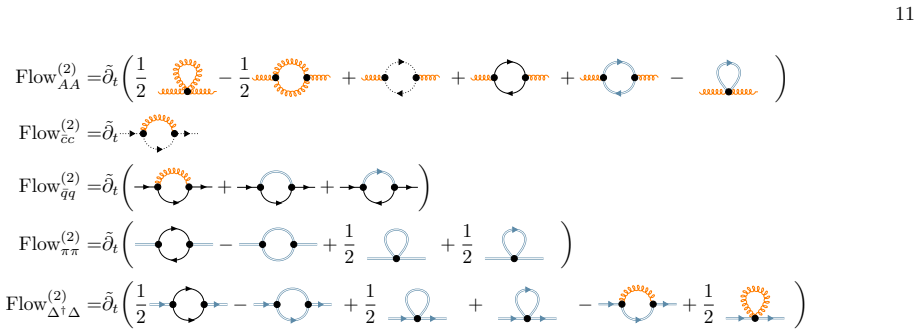
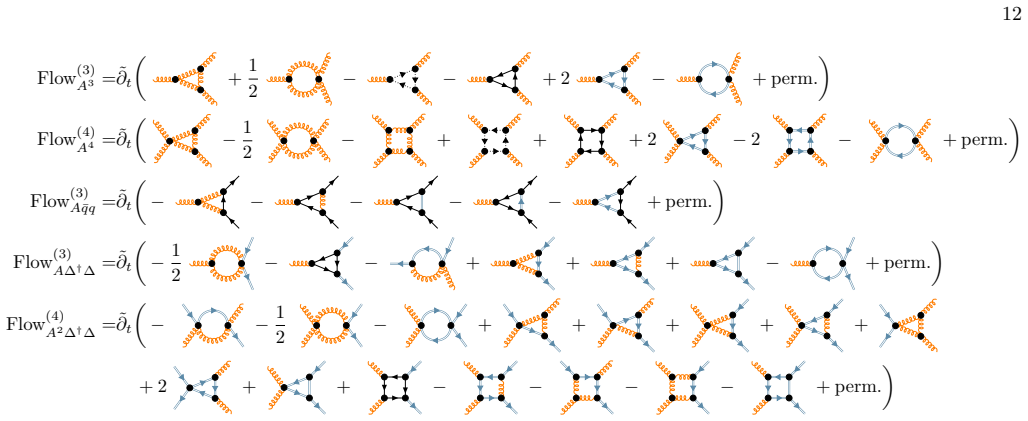
- [Abstract] Abstract (paragraph 2): the assertion that low-energy constants 'naturally emerge from the underlying renormalization group flow without introducing free parameters beyond those of QCD itself' is load-bearing for the entire claim. Without the explicit truncation scheme, the precise definition of the dynamical hadronization ansatz, and the flow equations for the effective potential and propagators, it is impossible to verify whether the hadronization procedure itself introduces implicit scale-setting or coupling definitions that function as fitted parameters.
Simulated Author's Rebuttal
We thank the referee for their positive assessment of the potential significance of our results for color-superconducting models. We address the single major comment below, providing the requested details on the truncation and ansatz while remaining within the scope of the existing manuscript.
read point-by-point responses
-
Referee: [Abstract] Abstract (paragraph 2): the assertion that low-energy constants 'naturally emerge from the underlying renormalization group flow without introducing free parameters beyond those of QCD itself' is load-bearing for the entire claim. Without the explicit truncation scheme, the precise definition of the dynamical hadronization ansatz, and the flow equations for the effective potential and propagators, it is impossible to verify whether the hadronization procedure itself introduces implicit scale-setting or coupling definitions that function as fitted parameters.
Authors: The manuscript specifies the truncation in Sec. 3 (including the choice of regulators and the inclusion of the four-quark and diquark channels), the dynamical hadronization ansatz in Sec. 2.2 (with the composite fields introduced via the scale-dependent transformation that preserves the QCD symmetries), and the flow equations for the effective potential and propagators in App. A. These choices are fixed by symmetry and the requirement of consistency with the underlying QCD action; no additional scale-setting or coupling parameters are introduced beyond the strong coupling and current quark masses. The low-energy constants are extracted directly from the infrared values of the flowing quantities. We can add a brief parenthetical reference to these sections in the abstract to make this explicit. revision: partial
Circularity Check
No significant circularity
full rationale
The paper presents a first-principles fRG framework with dynamical hadronization that derives low-energy constants for the pion, sigma, and scalar diquark directly from the QCD action and renormalization-group flow, without additional free parameters. No equations, self-citations, or procedures in the abstract reduce any output quantity to a fitted input or self-definition by construction. The central claim remains independent of the target results and is externally falsifiable via comparison to lattice QCD or other non-perturbative methods. This is the normal case of a self-contained derivation.
Axiom & Free-Parameter Ledger
axioms (1)
- domain assumption The dynamical hadronization technique within the functional renormalization group approach accurately captures the nonperturbative transition from fundamental two-flavor QCD to its low-energy composite degrees of freedom in vacuum.
Reference graph
Works this paper leans on
-
[1]
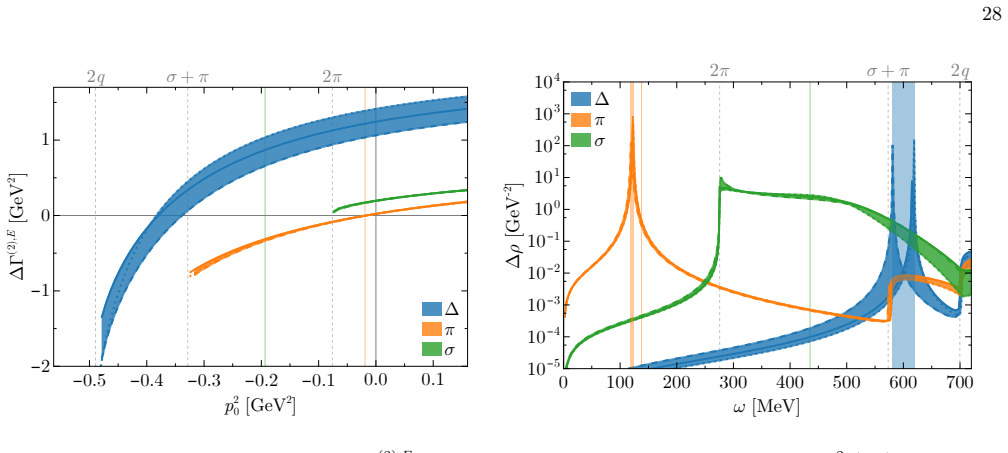
Negative values ofp 2 0 corresponds to imaginary tem- poral Euclidean momenta, i.e., Minkowski time. As ex- plained above, this procedure is only valid until the first branch cut on the real frequency axis, which is located at the smallest threshold for the decay of the associated field. These thresholds are indicated by gray dashed ver- tical lines in th...
-
[2]
We express the prop- agators of the different fields through GΦiΦj(p) = Gk(p) ij ,(B2) whereG k(p) is defined in Eq
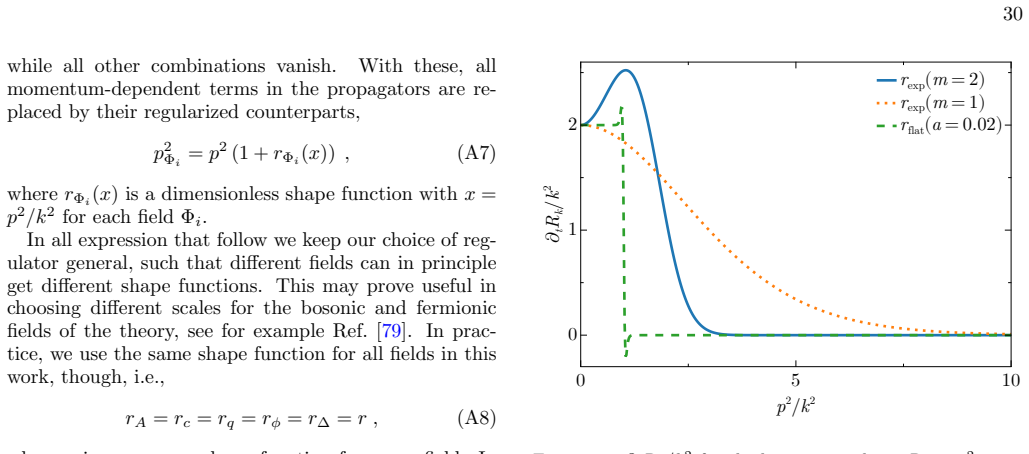
Propagators In this section we list the two-point functions and the associated regularized propagators. We express the prop- agators of the different fields through GΦiΦj(p) = Gk(p) ij ,(B2) whereG k(p) is defined in Eq. (18). Furthermore, we show all expressions on a non-vanishing diquark background, p2/k2 0 5 10 𝜕tRk/k2 0 1 2 rexp(m= 2) rexp(m= 1) rflat...
-
[3]
Vertices a. Strong coupling avatars In the pure glue sector we only consider the classical tensor structure which are given by h T (1) c¯cA(p, q) iabc µ =if abcqµ ,(B10) h T (1) A3 (p, q) iabc µνρ =if abc h (q−p) ρδµν (B11) −(p+ 2q) µδρν + (2p+q) νδµρ i , h T (1) A4 iabcd µνρσ =f eabf ecd δµρδνσ −δ µσδνρ +f eacf ebd δµνδρσ −δ µσδνρ +f eadf ebc δµνδρσ −δ µ...
-
[4]
Two-point functions In the following, we collect the explicit expressions entering the computation of the QCD two-point functions discussed in Sec. VI. Throughout, all quantities are given in Euclidean space and evaluated at vanishing external spatial momentum,p= (p 0,⃗0 ). Furthermore, we employ a three-dimensional spatial regulator. The dimensionless mo...
-
[5]
Zero-momentum expansion a. Effective potential The flow of the effective potential is given by ∂t ¯Uk =−4 ¯Uk + (2 +η ϕ)¯ρϕ∂¯ρϕ ¯Uk + (2 +η ∆)¯ρ∆∂¯ρ∆ ¯Uk + 1 16π2 Z ∞ 0 dx x3 8 rcηc + 2xr′ c x 1 +r c + 8 1 + rq 1 x 1 +r q 2 + ¯m2q + 2 x 1 +r q 2 + ¯m2q +g 2 ∆¯q¯q¯ρ∆ rqηq + 2xr′ q − 3 2 3 x+xr A + ¯m2gap + 4 x+xr A + ¯m2gap + 1 2 λA2∆†∆ ¯ρ∆ + 1 x+xr A + ¯m...
-
[6]
G. Baym, T. Hatsuda, T. Kojo, P. D. Powell, Y. Song, and T. Takatsuka, From hadrons to quarks in neutron stars: a review, Rept. Prog. Phys.81, 056902 (2018), 42 arXiv:1707.04966 [astro-ph.HE]
Pith/arXiv arXiv 2018
- [7]
-
[8]
B. P. Abbottet al.(LIGO Scientific, Virgo), GW170817: Observation of Gravitational Waves from a Binary Neu- tron Star Inspiral, Phys. Rev. Lett.119, 161101 (2017), arXiv:1710.05832 [gr-qc]
Pith/arXiv arXiv 2017
-
[9]
M. C. Milleret al., Psr j0030+0451 mass and radius from nicer data and implications for the properties of neutron star matter, Astrophys. J. Lett.887, L24 (2019), arXiv:1912.05705 [astro-ph.HE]
Pith/arXiv arXiv 2019
-
[10]
T. E. Rileyet al., A NICER View of the Massive Pul- sar PSR J0740+6620 Informed by Radio Timing and XMM-Newton Spectroscopy, Astrophys. J. Lett.918, L27 (2021), arXiv:2105.06980 [astro-ph.HE]
arXiv 2021
-
[11]
Bailin and A
D. Bailin and A. Love, Superfluidity and Superconduc- tivity in Relativistic Fermion Systems, Phys. Rept.107, 325 (1984)
1984
-
[12]
M. G. Alford, K. Rajagopal, and F. Wilczek, Color fla- vor locking and chiral symmetry breaking in high den- sity QCD, Nucl. Phys. B537, 443 (1999), arXiv:hep- ph/9804403
arXiv 1999
-
[13]
R. D. Pisarski and D. H. Rischke, Color superconductiv- ity in weak coupling, Phys. Rev. D61, 074017 (2000), arXiv:nucl-th/9910056
Pith/arXiv arXiv 2000
-
[14]
M. G. Alford, A. Schmitt, K. Rajagopal, and T. Sch¨ afer, Color superconductivity in dense quark matter, Rev. Mod. Phys.80, 1455 (2008), arXiv:0709.4635 [hep-ph]
Pith/arXiv arXiv 2008
-
[15]
Schmitt, Phases and properties of color superconduc- tors, (2025), arXiv:2511.07319 [hep-ph]
A. Schmitt, Phases and properties of color superconduc- tors, (2025), arXiv:2511.07319 [hep-ph]
arXiv 2025
-
[16]
K. Fukushima and T. Hatsuda, The phase diagram of dense QCD, Rept. Prog. Phys.74, 014001 (2011), arXiv:1005.4814 [hep-ph]
Pith/arXiv arXiv 2011
-
[17]
G. Eichmann, H. Sanchis-Alepuz, R. Williams, R. Alkofer, and C. S. Fischer, Baryons as relativistic three-quark bound states, Prog. Part. Nucl. Phys.91, 1 (2016), arXiv:1606.09602 [hep-ph]
Pith/arXiv arXiv 2016
-
[18]
M. Y. Barabanovet al., Diquark correlations in hadron physics: Origin, impact and evidence, Prog. Part. Nucl. Phys.116, 103835 (2021), arXiv:2008.07630 [hep-ph]
arXiv 2021
-
[19]
M. Alford and K. Rajagopal, Absence of two flavor color superconductivity in compact stars, JHEP06, 031, arXiv:hep-ph/0204001
-
[20]
Pasztor, The QCD phase diagram at finite temper- ature and density - a lattice perspective, PoSLAT- TICE2023, 108 (2024)
A. Pasztor, The QCD phase diagram at finite temper- ature and density - a lattice perspective, PoSLAT- TICE2023, 108 (2024)
2024
-
[21]
J. M. Pawlowski, Aspects of the functional renormalisa- tion group, Annals Phys.322, 2831 (2007), arXiv:hep- th/0512261
arXiv 2007
-
[22]
Gies, Introduction to the functional RG and appli- cations to gauge theories, Lect
H. Gies, Introduction to the functional RG and appli- cations to gauge theories, Lect. Notes Phys.852, 287 (2012), arXiv:hep-ph/0611146
Pith/arXiv arXiv 2012
-
[23]
O. J. Rosten, Fundamentals of the Exact Renor- malization Group, Phys. Rept.511, 177 (2012), arXiv:1003.1366 [hep-th]
Pith/arXiv arXiv 2012
-
[24]
Braun, Fermion Interactions and Universal Behavior in Strongly Interacting Theories, J
J. Braun, Fermion Interactions and Universal Behavior in Strongly Interacting Theories, J. Phys. G39, 033001 (2012), arXiv:1108.4449 [hep-ph]
Pith/arXiv arXiv 2012
- [25]
-
[26]
Fu, QCD at finite temperature and density within the fRG approach: an overview, Commun
W.-j. Fu, QCD at finite temperature and density within the fRG approach: an overview, Commun. Theor. Phys. 74, 097304 (2022), arXiv:2205.00468 [hep-ph]
arXiv 2022
-
[27]
R. Alkofer and L. von Smekal, The Infrared behav- ior of QCD Green’s functions: Confinement dynam- ical symmetry breaking, and hadrons as relativistic bound states, Phys. Rept.353, 281 (2001), arXiv:hep- ph/0007355
arXiv 2001
-
[28]
C. D. Roberts and S. M. Schmidt, Dyson-Schwinger equations: Density, temperature and continuum strong QCD, Prog. Part. Nucl. Phys.45, S1 (2000), arXiv:nucl- th/0005064
arXiv 2000
-
[29]
C. S. Fischer, Infrared properties of QCD from Dyson- Schwinger equations, J. Phys. G32, R253 (2006), arXiv:hep-ph/0605173
Pith/arXiv arXiv 2006
-
[30]
C. S. Fischer, QCD at finite temperature and chemical potential from Dyson–Schwinger equations, Prog. Part. Nucl. Phys.105, 1 (2019), arXiv:1810.12938 [hep-ph]
Pith/arXiv arXiv 2019
-
[31]
M. Q. Huber, Nonperturbative properties of Yang–Mills theories, Phys. Rept.879, 1 (2020), arXiv:1808.05227 [hep-ph]
arXiv 2020
-
[32]
F. Rennecke, QCD phase structure & equation of state: A functional perspective, EPJ Web Conf.364, 01018 (2026), arXiv:2510.11270 [hep-ph]
arXiv 2026
-
[33]
C. S. Fischer and J. M. Pawlowski, Phase structure and observables at high densities from first principles QCD, (2026), arXiv:2603.11135 [hep-ph]
arXiv 2026
-
[34]
C. S. Fischer and J. M. Pawlowski, Phase structure of strong interaction matter from Functional QCD, (2026), arXiv:2606.03703 [hep-ph]
Pith/arXiv arXiv 2026
-
[35]
C. S. Fischer and J. Luecker, Propagators and phase structure of Nf=2 and Nf=2+1 QCD, Phys. Lett. B718, 1036 (2013), arXiv:1206.5191 [hep-ph]
Pith/arXiv arXiv 2013
-
[36]
W.-j. Fu, J. M. Pawlowski, and F. Rennecke, QCD phase structure at finite temperature and density, Phys. Rev. D101, 054032 (2020), arXiv:1909.02991 [hep-ph]
arXiv 2020
- [37]
-
[38]
P. J. Gunkel and C. S. Fischer, Locating the critical endpoint of QCD: Mesonic backcoupling effects, Phys. Rev. D104, 054022 (2021), arXiv:2106.08356 [hep-ph]
arXiv 2021
-
[39]
W.-j. Fu, C. Huang, J. M. Pawlowski, F. Rennecke, R. Wen, and S. Yin, Strangeness neutrality and the QCD phase diagram, (2026), arXiv:2603.13455 [hep- ph]
arXiv 2026
-
[40]
W.-j. Fu, J. M. Pawlowski, R. D. Pisarski, F. Ren- necke, R. Wen, and S. Yin, QCD moat regime and its real-time properties, Phys. Rev. D111, 094026 (2025), arXiv:2412.15949 [hep-ph]
arXiv 2025
-
[41]
P. Isserstedt, C. S. Fischer, and T. Steinert, Thermody- namics from the quark condensate, Phys. Rev. D103, 054012 (2021), arXiv:2012.04991 [hep-ph]
arXiv 2021
-
[42]
Y. Lu, F. Gao, Y.-X. Liu, and J. M. Pawlowski, QCD equation of state and thermodynamic observables from computationally minimal Dyson-Schwinger equations, Phys. Rev. D110, 014036 (2024), arXiv:2310.18383 [hep-ph]
arXiv 2024
-
[43]
Y. Lu, F. Gao, Y.-x. Liu, and J. M. Pawlowski, Fi- nite density signatures of confining and chiral dynam- ics in QCD thermodynamics and fluctuations of con- served charges, Phys. Rev. D113, 054019 (2026), arXiv:2504.05099 [hep-ph]. 43
arXiv 2026
-
[44]
D. M¨ uller, M. Buballa, and J. Wambach, Dyson- Schwinger approach to color superconductivity at finite temperature and density, Eur. Phys. J. A49, 96 (2013), arXiv:1303.2693 [hep-ph]
Pith/arXiv arXiv 2013
-
[45]
D. M¨ uller, M. Buballa, and J. Wambach, Dyson- Schwinger Approach to Color-Superconductivity: Ef- fects of Selfconsistent Gluon Dressing, (2016), arXiv:1603.02865 [hep-ph]
Pith/arXiv arXiv 2016
-
[46]
M. Leonhardt, M. Pospiech, B. Schallmo, J. Braun, C. Drischler, K. Hebeler, and A. Schwenk, Symmetric nuclear matter from the strong interaction, Phys. Rev. Lett.125, 142502 (2020), arXiv:1907.05814 [nucl-th]
arXiv 2020
-
[47]
J. Braun and B. Schallmo, From quarks and gluons to color superconductivity at supranuclear densities, Phys. Rev. D105, 036003 (2022), arXiv:2106.04198 [hep-ph]
arXiv 2022
- [48]
-
[49]
P. Rehberg, S. P. Klevansky, and J. Hufner, Hadroniza- tion in the SU(3) Nambu-Jona-Lasinio model, Phys. Rev. C53, 410 (1996), arXiv:hep-ph/9506436
Pith/arXiv arXiv 1996
-
[50]
Buballa, NJL model analysis of quark matter at large density, Phys
M. Buballa, NJL model analysis of quark matter at large density, Phys. Rept.407, 205 (2005), arXiv:hep- ph/0402234
arXiv 2005
-
[51]
A. J. Helmboldt, J. M. Pawlowski, and N. Strodthoff, Towards quantitative precision in the chiral crossover: masses and fluctuation scales, Phys. Rev. D91, 054010 (2015), arXiv:1409.8414 [hep-ph]
Pith/arXiv arXiv 2015
-
[52]
R. Rapp, T. Sch¨ afer, E. V. Shuryak, and M. Velkovsky, Diquark Bose condensates in high density matter and instantons, Phys. Rev. Lett.81, 53 (1998), arXiv:hep- ph/9711396
arXiv 1998
-
[53]
M. Hess, F. Karsch, E. Laermann, and I. Wetzorke, Diquark masses from lattice QCD, Phys. Rev. D58, 111502 (1998), arXiv:hep-lat/9804023
Pith/arXiv arXiv 1998
-
[54]
M. Oettel, R. Alkofer, and L. von Smekal, Nucleon prop- erties in the covariant quark diquark model, Eur. Phys. J. A8, 553 (2000), arXiv:nucl-th/0006082
Pith/arXiv arXiv 2000
-
[55]
Maris, Effective masses of diquarks, Few Body Syst
P. Maris, Effective masses of diquarks, Few Body Syst. 32, 41 (2002), arXiv:nucl-th/0204020
Pith/arXiv arXiv 2002
-
[56]
D. Nicmorus, G. Eichmann, A. Krassnigg, and R. Alkofer, Delta-baryon mass in a covariant Fad- deev approach, Phys. Rev. D80, 054028 (2009), arXiv:0812.1665 [hep-ph]
Pith/arXiv arXiv 2009
-
[57]
Eichmann,Hadron properties from QCD bound- state equations, Ph.D
G. Eichmann,Hadron properties from QCD bound- state equations, Ph.D. thesis, Graz U. (2009), arXiv:0909.0703 [hep-ph]
Pith/arXiv arXiv 2009
-
[58]
G. Eichmann, C. S. Fischer, and H. Sanchis-Alepuz, Light baryons and their excitations, Phys. Rev. D94, 094033 (2016), arXiv:1607.05748 [hep-ph]
Pith/arXiv arXiv 2016
-
[59]
Watanabe, Quark-diquark potential and diquark mass from lattice QCD, Phys
K. Watanabe, Quark-diquark potential and diquark mass from lattice QCD, Phys. Rev. D105, 074510 (2022), arXiv:2111.15167 [hep-lat]
arXiv 2022
-
[60]
K.-W. Kelvin-Lee and N. Ishii, Diquark mass and quark-diquark potential by lattice QCD using an ex- tended HAL QCD method with a static quark, PoS HADRON2025, 113 (2026), arXiv:2601.10091 [hep- lat]
arXiv 2026
-
[61]
K.-W. Kelvin-Lee and N. Ishii, Scalar diquark mass and quark–diquark potential from lattice QCD using the potential method with a static quark, (2026), arXiv:2606.19840 [hep-lat]
Pith/arXiv arXiv 2026
-
[62]
A. Bender, C. D. Roberts, and L. Von Smekal, Gold- stone theorem and diquark confinement beyond rain- bow ladder approximation, Phys. Lett. B380, 7 (1996), arXiv:nucl-th/9602012
Pith/arXiv arXiv 1996
-
[63]
G. Raaijmakerset al., AN ICERview of PSR J0030+0451: Implications for the dense matter equa- tion of state, Astrophys. J. Lett.887, L22 (2019), arXiv:1912.05703 [astro-ph.HE]
arXiv 2019
-
[64]
G. Raaijmakers, S. K. Greif, K. Hebeler, T. Hinderer, S. Nissanke, A. Schwenk, T. E. Riley, A. L. Watts, J. M. Lattimer, and W. C. G. Ho, Constraints on the dense matter equation of state and neutron star properties from nicer mass-radius estimate of psr j0740+6620 and multimessenger observations, Astrophys. J. Lett.918, L29 (2021), arXiv:2105.06981 [astro-ph.HE]
arXiv 2021
-
[65]
D. Mroczek, M. C. Miller, J. Noronha-Hostler, and N. Yunes, Thermodynamics conditions of matter in neu- tron star mergers, Phys. Rev. D110, 123009 (2024), arXiv:2309.02345 [astro-ph.HE]
arXiv 2024
-
[66]
H. Gholami, I. A. Rather, M. Hofmann, M. Buballa, and J. Schaffner-Bielich, Astrophysical constraints on color- superconducting phases in compact stars within the RG-consistent NJL model, Phys. Rev. D111, 103034 (2025), arXiv:2411.04064 [hep-ph]
arXiv 2025
- [67]
-
[68]
A. Ayriyan, D. Blaschke, J. P. Carlomagno, G. A. Con- trera, and A. G. Grunfeld, Bayesian Analysis of Hybrid Neutron Star EOS Constraints Within an Instantaneous Nonlocal Chiral Quark Matter Model, Universe11, 141 (2025), arXiv:2501.00115 [nucl-th]
arXiv 2025
-
[69]
J.-E. Christian, I. A. Rather, H. Gholami, and M. Hof- mann, Hybrid stars with sequential QCD phase tran- sitions in the era of NICER and LIGO/Virgo, Astron. Astrophys.701, A145 (2025), arXiv:2503.13626 [astro- ph.HE]
arXiv 2025
-
[70]
J. M. Pawlowski, D. F. Litim, S. Nedelko, and L. von Smekal, Infrared behavior and fixed points in Lan- dau gauge QCD, Phys. Rev. Lett.93, 152002 (2004), arXiv:hep-th/0312324
Pith/arXiv arXiv 2004
-
[71]
C. S. Fischer and H. Gies, Renormalization flow of Yang-Mills propagators, JHEP10, 048, arXiv:hep- ph/0408089
-
[72]
A. K. Cyrol, L. Fister, M. Mitter, J. M. Pawlowski, and N. Strodthoff, Landau gauge Yang-Mills corre- lation functions, Phys. Rev. D94, 054005 (2016), arXiv:1605.01856 [hep-ph]
Pith/arXiv arXiv 2016
-
[73]
F. Goertz, ´A. Pastor-Guti´ errez, and J. M. Pawlowski, Gauge-fermion cartography: From confinement and chi- ral symmetry breaking to conformality, Phys. Rev. D 112, 034029 (2025), arXiv:2412.12254 [hep-th]
arXiv 2025
-
[74]
H. Gies and C. Wetterich, Renormalization flow of bound states, Phys. Rev. D65, 065001 (2002), arXiv:hep-th/0107221
Pith/arXiv arXiv 2002
-
[75]
H. Gies and C. Wetterich, Universality of spontaneous chiral symmetry breaking in gauge theories, Phys. Rev. D69, 025001 (2004), arXiv:hep-th/0209183
Pith/arXiv arXiv 2004
-
[76]
Braun, The QCD Phase Boundary from Quark- Gluon Dynamics, Eur
J. Braun, The QCD Phase Boundary from Quark- Gluon Dynamics, Eur. Phys. J. C64, 459 (2009), arXiv:0810.1727 [hep-ph]. 44
Pith/arXiv arXiv 2009
-
[77]
M. Mitter, J. M. Pawlowski, and N. Strodthoff, Chiral symmetry breaking in continuum QCD, Phys. Rev. D 91, 054035 (2015), arXiv:1411.7978 [hep-ph]
Pith/arXiv arXiv 2015
-
[78]
J. Braun, L. Fister, J. M. Pawlowski, and F. Rennecke, From Quarks and Gluons to Hadrons: Chiral Symmetry Breaking in Dynamical QCD, Phys. Rev. D94, 034016 (2016), arXiv:1412.1045 [hep-ph]
Pith/arXiv arXiv 2016
-
[79]
Rennecke, Vacuum structure of vector mesons in QCD, Phys
F. Rennecke, Vacuum structure of vector mesons in QCD, Phys. Rev. D92, 076012 (2015), arXiv:1504.03585 [hep-ph]
Pith/arXiv arXiv 2015
-
[80]
Wetterich, Exact evolution equation for the effec- tive potential, Phys
C. Wetterich, Exact evolution equation for the effec- tive potential, Phys. Lett. B301, 90 (1993), two identi- cal pdf papers original 1993 and 2017, arXiv:1710.05815 [hep-th]
Pith/arXiv arXiv 1993
discussion (0)
Sign in with ORCID, Apple, or X to comment. Anyone can read and Pith papers without signing in.