REVIEW 3 major objections 4 minor 59 references
CyberForge: Verified Vulnerability Injection at Repository Level for Cybersecurity Agent Training
T0 review · 3 major / 4 minor · reviewed 2026-08-15 · deepseek-v4-flash
Pith's one-line read CyberForge claims that execution-validated synthetic vulnerabilities can replace CVE mining as training data, improving repair agents by up to 14.7 points and transferring to other languages.
desk verdict Solid, well-engineered corpus paper; the training-data claim mostly holds, but the SEC-bench generalization claim needs an explicit project-overlap check. read the letter →
The pith
A machine-rendered reading of the paper's core claim, the machinery that carries it, and where it could break.
The reading
What carries the argument
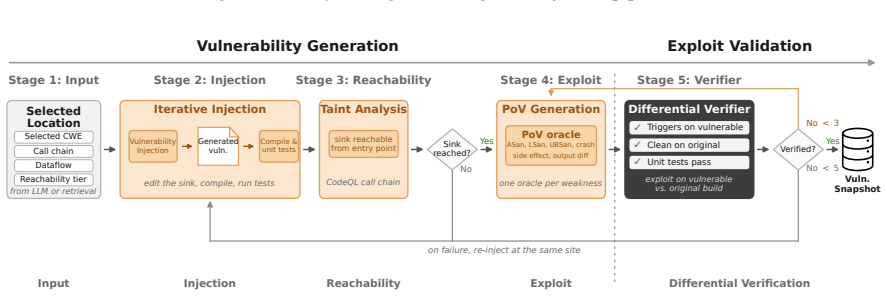
The load-bearing mechanism is a differential proof-of-vulnerability (PoV) oracle, applied to every candidate instance. It enforces two conditions: the injected build must pass the project's existing unit tests, and a generated PoV must trigger on the injected build while leaving the clean build unaffected. This oracle is shared by two complementary generation pipelines: a fuzzer-guided pipeline that targets functions reachable by existing harnesses, and an agentic in-context pipeline that selects sites by static analysis, retrieval of similar historical code patterns, and autonomous exploration. The oracle turns a synthetic bug into a certified training signal: it guarantees the injected project is still buildable and test-passing, that the weakness is latent under normal execution, and that it is demonstrably reachable by an adversarial input. The paper also uses the oracle to decide which teacher trajectories to keep, discarding any trajectory whose claimed success is not verified.
What would settle it
Compute the project-level overlap between the 80 training projects and the 24 SEC-bench projects (and any PatchEval repositories), retrain after deleting all training instances from overlapping projects, and check whether the SEC-bench and PatchEval improvements survive; if the gains collapse on fully disjoint projects, the generalization claim is falsified.
Extended reading notes
Core claim
On its own terms, the paper establishes that vulnerability injection with differential validation is a viable and scalable substitute for CVE mining. The core result is empirical: fine-tuning on oracle-verified trajectories over 1,034 injected vulnerabilities, across 80 projects and 63 weakness categories, improves a repair agent's success rate on the SEC-bench benchmark in every configuration tried. The improvements are not confined to the training distribution; every configuration also improves on PatchEval, whose Go, JavaScript, and Python instances are absent from the C/C++ corpus. The paper also claims the injected edits resemble real CVE patches in locality, with a two-sample Kolmogorov–Smirnov distance of 0.165 against a 0.190 real-versus-real baseline. The mechanism it credits is not better injection alone but the validation machinery: in the agentic pipeline, a naive single pass compiles and passes tests in 68.2% of attempts but validates 0% of them, while the full workflow raises validated yield to 7.5%.
Load-bearing premise
The evaluation benchmarks and the training projects may share source-level ancestry, so the reported gains could partly reflect memorization of familiar codebases rather than a general vulnerability-repair skill.
Editorial extensions
If this is right
- Corpus growth no longer depends on the rate of public vulnerability disclosure; any buildable project with a fuzzing harness can supply new training instances.
- Smaller students gain the most: the 12B model roughly doubles its SEC-bench score, and self-distillation improves every scale, so even a strong model can learn from its own verified trajectories.
- Fine-tuning transfers repair behavior, not just scores: students adopt the teacher's edit-and-verify workflow, with verification coverage rising from 20.7% to 82.7% at 12B and format-error rates collapsing.
- The gains carry to out-of-distribution languages (Go, JavaScript, Python), suggesting the corpus teaches general vulnerability-repair concepts rather than encoding C/C++ syntax patterns.
- Ensembling two students trained under different teachers beats either single student and even beats the stronger teacher (82.0% vs 74.0% at 31B), a post-hoc result the paper computes from the same runs.
Reading between the lines
- A testable extension not explored in the paper is to measure project-level overlap between the training projects and evaluation projects; if gains persist after excluding any overlapping repositories, that would strengthen the generalization claim beyond what is currently reported.
- Because validation is execution-based, the same differential oracle could be reused as a filter or reward signal for other synthetic-data generators, including those targeting other languages or non-memory-safety bug classes.
- The paper's edit-locality comparison suggests a cheap quality probe: monitor the Kolmogorov–Smirnov distance between injected and real patches over time as the pipeline scales; if distance grows, the corpus may drift toward idiosyncratic, easily caught bugs.
- One could test whether the trajectories' benefit comes from the successful-patch examples or from the failed attempts discarded by the oracle; training on filtered failures alone might reveal whether negative signal matters.
Signed reviews
Editorial analysis
A structured set of objections, weighed in public.
Referee Report
Summary. The paper presents CyberForge, a framework that generates repository-level vulnerability-injection training data for cybersecurity agents. CyberForge injects weaknesses into real C/C++ OSS-Fuzz projects, requires each injected build to pass the project's unit tests, and validates each instance by a differential proof-of-vulnerability oracle (PoV triggers on the injected build but not on the clean one). The released corpus contains 1034 validated vulnerabilities across 80 projects and 63 CWE categories. The authors collect agent trajectories on these instances using two teachers (GPT-5.4-mini and Gemma 4 31B) and fine-tune three Gemma 4 students (E4B, 12B, 31B). They report that all six student-teacher configurations improve SEC-bench patch repair by +3.3 to +14.7 percentage points, with the strongest 31B student reaching 72.7% against its teacher's 74.0%, and that all configurations also improve on PatchEval, a Go/JavaScript/Python benchmark disjoint in language from the C/C++ training corpus. The paper also claims that the injected edits have edit-locality statistics similar to real CVE patches under a real-versus-real noise floor.
Significance. If the empirical claims hold, this is a useful and timely contribution: it decouples security training-data generation from the rate of public CVE disclosure, provides reproducible containerized environments, validates every instance with an executable differential oracle rather than static heuristics, and shows consistent downstream gains across model scales and teachers. The cross-language PatchEval results and the self-distillation results are valuable pieces of evidence. The paper is also transparent about pipeline costs and reports a detailed cost accounting. The two main open issues are (1) unquantified project-level overlap between the CyberForge OSS-Fuzz training projects and the SEC-bench evaluation instances, which is load-bearing for the headline in-domain claim, and (2) the absence of repeated-seed or significance information behind the 'all six configurations improve' statement. These issues are fixable and do not undermine the framework's potential, but they must be resolved before the central claims can be accepted at face value.
major comments (3)
- [§3.1, Appendix A.4, Table 5] The paper never reports the project-level overlap between the 80 CyberForge training projects listed in Table 5 and the 24 SEC-bench projects. Because CyberForge deliberately targets OSS-Fuzz projects (§3.1) and Appendix A.4 states that SEC-bench's 300 real instances are split into '200 from the cve split and 100 from the oss split,' the two corpora plausibly share several projects (for example brotli, libarchive, libpng, or openssl). If common projects exist, the SEC-bench repair gains of +3.3 to +14.7 points (§5.1, Table 2) could reflect project-specific familiarity (file layout, build conventions, format-specific input quirks) rather than a general vulnerability-repair capability. This is load-bearing for the central claim that the gains are not memorization. Please report the exact project-level and instance-level overlap and re-evaluate on the disjoint subset of SEC-bench; PatchEval provides partial transfer evidence, but it does not validate the headline in-domain numbers on a disjoint C/C++ set.
- [§5.1, Table 2, Appendix D] Every fine-tuned model is trained once with seed 42 (Table 13) and evaluated on fixed benchmark sets, so there is no variance information and no significance testing behind the statement that all six student-teacher configurations improve. The smallest reported gains (+3.3 and +4.7 percentage points at E4B) are within the range that a single training run could flip under a different initialization or trajectory-sampling order, particularly given the small absolute number of solved instances (the E4B base solves only 9 of 150 SEC-bench instances). Please report multiple seeds (or permutation/bootstrap intervals over benchmark instances) and show that the improvements hold with accompanying uncertainty intervals.
- [§5.2 and Appendix A.4] The 'near-realistic' edit-locality claim is asserted from a single KS distance on functions changed (0.165 versus a real-to-real baseline of 0.190), but the same appendix reports injected-to-real distances of 0.123 for files touched and 0.243 for hunks, against baselines of 0.065 and 0.205. On the files-touched axis the injected corpus is nearly twice as far from real patches as two real corpora are from each other, so the statement that 'injected edits broadly resemble real patches' is not uniformly supported by the reported numbers. Please report all five axes with uncertainty estimates and either temper the realism claim or provide a multivariate assessment.
minor comments (4)
- [Figure 4] The pie-chart slices are described with percentages in the text but the figure itself does not show the values; adding percentage labels would make the failure-stage analysis self-contained.
- [Table 5] The caption says 'All 100 qualified OSS-Fuzz projects' but several rows show zero P1/P2 instances and zero CWE categories; please distinguish clearly between qualified projects and projects that contributed at least one validated instance, or mark the non-contributing rows explicitly.
- [Appendix E.5] The release metadata uses the value 'fuzz_poc_guided' as a producer identifier, while the paper consistently calls this pipeline 'fuzzer-guided'; please standardize the terminology between the paper and the released corpus metadata.
- [Listing 1] The text says the deleted line is shown in red, but the listing is monochrome; please use an explicit deletion marker or a footnote so the removed line is unambiguous in print.
Circularity Check
No circularity: CyberForge training and SEC-bench/PatchEval evaluation are connected empirically, not by construction.
full rationale
The claimed derivation chain is self-contained and non-circular. CyberForge builds a synthetic vulnerability corpus by injecting defects into OSS-Fuzz projects and admits instances only through a differential PoV oracle (unit tests pass; PoV fires on the injected build only). The downstream claim is that fine-tuning on teacher trajectories over this corpus raises SEC-bench and PatchEval repair scores. Nothing in that chain equates the training objective to the evaluation outcome: no SEC-bench instance or label enters the corpus, no parameter is fit to SEC-bench scores, and the differential oracle is not SEC-bench's oracle. The closest passage is Section 3.4: "Task construction matches SEC-bench (Lee et al. 2025), following the same methodology as (Luo et al. 2026), so that training and evaluation align," together with the trajectory-environment normalization in Appendix D. That creates a legitimate in-distribution/possible-contamination concern (project overlap between the 80 OSS-Fuzz training projects and SEC-bench's projects is not reported), but this is a validity or reproducibility risk, not circularity: the SEC-bench numbers are not implied by construction from the training data. The KS-distance realism comparison (Section 5.2, Appendix A.4) is a descriptive statistic against SEC-bench, not an optimized target. The only author self-citation, AVIATOR (Lbath et al. 2026), is used as comparative related work and is not load-bearing. No uniqueness theorem or ansatz is imported from the authors' prior work.
Assumptions & free parameters
free parameters (2)
- Candidate scoring weights
- Pipeline retry limits and time budgets
assumptions (3)
- domain assumption The differential PoV oracle is a sufficient certificate that an injected change is a real vulnerability.
- domain assumption OSS-Fuzz projects and their unit test suites are representative of real-world C/C++ software.
- domain assumption KS distance between edit-size distributions is a meaningful proxy for task-relevant realism of injected vulnerabilities.
Cite this review
Pith. "Pith review of CyberForge: Verified Vulnerability Injection at Repository Level for Cybersecurity Agent Training." pith.science (2026). https://pith.science/paper/MN35A37F
@misc{pith2026260806471,
  author       = {Pith},
  title        = {Pith review of: CyberForge: Verified Vulnerability Injection at Repository Level for Cybersecurity Agent Training},
  year         = {2026},
  howpublished = {\url{https://pith.science/paper/MN35A37F}},
  note         = {Machine review of arXiv:2608.06471}
}
read the original abstract
Despite recent advances, frontier large language model (LLM) agents remain limited in discovering and patching complex vulnerabilities in real-world software. Generally available agents can already aid attackers, who only need to find one exploitable weakness, while defenders must continuously identify and patch all vulnerabilities across fast-growing codebases. Stronger defensive agents would help close this gap, yet the scarcity of security training data with reproducible build and execution environments remains a bottleneck. We present CyberForge, a framework that synthesizes executable, repository-level security training data by injecting vulnerabilities into real C/C++ projects. It validates each instance dynamically: the injected build must pass the project's unit tests, and generated proof-of-vulnerability (PoV) must trigger on the injected build and not on the clean one. CyberForge is not limited by the availability of disclosed vulnerabilities, therefore it can scale in comparison to data augmentation techniques which rely on historic CVE data. The resulting corpus holds 1034 validated vulnerabilities across 80 projects and 63 weakness categories, with edit locality similar to real CVE patches under a real-versus-real noise floor. Fine-tuning on trajectories collected over this corpus improves SEC-bench patch repair by +3.3 to +14.7 points, in all six configurations of three model scales and two teachers, with the 31B student reaching its GPT-5.4-mini teacher, 72.7% against 74.0%. These gains generalize out of distribution to PatchEval, a corpus containing other programming languages, where every configuration also improves and the 31B student passes its teacher.
Figures


Figures from the paper (8 more)




Reference graph
Works this paper leans on
- [1]
-
[2]
Project Naptime / Big Sleep: From Naptime to Big Sleep---Evaluating Offensive Security Capabilities of Large Language Models , author =. 2024 , howpublished =
work page 2024
- [3]
-
[4]
Fang, Richard and Bindu, Rohan and Gupta, Akul and Kang, Daniel , journal =. 2024 , url =
work page 2024
- [5]
-
[6]
Pearce, Hammond and Ahmad, Baleegh and Tan, Benjamin and Dolan-Gavitt, Brendan and Karri, Ramesh , booktitle =. Asleep at the Keyboard?. 2022 , doi =
work page 2022
- [7]
-
[8]
2024 , url=
John Yang and Carlos E Jimenez and Alexander Wettig and Kilian Lieret and Shunyu Yao and Karthik R Narasimhan and Ofir Press , booktitle=. 2024 , url=
2024
Show all 59 references
-
[9]
2024 , url =
Ding, Yangruibo and Fu, Yanjun and Ibrahim, Omniyyah and Sitawarin, Chawin and Chen, Xinyun and Tizpaz-Niari, Saeid and Millstein, Todd and Ray, Baishakhi and Wang, Yizheng , booktitle =. 2024 , url =
2024
-
[10]
and Yang, John and Wettig, Alexander and Yao, Shunyu and Narasimhan, Karthik and Press, Ofir , booktitle =
Jimenez, Carlos E. and Yang, John and Wettig, Alexander and Yao, Shunyu and Narasimhan, Karthik and Press, Ofir , booktitle =. 2024 , url =
2024
-
[11]
Training Software Engineering Agents and Verifiers with
Pan, Jiayi and Wang, Xingyao and Neubig, Graham and Jaitly, Navdeep and Ji, Heng and Suhr, Alane and Zhang, Yizhen , booktitle =. Training Software Engineering Agents and Verifiers with. 2025 , note =
2025
-
[12]
and Wettig, Alexander and Khandpur, Kabir and Zhang, Yanzhe and Hui, Binyuan and Press, Ofir and Schmidt, Ludwig and Yang, Diyi , booktitle =
Yang, John and Lieret, Kilian and Jimenez, Carlos E. and Wettig, Alexander and Khandpur, Kabir and Zhang, Yanzhe and Hui, Binyuan and Press, Ofir and Schmidt, Ludwig and Yang, Diyi , booktitle =. 2025 , note =
2025
-
[13]
2025 , note =
Jain, Naman and others , booktitle =. 2025 , note =
2025
-
[14]
, booktitle =
Wei, Yuxiang and Duchenne, Olivier and Copet, Jade and Carbonneaux, Quentin and Zhang, Lingming and Fried, Daniel and Synnaeve, Gabriel and Singh, Rishabh and Wang, Sida I. , booktitle =. 2025 , note =
2025
-
[15]
2025 , url =
Lee, Hwiwon and others , journal =. 2025 , url =
2025
-
[16]
and others , booktitle =
Zhang, Andy K. and others , booktitle =. 2025 , note =
2025
-
[17]
2025 , note =
Zhu, Yuxuan and others , booktitle =. 2025 , note =
2025
-
[18]
2026 , eprint=
CyberGym: Evaluating AI Agents' Real-World Cybersecurity Capabilities at Scale , author=. 2026 , eprint=
2026
-
[19]
arXiv preprint arXiv:2408.08926 , year =
Cybench: A Framework for Evaluating Cybersecurity Capabilities and Risks of Language Models , author =. arXiv preprint arXiv:2408.08926 , year =
-
[20]
Shao, Minghao and Jancheska, Sofija and Udeshi, Meet and Dolan-Gavitt, Brendan and Xi, Haoran and Milner, Kimberly and Chen, Boyuan and Yin, Max and Garg, Siddharth and Krishnamurthy, Prashanth and Khorrami, Farshad and Karri, Ramesh and Shafique, Mohammad , booktitle =
-
[21]
arXiv preprint arXiv:2508.00910 , year =
Cyber-Zero: Training Cybersecurity Agents without Runtime , author =. arXiv preprint arXiv:2508.00910 , year =
-
[22]
arXiv preprint arXiv:2508.18370 , year =
Training Language Model Agents to Find Vulnerabilities with CTF-Dojo , author =. arXiv preprint arXiv:2508.18370 , year =
-
[23]
2023 , doi =
Nong, Yu and Ou, Yuzhe and Pradel, Michael and Chen, Feng and Cai, Haipeng , booktitle =. 2023 , doi =
2023
-
[24]
2023 , url =
Nong, Yu and Fang, Richard and Yi, Guangbei and Zhao, Kunsong and Luo, Xiapu and Chen, Feng and Cai, Haipeng , journal =. 2023 , url =
2023
-
[25]
2025 , note =
Xu, Xiangzhe and Su, Zian and Guo, Jinyao and Zhang, Kaiyuan and Wang, Zhenting and Zhang, Xiangyu , booktitle =. 2025 , note =
2025
-
[26]
From CVE Entries to Verifiable Exploits: An Automated Multi-Agent Framework for Reproducing
Saad Ullah and Praneeth Balasubramanian and Wenbo Guo and Amanda Burnett and Hammond Pearce and Christopher Kruegel and Giovanni Vigna and Gianluca Stringhini , journal =. From CVE Entries to Verifiable Exploits: An Automated Multi-Agent Framework for Reproducing. 2025 , url =
2025
-
[27]
Advances in Neural Information Processing Systems (NeurIPS) , year =
Devign: Effective Vulnerability Identification by Learning Comprehensive Program Semantics via Graph Neural Networks , author =. Advances in Neural Information Processing Systems (NeurIPS) , year =
-
[28]
2023 , url =
Chen, Yizheng and Ding, Zhoujie and Lamotte, Wyatt and Bhatt, Dhruv , booktitle =. 2023 , url =
2023
-
[29]
ACM Transactions on Software Engineering and Methodology , volume =
Large Language Model for Vulnerability Detection and Repair: Literature Review and the Road Ahead , author =. ACM Transactions on Software Engineering and Methodology , volume =. 2025 , doi =
2025
-
[30]
Fixing Security Vulnerabilities with
Zhang, Yuntong and others , booktitle =. Fixing Security Vulnerabilities with. 2026 , note =
2026
-
[31]
Disrupting the First Reported
Anthropic , year =. Disrupting the First Reported
-
[32]
2026 , url =
Wang, Zhun and Schiller, Nico and Li, Hongwei and He, Jingxuan and Holz, Thorsten and Song, Dawn , journal =. 2026 , url =
2026
-
[33]
Shi, Tianneng and Rheem, Robin and Jiang, Dongwei and Wang, Mona and Guo, Wenbo and Song, Dawn , journal =
-
[34]
2026 , url =
Lbath, Amine and Amini, Massih-Reza and Delaitre, Aurelien and Okun, Vadim , journal =. 2026 , url =
2026
-
[35]
2024 , doi =
Daneshvar, Seyed Shayan and Nong, Yu and Yang, Xu and Wang, Shaowei and Cai, Haipeng , journal =. 2024 , doi =
2024
-
[36]
2025 , url =
Yu, Yao-Ching and Chiang, Tsun-Han and Tsai, Cheng-Wei and Huang, Chien-Ming and Tsao, Wen-Kwang , journal =. 2025 , url =
2025
-
[37]
Frontier
Potter, Yujin and Guo, Wenbo and Wang, Zhun and Shi, Tianneng and Li, Hongwei and Zhang, Andy and Kelley, Patrick Gage and Thomas, Kurt and Song, Dawn , journal =. Frontier. 2025 , url =
2025
-
[38]
To Defend Against Cyber Attacks, We Must Teach
Zhuo, Terry Yue and Ding, Yangruibo and Guo, Wenbo and Meng, Ruijie , journal =. To Defend Against Cyber Attacks, We Must Teach. 2026 , url =
2026
-
[39]
2026 , howpublished =
Scaling Trusted Access for Cyber with. 2026 , howpublished =
2026
-
[40]
arXiv preprint arXiv:2408.12986 , year =
Top Score on the Wrong Exam: On Benchmarking in Machine Learning for Vulnerability Detection , author =. arXiv preprint arXiv:2408.12986 , year =
-
[41]
IEEE Transactions on Software Engineering , year =
Deep Learning Based Vulnerability Detection: Are We There Yet? , author =. IEEE Transactions on Software Engineering , year =
-
[42]
2024 , howpublished =
2024
-
[43]
Jiang, Lingxiao and Misherghi, Ghassan and Su, Zhendong and Glondu, Stephane , booktitle =
-
[44]
Proceedings of the 32nd International ACM SIGIR Conference on Research and Development in Information Retrieval , pages =
Reciprocal Rank Fusion Outperforms Condorcet and Individual Rank Learning Methods , author =. Proceedings of the 32nd International ACM SIGIR Conference on Research and Development in Information Retrieval , pages =
-
[45]
Transactions of the Association for Computational Linguistics (TACL) , volume =
Sparse, Dense, and Attentional Representations for Text Retrieval , author =. Transactions of the Association for Computational Linguistics (TACL) , volume =
-
[46]
Proceedings of the 2019 27th ACM Joint Meeting on European Software Engineering Conference and Symposium on the Foundations of Software Engineering (ESEC/FSE) , pages =
When Deep Learning Met Code Search , author =. Proceedings of the 2019 27th ACM Joint Meeting on European Software Engineering Conference and Symposium on the Foundations of Software Engineering (ESEC/FSE) , pages =
2019
-
[47]
2012 , publisher =
Serebryany, Konstantin and Bruening, Derek and Potapenko, Alexander and Vyukov, Dmitriy , booktitle =. 2012 , publisher =
2012
-
[48]
2026 , howpublished =
2026
-
[49]
2016 , publisher =
Dolan-Gavitt, Brendan and Hulin, Patrick and Kirda, Engin and Leek, Tim and Mambretti, Andrea and Robertson, Wil and Ulrich, Frederick and Whelan, Ryan , booktitle =. 2016 , publisher =
2016
-
[50]
2016 , publisher =
Pewny, Jannik and Holz, Thorsten , booktitle =. 2016 , publisher =
2016
-
[51]
Advances in Neural Information Processing Systems , volume =
Training Language Models to Follow Instructions with Human Feedback , author =. Advances in Neural Information Processing Systems , volume =
-
[52]
and Shen, Yelong and Wallis, Phillip and Allen-Zhu, Zeyuan and Li, Yuanzhi and Wang, Shean and Wang, Lu and Chen, Weizhu , booktitle =
Hu, Edward J. and Shen, Yelong and Wallis, Phillip and Allen-Zhu, Zeyuan and Li, Yuanzhi and Wang, Shean and Wang, Lu and Chen, Weizhu , booktitle =
-
[53]
mini-swe-agent: The 100 line AI agent that solves GitHub issues , year =
-
[54]
USENIX Security Symposium , year =
On the Benefits of Cheating in Fuzzing: Reassessing Bug Injection for Fuzzer Evaluation , author =. USENIX Security Symposium , year =
-
[55]
arXiv preprint arXiv:2511.11019 , year =
PatchEval: A Multi-Language Benchmark for Automated Vulnerability Repair , author =. arXiv preprint arXiv:2511.11019 , year =
-
[56]
2026 , month = jul, howpublished =
2026
-
[57]
2026 , note =
Luo, Xianzhen and Zhang, Jingyuan and Zhou, Shiqi and Huang, Rain and Xiao, Chuan and Zhu, Qingfu and Ma, Zhiyuan and Yue, Xing and Yue, Yang and Zeng, Wencong and Che, Wanxiang , booktitle =. 2026 , note =
2026
-
[58]
, booktitle =
Zelikman, Eric and Wu, Yuhuai and Mu, Jesse and Goodman, Noah D. , booktitle =
-
[59]
The Annals of Mathematical Statistics , volume =
Table for Estimating the Goodness of Fit of Empirical Distributions , author =. The Annals of Mathematical Statistics , volume =
Reviewed August 15, 2026 · model on record in the stance chip above.
Discussion (0). Continue with ORCID to comment.