Anomalous magneto-optical response at RuO₂ / WSe₂ van der Waals interface
Pith reviewed 2026-06-26 16:19 UTC · model grok-4.3
The pith
Weak surface magnetic states in RuO2 control valley splitting in adjacent WSe2 through interfacial exchange fields instead of linear Zeeman response.
A machine-rendered reading of the paper's core claim, the machinery that carries it, and where it could break.
Core claim
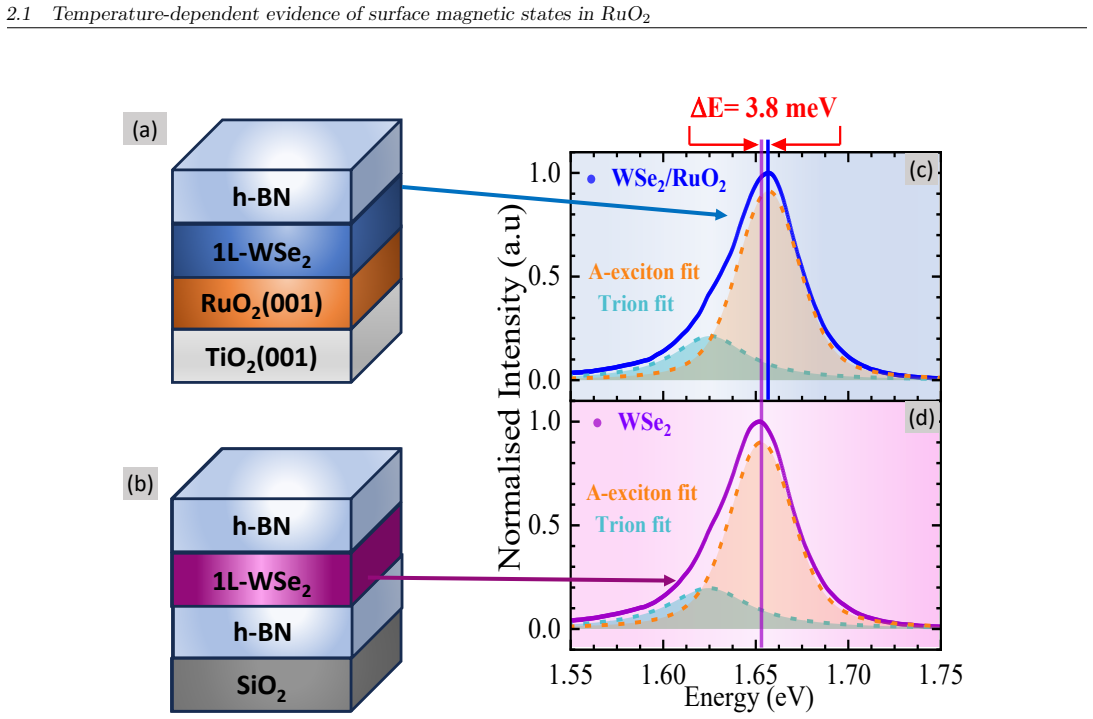
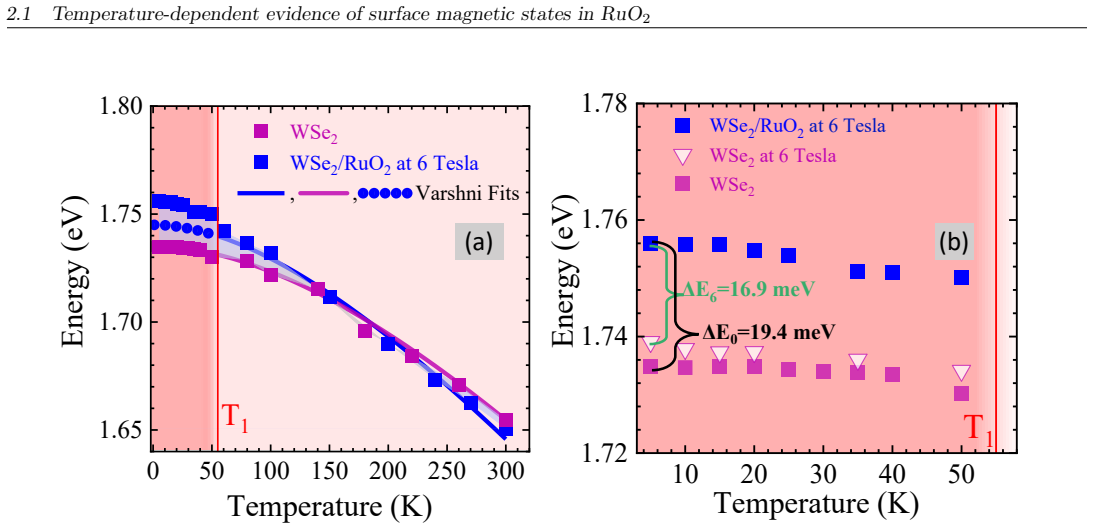
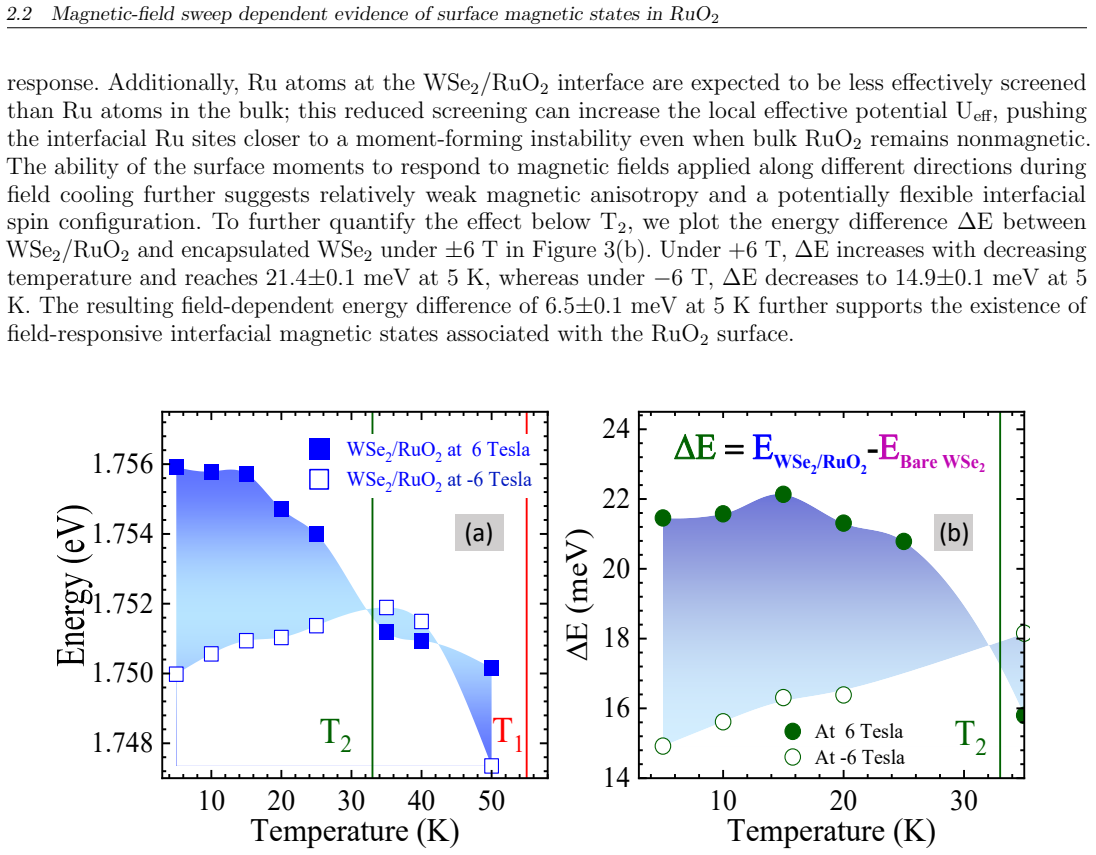
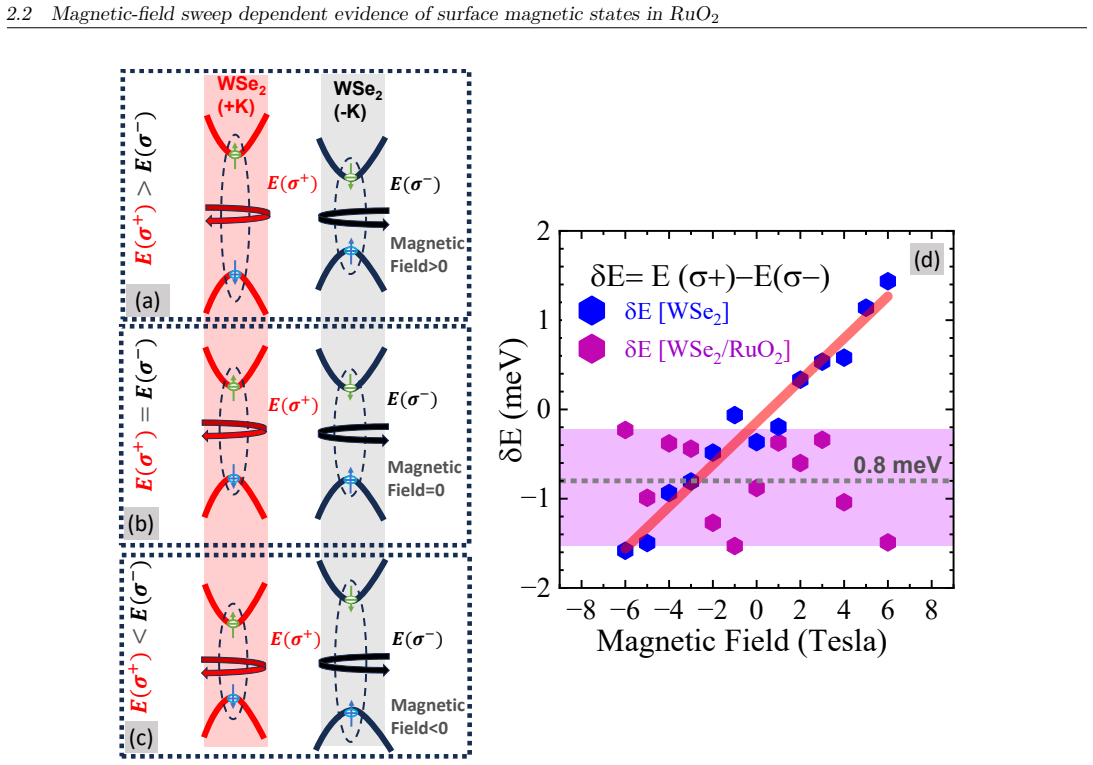
The valley states in WSe2 are governed predominantly by interfacial exchange fields associated with weak surface magnetic states in RuO2, which do not produce a conventional linear Zeeman response within the applied magnetic field range. This is shown by the anomalous excitonic energy shift that reverses upon field cooling with opposite polarity and by the nearly field-independent fluctuating valley splitting, both absent in encapsulated WSe2 controls.
What carries the argument
Magnetic proximity effect at the RuO2/WSe2 van der Waals interface, which couples WSe2 excitons to weak surface magnetic states in RuO2 and produces the observed anomalous shifts and splitting.
If this is right
- Direct optical access to emergent surface magnetism becomes possible in materials whose bulk magnetic order is under debate.
- MPE-based spectroscopy can serve as a probe for weak surface magnetism without requiring an additional ferromagnetic layer.
- New routes open for studying altermagnetic candidates and other controversial magnetic states through valley optics.
- Temperature and field-cooling protocols can distinguish magnetic from non-magnetic interface contributions.
Where Pith is reading between the lines
- If the surface states are confirmed as magnetic, similar heterostructures could map hidden magnetism in other oxide films.
- The fluctuating splitting may indicate nanoscale magnetic domains or slow dynamics at the interface that could be tested with local probes.
- This optical method might be combined with electrical transport to separate exchange from orbital effects in the same stack.
Load-bearing premise
The anomalous excitonic shift and fluctuating valley splitting are caused specifically by magnetic exchange from weak surface states in RuO2 rather than by non-magnetic interface effects such as strain or charge transfer.
What would settle it
Observation of the same anomalous shift and fluctuating splitting in a control heterostructure using non-magnetic RuO2, or emergence of conventional linear Zeeman splitting at higher fields or different temperatures.
Figures
read the original abstract
Ruthenium dioxide ($\mathrm{RuO_2}$) has been proposed as an altermagnetic candidate, although its magnetic ground state remains controversial. Here, we probe weak interfacial magnetic states at the surface of (001)-oriented $\mathrm{RuO_2}$ films using the magnetic proximity effect (MPE) in a van der Waals heterostructure consisting of monolayer tungsten diselenide ($\mathrm{WSe_2}$) atop $\mathrm{RuO_2}$. Temperature-dependent magneto-optical spectroscopy reveals an anomalous excitonic energy shift and a deviation from conventional Varshni behavior below 55 K that are absent in an encapsulated $\mathrm{WSe_2}$ control sample. The anomalous shift reverses sign upon field cooling with opposite magnetic field polarity, indicating a magnetic origin. Polarization-resolved measurements further show a nearly field-independent and fluctuating valley splitting in $\mathrm{WSe_2 / RuO_2}$ in strong contrast to the conventional linear Zeeman splitting observed in the control bare $\mathrm{WSe_2}$ sample. These results suggest that the valley states are governed predominantly by interfacial exchange fields associated with weak surface magnetic states in $\mathrm{RuO_2}$, which do not produce a conventional linear Zeeman response within the applied magnetic field range. Importantly, this approach enables direct optical probing of emergent surface magnetism without introducing an additional ferromagnetic layer, positioning MPE-based optical probing as a tool for investigating weak surface magnetism and offering new possibilities for studying magnetic materials with controversial magnetic states.
Editorial analysis
A structured set of objections, weighed in public.
Referee Report
Summary. The manuscript reports temperature- and field-dependent magneto-optical spectroscopy on monolayer WSe2 atop (001) RuO2 films. It claims observation of an anomalous excitonic energy shift below 55 K (absent in encapsulated WSe2 control) that reverses sign upon opposite-polarity field cooling, together with a nearly field-independent fluctuating valley splitting (contrasting linear Zeeman response in bare WSe2). These are interpreted as signatures of interfacial exchange fields from weak surface magnetic states in RuO2 rather than conventional Zeeman or non-magnetic interfacial effects, positioning the approach as a tool for probing controversial magnetism without an added ferromagnetic layer.
Significance. If the magnetic attribution holds after stronger controls, the work would provide a direct optical probe of weak surface magnetism in candidate altermagnets such as RuO2 and demonstrate MPE-based spectroscopy as a general method for 2D heterostructures, which is of interest to the condensed-matter community.
major comments (2)
- [Abstract / Results interpretation] Abstract and main text: the attribution of the anomalous excitonic shift and fluctuating valley splitting specifically to interfacial exchange fields from weak surface magnetic states in RuO2 is not quantitatively supported. The encapsulated WSe2 control excludes only substrate-independent effects; it does not address whether history-dependent shifts or fluctuations could arise from non-magnetic mechanisms (field-modulated charge transfer, strain relaxation below 55 K). No modeling of expected exchange-field magnitude, no additional non-magnetic interface controls, and no direct magnetic characterization are described.
- [Results / Data Analysis] Data presentation: the abstract and reported observations are purely qualitative, with no quantitative values, error bars, sample statistics, or details on how post-processing or fitting choices affect the claimed deviation from Varshni behavior and the field independence of the valley splitting. This weakens the ability to assess the robustness of the magnetic-origin claim.
minor comments (1)
- [Abstract / Methods] Notation for the RuO2 surface states and the precise definition of 'nearly field-independent' should be clarified with explicit field ranges and fitting procedures.
Simulated Author's Rebuttal
We thank the referee for the constructive feedback on our manuscript. We address each major comment below with clarifications and note the planned revisions.
read point-by-point responses
-
Referee: [Abstract / Results interpretation] Abstract and main text: the attribution of the anomalous excitonic shift and fluctuating valley splitting specifically to interfacial exchange fields from weak surface magnetic states in RuO2 is not quantitatively supported. The encapsulated WSe2 control excludes only substrate-independent effects; it does not address whether history-dependent shifts or fluctuations could arise from non-magnetic mechanisms (field-modulated charge transfer, strain relaxation below 55 K). No modeling of expected exchange-field magnitude, no additional non-magnetic interface controls, and no direct magnetic characterization are described.
Authors: We agree that quantitative modeling of the exchange-field magnitude is absent and that direct magnetic characterization is not included. However, the reversal of the anomalous excitonic shift upon opposite-polarity field cooling provides a signature difficult to attribute to non-magnetic mechanisms such as charge transfer or strain relaxation, which lack this magnetic-history dependence. The encapsulated control and contrast to the linear Zeeman response in bare WSe2 further support the interfacial magnetic interpretation. We will revise the manuscript to add explicit discussion of alternative non-magnetic mechanisms and their incompatibility with the polarity-dependent data, while noting the lack of quantitative modeling and direct magnetic measurements as limitations. revision: partial
-
Referee: [Results / Data Analysis] Data presentation: the abstract and reported observations are purely qualitative, with no quantitative values, error bars, sample statistics, or details on how post-processing or fitting choices affect the claimed deviation from Varshni behavior and the field independence of the valley splitting. This weakens the ability to assess the robustness of the magnetic-origin claim.
Authors: We accept that the data presentation is qualitative in the current version. The revised manuscript will include quantitative values for the excitonic shifts and valley splittings, error bars from repeated measurements, sample statistics across multiple devices, and detailed descriptions of post-processing and fitting procedures to demonstrate how these choices affect the identified deviations from Varshni behavior and the observed field independence. revision: yes
Circularity Check
No circularity: purely experimental spectroscopic report with no derivations or self-referential reductions
full rationale
The manuscript reports temperature- and field-dependent magneto-optical spectroscopy on a WSe2/RuO2 heterostructure versus controls. No equations, fitted parameters, or derivations are present in the provided text or abstract. Claims rest on direct observation of anomalous shifts and valley splitting, interpreted via sign reversal under field-cooling polarity and contrast to the encapsulated control. No self-citation chains, ansatzes, or uniqueness theorems are invoked to force results. The interpretation that interfacial exchange fields from weak surface magnetism dominate is presented as a suggestion from the data, not a mathematical reduction to inputs. This meets the criteria for a self-contained experimental paper against external benchmarks (control samples, temperature/field dependence), warranting score 0 with no steps.
Axiom & Free-Parameter Ledger
axioms (1)
- domain assumption Magnetic proximity effect from RuO2 surface states produces exchange fields that dominate valley and excitonic response in overlying WSe2.
Reference graph
Works this paper leans on
-
[1]
Zhong, K
D. Zhong, K. L. Seyler, X. Linpeng, N. P. Wilson, T. Taniguchi, K. Watanabe, M. A. McGuire, K.-M. C. Fu, D. Xiao, W. Yao,Nat. Nanotechnol.2020,15187
2020
-
[2]
M. H. Shaikh, M. P. Whalen, D. Q. Ho, A. Ishraq, C. Maurtua, K. Watanabe, T. Taniguchi, Y. Ren, A. Janotti, J. Q. Xiao, C. Chakraborty,ACS Nano2025,19, 41 36294
-
[3]
C. Chakraborty, M. H. Shaikh, In2D Photonic Materials and Devices VII, volume PC12888. SPIE,2024 PC1288805, URL https://www.spiedigitallibrary.org/conference-proceedings-of-spie/ PC12888/PC1288805/Flatland-quantum-materials/10.1117/12.3006501.full
-
[4]
Zhang, X
X. Zhang, X. Xie, S. Li, J. Chen, S. Hou, Y. Chen, J. He, Z. Liu, Y. Liu,Small2026, e11798
-
[5]
A. Beer, K. Zollner, C. Serati De Brito, P. E. Faria Junior, P. Parzefall, T. S. Ghiasi, J. Ingla-Ayn´ es, S. Ma˜ nas-Valero, C. Boix-Constant, K. Watanabe, T. Taniguchi, J. Fabian, H. S. J. Van Der Zant, Y. Galv˜ ao Gobato, C. Sch¨ uller,ACS Nano2024,18, 45 31044
-
[6]
M. H. Shaikh, A. Hutchinson, C. Maurtua, S. Nepal, K. Watanabe, T. Taniguchi, L. N. Holtz- man, K. Barmak, J. Hone, J. Q. Xiao, C. Chakraborty,Small Methods n/a, n/a e00011, eprint: https://onlinelibrary.wiley.com/doi/pdf/10.1002/smtd.202600011
-
[7]
A. Raja, A. Chaves, J. Yu, G. Arefe, H. M. Hill, A. F. Rigosi, T. C. Berkelbach, P. Nagler, C. Sch¨ uller, T. Korn, C. Nuckolls, J. Hone, L. E. Brus, T. F. Heinz, D. R. Reichman, A. Chernikov,Nat. Commun. 2017,8, 1 15251
2017
-
[8]
Chernikov, T
A. Chernikov, T. C. Berkelbach, H. M. Hill, A. Rigosi, Y. Li, B. Aslan, D. R. Reichman, M. S. Hybertsen, T. F. Heinz,Phys. Rev. Lett.2014,113076802
2014
-
[9]
Huang, T
J. Huang, T. B. Hoang, M. H. Mikkelsen,Sci. Rep.2016,6, 1 22414
2016
-
[10]
Varshni,Physica1967,34, 1 149
Y. Varshni,Physica1967,34, 1 149
-
[11]
Chakraborty, K
C. Chakraborty, K. M. Goodfellow, S. Dhara, A. Yoshimura, V. Meunier, A. N. Vamivakas,Nano Letters2017,17, 4 2253, publisher: American Chemical Society
-
[12]
Chakraborty,Physical Review B2019,99, 4
C. Chakraborty,Physical Review B2019,99, 4
-
[13]
Srivastava, M
A. Srivastava, M. Sidler, A. V. Allain, D. S. Lembke, A. Kis, A. Imamo˘ glu,Nature Physics2015,11, 2 141, publisher: Nature Publishing Group
-
[14]
J. H. Prechtel, F. Maier, J. Houel, A. V. Kuhlmann, A. Ludwig, A. D. Wieck, D. Loss, R. J. Warburton, Physical Review B2015,91, 16 165304, publisher: American Physical Society
-
[15]
Q. Zhou, F. Wang, A. Soleymani, K. Watanabe, T. Taniguchi, J. Wei, X. Lu,npj 2D Materials and Applications2025,9, 1 116, publisher: Nature Publishing Group. 10
discussion (0)
Sign in with ORCID, Apple, or X to comment. Anyone can read and Pith papers without signing in.