REVIEW 2 major objections 5 minor 43 references
Active spin model for cell assemblies on 1D substrates
T0 review · 2 major / 5 minor · reviewed 2026-08-06 · deepseek-v4-flash
Pith's one-line read This paper derives an exact exponential cluster-size law for fast-switching cell assemblies on 1D substrates and an approximate universal scaling law for the high-activity regime.
desk verdict A solid but modest paper: the new KLS exact limit is worth knowing, while the Q>>1 scaling rests on an ad hoc closure the referee should push on. read the letter →
The pith
A machine-rendered reading of the paper's core claim, the machinery that carries it, and where it could break.
The reading
What carries the argument
The argument runs on two calculational devices plus one controlling parameter. First, the KLS mapping: in the fast-switching limit $Q\ll 1$ and with CIL and alignment interactions switched off, the polarity degrees of freedom equilibrate, leaving an occupation Hamiltonian $H_{\rm KLS} = -J_o\sum_i n_i n_{i+1}$ with $J_o = \ln((a+\delta)/(a-\delta))$; rewriting occupations as Ising spins $s_i = 2n_i - 1$ lets the transfer matrix produce the exact partition function and cluster probabilities. Second, for $Q\gg 1$ an effective Helmholtz free-energy functional counts dense clusters $G_c(m)$ of size $m$, combines the configurational entropy of arranging them with cluster energies $E_a(m) = -(m-1)J_o$ and the CIL energy $E_p(m)$, and fixes particle number and cluster number by Lagrange multipliers; minimizing $F$ yields the exponential cluster-size distributions and their means. Third, the dimensionless Péclet number $Q = a/b$ selects which device applies and sets the scaling $\langle m_c\rangle \propto Q^{1/2}$, so the model's regime of validity is written directly into its main predictions.
What would settle it
Run the same Monte Carlo dynamics at $Q\gg 1$ with fixed switching rate $b$ and measure the average dense-cluster size over a range of $Q$ and $J_1$; if $\langle m_c\rangle/(Q^{1/2}e^{J_1/4})$ drifts systematically instead of staying flat, the assumed gas-phase dimer balance is wrong. Alternatively, count dimer creation and breakup events in the gas phase directly and compare their rates with condition (d) of Appendix C.
Extended reading notes
Core claim
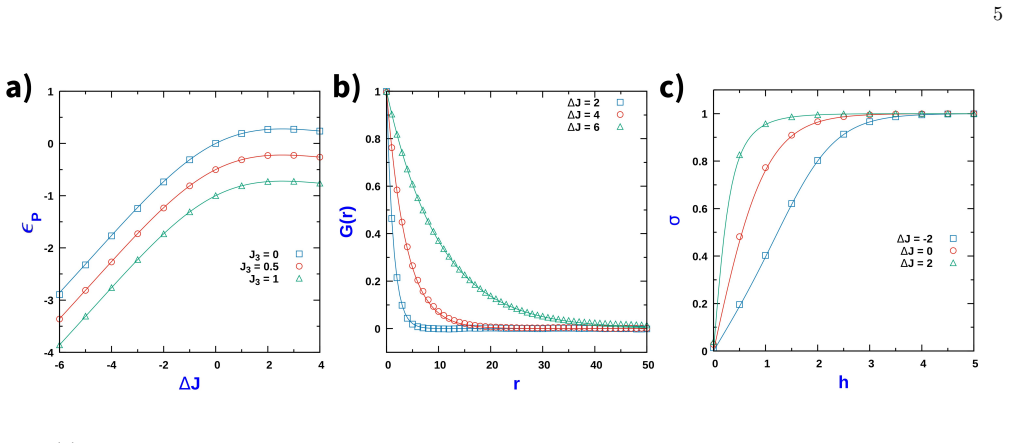
At the paper's heart is the claim that a minimal driven lattice gas, not a hydrodynamic description, captures the emergent clustering of confined cell sheets. For a confluent monolayer the model is an equilibrium spin chain solved exactly by transfer matrices: mean polarization vanishes, polarization correlations decay exponentially with a length set by $\Delta J = J_1 - J_2 + 4J_3$, and a polarizing field produces the magnetization response of Eq. (9). With vacancies, the fast-switching limit without CIL or alignment is an exact KLS model, and the transfer-matrix solution yields the exponential cluster-size distribution $P(m) = (e^D - 1)e^{-Dm}$, with decay constant $D$ given by Eq. (18); the average cluster size follows as $\langle m\rangle = e^D/(e^D - 1)$, reducing at density $\rho = 1/2$ to $\langle m\rangle = 1 + e^{J_o/2}$. In the high-activity regime $Q \gg 1$, minimizing the effective Helmholtz free energy over cluster numbers gives an exponential dense-cluster distribution $P_c(m) = A_c e^{-m/m_c}$ whose mean behaves at leading order as $\langle m_c\rangle = (\rho/(1-\rho))^{1/2} e^{J_1/4} Q^{1/2}$, independent of the attractive strength $J_o$; rescaling cluster sizes by $\omega = m((1-\rho)/(Q\rho))^{1/2} e^{-J_1/4}$ collapses distributions from different parameters onto one curve in the approximate sense stated in the paper. The same free-energy framework underlies the reported non-monotonic, re-entrant dependence of average cluster size on CIL strength, hopping rate, and attraction.
Load-bearing premise
In the high-activity regime the paper assumes, rather than derives, a steady-state balance between the creation and breakup of two-cell clusters in the sparse gas phase (condition (d) in Appendix C); the predicted $Q^{1/2}$ scaling would fail if that balance is inaccurate.
Editorial extensions
If this is right
- In the fast-switching regime, the closed form $P(m) = (e^D - 1)e^{-Dm}$ makes the effective attraction $J_o$ directly inferable from measured cluster-size histograms.
- At high activity, dense-cluster size grows as $Q^{1/2}e^{J_1/4}$ and only weakly depends on attraction, so in this regime CIL strength is the dominant control knob for cluster growth.
- Rescaling cluster sizes by $\omega = m((1-\rho)/(Q\rho))^{1/2}e^{-J_1/4}$ should collapse cluster-size distributions across densities, activities, and CIL strengths onto a single exponential master curve.
- For confluent packing, the model predicts no spontaneous polar order and an exponentially decaying polarity correlation function, with correlation length controlled by $\Delta J$; this is a measurable prediction for dense monolayers.
Reading between the lines
- Because the low-$Q$ formula is exact, it invites an inverse analysis the paper does not develop: fitting experimental $P(m)$ histograms to $P(m)=(e^D-1)e^{-Dm}$ yields a value of $J_o$, and repeating the fit at several densities tests the model itself rather than assuming it.
- The high-$Q$ prediction that $\langle m_c\rangle$ is, to leading order, independent of the attractive strength suggests that mutations altering cell adhesion may leave cluster growth unchanged when CIL dominates; a crossover experiment varying adhesion at fixed CIL would probe this boundary.
- The paper's own caveat that strict exclusion and unscaled switching and hopping suppress motility-induced phase separation in one dimension suggests a concrete next test: relaxing particle crossing or rescaling rates with system size could make macroscopic phase separation appear, and the scaling law derived here would then mark the crossover.
Signed reviews
Editorial analysis
A structured set of objections, weighed in public.
Referee Report
Summary. The paper introduces a 1D lattice-gas model of cell assemblies with self-propulsion, polarity switching, short-range attraction, and contact inhibition of locomotion (CIL). In the fully packed state, translation is arrested and the model reduces to an equilibrium spin model solved exactly by transfer matrix methods. In the presence of vacancies and in the absence of CIL/alignment interactions, the authors map the fast-switching limit Q<<1 to the Katz-Lebowitz-Spohn (KLS) model and derive closed-form expressions for the cluster size distribution and average cluster size, validating them with Monte Carlo simulations at Q=0.01. For Q>>1, an effective free-energy minimization is used to predict exponentially distributed clusters with average size scaling as Q^{1/2} e^{J1/4}, and a data collapse in terms of a scaled cluster size is reported. The paper closes with parameter estimates from MDCK experiments and a discussion of non-monotonic cluster-size behavior in contour plots.
Significance. If the central results hold, the paper provides a useful analytic reference for clustering in quasi-1D cell assays: an exact (in the fast-switching limit) cluster size distribution for the non-CIL case, and a compact scaling prediction for the CIL-dominated regime. The transfer-matrix solution of the fully packed state and the KLS-based expressions for cluster statistics are clear strengths, and the Monte Carlo comparisons at Q=0.01 support the KLS mapping. The paper also gives a falsifiable prediction for the average cluster size and a plausible route to estimate interaction parameters from experiments. However, the Q>>1 scaling rests on an ad hoc closure that is not derived from the microscopic rates, and the range of validity of the scaling is not established; these issues affect the central large-Q claim.
major comments (2)
- [Appendix C, condition (d)] The Q>>1 derivation is closed by a dimer production/disintegration balance that is not derived from the microscopic transition rates in Table I. Conditions (a)-(c) fix only total particle number, cluster number, and density balance, leaving mc and mg undetermined; condition (d) then fixes them by assuming that every particle emitted from a cluster forms a dimer before reaching the next cluster, using the geometric-mean escape rate k_out = b(a-δ)/(b+a-δ), and evaluating the disintegration rate with G_c(2) from the exponential form being fitted. None of these rate expressions follows from the master equation, and no simulation test of condition (d) is reported. Since Eq. (26) and the collapse in Fig. 5(c) are consequences of this closure, the central Q>>1 scaling prediction is not yet established. I ask the authors to derive condition (d) from the microscopic transition rates or to test it directly by measuring dimer production and disintegration currents in the simulations, and to assess the sensitivity of Eq. (26) to alternative closures.
- [Equation (26) and Appendix C] The stated range of validity preceding Eq. (26), namely 'Q >> e^{J0}, e^{J1}', is asserted rather than derived. As written, this condition does not guarantee that the leading term Q^{1/2} e^{J1/4} dominates the subleading terms in the full expression for <mc> in Appendix C, particularly for large J1 where the full expression contains e^{J1}-type contributions. The authors should expand the full expression explicitly, identify the subleading terms, and state the precise asymptotic condition under which Eq. (26) holds.
minor comments (5)
- [Abstract and Section III.B.1] The text calls the reduction to KLS an 'exact mapping', but the model is only approximated by KLS in the limit Q<<1; please rephrase to 'asymptotically exact as Q→0' to avoid overstatement.
- [Figures 4 and 5] The captions of Figs. 4 and 5 do not list the parameter values used for each curve (e.g., the values of Q and Jo for each data set, and the full parameter list for the collapse in Fig. 5(c)). Without these values, the comparison with Eq. (26) and the claimed universal collapse cannot be independently assessed; please add a table or explicit parameter lists.
- [Equation (16)] The expression for the average energy per site in Eq. (16) has unbalanced parentheses and ambiguous notation; please define all symbols explicitly and ensure the equation is typeset correctly.
- [General text] There are several typographical errors, including 'aseemblies' in Section I, 'avarage' in Appendix C, and garbled layouts in the displayed formulas of Appendix C; a careful proofread is needed.
- [Section III.C.2] The non-monotonic 're-entrant-like' behavior is discussed for ρ=0.8 only, while the abstract and scaling results emphasize the role of density; the dependence of the contour behavior on ρ is not characterized, so the generality of the phase behavior remains unclear.
Circularity Check
No significant circularity; the Q<<1 KLS mapping is independently derived and MC-validated, and the Q>>1 closure in Appendix C is ad hoc but not a circular reduction.
full rationale
The paper's main derivations are self-contained against Monte Carlo simulation. The Q<<1 KLS mapping follows directly from the microscopic rates: with J1=J2=J3=0 the effective Hamiltonian is HT = -Jo sum_i n_i n_{i+1} with Jo = ln((a+delta)/(a-delta)) (Eq. 10), and the transfer-matrix calculation (Eqs. 12-16) yields the exact cluster-size distribution (Eq. 17) and average cluster size (Eq. 19), which are then compared with MC simulations in Fig. 3. This is a genuine mapping and prediction, not a renamed known result or a fitted input. The Q>>1 calculation minimizes an effective Helmholtz free energy (Eq. 23) and obtains exponential cluster-size forms (Eqs. 24-25) from delta F = 0; the parameters are fixed by mass-balance conditions (a)-(e) in Appendix C. Condition (d), the dimer-production/disintegration balance, is indeed an ad hoc closure rather than a first-principles microscopic rate balance, so the predicted scaling <mc> ~ Q^{1/2} e^{J1/4} carries a correctness risk. However, this condition is not fitted to the MC data used for validation and is not equivalent to the predicted output by construction. The citation of the authors' own Ref. [21] for the free-energy method is a self-citation, but the paper re-derives the calculation and validates it against independent MC data in Figs. 4-5, so it does not make the argument circular. No step satisfying the hard circularity criteria—self-definition, fitted prediction, load-bearing self-citation, or ansatz smuggled in via citation—was found.
Assumptions & free parameters
assumptions (4)
- domain assumption Separation of timescales for Q<<1: polarity switching rate b is much faster than hopping rate a, so the system equilibrates with respect to the attractive Hamiltonian.
- domain assumption The hopping rates a+delta and a-delta satisfy detailed balance with the attractive energy Jo = ln((a+delta)/(a-delta)).
- ad hoc to paper In the Q>>1 regime, the steady state consists of coexisting dense cluster and dilute gas phases with exponential cluster size distributions.
- ad hoc to paper The dimer production/disintegration rate balance (condition (d) in Appendix C) determines the steady state in Q>>1.
Cite this review
Pith. "Pith review of Active spin model for cell assemblies on 1D substrates." pith.science (2026). https://pith.science/paper/MNJLCD46
@misc{pith2026250722639,
  author       = {Pith},
  title        = {Pith review of: Active spin model for cell assemblies on 1D substrates},
  year         = {2026},
  howpublished = {\url{https://pith.science/paper/MNJLCD46}},
  note         = {Machine review of arXiv:2507.22639}
}
read the original abstract
The experimental use of micropatterned quasi-1D substrates has emerged as an useful experimental tool to study the nature of cell-cell interactions and gain insight on collective behaviour of cell colonies. Inspired by these experiments, we propose an active spin model to investigate the emergent properties of the cell assemblies. The lattice gas model incorporates the interplay of self-propulsion, polarity directional switching, intra-cellular attraction, and contact Inhibition Locomotion (CIL). In the absence of vacancies, which corresponds to a confluent cell packing on the substrate, the model reduces to an equilibrium spin model which can be solved exactly. In the presence of vacancies, the clustering is controlled by a dimensionless Peclet Number, Q - the ratio of magnitude of self-propulsion rate and directional switching rate of particles. In the absence of CIL interactions, we invoke a mapping to Katz-Lebowitz-Spohn(KLS) model to determine an exact analytical form of the cluster size distribution in the limit Q << 1. In the limit of Q >> 1, the cluster size distribution exhibits an universal scaling behaviour (in an approximate sense), such that the distribution function can be expressed as a scaled function of Q, particle density and CIL interaction strength. We characterize the phase behaviour of the system in terms of contour plots of average cluster size. The average cluster size exhibit a non-monotonic dependence on CIL interaction strength, attractive interaction strength, and self-propulsion.
Figures


Figures from the paper (5 more)


Reference graph
Works this paper leans on
- [21]
-
[1]
Reduction to KLS model We now focus on the regime where the polarization alignment interactions are weak or negligible, which cor- responds to J1 = J2 = J3 = 0. If the rate of polarity switching, b, is much faster than the rate of hopping a, corresponding to the limit, Q ≪ 1, the model can be approximated by an effective KLS model. Accordingly, we use the...
-
[2]
Partition function and Average Energy The corresponding Gibb’s partition function in the constant density ensemble reads, ZG(L, ρ) = X si exp "X i Jo 4 sisi+1 + hosi # (12) 5 FIG. 2. (a) Variation of the average energy per particle ϵp as a function of ∆J for different values of J3. ϵp is expressed in units of kBT , with T being the effective active temper...
work page 2000
-
[3]
Cluster size characteristics A cluster of size m is a continuous stretch of m par- ticles, with vacancies on both sides. A general configu- ration of a cluster of size m can be schematically repre- sented as, −1 11111 ...1| {z } m −1 The probability of a cluster of size m with L sites i.e. PL,ρ(m) can be expressed in terms of the probability of finding a ...
work page 2000
-
[4]
Universality of cluster size distribution when Q ≫ 1 When the translation rate is larger than the polarity switching rate, Q ≫ 1, the system segregates into alter- nate regions of dense clusters(c) phase and a low density gas phase(g). It maybe noted that for the dense cluster(c) phase, the smallest cluster comprises of at least two par- ticles. In this l...
work page 2000
-
[5]
General cluster size properties We focus on the nature of clustering in cell assemblies due to the interplay of CIL strength through J1 and J2, the aligning interaction strength J3, the translation hop- ping rate a, and the attractive interaction strength δ. Cluster size is controlled by the interplay of Q = a b (ratio of transition rate a to switching ra...
work page 2000
-
[6]
Comparison of KLS model cluster characteristics with MC simulations in Q ≫ 1 limit Fig. 7 shows the comparison of cluster characteristics using MC simulation results in the Q ≫ 1 limit, with analytical form of average energy per site, P(m) and ⟨m⟩ obtained by mapping the problem to KLS model. As ex- pected, in the Q ≫ 1 limit, the divergence of the MC sim...
-
[7]
8) to further illustrate the dy- namic behavior of the system under investigation
Spatio-T emporal Plots In this appendix, we present additional spatio- temporal plots (see Fig. 8) to further illustrate the dy- namic behavior of the system under investigation. These plots provide a more comprehensive view of the evolution of spatial patterns over time. By analyzing these visu- alizations, we aim to highlight features that may not be ap...
Show all 43 references
-
[8]
Smeets and et al., Proc
B. Smeets and et al., Proc. Natl. Acad. Sci. 113, 14621 (2016)
2016
-
[9]
Alert and X
R. Alert and X. Trepat, Annu. rev. Conens. Matter Phys. 11, 77 (2020)
2020
-
[10]
Friedl and D
P. Friedl and D. Gilmour, Nat. Rev. Mol. Cell. Biol. 10, 445 (2009)
2009
-
[11]
M. C. Moh and S. Shen, Cell Adh Migr. 3, 334 (2009)
2009
-
[12]
A. X. S. Santos and P. Liberali, FEBS J. 286(8), 1495 (2019)
2019
-
[13]
D. T. Tambe and et al., Nat. Mater. 10, 469 (2011)
2011
-
[14]
Ramaswamy, Ann
S. Ramaswamy, Ann. Rev. Cond. Mat. Phys. 1, 323 (2010)
2010
-
[15]
Ladoux and R
B. Ladoux and R. Mege, Nat. Rev. Mol. Cell Biol. 18(12), 743 (2017)
2017
-
[16]
Roycroft and R
A. Roycroft and R. Mayor, Trends in Cell Biol. 25(7), 373 (2015)
2015
-
[17]
Scarpa and et al., Biol
E. Scarpa and et al., Biol. Open 2(9), 901 (2013)
2013
-
[18]
B. A. C. D.A. Kulawiak and W.-J. Rappel, PloS Comput Biol 12, e1005239 (2016)
2016
-
[19]
Zimmermann, B
J. Zimmermann, B. A. Camley, W. Rappel, and H. Levine, Proc. Natl. Acad. Sci. 113, 2660 (2016)
2016
-
[20]
M. E. Cates and J. Tailleur, Ann. Rev. Cond. Mat. Phys. 6, 219 (2015)
2015
-
[22]
J. M. Belmonte, G. L. Thomas, L. G. Brunnet, R. M. C. de Almeida, and H. Chate, Phys. Rev. Lett. 100, 248702 (2008)
2008
-
[23]
B. A. Camley, J. Zimmermann, H. Levine, and W. Rap- pel, Phys. Rev. Lett. 116, 098101 (2016)
2016
-
[24]
Soto and R
R. Soto and R. Golestanian, Phys. Rev. E 89, 012706 (2014)
2014
-
[25]
Duclos and et al., Nat
G. Duclos and et al., Nat. Phys. 14(7), 728 (2018)
2018
-
[26]
T. B. Saw and et al., Nature 544, 212 (2017)
2017
-
[27]
Bertrand and et al., Phys
T. Bertrand and et al., Phys. Rev. Res. 6, 023022 (2024)
2024
-
[28]
Potdar, I
H. Potdar, I. Pagonabarraga, and S. Muhuri, Sci. Rep. 13, 21391 (2023)
2023
-
[29]
G. M. Schutz, J. Phys. A: Math. Gen. 36, R339 (2003)
2003
-
[30]
Muhuri, Europhys
S. Muhuri, Europhys. Lett. 106, 28001 (2014)
2014
-
[31]
Chou and D
T. Chou and D. Lohse, Phys. Rev. Lett. 82, 3553 (1999)
1999
-
[32]
Muhuri and I
S. Muhuri and I. Pagonabarraga, Phys. Rev. E 82, 021925 (2010)
2010
-
[33]
Muhuri, L
S. Muhuri, L. Shagolsem, and M. Rao, Phys. Rev. E 84, 031921 (2011)
2011
-
[34]
K. E. P. Sugden, M. R. Evans, W. C. K. Poon, and N. D. Read, Phys. Rev. E 75, 031909 (2007)
2007
-
[35]
Muhuri, EPL 101, 38001 (2013)
S. Muhuri, EPL 101, 38001 (2013)
2013
-
[36]
Shinde, S
B. Shinde, S. Khan, and S. Muhuri, Phys. Rev. Res. 2, 023111 (2020)
2020
-
[37]
S. Katz, J. L. Lebowitz, and H. Spohn, Journal of Sta- tistical Physics 34, Nos. 3/4 , 497 (1984)
1984
-
[38]
Pelizzola, M
A. Pelizzola, M. Pretti, , and F. Puccioni, Entropy 21(1028) (2019)
2019
- [39]
-
[40]
Dhakal and J
S. Dhakal and J. V. Selinger, Phys. Rev. E 81, 031704 (2010)
2010
-
[41]
A. P. Solon and J. Tailleur, Phys. Rev. Lett. 111, 078101 (2013)
2013
-
[42]
Dolai and et al., Soft Matter 16, 7077 (2020)
P. Dolai and et al., Soft Matter 16, 7077 (2020)
2020
-
[43]
Chacko, S
J. Chacko, S. Muhuri, and G. Tripathy, Indian. J. Phys. 98, 1553–1560 (2024)
2024
Reviewed August 6, 2026 · model on record in the stance chip above.
Discussion (0). Continue with ORCID to comment.