DR-GS: Physically-Based Deformable and Relightable 2D Gaussians
Pith reviewed 2026-06-30 07:02 UTC · model grok-4.3
The pith
DR-GS separates geometry, illumination, and material in 2D Gaussians to allow deformation and relighting without baked errors.
A machine-rendered reading of the paper's core claim, the machinery that carries it, and where it could break.
Core claim
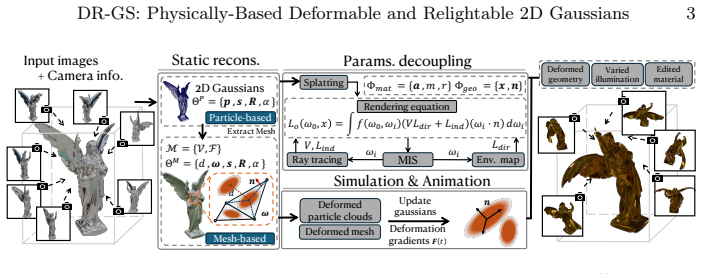
DR-GS is a unified Gaussian framework that integrates physically-based inverse rendering, relighting, and deformation-aware manipulation through explicit disentanglement of geometry, illumination, and material representations, overcoming the limitations of static snapshots and enabling post-reconstruction parameter editing.
What carries the argument
Explicit disentanglement of geometry, illumination, and material representations inside the 2D Gaussian splatting pipeline
If this is right
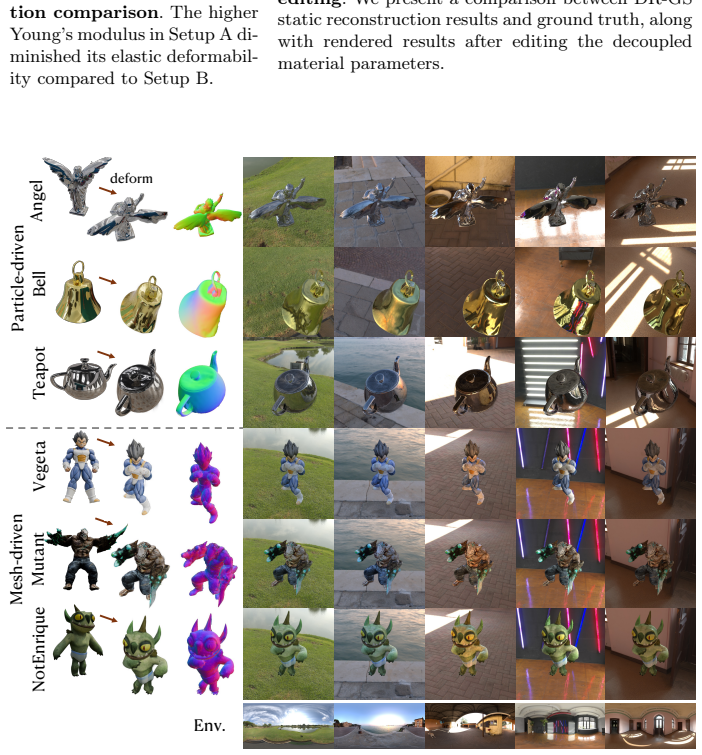
- Appearance stays physically consistent when objects deform or lighting changes.
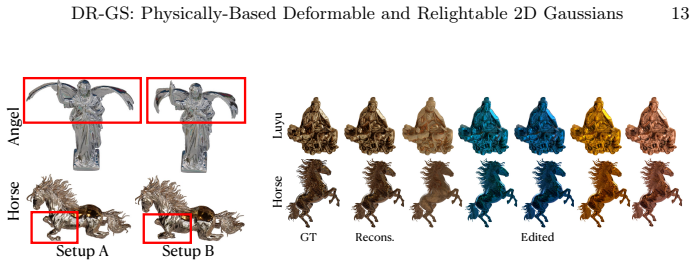
- Material parameters can be edited after the initial reconstruction is complete.
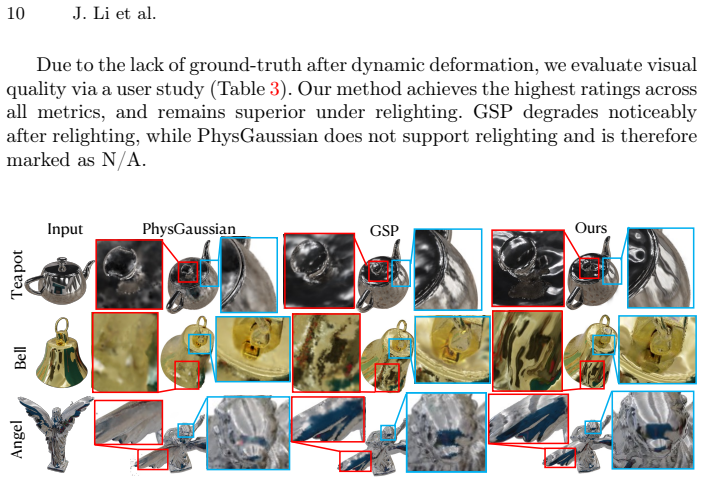
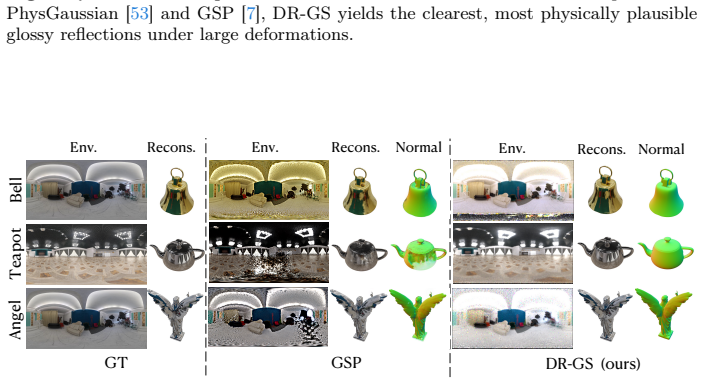
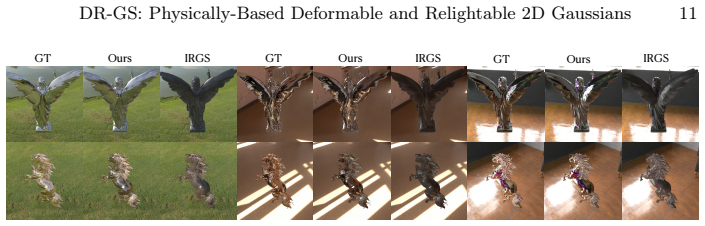
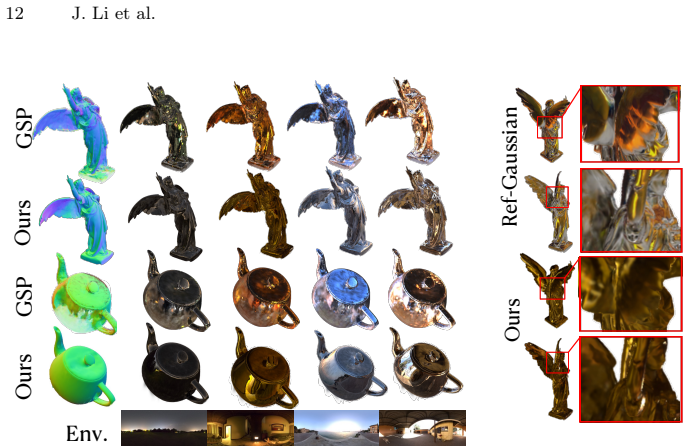
- Reflections and specular highlights on glossy surfaces are preserved during both deformation and relighting.
- A fully decoupled geometry-illumination-material pipeline supports high-quality 3D asset creation and editing.
Where Pith is reading between the lines
- The same separation could be tested on other explicit scene representations to see if the consistency and editing benefits transfer.
- Real-time VR or AR pipelines might use the decoupled parameters to update only the needed component instead of reprocessing the entire scene.
- Combining the pipeline with external physics simulators could produce interactions whose lighting and material responses update automatically.
Load-bearing premise
The input data contain enough independent information to separate geometry, illumination, and material without extra constraints or multi-view capture.
What would settle it
Apply DR-GS to a glossy object that undergoes large non-rigid deformation under multiple new light directions and check whether the specular highlights remain physically consistent or revert to baked-in appearance.
Figures
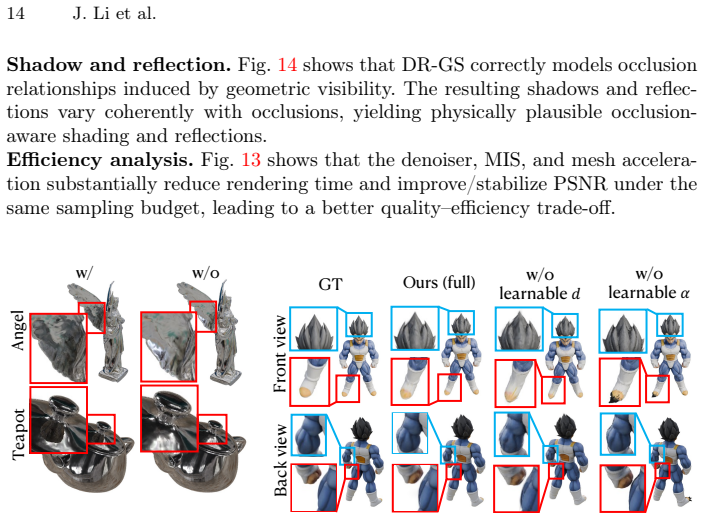
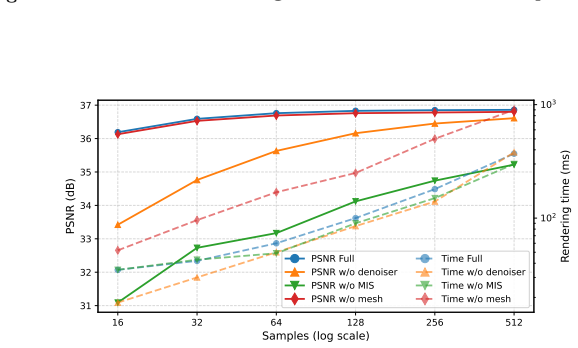
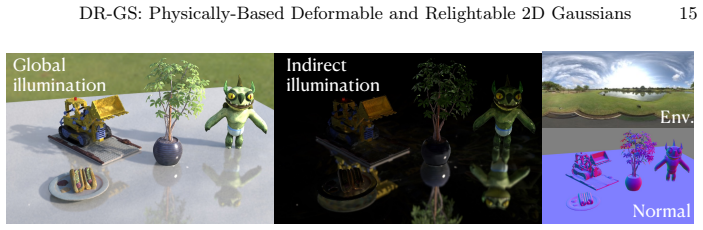
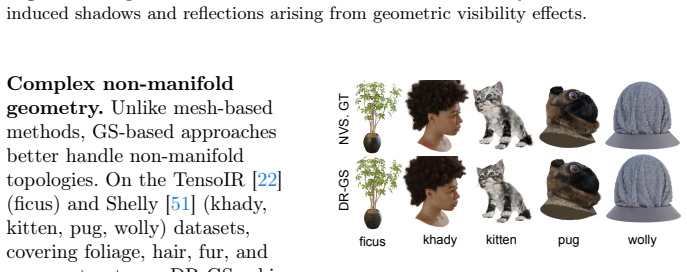
read the original abstract
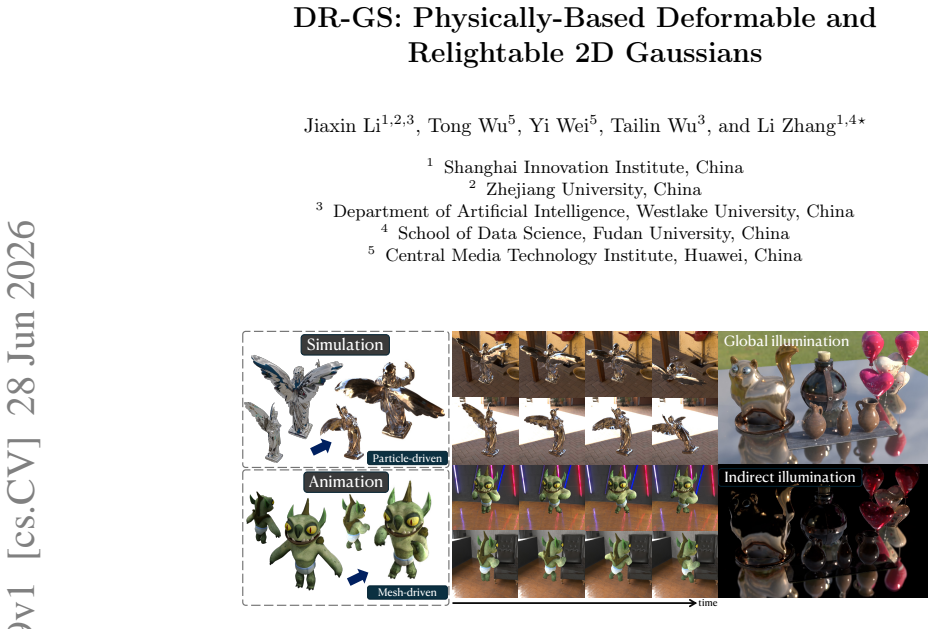
Gaussian splatting (GS) has garnered significant attention in VR/AR and digital content creation due to its explicit parameterization and efficient rendering capabilities. However, existing GS-based methods for deformable objects face two key limitations: (i) illumination is erroneously baked into textures, causing physically inconsistent responses under dynamic deformations and lighting changes; (ii) snapshot-based reconstruction restricts post-reconstruction material editing. To address these challenges, we propose Deformable and Relightable GS (DR-GS), a unified Gaussian framework that integrates physically-based inverse rendering, relighting, and deformation-aware manipulation. Through explicitly disentangling geometry, illumination, and material representations, DR-GS overcomes the limitations of static snapshots, resolving unrealistic appearance under varying conditions while enabling post-reconstruction parameter editing. Extensive experiments show that DR-GS achieves leading visual quality across static reconstruction, dynamic deformation, and relighting, reliably preserving reflections and specular highlights on glossy surfaces. It further establishes a fully decoupled geometry-illumination-material pipeline, enabling high-quality 3D asset creation and comprehensive post-editing.
Editorial analysis
A structured set of objections, weighed in public.
Referee Report
Summary. The paper proposes DR-GS, a unified 2D Gaussian splatting framework that integrates physically-based inverse rendering to explicitly disentangle geometry, illumination, and material representations for deformable objects. It addresses limitations in existing GS methods where illumination is baked into textures (causing inconsistent appearance under deformation and lighting changes) and snapshot-based reconstructions prevent post-editing of materials. The method enables relighting, deformation-aware manipulation, and parameter editing while preserving reflections and specular highlights; experiments claim leading visual quality across static reconstruction, dynamic deformation, and relighting tasks.
Significance. If the central claims hold, this advances explicit 3D representation methods by providing a physically consistent pipeline for dynamic scenes, which is valuable for VR/AR and digital content creation. The explicit disentanglement and post-reconstruction editing capabilities represent a meaningful step beyond static GS approaches, with potential for high-quality 3D asset pipelines.
minor comments (2)
- The abstract refers to 'extensive experiments' and 'leading visual quality' without specifying the datasets, baselines, or quantitative metrics used; this should be clarified in the introduction or experiments section for reproducibility.
- Notation for the disentangled representations (geometry, illumination, material) is introduced in the abstract but would benefit from explicit definitions and symbols in §3 or §4 to avoid ambiguity in the pipeline description.
Simulated Author's Rebuttal
We thank the referee for their summary of our work and for recognizing its potential significance for dynamic scene representation and content creation pipelines. The recommendation is listed as uncertain, yet the report contains no specific major comments or requests for clarification. We therefore provide no point-by-point responses below. Should the referee have additional questions or concerns not captured in the provided report, we are happy to address them in a revised version or supplementary material.
Circularity Check
No significant circularity; derivation self-contained
full rationale
The abstract and description present DR-GS as integrating physically-based inverse rendering with explicit disentanglement of geometry, illumination, and material in a 2D Gaussian framework. No equations, fitted parameters, or self-citations are shown that reduce any claimed prediction or result to the inputs by construction. Central claims rest on experimental validation and post-reconstruction editing capabilities, which are independent of the method's internal definitions. This is the common honest finding for a methods paper whose core pipeline does not collapse into self-definition or fitted renaming.
Axiom & Free-Parameter Ledger
Reference graph
Works this paper leans on
-
[1]
In: ICCV (2021) 3
Boss, M., Braun, R., Jampani, V., Barron, J.T., Liu, C., Lensch, H.P.: Nerd: Neural reflectance decomposition from image collections. In: ICCV (2021) 3
2021
-
[2]
In: NeurIPS (2022) 3
Boss, M., Engelhardt, A., Kar, A., Li, Y., Sun, D., Barron, J.T., Lensch, H.P.A., Jampani, V.: Samurai: Shape and material from unconstrained real-world arbitrary image collections. In: NeurIPS (2022) 3
2022
-
[3]
In: NeurIPS (2024) 3
Cao, J., Guan, S., Ge, Y., Li, W., Yang, X., Ma, C.: NeuMA: Neural material adaptor for visual grounding of intrinsic dynamics. In: NeurIPS (2024) 3
2024
-
[4]
In: ICLR (2025) 4
Chen, H., Lin, Z., Zhang, J.: Gi-gs: Global illumination decomposition on gaussian splatting for inverse rendering. In: ICLR (2025) 4
2025
- [5]
-
[6]
ACM TOG (1982) 6
Cook, R.L., Torrance, K.E.: A reflectance model for computer graphics. ACM TOG (1982) 6
1982
-
[7]
In: CVPR (2025) 2, 3, 9, 10
Feng, Y., Feng, X., Shang, Y., Jiang, Y., Yu, C., Zong, Z., Shao, T., Wu, H., Zhou, K., Jiang, C., Yang, Y.: Gaussian splashing: Unified particles for versatile motion synthesis and rendering. In: CVPR (2025) 2, 3, 9, 10
2025
-
[8]
In: ECCV (2024) 4
Gao, J., Gu, C., Lin, Y., Zhu, H., Cao, X., Zhang, L., Yao, Y.: Relightable 3d gaussian: Real-time point cloud relighting with brdf decomposition and ray tracing. In: ECCV (2024) 4
2024
-
[9]
ACM TOG (2024) 2, 3, 5, 9
Gao, L., Yang, J., Zhang, B., Sun, J., Yuan, Y., Fu, H., Lai, Y.K.: Real-time large-scale deformation of gaussian splatting. ACM TOG (2024) 2, 3, 5, 9
2024
-
[10]
In: CVPR (2025) 2, 3, 9
Gao,X.,Li,X.,Zhuang,Y.,Zhang,Q.,Hu,W.,Zhang,C.,Yao,Y.,Shan,Y.,Quan, L.: Mani-gs: Gaussian splatting manipulation with triangular mesh. In: CVPR (2025) 2, 3, 9
2025
-
[11]
In: CVPR (2025) 2, 4, 5, 6, 9
Gu, C., Wei, X., Zeng, Z., Yao, Y., Zhang, L.: Irgs: Inter-reflective gaussian splat- ting with 2d gaussian ray tracing. In: CVPR (2025) 2, 4, 5, 6, 9
2025
-
[12]
In: CVPR (2025) 3
Gu, C., Wei, X., Zhang, L., Zhu, X.: Tensoflow: Tensorial flow-based sampler for inverse rendering. In: CVPR (2025) 3
2025
-
[13]
In: CVPR (2024) 2, 3, 9
Guédon, A., Lepetit, V.: Sugar: Surface-aligned gaussian splatting for efficient 3d mesh reconstruction and high-quality mesh rendering. In: CVPR (2024) 2, 3, 9
2024
-
[14]
In: CVPR (2025) 2
Guo, M., Chiang, M.J.Y., Santesteban, I., Sarafianos, N., Chen, H.y., Halimi, O., Božič, A., Saito, S., Wu, J., Liu, C.K., Stuyck, T., Larionov, E.: Pgc: Physics-based gaussian cloth from a single pose. In: CVPR (2025) 2
2025
-
[15]
In: MM (2024) 4
Guo, Y., Bai, Y., Hu, L., Guo, Z., Liu, M., Cai, Y., Huang, T., Ma, L.: Prtgs: Pre- computed radiance transfer of gaussian splats for real-time high-quality relighting. In: MM (2024) 4
2024
-
[16]
JCGT (2018) 2
Heitz, E.: Sampling the ggx distribution of visible normals. JCGT (2018) 2
2018
-
[17]
In: CVPR (2024) 2, 3
Hu, L., Zhang, H., Zhang, Y., Zhou, B., Liu, B., Zhang, S., Nie, L.: Gaussianavatar: Towards realistic human avatar modeling from a single video via animatable 3d gaussians. In: CVPR (2024) 2, 3
2024
-
[18]
In: SIGGRAPH (2024) 4
Huang, B., Yu, Z., Chen, A., Geiger, A., Gao, S.: 2d gaussian splatting for geo- metrically accurate radiance fields. In: SIGGRAPH (2024) 4
2024
-
[19]
In: AAAI (2025) 2, 3
Huang, T., Zeng, Y., Li, H., Zuo, W., Lau, R.W.: Dreamphysics: Learning physical properties of dynamic 3d gaussians with video diffusion priors. In: AAAI (2025) 2, 3
2025
-
[20]
In: CoRL (2024) 2 DR-GS: Physically-Based Deformable and Relightable 2D Gaussians 17
Ji, M., Qiu, R.Z., Zou, X., Wang, X.: Graspsplats: Efficient manipulation with 3d feature splatting. In: CoRL (2024) 2 DR-GS: Physically-Based Deformable and Relightable 2D Gaussians 17
2024
-
[21]
In: SIGGRAPH (2024) 2, 3
Jiang, Y., Yu, C., Xie, T., Li, X., Feng, Y., Wang, H., Li, M., Lau, H., Gao, F., Yang, Y., Jiang, C.: Vr-gs: A physical dynamics-aware interactive gaussian splatting system in virtual reality. In: SIGGRAPH (2024) 2, 3
2024
-
[22]
In: CVPR (2023) 8, 15
Jin, H., Liu, I., Xu, P., Zhang, X., Han, S., Bi, S., Zhou, X., Xu, Z., Su, H.: Tensoir: Tensorial inverse rendering. In: CVPR (2023) 8, 15
2023
-
[23]
In: Proceedings of the 13th Annual Confer- ence on Computer Graphics and Interactive Techniques (1986) 6
Kajiya, J.T.: The rendering equation. In: Proceedings of the 13th Annual Confer- ence on Computer Graphics and Interactive Techniques (1986) 6
1986
-
[24]
ACM TOG (2023) 3, 4, 7
Kerbl, B., Kopanas, G., Leimkühler, T., Drettakis, G.: 3d gaussian splatting for real-time radiance field rendering. ACM TOG (2023) 3, 4, 7
2023
-
[25]
TVCG (2025) 4
Lai, S., Huang, L., Guo, J., Cheng, K., Pan, B., Long, X., Lyu, J., Lv, C., Guo, Y.: Glossygs: Inverse rendering of glossy objects with 3d gaussian splatting. TVCG (2025) 4
2025
-
[26]
ArXiv (2025) 2, 3
Li, M., Yao, S., Kai, C., Xie, Z., Chen, K., Jiang, Y.G.: Anigaussian: Animatable gaussian avatar with pose-guided deformation. ArXiv (2025) 2, 3
2025
-
[27]
In: CVPR (2024) 3
Li, Z., Chen, Z., Li, Z., Xu, Y.: Spacetime gaussian feature splatting for real-time dynamic view synthesis. In: CVPR (2024) 3
2024
-
[28]
In: ICCV (2025) 2
Li, Z., Yu, H.X., Liu, W., Yang, Y., Herrmann, C., Wetzstein, G., Wu, J.: Won- derplay: Dynamic 3d scene generation from a single image and actions. In: ICCV (2025) 2
2025
-
[29]
In: CVPR (2024) 4
Liang, Z., Zhang, Q., Feng, Y., Shan, Y., Jia, K.: Gs-ir: 3d gaussian splatting for inverse rendering. In: CVPR (2024) 4
2024
-
[30]
Physics3d: Learning physical properties of 3d gaussians via video diffusion,
Liu,F.,Wang,H.,Yao,S.,Zhang,S.,Zhou,J.,Duan,Y.:Physics3d:Learningphys- ical properties of 3d gaussians via video diffusion. arXiv preprint arXiv:2406.04338 (2024) 2, 3
-
[31]
ACM Transactions on Graphics (ToG) (2023) 3, 8, 11, 12
Liu, Y., Wang, P., Lin, C., Long, X., Wang, J., Liu, L., Komura, T., Wang, W.: Nero: Neural geometry and brdf reconstruction of reflective objects from multiview images. ACM Transactions on Graphics (ToG) (2023) 3, 8, 11, 12
2023
-
[32]
In: ECCV (2024) 2
Lu, G., Zhang, S., Wang, Z., Liu, C., Lu, J., Tang, Y.: Manigaussian: Dynamic gaussian splatting for multi-task robotic manipulation. In: ECCV (2024) 2
2024
-
[33]
ACM TOG (2025) 2, 3
Luo, Z., Cui, Z., Luo, S., Chu, M., Li, M.: Vr-doh: Hands-on 3d modeling in virtual reality. ACM TOG (2025) 2, 3
2025
-
[34]
In: ICCV (2025) 3
Ma, Z., Jiang, J., Chen, Y., Zhang, L.: Béziergs: Dynamic urban scene reconstruc- tion with bézier curve gaussian splatting. In: ICCV (2025) 3
2025
-
[35]
ACM Transactions on Graphics (TOG) (2010) 2
Martin, S., Kaufmann, P., Botsch, M., Grinspun, E., Gross, M.: Unified simulation of elastic rods, shells, and solids. ACM Transactions on Graphics (TOG) (2010) 2
2010
-
[36]
Commu- nications of the ACM (2021) 2
Mildenhall, B., Srinivasan, P.P., Tancik, M., Barron, J.T., Ramamoorthi, R., Ng, R.: Nerf: Representing scenes as neural radiance fields for view synthesis. Commu- nications of the ACM (2021) 2
2021
-
[37]
ACM Transactions on Graphics (TOG)43(6), 1–19 (2024) 4
Moenne-Loccoz, N.,Mirzaei, A.,Perel,O.,De Lutio,R., MartinezEsturo,J., State, G., Fidler, S., Sharp, N., Gojcic, Z.: 3d gaussian ray tracing: Fast tracing of particle scenes. ACM Transactions on Graphics (TOG)43(6), 1–19 (2024) 4
2024
-
[38]
ACM TOG (2010) 4
Parker, S.G., Bigler, J., Dietrich, A., Friedrich, H., Hoberock, J., Luebke, D., McAl- lister,D.,McGuire,M.,Morley,K.,Robison,A.,Stich,M.:Optix:ageneralpurpose ray tracing engine. ACM TOG (2010) 4
2010
-
[39]
San Francisco, CA, USA, 3rd edn
Pharr, M., Jakob, W., Humphreys, G.: Physically Based Rendering: From Theory to Implementation. San Francisco, CA, USA, 3rd edn. (2016) 2
2016
-
[40]
In: CVPR (2024) 2, 3
Qian, S., Kirschstein, T., Schoneveld, L., Davoli, D., Giebenhain, S., Nießner, M.: Gaussianavatars: Photorealistic head avatars with rigged 3d gaussians. In: CVPR (2024) 2, 3
2024
-
[41]
In: ECCV (2024) 3 18 J
Qiu, R.Z., Yang, G., Zeng, W., Wang, X.: Language-driven physics-based scene synthesis and editing via feature splatting. In: ECCV (2024) 3 18 J. Li et al
2024
-
[42]
In: Proceed- ings of High Performance Graphics (2017) 2, 8
Schied, C., Kaplanyan, A., Wyman, C., Patney, A., Chaitanya, C.R.A., Burgess, J., Liu, S., Dachsbacher, C., Lefohn, A., Salvi, M.: Spatiotemporal variance-guided filtering: real-time reconstruction for path-traced global illumination. In: Proceed- ings of High Performance Graphics (2017) 2, 8
2017
-
[43]
ACM TOG (2023) 7
Shen, T., Munkberg, J., Hasselgren, J., Yin, K., Wang, Z., Chen, W., Gojcic, Z., Fidler, S., Sharp, N., Gao, J.: Flexible isosurface extraction for gradient-based mesh optimization. ACM TOG (2023) 7
2023
-
[44]
T-PAMI (2025) 4
Shi, Y., Wu, Y., Wu, C., Liu, X., Zhao, C., Feng, H., Zhang, J., Zhou, B., Ding, E., Wang, J.: Gir: 3d gaussian inverse rendering for relightable scene factorization. T-PAMI (2025) 4
2025
-
[45]
In: 8th Annual Conference on Robot Learning (2024) 2
Shorinwa, O., Tucker, J., Smith, A., Swann, A., Chen, T., Firoozi, R., Kennedy, M.D., Schwager, M.: Splat-mover: Multi-stage, open-vocabulary robotic manipula- tion via editable gaussian splatting. In: 8th Annual Conference on Robot Learning (2024) 2
2024
-
[46]
In: CVPR (2021) 3
Srinivasan, P.P., Deng, B., Zhang, X., Tancik, M., Mildenhall, B., Barron, J.T.: Nerv: Neural reflectance and visibility fields for relighting and view synthesis. In: CVPR (2021) 3
2021
-
[47]
In: CVPR (2025) 4
Sun, H., Gao, Y., Xie, J., Yang, J., Wang, B.: Svg-ir: Spatially-varying gaussian splatting for inverse rendering. In: CVPR (2025) 4
2025
-
[48]
In: Proceedings of the 22nd Annual Conference on Computer Graphics and Interactive Techniques (1995) 8
Veach, E., Guibas, L.J.: Optimally combining sampling techniques for monte carlo rendering. In: Proceedings of the 22nd Annual Conference on Computer Graphics and Interactive Techniques (1995) 8
1995
-
[49]
arXiv preprint arXiv:2402.01459 (2024) 3
Waczyńska, J., Borycki, P., Tadeja, S., Tabor, J., Spurek, P.: Games: Mesh-based adapting and modification of gaussian splatting. arXiv preprint arXiv:2402.01459 (2024) 3
-
[50]
IEEE Transactions on Image Processing (2004) 9
Wang, Z., Bovik, A., Sheikh, H., Simoncelli, E.: Image quality assessment: from error visibility to structural similarity. IEEE Transactions on Image Processing (2004) 9
2004
-
[51]
Wang, Z., Shen, T., Nimier-David, M., Sharp, N., Gao, J., Keller, A., Fidler, S., Müller, T., Gojcic, Z.: Adaptive shells for efficient neural radiance field rendering. ACM Trans. Graph.42(6) (2023).https://doi.org/10.1145/3618390,https: //doi.org/10.1145/361839015
-
[52]
In: CVPR (2024) 3
Wu, G., Yi, T., Fang, J., Xie, L., Zhang, X., Wei, W., Liu, W., Tian, Q., Wang, X.: 4d gaussian splatting for real-time dynamic scene rendering. In: CVPR (2024) 3
2024
-
[53]
In: CVPR (2024) 2, 3, 9, 10
Xie, T., Zong, Z., Qiu, Y., Li, X., Feng, Y., Yang, Y., Jiang, C.: Physgaussian: Physics-integrated 3d gaussians for generative dynamics. In: CVPR (2024) 2, 3, 9, 10
2024
-
[54]
In: ICLR (2024) 3
Yang, Z., Yang, H., Pan, Z., Zhang, L.: Real-time photorealistic dynamic scene representation and rendering with 4d gaussian splatting. In: ICLR (2024) 3
2024
-
[55]
In: CVPR (2024) 3
Yang, Z., Gao, X., Zhou, W., Jiao, S., Zhang, Y., Jin, X.: Deformable 3d gaussians for high-fidelity monocular dynamic scene reconstruction. In: CVPR (2024) 3
2024
-
[56]
In: ICLR (2025) 4, 5, 9
Yao, Y., Zeng, Z., Gu, C., Zhu, X., Zhang, L.: Reflective gaussian splatting. In: ICLR (2025) 4, 5, 9
2025
-
[57]
Yu, J., Fu, L., Huang, H., El-Refai, K., Ambrus, R.A., Cheng, R., Irshad, M.Z., Goldberg, K.: Real2render2real: Scaling robot data without dynamics simulation or robot hardware. arXiv preprint arXiv:2505.09601 (2025) 2
-
[58]
In: Proceedings of the IEEE/CVF International Conference on Computer Vision
Zhang, J., Yao, Y., Li, S., Liu, J., Fang, T., McKinnon, D., Tsin, Y., Quan, L.: Neilf++: Inter-reflectable light fields for geometry and material estimation. In: Proceedings of the IEEE/CVF International Conference on Computer Vision. pp. 3601–3610 (2023) 3 DR-GS: Physically-Based Deformable and Relightable 2D Gaussians 19
2023
-
[59]
In: CVPR (2018) 9
Zhang, R., Isola, P., Efros, A.A., Shechtman, E., Wang, O.: The unreasonable effectiveness of deep features as a perceptual metric. In: CVPR (2018) 9
2018
-
[60]
In: ECCV (2024) 3
Zhang, T., Yu, H.X., Wu, R., Feng, B.Y., Zheng, C., Snavely, N., Wu, J., Freeman, W.T.: PhysDreamer: Physics-based interaction with 3d objects via video genera- tion. In: ECCV (2024) 3
2024
-
[61]
Efficient physics simulation for 3d scenes via mllm-guided gaussian splatting,
Zhao, H., Wang, H., Zhao, X., Fei, H., Wang, H., Long, C., Zou, H.: Efficient physics simulation for 3d scenes via mllm-guided gaussian splatting. arXiv preprint arXiv:2411.12789 (2024) 3
-
[62]
IEEE Robotics and Automation Letters (2024) 2
Zheng, Y., Chen, X., Zheng, Y., Gu, S., Yang, R., Jin, B., Li, P., Zhong, C., Wang, Z., Liu, L., et al.: Gaussiangrasper: 3d language gaussian splatting for open- vocabulary robotic grasping. IEEE Robotics and Automation Letters (2024) 2
2024
-
[63]
NeurIPS (2024) 3
Zhu, T., Chen, Z., Gao, J., Yan, Y., Yang, X.: Multi-times monte carlo rendering for inter-reflection reconstruction. NeurIPS (2024) 3
2024
-
[64]
In: ACM TOG (2025) 9
Zhu, Z.L., Wang, B., Yang, J.: Gs-ror2: Bidirectional-guided 3dgs and sdf for re- flective object relighting and reconstruction. In: ACM TOG (2025) 9
2025
discussion (0)
Sign in with ORCID, Apple, or X to comment. Anyone can read and Pith papers without signing in.