Pauli-Sparse regularised Counterdiabatic Shortcuts for Linear-Ramp QAOA
Pith reviewed 2026-06-30 00:54 UTC · model grok-4.3
The pith
A Pauli-sparse regularized counterdiabatic correction enhances linear-ramp QAOA on instances with small spectral gaps.
A machine-rendered reading of the paper's core claim, the machinery that carries it, and where it could break.
Core claim
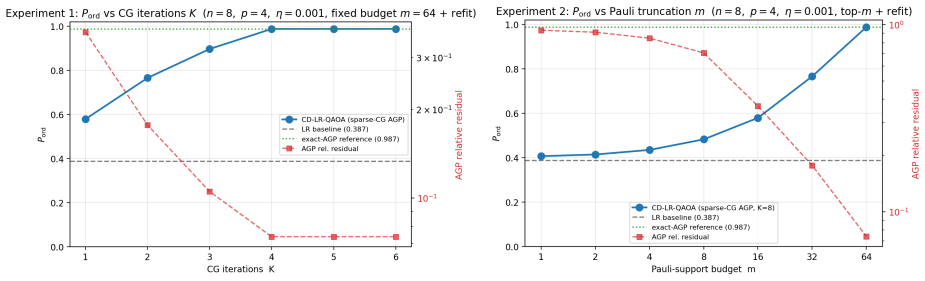
Solving the regularized adiabatic gauge potential equation (L_H^{2} + ηI) A = -i L_H (∂_λ H) approximately in Pauli coordinates via conjugate gradient, with Pauli truncation, Galerkin refit, and residual certification, produces a sparse set of rotations that improve QAOA performance by mitigating diabatic transitions without needing to resolve tiny splittings in the low-energy manifold.
What carries the argument
The regularised adiabatic gauge potential, obtained by solving the linear equation involving the commutator superoperator L_H with regularization η, truncated to Pauli strings for implementability.
If this is right
- The resulting LR-CD-QAOA ansatz improves approximation ratios over uncorrected linear ramp QAOA.
- It broadens practical applicability to QUBO optimization problems with near-degenerate low-energy structures.
- The method provides a gate-budget-aware selection of counterdiabatic terms.
- Certification by a posteriori residual bound ensures the approximation quality.
Where Pith is reading between the lines
- This approach might be adaptable to other quantum annealing or variational algorithms facing similar gap issues.
- Choosing η based on problem-specific gap estimates could further optimize performance.
- Scaling the method to larger qubit numbers could be tested by monitoring the sparsity of the selected Pauli terms.
Load-bearing premise
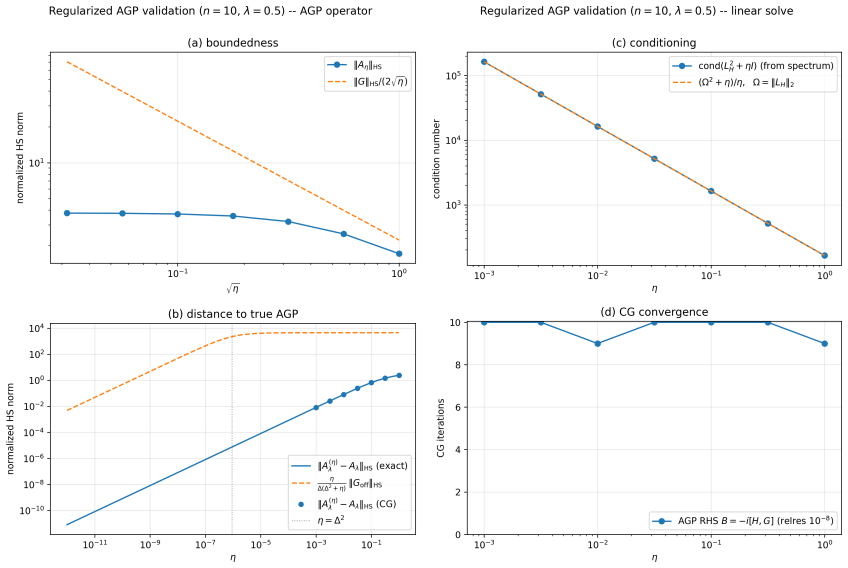
The regularization parameter η can be chosen to suppress transitions below √η while retaining larger-gap transitions, thereby avoiding the need to resolve exponentially small splittings inside a low-energy solution manifold.
What would settle it
Running the proposed LR-CD-QAOA on the Ferromagnetic Chain or MaxCut instances and observing no consistent improvement in approximation ratios compared to standard LR-QAOA across multiple η values would falsify the improvement claim.
Figures
read the original abstract
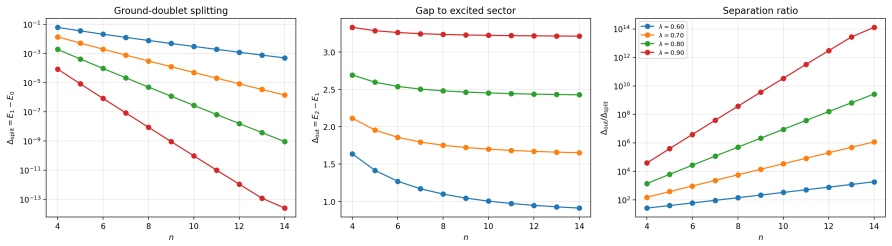
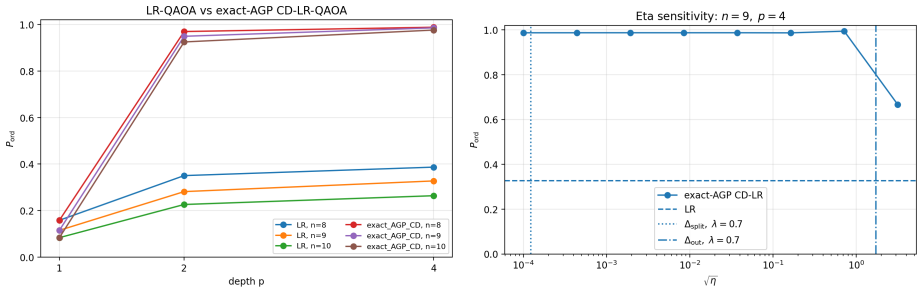
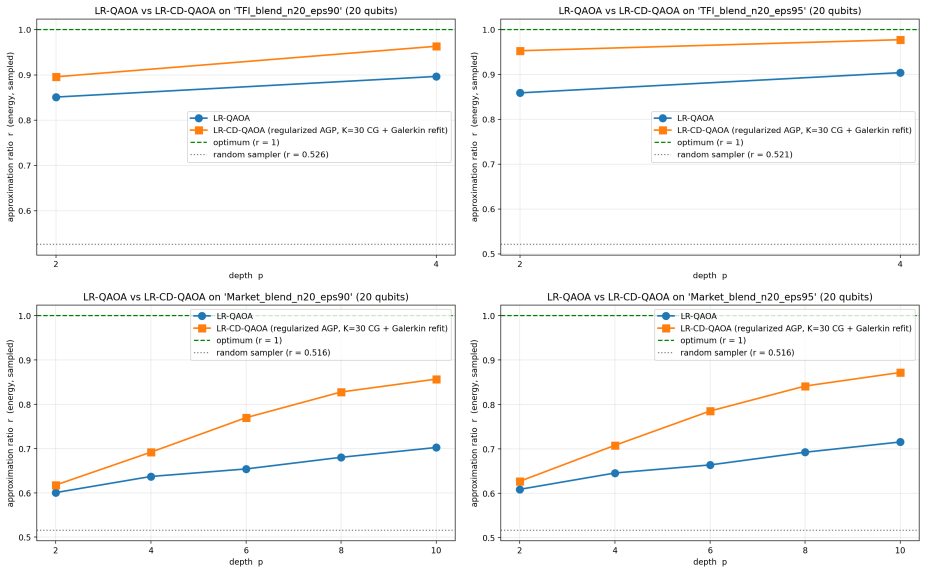
Combinatorial optimization is a leading target for quantum algorithms, but finite-depth QAOA can suffer from strong diabatic errors when the interpolation Hamiltonian has small, or exponentially small, spectral gaps. We propose a Pauli-sparse counterdiabatic extension of linear-ramp QAOA based on the regularised adiabatic gauge potential \[ \bigl(\mathcal L_H^2+\eta I\bigr)A_\lambda^{(\eta)} = -\mathrm{i}\mathcal L_H(\partial_\lambda H), \qquad \mathcal L_H(X)=[H,X]. \] Instead of computing a dense AGP, we solve this equation approximately by an inexact conjugate-gradient method in Pauli coordinates, truncating the Pauli expansion during the iteration to obtain a gate-budget-aware set of implementable rotations. The selected support is then improved by a Galerkin refit and certified by an a posteriori residual bound. The regularization parameter \(\eta\) acts as an energy-resolution scale: it suppresses transitions below \(\sqrt{\eta}\) while retaining larger-gap transitions. Thus, the method can avoid resolving exponentially small splittings inside a low-energy solution manifold while reducing leakage away from it. Numerical experiments on Ferromagnetic Chain (FC) and perturbed FC--MaxCut/MarketSplit instances show that the resulting LR-CD-QAOA ansatz improves approximation ratios over the uncorrected linear ramp, especially in regimes where LR-QAOA remains far from the optimum. Overall, the proposed regularized LR-CD-QAOA framework substantially broadens the practical applicability of QAOA to QUBO optimization by improving its robustness across heterogeneous problem landscapes, including instances with near-degenerate low-energy structures and small spectral gaps.
Editorial analysis
A structured set of objections, weighed in public.
Referee Report
Summary. The paper proposes a Pauli-sparse regularized counterdiabatic extension to linear-ramp QAOA. It solves a regularized AGP equation (L_H^2 + η I) A_λ^(η) = -i L_H (∂_λ H) approximately via inexact conjugate-gradient in Pauli coordinates, with truncation, Galerkin refit, and residual bound. The regularization η is presented as an energy-resolution scale that suppresses small-gap transitions. Numerical experiments on ferromagnetic chain and perturbed FC-MaxCut/MarketSplit instances are reported to yield higher approximation ratios than uncorrected linear-ramp QAOA, particularly when the latter remains far from optimum.
Significance. If the reported numerical gains hold under rigorous statistical controls, the framework would offer a practical route to improve QAOA robustness on instances with near-degenerate low-energy manifolds and small gaps, without requiring resolution of exponentially small splittings. The explicit regularization, Pauli-truncation pipeline, and a-posteriori residual bound constitute concrete, implementable strengths.
major comments (2)
- [Numerical experiments] Numerical experiments section: the central claim of improved approximation ratios rests on reported gains for FC and perturbed MaxCut/MarketSplit instances, yet the provided text supplies neither error bars, number of random instances or seeds, nor explicit comparison to standard QAOA baselines with matched gate budgets; this renders the quantitative support for the claim unverifiable from the given description.
- [Abstract / η discussion] Abstract and § on role of η: the statement that η 'suppresses transitions below √η while retaining larger-gap transitions' follows from the resolvent scaling, but the manuscript does not demonstrate that the chosen η values avoid the exponentially small splittings inside the solution manifold on the tested instances; a concrete check against the actual gap spectrum of the FC and MaxCut Hamiltonians is needed to confirm the mechanism.
minor comments (2)
- [Method] Notation: the superoperator L_H is defined but its action on the specific Pauli basis used for the conjugate-gradient iteration should be stated explicitly to allow reproduction.
- [Figures] Figure clarity: any plots of approximation ratio versus depth or η should include the uncorrected LR-QAOA curve with the same color scale and gate-count normalization for direct visual comparison.
Simulated Author's Rebuttal
We thank the referee for the careful reading and constructive comments on our manuscript. We address each major comment below and will revise the manuscript to strengthen the presentation of the numerical results and the discussion of the regularization parameter.
read point-by-point responses
-
Referee: Numerical experiments section: the central claim of improved approximation ratios rests on reported gains for FC and perturbed MaxCut/MarketSplit instances, yet the provided text supplies neither error bars, number of random instances or seeds, nor explicit comparison to standard QAOA baselines with matched gate budgets; this renders the quantitative support for the claim unverifiable from the given description.
Authors: We agree that the current description of the numerical experiments lacks sufficient statistical detail for full verifiability. In the revised manuscript we will report error bars obtained from multiple independent runs, specify the precise number of random instances and random seeds employed for each problem family, and include direct comparisons against standard linear-ramp QAOA executed with an identical total gate budget. revision: yes
-
Referee: Abstract and § on role of η: the statement that η 'suppresses transitions below √η while retaining larger-gap transitions' follows from the resolvent scaling, but the manuscript does not demonstrate that the chosen η values avoid the exponentially small splittings inside the solution manifold on the tested instances; a concrete check against the actual gap spectrum of the FC and MaxCut Hamiltonians is needed to confirm the mechanism.
Authors: The scaling argument for η follows directly from the resolvent of the regularized Liouvillian. We acknowledge that an explicit verification on the gap spectra of the concrete instances would make the mechanism more transparent. We will add a supplementary analysis that computes the relevant low-lying gaps for the ferromagnetic-chain and perturbed MaxCut Hamiltonians and confirms that the chosen η values lie above the exponentially small splittings within the solution manifold. revision: yes
Circularity Check
No significant circularity
full rationale
The paper's derivation begins with the explicit regularized AGP equation (L_H^2 + ηI)A = -i L_H(∂_λ H), which is a standard resolvent regularization whose √η scale is the direct mathematical consequence of the superoperator definition rather than a fitted quantity. The subsequent Pauli-truncation, inexact CG solve, Galerkin refit, and residual bound are standard inexact-solver techniques applied to obtain a sparse implementable operator; none of these steps redefine the target approximation ratio or claim a prediction that is forced by construction from the inputs. Numerical experiments on FC and perturbed MaxCut/MarketSplit instances report concrete improvements over the uncorrected linear ramp without the reported gain being equivalent to a parameter fit or self-citation chain. The central claim therefore remains independent of its own fitted values and is self-contained against external benchmarks.
Axiom & Free-Parameter Ledger
free parameters (1)
- regularization parameter η
axioms (1)
- standard math The adiabatic gauge potential satisfies the regularized Lyapunov equation (L_H² + η I) A_λ^(η) = -i L_H (∂_λ H)
Reference graph
Works this paper leans on
-
[4]
and Venturelli, Davide and Biswas, Rupak , title =
Hadfield, Stuart and Wang, Zhihui and O'Gorman, Bryan and Rieffel, Eleanor G. and Venturelli, Davide and Biswas, Rupak , title =. Algorithms , volume =. 2019 , doi =
2019
-
[6]
Physics Reports , volume =
Kolodrubetz, Michael and Sels, Dries and Mehta, Pankaj and Polkovnikov, Anatoli , title =. Physics Reports , volume =. 2017 , doi =
2017
-
[8]
Frontiers in Physics , volume =
Lucas, Andrew , title =. Frontiers in Physics , volume =. 2014 , doi =
2014
-
[12]
Proceedings of the National Academy of Sciences , volume =
Sels, Dries and Polkovnikov, Anatoli , title =. Proceedings of the National Academy of Sciences , volume =. 2017 , doi =
2017
-
[13]
Physical Review X , volume =
Takahashi, Kazutaka and del Campo, Adolfo , title =. Physical Review X , volume =. 2024 , doi =
2024
-
[16]
, title =
Zhou, Leo and Wang, Sheng-Tao and Choi, Soonwon and Pichler, Hannes and Lukin, Mikhail D. , title =. Physical Review X , volume =. 2020 , doi =
2020
-
[19]
and Johnson, Charles R
Horn, Roger A. and Johnson, Charles R. , TITLE =. 2013 , PAGES =
2013
-
[22]
2025 , eprint=
An Introduction to the Quantum Approximate Optimization Algorithm , author=. 2025 , eprint=
2025
-
[23]
2026 , eprint=
Continuous-time quantum control across an exponentially small bottleneck in a frustrated Ising ring model , author=. 2026 , eprint=
2026
-
[25]
2025 , eprint=
Evaluating the performance of quantum processing units at large width and depth , author=. 2025 , eprint=
2025
-
[27]
2026 , eprint=
Weighted Nested Commutators for Scalable Counterdiabatic State Preparation , author=. 2026 , eprint=
2026
-
[34]
Abbas, Amira and Ambainis, Andris and Augustino, Brandon and others , title =. Nat. Rev. Phys. , volume =. 2024 , doi =
2024
-
[36]
1997 , eprint=
Stabilizer Codes and Quantum Error Correction , author=. 1997 , eprint=
1997
-
[38]
and Chen, Ying and Cortiana, Giorgio and Egger, Daniel J
Koch, Thorsten and Bernal Neira, David E. and Chen, Ying and Cortiana, Giorgio and Egger, Daniel J. and Heese, Raoul and Hegade, Narendra N. and Gomez Cadavid, Alejandro and Huang, Rhea and Itoko, Toshinari and Kleinert, Thomas and Maciel Xavier, Pedro and Mohseni, Naeimeh and Montanez-Barrera, Jhon A. and Nakano, Koji and Nannicini, Giacomo and O'Meara, ...
2026
-
[39]
Nature Reviews Physics 6(12):718--735, ISSN 2522-5820, ://dx.doi.org/10.1038/s42254-024-00770-9
Abbas A, Ambainis A, Augustino B, et al. (2024) Challenges and opportunities in quantum optimization. Nat. Rev. Phys. 6:718--735, ://dx.doi.org/10.1038/s42254-024-00770-9
-
[40]
arXiv preprint arXiv:2311.03215 ://arxiv.org/abs/2311.03215
Apers S, Gribling S (2023) Quantum speedups for linear programming via interior point methods. arXiv preprint arXiv:2311.03215 ://arxiv.org/abs/2311.03215
arXiv 2023
-
[41]
Arezzo VR, Thengil K, Santoro G (2026) Continuous-time quantum control across an exponentially small bottleneck in a frustrated ising ring model. ://arxiv.org/abs/2606.07168
Pith/arXiv arXiv 2026
-
[42]
Bucci A, Palitta D, Robol L (2025) Randomized sketched TT - GMRES for linear systems with tensor structure. SIAM J. Sci. Comput. 47(5):A2801--A2827, ISSN 1064-8275,1095-7197, ://dx.doi.org/10.1137/24M1694999
-
[43]
Dalal A, Montalban I, Hegade NN, Cadavid AG, Solano E, Awasthi A, Vodola D, Jones C, Weiss H, F\"uchsel G (2024) Digitized counterdiabatic quantum algorithms for logistics scheduling. Phys. Rev. Appl. 22:064068, ://dx.doi.org/10.1103/PhysRevApplied.22.064068
-
[44]
arXiv preprint arXiv:2504.08577 ://arxiv.org/abs/2504.08577
Dehn V, Zaefferer M, Hellstern G, Reiter F, Wellens T (2025) Extrapolation method to optimize linear-ramp qaoa parameters: Evaluation of qaoa runtime scaling. arXiv preprint arXiv:2504.08577 ://arxiv.org/abs/2504.08577
Pith/arXiv arXiv 2025
-
[45]
Dolgov SV (2013) T T - GMRES : solution to a linear system in the structured tensor format. Russian J. Numer. Anal. Math. Modelling 28(2):149--172, ISSN 0927-6467,1569-3988, ://dx.doi.org/10.1515/rnam-2013-0009
-
[46]
arXiv preprint arXiv:1411.4028 ://arxiv.org/abs/1411.4028
Farhi E, Goldstone J, Gutmann S (2014) A quantum approximate optimization algorithm. arXiv preprint arXiv:1411.4028 ://arxiv.org/abs/1411.4028
Pith/arXiv arXiv 2014
-
[47]
Fin z z gar JR, Notarnicola S, Cain M, Lukin MD, Sels D (2025) Counterdiabatic driving with performance guarantees. Phys. Rev. Lett. 135:180602, ://dx.doi.org/10.1103/pqhl-nbtk
-
[48]
Giovagnoli A (2025) An introduction to the quantum approximate optimization algorithm. ://arxiv.org/abs/2511.18377
arXiv 2025
-
[49]
Golub GH, Ye Q (1999/00) Inexact preconditioned conjugate gradient method with inner-outer iteration. SIAM J. Sci. Comput. 21(4):1305--1320, ISSN 1064-8275,1095-7197, ://dx.doi.org/10.1137/S1064827597323415
-
[50]
Algorithms 12(2):34, ://dx.doi.org/10.3390/a12020034
Hadfield S, Wang Z, O'Gorman B, Rieffel EG, Venturelli D, Biswas R (2019) From the quantum approximate optimization algorithm to a quantum alternating operator ansatz. Algorithms 12(2):34, ://dx.doi.org/10.3390/a12020034
-
[51]
Hatomura T (2024) Shortcuts to adiabaticity: theoretical framework, relations between different methods, and versatile approximations. Journal of Physics B: Atomic, Molecular and Optical Physics 57(10):102001, ://dx.doi.org/10.1088/1361-6455/ad38f1
-
[52]
Hegade NN, Chen X, Solano E (2022) Digitized counterdiabatic quantum optimization. Phys. Rev. Res. 4:L042030, ://dx.doi.org/10.1103/PhysRevResearch.4.L042030
-
[53]
arXiv preprint arXiv:2310.18281 ://arxiv.org/abs/2310.18281
Henderson ER, Nagarajan H, Coffrin C (2023) Exploring non-linear programming formulations in quantumcircuitopt for optimal circuit design. arXiv preprint arXiv:2310.18281 ://arxiv.org/abs/2310.18281
arXiv 2023
-
[54]
Horn RA, Johnson CR (2013) Matrix analysis (Cambridge University Press, Cambridge), second edition, ISBN 978-0-521-54823-6
2013
-
[55]
Joly P, Meurant G (1993) Complex conjugate gradient methods. Numer. Algorithms 4(4):379--406, ISSN 1017-1398,1572-9265, ://dx.doi.org/10.1007/BF02145754
-
[56]
Khoromskij BN (2015) Tensor numerical methods for multidimensional PDE s: theoretical analysis and initial applications. C EMRACS 2013---modelling and simulation of complex systems: stochastic and deterministic approaches , volume 48 of ESAIM Proc. Surveys, 1--28 (EDP Sci., Les Ulis), ://dx.doi.org/10.1051/proc/201448001
-
[57]
Nature Computational Science ISSN 2662-8457, ://dx.doi.org/10.1038/s43588-026-00991-1
Koch T, Bernal Neira DE, Chen Y, Cortiana G, Egger DJ, Heese R, Hegade NN, Gomez Cadavid A, Huang R, Itoko T, Kleinert T, Maciel Xavier P, Mohseni N, Montanez-Barrera JA, Nakano K, Nannicini G, O'Meara C, Pauckert J, Proissl M, Ramesh A, Schicker M, Shimada N, Takeori M, Valls V, Van Bulck D, Woerner S, Zoufal C (2026) The quantum optimization benchmarkin...
-
[58]
Physics Reports 697:1--87, ://dx.doi.org/10.1016/j.physrep.2017.07.001
Kolodrubetz M, Sels D, Mehta P, Polkovnikov A (2017) Geometry and non-adiabatic response in quantum and classical systems. Physics Reports 697:1--87, ://dx.doi.org/10.1016/j.physrep.2017.07.001
-
[59]
Lawrence E, Schmid SFJ, Čepaitė I, Kirton P, Duncan CW (2025) A numerical approach for calculating exact non-adiabatic terms in quantum dynamics. SciPost Phys. 18:014, ://dx.doi.org/10.21468/SciPostPhys.18.1.014
-
[60]
arXiv preprint arXiv:2102.06813 ://arxiv.org/abs/2102.06813
Lotshaw PC, Humble TS, Herrman R, Ostrowski J, Siopsis G (2021) Empirical performance bounds for quantum approximate optimization. arXiv preprint arXiv:2102.06813 ://arxiv.org/abs/2102.06813
arXiv 2021
-
[61]
Ising formulations of many NP problems.Frontiers in Physics, 2:5, 2014
Lucas A (2014) Ising formulations of many np problems. Frontiers in Physics 2:5, ://dx.doi.org/10.3389/fphy.2014.00005
-
[62]
arXiv preprint arXiv:2604.24580 ://arxiv.org/abs/2604.24580
McDowall K, Georgopoulos K, Wallden P (2026) A spectral gap informed parameter schedule for qaoa. arXiv preprint arXiv:2604.24580 ://arxiv.org/abs/2604.24580
Pith/arXiv arXiv 2026
-
[63]
Montanez-Barrera JA, Michielsen K, Neira DEB (2025) Evaluating the performance of quantum processing units at large width and depth. ://arxiv.org/abs/2502.06471
arXiv 2025
-
[64]
arXiv preprint arXiv:2503.01952 ://arxiv.org/abs/2503.01952
Morawetz S, Polkovnikov A (2025 a ) Universal counterdiabatic driving in krylov space. arXiv preprint arXiv:2503.01952 ://arxiv.org/abs/2503.01952
arXiv 2025
-
[65]
PRX Quantum 6:040320, ://dx.doi.org/10.1103/wbbs-s8fs
Morawetz S, Polkovnikov A (2025 b ) Universal counterdiabatic driving in krylov space. PRX Quantum 6:040320, ://dx.doi.org/10.1103/wbbs-s8fs
-
[66]
arXiv preprint arXiv:2111.11674 ://arxiv.org/abs/2111.11674
Nagarajan H, Lockwood O, Coffrin C (2021) Quantumcircuitopt: An open-source framework for provably optimal quantum circuit design. arXiv preprint arXiv:2111.11674 ://arxiv.org/abs/2111.11674
arXiv 2021
-
[67]
Oseledets IV (2011) Tensor-train decomposition. SIAM J. Sci. Comput. 33(5):2295--2317, ISSN 1064-8275,1095-7197, ://dx.doi.org/10.1137/090752286
-
[68]
Saad Y (2003) Iterative methods for sparse linear systems (Society for Industrial and Applied Mathematics, Philadelphia, PA), second edition, ISBN 0-89871-534-2, ://dx.doi.org/10.1137/1.9780898718003
-
[69]
Sels D, Polkovnikov A (2017) Minimizing irreversible losses in quantum systems by local counterdiabatic driving. Proceedings of the National Academy of Sciences 114(20):E3909--E3916, ://dx.doi.org/10.1073/pnas.1619826114
-
[70]
Simoncini V, Szyld DB (2003) Theory of inexact K rylov subspace methods and applications to scientific computing. SIAM J. Sci. Comput. 25(2):454--477, ISSN 1064-8275,1095-7197, ://dx.doi.org/10.1137/S1064827502406415
-
[71]
Physical Review X 14:011032, ://dx.doi.org/10.1103/PhysRevX.14.011032
Takahashi K, del Campo A (2024) Shortcuts to adiabaticity in krylov space. Physical Review X 14:011032, ://dx.doi.org/10.1103/PhysRevX.14.011032
-
[72]
Tang J, Chen X, Wei ZY (2026) Weighted nested commutators for scalable counterdiabatic state preparation. ://arxiv.org/abs/2603.25625
arXiv 2026
-
[73]
arXiv preprint arXiv:2402.18412 ://arxiv.org/abs/2402.18412
Wilkie A, Gaidai I, Ostrowski J, Herrman R (2024) Quantum approximate optimization algorithm with random and subgraph phase operators. arXiv preprint arXiv:2402.18412 ://arxiv.org/abs/2402.18412
arXiv 2024
-
[74]
arXiv preprint arXiv:2106.15645 ://arxiv.org/abs/2106.15645
Wurtz J, Love PJ (2021) Counterdiabaticity and the quantum approximate optimization algorithm. arXiv preprint arXiv:2106.15645 ://arxiv.org/abs/2106.15645
arXiv 2021
-
[75]
Physical Review X 10:021067, ://dx.doi.org/10.1103/PhysRevX.10.021067
Zhou L, Wang ST, Choi S, Pichler H, Lukin MD (2020) Quantum approximate optimization algorithm: Performance, mechanism, and implementation on near-term devices. Physical Review X 10:021067, ://dx.doi.org/10.1103/PhysRevX.10.021067
discussion (0)
Sign in with ORCID, Apple, or X to comment. Anyone can read and Pith papers without signing in.