REVIEW 2 major objections 2 minor 65 references
One-step generative models recover key galaxy morphology statistics from redshift-conditioned images at orders-of-magnitude lower cost than standard diffusion sampling.
Reviewed by Pith at T0; open to challenge. T0 means a machine referee read the full paper against a public rubric. the ladder, T0–T4 →
T0 review · grok-4.3
2026-05-19 22:06 UTC pith:MPMLJM6W
load-bearing objection The paper shows one-step pixel-MeanFlow recovers basic galaxy morphology stats at far lower cost than DDPM sampling on GalaxiesML-64, but those stats may not be enough to confirm the images work for downstream cosmological inference. the 2 major comments →
Accelerating Redshift-Conditioned Galaxy Image Synthesis with One-step Generative Modeling
The pith
A machine-rendered reading of the paper's core claim, the machinery that carries it, and where it could break.
Core claim
Pixel-MeanFlow performs single-step redshift-conditioned galaxy image synthesis that achieves competitive scores on ellipticity, semi-major axis, Sérsic index, and isophotal area relative to many-step DDPM sampling, at orders-of-magnitude lower computational cost, although it is weaker than multi-step methods on fine-grained structural details.
What carries the argument
Pixel-MeanFlow, a one-step generative model that directly maps noise and conditioning information to pixel values without iterative denoising steps.
Load-bearing premise
The selected morphology metrics are adequate proxies for whether the generated images remain scientifically useful in downstream cosmological analyses.
What would settle it
Feeding the one-step generated images into a full cosmological parameter inference pipeline and observing that the recovered parameters or uncertainties deviate from those obtained with high-fidelity images by more than the morphology metrics alone would predict.
If this is right
- Large cosmological surveys can incorporate conditional image simulators that run at practical speeds.
- Simulation-based inference tasks become feasible at scales previously limited by generation cost.
- Second-order samplers offer an intermediate accuracy-efficiency point between DDIM and full DDPM.
- One-step models provide a practical route to redshift-conditioned simulators when fine structure is not the primary concern.
Where Pith is reading between the lines
- The approach could be adapted to generate mock images for other survey instruments or wavelength bands without retraining the entire pipeline from scratch.
- Combining one-step generation with existing hydrodynamic simulations might reduce the overall cost of producing realistic mock catalogs for next-generation surveys.
- Residual gaps in fine structure could be addressed by hybrid models that apply a small number of refinement steps only to selected regions.
Editorial analysis
A structured set of objections, weighed in public.
Referee Report
Summary. The manuscript evaluates one-step generative modeling via pixel-MeanFlow for redshift-conditioned galaxy image synthesis on the GalaxiesML-64 dataset. It compares this approach against multi-step diffusion samplers (DDPM, DDIM, DEIS-AB2, DPM++2M) using four morphology summary statistics (ellipticity, semi-major axis, Sérsic index, isophotal area), reports an accuracy-efficiency trade-off, and concludes that one-step models recover key statistics at orders-of-magnitude lower cost for potential use in cosmological survey simulations and inference.
Significance. If the generated conditional distributions prove faithful beyond the reported scalar metrics, the work could enable computationally tractable large-scale galaxy image catalogs, directly supporting simulation-based inference pipelines for upcoming surveys where multi-step diffusion sampling is currently prohibitive.
major comments (2)
- [Abstract and evaluation sections] Abstract and evaluation sections: the claim of 'competitive performance' and 'recover key galaxy morphology statistics' is presented without quantitative values, error bars, statistical tests, training details, or data-split information, preventing assessment of the reported accuracy-efficiency trade-off.
- [Abstract and discussion] Abstract and discussion: the central claim that the approach opens a path to 'efficient conditional simulators for ... simulation-based scientific inference' rests on agreement with four low-dimensional morphology scalars; these do not constrain higher-order spatial correlations or joint pixel distributions required by weak-lensing or galaxy-galaxy lensing estimators.
minor comments (2)
- [Abstract] Ensure consistent rendering of Sérsic index (currently shown with escaped LaTeX in the abstract).
- [Discussion] Add explicit discussion of how the chosen metrics relate to downstream cosmological observables, even if only as a limitations paragraph.
Simulated Author's Rebuttal
We thank the referee for their constructive and detailed feedback, which has helped clarify the scope and limitations of our work. We address each major comment point by point below, indicating the revisions planned for the next manuscript version.
read point-by-point responses
-
Referee: [Abstract and evaluation sections] Abstract and evaluation sections: the claim of 'competitive performance' and 'recover key galaxy morphology statistics' is presented without quantitative values, error bars, statistical tests, training details, or data-split information, preventing assessment of the reported accuracy-efficiency trade-off.
Authors: We agree that the abstract and evaluation sections would benefit from greater quantitative rigor. In the revised manuscript we will add explicit numerical values for the four morphology statistics (including mean offsets and standard deviations across runs), error bars or confidence intervals where appropriate, basic statistical comparison tests, and concise details on the training configuration and data splits. These additions will allow readers to directly assess the accuracy-efficiency trade-off. revision: yes
-
Referee: [Abstract and discussion] Abstract and discussion: the central claim that the approach opens a path to 'efficient conditional simulators for ... simulation-based scientific inference' rests on agreement with four low-dimensional morphology scalars; these do not constrain higher-order spatial correlations or joint pixel distributions required by weak-lensing or galaxy-galaxy lensing estimators.
Authors: The referee correctly identifies a limitation: the four scalar morphology metrics do not capture higher-order spatial correlations or joint pixel statistics needed for weak-lensing or galaxy-galaxy lensing applications. Our manuscript already states that the one-step model remains weaker than multi-step DDPM on fine-grained structure. We will revise the abstract and discussion to explicitly acknowledge this scope limitation, qualify the inference-related claims, and note that future work should include validation against higher-order statistics. We maintain that the reported efficiency gains still open a practical path for survey-simulation use cases where the evaluated summary statistics are the primary requirement. revision: partial
Circularity Check
No circularity: empirical model comparisons rest on external benchmarks
full rationale
The paper conducts direct empirical evaluations of DDPM, DDIM, DEIS-AB2, DPM++2M, and pixel-MeanFlow on the GalaxiesML-64 dataset using fixed morphology metrics (ellipticity, semi-major axis, Sérsic index, isophotal area). These are standard, externally defined statistics computed on generated vs. real images; no parameter is fitted to a subset and then relabeled as a prediction. The review of connections between score-based diffusion, Flow Matching, and one-step models follows established literature without load-bearing self-citations or uniqueness theorems imported from prior author work. The accuracy-efficiency trade-off is validated against independent baselines rather than by construction. The derivation chain is therefore self-contained.
Axiom & Free-Parameter Ledger
read the original abstract
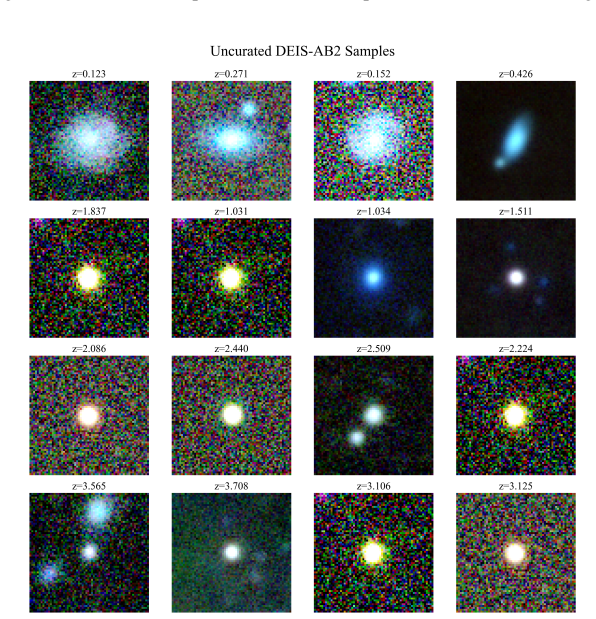
Understanding galaxy morphology evolution across cosmic time requires models that can generate realistic galaxy populations conditioned on redshift. In this work, we study efficient redshift-conditioned generative modeling for astrophysical image synthesis using diffusion models and pixel-MeanFlow. We first review the connections between score-based diffusion models, Flow Matching, one-step generative models, and modern diffusion samplers. We then evaluate DDPM, DDIM, DEIS-AB2, DPM++2M, and one-step pixel-MeanFlow on the GalaxiesML-64 dataset using morphology-based metrics, including ellipticity, semi-major axis, S\'ersic index, and isophotal area. Our results show a clear accuracy-efficiency trade-off: standard DDPM sampling achieves the best distributional fidelity but requires high computational cost, while second-order samplers substantially improve efficiency over DDIM. Pixel-MeanFlow enables single-step generation and achieves competitive performance on several morphology statistics, though it remains weaker than many-step DDPM for fine-grained structure. Our results demonstrate that one-step generative models can recover key galaxy morphology statistics at orders-of-magnitude lower computational cost, opening a path toward efficient conditional simulators for large cosmological surveys and simulation-based scientific inference.
Figures




Reference graph
Works this paper leans on
-
[1]
Christopher P. et al. The Ninth Data Release of the Sloan Digital Sky Survey: First Spectroscopic Data from the SDSS-III Baryon Oscillation Spectroscopic Survey.The Astrophysical Journal Supplement Series, 203(2):21, December 2012. doi: 10.1088/0067-0049/203/2/21
-
[2]
T. M. C. et al. Abbott. Dark energy survey year 3 results: Cosmological constraints from galaxy clustering and weak lensing.Phys. Rev. D, 105:023520, Jan 2022. doi: 10.1103/PhysRevD.105. 023520. URLhttps://link.aps.org/doi/10.1103/PhysRevD.105.023520
-
[3]
K. et al. Kuijken. The fourth data release of the kilo-degree survey:<i>ugri</i>imaging and nine-band optical-ir photometry over 1000 square degrees.Astronomy & Astrophysics, 625:A2, April 2019. ISSN 1432-0746. doi: 10.1051/0004-6361/201834918. URL http://dx.doi. org/10.1051/0004-6361/201834918
-
[4]
Second data release of the Hyper Suprime-Cam Subaru Strategic Program
Hiroaki Aihara et al. Second data release of the Hyper Suprime-Cam Subaru Strategic Program. Publications of the Astronomical Society of Japan, 71(6):114, December 2019. doi: 10.1093/ pasj/psz103. 9
work page 2019
-
[5]
Tuan Do, Bernie Boscoe, Evan Jones, Yun Qi Li, and Kevin Alfaro. Galaxiesml: a dataset of galaxy images, photometry, redshifts, and structural parameters for machine learning, 2024. URLhttps://arxiv.org/abs/2410.00271
work page Pith review arXiv 2024
-
[6]
Tri Nguyen, Francisco Villaescusa-Navarro, Siddharth Mishra-Sharma, Carolina Cuesta-Lazaro, Paul Torrey, Arya Farahi, Alex M. Garcia, Jonah C. Rose, Stephanie O’Neil, Mark V ogelsberger, Xuejian Shen, Cian Roche, Daniel Anglés-Alcázar, Nitya Kallivayalil, Julian B. Muñoz, Francis- Yan Cyr-Racine, Sandip Roy, Lina Necib, and Kassidy E. Kollmann. How dreams...
- [7]
-
[8]
E. Lastufka, O. Bait, M. Drozdova, V . Kinakh, D. Piras, M. Audard, M. Dessauges-Zavadsky, T. Holotyak, D. Schaerer, and S. V oloshynovskiy. Examining vision foundation models for classification and detection in optical and radio astronomy.Astronomy &; Astrophysics, 703: A217, November 2025. ISSN 1432-0746. doi: 10.1051/0004-6361/202553691. URL http: //dx...
-
[9]
Auto-Encoding Variational Bayes
Diederik P Kingma and Max Welling. Auto-encoding variational bayes.arXiv preprint arXiv:1312.6114, 2013
work page internal anchor Pith review Pith/arXiv arXiv 2013
-
[10]
Generative adversarial networks.Communications of the ACM, 63(11):139–144, 2020
Ian Goodfellow, Jean Pouget-Abadie, Mehdi Mirza, Bing Xu, David Warde-Farley, Sherjil Ozair, Aaron Courville, and Yoshua Bengio. Generative adversarial networks.Communications of the ACM, 63(11):139–144, 2020
work page 2020
-
[11]
Variational inference with normalizing flows
Danilo Rezende and Shakir Mohamed. Variational inference with normalizing flows. In International conference on machine learning, pages 1530–1538. PMLR, 2015
work page 2015
-
[12]
Jonathan Ho, Ajay Jain, and Pieter Abbeel. Denoising diffusion probabilistic models.Advances in neural information processing systems, 33:6840–6851, 2020
work page 2020
-
[13]
Diffusion models beat gans on image synthesis
Prafulla Dhariwal and Alexander Nichol. Diffusion models beat gans on image synthesis. Advances in neural information processing systems, 34:8780–8794, 2021
work page 2021
-
[14]
Prediff: Precipitation nowcasting with latent diffusion models
Zhihan Gao, Xingjian Shi, Boran Han, Hao Wang, Xiaoyong Jin, Danielle Maddix, Yi Zhu, Mu Li, and Yuyang Bernie Wang. Prediff: Precipitation nowcasting with latent diffusion models. Advances in Neural Information Processing Systems, 36:78621–78656, 2023
work page 2023
-
[15]
Bi Kaifeng, Lingxi Xie, Hengheng Zhang, Xin Chen, Xiaotao Gu, and Qi Tian. Pangu-weather: A 3d high-resolution system for fast and accurate global weather forecast.Nature, https://doi. org/10.1038/s41586-023-06185-3, 2023
-
[16]
MENO: MeanFlow-Enhanced Neural Operators for Dynamical Systems
Tianyue Yang and Xiao Xue. Meno: Meanflow-enhanced neural operators for dynamical systems.arXiv preprint arXiv:2604.06881, 2026
work page internal anchor Pith review Pith/arXiv arXiv 2026
-
[17]
Xiao Xue, Tianyue Yang, Mingyang Gao, Leyu Pan, Maida Wang, Kewei Zhu, Shuo Wang, Jiuling Li, Marco FP ten Eikelder, and Peter V Coveney. Uni-flow: a unified autoregressive- diffusion model for complex multiscale flows.arXiv preprint arXiv:2602.15592, 2026
-
[18]
Salva Rühling Cachay, Bo Zhao, Hailey Joren, and Rose Yu. Dyffusion: A dynamics-informed diffusion model for spatiotemporal forecasting.Advances in neural information processing systems, 36:45259–45287, 2023
work page 2023
-
[19]
David Ruhe, Jonathan Heek, Tim Salimans, and Emiel Hoogeboom. Rolling diffusion models. arXiv preprint arXiv:2402.09470, 2024
work page Pith review arXiv 2024
-
[20]
Salva Ruhling Cachay, Duncan Watson-Parris, and Rose Yu
Salva Rühling Cachay, Miika Aittala, Karsten Kreis, Noah Brenowitz, Arash Vahdat, Morteza Mardani, and Rose Yu. Elucidated rolling diffusion models for probabilistic forecasting of complex dynamics.arXiv preprint arXiv:2506.20024, 2025
-
[21]
Crystalflow: a flow-based generative model for crystalline materials
Xiaoshan Luo, Zhenyu Wang, Qingchang Wang, Xuechen Shao, Jian Lv, Lei Wang, Yanchao Wang, and Yanming Ma. Crystalflow: a flow-based generative model for crystalline materials. Nature Communications, 16(1):9267, 2025. 10
work page 2025
-
[22]
Flow Matching for Generative Modeling
Yaron Lipman, Ricky TQ Chen, Heli Ben-Hamu, Maximilian Nickel, and Matt Le. Flow matching for generative modeling.arXiv preprint arXiv:2210.02747, 2022
work page internal anchor Pith review Pith/arXiv arXiv 2022
-
[23]
Stochastic Interpolants: A Unifying Framework for Flows and Diffusions
Michael S Albergo, Nicholas M Boffi, and Eric Vanden-Eijnden. Stochastic interpolants: A unifying framework for flows and diffusions.arXiv preprint arXiv:2303.08797, 2023
work page internal anchor Pith review Pith/arXiv arXiv 2023
-
[24]
Denoising Diffusion Implicit Models
Jiaming Song, Chenlin Meng, and Stefano Ermon. Denoising diffusion implicit models.arXiv preprint arXiv:2010.02502, 2020
work page internal anchor Pith review Pith/arXiv arXiv 2010
-
[25]
DPM-Solver: A Fast ODE Solver for Diffusion Probabilistic Model Sampling in Around 10 Steps
Cheng Lu, Yuhao Zhou, Fan Bao, Jianfei Chen, Chongxuan Li, and Jun Zhu. Dpm-solver: A fast ode solver for diffusion probabilistic model sampling in around 10 steps, 2022. URL https://arxiv.org/abs/2206.00927
work page Pith review arXiv 2022
-
[26]
Cheng Lu, Yuhao Zhou, Fan Bao, Jianfei Chen, Chongxuan Li, and Jun Zhu. Dpm-solver++: Fast solver for guided sampling of diffusion probabilistic models.Machine Intelligence Re- search, 22(4):730–751, 2025
work page 2025
-
[27]
arXiv preprint arXiv:2204.13902 (2022)
Qinsheng Zhang and Yongxin Chen. Fast sampling of diffusion models with exponential integrator.arXiv preprint arXiv:2204.13902, 2022
-
[28]
Yang Song, Prafulla Dhariwal, Mark Chen, and Ilya Sutskever. Consistency models. 2023
work page 2023
-
[29]
Simplifying, Stabilizing and Scaling Continuous-Time Consistency Models
Cheng Lu and Yang Song. Simplifying, stabilizing and scaling continuous-time consistency models.arXiv preprint arXiv:2410.11081, 2024
work page internal anchor Pith review Pith/arXiv arXiv 2024
-
[30]
One Step Diffusion via Shortcut Models
Kevin Frans, Danijar Hafner, Sergey Levine, and Pieter Abbeel. One step diffusion via shortcut models.arXiv preprint arXiv:2410.12557, 2024
work page internal anchor Pith review Pith/arXiv arXiv 2024
- [31]
-
[32]
arXiv preprint arXiv:2503.07565 , year=
Linqi Zhou, Stefano Ermon, and Jiaming Song. Inductive moment matching.arXiv preprint arXiv:2503.07565, 2025
-
[33]
François Lanusse, Rachel Mandelbaum, Siamak Ravanbakhsh, Chun-Liang Li, Peter Freeman, and Barnabás Póczos. Deep generative models for galaxy image simulations.Monthly Notices of the Royal Astronomical Society, 504(4):5543–5555, 2021
work page 2021
-
[34]
H Bretonnière, A Boucaud, F Lanusse, E Jullo, E Merlin, D Tuccillo, M Castellano, J Brinch- mann, CJ Conselice, H Dole, et al. Euclid preparation-xiii. forecasts for galaxy morphology with the euclid survey using deep generative models.Astronomy & Astrophysics, 657:A90, 2022
work page 2022
-
[35]
Mustafa Mustafa, Deborah Bard, Wahid Bhimji, Zarija Luki ´c, Rami Al-Rfou, and Jan M Kratochvil. Cosmogan: creating high-fidelity weak lensing convergence maps using generative adversarial networks.Computational Astrophysics and Cosmology, 6(1):1, 2019
work page 2019
-
[36]
Nathanaël Perraudin, Sandro Marcon, Aurelien Lucchi, and Tomasz Kacprzak. Emulation of cosmological mass maps with conditional generative adversarial networks.Frontiers in Artificial Intelligence, 4:673062, 2021
work page 2021
-
[37]
Kate Storey-Fisher, Marc Huertas-Company, Nesar Ramachandra, Francois Lanusse, Alexie Leauthaud, Yifei Luo, Song Huang, and J Xavier Prochaska. Anomaly detection in hyper suprime-cam galaxy images with generative adversarial networks.Monthly Notices of the Royal Astronomical Society, 508(2):2946–2963, 2021
work page 2021
-
[38]
Stephen KN Portillo, John K Parejko, Jorge R Vergara, and Andrew J Connolly. Dimensionality reduction of sdss spectra with variational autoencoders.The Astronomical Journal, 160(1):45, 2020
work page 2020
-
[39]
Andrew Lizarraga, Eric Hanchen Jiang, Jacob Nowack, Yun Qi Li, Ying Nian Wu, Bernie Boscoe, and Tuan Do. Understanding galaxy morphology evolution through cosmic time via redshift conditioned diffusion models, 2025. URLhttps://arxiv.org/abs/2411.18440. 11
-
[40]
Michael J Smith, James E Geach, Ryan A Jackson, Nikhil Arora, Connor Stone, and Stéphane Courteau. Realistic galaxy image simulation via score-based generative models.Monthly Notices of the Royal Astronomical Society, 511(2):1808–1818, 2022
work page 2022
-
[41]
Nayantara Mudur and Douglas P Finkbeiner. Can denoising diffusion probabilistic models generate realistic astrophysical fields?arXiv preprint arXiv:2211.12444, 2022
-
[42]
Jonas Wildberger, Maximilian Dax, Simon Buchholz, Stephen Green, Jakob H Macke, and Bernhard Schölkopf. Flow matching for scalable simulation-based inference.Advances in Neural Information Processing Systems, 36:16837–16864, 2023
work page 2023
-
[43]
Hamees Sayed, Pranath Reddy, Michael W Toomey, and Sergei Gleyzer. Flowlensing: Simulat- ing gravitational lensing with flow matching.arXiv preprint arXiv:2510.07878, 2025
-
[44]
Mean Flows for One-step Generative Modeling
Zhengyang Geng, Mingyang Deng, Xingjian Bai, J Zico Kolter, and Kaiming He. Mean flows for one-step generative modeling.arXiv preprint arXiv:2505.13447, 2025
work page internal anchor Pith review Pith/arXiv arXiv 2025
-
[45]
One-step Latent-free Image Generation with Pixel Mean Flows
Yiyang Lu, Susie Lu, Qiao Sun, Hanhong Zhao, Zhicheng Jiang, Xianbang Wang, Tianhong Li, Zhengyang Geng, and Kaiming He. One-step latent-free image generation with pixel mean flows, 2026. URLhttps://arxiv.org/abs/2601.22158
work page internal anchor Pith review Pith/arXiv arXiv 2026
-
[46]
G. E. Hinton and R. R. Salakhutdinov. Reducing the dimensionality of data with neural networks.Science, 313(5786):504–507, 2006. doi: 10.1126/science.1127647. URL https: //www.science.org/doi/abs/10.1126/science.1127647
-
[47]
On the convergence properties of the hopfield model.Proceedings of the IEEE, 78(10), October 1990
Jehoshua Bruck. On the convergence properties of the hopfield model.Proceedings of the IEEE, 78(10), October 1990. doi: 10.1109/5.58341. URLhttps://doi.org/10.1109/5.58341
-
[48]
Aapo Hyvärinen and Peter Dayan. Estimation of non-normalized statistical models by score matching.Journal of Machine Learning Research, 6(4), 2005
work page 2005
-
[49]
Pascal Vincent. A connection between score matching and denoising autoencoders.Neural computation, 23(7):1661–1674, 2011
work page 2011
-
[50]
Yang Song and Stefano Ermon. Generative modeling by estimating gradients of the data distribution.Advances in neural information processing systems, 32, 2019
work page 2019
-
[51]
Score-Based Generative Modeling through Stochastic Differential Equations
Yang Song, Jascha Sohl-Dickstein, Diederik P Kingma, Abhishek Kumar, Stefano Ermon, and Ben Poole. Score-based generative modeling through stochastic differential equations.arXiv preprint arXiv:2011.13456, 2020
work page internal anchor Pith review Pith/arXiv arXiv 2011
-
[52]
Bradley Efron. Tweedie’s formula and selection bias.Journal of the American Statistical Association, 106(496):1602–1614, 2011
work page 2011
-
[53]
Tero Karras, Miika Aittala, Timo Aila, and Samuli Laine. Elucidating the design space of diffusion-based generative models.Advances in neural information processing systems, 35: 26565–26577, 2022
work page 2022
-
[54]
Neural ordinary differential equations.Advances in neural information processing systems, 31, 2018
Ricky TQ Chen, Yulia Rubanova, Jesse Bettencourt, and David K Duvenaud. Neural ordinary differential equations.Advances in neural information processing systems, 31, 2018
work page 2018
-
[55]
i-RevNet: Deep Invertible Networks
Jörn-Henrik Jacobsen, Arnold Smeulders, and Edouard Oyallon. i-revnet: Deep invertible networks.arXiv preprint arXiv:1802.07088, 2018
work page internal anchor Pith review Pith/arXiv arXiv 2018
-
[56]
Seunghun Lee, Jinyoung Park, Jaewon Chu, Minseo Yoon, and Hyunwoo J Kim. Latent bayesian optimization via autoregressive normalizing flows.arXiv preprint arXiv:2504.14889, 2025
-
[57]
Clemens Arndt and Judith Nickel. Invertible resnets for inverse imaging problems: Competitive performance with provable regularization properties.SIAM Journal on Imaging Sciences, 19(1): 266–301, 2026
work page 2026
-
[58]
Improved Mean Flows: On the Challenges of Fastforward Generative Models
Zhengyang Geng, Yiyang Lu, Zongze Wu, Eli Shechtman, J Zico Kolter, and Kaiming He. Improved mean flows: On the challenges of fastforward generative models.arXiv preprint arXiv:2512.02012, 2025. 12
work page internal anchor Pith review Pith/arXiv arXiv 2025
-
[59]
arXiv preprint arXiv:2510.20771 , year=
Huijie Zhang, Aliaksandr Siarohin, Willi Menapace, Michael Vasilkovsky, Sergey Tulyakov, Qing Qu, and Ivan Skorokhodov. Alphaflow: Understanding and improving meanflow models. arXiv preprint arXiv:2510.20771, 2025
-
[60]
Back to Basics: Let Denoising Generative Models Denoise
Tianhong Li and Kaiming He. Back to basics: Let denoising generative models denoise.arXiv preprint arXiv:2511.13720, 2025
work page internal anchor Pith review Pith/arXiv arXiv 2025
-
[61]
JAX: composable transformations of Python+NumPy programs, 2018
James Bradbury, Roy Frostig, Peter Hawkins, Matthew James Johnson, Yash Katariya, Chris Leary, Dougal Maclaurin, George Necula, Adam Paszke, Jake VanderPlas, Skye Wanderman- Milne, and Qiao Zhang. JAX: composable transformations of Python+NumPy programs, 2018. URLhttp://github.com/jax-ml/jax
work page 2018
-
[62]
Flax: A neural network library and ecosystem for JAX, 2024
Jonathan Heek, Anselm Levskaya, Avital Oliver, Marvin Ritter, Bertrand Rondepierre, Andreas Steiner, and Marc van Zee. Flax: A neural network library and ecosystem for JAX, 2024. URL http://github.com/google/flax
work page 2024
-
[63]
Adam: A Method for Stochastic Optimization
Diederik P Kingma and Jimmy Ba. Adam: A method for stochastic optimization.arXiv preprint arXiv:1412.6980, 2014
work page internal anchor Pith review Pith/arXiv arXiv 2014
-
[64]
Accurate, Large Minibatch SGD: Training ImageNet in 1 Hour
Priya Goyal, Piotr Dollár, Ross Girshick, Pieter Noordhuis, Lukasz Wesolowski, Aapo Kyrola, Andrew Tulloch, Yangqing Jia, and Kaiming He. Accurate, large minibatch sgd: Training imagenet in 1 hour.arXiv preprint arXiv:1706.02677, 2017
work page internal anchor Pith review Pith/arXiv arXiv 2017
-
[65]
Improved techniques for training score-based generative models
Yang Song and Stefano Ermon. Improved techniques for training score-based generative models. Advances in neural information processing systems, 33:12438–12448, 2020. 13 A Experimental Setting Optimization Setting.The training setup for the diffusion model follows Lizarraga et al. [38]. We use the Adam optimizer [62, 63] with a learning rate of 5×10 −5. We...
work page 2020
discussion (0)
Sign in with ORCID, Apple, or X to comment. Anyone can read and Pith papers without signing in.