REVIEW 3 major objections 5 minor 1 cited by
Parton physics from a heavy-quark operator product expansion: Lattice QCD calculation of the fourth moment of the pion distribution amplitude
T0 review · 3 major / 5 minor · reviewed 2026-08-15 · deepseek-v4-flash
Pith's one-line read Lattice QCD using a heavy-quark operator product expansion determines, for the first time, the continuum-limit fourth Mellin moment of the pion light-cone distribution amplitude.
desk verdict First continuum-limit HOPE result for the pion LCDA's fourth moment, but the value is weak (~1.3σ) and the excited-state control is thinner than the headline. read the letter →
The pith
A machine-rendered reading of the paper's core claim, the machinery that carries it, and where it could break.
The reading
What carries the argument
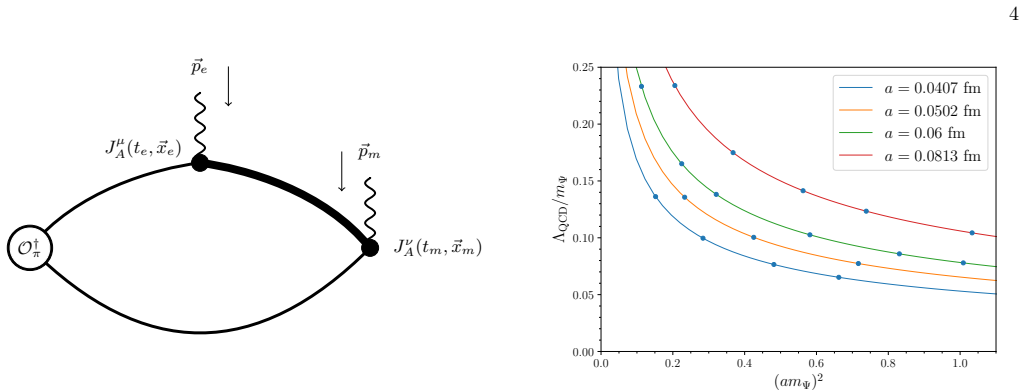
The load-bearing object is the heavy-quark operator product expansion, abbreviated HOPE: a hadronic tensor built from two heavy-light axial-vector currents, separated in Euclidean time, is expanded in a local OPE, with the fictitious heavy quark providing a second hard scale that suppresses higher-twist corrections. The coefficients $F_n$ of this expansion are computed to one loop in perturbation theory, and the lattice three-point-function ratio is fit to the Fourier transform of the OPE expression. The special kinematics $\vec p = (2,0,0)\,2\pi/L$, $\vec q = (1,0,-1)\,2\pi/L$ with Lorentz indices $\mu,\nu = 1,2$ make the antisymmetric part of the tensor dominated by the $\langle\xi^2\rangle$ Gegenbauer moment, with $\langle\xi^4\rangle$ entering as the next correction; this separation is what allows a four-moment fit. The Mellin moments follow from the fitted Gegenbauer moments through fixed linear relations.
What would settle it
On the finest ensemble ($L/a = 48$), compute the same three-point ratio at two additional source-current separations, for example $t_e/a = 16$ and $t_e/a = 20$, and compare the fitted $\langle\xi^4\rangle$ at a fixed physical $t_-$ window; if the result shifts by more than the quoted statistical error, the excited-state assumption behind the continuum extrapolation is invalid.
Extended reading notes
Core claim
The paper's central claim is that the fourth Mellin moment of the pion LCDA can be determined in the continuum limit by lattice QCD, and that the heavy-quark OPE is the technique that makes it accessible. In quenched QCD at $m_\pi \approx 550$ MeV, the continuum extrapolation yields $\langle\xi^2\rangle(\mu = 2\ \mathrm{GeV}) = 0.202(8)(9)$ and $\langle\xi^4\rangle(\mu = 2\ \mathrm{GeV}) = 0.039(28)(11)$, where the first error combines statistical and analysis-systematic uncertainty and the second is the one-loop Wilson-coefficient scale uncertainty. The fourth moment lies slightly more than one standard deviation below the asymptotic prediction $\langle\xi^4\rangle_\mathrm{asym} = 0.086$, which the authors read as weak evidence that the LCDA has not yet reached its asymptotic shape at this scale. The second moment agrees with the earlier HOPE determination, and the authors present the calculation as the first demonstration that the method is not limited to the second moment.
Load-bearing premise
The calculation assumes that excited-state contamination in the three-point correlation function is already negligible at the fixed source-current separations used on all four ensembles, although the check of that assumption was performed only on the coarsest ensemble.
Editorial extensions
If this is right
- The fourth Mellin moment of the pion LCDA now has a first continuum-limit value, so lattice results can be compared with other determinations at the level of a single number rather than through finite-lattice-spacing estimates.
- HOPE is shown to handle higher Mellin moments, so the same strategy should extend to yet higher moments and to other hadron-structure observables with a short-distance OPE.
- The consistency of the new $\langle\xi^2\rangle$ with the earlier HOPE result on a subset of the same ensembles provides an internal check that the method is stable under the added measurement statistics and momentum choices.
- At $\mu=2$ GeV the fourth moment sits below the asymptotic value, indicating that the pion LCDA is still evolving toward its asymptotic form at the perturbative scales available to lattice calculations.
Reading between the lines
- A testable extension the authors do not carry out is computing $\langle\xi^6\rangle$ on the same ensembles; because the HOPE expansion naturally contains all even moments, a sixth-moment measurement would sharpen the twist-expansion systematics that currently dominate the fourth moment.
- The scale-variation estimate of the Wilson-coefficient uncertainty might change if the threshold-log resummation the authors defer to future work is implemented in $t_-$ space; their own Fourier-transform estimate keeps the effective initial scale above roughly 1.5 GeV in the fitted window, so the shift could be comparable to the quoted 0.011 error on $\langle\xi^4\rangle$.
- The quenched approximation and the 550 MeV pion mass are the largest uncontrolled systematics; the dynamical-fermion, physical-pion continuation the authors say is underway will reveal whether the empirically expected 10-20% quenching shifts actually appear in $\langle\xi^2\rangle$ and $\langle\xi^4\rangle$.
Signed reviews
Editorial analysis
A structured set of objections, weighed in public.
Referee Report
Summary. The paper presents a lattice QCD calculation of the second and fourth Mellin moments of the pion light-cone distribution amplitude using the heavy-quark operator product expansion (HOPE) method. Four quenched ensembles with lattice spacings from 0.0407 fm to 0.0813 fm and several fictitious heavy-quark masses are used. The lattice correlation functions are fit to the one-loop HOPE formula, and the resulting (a, m_Ψ)-dependent moments are extrapolated to the continuum twist-2 limit using model averaging over the functional form in Eq. (43). The final results are ⟨ξ²⟩ = 0.202(8)(9) and ⟨ξ⁴⟩ = 0.039(28)(11) in the MSbar scheme at μ = 2 GeV. The second moment is consistent with the earlier HOPE determination, and the fourth moment is presented as the first continuum-limit determination of this quantity.
Significance. If the result stands, the paper provides a useful proof-of-principle that the HOPE method can reach the fourth Mellin moment of a meson distribution amplitude without the power divergences that limit the local-operator approach. The calculation has genuine strengths: four lattice spacings, multiple heavy-quark masses per ensemble, model averaging over fit windows and continuum extrapolation models, an explicit one-loop scale-variation estimate, and agreement with the previous HOPE determination of the second moment. The main limitation is the statistical significance of the headline result: ⟨ξ⁴⟩ = 0.039(28)(11) is only about 1.3σ from zero, so the paper should be read primarily as a controlled demonstration of the method and a broad constraint on the fourth moment, rather than as a precision determination. The excited-state control is also weaker than the production analysis in a way that directly affects the quoted uncertainty budget.
major comments (3)
- [Sec. III.C, Fig. 5] The central continuum-limit claim rests on the assumption that excited-state contamination is negligible at the chosen t_e values on all four ensembles, but the only check shown is on the coarsest L/a=24 ensemble with N_meas=2000 and a single heavy-quark mass κ_H=0.120, whereas the production data use up to N_meas=14,000 and several κ_H values. Since ⟨ξ⁴⟩ enters as a small correction to the leading ⟨ξ²⟩ term in R_anti, a contamination of only a few percent in the ratio, with a different t_- dependence, could shift ⟨ξ⁴⟩ by an amount comparable to its quoted central value or combined uncertainty. I request either a comparable excited-state check on at least one finer ensemble with production statistics, a quantitative t_e-extrapolation test, or an explicit excited-state systematic uncertainty incorporated into Eq. (49).
- [Sec. III.C, fit-window bootstrap] The bootstrap resampling over fit windows is explicitly described as heuristic, and the authors state that the width of the bootstrap distribution "no longer has a rigorous relationship to the statistical uncertainty." Because this width feeds directly into the first error quoted in Eqs. (46)-(49) and then propagates into the continuum extrapolation, the reported errors do not have a validated coverage property. The authors should validate the procedure, for example on synthetic data with known moments, or compare against an alternative window-selection prescription, to demonstrate that the final errors are not an artifact of this heuristic.
- [Eq. (43), Figs. 7-9] The continuum and twist-2 extrapolation assumes the functional form X(a,m_Ψ)=X0+X1/m_Ψ+X2 a²+X3 a² m_Ψ+X4 a² m_Ψ², with model averaging only over nested subsets of the nuisance parameters. For the fourth moment, Fig. 9 shows quite scattered data and an extrapolated value near zero; no stability check is shown, such as adding a 1/m_Ψ² term or removing the lowest m_Ψ points. Since the final ⟨ξ⁴⟩ depends on this extrapolation, an explicit check that the result is stable under these variations would make the continuum interpretation in Eq. (49) more convincing.
minor comments (5)
- [Abstract and Sec. V] The word "determined" is used for the fourth Mellin moment, but the result 0.039(28)(11) is consistent with zero at roughly 1.3σ; I recommend phrasing such as "constrained" or "estimated with large uncertainty" to avoid overstating the precision.
- [Fig. 2] The caption says "for am_Ψ ~ 1 large lattice artifacts are anticipated," but the plotted range of (am_Ψ)² is only 0 to 1; please clarify the actual heavy-quark masses used on each ensemble and reconcile the caption with the figure range.
- [Fig. 9] The second half of the caption repeats "Continuum, twist-2 extrapolation of second Mellin moment of pion LCDA" for the plot of ⟨ξ⁴⟩; it should say fourth Mellin moment.
- [Throughout] There are several typographical errors that should be corrected, including "distrbution" in the introduction, "posess" after Eq. (16), "mmultiple" in Table I, "desibed" in Sec. III.A, "coeficents" in Sec. III.C, and "asymtotically" in Sec. IV.
- [Sec. III.A] The construction of R_anti and the claim that an incorrect tilde b_A is absorbed into f_π and is irrelevant for the moments would benefit from an explicit algebraic demonstration, since the moments are extracted from the t_- dependence of the antisymmetric part rather than from the overall normalization.
Circularity Check
No circularity found: the Mellin moments are fit parameters from lattice correlators, and the self-cited Wilson coefficients are parameter-free perturbative inputs.
full rationale
The derivation chain is self-contained with respect to the central numerical claim. The moments ⟨ξ²⟩ and ⟨ξ⁴⟩ are free parameters in a fit of the lattice ratio Rµν(t+,t−;p,q) to the time-momentum representation of the one-loop HOPE formula (Eqs. 10 and 24, Sec. III.C); they are not defined in terms of the fit output, and the fit output is not defined in terms of the final quoted values. The Wilson coefficients F_n are taken from Ref. [39], a prior perturbative calculation by the same collaboration, but those coefficients are parameter-free one-loop QCD expressions that do not contain the target Mellin moments, so citing them does not constitute circularity under the stated review rules. The agreement of ⟨ξ²⟩ with the earlier HOPE determination [40] is presented as an internal consistency check, not as an input that determines the present result. The continuum and twist-2 extrapolation (Eq. 43) and the scale-variation estimate (Sec. III.D) are standard model-averaging and renormalization-scale procedures, and no equation in the paper is equivalent by construction to Eqs. (48)-(49). The excited-state contamination discussion in Sec. III.C is a systematic-uncertainty risk rather than a circular-step concern, because the paper does not fit the final moment to the excited-state check. Overall, the quoted values are ordinary lattice extractions with perturbative external inputs, and no load-bearing step reduces to its own input.
Assumptions & free parameters
free parameters (4)
- X1 (1/m_Psi coefficient)
- X2 (a^2 coefficient)
- X3 (a^2 m_Psi coefficient)
- X4 (a^2 m_Psi^2 coefficient)
assumptions (3)
- domain assumption The one-loop HOPE formula, Eq. (10), with Wilson coefficients from Ref. [39], accurately describes the lattice correlators over the fitted t- range; neglected higher-twist terms are captured by the 1/m_Psi term in Eq. (43).
- ad hoc to paper The continuum extrapolation model X(a,m_Psi) = X0 + X1/m_Psi + X2 a^2 + X3 a^2 m_Psi + X4 a^2 m_Psi^2, Eq. (43), captures all leading lattice artifacts and higher-twist effects with no missing functional forms.
- domain assumption Residual excited-state contamination is negligible at the chosen t_e values on all four ensembles, based on a single L/a=24 check.
invented entities (1)
-
Fictitious valence heavy quark field Psi
Cite this review
Pith. "Pith review of Parton physics from a heavy-quark operator product expansion: Lattice QCD calculation of the fourth moment of the pion distribution amplitude." pith.science (2026). https://pith.science/paper/MQK2K23B
@misc{pith2026250904799,
  author       = {Pith},
  title        = {Pith review of: Parton physics from a heavy-quark operator product expansion: Lattice QCD calculation of the fourth moment of the pion distribution amplitude},
  year         = {2026},
  howpublished = {\url{https://pith.science/paper/MQK2K23B}},
  note         = {Machine review of arXiv:2509.04799}
}
abstract
The pion light-cone distribution amplitude (LCDA) is an essential non-perturbative input for a range of high-energy exclusive processes in quantum chromodynamics. Building on our previous work, the continuum limit of the fourth Mellin moment of the pion LCDA is determined in quenched QCD using quark masses which correspond to a pion mass of $m_\pi = 550$ MeV. This calculation finds $\langle\xi^2\rangle = 0.202(8)(9)$ and $\langle \xi^4 \rangle = 0.039(28)(11)$ where the first error indicates the combined statistical and systematic uncertainty from the analysis and the second indicates the uncertainty from working with Wilson coefficients computed to next-to-leading order. These results are presented in the $\overline{\text{MS}}$ scheme at a renormalization scale of $\mu = 2$ GeV.
Figures


Figures from the paper (10 more)


Forward citations
Cited by 1 Pith paper
-
The nucleon unpolarized generalized form factors and Mellin moments up to fourth order
First lattice-QCD extraction of nucleon unpolarized Mellin moments through fourth order at physical pion mass, with GFF Q^{2} dependence and a reconstructed isovector valence PDF.
Reference graph
Works this paper leans on
-
[1]
A. V. Radyushkin, Deep Elastic Processes of Compos- ite Particles in Field Theory and Asymptotic Freedom, (1977), arXiv:hep-ph/0410276
arXiv 1977
-
[2]
G. R. Farrar and D. R. Jackson, The Pion Form-Factor, Phys. Rev. Lett.43, 246 (1979)
1979
-
[3]
G. Lepage and S. J. Brodsky, Exclusive Processes in Per- turbative Quantum Chromodynamics, Phys. Rev. D22, 2157 (1980)
work page 1980
- [4]
-
[5]
M. J. Dugan and B. Grinstein, QCD basis for factoriza- tion in decays of heavy mesons, Phys. Lett. B255, 583 (1991)
work page 1991
- [6]
-
[7]
Y. Y. Keum, H.-N. Li, and A. I. Sanda, Penguin enhance- ment andB→Kπdecays in perturbative QCD, Phys. Rev. D63, 054008 (2001), arXiv:hep-ph/0004173
arXiv 2001
-
[8]
C. W. Bauer, I. Z. Rothstein, and I. W. Stewart, SCET analysis of B —>K pi, B —>K anti-K, and B —>pi pi decays, Phys. Rev. D74, 034010 (2006), arXiv:hep- ph/0510241
arXiv 2006
Show all 66 references
-
[9]
J. C. Collins, L. Frankfurt, and M. Strikman, Factor- ization for hard exclusive electroproduction of mesons in QCD, Phys. Rev. D56, 2982 (1997), arXiv:hep- ph/9611433
1997
-
[10]
S. D. Drell, H. R. Quinn, B. Svetitsky, and M. Weinstein, QED on a Lattice: A Hamiltonian Variational Approach to the Physics of the Weak Coupling Region, Phys. Rev. D19, 619 (1979)
1979
-
[11]
H. Lamm, S. Lawrence, and Y. Yamauchi (NuQS), Par- ton physics on a quantum computer, Phys. Rev. Res.2, 013272 (2020), arXiv:1908.10439 [hep-lat]
2020 arXiv
-
[12]
M. G. Echevarria, I. L. Egusquiza, E. Rico, and G. Schnell, Quantum simulation of light-front par- ton correlators, Phys. Rev. D104, 014512 (2021), arXiv:2011.01275 [quant-ph]
2021 arXiv
-
[13]
Z.-B. Kang, N. Moran, P. Nguyen, and W. Qian, Par- tonic distribution functions and amplitudes using tensor network methods, (2025), arXiv:2501.09738 [hep-ph]
2025
-
[14]
M. C. Ba˜ nuls, K. Cichy, C. J. D. Lin, and M. Schneider, Parton Distribution Functions in the Schwinger model from Tensor Network States, (2025), arXiv:2504.07508 [hep-lat]
2025
-
[15]
Chen, Y.-T
J.-W. Chen, Y.-T. Chen, and G. Meher, Parton Distribu- tions on a Quantum Computer, (2025), arXiv:2506.16829 [hep-lat]
2025
-
[16]
A. S. Kronfeld and D. M. Photiadis, Phenomenology on the Lattice: Composite Operators in Lattice Gauge The- ory, Phys. Rev. D31, 2939 (1985)
1985
-
[17]
Martinelli and C
G. Martinelli and C. T. Sachrajda, A Lattice Calculation of the Second Moment of the Pion’s Distribution Ampli- tude, Phys. Lett. B190, 151 (1987)
1987
-
[18]
Arthur, P
R. Arthur, P. A. Boyle, D. Brommel, M. A. Donnel- lan, J. M. Flynn, A. Juttner, T. D. Rae, and C. T. C. Sachrajda, Lattice Results for Low Moments of Light Me- son Distribution Amplitudes, Phys. Rev. D83, 074505 (2011), arXiv:1011.5906 [hep-lat]
2011 arXiv
-
[19]
G. S. Bali, V. M. Braun, S. B¨ urger, M. G¨ ockeler, M. Gru- ber, F. Hutzler, P. Korcyl, A. Sch¨ afer, A. Sternbeck, and P. Wein (RQCD), Light-cone distribution amplitudes of pseudoscalar mesons from lattice QCD, JHEP08, 065, [Addendum: JHEP 11, 037 (2020)], arXiv:1903.08038 [hep-lat]
2020 arXiv
-
[20]
Liu and S.-J
K.-F. Liu and S.-J. Dong, Origin of difference between anti-d and anti-u partons in the nucleon, Phys. Rev. Lett. 72, 1790 (1994), arXiv:hep-ph/9306299
1994 arXiv
-
[21]
Aglietti, M
U. Aglietti, M. Ciuchini, G. Corbo, E. Franco, G. Mar- tinelli, and L. Silvestrini, Model independent determi- nation of the light cone wave functions for exclusive processes, Phys. Lett. B441, 371 (1998), arXiv:hep- ph/9806277
1998
-
[22]
Liu, Parton degrees of freedom from the path integral formalism, Phys
K.-F. Liu, Parton degrees of freedom from the path integral formalism, Phys. Rev. D62, 074501 (2000), arXiv:hep-ph/9910306
2000 arXiv
-
[23]
Detmold and C.-J
W. Detmold and C.-J. D. Lin, Deep-inelastic scatter- ing and the operator product expansion in lattice QCD, Phys. Rev. D73, 014501 (2006), arXiv:hep-lat/0507007
2006 arXiv
-
[24]
Braun and D
V. Braun and D. M¨ uller, Exclusive processes in position space and the pion distribution amplitude, Eur. Phys. J. C55, 349 (2008), arXiv:0709.1348 [hep-ph]
2008 arXiv
-
[25]
Davoudi and M
Z. Davoudi and M. J. Savage, Restoration of Rotational Symmetry in the Continuum Limit of Lattice Field The- ories, Phys. Rev. D86, 054505 (2012), arXiv:1204.4146 [hep-lat]
2012 arXiv
-
[26]
Ji, Parton Physics on a Euclidean Lattice, Phys
X. Ji, Parton Physics on a Euclidean Lattice, Phys. Rev. Lett.110, 262002 (2013), arXiv:1305.1539 [hep-ph]
2013 arXiv
-
[27]
Ji, Parton Physics from Large-Momentum Effective Field Theory, Sci
X. Ji, Parton Physics from Large-Momentum Effective Field Theory, Sci. China Phys. Mech. Astron.57, 1407 (2014), arXiv:1404.6680 [hep-ph]
2014 arXiv
-
[28]
Ji, Y.-S
X. Ji, Y.-S. Liu, Y. Liu, J.-H. Zhang, and Y. Zhao, Large- Momentum Effective Theory, (2020), arXiv:2004.03543 [hep-ph]
2020 arXiv
-
[29]
Chambers, R
A. Chambers, R. Horsley, Y. Nakamura, H. Perlt, P. Rakow, G. Schierholz, A. Schiller, K. Somfleth, R. Young, and J. Zanotti, Nucleon Structure Functions from Operator Product Expansion on the Lattice, Phys. Rev. Lett.118, 242001 (2017), arXiv:1703.01153 [hep- lat]
2017 arXiv
-
[30]
Radyushkin, Quasi-parton distribution functions, momentum distributions, and pseudo-parton distri- bution functions, Phys
A. Radyushkin, Quasi-parton distribution functions, momentum distributions, and pseudo-parton distri- bution functions, Phys. Rev. D96, 034025 (2017), arXiv:1705.01488 [hep-ph]
2017 arXiv
-
[31]
Orginos, A
K. Orginos, A. Radyushkin, J. Karpie, and S. Zafeiropou- los, Lattice QCD exploration of parton pseudo- distribution functions, Phys. Rev. D96, 094503 (2017), arXiv:1706.05373 [hep-ph]
2017 arXiv
-
[32]
Ma and J.-W
Y.-Q. Ma and J.-W. Qiu, Exploring Partonic Structure of Hadrons Using ab initio Lattice QCD Calculations, Phys. Rev. Lett.120, 022003 (2018), arXiv:1709.03018 [hep-ph]
2018 arXiv
-
[33]
M. T. Hansen, H. B. Meyer, and D. Robaina, From deep inelastic scattering to heavy-flavor semileptonic decays: Total rates into multihadron final states from lattice QCD, Phys. Rev. D96, 094513 (2017), arXiv:1704.08993 [hep-lat]
2017 arXiv
-
[34]
Hansen, A
M. Hansen, A. Lupo, and N. Tantalo, Extraction of spec- tral densities from lattice correlators, Phys. Rev. D99, 19 094508 (2019), arXiv:1903.06476 [hep-lat]
2019 arXiv
-
[35]
Shindler, Moments of parton distribution functions of any order from lattice QCD, Phys
A. Shindler, Moments of parton distribution functions of any order from lattice QCD, Phys. Rev. D110, L051503 (2024), arXiv:2311.18704 [hep-lat]
2024 arXiv
-
[36]
Gao, W.-Y
X. Gao, W.-Y. Liu, and Y. Zhao, Parton distributions from boosted fields in the Coulomb gauge, Phys. Rev. D 109, 094506 (2024), arXiv:2306.14960 [hep-ph]
2024 arXiv
-
[37]
Liang, T
J. Liang, T. Draper, K.-F. Liu, A. Rothkopf, and Y.- B. Yang (XQCD), Towards the nucleon hadronic ten- sor from lattice QCD, Phys. Rev. D101, 114503 (2020), arXiv:1906.05312 [hep-ph]
2020 arXiv
-
[38]
X. Ji, Ab Initio Lattice Quantum Chromodynamics Calculations of Parton Physics in the Proton: Large- Momentum Effective Theory versus Short-Distance Ex- pansion, Research8, 0695 (2025)
2025
-
[39]
Detmold, A
W. Detmold, A. V. Grebe, I. Kanamori, C.-J. D. Lin, R. J. Perry, and Y. Zhao, Parton Physics from a Heavy- Quark Operator Product Expansion: I. Formalism and Wilson Coefficients, (2021), arXiv:2103.09529 [hep-lat]
2021 arXiv
-
[40]
Detmold, A
W. Detmold, A. V. Grebe, I. Kanamori, C. J. D. Lin, S. Mondal, R. J. Perry, and Y. Zhao (HOPE), Parton physics from a heavy-quark operator product expansion: Lattice QCD calculation of the second moment of the pion distribution amplitude, Phys. Rev. D105, 034506 (2022), arXiv:...
2022 arXiv
-
[41]
A. V. Efremov and A. V. Radyushkin, Asymptotical Be- havior of Pion Electromagnetic Form-Factor in QCD, Theor. Math. Phys.42, 97 (1980)
1980
-
[42]
G. W. Kilcup, S. R. Sharpe, R. Gupta, G. Guralnik, A. Patel, and T. Warnock,ϵBeyond the Naive Mass Spectrum, Phys. Lett. B164, 347 (1985)
1985
-
[43]
R. G. L. C. Edwards and B. U. C. Jo´ o, The chroma soft- ware system for lattice qcd, Nucl. Phys. Proc. Suppl.140, 832 (2005), arXiv:hep-lat/0409003
2005 arXiv
-
[44]
Jo´ o, D
B. Jo´ o, D. D. Kalamkar, T. Kurth, K. Vaidyanathan, and A. Walden, Optimizing wilson-dirac operator and linear solvers for intel © knl, inHigh Performance Computing, Lecture Notes in Computer Science, Vol. 9945, edited by M. Taufer, B. Mohr, and J. Kunkel (Springer, 2016) pp. 415–427
2016
-
[45]
A. V. Grebe, in preparation (2025)
2025
-
[46]
Luscher, S
M. Luscher, S. Sint, R. Sommer, and H. Wittig, Nonper- turbative determination of the axial current normaliza- tion constant in O(a) improved lattice QCD, Nucl. Phys. B491, 344 (1997), arXiv:hep-lat/9611015
1997 arXiv
-
[47]
Bhattacharya, R
T. Bhattacharya, R. Gupta, W. Lee, and S. R. Sharpe, Scaling behavior of discretization errors in renormal- ization and improvement constants, Phys. Rev. D73, 114507 (2006), arXiv:hep-lat/0509160
2006 arXiv
-
[48]
Detmold, A
W. Detmold, A. V. Grebe, I. Kanamori, C.-J. D. Lin, S. Mondal, R. J. Perry, and Y. Zhao, A Preliminary De- termination of the Second Mellin Moment of the Pion’s Distribution Amplitude Using the Heavy Quark Opera- tor Product Expansion, inAsia-Pacific Symposium for Lattice Fiel...
2020 arXiv
-
[49]
Michael and I
C. Michael and I. Teasdale, Extracting Glueball Masses From Lattice QCD, Nucl. Phys. B215, 433 (1983)
1983
-
[50]
Luscher and U
M. Luscher and U. Wolff, How to Calculate the Elastic Scattering Matrix in Two-dimensional Quantum Field Theories by Numerical Simulation, Nucl. Phys. B339, 222 (1990)
1990
-
[51]
Zhang, A
R. Zhang, A. V. Grebe, D. C. Hackett, M. L. Wagman, and Y. Zhao, Kinematically-enhanced interpolating op- erators for boosted hadrons, (2025), arXiv:2501.00729 [hep-lat]
2025
-
[52]
G. S. Bali, B. Lang, B. U. Musch, and A. Sch¨ afer, Novel quark smearing for hadrons with high momenta in lattice QCD, Phys. Rev. D93, 094515 (2016), arXiv:1602.05525 [hep-lat]
2016 arXiv
-
[53]
Frigo and V
M. Frigo and V. Strumpen, The memory behavior of cache oblivious stencil computations, J. Supercomput. 39, 93 (2007)
2007
-
[54]
Akaike, A new look at the statistical model identi- fication, IEEE Transactions on Automatic Control19, 716–723 (1974)
H. Akaike, A new look at the statistical model identi- fication, IEEE Transactions on Automatic Control19, 716–723 (1974)
1974
-
[55]
W. I. Jay and E. T. Neil, Bayesian model averaging for analysis of lattice field theory results, Phys. Rev. D103, 114502 (2021), arXiv:2008.01069 [stat.ME]
2021 arXiv
-
[56]
Della Morte, R
M. Della Morte, R. Sommer, and S. Takeda, On cutoff effects in lattice QCD from short to long distances, Phys. Lett. B672, 407 (2009), arXiv:0807.1120 [hep-lat]
2009 arXiv
-
[57]
M. C` e, T. Harris, H. B. Meyer, A. Toniato, and C. T¨ or¨ ok, Vacuum correlators at short distances from lattice QCD, JHEP12, 215, arXiv:2106.15293 [hep-lat]
-
[58]
X. Gao, K. Lee, S. Mukherjee, C. Shugert, and Y. Zhao, Origin and resummation of threshold logarithms in the lattice QCD calculations of PDFs, Phys. Rev. D103, 094504 (2021), arXiv:2102.01101 [hep-ph]
2021 arXiv
-
[59]
Y. Su, J. Holligan, X. Ji, F. Yao, J.-H. Zhang, and R. Zhang, Resumming quark’s longitudinal momentum logarithms in LaMET expansion of lattice PDFs, Nucl. Phys. B991, 116201 (2023), arXiv:2209.01236 [hep-ph]
2023 arXiv
-
[60]
Baker, D
E. Baker, D. Bollweg, P. Boyle, I. Clo¨ et, X. Gao, S. Mukherjee, P. Petreczky, R. Zhang, and Y. Zhao, Lat- tice QCD calculation of the pion distribution amplitude with domain wall fermions at physical pion mass, JHEP 07, 211, arXiv:2405.20120 [hep-lat]
-
[61]
Cloet, X
I. Cloet, X. Gao, S. Mukherjee, S. Syritsyn, N. Karthik, P. Petreczky, R. Zhang, and Y. Zhao, Lattice QCD calcu- lation of x-dependent meson distribution amplitudes at physical pion mass with threshold logarithm resumma- tion, Phys. Rev. D110, 114502 (2024), arXiv:2407.00206 [hep-lat]
2024 arXiv
-
[62]
Braun, S
V. Braun, S. Collins, M. G¨ ockeler, P. P´ erez-Rubio, A. Sch¨ afer, R. Schiel, and A. Sternbeck, Second Mo- ment of the Pion Light-cone Distribution Amplitude from Lattice QCD, Phys. Rev. D92, 014504 (2015), arXiv:1503.03656 [hep-lat]
2015 arXiv
-
[63]
X. Gao, A. D. Hanlon, N. Karthik, S. Mukherjee, P. Petreczky, P. Scior, S. Syritsyn, and Y. Zhao, Pion distribution amplitude at the physical point us- ing the leading-twist expansion of the quasi-distribution- amplitude matrix element, Phys. Rev. D106, 074505 (2022), arXiv:22...
2022 arXiv
-
[64]
Zhang, C
R. Zhang, C. Honkala, H.-W. Lin, and J.-W. Chen, Pion and Kaon Distribution Amplitudes in the Continuum Limit, (2020), arXiv:2005.13955 [hep-lat]
2020 arXiv
-
[65]
Holligan, X
J. Holligan, X. Ji, H.-W. Lin, Y. Su, and R. Zhang, Preci- sion control in lattice calculation of x-dependent pion dis- tribution amplitude, Nucl. Phys. B993, 116282 (2023), arXiv:2301.10372 [hep-lat]
2023 arXiv
-
[66]
G. S. Bali, V. M. Braun, B. Gl¨ aßle, M. G¨ ockeler, M. Gruber, F. Hutzler, P. Korcyl, A. Sch¨ afer, P. Wein, and J.-H. Zhang, Pion distribution amplitude from Eu- clidean correlation functions: Exploring universality and higher-twist effects, Phys. Rev. D98, 094507 (2018), ar...
2018 arXiv
Reviewed August 15, 2026 · model on record in the stance chip above.
Discussion (0). Continue with ORCID to comment.