A Variational Framework for LLM Generator-Regulator Games
Pith reviewed 2026-06-26 21:38 UTC · model grok-4.3
The pith
The generator-regulator interaction in language models is a saddle-point problem whose equilibrium balances utility, entropy, alignment, and detectability.
A machine-rendered reading of the paper's core claim, the machinery that carries it, and where it could break.
Core claim
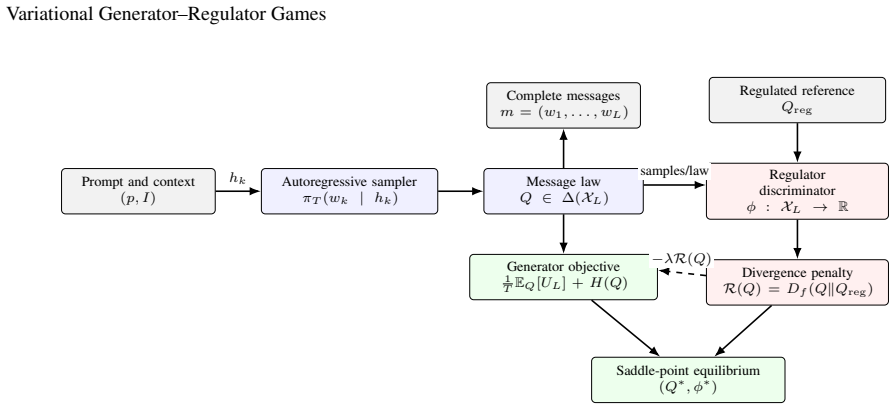
The generator-regulator interaction is formulated as a saddle-point problem whose equilibrium clarifies the tradeoff among utility, entropy, regulatory alignment, and finite-length detectability. Regulation is modeled as an optimal discriminator whose convex-dual value is an f-divergence, and the induced distribution over complete messages from autoregressive token sampling is related to an entropy-regularized Gibbs law. The framework applies to moderation, censorship, AI deception detection, compliance auditing, phishing defense, and manipulation control, where regulation concerns a distribution over possible messages rather than a single output.
What carries the argument
The saddle-point formulation of the generator-regulator game, where the regulator value is the convex dual of an f-divergence and the message distribution follows an entropy-regularized Gibbs law.
If this is right
- Regulation concerns a distribution over possible messages rather than a single output.
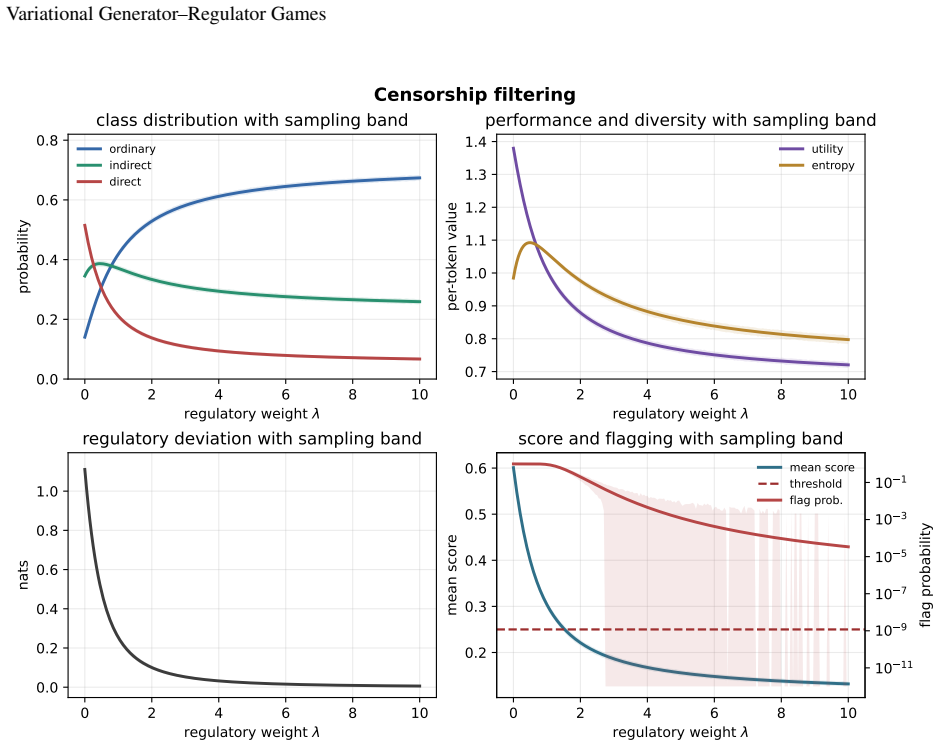
- The equilibrium quantifies tradeoffs through utility, entropy, divergence, receiver-side scores, and detection probability.
- The same saddle-point setup applies to censorship filtering, phishing defense, deception detection, compliance auditing, and manipulation control.
- Finite-length detectability emerges directly from the equilibrium without separate modeling.
Where Pith is reading between the lines
- The saddle-point view could be turned into a training objective that embeds regulatory constraints directly into generation.
- Different choices of f-divergence would let regulators tune the strength of alignment without changing the overall game structure.
- Extending the finite-vocabulary case studies to full tokenizers would test whether the Gibbs-law approximation still holds at scale.
- Detection systems could be designed around the equilibrium divergence rather than separate classifiers.
Load-bearing premise
The induced distribution over complete messages from autoregressive token sampling can be related exactly to an entropy-regularized Gibbs law, and regulation can be modeled precisely as an optimal discriminator whose convex-dual value is an f-divergence.
What would settle it
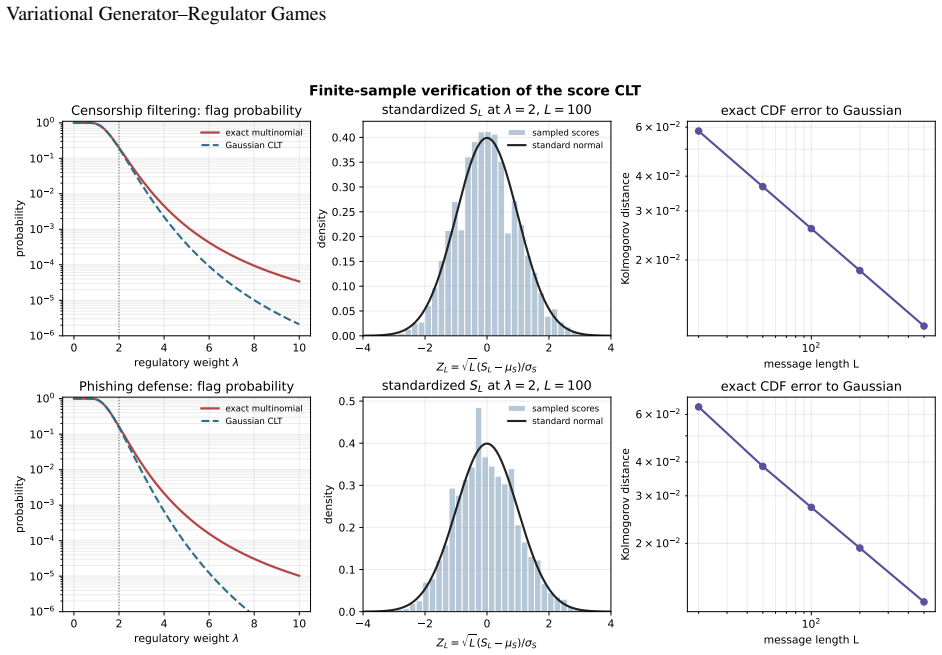
A numerical check in a small-vocabulary censorship scenario where the computed saddle-point equilibrium fails to predict the observed detection probability at given message lengths would falsify the framework.
Figures
read the original abstract
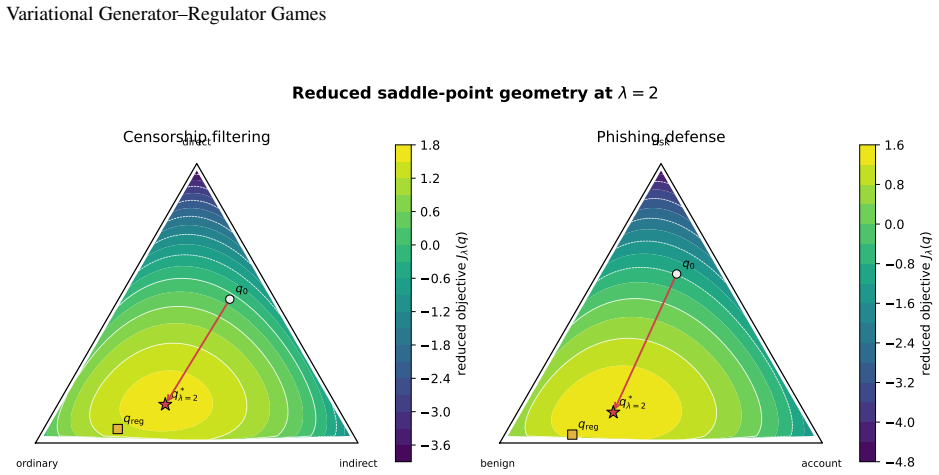
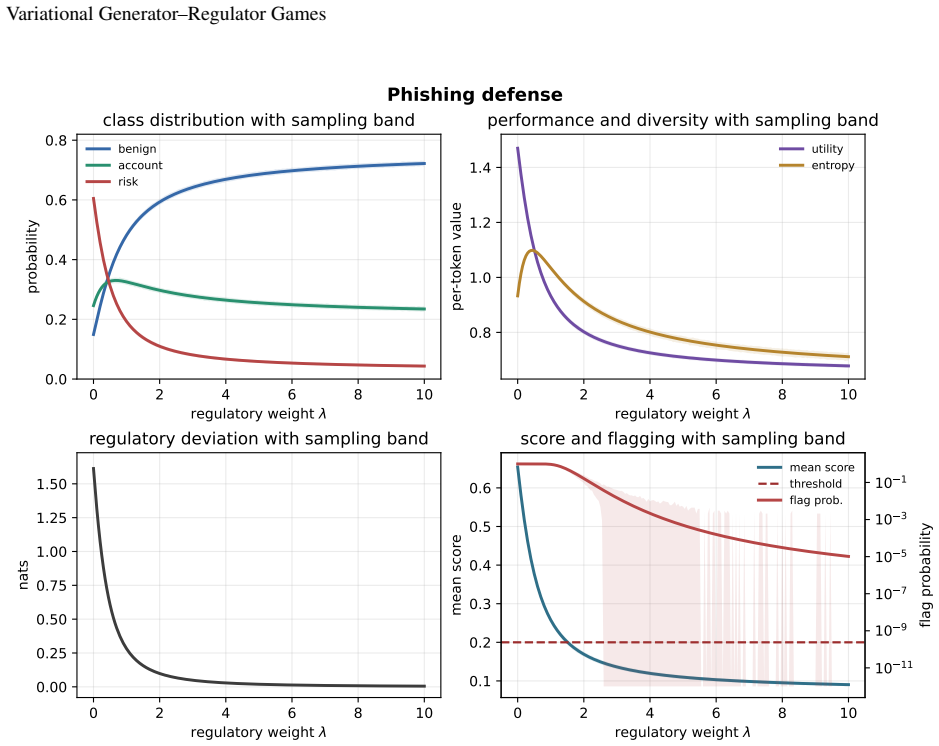
This paper develops a variational framework for regulated language generation. Starting from autoregressive token sampling, we derive the induced distribution over complete messages and relate it to an entropy-regularized Gibbs law. Regulation is modeled as an optimal discriminator whose convex-dual value is an f-divergence, and the generator-regulator interaction is formulated as a saddle-point problem. The framework applies to moderation, censorship, AI deception detection, compliance auditing, phishing defense, and manipulation control, where regulation concerns a distribution over possible messages rather than a single output. The equilibrium clarifies the tradeoff among utility, entropy, regulatory alignment, and finite-length detectability. Two finite-vocabulary case studies, censorship filtering and phishing defense, illustrate how the theory can be evaluated through utility, entropy, divergence, receiver-side scores, and detection probability.
Editorial analysis
A structured set of objections, weighed in public.
Referee Report
Summary. The paper develops a variational framework for regulated language generation. Starting from autoregressive token sampling, it derives the induced distribution over complete messages and relates it to an entropy-regularized Gibbs law. Regulation is modeled as an optimal discriminator whose convex-dual value is an f-divergence, and the generator-regulator interaction is formulated as a saddle-point problem. The equilibrium is claimed to clarify tradeoffs among utility, entropy, regulatory alignment, and finite-length detectability. Two finite-vocabulary case studies (censorship filtering and phishing defense) illustrate evaluation via utility, entropy, divergence, receiver-side scores, and detection probability.
Significance. If the derivations are rigorous, the framework could unify ideas from variational methods, game theory, and f-divergences to analyze regulation of message distributions in LLMs, with relevance to AI safety tasks. The case studies provide a template for empirical checks, though limited to finite vocabularies. The saddle-point formulation, if valid, offers a principled way to quantify the listed tradeoffs.
major comments (1)
- [Derivation from autoregressive sampling to Gibbs law] The central derivation relating the product distribution induced by autoregressive sampling p(token_i | prefix) to an entropy-regularized Gibbs law over full messages m requires an unstated separability or additivity condition on the utility U(m) that is compatible with the chain rule. Without this, the normalizing constant and entropy term do not separate as claimed. This step underpins the saddle-point formulation and all subsequent equilibrium claims; it is not verified in the finite-vocabulary case studies, which are presented only as illustrations.
Simulated Author's Rebuttal
We are grateful to the referee for the thorough review and valuable feedback on our variational framework for LLM generator-regulator games. We address the major comment in detail below and will incorporate clarifications in the revised manuscript.
read point-by-point responses
-
Referee: [Derivation from autoregressive sampling to Gibbs law] The central derivation relating the product distribution induced by autoregressive sampling p(token_i | prefix) to an entropy-regularized Gibbs law over full messages m requires an unstated separability or additivity condition on the utility U(m) that is compatible with the chain rule. Without this, the normalizing constant and entropy term do not separate as claimed. This step underpins the saddle-point formulation and all subsequent equilibrium claims; it is not verified in the finite-vocabulary case studies, which are presented only as illustrations.
Authors: We thank the referee for highlighting this aspect of the central derivation. The relation between the autoregressive product distribution and the entropy-regularized Gibbs law over messages does rely on the utility U(m) admitting a decomposition compatible with the chain rule for the log-probabilities. In the framework, this holds when U(m) can be expressed via token-level contributions aligned with the prefixes, allowing the partition function and entropy terms to separate as stated. We will revise the relevant section to explicitly state this separability condition and include a concise derivation sketch demonstrating the separation. Regarding the case studies, the finite-vocabulary enumerations compute the exact message distributions from the autoregressive process, which by construction satisfies the compatibility for the utilities employed; we will add a clarifying remark confirming this in the case-study sections. revision: yes
Circularity Check
No circularity identified; derivation chain self-contained from sampling to variational objective.
full rationale
The abstract states that the induced distribution over messages is derived from autoregressive token sampling and related to an entropy-regularized Gibbs law, with regulation modeled via f-divergence and formulated as a saddle-point problem. No equations, self-citations, fitted parameters renamed as predictions, or ansatzes are visible in the provided text that would allow exhibition of a reduction by construction. The finite-vocabulary case studies are described as illustrations rather than load-bearing inputs. Per the rules, absence of quotable specific reductions means the central claim does not reduce to its inputs; this is the expected honest non-finding when the derivation remains independent of self-referential steps.
Axiom & Free-Parameter Ledger
Reference graph
Works this paper leans on
-
[1]
Gomez, Lukasz Kaiser, and Illia Polosukhin
Ashish Vaswani, Noam Shazeer, Niki Parmar, Jakob Uszkoreit, Llion Jones, Aidan N. Gomez, Lukasz Kaiser, and Illia Polosukhin. Attention is all you need. InAdvances in Neural Information Processing Systems, volume 30, 2017
2017
-
[2]
Tom B. Brown, Benjamin Mann, Nick Ryder, Melanie Subbiah, Jared Kaplan, Prafulla Dhariwal, Arvind Nee- lakantan, Pranav Shyam, Girish Sastry, Amanda Askell, Sandhini Agarwal, Ariel Herbert-V oss, Gretchen Krueger, Tom Henighan, Rewon Child, Aditya Ramesh, Daniel M. Ziegler, Jeffrey Wu, Clemens Winter, Christopher Hesse, Mark Chen, Eric Sigler, Mateusz Lit...
1901
-
[3]
Claude E. Shannon. A mathematical theory of communication.The Bell System Technical Journal, 27(3):379–423, 1948
1948
-
[4]
Cover and Joy A
Thomas M. Cover and Joy A. Thomas.Elements of Information Theory. Wiley-Interscience, Hoboken, NJ, 2 edition, 2006
2006
-
[5]
Tyrrell Rockafellar.Convex Analysis
R. Tyrrell Rockafellar.Convex Analysis. Princeton University Press, Princeton, NJ, 1970
1970
-
[6]
On general minimax theorems.Pacific Journal of Mathematics, 8(1):171–176, 1958
Maurice Sion. On general minimax theorems.Pacific Journal of Mathematics, 8(1):171–176, 1958
1958
-
[7]
A Game-Theoretic Taxonomy and Survey of Defensive Deception for Cybersecurity and Privacy
Jeffrey Pawlick, Edward Colbert, and Quanyan Zhu. A game-theoretic taxonomy and survey of defensive deception for cybersecurity and privacy, 2017. arXiv:1712.05441
work page internal anchor Pith review Pith/arXiv arXiv 2017
-
[8]
Modeling and Analysis of Leaky Deception using Signaling Games with Evidence
Jeffrey Pawlick, Edward Colbert, and Quanyan Zhu. Modeling and analysis of leaky deception using signaling games with evidence, 2018. arXiv:1804.06831
work page internal anchor Pith review Pith/arXiv arXiv 2018
-
[9]
A Game-Theoretic Foundation of Deception: Knowledge Acquisition and Fundamental Limits
Tao Zhang and Quanyan Zhu. A game-theoretic foundation of deception: Knowledge acquisition and fundamental limits, 2018. arXiv:1810.00752
work page internal anchor Pith review Pith/arXiv arXiv 2018
-
[10]
Game Theory for Cyber Deception: A Tutorial
Quanyan Zhu. Game theory for cyber deception: A tutorial, 2019. arXiv:1903.01442
work page internal anchor Pith review Pith/arXiv arXiv 2019
-
[11]
Foundations of cyber resilience: The confluence of game, control, and learning theories, 2024
Quanyan Zhu. Foundations of cyber resilience: The confluence of game, control, and learning theories, 2024. arXiv:2404.01205
-
[12]
Donsker and S
Monroe D. Donsker and S. R. Srinivasa Varadhan. Asymptotic evaluation of certain Markov process expectations for large time, I.Communications on Pure and Applied Mathematics, 28(1):1–47, 1975
1975
-
[13]
Generative adversarial nets
Ian Goodfellow, Jean Pouget-Abadie, Mehdi Mirza, Bing Xu, David Warde-Farley, Sherjil Ozair, Aaron Courville, and Yoshua Bengio. Generative adversarial nets. InAdvances in Neural Information Processing Systems, volume 27, pages 2672–2680, 2014
2014
-
[14]
f-GAN: Training generative neural samplers using variational divergence minimization
Sebastian Nowozin, Botond Cseke, and Ryota Tomioka. f-GAN: Training generative neural samplers using variational divergence minimization. InAdvances in Neural Information Processing Systems, volume 29, 2016
2016
-
[15]
Information-type measures of difference of probability distributions and indirect observations
Imre Csiszar. Information-type measures of difference of probability distributions and indirect observations. Studia Scientiarum Mathematicarum Hungarica, 2:299–318, 1967
1967
-
[16]
Zur theorie der gesellschaftsspiele.Mathematische Annalen, 100:295–320, 1928
John von Neumann. Zur theorie der gesellschaftsspiele.Mathematische Annalen, 100:295–320, 1928
1928
-
[17]
Game Theory Meets Network Security: A Tutorial at ACM CCS
Quanyan Zhu and Stefan Rass. Game theory meets network security: A tutorial at ACM CCS, 2018. arXiv:1808.08066
work page internal anchor Pith review Pith/arXiv arXiv 2018
-
[18]
Security of distributed machine learning: A game-theoretic approach to design secure DSVM, 2020
Rui Zhang and Quanyan Zhu. Security of distributed machine learning: A game-theoretic approach to design secure DSVM, 2020. arXiv:2003.04735
-
[19]
Gary King, Jennifer Pan, and Margaret E. Roberts. How censorship in China allows government criticism but silences collective expression.American Political Science Review, 107(2):326–343, 2013
2013
-
[20]
Roberts.Censored: Distraction and Diversion Inside China’s Great Firewall
Margaret E. Roberts.Censored: Distraction and Diversion Inside China’s Great Firewall. Princeton University Press, Princeton, NJ, 2018
2018
-
[21]
chat-censorship: Data related to the investigation of realtime censorship
The Citizen Lab. chat-censorship: Data related to the investigation of realtime censorship. GitHub repository,
-
[22]
Accessed June 16, 2026
2026
-
[23]
Thomas Wolf, Lysandre Debut, Victor Sanh, Julien Chaumond, Clement Delangue, Anthony Moi, Pierric Cistac, Tim Rault, Remi Louf, Morgan Funtowicz, Joe Davison, Sam Shleifer, Patrick von Platen, Clara Ma, Yacine Jernite, Julien Plu, Canwen Xu, Teven Le Scao, Sylvain Gugger, Mariama Drame, Quentin Lhoest, and Alexander M. Rush. Transformers: State-of-the-art...
2020
-
[24]
Rachna Dhamija, J. D. Tygar, and Marti Hearst. Why phishing works. InProceedings of the SIGCHI Conference on Human Factors in Computing Systems, pages 581–590. ACM, 2006
2006
-
[25]
Phishing detection: A literature survey.IEEE Communica- tions Surveys & Tutorials, 15(4):2091–2121, 2013
Mahmoud Khonji, Youssef Iraqi, and Andrew Jones. Phishing detection: A literature survey.IEEE Communica- tions Surveys & Tutorials, 15(4):2091–2121, 2013
2091
-
[26]
Ya-Ting Yang and Quanyan Zhu. Game-theoretic foundations for cyber resilience against deceptive information attacks in intelligent transportation systems, 2024. arXiv:2412.04627
-
[27]
phishing-attacks topic
GitHub. phishing-attacks topic. GitHub Topics, 2026. Accessed June 16, 2026. 26
2026
discussion (0)
Sign in with ORCID, Apple, or X to comment. Anyone can read and Pith papers without signing in.