REVIEW 3 major objections 4 minor 40 references
Meson mass spectrum in Ising Field Theory
T0 review · 3 major / 4 minor · reviewed 2026-08-06 · deepseek-v4-flash
Pith's one-line read The paper derives exact spectral sums and a large-n WKB expansion for the meson spectrum of the two-particle Bethe-Salpeter approximation of Ising field theory, and predicts two infinite series of complex critical points where meson…
desk verdict Solid transfer of FLZ machinery to IFT with strong limiting checks, but the complex-plane critical point claim contains an internal arithmetic contradiction and the core log-derivative identities remain unproved. read the letter →
The pith
A machine-rendered reading of the paper's core claim, the machinery that carries it, and where it could break.
The reading
What carries the argument
The central object is the Q-function $Q_\pm(\nu|\lambda)$, a solution of the Baxter TQ equation $Q(\nu+2i)+Q(\nu-2i)-2Q(\nu)=-\frac{2z}{\nu+\alpha x}Q(\nu)$, a second-order difference equation with coefficients built from $\coth(\pi\nu/2)$; the requirement that $Q$ be pole-free and grow slowly selects the eigenvalues $\lambda_n$. The load-bearing step is a pair of log-derivative identities, equations (4.15)-(4.16), that express $\partial_\lambda \log D_\pm(\lambda)$ through $\partial_\nu \log Q_\pm(\nu|\lambda)$ evaluated at $\nu=2i$. These identities convert analytic solutions of the difference equation into spectral data, and the paper states that they have no rigorous proof but have passed compatibility and numerical tests.
What would settle it
Discretize the Bethe-Salpeter operator on a fine rapidity grid at a fixed value such as $\alpha=1$, compute the first several eigenvalues and spectral sums to high precision, and compare the left- and right-hand sides of (4.15)-(4.16) order by order in $\lambda$; any discrepancy larger than the discretization error at the first unlisted order would falsify the central claim.
Extended reading notes
Core claim
On the paper's own terms, the discovery is that the two-particle Bethe-Salpeter equation of Ising field theory, written in the dimensionless variables $\alpha = \pi m^2/(2f_0)$ and $\lambda = M^2/(4\pi f_0)$, belongs to the same integrable class as the 't Hooft model: its solutions are encoded in a Q-function satisfying a Baxter TQ difference equation. From the asymptotic solutions of that equation, together with a set of log-derivative identities connecting the Q-function to the spectral determinants $D_\pm(\lambda)$, the paper derives closed expressions for the first three spectral sums $G^{(s)}_\pm$ and the first several orders of the large-$n$ WKB expansion $\lambda_n = n/2 + \ldots$ for the infinite tower of mesons. It then analytically continues the spectral data in $\alpha$ and finds two infinite families of critical points: $\alpha^*_k$, where a pair of even-parity meson masses vanishes as $(\alpha-\alpha^*_k)^{1/4}$ and the spectrum develops fourth-root branch cuts, and $\tilde\alpha_k$, where a single odd-parity physical meson mass vanishes linearly. The paper presents these as conjectures supported by numerical checks, by agreement with the $E_8$ and free-fermion limits, and by consistency with the Yang-Lee critical behavior at the qualitative level.
Load-bearing premise
The load-bearing premise is the pair of log-derivative identities (4.15)-(4.16), which the paper states but does not prove; if either identity fails beyond the orders that have been tested, the spectral sums, WKB expansion, and critical-point predictions would not be established.
Editorial extensions
If this is right
- The spectral sums (5.1)-(5.3) provide high-precision benchmark values for the two-quark Bethe-Salpeter operator and can validate future numerical or approximate schemes for IFT mesons.
- The WKB expansions (5.15)-(5.16) give a systematic large-$n$ formula for the whole tower of even and odd meson masses, most accurate for highly excited states.
- In the chiral limit $\alpha\to0$ the formulas reproduce known leading behaviour and provide exact coefficients for the small-$\eta$ expansion of low-lying masses.
- In the heavy-quark limit $\alpha\to\infty$ the formulas reproduce the relativistic quasilinear spectrum and the non-relativistic Airy scaling.
- Under analytic continuation the predicted critical points $\alpha^*_k$ and $\tilde\alpha_k$ imply concrete vanishing laws for meson masses, which can be searched for numerically in the analytically continued Bethe-Salpeter equation.
Reading between the lines
- A proof of the log-derivative identities would be the shortest route to putting the whole construction on solid ground; if such a proof exists for the closely related 't Hooft operator, the same Wronskian and resolvent logic may prove them here.
- The even-parity sector of the Bethe-Salpeter equation, though non-physical for IFT, appears to carry chiral information: the $\alpha=0$ square-root vanishing of the lightest even mass parallels the Gell-Mann-Oakes-Renner relation in the 't Hooft model.
- The linear vanishing law (7.12) at $\tilde\alpha_k$ differs from the full Yang-Lee exponent $5/6$, so comparing the two near the estimated Yang-Lee point gives a quantitative measure of how much multi-quark effects change the critical behavior.
- The same TQ machinery should transfer to the coupled-chain (two unequal masses) generalization the paper sketches, and the resulting critical points would then be testable predictions for lattice simulations of coupled Ising chains.
Editorial analysis
A structured set of objections, weighed in public.
Referee Report
Summary. The paper develops a new analytical framework for the two-particle Bethe-Salpeter (BS) equation of the Ising Field Theory (IFT) by recasting it as a Baxter TQ equation, following the FLZ approach previously applied to the 't Hooft model. From the TQ equation the authors construct Q-functions in the small-λ and large-λ regimes and propose log-derivative identities (4.15)-(4.16) that connect these Q-functions to the spectral determinants D_±(λ). These identities are then used to derive explicit expressions for spectral sums G(s)_± (Eqs. (5.1)-(5.3)), a large-n WKB expansion for the meson masses (Eqs. (5.15)-(5.16)), and a detailed analysis of analytic continuation of the parameter α into the complex plane. The central new predictions are two infinite series of critical points α*_k and eα_k on the second sheet where one or two meson masses vanish with fourth-root or linear behavior, respectively (Eqs. (7.6) and (7.12)). The paper also presents consistency checks in the E_8 (α→0) and free-fermion (α→∞) limits.
Significance. If the results were fully established, the paper would provide a non-perturbative analytic description of the two-particle BS spectrum, exact spectral-sum identities, and a systematic WKB expansion valid to arbitrary order. It would also open a window into the complex analytic structure of meson masses, a direction that is largely unexplored. The structural analogy with the 't Hooft model is well exploited, and the limiting-case checks against known E_8 and free-fermion results are nontrivial. The paper ships three Mathematica notebooks with explicit expressions for spectral sums, phase functions, and WKB terms, which is a reproducible resource. It is also a strength that no parameters are fitted to the target spectrum: α is an input and λ is the eigenvalue, so the framework is not circular in that sense. However, the critical-point predictions are currently undermined by an internal arithmetic inconsistency and by the absence of direct numerical verification.
major comments (3)
- [§7.2, Eqs. (7.5)-(7.6)] The proposed vanishing behavior (7.6) is inconsistent with the spectral-sum expansion (7.5) from which it is derived. For the pair λ_± = ±i C δ^{1/4} + O(δ^{1/2}) with C = sqrt(2π(1+α*_k)), both λ_+^2 and λ_-^2 equal -C^2 δ^{1/2}, so each contributes -C^{-2}δ^{-1/2} to G(2)_+, and the pair contributes -2C^{-2}δ^{-1/2} = -[π(1+α*_k)]^{-1}δ^{-1/2}. However (7.5) states G(2)_+ = -4π(1+α*_k)δ^{1/2}+O(1), which vanishes at δ=0 and contains no divergent term. Similarly, the pair contributes 2C^{-4}δ^{-1} = [2π^2(1+α*_k)^2]^{-1}δ^{-1} to G(4)_+, whereas (7.5) gives 8π^2(1+α*_k)^2δ^{-1}. These coefficients are not equal, and no cancellation mechanism is described: a cancellation in G(2) would require the squares of the two eigenvalues to have opposite signs, but the phases ±π/2 in (7.6) give equal squares. Since the two critical-point series are a headline result, Eqs. (7.5) and (7.6) cannot both stand as written; the analysis must be corrected or replaced with a numerically verified alternative.
- [§4.3, Eqs. (4.15)-(4.16)] The log-derivative relations (4.15)-(4.16) are explicitly stated to have no rigorous proof, yet they are the sole basis for the spectral sums (5.1)-(5.3), the WKB expansion (5.15)-(5.16), and the analytic-continuation analysis of Section 7. The paper's statement that these identities 'have successfully passed all the tests we have conducted' is not sufficient for exact results. The manuscript should either supply a proof, or clearly label the main outputs of Sections 5 and 7 as conjectural and provide the numerical validation in the complex-α region where the critical-point predictions are made.
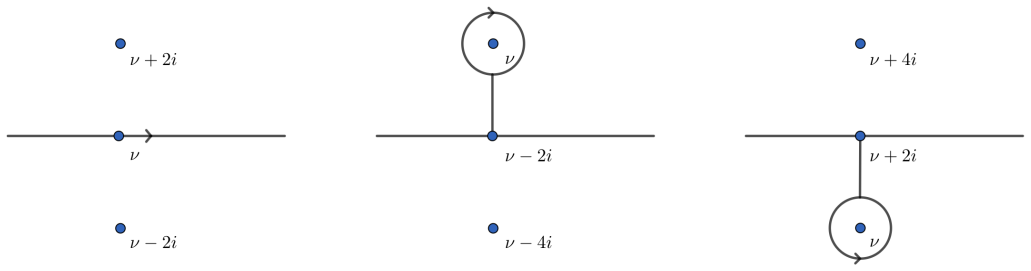
- [§7.2, critical-point predictions] No direct numerical verification is presented for the predicted vanishing of meson masses at α*_k and eα_k. Given the inconsistency identified above between (7.5) and (7.6), a numerical solution of the Bethe-Salpeter equation (2.9) for complex α in the vicinity of, e.g., α*_1 and eα_1 is necessary to support (7.6) and (7.12). This is particularly important because the critical points lie on the second sheet and the paper does not specify how the spectral sums are defined or analytically continued there; the claimed cancellation of residue contributions after a 4π rotation also deserves an explicit demonstration.
minor comments (4)
- [§6.1, Table 1] The entries marked '*.*****' in Table 1 are not defined; the asterisks should be explained (e.g., coefficients that are complex or unreliable) or the entries should be removed.
- [§2.3, Eq. (2.45)] The expression for v(α) in Eq. (2.45) refers to u_3(α) which is not defined until Eq. (3.8); a cross-reference would help the reader.
- [§7.2, Tables 2 and 3] The notation 'eαk' for the second family of critical points is ambiguous; distinct typography (e.g., \(\tilde\alpha_k\)) should be used consistently in the text, tables, and figures.
- [§5.1] For clarity, the statement that matrix elements are omitted should specify that the first two are given in Appendix A and the others are available in the supplementary files; this would let readers verify the formulas more easily.
Circularity Check
No circularity: spectral sums and WKB expansion are derived from the TQ/Bethe–Salpeter equations; unproved identities are support gaps, not circular inputs.
full rationale
The derivation chain starts from the Bethe–Salpeter equation (2.9), rewrites it as the TQ equation (2.28) via the Q-function, constructs Q±(ν|λ) as asymptotic series with coefficients fixed by pole cancellation (Section 3), and extracts spectral data through the Wronskian (4.12) and log-derivative relations (4.15)–(4.16). No parameter is fitted to the target spectrum: α is an input, λ is the eigenvalue, and the spectral sums G(s)± are defined from the same eigenvalues whose values are later checked numerically. The log-derivative relations are admittedly unproved — "Again, the status of equation (4.16) remains unchanged: although it does not have a rigorous proof, it has successfully passed all the tests that we have conducted" (Sec. 4.3) — but an unproved assumption is an unsupported-premise risk, not a circular reuse of the result. Citations of [27–29] are methodological analogies and extensions by the same authors; they do not smuggle in the IFT spectral sums or the critical-point predictions. The paper also validates against independent external data (E8 masses, free-fermion limit, TFFSA numerics). One internal-consistency problem exists but is a correctness issue, not circularity: under (7.6), the pair λ± = ±i C δ^{1/4} would contribute −2 C^{-2} δ^{-1/2} to G(2)+, whereas (7.5) gives −4π(1+α*) δ^{1/2}; if real, this would falsify (7.6), which is the opposite of a circular reduction.
Assumptions & free parameters
assumptions (4)
- domain assumption The Bethe-Salpeter equation (2.9) is taken as the correct two-particle model of IFT mesons.
- ad hoc to paper Log-derivative relations (4.15) and (4.16) connect spectral determinants D_± to Q-functions without rigorous proof.
- ad hoc to paper The asymptotic expansions of Q_±(ν|λ) in λ and λ^-1, and the large-λ determinant representation (5.5) with the continuation (5.9), capture the full spectrum.
- ad hoc to paper The analytic-continuation scenario in Section 7: on the second sheet the only singularities that cross the real axis are the pairs ±iν*_k(α), and the contours of pole evolution determine the branch structure.
Cite this review
Pith. "Pith review of Meson mass spectrum in Ising Field Theory." pith.science (2026). https://pith.science/paper/MSWAM4P6
@misc{pith2026250715766,
  author       = {Pith},
  title        = {Pith review of: Meson mass spectrum in Ising Field Theory},
  year         = {2026},
  howpublished = {\url{https://pith.science/paper/MSWAM4P6}},
  note         = {Machine review of arXiv:2507.15766}
}
abstract
We study the two-particle approximation of the Ising Field Theory (IFT), formulated in terms of the Bethe-Salpeter (BS) equation. Derived by Fonseca and Zamolodchikov as a systematic realization of the McCoy-Wu approach, this equation captures confinement by modeling ``mesons'' as bound states of two Majorana fermions (``quarks''), in a way analogous to the integral equation in the 't Hooft model. Despite its approximate nature, the BS equation provides remarkably accurate predictions for the mass spectrum of stable mesons across a wide range of parameters. Motivated by the striking structural similarity between the BS equation in IFT and the 't Hooft equation in two-dimensional QCD, we develop a new non-perturbative analytical framework inspired by the method of Fateev, Lukyanov, and Zamolodchikov (FLZ). Within this approach, we compute spectral sums and systematically derive the large-$n$ WKB expansion for the Bethe-Salpeter equation, which governs the spectrum of an infinite tower of mesons. We further examine how our analytical results capture the known behavior of the spectrum in well-studied asymptotic regimes, such as the $E_8$ limit and the free-fermion point, where exact solutions are available for comparison. Finally, we discuss how the obtained spectral data admit a natural analytic continuation to complex values of the parameters -- an extension that was one of the primary motivations for this work.
Figures


Figures from the paper (2 more)


Reference graph
Works this paper leans on
-
[1]
A. A. Belavin, A. M. Polyakov and A. B. Zamolodchikov, Infinite Conformal Symmetry in Two-Dimensional Quantum Field Theory , Nucl. Phys. B 241 (1984) 333
1984
-
[2]
B. M. McCoy and T. T. Wu, Two-dimensional Ising Field Theory in a Magnetic Field: Breakup of the Cut in the Two Point Function , Phys. Rev. D 18 (1978) 1259
work page 1978
-
[3]
L. Onsager, Crystal statistics. 1. A Two-dimensional model with an order disorder transition , Phys. Rev. 65 (1944) 117
work page 1944
-
[4]
A. B. Zamolodchikov, Integrals of Motion and S Matrix of the (Scaled) T=T(c) Ising Model with Magnetic Field , Int. J. Mod. Phys. A 4 (1989) 4235. 49
work page 1989
-
[5]
Zamolodchikov, Integrable field theory from conformal field theory , Adv
A. Zamolodchikov, Integrable field theory from conformal field theory , Adv. Stud. Pure Math. 19 (1989) 641
work page 1989
-
[6]
C.-N. Yang and T. D. Lee, Statistical theory of equations of state and phase transitions. 1. Theory of condensation, Phys. Rev. 87 (1952) 404
work page 1952
-
[7]
T. D. Lee and C.-N. Yang, Statistical theory of equations of state and phase transitions. 2. Lattice gas and Ising model , Phys. Rev. 87 (1952) 410
work page 1952
-
[8]
P. Fonseca and A. Zamolodchikov, Ising field theory in a magnetic field: Analytic properties of the free energy, hep-th/0112167
Show all 40 references
-
[9]
Xu and A
H.-L. Xu and A. Zamolodchikov, 2D Ising Field Theory in a magnetic field: the Yang-Lee singularity, JHEP 08 (2022) 057 [ 2203.11262]
2022 arXiv
-
[10]
V. V. Mangazeev, B. Hagan and V. V. Bazhanov, Corner transfer matrix approach to the Yang-Lee singularity in the two-dimensional Ising model in a magnetic field , Phys. Rev. E 108 (2023) 064136 [ 2308.15113]
2023 arXiv
-
[11]
M. E. Fisher, Yang-Lee Edge Singularity and ϕ3 Field Theory, Phys. Rev. Lett. 40 (1978) 1610
1978
-
[12]
J. L. Cardy, Conformal Invariance and the Yang-lee Edge Singularity in Two-dimensions , Phys. Rev. Lett. 54 (1985) 1354
1985
-
[13]
J. L. Cardy and G. Mussardo, S Matrix of the Yang-Lee Edge Singularity in Two-Dimensions , Phys. Lett. B 225 (1989) 275
1989
-
[14]
Xu and A
H.-L. Xu and A. Zamolodchikov, Ising field theory in a magnetic field: φ3 coupling at T > Tc, JHEP 08 (2023) 161 [ 2304.07886]
2023 arXiv
-
[15]
Fonseca and A
P. Fonseca and A. Zamolodchikov, Ising spectroscopy. I. Mesons at T < Tc, hep-th/0612304
-
[16]
Zamolodchikov, Ising Spectroscopy II: Particles and poles at T > Tc, 1310.4821
A. Zamolodchikov, Ising Spectroscopy II: Particles and poles at T > Tc, 1310.4821
-
[17]
Delfino, G
G. Delfino, G. Mussardo and P. Simonetti, Nonintegrable quantum field theories as perturbations of certain integrable models , Nucl. Phys. B 473 (1996) 469 [ hep-th/9603011]
1996 arXiv
-
[18]
Delfino, P
G. Delfino, P. Grinza and G. Mussardo, Decay of particles above threshold in the Ising field theory with magnetic field , Nucl. Phys. B 737 (2006) 291 [ hep-th/0507133]
2006 arXiv
-
[19]
S. B. Rutkevich, Large-n excitations in the ferromagnetic Ising field theory in a small magnetic field: Mass spectrum and decay widths , Phys. Rev. Lett. 95 (2005) 250601 [ hep-th/0509149]
2005 arXiv
-
[20]
S. B. Rutkevich, Formfactor perturbation expansions and confinement in the Ising field theory , J. Phys. A 42 (2009) 304025 [ 0901.1571]
2009 arXiv
-
[21]
S. B. Rutkevich, Radiative corrections to the quark masses in the ferromagnetic Ising and Potts field theories, Nucl. Phys. B 923 (2017) 508 [ 1706.05281]
2017 arXiv
-
[22]
Lencses and G
M. Lencses and G. Takacs, Confinement in the q-state Potts model: an RG-TCSA study , JHEP 09 (2015) 146 [ 1506.06477]. 50
2015 arXiv
-
[23]
Gabai and X
B. Gabai and X. Yin, On the S-matrix of Ising field theory in two dimensions , JHEP 10 (2022) 168 [1905.00710]
2022 arXiv
-
[24]
A. L. Fitzpatrick, E. Katz and Y. Xin, Lightcone Hamiltonian for Ising Field Theory I: T < Tc, SciPost Phys. 18 (2025) 179 [ 2311.16290]
2025 arXiv
-
[25]
R. G. Jha, A. Milsted, D. Neuenfeld, J. Preskill and P. Vieira, Real-time scattering in Ising field theory using matrix product states , Phys. Rev. Res. 7 (2025) 023266 [ 2411.13645]
2025 arXiv
-
[26]
’t Hooft, A Two-Dimensional Model for Mesons , Nucl
G. ’t Hooft, A Two-Dimensional Model for Mesons , Nucl. Phys. B 75 (1974) 461
1974
-
[27]
V. A. Fateev, S. L. Lukyanov and A. B. Zamolodchikov, On mass spectrum in ’t Hooft’s 2D model of mesons , J. Phys. A 42 (2009) 304012 [ 0905.2280]
2009 arXiv
-
[28]
Litvinov and P
A. Litvinov and P. Meshcheriakov, Meson mass spectrum in QCD2 ’t Hooft’s model , Nucl. Phys. B 1010 (2025) 116766 [ 2409.11324]
2025 arXiv
-
[29]
Artemev, A
A. Artemev, A. Litvinov and P. Meshcheriakov, QCD2 ’t Hooft model: Two-flavor mesons spectrum, Phys. Rev. D 111 (2025) 125001 [ 2504.12081]
2025 arXiv
-
[30]
T. T. Wu, B. M. McCoy, C. A. Tracy and E. Barouch, Spin spin correlation functions for the two-dimensional Ising model: Exact theory in the scaling region , Phys. Rev. B 13 (1976) 316
1976
-
[31]
Fonseca and A
P. Fonseca and A. Zamolodchikov, Ward identities and integrable differential equations in the Ising field theory , hep-th/0309228
-
[32]
M. B. Voloshin, Decay of false vacuum in (1 + 1)-dimensions, Yad. Fiz. 42 (1985) 1017
1985
-
[33]
Y. Gao, Y. Jiang and J. Wu, Mesons in a quantum Ising ladder , 2502.15463
-
[34]
R. J. Baxter, Partition function of the eight vertex lattice model , Annals Phys. 70 (1972) 193
1972
-
[35]
A. R. Its, A. G. Izergin and V. E. Korepin, Temperature correlators of the impenetrable Bose gas as an integrable system , Commun. Math. Phys. 129 (1990) 205
1990
-
[36]
A. Its, A. Izergin, V. Korepin and N. Slavnov, Differential equations for quantum correlation functions, Int. J. Mod. Phys. B 04 (1990) 1003–1037
1990
-
[37]
Deift, Integrable operators, in Differential operators and spectral theory
P. Deift, Integrable operators, in Differential operators and spectral theory. M. Sh. Birman ’s 70th anniversary collection, pp. 69–84, Providence, RI: American Mathematical Society, (1999)
1999
-
[38]
V. A. Fateev, The exact relations between the coupling constants and the masses of particles for the integrable perturbed conformal field theories , Phys. Lett. B324 (1994) 45
1994
-
[39]
Ziyatdinov, Asymptotic properties of mass spectrum in ’t Hooft’s model of mesons , Int
I. Ziyatdinov, Asymptotic properties of mass spectrum in ’t Hooft’s model of mesons , Int. J. Mod. Phys. A 25 (2010) 3899 [ 1003.4304]
2010 arXiv
-
[40]
Zamolodchikov, On Confining Interactions in 1 + 1
A. Zamolodchikov, On Confining Interactions in 1 + 1. Talk at Conference in the Memory of Aliosha Zamolodchikov, Saclay , https: // indico. in2p3. fr/ event/ 1886/ sessions/ 3945/ attachments/ 17798/ 21781/ Zamolodchikov. pdf(2009) . 51
2009
Reviewed August 6, 2026 · model on record in the stance chip above.
Discussion (0). Sign in to comment.