REVIEW 3 major objections 5 minor 39 references
Self-supervised predictive pre-training on unlabeled sensor data matches supervised learning on common activities and exceeds it on rare, short transitions.
Reviewed by Pith at T0; open to challenge. T0 means a machine referee read the full paper against a public rubric. the ladder, T0–T4 →
T0 review · deepseek-v4-flash
2026-08-01 22:41 UTC pith:MVPCQIZW
load-bearing objection First JEPA-for-HAR paper with a plausible two-window design, but the evaluation leaks between train and test and sigma is chosen on the test set, so the transition-class gains are not yet established. the 3 major comments →
Joint-Embedding Predictive Architecture for Sensor-based Activity Recognition
The pith
A machine-rendered reading of the paper's core claim, the machinery that carries it, and where it could break.
Core claim
On its own terms, the paper establishes that HAR-JEPA learns activity representations from unlabeled inertial sensor data that transfer to downstream classification better than fully supervised training specifically for transitional activities (sit-to-stand, sit-to-lie, lie-to-sit, stand-to-lie), while remaining competitive on basic static and dynamic activities. Support comes from linear probing, t-SNE visualization, and fine-tuned classification on two continuously performed activity datasets, where the JEPA-pretrained convolutional encoder reaches average F1 of 0.8654 on one dataset and 0.7763 on the other, improving on the rarest transition classes by up to 0.06 F1 over the same architec
What carries the argument
The central mechanism is a JEPA pipeline: consecutive sensor windows are patched with a 1D convolution, given learnable window-position embeddings to mark whether a patch belongs to the previous or current window, and fed to a context encoder (CNN or Transformer). A lightweight transformer predictor estimates the latent embeddings of masked patches; a target encoder, updated by exponential moving average, supplies regression targets. The pre-training loss is an improved VICReg objective combining invariance (Smooth L1), variance, covariance, and a new norm term that penalizes deviation of the embedding norm from a target value to prevent collapse and stabilize scale. This machinery forces th
Load-bearing premise
The evaluation assumes that a random 70/5/25 split of continuously recorded windows with 50% overlap does not leak between training and test; because neighboring windows from the same recording are nearly identical, the reported gains on transitional activities could be inflated if the split is not subject- or recording-disjoint.
What would settle it
Re-run the downstream experiments using a subject-disjoint split—train on one set of participants and validate/test on held-out participants—while keeping all other settings fixed. If the HAR-JEPA advantage on sit-to-stand and sit-to-lie shrinks to zero or reverses, the central generalization claim is not supported.
If this is right
- Labeled HAR datasets can be reduced substantially: pre-train on unlabeled recordings and fine-tune on small labeled sets, with rare transition classes benefiting the most.
- On the two benchmark datasets, HAR-JEPA matches supervised baselines on basic activities while raising F1 on sit-to-stand, sit-to-lie, and stand-to-sit by up to 0.06, making self-supervised pre-training a practical alternative to collecting balanced labeled data for transitions.
- The window-aware embedding design indicates that modeling context across adjacent windows is more important for brief, high-variance transitions than for sustained activities.
- The norm-stabilized VICReg objective offers a lightweight fix for scale collapse in low-dimensional, noisy sensor signals, independent of the JEPA architecture.
Where Pith is reading between the lines
- If the reported gains survive a subject-disjoint split, JEPA pre-training could become a standard front-end for wearable HAR, reducing the per-user labeling burden in health monitoring and sports analytics.
- The window-aware patching idea likely transfers to other low-dimensional, noisy time-series domains (ECG, speech, industrial sensors) where transitions between states are the difficult minority classes.
- A testable extension would combine HAR-JEPA with subject-invariant contrastive learning to see whether cross-user generalization improves further.
- The norm-term ablation suggests the optimal dispersion coefficient is dataset-dependent; a self-tuning version could remove one hyperparameter in practice.
Editorial analysis
A structured set of objections, weighed in public.
Referee Report
Summary. The paper proposes HAR-JEPA, a joint-embedding predictive architecture for sensor-based human activity recognition. The method pre-trains a context encoder on the REALDISP dataset using a VICReg-style objective augmented by a norm term, with two-window inputs and learnable window embeddings to capture both intra-window and inter-window temporal structure. Two encoder variants (convolutional and transformer) are evaluated. After pre-training, the encoder is fine-tuned with progressive unfreezing on SBHARPT and FORTH-TRACE. The central empirical claim is that JEPA pre-training yields better F1 scores than supervised training on minority transitional activities (e.g., sit-to-stand, sit-to-lie) while matching or exceeding supervised baselines on basic activities.
Significance. The topic is timely and the paper makes a concrete contribution by extending JEPA to wearable sensor data, comparing two encoder architectures, and providing class-level results on two public benchmarks. The code is made available, and the class-wise reporting with support counts is helpful for assessing rare-class behavior. If the reported gains on transitional activities survive a leakage-free evaluation protocol, the work would provide useful evidence that self-supervised pre-training can reduce labeled-data requirements for HAR, particularly for underrepresented transition classes. The main limitations are the downstream evaluation protocol and the post-hoc selection of the dispersion coefficient, both of which affect the headline numbers.
major comments (3)
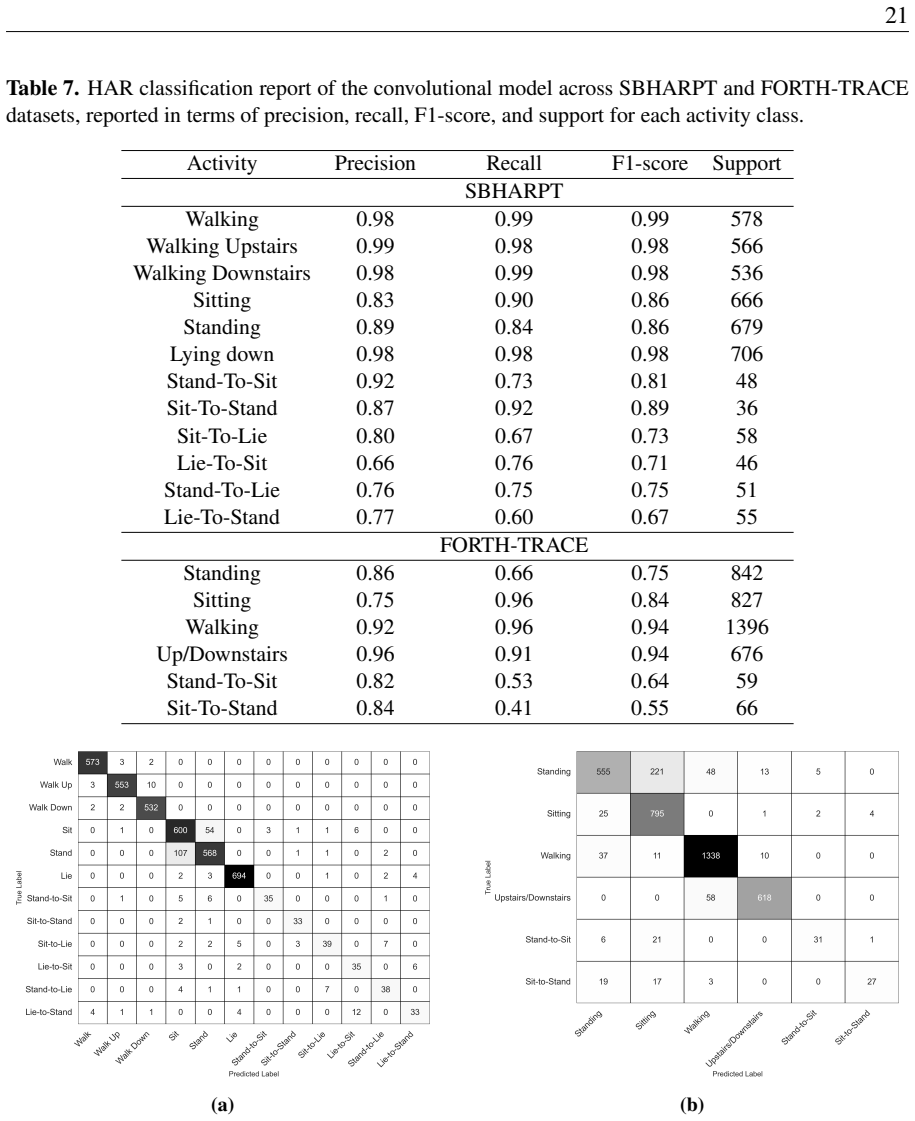
- [Section 4.1, Table 2, and Section 5.6] The downstream evaluation uses a 70/5/25 split with 50% overlapping windows and no stated subject-level or recording-level separation. With 50% overlap, consecutive windows share half of their samples, so a random split places near-duplicate windows in both training and test sets. This inflates all reported metrics and is most damaging for transition classes, which have only 36–58 test windows on SBHARPT and 59–66 on FORTH-TRACE. The reported transition advantages (e.g., 0.85 vs 0.83, 0.76 vs 0.71, 0.62 vs 0.56) correspond to a handful of windows and can easily be produced or erased by leakage. Section 5.6 acknowledges that subject-independent versus subject-dependent splitting is an unresolved protocol variable, but the paper does not state which protocol is used. The authors should re-run the downstream evaluation with subject- or recording-level separation (or at least non-overlapping
- [Section 5.4, Table 10, and Tables 14/15] The dispersion coefficient σ is selected after examining test-set performance. Tables 14 and 15 report results for the best σ per dataset (σ=0.30 for SBHARPT, σ=0.20 for FORTH-TRACE), while Table 10 shows that σ has a material effect on F1. This is a test-set fitting step and adds optimistic bias to the headline numbers. The coefficient should be selected on the validation split, or results should be reported for all σ values without post-hoc selection. The paper’s main comparison against supervised baselines in Section 5.5 uses only these selected configurations, so the comparison is not a clean test of the method.
- [Section 5.5 and Tables 12–15] The claim that JEPA pre-training 'demonstrates superior generalization' on transitional activities is not supported with uncertainty quantification. The test supports for transition classes are tiny (36–66 examples), and several of the reported differences are within chance variation (for example, sit-to-stand F1 0.85 vs 0.83 on SBHARPT, and sit-to-stand 0.52 vs 0.48 on FORTH-TRACE). Confidence intervals or paired significance tests (e.g., McNemar or bootstrap) for the transition classes should be reported, or the claim should be tempered to reflect the small-sample evidence.
minor comments (5)
- [Section 5.1, Table 3] The sentence 'the convolutional encoder demonstrates superior performance, achieving average F1-scores of 0.7183 and 0.6442, noticeably outperforming transformer-based encoder which achieves 0.6717 and 0.5196' misattributes the dataset ordering. The correct comparison is 0.7183/0.6717 for the convolutional encoder versus 0.6442/0.5196 for the transformer encoder.
- [Section 3.3, Eq. (8)] The variance loss sums over an index i with range N, but Eq. (7) defines the standard deviation per embedding dimension j. It would be clearer to sum over embedding dimensions D, not the batch/sequence dimension N.
- [Abstract and Section 3.3] Typos: 'progressed' should be 'progress' in the abstract; 'warp-up' should be 'warm-up' in Section 3.3.
- [Section 3.4] 'The the hidden layer size is set' should read 'The hidden layer size is set'.
- [General] There are several minor language issues, such as 'In constrast' (Section 5.1) and 'Yarici et el.' (Table 17 caption and reference list); a careful proofread is recommended.
Circularity Check
No internal circularity; the main threats to the central claim are evaluation-protocol and test-set-selection issues, not a circular derivation.
full rationale
This is an empirical systems paper rather than a derivation, so most circularity categories do not apply. The pre-training objective is a standard VICReg loss (Eqs. 5-11) plus a newly introduced norm term (Eq. 12), and the downstream comparisons are against supervised models trained in-paper with the same encoder architectures (Tables 11-13). The headline transition-class advantage is therefore not by construction equal to the pre-training inputs. Self-citations (refs 11, 12, 14, 30, 32, 33) appear as related-work context and as external comparison numbers in Table 16, but they do not justify the central JEPA claim, which rests on in-paper measurements and public benchmarks (REALDISP, SBHARPT, FORTH-TRACE). Two validity threats exist but are not internal circularity: Section 4.1 uses a 70/5/25 random split with 50% overlapping windows for downstream tasks and does not describe subject- or recording-level separation, and Section 5.4/Table 10 select sigma on the downstream test set before Tables 14-15 report the best per-dataset sigma values. The paper itself acknowledges in Section 5.6 that 'subject-independent versus subject-dependent splitting' is an unresolved protocol variable but does not state which protocol was used. These are soundness/statistical concerns, not cases where a prediction reduces by construction to a fitted parameter or a self-citation chain. Score 2 reflects the presence of non-load-bearing self-citations and the test-selection/evaluation-protocol concerns, not a circular derivation.
Axiom & Free-Parameter Ledger
free parameters (5)
- Dispersion coefficient sigma =
0.30 (SBHARPT), 0.20/0.25 (FORTH-TRACE) depending on table
- VICReg loss weights (nu_s, nu_v, nu_c, nu_n) =
1.0, 5.0, 0.2, 0.1
- Variance threshold gamma =
0.5
- Patch size P =
Not stated
- Window size L and overlap =
L=102 samples, 50% overlap downstream
axioms (4)
- domain assumption The 70/5/25 train/validation/test split is performed without leakage
- domain assumption Pre-training on REALDISP transfers to SBHARPT and FORTH-TRACE sensor placements
- domain assumption Merging FORTH-TRACE 'talking with movement' classes into climbing stairs preserves label semantics
- standard math VICReg variance/covariance/norm terms prevent representation collapse as intended
read the original abstract
Sensor-based human activity recognition (HAR) has achieved significant progressed in fully supervised learning settings. However, these supervised learning models rely on large amount of labeled data, which require labor-intensive collection and meticulous annotation. To address these challenges, this paper proposes a Joint Embedding Predictive Architecture framework tailored for sensor-based HAR, designed to learn robust and generalizable representations from unlabeled datasets. The proposed framework features an encoder designed to explicitly model both the fine-grained local temporal representations within individual window and the long-term temporal sequence of adjacent windows. Furthermore, we introduce an improved Variance-Invariance-Covariance Regularization (VICReg) objective function that incorporates computationally lightweight norm term to stabilize the JEPA pre-training phase. This term balances variance, invariance and covariance constraints to prevent representation collapse. The proposed HAR-JEPA framework is evaluated using two benchmark continuously performed activity datasets. The results show that high-quality representations are successfully learned by the proposed framework. Furthermore, the representations learned by HAR-JEPA demonstrates superior generalization on minority, high variance transitional activities such as sit-to-stand and sit-to-lie where supervised learning tend to overfit due to limited support.
Figures



Reference graph
Works this paper leans on
-
[1]
Enhanced elderly activity recognition in smart home environ- ments using ConvLSTM2D with localization
Maddala JB and Akthar S. Enhanced elderly activity recognition in smart home environ- ments using ConvLSTM2D with localization. International Journal of System Assurance Engineering and Management 2026
2026
-
[2]
Enhancing Dynamic Human Activity Recog- nition Through a Novel Martingale-Based Algorithm for Change Detection
Etumusei J, Carracedo JM, and McClean S. Enhancing Dynamic Human Activity Recog- nition Through a Novel Martingale-Based Algorithm for Change Detection. SN Computer Science 5 2025;6
2025
-
[3]
IoT framework for sports activity safety monitoring based on wearable sensors and CRNN spatiotemporal analysis
Zhang SZ, Yang HZ, and Gao Y. IoT framework for sports activity safety monitoring based on wearable sensors and CRNN spatiotemporal analysis. Scientific Reports 2026
2026
-
[4]
Past, Present, and Future of Sensor-based Human Activity Recognition Using Wearables: A Surveying Tutorial on a Still Challenging Task
Haresamudram H, Tang CI, Suh S, Lukowicz P, and Pl ¨otz T. Past, Present, and Future of Sensor-based Human Activity Recognition Using Wearables: A Surveying Tutorial on a Still Challenging Task. Proceedings of the ACM on Interactive, Mobile, Wearable and Ubiquitous Technologies 2 2025;9
2025
-
[5]
Self-supervised learning for human activity recognition using 700,000 person-days of wearable data
Yuan H, Chan S, Creagh AP, et al. Self-supervised learning for human activity recognition using 700,000 person-days of wearable data. npj Digital Medicine 2024;7. Publisher: Nature Publishing Group:91. 34
2024
-
[6]
SelfPAB: large-scale pre-training on ac- celerometer data for human activity recognition
Logacjov A, Herland S, Ustad A, and Bach K. SelfPAB: large-scale pre-training on ac- celerometer data for human activity recognition. Applied Intelligence 2024;54:4545–63
2024
-
[7]
Temporal Contrastive Learning for Sensor- Based Human Activity Recognition: A Self-Supervised Approach
Chen X, Zhou X, Sun M, and Wang H. Temporal Contrastive Learning for Sensor- Based Human Activity Recognition: A Self-Supervised Approach. IEEE Sensors Journal 2025;25:1839–50
2025
-
[8]
TFC: Time–frequency contrasting net- work for wearable-based human activity recognition
Huang Z, Deng J, Wang S, Tang C, and Xiao S. TFC: Time–frequency contrasting net- work for wearable-based human activity recognition. Knowledge-Based Systems 2025;319:113373
2025
-
[9]
Self-Supervised Learning from Images with a Joint- Embedding Predictive Architecture
Assran M, Duval Q, Misra I, et al. Self-Supervised Learning from Images with a Joint- Embedding Predictive Architecture. arXiv:2301.08243 [cs]. 2023. DOI: 10 . 48550 / arXiv.2301.08243. URL: http://arxiv.org/abs/2301.08243 (visited on 01/24/2026)
-
[10]
Revisiting Feature Prediction for Learning Visual Representations from Video
Bardes A, Garrido Q, Ponce J, et al. Revisiting Feature Prediction for Learning Visual Representations from Video. arXiv:2404.08471 [cs]. 2024. DOI: 10.48550/arXiv. 2404 . 08471. URL: http : / / arxiv . org / abs / 2404 . 08471 (visited on 01/24/2026)
-
[11]
Deep similarity segmentation model for sensor-based activity recognition
Baraka A and Mohd Noor MH. Deep similarity segmentation model for sensor-based activity recognition. Multimedia Tools and Applications 2025;84:8869–92
2025
-
[12]
Deep Temporal Conv-LSTM for Activity Recog- nition
Noor MHM, Tan SY, and Wahab MNA. Deep Temporal Conv-LSTM for Activity Recog- nition. Neural Processing Letters 5 2022;54:4027–49
2022
-
[13]
Retentive-HAR: Human Activity Recognition from Wearable Sensors with Enhanced Temporal and Inter-Feature Dependency Retention
Ige AO, Oladele DA, and Sibiya M. Retentive-HAR: Human Activity Recognition from Wearable Sensors with Enhanced Temporal and Inter-Feature Dependency Retention. Ap- plied Sciences (Switzerland) 23 2025;15
2025
-
[14]
Feature learning using convolutional denoising autoencoder for activity recognition
Noor MHM. Feature learning using convolutional denoising autoencoder for activity recognition. Neural Computing and Applications 17 2021;33:10909–22
2021
-
[15]
A GAN-based data augmentation method for human activity recognition via the caching ability
Shi J, Zuo D, and Zhang Z. A GAN-based data augmentation method for human activity recognition via the caching ability. Internet Technology Letters 2021;4:e257
2021
-
[16]
Deep Learning in Human Activity Recognition with Wear- able Sensors: A Review on Advances
Zhang S, Li Y, Zhang S, et al. Deep Learning in Human Activity Recognition with Wear- able Sensors: A Review on Advances. Sensors 2022;22
2022
-
[17]
ThinkJEPA: Empowering Latent World Models with Large Vision-Language Reasoning Model
Zhang H, Li Y, He S, et al. ThinkJEPA: Empowering Latent World Models with Large Vision-Language Reasoning Model. 2026. arXiv:2603.22281 [cs.CV]. URL: https: //arxiv.org/abs/2603.22281
Pith/arXiv arXiv 2026
-
[18]
A-JEPA: Joint-Embedding Predictive Architecture Can Lis- ten
Fei Z, Fan M, and Huang J. A-JEPA: Joint-Embedding Predictive Architecture Can Lis- ten. arXiv:2311.15830 [cs]. 2024. DOI: 10 . 48550 / arXiv . 2311 . 15830. URL: http://arxiv.org/abs/2311.15830 (visited on 01/22/2026). 35
-
[19]
Audio-JEPA: Joint-Embedding Predic- tive Architecture for Audio Representation Learning
Tuncay L, Labb ´e E, Benetos E, and Pellegrini T. Audio-JEPA: Joint-Embedding Predic- tive Architecture for Audio Representation Learning. arXiv:2507.02915 [cs]. 2025. DOI: 10 . 48550 / arXiv . 2507 . 02915. URL: http : / / arxiv . org / abs / 2507 . 02915 (visited on 01/22/2026)
-
[20]
Weimann K and Conrad TOF. Self-Supervised Pre-Training with Joint-Embedding Pre- dictive Architecture Boosts ECG Classification Performance. arXiv:2410.13867 [eess]
-
[21]
Kim S. Learning General Representation of 12-Lead Electrocardiogram with a Joint- Embedding Predictive Architecture. arXiv:2410.08559 [cs]. 2024. DOI: 10 . 48550 / arXiv.2410.08559. URL: http://arxiv.org/abs/2410.08559 (visited on 01/22/2026)
-
[22]
VICReg: Variance-Invariance-Covariance Regular- ization for Self-Supervised Learning
Bardes A, Ponce J, and LeCun Y. VICReg: Variance-Invariance-Covariance Regular- ization for Self-Supervised Learning. arXiv:2105.04906 [cs]. 2022. DOI: 10.48550/ arXiv.2105.04906. URL: http://arxiv.org/abs/2105.04906 (visited on 03/11/2026)
-
[23]
BiJEPA: Bi-directional Joint Embedding Predictive Architecture for Symmetric Representation Learning
Huang Y. BiJEPA: Bi-directional Joint Embedding Predictive Architecture for Symmetric Representation Learning. arXiv:2603.00049 [cs.LG]. 2026. DOI: 10.48550/arXiv. 2603 . 00049. URL: http : / / arxiv . org / abs / 2603 . 00049 (visited on 07/11/2026)
-
[24]
Radial-VCReg: More Informative Represen- tation Learning Through Radial Gaussianization
Kuang Y, Dagade Y, Chakraborty D, et al. Radial-VCReg: More Informative Represen- tation Learning Through Radial Gaussianization. 2026. URL: https://arxiv.org/ abs/2602.14272v1 (visited on 07/11/2026)
arXiv 2026
-
[25]
Kernel VICReg for Self-Supervised Learning in Reproducing Kernel Hilbert Space
Sepanj MH, Ghojogh B, Moradi S, and Fieguth P. Kernel VICReg for Self-Supervised Learning in Reproducing Kernel Hilbert Space. 2025.DOI: 10.3390/bdcc10030078. URL: https://arxiv.org/abs/2509.07289v2 (visited on 07/11/2026)
arXiv 2025
-
[26]
Decoupled Weight Decay Regularization
Loshchilov I and Hutter F. Decoupled Weight Decay Regularization. arXiv:1711.05101 [cs]. 2019. DOI: 10.48550/arXiv.1711.05101 . URL: http://arxiv.org/ abs/1711.05101 (visited on 03/16/2026)
-
[27]
REALDISP Activity Recognition Dataset
Banos O, T ´oth M, and Amft O. REALDISP Activity Recognition Dataset. UCI Machine Learning Repository, 2012. DOI: https://doi.org/10.24432/C5GP6D
-
[28]
Transition-Aware Human Ac- tivity Recognition Using Smartphones
Reyes-Ortiz JL, Oneto L, Sam `a A, Parra X, and Anguita D. Transition-Aware Human Ac- tivity Recognition Using Smartphones. 2016. DOI: https://doi.org/10.24432/ C54G7M. URL: https : / / www . sciencedirect . com / science / article / pii/S0925231215010930. 36
2016
-
[29]
Karagiannaki K, Panousopoulou A, and Tsakalides P. The FORTH-TRACE dataset for human activity recognition of simple activities and postural transitions using a Body Area Network. Zenodo, 2016. DOI: 10.5281/zenodo.841301 . URL: https://doi. org/10.5281/zenodo.841301
-
[30]
Similarity Segmentation Approach for Sensor-Based Activity Recognition
Baraka AMA and Mohd Noor MH. Similarity Segmentation Approach for Sensor-Based Activity Recognition. IEEE Sensors Journal 2023;23:19704–16
2023
-
[31]
A systematic review of smartphone-based human activity recognition methods for health research
Straczkiewicz M, James P, and Onnela JP. A systematic review of smartphone-based human activity recognition methods for health research. npj Digital Medicine 1 2021;4
2021
-
[32]
Similarity Segmentation Approach for Sensor-Based Activ- ity Recognition
Baraka AM and Noor MHM. Similarity Segmentation Approach for Sensor-Based Activ- ity Recognition. IEEE Sensors Journal 17 2023;23:19704–16
2023
-
[33]
Deep similarity segmentation model for sensor-based activ- ity recognition
Baraka AR and Noor MHM. Deep similarity segmentation model for sensor-based activ- ity recognition. Multimedia Tools and Applications 2024
2024
-
[34]
Detecting basic human activities and postural transition using robust machine learning techniques by applying dimensionality reduction methods
Lone KJ, Hussain L, Saeed S, Aslam A, Maqbool A, and Butt FM. Detecting basic human activities and postural transition using robust machine learning techniques by applying dimensionality reduction methods. Waves in Random and Complex Media 2021
2021
-
[35]
A novel hybrid deep learning model for human activity recognition based on transitional activities
Irfan S, Anjum N, Masood N, Khattak AS, and Ramzan N. A novel hybrid deep learning model for human activity recognition based on transitional activities. Sensors 24 2021;21
2021
-
[36]
RobustHAR: Multi-scale Spatial-temporal Masked Self-supervised Pre-training for Robust Human Activity Recognition
Liu X, Yuan G, Zhang Y, Liu S, and Yan Q. RobustHAR: Multi-scale Spatial-temporal Masked Self-supervised Pre-training for Robust Human Activity Recognition. In: Pro- ceedings of the Thirty-Fourth International Joint Conference on Artificial Intelligence . 2025:8563–71
2025
-
[37]
Contrastive Self-supervised Learning for Sensor-based Human Activity Recognition
Khaertdinov B, Ghaleb E, and Asteriadis S. Contrastive Self-supervised Learning for Sensor-based Human Activity Recognition. In:2021 IEEE International Joint Conference on Biometrics (IJCB) . 2021:1–8. DOI: 10 . 1109 / IJCB52358 . 2021 . 9484410. URL: https : / / ieeexplore . ieee . org / document / 9484410(visited on 01/22/2026)
2021
-
[38]
Subject Invariant Contrastive Learning for Human Activity Recognition
Yarici Y, Kokilepersaud K, Prabhushankar M, and AlRegib G. Subject Invariant Con- trastive Learning for Human Activity Recognition. arXiv:2507.03250 [cs]. 2025. DOI: 10 . 48550 / arXiv . 2507 . 03250. URL: http : / / arxiv . org / abs / 2507 . 03250 (visited on 01/22/2026)
work page internal anchor Pith review Pith/arXiv arXiv doi:10.48550/arxiv.2507.03250 2025
-
[2024]
URL: http://arxiv.org/abs/ 2410.13867 (visited on 01/22/2026)
DOI: 10.48550/arXiv.2410.13867 . URL: http://arxiv.org/abs/ 2410.13867 (visited on 01/22/2026)
discussion (0)
Sign in with ORCID, Apple, or X to comment. Anyone can read and Pith papers without signing in.