REVIEW 3 major objections 6 minor 1 cited by
Knowledge Graphs: The Future of Data Integration and Insightful Discovery
T0 review · 3 major / 6 minor · reviewed 2026-08-11 · deepseek-v4-flash
Pith's one-line read Knowledge graphs, the paper argues, are a versatile way to connect diverse data into one queryable web, and dynamic versions make that web keep up with change.
desk verdict A serviceable didactic survey of knowledge graphs whose concrete climate-KG evidence is undermined by swapped citations; useful for beginners, not for researchers. read the letter →
The pith
A machine-rendered reading of the paper's core claim, the machinery that carries it, and where it could break.
The reading
What carries the argument
The load-bearing object is the knowledge graph itself: a multi-relational graph whose nodes are entities and whose edges are typed relations. The paper treats this graph as the semantic layer that connects raw data to applications. Construction proceeds through three stages—knowledge extraction (entity, attribute, and relation extraction), knowledge fusion (entity alignment and linking), and knowledge refinement (classification, relation prediction, and anomaly detection)—followed by reasoning and representation. For the static-to-dynamic step, the machinery includes clustering (K-means, agglomerative, and ExCut explainable clustering) and link prediction (the RAGAT graph attention network and TransE-style embeddings) to add missing edges and entities. This combination is what lets a graph incorporate new data without discarding prior knowledge.
What would settle it
A direct test would be to run the paper's described pipeline—spaCy-based or LLM-based extraction, TransE or RAGAT link prediction, and clustering on the same benchmark datasets—and compare the reproduced scores against the cited values. If WN18RR MRR falls far below 0.489, FB15k-237 MRR falls far below 0.365, or a climate graph fails to show the reported accuracy gain, the paper's supporting evidence is weakened.
Extended reading notes
Core claim
The central claim is that knowledge graphs are an efficient representation for organizing information across concepts and domains, precisely because the graph structure makes relationships between entities explicit and machine-usable. On the paper's account, a knowledge graph turns structured, semi-structured, and unstructured data into a web of nodes and edges, and this structure is what powers semantic search, recommendation, question answering, and reasoning. The paper defends that position by describing the construction pipeline—knowledge extraction, fusion, and refinement—and by distinguishing static graphs, which present a fixed snapshot, from dynamic graphs, which evolve as new data arrives. The dynamic case matters most to the authors: continuous update mechanisms, including LLM-based extraction, explainable clustering, and graph neural link prediction, allow the graph to reflect changing knowledge rather than going stale.
Load-bearing premise
The paper's case for knowledge graphs depends on trusting the accuracy of the many external systems it cites, such as RAGAT's link-prediction scores, ExCut's cluster quality, and the climate graph accuracy gains, none of which are independently rerun here.
Editorial extensions
If this is right
- Organizations can bridge structured, semi-structured, and unstructured data into a single knowledge model, making relationships visible that isolated records would hide.
- Dynamic knowledge graphs, kept current by link prediction and clustering, can support applications where a static snapshot would quickly become outdated.
- Automated extraction with large language models and NLP tools, combined with human curation, is presented as the viable recipe for accuracy; fully automatic construction is not yet sufficient.
- Graphs enrich downstream AI applications: chatbots gain contextual answers, explainable AI gains pre- and post-model explanations, and autonomous-driving and climate systems gain measurable prediction accuracy.
- The same representation scales across disciplines, so adding new sources means extending an existing graph rather than rebuilding a database.
Reading between the lines
- The static-to-dynamic pipeline described in the paper could be turned into a generic recipe for any fast-evolving domain, such as epidemiology or financial regulation, where the hard part is deciding which edges need human review versus automatic updates.
- I infer that hybrid graphs—automatic updates for high-turnover relationships and human oversight for core ontology decisions—will outperform either fully manual or fully automated construction in practice, although the paper does not test this directly.
- A natural next experiment would be to measure whether the reported gains transfer when the same extraction and link-prediction tools are applied to a dataset of comparable size but from a different domain, since most cited results are benchmark-specific.
- The paper treats explainability as a property that graphs confer on AI systems, which suggests a testable extension: comparing user trust in explanations generated from graph-encoded rules against explanations from attention weights alone.
Signed reviews
Editorial analysis
A structured set of objections, weighed in public.
Referee Report
Summary. The paper is a survey-style book chapter on knowledge graphs (KGs). Its central claim, stated in the abstract and conclusion, is that KGs are an efficient method for representing and connecting information across concepts and are useful for reasoning, question answering, and knowledge base completion, as well as for integrating diverse data sources across disciplines. The paper provides background on static and dynamic KGs, discusses data-source diversity and knowledge extraction techniques (including LLM-based and NLP-based methods), describes the authors' own illustrative experiments on clustering and link prediction, and surveys applications in explainable AI, automatic code understanding, autonomous driving, and climate change. The manuscript concludes that KGs improve data use and will drive innovation and efficiency across industries.
Significance. If the claims hold, the paper would provide a broad, accessible overview of KG benefits to a general technical audience. However, the central thesis is a restatement of a widely accepted position in the field; the paper's main value is as a survey rather than as a source of new research results. The paper does include some hands-on illustrations (KG extraction with LLMs, clustering with node embeddings) that may be useful to practitioners, and it draws on a large and relevant literature. At the same time, several of the paper's own quantitative claims are not adequately supported, and the climate-change section contains multiple reference misattributions that make parts of the evidence base unverifiable. These issues need to be resolved before the manuscript can be considered reliable as a survey.
major comments (3)
- [Section 7.4] Several concrete empirical results in the climate-change applications section are attached to the wrong references. The paragraph crediting 'Mishra and Mittal (2021)' with a typhoon-intensity KG and a 23-31% prediction-error reduction does not match the bibliography entry for Mishra and Mittal (2021), which is the NeuralNERE relation-extraction paper; the typhoon study appears to be a different work. Conversely, the next paragraph credits 'Ge et al. (2022)' with the NeuralNERE/SciDCC climate KG, while the bibliography lists Ge et al. (2022) as the disaster-prediction DPKG paper. Similar swaps occur for 'Fotopoulou et al. (2022)' (credited with KnowUREnvironment, but the bibliography gives Sustaingraph to Fotopoulou and KnowUREnvironment to Islam 2022), for 'Wu et al. (2022b)' (credited with DPKG, which is Ge et al. 2022), and for the first 'Wu et al. (2023)' paragraph (credited with rainfall-detection accuracy gains, which belong to Wu et al. 2022b). These mismatches make the empirical support for the central claim unverifiable as written. The authors should correct the citations or explicitly mark these as attributed on the authority of secondary sources.
- [Section 6.1.1, Table 2] The column heading 'Accuracy' in Table 2 is misleading. The text states that clustering quality was measured with silhouette scores, which is an internal cohesion/separation measure, not accuracy against a ground-truth labeling. Without a gold-standard cluster assignment, the numbers 0.68, 0.53, 0.63, and 0.64 do not support the claim that one embedding model gives a more accurate clustering. Please either report a proper accuracy metric with the ground-truth clusters used for the Wikipedia sentences, or rename the column to 'Silhouette score' and adjust the claims accordingly.
- [Sections 5.2.1 and 6.1.1] The paper's own experiments (Llama 7B triple extraction and the clustering comparisons) are presented without the experimental setup needed for verification: the Wikipedia dataset is not described (size, domain, number of sentences), no random seed or number of runs is reported, and the fine-tuning procedure for Llama 7B on the Wikipedia dataset is not specified. Because the paper uses these results to support the general claim that LLM-based extraction and clustering are effective for KG construction, please either supply the full experimental details or clearly label these as illustrative examples that are not meant to be evidence.
minor comments (6)
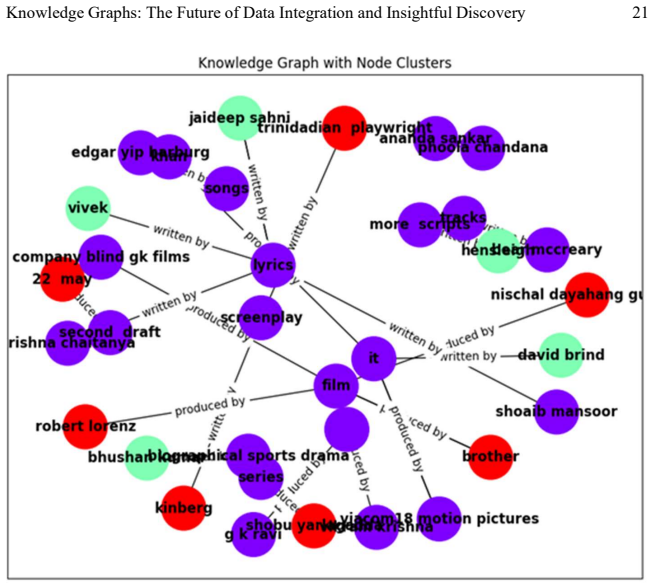
- [Figures 1-13] Figures 1, 2, 4, 5, 6, 7, 8, 9, 10, 11, 12, and 13 are referenced in the text but appear only as placeholders in this version; please ensure the final submission includes the actual figures.
- [Sections 7.3-7.4] There are inconsistent citation markers: bracketed numbers such as [1], [8], [11], [12], [13], [23], and [29] appear in Sections 7.3 and 7.4, but the reference list is author-year; please reconcile these.
- [Sections 6.1.2 and 7.3] Gad-Elrab et al. (2020) ExCut is described in nearly identical paragraphs in Section 6.1.2 and in Section 7.3; the duplicate passage should be removed or one should be replaced with a cross-reference.
- [Section 7.4] Two paragraphs are both attributed to 'Wu et al. (2023)' but discuss different studies (rainfall detection and tourism analytics); the bibliography contains only one Wu et al. (2023) entry, so one of the citations is likely wrong.
- [Abstract] The abstract environment includes the stray text 'abstract environment.' immediately before the keywords; this LaTeX artifact should be removed.
- [General] Several typos appear throughout the text (e.g., 'eficient' for 'efficient,' 'dificulty' for 'difficulty,' 'sufice' for 'suffice'), and the paper would benefit from a careful proofreading pass. Additionally, the manuscript does not state the inclusion/exclusion criteria for the survey or its limitations; adding a short limitations paragraph would help.
Circularity Check
No significant circularity: the paper is a survey whose claims are supported by external cited work and whose own experiments are illustrative, not fitted-to-conclusion.
full rationale
The paper does not derive a result from its own assumptions. Its central claim—that knowledge graphs are an efficient way to represent and connect information across concepts—is a definitional characterization of the subject, supported by a broad review of external literature (e.g., Hogan et al. 2021; Liu et al. 2021; Gad-Elrab et al. 2020; Fotopoulou et al. 2022). No parameter is fitted to a subset of data and then presented as a prediction of a closely related quantity; the reported metrics (RAGAT MRR in Table 4, ExCut cluster quality, climate-KG accuracy gains) are explicitly attributed to prior works rather than derived in this paper. The exploratory KG construction with spaCy/NetworkX/Llama in Sections 5 and 6 is presented as an illustration of methods, not as evidence that would force the survey's general conclusion, so there is no fitted-input-called-prediction loop. There are no equations whose outputs equal their inputs by construction, and no uniqueness theorem or ansatz is imported from the authors' own prior work. Some Section 7.4 attributions appear mismatched with the bibliography (e.g., Mishra and Mittal 2021 credited with a typhoon-intensity KG while the reference is NeuralNERE; Fotopoulou et al. 2022 credited with KnowUREnvironment while the reference is SustainGraph), but citation accuracy is a correctness risk, not circularity: the cited works are external and independent of the present paper. Because all load-bearing empirical claims are external or illustrative, the paper's central claim is not circularly forced. Score 0.
Assumptions & free parameters
assumptions (3)
- domain assumption The cited external results are accurately reported (e.g., RAGAT's MRR scores in Table 4, ExCut's cluster quality, climate KG accuracy gains).
- domain assumption Knowledge graphs provide semantic context that improves downstream applications such as search, question answering, and autonomous driving.
- domain assumption Language models and NLP tools such as Llama and spaCy can extract entities and relations from unstructured text reliably enough for knowledge graph construction.
Cite this review
Pith. "Pith review of Knowledge Graphs: The Future of Data Integration and Insightful Discovery." pith.science (2026). https://pith.science/paper/MWLA6G2V
@misc{pith2026250215689,
  author       = {Pith},
  title        = {Pith review of: Knowledge Graphs: The Future of Data Integration and Insightful Discovery},
  year         = {2026},
  howpublished = {\url{https://pith.science/paper/MWLA6G2V}},
  note         = {Machine review of arXiv:2502.15689}
}
read the original abstract
Knowledge graphs are an efficient method for representing and connecting information across various concepts, useful in reasoning, question answering, and knowledge base completion tasks. They organize data by linking points, enabling researchers to combine diverse information sources into a single database. This interdisciplinary approach helps uncover new research questions and ideas. Knowledge graphs create a web of data points (nodes) and their connections (edges), which enhances navigation, comprehension, and utilization of data for multiple purposes. They capture complex relationships inherent in unstructured data sources, offering a semantic framework for diverse entities and their attributes. Strategies for developing knowledge graphs include using seed data, named entity recognition, and relationship extraction. These graphs enhance chatbot accuracy and include multimedia data for richer information. Creating high-quality knowledge graphs involves both automated methods and human oversight, essential for accurate and comprehensive data representation.
Figures


Figures from the paper (11 more)



Forward citations
Cited by 1 Pith paper
-
The KG-ER Conceptual Schema Language
KG-ER is a formally defined conceptual schema language for knowledge graphs, with entity, relationship, attribute, tree-pattern key, and hierarchy constraints, targeting representation-independent design across relati...
Reference graph
Works this paper leans on
-
[6]
Build-ing Dynamic Knowledge Graphs from Text using Machine Reading Compre-hension. Technical Report. URL: https://arxiv.org/abs/1810.05682. accessed: Oct. 26,
-
[10]
Gad-Elrab, M.H., Stepanova, D., Tran, T.K., Adel, H., Weikum, G.,
doi:https://doi.org/ 10.3389/fenvs.2022.1003599. Gad-Elrab, M.H., Stepanova, D., Tran, T.K., Adel, H., Weikum, G.,
arXiv 2022
-
[11]
Knowledge Graphs. Technical Report. Available: https://arxiv.org/pdf/2003.02320.pdf. Huguet Cabot, P.L., Navigli, R.,
arXiv 2003
-
[14]
URL: https://www.cl imatechange.ai/papers/aaaifss2022/3
Knowurenvironment: An automated knowledge graph for climate change and environmental issues, in: AAAI 2022 Fall Symposium: The Role of AI in Responding to Climate Challenges. URL: https://www.cl imatechange.ai/papers/aaaifss2022/3. Kontopoulos, E., et al.,
work page 2022
-
[15]
Dynamic knowledge graph embeddings via local embedding reconstructions, in: Lecture Notes in Computer Science, pp. 215–223. doi:ht tps://doi.org/10.1007/978-3-031-11609-4_36. Lavdim, H., et al.,
-
[18]
doi:https://doi.org/10.3390/su13063191. Touvron, H., Lavril, T., Izacard, G., Martinet, X., Lachaux, M.A., Lacroix, T., Rozi`ere, B., Goyal, N., Hambro, E., Azhar, F., Rodriguez, A., Joulin, A., Grave, E., Lample, G.,
-
[19]
Llama: Open and eficient foundation language models. ArXiv abs/2302.13971. URL: https://api.semanticscholar.org/ CorpusID:257219404. Web, P.,
-
[20]
An Evaluation of Knowledge Graph Embeddings for Autonomous Driving Data: Experience and Practice
An Evaluation of Knowledge Graph Embeddings for Autonomous Driving Data: Experience and Practice. Technical Report. URL: https://arxiv.org/abs/2003.00344. accessed: Oct. 14,
work page Pith review arXiv 2003
Show all 27 references
-
[21]
ArXiv (Cornell University) doi:https://doi.org/10.23919/usnc-ursi51813.2021.9703620
Auto-mated climate analyses using knowledge graph. ArXiv (Cornell University) doi:https://doi.org/10.23919/usnc-ursi51813.2021.9703620. Wu, J., Orlandi, F., O’Sullivan, D., Dev, S., 2022a. Linkclimate: An interoperable knowledge graph platform for climate data. Computers & Geo...
2021
-
[22]
IEEE Journal of Selected Topics in Applied Earth Observations and Remote Sensing 16, 2402–2412
Improving tourism analytics from climate data using knowledge graphs. IEEE Journal of Selected Topics in Applied Earth Observations and Remote Sensing 16, 2402–2412. doi:https://doi.org/10.1109/jstars.2023.3239831. Wu, T., Wang, H., Li, C., Qi, G., Niu, X., Wang, M., Li, L., Shi, C.,
2023
-
[23]
Technical Report
Knowledge Augmented Machine Learning with Applications in Autonomous Driving: A Survey. Technical Report. URL: https://arxiv.org/abs/2205.04712. accessed: Oct. 14,
-
[24]
Geoscience Frontiers , 101450doi:https://doi.org/10.1016/j.gsf.2022.1 01450
Climate paleogeography knowledge graph and deep time paleoclimate classifications. Geoscience Frontiers , 101450doi:https://doi.org/10.1016/j.gsf.2022.1 01450. Yu, S., He, T., Glass, J.,
2022 doi
-
[25]
arXiv preprint arXiv:2008.08995
Autokg: Constructing virtual knowledge graphs from unstructured documents for question answering. arXiv preprint arXiv:2008.08995 . Zhang, J., Ilievski, F., Kollaa, A., Francis, J., Ma, K., Oltramari, A.,
2008 arXiv
-
[26]
Technical Report
Utilizing Background Knowledge for Robust Reasoning over Trafic Situations. Technical Report. URL: https://arxiv.org/abs/2212.07798. accessed: Oct. 10,
-
[28]
ACLWeb URL: https://aclantho logy.org/2022.coling-1.116/
Dynamic relevance graph network for knowledge-aware question answering. ACLWeb URL: https://aclantho logy.org/2022.coling-1.116/. accessed: Oct. 26,
2022
-
[195]
Li, F., Xie, W., Wang, X., Fan, Z., 2020a. Research on optimization of knowl-edge graph construction flow chart, in: 2020 IEEE 9th Joint International Information Technology and Artificial Intelligence Conference (ITAIC), pp. 1386–1390. doi:10.1109/ITAIC49862.2020.9338900. Li,...
2020
-
[1214]
Geng, Y., Chen, J., Ye, Z., Zhang, W., Chen, H.,
doi:https://doi.org/10.3390/rs14 051214. Geng, Y., Chen, J., Ye, Z., Zhang, W., Chen, H.,
-
[2007]
Yago: A core of semantic knowledge, in: Proceedings of the 16th International Conference on World Wide Web, Association for Computing Machinery, New York, NY, USA. p. 697–706. URL: https://doi.org/10.1145/1242572.1242667, doi:10.114 5/1242572.1242667. Tan, J., Qiu, Q., Guo, W....
-
[2008]
1247–1250
Freebase: a collaboratively created graph database for structuring human knowledge, in: Proceedings of the 2008 ACM SIGMOD international conference on Manage-ment of data, pp. 1247–1250. Bosch, J., Monka, S., Bosch, C., Luettin, J., Henson, C., Halilaj, L.,
2008
-
[2016]
doi:https://doi.org/10.1109/ivs.2016.7535382
Fast decision mak-ing using ontology-based knowledge base, in: 2016 IEEE Intelligent Vehicles Symposium (IV). doi:https://doi.org/10.1109/ivs.2016.7535382. Zheng, C., Kordjamshidi, P.,
2016
-
[2017]
Knowledge graph construction based on judicial data with social media, in: 2017 14th Web Information Systems and Applications Conference (WISA), IEEE. pp. 225–227. Liang, K., Meng, L., Liu, M., Liu, Y., Tu, W., Wang, S., Zhou, S., Liu, X., Sun, F.,
2017
-
[2018]
URL: https://doi.org/10.1145/323164 4.3231698, doi:10.1145/3231644.3231698
An automatic knowledge graph construction system for k-12 education, in: Proceedings of the Fifth Annual ACM Conference on Learning at Scale, Association for Computing Machinery, New York, NY, USA. URL: https://doi.org/10.1145/323164 4.3231698, doi:10.1145/3231644.3231698. Che...
-
[2019]
Agrikg: an agricultural knowledge graph and its applications, in: Database Systems for Advanced Applications: DASFAA 2019 International Workshops: BDMS, BDQM, and GDMA, Chiang Mai, Thailand, April 22–25, 2019, Proceedings 24, Springer. pp. 533–537. Chi, Y., Qin, Y., Song, R., Xu, H.,
2019
-
[2020]
IOP Conference Series
Building a natural disaster knowledge base expert system based on the distributed and incremental crawling technology. IOP Conference Series. Earth and Environmental Science 435, 012024. doi:ht tps://doi.org/10.1088/1755-1315/435/1/012024. Chen, Y., Kuang, J., Cheng, D., Zheng...
-
[2021]
(Eds.), Findings of the Association for Computational Linguistics: EMNLP 2021, Association for Computational Linguistics, Punta Cana, Dominican Re-public
REBEL: Relation extraction by end-to-end language generation, in: Moens, M.F., Huang, X., Specia, L., Yih, S.W.t. (Eds.), Findings of the Association for Computational Linguistics: EMNLP 2021, Association for Computational Linguistics, Punta Cana, Dominican Re-public. pp. 2370...
2021 doi
-
[2022]
arXiv preprint arXiv:2212.10007
Cocomic: Code completion by jointly modeling in-file and cross-file context. arXiv preprint arXiv:2212.10007 . El Asmar, B., Chelly, S., F¨arber, M.,
-
[2023]
International Jour-nal of Semantic Computing doi:https://doi.org/10.1142/s1793351x236 00048
Knowledge graphs- based integration of autonomous driving datasets. International Jour-nal of Semantic Computing doi:https://doi.org/10.1142/s1793351x236 00048. Hogan, A., Blomqvist, E., Cochez, M., d’Amato, C., Melo, G.D., Gutierrez, C., Kirrane, S., Gayo, J.E.L., Navigli, R....
Reviewed August 11, 2026 · model on record in the stance chip above.
Discussion (0). Continue with ORCID to comment.