REVIEW 5 major objections 5 minor 51 references
A Novel Active Learning Approach to Label One Million Unknown Malware Variants
T0 review · 5 major / 5 minor · reviewed 2026-08-06 · deepseek-v4-flash
Pith's one-line read A transformer-plus-Bayesian pipeline labels a million malware samples, ending with only 10 uncertain samples.
desk verdict The paper's central new ingredient, a Gaussian scaling parameter λ, cancels out of the Bayesian posterior, so the headline uncertainty-handling claim is mathematically unsupported; the reported near-perfect accuracy numbers add to a clear reject. read the letter →
The pith
A machine-rendered reading of the paper's core claim, the machinery that carries it, and where it could break.
The reading
What carries the argument
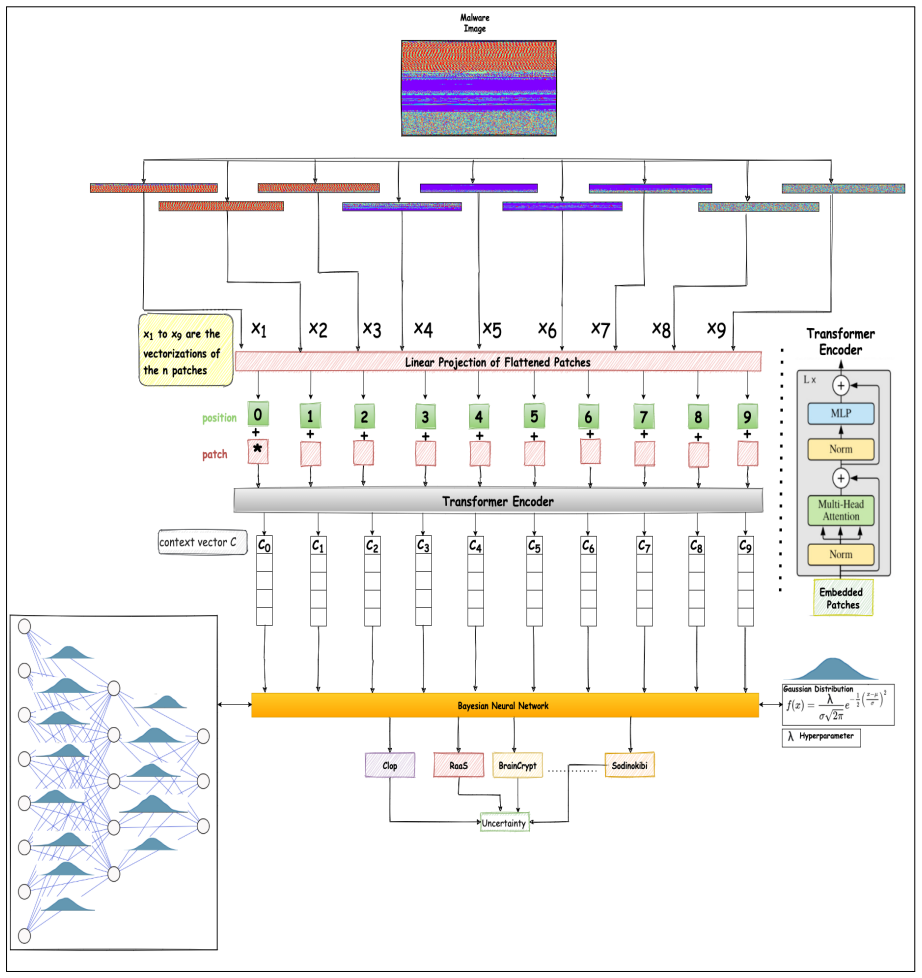
The central object is the ViT-BNN: a Vision Transformer that embeds image patches, with its classification head replaced by a Bayesian neural network whose weights carry Gaussian distributions instead of point values, so each prediction comes with a variational posterior and an entropy or variance estimate. The machinery that carries the argument is the Gaussian variational approximation, the entropy- and moment-based uncertainty scores used to select samples, and the added scaling parameter $\lambda$ in Equation (27), which the paper treats as tuning how strongly the Gaussian distribution shapes uncertainty. A separate pipeline extracts Inception-V4 features, reduces them with PCA, and classifies with uncertainty-aware SVM variants (UTSVM, PSVM, SVM-GSU, TBSVM), serving as the comparison that the ViT-BNN is claimed to beat.
What would settle it
Renormalize the predictive Gaussian after applying Equation (27) and rerun the five active-learning cycles: if the 'not confident' counts stay exactly the same as without $\lambda$, the reported $\lambda = 0.3$ advantage is an artifact of an unnormalized score. A complementary check is to oracle-label the samples the model calls not confident and an equal random sample of confident ones, and compare whether the not-confident set actually contains more mislabels or disagreements.
Extended reading notes
Core claim
The paper's central claim is that replacing the MLP head of a Vision Transformer with a Bayesian neural network, and scaling the Gaussian density in the predictive model by a parameter $\lambda$, yields an active learning system that is more stable and robust in handling uncertainty than the Inception-V4+PCA+SVM alternatives. In the authors' experiments, the configuration $\lambda = 0.3$ reduces the number of samples the model reports as not confident from 55 in cycle 0 to 10 in the final cycle on the malware dataset, reaches 99% accuracy with an expected calibration error of 0.002, and outperforms comparator active learning methods on several public datasets. The authors state this as a state-of-the-art result and claim the approach can be applied to any task.
Load-bearing premise
The load-bearing premise is that the scalar $\lambda$ in Equation (27) changes the model's uncertainty behavior and that the model's own count of 'not confident' predictions is a valid measure of labeling quality; in standard Bayesian inference a constant scaling factor cancels out of the normalized posterior, and the confidence proxy is never validated against oracle labels.
Editorial extensions
If this is right
- A single active-learning run with ViT-BNN can label a million malware images while asking the oracle to inspect only a few hundred samples across five cycles.
- The $\lambda = 0.3$ configuration reported at 99% accuracy and ECE 0.002 would give cybersecurity teams a calibrated classifier for unknown malware families.
- The same method is claimed to reach 99.9% accuracy on ImageNet, 99.83% on MNIST, and 99.93% on CIFAR-100 with few uncertain samples, suggesting the approach is task-generic.
- The ViT-BNN configuration consumes less memory (0.24 GB) and less training time (19 hours) than the Inception-V4+SVM pipelines, making the large-scale labeling run feasible.
Reading between the lines
- Editorial inference: a constant multiplier on a Gaussian density cancels in any properly normalized posterior, so if the lambda effect is real it must enter through the unnormalized variational objective or the confidence threshold; a direct check is to renormalize the predictive distribution and see whether the 'not confident' counts change.
- Editorial inference: the paper's headline metric, the count of not-confident samples, measures the model's self-reported confidence, not label correctness; it becomes convincing only if the selected uncertain samples are shown to be the ones an oracle actually finds hard or mislabels.
- Editorial inference: the near-perfect transfer results on ImageNet, CIFAR-100, and MNIST are far above typical benchmarks for those datasets, so an independent replication with standard train/test splits would be needed before treating the method as generally state-of-the-art.
Editorial analysis
A structured set of objections, weighed in public.
Referee Report
Summary. The paper proposes two active-learning pipelines for labeling a claimed one-million-sample malware image dataset: Inception-V4+PCA combined with four SVM variants, and a Vision Transformer whose MLP head is replaced by a Bayesian neural network (BNN). The central claim is that the ViT-BNN is state of the art in uncertainty handling, specifically that scaling a Gaussian distribution by a hyperparameter λ, with λ=0.3, reduces the number of 'not confident' samples across active-learning cycles and improves accuracy and calibration. The empirical section reports tables and figures comparing not-confident counts, accuracy, precision, recall, F1, ECE, and KL divergence against SVM baselines and several prior active-learning methods, plus resource usage comparisons and t-tests on external UCI-style datasets.
Significance. If the results were credible, the paper would address a genuinely useful problem: reducing human labeling cost for large malware corpora through uncertainty-guided sample selection. The authors also make a praiseworthy effort to compare many baselines and to report computational costs, which is often missing in active-learning papers. However, the load-bearing evidence is not credible as presented. The proposed λ mechanism is mathematically inert under the paper's own Bayesian formulation, the 'not confident' metric is never validated against label quality, the reported external-dataset accuracies (e.g., 99.90% on ImageNet with 80,000 unlabeled samples) are far outside published results and lack any experimental protocol, and the λ=0.3 choice is selected on the same metric used to declare superiority. The manuscript therefore does not currently support its central claims.
major comments (5)
- [§4.4.3, Eq. (27)] The scaling parameter λ is mathematically inert in the proposed Bayesian pipeline. Equation (27) defines f(x)=λ·φ(x), a constant multiple of a Gaussian density. Under the paper's own Bayesian update in Eqs. (24)-(26), a constant multiplier of the likelihood cancels in the normalization of the posterior, and it also cancels from the ELBO in Eq. (17) because log λ is independent of the variational parameters. The predictive distribution in Eq. (26) therefore cannot depend on λ. If f is instead used directly as a predictive score, it is unnormalized, and changing λ merely rescales a thresholded counting metric rather than changing model behavior. The reported reduction in 'not confident' samples from λ=0.3 is therefore not attributable to any change in the model's uncertainty, and the paper provides no alternative mechanism connecting λ to posterior uncertainty.
- [§5.2, Figure 7 and Table 2] The evaluation of λ is circular. The authors choose λ∈{0.1,0.3,0.5}, select λ=0.3 because it gives the lowest 'not confident' counts in Figure 7, and then report the same λ=0.3 as the best method using the same 'not confident' counts in Table 2 and Figure 8. This is a fitted choice reported as a finding. Additionally, the threshold used to define 'not confident' is never specified, and the counts are a self-reported property of the model rather than a measure of labeling quality; they are never validated against ground-truth label accuracy or oracle agreement. Without a defined threshold and external validation, the central metric cannot support the superiority claim.
- [§5, Table 4] The external-dataset results in Table 4 are not credible as stated. Reporting 99.90% accuracy on ImageNet with 80,000 unlabeled samples over five cycles, 99.93% on CIFAR-100 with 50,000 samples, and 99.83% on MNIST with 30,000 samples, with only 2-16 'not confident' samples, is far beyond any published active-learning result on these benchmarks. No network variant, image size, optimizer, data split, number of classes, or evaluation protocol is given for these runs, and no code or reproducibility artifacts are provided. As presented, these numbers cannot be checked and are inconsistent with the state of the art; the table therefore cannot support the claim of general applicability.
- [§5, dataset description] The dataset and labeling procedure are not described sufficiently to support a claim of labeling one million malware variants. The text states only that samples were collected from VirusTotal, Contagio, Malshare, and VirusShare and converted to color images; there is no description of ground-truth family labels, the oracle used in active learning, inter-annotator agreement, class distribution, or how the 1,000,000 total is reconciled with the 90,000/10,000 train/test split and the 200,000-sample cycles described in Section 5. The 'not confident' counts are never compared with the labels actually produced by the oracle, so the paper does not demonstrate that its uncertainty measure improves labeling quality.
- [§5.1-5.2 and Table 3] The two hypotheses are not tested as stated. Section 5.1 and 5.2 assert that Hypothesis 1 and Hypothesis 2 reduce uncertain samples, but the only difference between them is not formalized: Hypothesis 2 is described as using 'more informative and flexible priors' without any mathematical specification of the prior used in the experiments. Table 3 then reports accuracy of 0.98 for Hypothesis 1 but 0.99 for λ=0.3 in the same table, which is inconsistent with the text's claim that Hypothesis 1 is the best overall model. This inconsistency, combined with the lack of a defined procedure for generating each configuration, makes the performance comparison unreliable.
minor comments (5)
- [§4.3.5] Equation (12) is labeled (26) in the text ('as expressed in Equation (26)'), and the equation for the variational predictive distribution has an obvious missing integral sign; Equation (21) is similarly referenced as the entropy definition in two places with different equation numbers. The numbering should be corrected throughout.
- [§5] There are multiple typographical errors, including '1000,000' in the text above Section 5, 'uncertinty' in Section 4.1, and 'SRSVM' in the conclusion, which should read 'SVM-GSU' or the intended method name.
- [Figure 4 and Figure 5] The captions 'patches to features' and 'Linear projection' appear to be swapped with respect to the figure content described in Section 4.2; the authors should verify that the figures match the text.
- [§5, Table 6] Table 6 lists 'Vision Transformer + DBNN λ = 0.1' for MNIST, λ = 0.3 for ImageNet, and λ = 0.5 for CIFAR-100, but the surrounding text claims the λ=0.3 configuration is being compared with Inception-V4 baselines across all three datasets. This discrepancy should be resolved.
- [§5, Table 7] The t-test statistics in Table 7 appear to compare ViT+DBNN with Hoarau et al., but the reported p-values are extremely small (e.g., 0.00001) and no degrees of freedom, number of runs, or variance estimates are given; the statistical procedure should be described so the results are reproducible.
Circularity Check
The λ mechanism in Eq. (27) is mathematically inert under the paper's own Bayes equations, and λ=0.3 is selected and then reported using the same self-referential 'not confident' metric.
-
other
[Section 4.4.3, Eq. (27), with Eqs. (24)-(26)]
"Additionally, we enhanced the predictive distribution p(y|x,ω) by applying a Gaussian distribution with a scaling parameter λ, as shown in Equation (27): f(x)=λ 1/(σ√(2π)) e^{-1/2((x-μ)/σ)^2}. In this formulation, λ controls the scaling of the distribution, allowing us to fine-tune the uncertainty modeling further."
Under the paper's own Bayesian pipeline, the posterior is p(ω|D) ∝ p(D|ω)p(ω) (Eq. 24) and the predictive distribution is p(y*|x*,D)=∫p(y*|x*,ω)p(ω|D)dω (Eq. 26). Eq. 27 defines f as a constant multiple λφ(x) of a Gaussian density. If f is the likelihood, λ factors out of the posterior normalization and cancels from the predictive distribution; the variational optimum θ* in Eq. 25 is also unchanged because log λ is a constant in the ELBO. If f is instead treated directly as the predictive density, it is unnormalized (∫f=λ), so changing λ only rescales the score, leaving the model's ranking and calibrated uncertainty identical. Thus the reported λ-dependence of the not-confident counts in Table 2/Fig. 7 is not derivable from Eq.
-
fitted input called prediction
[Section 5.2, Figure 7 and Table 2]
"The results demonstrate that increasing λ generally reduces the number of uncertain samples, with λ = 0.3 showing the most significant reduction, while λ = 0.5 exhibits a higher number of uncertain samples compared to λ = 0.3. This suggests that an optimal λ value can enhance the model's confidence in its predictions, improving uncertainty handling."
λ is selected among the tested values {0.1, 0.3, 0.5} by minimizing the same 'number of not confident samples' metric that is then presented as the evidence for superiority (Table 2, Figure 7, and again in Table 4 / Figure 11). The conclusion 'λ=0.3 handles uncertainty best' is therefore a restatement of the tuning objective, not an independent prediction. Moreover, the 'not confident' count is the model's own thresholded uncertainty and is never validated against ground-truth label quality, so the evaluation loop closes on the metric used to pick λ. The external accuracy numbers in Table 4 do not break this circularity because no experimental setup or uncertainty-calibration validation is reported.
full rationale
The central uncertainty-handling claim of the paper rests on two interlocking problems. First, the mathematical mechanism advertised for improving uncertainty—scaling a Gaussian density by λ in Eq. (27)—is inert within the paper's own Bayesian formulation: a constant factor in the likelihood cancels from the posterior and predictive distribution, so it cannot change the model's uncertainty behavior. Second, the value λ=0.3 is chosen and then reported as state-of-the-art using the same 'not confident' count that serves as both the tuning objective and the evaluation metric, with no ground-truth validation of that proxy. The self-citations to the authors' earlier malware papers (refs. [2-5]) are background citations and are not load-bearing in the derivation, so they do not contribute to the circularity score. The SVM-vs-ViT comparisons and resource tables are independent content, but they do not rescue the headline claim about λ-based uncertainty handling, which reduces by construction to a fitted rescaling. Score 7 reflects that the paper's central 'state-of-the-art uncertainty' result is forced by the choice of λ and the choice of metric, rather than by the Bayesian model the paper presents.
Assumptions & free parameters
free parameters (3)
- lambda (Gaussian scaling) =
0.3 (best among 0.1, 0.3, 0.5)
- sigma (prior variance) =
not specified
- uncertainty threshold for not-confident =
not specified
assumptions (3)
- standard math Bayesian inference and variational inference are valid for the BNN
- domain assumption Malware executables can be represented as images and this representation preserves class information
- ad hoc to paper Lambda scaling of a Gaussian density affects predictive uncertainty
Cite this review
Pith. "Pith review of A Novel Active Learning Approach to Label One Million Unknown Malware Variants." pith.science (2026). https://pith.science/paper/MXS4J4OK
@misc{pith2026250702959,
  author       = {Pith},
  title        = {Pith review of: A Novel Active Learning Approach to Label One Million Unknown Malware Variants},
  year         = {2026},
  howpublished = {\url{https://pith.science/paper/MXS4J4OK}},
  note         = {Machine review of arXiv:2507.02959}
}
read the original abstract
Active learning for classification seeks to reduce the cost of labeling samples by finding unlabeled examples about which the current model is least certain and sending them to an annotator/expert to label. Bayesian theory can provide a probabilistic view of deep neural network models by asserting a prior distribution over model parameters and estimating the uncertainties by posterior distribution over these parameters. This paper proposes two novel active learning approaches to label one million malware examples belonging to different unknown modern malware families. The first model is Inception-V4+PCA combined with several support vector machine (SVM) algorithms (UTSVM, PSVM, SVM-GSU, TBSVM). The second model is Vision Transformer based Bayesian Neural Networks ViT-BNN. Our proposed ViT-BNN is a state-of-the-art active learning approach that differs from current methods and can apply to any particular task. The experiments demonstrate that the ViT-BNN is more stable and robust in handling uncertainty.
Figures


Figures from the paper (12 more)




Reference graph
Works this paper leans on
-
[1]
Vision transformers for remote sensing image classification
Bazi, Y., Bashmal, L., Rahhal, M.M.A., Dayil, R.A., Ajlan, N.A., 2021. Vision transformers for remote sensing image classification. Remote Sensing 13, 516. 22
work page 2021
-
[2]
Bensaoud,A.,Kalita,J.,2022.Deepmulti-tasklearningformalwareimageclassification.JournalofInformationSecurityandApplications 64, 103057
work page 2022
-
[3]
Cnn-lstm and transfer learning models for malware classification based on opcodes and api calls
Bensaoud, A., Kalita, J., 2024. Cnn-lstm and transfer learning models for malware classification based on opcodes and api calls. Knowledge-Based Systems 290, 111543
work page 2024
-
[4]
Optimized detection of cyber-attacks on iot networks via hybrid deep learning models
Bensaoud, A., Kalita, J., 2025. Optimized detection of cyber-attacks on iot networks via hybrid deep learning models. Ad Hoc Networks 170, 103770
work page 2025
-
[5]
A survey of malware detection using deep learning
Bensaoud, A., Kalita, J., Bensaoud, M., 2024. A survey of malware detection using deep learning. Machine Learning With Applications 16, 100546
work page 2024
-
[6]
Bhojanapalli,S.,Chakrabarti,A.,Glasner,D.,Li,D.,Unterthiner,T.,Veit,A.,2021. Understandingrobustnessoftransformersforimage classification, in: Proceedings of the IEEE/CVF international conference on computer vision, pp. 10231–10241
work page 2021
-
[7]
Weight uncertainty in neural network, in: International conference on machine learning, PMLR
Blundell, C., Cornebise, J., Kavukcuoglu, K., Wierstra, D., 2015. Weight uncertainty in neural network, in: International conference on machine learning, PMLR. pp. 1613–1622
work page 2015
-
[8]
Boukela,L.,Zhang,G.,Yacoub,M.,Bouzefrane,S.,2021. Anear-autonomousandincrementalintrusiondetectionsystemthroughactive learning of known and unknown attacks, in: 2021 International Conference on Security, Pattern Analysis, and Cybernetics(SPAC), pp. 374–379. doi:10.1109/SPAC53836.2021.9539947
Show all 51 references
-
[9]
End-to-end object detection with transformers, in: Computer Vision–ECCV 2020: 16th European Conference, Glasgow, UK, August 23–28, 2020, Proceedings, Part I 16, Springer
Carion, N., Massa, F., Synnaeve, G., Usunier, N., Kirillov, A., Zagoruyko, S., 2020. End-to-end object detection with transformers, in: Computer Vision–ECCV 2020: 16th European Conference, Glasgow, UK, August 23–28, 2020, Proceedings, Part I 16, Springer. pp. 213–229
2020
-
[10]
Crossvit: Cross-attention multi-scale vision transformer for image classification, in: Proceedings of the IEEE/CVF international conference on computer vision, pp
Chen, C.F.R., Fan, Q., Panda, R., 2021. Crossvit: Cross-attention multi-scale vision transformer for image classification, in: Proceedings of the IEEE/CVF international conference on computer vision, pp. 357–366
2021
-
[11]
Malware family classification using active learning by learning, in: 2020 22nd International Conference on Advanced Communication Technology (ICACT), IEEE
Chen, C.W., Su, C.H., Lee, K.W., Bair, P.H., 2020. Malware family classification using active learning by learning, in: 2020 22nd International Conference on Advanced Communication Technology (ICACT), IEEE. pp. 590–595
2020
-
[12]
Semi-supervised active learning for object detection
Chen, S., Yang, Y., Hua, Y., 2023. Semi-supervised active learning for object detection. Electronics 12, 375
2023
-
[13]
Choi, J., Chun, D., Kim, H., Lee, H.J., 2019. Gaussian yolov3: An accurate and fast object detector using localization uncertainty for autonomous driving, in: Proceedings of the IEEE/CVF International Conference on Computer Vision, pp. 502–511
2019
-
[14]
A novel transfer learning based approach for pneumonia detection in chest x-ray images
Chouhan, V., Singh, S.K., Khamparia, A., Gupta, D., Tiwari, P., Moreira, C., Damaševičius, R., De Albuquerque, V.H.C., 2020. A novel transfer learning based approach for pneumonia detection in chest x-ray images. Applied Sciences 10, 559
2020
-
[15]
Active learning-based mobile malware detection utilizing auto-labeling and data drift detection, in: 2024 IEEE International Conference on Cyber Security and Resilience (CSR), IEEE
Deng, Z., Hubert, A., Yahia, S.B., Bahsi, H., 2024. Active learning-based mobile malware detection utilizing auto-labeling and data drift detection, in: 2024 IEEE International Conference on Cyber Security and Resilience (CSR), IEEE. pp. 146–151
2024
-
[16]
An image is worth 16x16 words: Transformers for image recognition at scale
Dosovitskiy, A., Beyer, L., Kolesnikov, A., Weissenborn, D., Zhai, X., Unterthiner, T., Dehghani, M., Minderer, M., Heigold, G., Gelly, S., et al., 2020. An image is worth 16x16 words: Transformers for image recognition at scale. arXiv preprint arXiv:2010.11929
2020 arXiv
-
[17]
Uncertainty-guidedcontinuallearningwithbayesianneuralnetworks
Ebrahimi,S.,Elhoseiny,M.,Darrell,T.,Rohrbach,M.,2019. Uncertainty-guidedcontinuallearningwithbayesianneuralnetworks. arXiv preprint arXiv:1906.02425
2019 arXiv
-
[18]
Efficientclassificationofimbalancednaturaldisastersdatausinggenerativeadversarial networks for data augmentation
Eltehewy,R.,Abouelfarag,A.,Saleh,S.N.,2023. Efficientclassificationofimbalancednaturaldisastersdatausinggenerativeadversarial networks for data augmentation. ISPRS International Journal of Geo-Information 12, 245
2023
-
[19]
Multiscale vision transformers, in: Proceedings of the IEEE/CVF International Conference on Computer Vision, pp
Fan, H., Xiong, B., Mangalam, K., Li, Y., Yan, Z., Malik, J., Feichtenhofer, C., 2021. Multiscale vision transformers, in: Proceedings of the IEEE/CVF International Conference on Computer Vision, pp. 6824–6835
2021
-
[20]
On the expressiveness of approximate inference in bayesian neural networks
Foong, A., Burt, D., Li, Y., Turner, R., 2020. On the expressiveness of approximate inference in bayesian neural networks. Advances in Neural Information Processing Systems 33, 15897–15908
2020
-
[21]
Expertsstillneeded:boostinglong-termandroidmalwaredetectionwithactivelearning
Guerra-Manzanares,A.,Bahsi,H.,2024. Expertsstillneeded:boostinglong-termandroidmalwaredetectionwithactivelearning. Journal of Computer Virology and Hacking Techniques , 1–18
2024
-
[22]
Evidential uncertainty sampling strategies for active learning
Hoarau, A., Lemaire, V., Le Gall, Y., Dubois, J.C., Martin, A., 2024. Evidential uncertainty sampling strategies for active learning. Machine Learning 113, 6453–6474
2024
-
[23]
Deep active learning with augmentation-based consistency estimation
Hong, S., Ha, H., Kim, J., Choi, M.K., 2020. Deep active learning with augmentation-based consistency estimation. arXiv preprint arXiv:2011.02666
2020 arXiv
-
[24]
Uncertainty-driven active developmental learning
Hu, Q., Ji, L., Wang, Y., Zhao, S., Lin, Z., 2024. Uncertainty-driven active developmental learning. Pattern Recognition , 110384
2024
-
[25]
Deepactivelearningwithweightingfilterforobjectdetection
Huang,W.,Sun,S.,Lin,X.,Zhang,D.,Ma,L.,2023. Deepactivelearningwithweightingfilterforobjectdetection. Displays76,102282
2023
-
[26]
Whatuncertaintiesdoweneedinbayesiandeeplearningforcomputervision? Advancesinneuralinformation processing systems 30
Kendall,A.,Gal,Y.,2017. Whatuncertaintiesdoweneedinbayesiandeeplearningforcomputervision? Advancesinneuralinformation processing systems 30
2017
-
[27]
Active learning for data quality control: A survey
Li, N., Qi, Y., Li, C., Zhao, Z., 2024a. Active learning for data quality control: A survey. ACM Journal of Data and Information Quality
-
[28]
Unlabeleddataselectionforactivelearninginimageclassification
Li,X.,Wang,X.,Chen,X.,Lu,Y.,Fu,H.,Wu,Y.C.,2024b. Unlabeleddataselectionforactivelearninginimageclassification. Scientific Reports 14, 424
-
[29]
Deepactivelearningwithnoisestability,in:ProceedingsoftheAAAI Conference on Artificial Intelligence, pp
Li,X.,Yang,P.,Gu,Y.,Zhan,X.,Wang,T.,Xu,M.,Xu,C.,2024c. Deepactivelearningwithnoisestability,in:ProceedingsoftheAAAI Conference on Artificial Intelligence, pp. 13655–13663
-
[30]
Uncertainty-aware twin support vector machines
Liang, Z., Zhang, L., 2022. Uncertainty-aware twin support vector machines. Pattern Recognition 129, 108706
2022
-
[31]
Active learning under malicious mislabeling and poisoning attacks
Lin, J., Luley, R., Xiong, K., 2021. Active learning under malicious mislabeling and poisoning attacks. arXiv preprint arXiv:2101.00157
2021 arXiv
-
[32]
Multiplicative normalizing flows for variational bayesian neural networks, in: International Conference on Machine Learning, PMLR
Louizos, C., Welling, M., 2017. Multiplicative normalizing flows for variational bayesian neural networks, in: International Conference on Machine Learning, PMLR. pp. 2218–2227
2017
-
[33]
Multisurface proximal support vector machine classification via generalized eigenvalues
Mangasarian, O.L., Wild, E.W., 2005. Multisurface proximal support vector machine classification via generalized eigenvalues. IEEE transactions on pattern analysis and machine intelligence 28, 69–74
2005
-
[34]
Adecadesurveyoftransferlearning(2010–2020)
Niu,S.,Liu,Y.,Wang,J.,Song,H.,2020. Adecadesurveyoftransferlearning(2010–2020). IEEETransactionsonArtificialIntelligence 1, 151–166
2020
-
[35]
What is a support vector machine? Nature biotechnology 24, 1565–1567
Noble, W.S., 2006. What is a support vector machine? Nature biotechnology 24, 1565–1567
2006
-
[36]
Activelearningforobjectdetectionwithevidentialdeeplearningandhierarchical uncertainty aggregation, in: The Eleventh International Conference on Learning Representations
Park,Y.,Choi,W.,Kim,S.,Han,D.J.,Moon,J.,2023. Activelearningforobjectdetectionwithevidentialdeeplearningandhierarchical uncertainty aggregation, in: The Eleventh International Conference on Learning Representations
2023
-
[37]
Active learning literature survey
Settles, B., 2009. Active learning literature survey. Technical Report, University of Wisconsin-Madison, Department of Computer Sciences. Technical Report 1648
2009
-
[38]
A mathematical theory of communication
Shannon, C.E., 2001. A mathematical theory of communication. ACM SIGMOBILE mobile computing and communications review 5, 3–55. 23
2001
-
[39]
Improvements on twin support vector machines
Shao, Y.H., Zhang, C.H., Wang, X.B., Deng, N.Y., 2011. Improvements on twin support vector machines. IEEE transactions on neural networks 22, 962–968
2011
-
[40]
Rethinking deep active learning: Using unlabeled data at model training, in: 2020 25th International conference on pattern recognition (ICPR), IEEE
Siméoni, O., Budnik, M., Avrithis, Y., Gravier, G., 2021. Rethinking deep active learning: Using unlabeled data at model training, in: 2020 25th International conference on pattern recognition (ICPR), IEEE. pp. 1220–1227
2021
-
[41]
Inception-v4,inception-resnetandtheimpactofresidualconnectionsonlearning, in: Proceedings of the AAAI Conference on Artificial Intelligence, pp
Szegedy,C.,Ioffe,S.,Vanhoucke,V.,Alemi,A.,2017. Inception-v4,inception-resnetandtheimpactofresidualconnectionsonlearning, in: Proceedings of the AAAI Conference on Artificial Intelligence, pp. 4278–4287
2017
-
[42]
Tan, C., Sun, F., Kong, T., Zhang, W., Yang, C., Liu, C., 2018. A survey on deep transfer learning, in: Artificial Neural Networks and Machine Learning–ICANN 2018: 27th International Conference on Artificial Neural Networks, Rhodes, Greece, October 4-7, 2018, Proceedings, Part...
2018
-
[43]
Teye,M.,Azizpour,H.,Smith,K.,2018.Bayesianuncertaintyestimationforbatchnormalizeddeepnetworks,in:InternationalConference on Machine Learning, PMLR. pp. 4907–4916
2018
-
[44]
Fixing the train-test resolution discrepancy
Touvron, H., Vedaldi, A., Douze, M., Jégou, H., 2019. Fixing the train-test resolution discrepancy. Advances in neural information processing systems 32
2019
-
[45]
Eigenfaces for recognition
Turk, M., Pentland, A., 1991. Eigenfaces for recognition. Journal of cognitive neuroscience 3, 71–86
1991
-
[46]
Linear maximum margin classifier for learning from uncertain data
Tzelepis, C., Mezaris, V., Patras, I., 2017. Linear maximum margin classifier for learning from uncertain data. IEEE transactions on pattern analysis and machine intelligence 40, 2948–2962
2017
-
[47]
Tokens-to-token vit: Training vision transformers from scratch on imagenet, in: Proceedings of the IEEE/CVF international conference on computer vision, pp
Yuan, L., Chen, Y., Wang, T., Yu, W., Shi, Y., Jiang, Z.H., Tay, F.E., Feng, J., Yan, S., 2021a. Tokens-to-token vit: Training vision transformers from scratch on imagenet, in: Proceedings of the IEEE/CVF international conference on computer vision, pp. 558–567
-
[48]
Multiple instance active learning for object detection, in: Proceedings of the IEEE/CVF Conference on Computer Vision and Pattern Recognition, pp
Yuan, T., Wan, F., Fu, M., Liu, J., Xu, S., Ji, X., Ye, Q., 2021b. Multiple instance active learning for object detection, in: Proceedings of the IEEE/CVF Conference on Computer Vision and Pattern Recognition, pp. 5330–5339
-
[49]
Cyclical stochastic gradient mcmc for bayesian deep learning
Zhang, R., Li, C., Zhang, J., Chen, C., Wilson, A.G., 2019. Cyclical stochastic gradient mcmc for bayesian deep learning. arXiv preprint arXiv:1902.03932
2019 arXiv
-
[50]
Active learning based on belief functions
Zhang, S., Han, D., Yang, Y., 2020. Active learning based on belief functions. Science China Information Sciences 63, 210205
2020
-
[51]
Powersvm:Generalizationwithexemplarclassificationuncertainty,in:2012IEEEConference on Computer Vision and Pattern Recognition, IEEE
Zhang,W.,Stella,X.Y.,Teng,S.H.,2012. Powersvm:Generalizationwithexemplarclassificationuncertainty,in:2012IEEEConference on Computer Vision and Pattern Recognition, IEEE. pp. 2144–2151. 24 Table 9 Mathematical notations for Bayesian Neural Networks Symbol Description 𝐿 Number o...
2012
Reviewed August 6, 2026 · model on record in the stance chip above.
Discussion (0). Continue with ORCID to comment.