REVIEW 3 major objections 4 minor 68 references
Temporally Consistent Object-Centric Learning by Contrasting Slots
T0 review · 3 major / 4 minor · reviewed 2026-08-11 · deepseek-v4-flash
Pith's one-line read A temporal contrastive loss on slots makes unsupervised video object discovery state of the art.
desk verdict A simple, well-executed batch slot-slot InfoNCE objective that improves temporal consistency and per-frame object discovery; the main unverified assumption is that slot index tracks object identity across occlusions. read the letter →
The pith
A machine-rendered reading of the paper's core claim, the machinery that carries it, and where it could break.
The reading
What carries the argument
The load-bearing mechanism is the slot-slot contrastive loss (Eq. 5), an InfoNCE loss over cosine similarities between slot vectors from adjacent frames: the positive sample for slot $i$ in video $j$ at time $t-1$ is the same-index slot at time $t$, and the negatives are all other slots in the batch. It is paired with a learned fixed initialization $S_0$ that makes first-frame slots mutually contrastive, and with a feature reconstruction loss on DINOv2 features that keeps each slot informative about its input region. The loss works by turning slot identity into a learnable object identifier, while the batch-wide negative set prevents the model from satisfying consistency merely through a distinctive initialization.
What would settle it
Take video sequences with ground-truth object identities and compute, for every pair of consecutive frames, the best assignment of slots to objects; then measure the slot-identity switch rate, the fraction of slot indices whose assigned object changes without an occlusion event. If the model trained with SLOT CONTRAST has a switch rate comparable to the feature-reconstruction baseline, the temporal-consistency claim is unsupported. A second check is to randomly permute slot indices between frames during training: if the reported FG-ARI gains on YouTube-VIS do not collapse, the improvements come from something other than temporal binding.
Extended reading notes
Core claim
The paper's central claim is that temporal consistency in video object-centric models can be enforced directly at the slot level, and that doing so improves both consistency and discovery. Slot representations $s_{t-1}^i$ and $s_t^i$ from consecutive frames form positive pairs; the denominator of an InfoNCE-style loss includes all other slots in the batch, from the same video and from other videos. The authors report that this yields 84.8 image FG-ARI on MOVi-E and 38.0 video FG-ARI on YouTube-VIS, surpassing VideoSAUR and even weakly supervised models that consume motion masks. They further show the learned slots support downstream dynamics prediction with SlotFormer and improve re-identification after full occlusions, presenting the contrastive objective as a simple replacement for hand-crafted temporal regularizers in object-centric video learning.
Load-bearing premise
The loss assumes that slot number $i$ in one frame and slot number $i$ in the next frame always correspond to the same object; if the slot-attention module reorders or reassigns slots at object splits, merges, or reappearances, the objective actively pulls unrelated slots together and can corrupt consistency.
Editorial extensions
If this is right
- If the central claim holds, unsupervised object-centric video models can be made temporally consistent with a single contrastive term, requiring no motion masks and no human annotations.
- The 84.8 image FG-ARI on MOVi-E suggests temporal contrast also improves per-frame segmentation quality, not just tracking stability.
- On YouTube-VIS, video FG-ARI rises from 31.2 (VideoSAURv2) to 38.0, narrowing the gap to zero-shot supervised tracking with SAM2 when combined with SLOT CONTRAST masks.
- Consistent slots improve downstream dynamics prediction with SlotFormer on MOVi-C (63.8 vs 50.7 FG-ARI) and give modest gains on YouTube-VIS.
- Learned initialization matters: under the contrastive objective, fixed learned queries outperform random Gaussian initialization on all three datasets.
Reading between the lines
- The paper never verifies that slot index $i$ actually tracks the same physical object; it reports aggregate mask metrics and a 60-sequence occlusion subset. A direct identity-switch metric would make the temporal-consistency claim falsifiable and could reveal whether the loss works through genuine object permanence or through stabilizing mask geometry.
- Because the negative set spans the whole batch, contrastive difficulty grows with batch size; a testable extension is whether larger batches or hard-negative mining over similar-looking objects further improve consistency.
- The loss constrains the slot space only, not the decoder, so it should transfer to other slot-based video models, including diffusion-based object-centric approaches, provided they use recurrent or propagated slot representations.
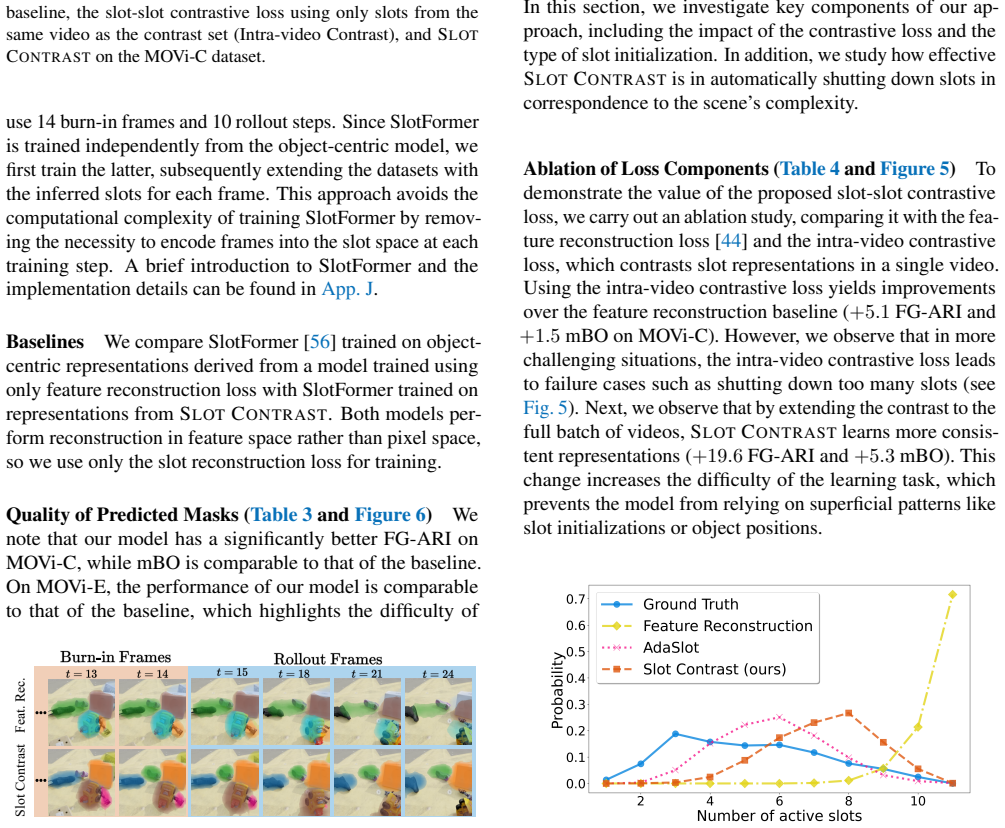
- The batch-wide contrast acts as an implicit slot-competition regularizer, which may explain why redundant slots shut down and the predicted number of objects matches the ground-truth distribution more closely without an explicit sparsity prior.
Editorial analysis
A structured set of objections, weighed in public.
Referee Report
Summary. The paper proposes SLOT CONTRAST, an unsupervised video object-centric learning method that adds a slot-slot temporal contrastive loss to a recurrent slot-attention architecture built on DINOv2 features. The loss pulls same-index slots from adjacent frames together and repels all other slots in the batch (Eqs. 4-5), with a learned slot initialization replacing random initialization. The authors report experiments on MOVi-C, MOVi-E, and YouTube-VIS 2021, showing improved video FG-ARI over VideoSAUR, improved per-frame FG-ARI on MOVi-E (84.8) and YTVIS, improved downstream object dynamics prediction with SlotFormer on MOVi-C, and better mBO on an occlusion subset of MOVi-C. The paper claims state-of-the-art object discovery and temporal consistency, including superiority over weakly supervised methods that use motion masks.
Significance. If the results hold, the method is a simple and effective contribution to real-world video object-centric learning: the per-frame FG-ARI of 84.8 on MOVi-E and video FG-ARI of 38.0 on YTVIS are strong, and the downstream dynamics prediction gain on MOVi-C (63.8 vs 50.7 FG-ARI) is notable. The paper is thorough in providing ablations, hyperparameter tables, and qualitative visualizations, and the proposed loss is easy to integrate into existing slot-based video models. However, the central temporal-consistency mechanism rests on an assumption about slot-index stability that is never directly measured, and the reported numbers lack multiple seeds or error bars. The claims in the abstract are also stronger than the evidence for synthetic datasets, where mBO is lower than VideoSAUR.
major comments (3)
- [Section 3.2, Eqs. (4)-(5); Appendix D; Appendix K] The positive-pair construction assumes that slot i at time t-1 and slot i at time t represent the same physical object. This assumption is load-bearing for the claimed mechanism, but it is not directly verified. The reported metrics (video FG-ARI, mBO) are aggregate over all slots and frames, and the occlusion study in App. K uses only 60 filtered sequences and reports only mBO, not whether the slot index preserved the same object's identity through occlusion and reappearance. Appendix D acknowledges the 'wrong slots pulling' risk and argues that the feature reconstruction loss prevents it, but that is a heuristic argument, not an evaluation. I ask the authors to directly measure slot-object identity preservation, for example by reporting the frequency of slot-index switches for ground-truth objects matched across frames, especially on the occlusion subset and on YTVIS, or by testing the loss under a deliberately permuted slot order between frames. Without such a measurement, the improved temporal consistency could be partly an artifact of optimizing the same index-stability quantity measured by video FG-ARI.
- [Tables 1-5] No standard deviations or number of seeds are reported for any experiment. Several key comparisons are small or dataset-dependent: in Table 4, the YTVIS mBO values for the three loss configurations are 31.4, 33.6, and 33.7, and the MOVi-E mBO values are 28.4, 29.1, and 29.2; in Table 3, MOVi-E FG-ARI is 70.6 vs 70.5 for the dynamics prediction comparison. Without repeated seeds and variance estimates, the reader cannot judge whether the claimed improvements are robust, especially where the method is worse on mBO than VideoSAUR (Table 1). I recommend reporting at least 3-5 seeds with mean and standard deviation for all main tables.
- [Abstract; Section 4.1; Table 1; Table 2] The abstract's claim of 'state-of-the-art results on both synthetic and real-world datasets' is stronger than the evidence. In Table 1, VideoSAUR achieves higher mBO than SLOT CONTRAST on both MOVi-C (38.9 vs 32.7) and MOVi-E (35.6 vs 29.2), so the method is not state-of-the-art on mask quality for synthetic data. The claim of 'outperforming even weakly-supervised methods that leverage motion masks' is based only on per-frame image FG-ARI in Table 2, not on video metrics or mBO, and the margin over DIOD is 2.6 points. Please qualify the claims to the specific metrics and datasets where they hold, and note the mBO trade-off explicitly.
minor comments (4)
- [Section 3.1 and Eq. (6)] The notation for the decoder output is inconsistent: Section 3.1 says the decoder produces reconstructions \hat g_t, while Eq. (6) writes Lrec(h_t, \hat h_t). Please unify the notation.
- [Appendix C and Eqs. (4)-(5)] The implementation described in Appendix C, which applies cross-entropy between P = softmax(A) and the identity matrix, includes the positive pair in the denominator of the softmax. This differs from Eqs. (4)-(5), where the indicator explicitly excludes the positive pair from the denominator. Please align the description with the equations or explain the equivalence.
- [Section 4.3, Table 4] The sentence 'Using the intra-video contrastive loss yields improvements over the feature reconstruction baseline (+5.1 FG-ARI and +1.5 mBO on MOVi-C)' is dataset-specific but reads as a general statement. In Table 4, the intra-video loss decreases FG-ARI on MOVi-E from 79.8 to 78.7. Please report the effect per dataset.
- [Appendix H] The text says 'Our method outperforms all state-of-the-art approaches by a significant margin, with the sole exception of VideoSAUR, where we observe a minor performance gap of just 0.4 points.' The phrase 'significant margin' is contradicted by the 0.4-point gap to VideoSAUR on the same metric; please rephrase.
Circularity Check
No significant circularity: the contrastive loss is an empirical training objective, and the evaluation metrics are independent ground-truth-based scores.
full rationale
The paper's central claims are empirical. SLOT CONTRAST adds the slot-slot contrastive loss of Eq. 5 to a feature-reconstruction objective and then measures object discovery (video and image FG-ARI/mBO) and downstream dynamics prediction against ground-truth annotations. Those metrics are not numerically identical to the cosine-similarity objective in Eqs. 4-5: the loss operates on slot vectors, while FG-ARI/mBO operate on decoded masks matched to ground-truth objects, so the improved scores are a learned consequence, not a renaming of the loss. The positive-pair definition (slot index i at adjacent frames) encodes an inductive bias that the same index tracks the same object; this can fail under occlusions, and the paper itself notes the 'wrong slots pulling' risk in App. D. That is a robustness/validity limitation rather than circularity, because the objective does not use ground-truth identity and the paper does not claim to derive consistency from the loss by definition. Baselines such as VideoSAUR and DINOSAUR are prior works with overlapping authors, but they are used as external comparisons and building blocks, not as load-bearing self-citations or uniqueness theorems. The ablations (Table 4) and the SlotFormer dynamics experiments (Table 3) provide additional evidence that is not directly optimized by the proposed loss. No step in the paper reduces to its own input by construction.
Assumptions & free parameters
free parameters (4)
- Contrastive loss weight alpha =
0.5 (MOVi-C, YTVIS), 1.0 (MOVi-E)
- Softmax temperature tau =
0.1 (all datasets)
- Number of slots K =
11 (MOVi-C), 15 (MOVi-E), 7 (YTVIS)
- Slot dimension =
64 (MOVi-C, YTVIS), 128 (MOVi-E)
assumptions (4)
- domain assumption Frozen DINOv2 features are a sufficient semantic substrate for object discovery after an MLP adaptation.
- domain assumption Slot index i at time t-1 and slot index i at time t refer to the same physical object.
- domain assumption Feature reconstruction loss prevents contrastive collapse and keeps slots informative.
- domain assumption A fixed number of slots K is sufficient for all sequences in each dataset, with redundant slots expected to shut down.
Cite this review
Pith. "Pith review of Temporally Consistent Object-Centric Learning by Contrasting Slots." pith.science (2026). https://pith.science/paper/MXZBHFFB
@misc{pith2026241214295,
  author       = {Pith},
  title        = {Pith review of: Temporally Consistent Object-Centric Learning by Contrasting Slots},
  year         = {2026},
  howpublished = {\url{https://pith.science/paper/MXZBHFFB}},
  note         = {Machine review of arXiv:2412.14295}
}
read the original abstract
Unsupervised object-centric learning from videos is a promising approach to extract structured representations from large, unlabeled collections of videos. To support downstream tasks like autonomous control, these representations must be both compositional and temporally consistent. Existing approaches based on recurrent processing often lack long-term stability across frames because their training objective does not enforce temporal consistency. In this work, we introduce a novel object-level temporal contrastive loss for video object-centric models that explicitly promotes temporal consistency. Our method significantly improves the temporal consistency of the learned object-centric representations, yielding more reliable video decompositions that facilitate challenging downstream tasks such as unsupervised object dynamics prediction. Furthermore, the inductive bias added by our loss strongly improves object discovery, leading to state-of-the-art results on both synthetic and real-world datasets, outperforming even weakly-supervised methods that leverage motion masks as additional cues.
Figures


Figures from the paper (3 more)


Reference graph
Works this paper leans on
-
[1]
Lawrence Zitnick, and Devi Parikh
Stanislaw Antol, Aishwarya Agrawal, Jiasen Lu, Margaret Mitchell, Dhruv Batra, C. Lawrence Zitnick, and Devi Parikh. Vqa: Visual question answering. In International Conference on Computer Vision (ICCV), 2015. 1
work page 2015
-
[2]
Self- supervised object-centric learning for videos
G¨orkay Aydemir, Weidi Xie, and Fatma G ¨uney. Self- supervised object-centric learning for videos. In NeurIPS,
-
[3]
Object discovery from motion- guided tokens
Zhipeng Bao, Pavel Tokmakov, Yu-Xiong Wang, Adrien Gaidon, and Martial Hebert. Object discovery from motion- guided tokens. In Proceedings of the IEEE/CVF Conference on Computer Vision and Pattern Recognition, pages 22972– 22981, 2023. 6, 15
work page 2023
-
[4]
Christopher P. Burgess, Loic Matthey, Nicholas Watters, Rishabh Kabra, Irina Higgins, Matt Botvinick, and Alexander Lerchner. MONet: Unsupervised Scene Decomposition and Representation. arXiv:1901.11390, 2019. 1, 2
arXiv 1901
-
[5]
Emerg- ing Properties in Self-Supervised Vision Transformers
Mathilde Caron, Hugo Touvron, Ishan Misra, Herv´e J´egou, Julien Mairal, Piotr Bojanowski, and Armand Joulin. Emerg- ing Properties in Self-Supervised Vision Transformers. ICCV,
-
[6]
A Simple Framework for Contrastive Learning of Visual Representations
Ting Chen, Simon Kornblith, Mohammad Norouzi, and Geof- frey Hinton. A Simple Framework for Contrastive Learning of Visual Representations. In ICML, 2020. 3
work page 2020
-
[7]
Zero-shot object-centric representation learning
Aniket Didolkar, Andrii Zadaianchuk, Anirudh Goyal, Mike Mozer, Yoshua Bengio, Georg Martius, and Maximilian Seitzer. Zero-shot object-centric representation learning. arXiv preprint arXiv:2408.09162, 2024. 1
arXiv 2024
-
[8]
Ctrl-o: Language-controllable object-centric visual representation learning
Aniket Rajiv Didolkar, Andrii Zadaianchuk, Rabiul Awal, Maximilian Seitzer, Efstratios Gavves, and Aishwarya Agrawal. Ctrl-o: Language-controllable object-centric visual representation learning. In Proceedings of the IEEE/CVF Con- ference on Computer Vision and Pattern Recognition (CVPR),
Show all 68 references
-
[9]
Generaliza- tion and Robustness Implications in Object-Centric Learning
Andrea Dittadi, Samuele Papa, Michele De Vita, Bernhard Sch¨olkopf, Ole Winther, and Francesco Locatello. Generaliza- tion and Robustness Implications in Object-Centric Learning. In ICML, 2022. 1
2022
-
[10]
Danny Driess, Fei Xia, Mehdi S. M. Sajjadi, Corey Lynch, Aakanksha Chowdhery, Brian Ichter, Ayzaan Wahid, Jonathan Tompson, Quan Vuong, Tianhe Yu, Wenlong Huang, Yevgen Chebotar, Pierre Sermanet, Daniel Duckworth, Sergey Levine, Vincent Vanhoucke, Karol Hausman, Marc Toussaint...
2023
-
[11]
SA Vi++: Towards End-to-End Object-Centric Learning from Real-World Videos
Gamaleldin Fathy Elsayed, Aravindh Mahendran, Sjoerd van Steenkiste, Klaus Greff, Michael Curtis Mozer, and Thomas Kipf. SA Vi++: Towards End-to-End Object-Centric Learning from Real-World Videos. In NeurIPS, 2022. 1, 2, 5
2022
-
[12]
Adaptive slot attention: Object discovery with dynamic slot number
Ke Fan, Zechen Bai, Tianjun Xiao, Tong He, Max Horn, Yanwei Fu, Francesco Locatello, and Zheng Zhang. Adaptive slot attention: Object discovery with dynamic slot number. In Proceedings of the IEEE/CVF Conference on Computer Vision and Pattern Recognition, pages 23062–23071, 2024. 8
2024
-
[13]
Object-centric learning with slot attention
Locatello Francesco, Weissenborn Dirk, Unterthiner Thomas, Mahendran Aravindh, Heigold Georg, Uszkoreit Jakob, Doso- vitskiy Alexey, and Kipf Thomas. Object-centric learning with slot attention. Advances in Neural Information Process- ing Systems, 33:11525–11538, 2020. 2
2020
-
[14]
Multi-Object Representation Learning with Iterative Variational Inference
Klaus Greff, Rapha¨el Lopez Kaufman, Rishabh Kabra, Nick Watters, Christopher Burgess, Daniel Zoran, Loic Matthey, Matthew Botvinick, and Alexander Lerchner. Multi-Object Representation Learning with Iterative Variational Inference. In ICML, 2019. 1, 2, 5
2019
-
[15]
On the Binding Problem in Artificial Neural Networks
Klaus Greff, Sjoerd Van Steenkiste, and J ¨urgen Schmidhu- ber. On the Binding Problem in Artificial Neural Networks. arXiv:2012.05208, 2020. 2
2012 arXiv
-
[16]
Klaus Greff, Francois Belletti, Lucas Beyer, Carl Doersch, Yilun Du, Daniel Duckworth, David J. Fleet, Dan Gnanapra- gasam, Florian Golemo, Charles Herrmann, Thomas Kipf, Ab- hijit Kundu, Dmitry Lagun, Issam Laradji, Hsueh-Ti (Derek) Liu, Henning Meyer, Yishu Miao, Derek Nowro...
2022
-
[17]
Sparsely changing latent states for prediction and planning in partially observable domains
Christian Gumbsch, Martin V Butz, and Georg Martius. Sparsely changing latent states for prediction and planning in partially observable domains. In NeurIPS, 2021. 2
2021
-
[18]
Entity-centric reinforcement learning for object manipulation from pixels
Dan Haramati, Tal Daniel, and Aviv Tamar. Entity-centric reinforcement learning for object manipulation from pixels. In ICLR, 2024. 1
2024
-
[19]
Improving object- centric learning with query optimization
Baoxiong Jia, Yu Liu, and Siyuan Huang. Improving object- centric learning with query optimization. arXiv preprint arXiv:2210.08990, 2022. 3
2022 arXiv
-
[20]
SCALOR: Generative World Models with Scalable Object Representations
Jindong Jiang, Sepehr Janghorbani, Gerard de Melo, and Sungjin Ahn. SCALOR: Generative World Models with Scalable Object Representations. In ICLR, 2020. 1, 2
2020
-
[21]
Object-centric slot diffusion
Jindong Jiang, Fei Deng, Gautam Singh, and Sungjin Ahn. Object-centric slot diffusion. In NeurIPS, 2023. 2, 6, 15
2023
-
[22]
Clevr: A diagnostic dataset for compositional language and elementary visual reasoning
Justin Johnson, Bharath Hariharan, Laurens Van Der Maaten, Li Fei-Fei, C Lawrence Zitnick, and Ross Girshick. Clevr: A diagnostic dataset for compositional language and elementary visual reasoning. In Proceedings of the IEEE conference on computer vision and pattern recognitio...
-
[23]
Rishabh Kabra, Daniel Zoran, Goker Erdogan, Loic Matthey, Antonia Creswell, Matthew Botvinick, Alexander Lerch- ner, and Christopher P. Burgess. SIMONe: View-invariant, temporally-abstracted object representations via unsupervised video decomposition. In NeurIPS, 2021. 2
2021
-
[24]
Spot: Self-training with patch-order permutation for object-centric learning with au- toregressive transformers
Ioannis Kakogeorgiou, Spyros Gidaris, Konstantinos Karantzalos, and Nikos Komodakis. Spot: Self-training with patch-order permutation for object-centric learning with au- toregressive transformers. In Proceedings of the IEEE/CVF Conference on Computer Vision and Pattern Recogn...
2024
-
[25]
Diod: Self-distillation meets object discovery
Sandra Kara, Hejer Ammar, Julien Denize, Florian Chabot, and Quoc-Cuong Pham. Diod: Self-distillation meets object discovery. In Proceedings of the IEEE/CVF Conference on Computer Vision and Pattern Recognition (CVPR) , pages 3975–3985, 2024. 6
2024
-
[26]
Clevr- Tex: A Texture-Rich Benchmark for Unsupervised Multi- Object Segmentation
Laurynas Karazija, Iro Laina, and Christian Rupprecht. Clevr- Tex: A Texture-Rich Benchmark for Unsupervised Multi- Object Segmentation. In NeurIPS Track on Datasets and Benchmarks, 2021. 2
2021
-
[27]
Con- trastive learning of structured world models
Thomas Kipf, Elise Van der Pol, and Max Welling. Con- trastive learning of structured world models. arXiv preprint arXiv:1911.12247, 2019. 1, 2
1911 arXiv
-
[28]
Conditional Object-centric Learning from Video
Thomas Kipf, Gamaleldin Fathy Elsayed, Aravindh Mahen- dran, Austin Stone, Sara Sabour, Georg Heigold, Rico Jon- schkowski, Alexey Dosovitskiy, and Klaus Greff. Conditional Object-centric Learning from Video. In ICLR, 2022. 1, 2, 5, 8
2022
-
[29]
Segment any- thing
Alexander Kirillov, Eric Mintun, Nikhila Ravi, Hanzi Mao, Chloe Rolland, Laura Gustafson, Tete Xiao, Spencer White- head, Alexander C Berg, Wan-Yen Lo, et al. Segment any- thing. In Proceedings of the IEEE/CVF international confer- ence on computer vision, pages 4015–4026, 2023. 2
2023
-
[30]
Sequential Attend, Infer, Repeat: Generative Mod- elling of Moving Objects
Adam Kosiorek, Hyunjik Kim, Yee Whye Teh, and Ingmar Posner. Sequential Attend, Infer, Repeat: Generative Mod- elling of Moving Objects. In NeurIPS, 2018. 2
2018
-
[31]
Reasoning- enhanced object-centric learning for videos
Jian Li, Pu Ren, Yang Liu, and Hao Sun. Reasoning- enhanced object-centric learning for videos. arXiv preprint arXiv:2403.15245, 2024. 2
2024 arXiv
-
[32]
Object-Centric Learn- ing with Slot Attention
Francesco Locatello, Dirk Weissenborn, Thomas Unterthiner, Aravindh Mahendran, Georg Heigold, Jakob Uszkoreit, Alexey Dosovitskiy, and Thomas Kipf. Object-Centric Learn- ing with Slot Attention. In NeurIPS, 2020. 1, 2, 3
2020
-
[33]
Self-supervised multi-object tracking with path consistency
Zijia Lu, Bing Shuai, Yanbei Chen, Zhenlin Xu, and Davide Modolo. Self-supervised multi-object tracking with path consistency. arXiv preprint, 2024. 2
2024
-
[34]
Exploring the effectiveness of object-centric representations in visual question answering: Comparative insights with foun- dation models
Amir Mohammad Karimi Mamaghan, Samuele Papa, Karl Henrik Johansson, Stefan Bauer, and Andrea Dittadi. Exploring the effectiveness of object-centric representations in visual question answering: Comparative insights with foun- dation models. arXiv preprint arXiv:2407.15589, 2024. 1
2024 arXiv
-
[35]
Tracking without label: Unsupervised multiple object tracking via con- trastive similarity learning
Sha Meng, Dian Shao, Jiacheng Guo, and Shan Gao. Tracking without label: Unsupervised multiple object tracking via con- trastive similarity learning. In Proceedings of the IEEE/CVF International Conference on Computer Vision, pages 16264– 16273, 2023. 1
2023
-
[36]
Object-centric temporal consistency via conditional autoregressive inductive biases
Cristian Meo, Akihiro Nakano, Mircea Lic˘a, Aniket Didolkar, Masahiro Suzuki, Anirudh Goyal, Mengmi Zhang, Justin Dauwels, Yutaka Matsuo, and Yoshua Bengio. Object-centric temporal consistency via conditional autoregressive inductive biases. arXiv preprint arXiv:2410.15728, 2024. 2
-
[37]
Repre- sentation learning with contrastive predictive coding
Aaron van den Oord, Yazhe Li, and Oriol Vinyals. Repre- sentation learning with contrastive predictive coding. arXiv preprint arXiv:1807.03748, 2018. 4
2018 arXiv
-
[38]
Maxime Oquab, Timoth´ee Darcet, Theo Moutakanni, Huy V . V o, Marc Szafraniec, Vasil Khalidov, Pierre Fernandez, Daniel Haziza, Francisco Massa, Alaaeldin El-Nouby, Russell Howes, Po-Yao Huang, Hu Xu, Vasu Sharma, Shang-Wen Li, Wojciech Galuba, Mike Rabbat, Mido Assran, Nicola...
-
[39]
Spatiotempo- ral contrastive video representation learning
Rui Qian, Tianjian Meng, Boqing Gong, Ming-Hsuan Yang, Huisheng Wang, Serge Belongie, and Yin Cui. Spatiotempo- ral contrastive video representation learning. In Proceedings of the IEEE/CVF conference on computer vision and pattern recognition, pages 6964–6974, 2021. 3
2021
-
[40]
Seman- tics meets temporal correspondence: Self-supervised object- centric learning in videos
Rui Qian, Shuangrui Ding, Xian Liu, and Dahua Lin. Seman- tics meets temporal correspondence: Self-supervised object- centric learning in videos. In ICCV, 2023. 2
2023
-
[41]
Sam 2: Segment anything in images and videos
Nikhila Ravi, Valentin Gabeur, Yuan-Ting Hu, Ronghang Hu, Chaitanya Ryali, Tengyu Ma, Haitham Khedr, Roman R¨adle, Chloe Rolland, Laura Gustafson, Eric Mintun, Junting Pan, Kalyan Vasudev Alwala, Nicolas Carion, Chao-Yuan Wu, Ross Girshick, Piotr Doll ´ar, and Christoph Feicht...
2024 arXiv
-
[42]
Multi-object discovery by low-dimensional object motion
Sadra Safadoust and Fatma G¨uney. Multi-object discovery by low-dimensional object motion. In ICCV, 2023. 2, 6, 15
2023
-
[43]
Object scene rep- resentation transformer
Mehdi SM Sajjadi, Daniel Duckworth, Aravindh Mahendran, Sjoerd Van Steenkiste, Filip Pavetic, Mario Lucic, Leonidas J Guibas, Klaus Greff, and Thomas Kipf. Object scene rep- resentation transformer. Advances in Neural Information Processing Systems, 35:9512–9524, 2022. 3
2022
-
[44]
Bridging the gap to real-world object- centric learning
Maximilian Seitzer, Max Horn, Andrii Zadaianchuk, Dominik Zietlow, Tianjun Xiao, Carl-Johann Simon-Gabriel, Tong He, Zheng Zhang, Bernhard Sch ¨olkopf, Thomas Brox, and Francesco Locatello. Bridging the gap to real-world object- centric learning. In ICLR, 2023. 1, 2, 3, 4, 5, ...
2023
-
[45]
Simple Unsuper- vised Object-Centric Learning for Complex and Naturalistic Videos
Gautam Singh, Yi-Fu Wu, and Sungjin Ahn. Simple Unsuper- vised Object-Centric Learning for Complex and Naturalistic Videos. In NeurIPS, 2022. 1, 2, 5, 6, 15
2022
-
[46]
Un- supervised object learning via common fate
Matthias Tangemann, Steffen Schneider, Julius V on K¨ugelgen, Francesco Locatello, Peter Gehler, Thomas Brox, Matthias K¨ummerer, Matthias Bethge, and Bernhard Sch¨olkopf. Un- supervised object learning via common fate. arXiv preprint arXiv:2110.06562, 2021. 2
-
[47]
Object permanence emerges in a random walk along memory
Pavel Tokmakov, Allan Jabri, Jie Li, and Adrien Gaidon. Object permanence emerges in a random walk along memory. arXiv preprint arXiv:2204.01784, 2022. 2
2022 arXiv
-
[48]
Looping loci: Developing object permanence from videos
Manuel Traub, Frederic Becker, Sebastian Otte, and Martin V Butz. Looping loci: Developing object permanence from videos. arXiv preprint arXiv:2310.10372, 2023. 2
2023 arXiv
-
[49]
Manuel Traub, Sebastian Otte, Tobias Menge, Matthias Karl- bauer, Jannik Thuemmel, and Martin V . Butz. Learning What 10 and Where: Disentangling Location and Identity Tracking Without Supervision. In ICLR, 2023. 2
2023
-
[50]
Tracking through containers and occluders in the wild
Basile Van Hoorick, Pavel Tokmakov, Simon Stent, Jie Li, and Carl V ondrick. Tracking through containers and occluders in the wild. In Proceedings of the IEEE/CVF Conference on Computer Vision and Pattern Recognition, pages 13802– 13812, 2023. 2
2023
-
[51]
Relational neural expectation maximiza- tion: Unsupervised discovery of objects and their interactions
Sjoerd van Steenkiste, Michael Chang, Klaus Greff, and J¨urgen Schmidhuber. Relational neural expectation maximiza- tion: Unsupervised discovery of objects and their interactions. In ICLR, 2018. 2
2018
-
[52]
Co-Reyes, Michael Chang, Michael Janner, Chelsea Finn, Jiajun Wu, Joshua Tenenbaum, and Sergey Levine
Rishi Veerapaneni, John D. Co-Reyes, Michael Chang, Michael Janner, Chelsea Finn, Jiajun Wu, Joshua Tenenbaum, and Sergey Levine. Entity Abstraction in Visual Model-based Reinforcement Learning. In Conference on Robot Learning,
-
[53]
Unsupervised deep tracking
Ning Wang, Yibing Song, Chao Ma, Wengang Zhou, Wei Liu, and Houqiang Li. Unsupervised deep tracking. In Proceed- ings of the IEEE/CVF conference on computer vision and pattern recognition, pages 1308–1317, 2019. 1
2019
-
[54]
Learning correspondence from the cycle-consistency of time
Xiaolong Wang, Allan Jabri, and Alexei A Efros. Learning correspondence from the cycle-consistency of time. In Pro- ceedings of the IEEE/CVF conference on computer vision and pattern recognition, pages 2566–2576, 2019. 2
2019
-
[55]
Spatial broadcast decoder: A simple architecture for learning disentangled representations in vaes
Nicholas Watters, Loic Matthey, Christopher P Burgess, and Alexander Lerchner. Spatial broadcast decoder: A simple architecture for learning disentangled representations in vaes. arXiv preprint arXiv:1901.07017, 2019. 2
1901 arXiv
-
[56]
Slotformer: Unsupervised visual dynamics simulation with object-centric models
Ziyi Wu, Nikita Dvornik, Klaus Greff, Thomas Kipf, and Animesh Garg. Slotformer: Unsupervised visual dynamics simulation with object-centric models. In ICLR, 2023. 1, 2, 5, 6, 7, 16
2023
-
[57]
Slotdiffusion: Object-centric generative modeling with diffusion models
Ziyi Wu, Jingyu Hu, Wuyue Lu, Igor Gilitschenski, and Ani- mesh Garg. Slotdiffusion: Object-centric generative modeling with diffusion models. In NeurIPS, 2023. 1, 2, 6, 8
2023
-
[58]
Slot-VLM: Object-event slots for video-language model- ing
Jiaqi Xu, Cuiling Lan, Wenxuan Xie, Xuejin Chen, and Yan Lu. Slot-VLM: Object-event slots for video-language model- ing. In NeurIPS, 2024. 1
2024
-
[59]
Video instance segmentation
Linjie Yang, Yuchen Fan, and Ning Xu. Video instance segmentation. In ICCV, 2019. 1
2019
-
[60]
The 3rd large-scale video object segmentation challenge - video in- stance segmentation track, 2021
Linjie Yang, Yuchen Fan, Yang Fu, and Ning Xu. The 3rd large-scale video object segmentation challenge - video in- stance segmentation track, 2021. 1, 5
2021
-
[61]
An investigation into pre-training object-centric representations for reinforcement learning
Jaesik Yoon, Yi-Fu Wu, Heechul Bae, and Sungjin Ahn. An investigation into pre-training object-centric representations for reinforcement learning. In ICML, 2023. 1
2023
-
[62]
V onet: Unsupervised video object learning with parallel u-net attention and object-wise sequen- tial vae
Haonan Yu and Wei Xu. V onet: Unsupervised video object learning with parallel u-net attention and object-wise sequen- tial vae. arXiv preprint arXiv:2401.11110, 2024. 2
2024 arXiv
-
[63]
Self-supervised Visual Reinforcement Learning with Object- centric Representations
Andrii Zadaianchuk, Maximilian Seitzer, and Georg Martius. Self-supervised Visual Reinforcement Learning with Object- centric Representations. In ICLR, 2020. 1
2020
-
[64]
Object-centric learning for real-world videos by predicting temporal feature similarities
Andrii Zadaianchuk, Maximilian Seitzer, and Georg Martius. Object-centric learning for real-world videos by predicting temporal feature similarities. In Thirty-seventh Conference on Neural Information Processing Systems (NeurIPS 2023),
2023
-
[65]
Object-centric multiple object tracking
Zixu Zhao, Jiaze Wang, Max Horn, Yizhuo Ding, Tong He, Zechen Bai, Dominik Zietlow, Carl-Johann Simon-Gabriel, Bing Shuai, Zhuowen Tu, Thomas Brox, Bernt Schiele, Yan- wei Fu, Francesco Locatello, Zheng Zhang, and Tianjun Xiao. Object-centric multiple object tracking. ICCV, 2023. 2
2023
-
[66]
Daniel Zoran, Rishabh Kabra, Alexander Lerchner, and Danilo J. Rezende. PARTS: Unsupervised segmentation with slots, attention and independence maximization. In ICCV,
-
[2021]
wrong slots pulling
2 11 Temporally Consistent Object-Centric Learning by Contrasting Slots Supplementary Material A. Training Details The general hyperparameters utilized during training SLOT CONTRAST are outlined in Table S1, ensuring clarity and reproducibility. Furthermore, the task-specific ...
2021
-
[2023]
1, 2, 4, 5, 6, 8, 14, 15
Reviewed August 11, 2026 · model on record in the stance chip above.
Discussion (0). Continue with ORCID to comment.