REVIEW 4 major objections 5 minor 7 cited by
Simulating Human-like Daily Activities with Desire-driven Autonomy
T0 review · 4 major / 5 minor · reviewed 2026-08-11 · deepseek-v4-flash
Pith's one-line read An agent can behave like a person by chasing desires instead of following tasks.
desk verdict A solid integration of desire-driven autonomy for LLM agents with a real behavioral win-rate result, but the mechanistic claim rests on a self-referential metric that needs independent calibration. read the letter →
The pith
A machine-rendered reading of the paper's core claim, the machinery that carries it, and where it could break.
The reading
What carries the argument
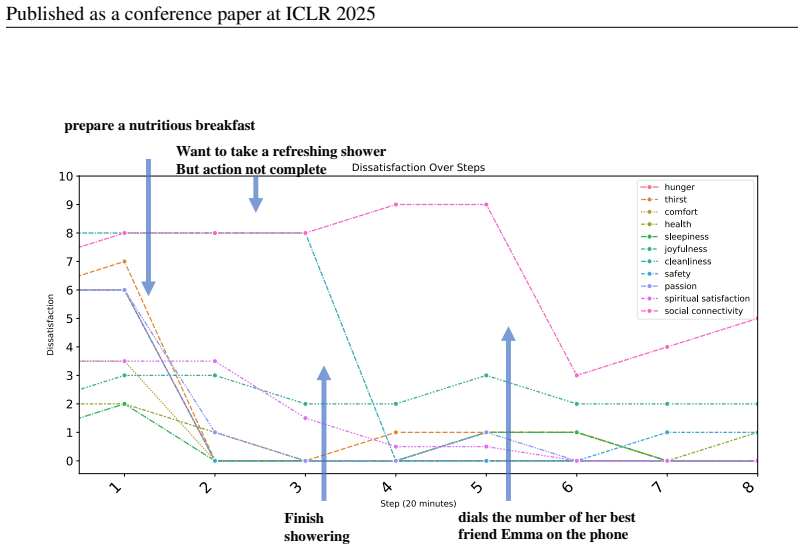
The mechanism is the Value System and the Desire-driven Planner working in a loop. The Value System keeps a numeric score for each desire dimension, decays scores probabilistically according to the profile, translates numbers into qualitative descriptions, and updates scores after each action using the LLM. The Planner proposes N candidate activities, imagines the post-action desire state of each, and selects the one with the most positive predicted impact. The reported Dissatisfaction metric—the sum over desires of the positive gap between expected and current values—is what ties the mechanism to the human-likeness evaluation.
What would settle it
Have independent human raters re-score the post-action desire values from the same transcripts, then recompute the dissatisfaction curves; if D2A's advantage over ReAct shrinks or reverses, the claimed human-likeness gain rests on the agent grading its own homework.
Extended reading notes
Core claim
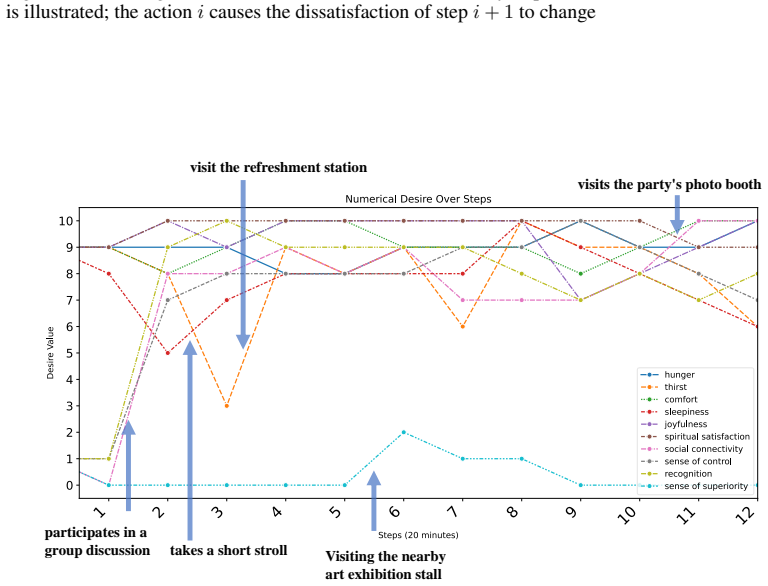
The central discovery is that a desire-driven loop is enough to produce human-like daily activity. D2A beats ReAct (0.85 win rate), LLMob (0.72), and BabyAGI (0.66) in GPT-4o judged human-likeness, and in the Fixed-12 experiment its average dissatisfaction curve is the closest automated match to three human annotators. The paper attributes this to desire-based motivation: D2A continuously evaluates its current desire deficits, proposes several candidate activities, predicts their effects, and chooses the one that best reduces the deficit, which yields sequences that are natural, coherent, and plausible.
Load-bearing premise
The desire-satisfaction results assume the same language model that chooses each activity also assigns accurate numerical updates to its own desire states after the activity.
Editorial extensions
If this is right
- An LLM agent can sustain long-running behavior from internal desire states alone, without task instructions or reward functions, while staying coherent and contextually appropriate.
- The dissatisfaction metric gives a quantitative handle on human-likeness: D2A's curves most closely match human-generated routines, so desire-satisfaction can be measured and optimized directly.
- The ablations show qualitative desire descriptions and a wider candidate-activity search matter, while multi-step planning hurts, which suggests immediate desire feedback is the operative mechanism.
- The framework transfers to social, multi-agent outdoor settings and to a different backbone LLM, so the mechanism is not tied to one environment or one model.
Reading between the lines
- The paper does not test this, but the same architecture could be read as an intrinsic-reward model: the desire deficit is a learnable signal that could steer behavior without external reward functions.
- A testable extension would hold the environment fixed and vary only the desire dimensions and decay rates; the framework predicts that action diversity and category balance track the set of unmet desires rather than the LLM's prior knowledge.
- Since the agent both chooses activities and assigns its own desire updates, independent re-scoring of value changes would separate genuine behavioral improvement from self-consistent scoring.
Signed reviews
Editorial analysis
A structured set of objections, weighed in public.
Referee Report
Summary. The paper introduces D2A, a desire-driven autonomous agent built on a multi-dimensional Value System inspired by the Theory of Needs, which enables an LLM to propose, evaluate, and select daily activities without explicit task instructions. The agent is evaluated in a Concordia-based text environment (indoor and outdoor, single- and multi-agent) against ReAct, BabyAGI, and LLMob. Using GPT-4o pairwise comparisons and a small human consistency check, the authors report that D2A generates activity sequences that are more natural, coherent, and plausible than the baselines; using a 'dissatisfaction' metric, they further claim that D2A satisfies its desires similarly to humans.
Significance. If the main claims hold, D2A is a meaningful step toward LLM agents with intrinsic motivation, with potential applications in simulation, games, and service agents. The paper has several concrete strengths: the framework is described in sufficient detail to reimplement from the appendix prompts; the evaluation spans two environments with different desire sets and demonstrates some generalization (including a different backbone in Appendix P); and the GPT-4o judgments are partially grounded by a human consistency study (Appendix B). However, the load-bearing evidence for the desire-satisfaction mechanism is weakened by flaws in the dissatisfaction metric and by the self-referential nature of the value update, and the behavioral win-rate evidence lacks statistical grounding and code release.
major comments (4)
- [Section 6.2, Eq. (6), Appendix H] The dissatisfaction metric in Eq. (6) has the wrong sign for the physiological dimensions. The value descriptions in Appendix H define hunger, thirst, and sleepiness such that 0 is the satisfied state and 10 is the deprived state, yet Eq. (6) uses max(v*_d - v_t_d, 0) for all dimensions, which yields zero dissatisfaction for a high (deprived) value of hunger relative to its expected value (e.g., hunger=8 vs. v*=2). This contradicts the case study in Appendix C.2, where hunger=8 is treated as a pressing need. The metric should be max(v_t_d - v*_d, 0) for these three dimensions (or, equivalently, the value scales should be inverted before applying Eq. 6). Because the metric is used to compare D2A with baselines in Figures 4(a), 4(b), 5, and 16, the quantitative support for the desire-satisfaction claim is questionable.
- [Sections 5.2 and 5.3, Eq. (6)] The Dissatisfaction curves in Section 6.3.2 are computed from value updates produced by the same Llama3.1-70B model that, in the Activity Evaluation (Eq. 4) and Activity Selection (Eq. 5) procedures, already imagines the desire states of candidate actions and selects the action that best fits that imagination. When this value-update model is applied to the baselines' actions, its ratings may be systematically more favorable for D2A's self-chosen actions, making the lower Dissatisfaction of D2A at least partly an artifact of model self-consistency rather than a demonstration of human-like need regulation. The human consistency check in Appendix B validates only the GPT-4o human-likeness judge, not the Value Update. The authors should calibrate the value update against human ratings or an independent, fixed reward rule, or explicitly argue that self-consistency cannot produce the observed gap.
- [Section 6.3.1, Figure 3, Appendix B] The pairwise win rates in Figure 3 are reported without confidence intervals or significance tests, so the repeated use of 'significantly' (e.g., in Section 6.3.2) is not supported by the displayed statistics. The human consistency study in Appendix B is based on 19 pairs and 8 annotators per questionnaire; the consistency rate for the 'difficult to distinguish' subset is 66.7%, and no inter-annotator agreement measure (e.g., Cohen's kappa) is reported. The authors should add binomial confidence intervals or a permutation test for the win rates and report inter-annotator agreement to support the claim that GPT-4o evaluations are reliable.
- [Section 3 and Section 6.3.1 (style rewriting); reproducibility] The activity sequences are style-rewritten with Llama3.1-70B before evaluation, but no analysis is provided that the rewrite preserves the content of the original sequences; since the raw sequences in Appendix V differ substantially across agents in granularity and detail, the rewriting could change the comparability. In addition, the paper does not release code, prompts, or data, which is particularly problematic because the core claims depend on the exact prompts and the value update procedure described in Appendices I-K. The authors should release the code and prompts (or a detailed pseudocode) and provide at least a small human check of the rewritten sequences against the originals.
minor comments (5)
- [Section 6.3.1] Section 6.3.1 refers to 'Appendix 1'; this should be Appendix B.
- [Section 6.1] In Section 6.1 a 'human-controlled agent' is mentioned but is not described in the experimental comparisons until Section 6.3.2; clarify its role in the setup.
- [Table 8, Appendix G] The expected value formulas in Table 8 (e.g., '3 − Degree') can yield non-integer values even though Appendix G states that all numerical values are integers; specify how these values are rounded or discretized in the implementation.
- [Appendix D] The heading 'D CASESTUDY FOR INOUTDOORENVIRONMENT' (Appendix D) contains missing spaces, and the section labels 'D.1' and 'D.2' are not consistently formatted; the paper would benefit from a careful proofreading pass.
- [Abstract] The abstract states that D2A 'significantly enhances the rationality' of simulated activities, but the evaluation criteria measured are naturalness, coherence, and plausibility; the term 'rationality' should be either defined or replaced by the measured criteria.
Circularity Check
GPT-4o win-rate evidence is externally judged, but the desire-satisfaction metric (Eq. 6) is self-referential: D2A selects actions using the same LLM-based value system that later scores them, so Figure 4 partly measures self-consistency.
-
self definitional
[Section 5.2-5.3, Eq. (6), Appendix J]
"Afterward, the Value System initiates the Value Update procedure, updating the intrinsic numerical values v t of the desire components based on the activity a t, the observation o t, the previous values v t−1, and the value description prompts (Appendix H). ... Dissatisfaction δ t of step t is defined as the relative difference between current numerical desire values v t and expected desire values v ∗ ... δt = X d max(v∗ d − v t d,0) (6)"
The Value Update that produces v^t is executed by the same Llama3.1-70B model that D2A uses in Activity Proposal (Eq. 3), Activity Evaluation (Eq. 4), and Activity Selection (Eq. 5). D2A therefore chooses a_t to maximize the LLM's imagined desire states, and the same LLM then writes the post-hoc v^t values. Eq. 6 is the agent's own objective scored by its own reward model; Appendix J even calls the updater 'the reward model.' No independent calibration of these updates against human desire ratings is provided—Appendix B only validates the GPT-4o human-likeness judge. Hence Figure 4 cannot separate genuine need regulation from LLM self-consistency.
-
other
[Section 6.3.2, Random-8-Steps Experiment]
"Although the baseline agents were equipped with the Value System for observation, we ensured that their intrinsic values v and descriptive desire states D remained hidden, preserving their original activity generation mechanisms."
D2A is given D_t and v* and is explicitly prompted to 'generate K activities that might have most positive impact on your own physical desires or value states' and to 'choose the action that has the most positive impact,' while baselines are deliberately denied that information. The Random-8 comparison then reports δ_t from Eq. 6 for both types of agents. This compares an optimizer with full access to the evaluation objective against policies that are blind to it; the lower D2A dissatisfaction is largely a consequence of the experimental design, not independent evidence for human-like desire regulation.
full rationale
The main human-likeness claim rests on GPT-4o pairwise win rates (Figure 3), which are validated against human annotators in Appendix B; that evaluation is external to the agent and not circular. The circularity is confined to Section 6.3.2's dissatisfaction experiments. D2A's Planner proposes, evaluates, and selects activities using imagined desire states produced by Llama3.1-70B (Eqs. 3-5), and the same backbone's Value Update then assigns the numerical v^t used in Eq. 6. The agent is thus scored by the same reward model it optimizes; the Random-8 protocol even denies the baselines access to D_t and v while D2A is given them. Without any calibration of the Value Update against human desire ratings (Appendix B validates only the GPT-4o judge), the lower D2A dissatisfaction is expected by construction and does not independently establish human-like need regulation. No load-bearing self-citation or uniqueness-theorem argument appears; the likelihood comparison remains a genuine behavioral result.
Assumptions & free parameters
free parameters (5)
- Expected desire values v*_d =
e.g., 9 for extremely sociable, 7 for slightly sociable; formulas in Table 8
- Desire decay probability p_d =
Degree / (60 / step_interval), with Degree in {0.5, 1.0, 1.5, 2.0}
- Initial desire values v0_d =
uniform random in [0,10]
- Planner width N =
3 (ablated to 1 and 5)
- Adjective-degree pairings =
random pairing at initialization
assumptions (6)
- domain assumption Maslow's Theory of Needs correctly describes human motivation as the drive to satisfy intrinsic needs.
- ad hoc to paper Personality adjectives and degree adverbs map to expected desire values via the predefined map (Eq. 2 and Tables 7-8).
- ad hoc to paper The chosen 11 (indoor) and 14 (outdoor) desire dimensions are sufficient to capture human-like motivation in these scenarios.
- domain assumption Language models can reliably translate numeric desire values into qualitative descriptions and back, and can update values after actions.
- ad hoc to paper Style rewriting with Llama3.1-70B preserves the semantic content of activity sequences.
- domain assumption GPT-4o's human-likeness judgments agree with human judgments.
invented entities (1)
-
Multi-dimensional Value System (desire components)
Cite this review
Pith. "Pith review of Simulating Human-like Daily Activities with Desire-driven Autonomy." pith.science (2026). https://pith.science/paper/MZJFWOLA
@misc{pith2026241206435,
  author       = {Pith},
  title        = {Pith review of: Simulating Human-like Daily Activities with Desire-driven Autonomy},
  year         = {2026},
  howpublished = {\url{https://pith.science/paper/MZJFWOLA}},
  note         = {Machine review of arXiv:2412.06435}
}
read the original abstract
Desires motivate humans to interact autonomously with the complex world. In contrast, current AI agents require explicit task specifications, such as instructions or reward functions, which constrain their autonomy and behavioral diversity. In this paper, we introduce a Desire-driven Autonomous Agent (D2A) that can enable a large language model (LLM) to autonomously propose and select tasks, motivated by satisfying its multi-dimensional desires. Specifically, the motivational framework of D2A is mainly constructed by a dynamic Value System, inspired by the Theory of Needs. It incorporates an understanding of human-like desires, such as the need for social interaction, personal fulfillment, and self-care. At each step, the agent evaluates the value of its current state, proposes a set of candidate activities, and selects the one that best aligns with its intrinsic motivations. We conduct experiments on Concordia, a text-based simulator, to demonstrate that our agent generates coherent, contextually relevant daily activities while exhibiting variability and adaptability similar to human behavior. A comparative analysis with other LLM-based agents demonstrates that our approach significantly enhances the rationality of the simulated activities.
Figures


Figures from the paper (13 more)




Forward citations
Cited by 7 Pith papers
-
Step-Level Preference Learning for Generative Agents in Social Simulations
Step-level human preference data collected via SimPref, then SFT+DPO, improves long-horizon social-simulation behavior of open-weight LLM agents on held-out events.
-
CAMS: A CityGPT-Powered Agentic Framework for Urban Human Mobility Simulation
CAMS, an agentic framework built on CityGPT, generates urban mobility trajectories from user profiles and claims superior JSD-based performance over prior simulators.
-
IndoorWorld: Integrating Physical Task Solving and Social Simulation in A Heterogeneous Multi-Agent Environment
IndoorWorld is a new multi-agent environment that combines physical task solving with social interaction, and its experiments show effects of collaboration, resource competition, and layout on agent behavior.
-
Matryoshka Agent: Unfolding Sub-Agents for Long-Horizon Machine Learning Engineering
Matryoshka Agent’s orchestrator–sub-agent hierarchy plus tree-ranked RL raises MLE-Dojo HumanRank, letting a 4B orchestrator approach o4-mini and giving a 30B coder up to 36.7% relative gain.
-
Simulating Human Behavior with the Psychological-mechanism Agent: Integrating Feeling, Thought, and Action
PSYA combines ALMA emotion layers and the Triple Network Model to make LLM agents behave more human-like and reproduce several classic psychology experiment results.
-
Toward LLM-Agent-Based Modeling of Transportation Systems: A Conceptual Framework
LLM-driven agents with profiles, memory, and feedback loops can generate plausible daily travel activities and learn to adjust commute timing in a small proof-of-concept, pointing toward a new direction for agent-base...
-
Large Language Model Powered Intelligent Urban Agents: Concepts, Capabilities, and Applications
The paper defines urban LLM agents, surveys their sensing, memory, reasoning, execution, and learning workflows, and organizes their applications across planning, transportation, environment, safety, and society.
Reference graph
Works this paper leans on
-
[1]
Josh Achiam, Steven Adler, Sandhini Agarwal, Lama Ahmad, Ilge Akkaya, Florencia Leoni Aleman, Diogo Almeida, Janko Altenschmidt, Sam Altman, Shyamal Anadkat, et al. Gpt-4 technical report. arXiv preprint arXiv:2303.08774, 2023
arXiv 2023
-
[2]
Patricia A Adler, Peter Adler, and Andrea Fontana. Everyday life sociology. Annual Review of Sociology, 13 0 (1): 0 217--235, 1987
work page 1987
-
[3]
Simadl: Simulated activities of daily living dataset
Talal Alshammari, Nasser Alshammari, Mohamed Sedky, and Chris Howard. Simadl: Simulated activities of daily living dataset. Data, 3 0 (2): 0 11, 2018
work page 2018
-
[4]
A survey on evaluation of large language models
Yupeng Chang, Xu Wang, Jindong Wang, Yuan Wu, Linyi Yang, Kaijie Zhu, Hao Chen, Xiaoyuan Yi, Cunxiang Wang, Yidong Wang, et al. A survey on evaluation of large language models. ACM Transactions on Intelligent Systems and Technology, 15 0 (3): 0 1--45, 2024
2024
-
[5]
Harrison Chase. LangChain , October 2022. URL https://github.com/langchain-ai/langchain
work page 2022
-
[6]
Augmenting autotelic agents with large language models
C \'e dric Colas, Laetitia Teodorescu, Pierre-Yves Oudeyer, Xingdi Yuan, and Marc-Alexandre C \^o t \'e . Augmenting autotelic agents with large language models. In Conference on Lifelong Learning Agents, pp.\ 205--226. PMLR, 2023
work page 2023
-
[7]
Learning to simulate human mobility
Jie Feng, Zeyu Yang, Fengli Xu, Haisu Yu, Mudan Wang, and Yong Li. Learning to simulate human mobility. In Proceedings of the 26th ACM SIGKDD International Conference on Knowledge Discovery & Data Mining, pp.\ 3426--3433, 2020
work page 2020
-
[8]
What is artificial intelligence? Springer, 1990
James H Fetzer and James H Fetzer. What is artificial intelligence? Springer, 1990
work page 1990
Show all 42 references
-
[9]
a rling and J \
Tommy G \"a rling and J \"o rgen Garvill. Psychological explanations of participation in everyday activities. In Advances in Psychology, volume 96, pp.\ 270--297. Elsevier, 1993
1993
-
[10]
Evaluation of virtual agents utilizing theory of mind in a real time action game
Mark Hoogendoorn and Jeremy Soumokil. Evaluation of virtual agents utilizing theory of mind in a real time action game. In Proceedings of the 9th International Conference on Autonomous Agents and Multiagent Systems: volume 1-Volume 1, pp.\ 59--66, 2010
2010
-
[11]
Bal \'a zs Korm \'a nyos and B \'e la Pataki. Multilevel simulation of daily activities: Why and how? In 2013 IEEE International Conference on Computational Intelligence and Virtual Environments for Measurement Systems and Applications (CIVEMSA), pp.\ 1--6. IEEE, 2013
2013
-
[12]
Camel: Communicative agents for" mind" exploration of large language model society
Guohao Li, Hasan Hammoud, Hani Itani, Dmitrii Khizbullin, and Bernard Ghanem. Camel: Communicative agents for" mind" exploration of large language model society. Advances in Neural Information Processing Systems, 36: 0 51991--52008, 2023
2023
-
[13]
Training socially aligned language models on simulated social interactions
Ruibo Liu, Ruixin Yang, Chenyan Jia, Ge Zhang, Denny Zhou, Andrew M Dai, Diyi Yang, and Soroush Vosoughi. Training socially aligned language models on simulated social interactions. arXiv preprint arXiv:2305.16960, 2023
2023 arXiv
-
[14]
Practical synthetic human trajectories generation based on variational point processes
Qingyue Long, Huandong Wang, Tong Li, Lisi Huang, Kun Wang, Qiong Wu, Guangyu Li, Yanping Liang, Li Yu, and Yong Li. Practical synthetic human trajectories generation based on variational point processes. In Proceedings of the 29th ACM SIGKDD Conference on Knowledge Discovery ...
2023
-
[15]
Forecasting and uncertainty in the economic and business world
Spyros Makridakis, Robin M Hogarth, and Anil Gaba. Forecasting and uncertainty in the economic and business world. International Journal of Forecasting, 25 0 (4): 0 794--812, 2009
2009
-
[16]
Yohei Nakajima. babyagi. https://github.com/yoheinakajima/babyagi, 2023. Accessed: 2024-09-29
2023
-
[17]
Generative agents: Interactive simulacra of human behavior
Joon Sung Park, Joseph O'Brien, Carrie Jun Cai, Meredith Ringel Morris, Percy Liang, and Michael S Bernstein. Generative agents: Interactive simulacra of human behavior. In Proceedings of the 36th Annual ACM Symposium on User Interface Software and Technology, pp.\ 1--22, 2023
2023
-
[18]
Turing test: 50 years later
Ayse Pinar Saygin, Ilyas Cicekli, and Varol Akman. Turing test: 50 years later. Minds and Machines, 10 0 (4): 0 463--518, 2000
2000
-
[19]
Hugginggpt: Solving ai tasks with chatgpt and its friends in hugging face
Yongliang Shen, Kaitao Song, Xu Tan, Dongsheng Li, Weiming Lu, and Yueting Zhuang. Hugginggpt: Solving ai tasks with chatgpt and its friends in hugging face. Advances in Neural Information Processing Systems, 36, 2024
2024
-
[20]
AutoGPT , 2023
Significant Gravitas . AutoGPT , 2023. URL https://github.com/Significant-Gravitas/AutoGPT
2023
-
[21]
A systematic study on reinforcement learning based applications
Keerthana Sivamayil, Elakkiya Rajasekar, Belqasem Aljafari, Srete Nikolovski, Subramaniyaswamy Vairavasundaram, and Indragandhi Vairavasundaram. A systematic study on reinforcement learning based applications. Energies, 16 0 (3): 0 1512, 2023
2023
-
[22]
Llm-planner: Few-shot grounded planning for embodied agents with large language models
Chan Hee Song, Jiaman Wu, Clayton Washington, Brian M Sadler, Wei-Lun Chao, and Yu Su. Llm-planner: Few-shot grounded planning for embodied agents with large language models. In Proceedings of the IEEE/CVF International Conference on Computer Vision, pp.\ 2998--3009, 2023
2023
-
[23]
Qwen2.5: A party of foundation models, September 2024
Qwen Team. Qwen2.5: A party of foundation models, September 2024. URL https://qwenlm.github.io/blog/qwen2.5/
2024
-
[24]
Generative agent-based modeling with actions grounded in physical, social, or digital space using concordia
Alexander Sasha Vezhnevets, John P Agapiou, Avia Aharon, Ron Ziv, Jayd Matyas, Edgar A Du \'e \ n ez-Guzm \'a n, William A Cunningham, Simon Osindero, Danny Karmon, and Joel Z Leibo. Generative agent-based modeling with actions grounded in physical, social, or digital space us...
2023 arXiv
-
[25]
A review of agent and service-oriented concepts applied to intelligent energy systems
Pavel Vrba, Vladim \' r Ma r \' k, Pierluigi Siano, Paulo Leit \ a o, Gulnara Zhabelova, Valeriy Vyatkin, and Thomas Strasser. A review of agent and service-oriented concepts applied to intelligent energy systems. IEEE Transactions on Industrial Informatics, 10 0 (3): 0 1890--...
1903
-
[26]
Modeling autobiographical memory in human-like autonomous agents
Di Wang, Ah-Hwee Tan, and Chunyan Miao. Modeling autobiographical memory in human-like autonomous agents. In Proceedings of the 2016 International Conference on Autonomous Agents & Multiagent Systems, pp.\ 845–853, 2016
2016
-
[27]
Voyager: An open-ended embodied agent with large language models
Guanzhi Wang, Yuqi Xie, Yunfan Jiang, Ajay Mandlekar, Chaowei Xiao, Yuke Zhu, Linxi Fan, and Anima Anandkumar. Voyager: An open-ended embodied agent with large language models. arXiv preprint arXiv:2305.16291, 2023 a
2023 arXiv
-
[28]
Large language models as urban residents: An llm agent framework for personal mobility generation
Jiawei Wang, Renhe Jiang, Chuang Yang, Zengqing Wu, Makoto Onizuka, Ryosuke Shibasaki, Noboru Koshizuka, and Chuan Xiao. Large language models as urban residents: An llm agent framework for personal mobility generation. Advances in Neural Information Processing Systems, 2024 a
2024
-
[29]
A survey on large language model based autonomous agents
Lei Wang, Chen Ma, Xueyang Feng, Zeyu Zhang, Hao Yang, Jingsen Zhang, Zhiyuan Chen, Jiakai Tang, Xu Chen, Yankai Lin, et al. A survey on large language model based autonomous agents. Frontiers of Computer Science, 18 0 (6): 0 186345, 2024 b
2024
-
[30]
Humanoid agents: Platform for simulating human-like generative agents
Zhilin Wang, Yu Ying Chiu, and Yu Cheung Chiu. Humanoid agents: Platform for simulating human-like generative agents. In Proceedings of the 2023 Conference on Empirical Methods in Natural Language Processing: System Demonstrations, pp.\ 167--176, 2023 b
2023
-
[31]
The rise and potential of large language model based agents: A survey
Zhiheng Xi, Wenxiang Chen, Xin Guo, Wei He, Yiwen Ding, Boyang Hong, Ming Zhang, Junzhe Wang, Senjie Jin, Enyu Zhou, et al. The rise and potential of large language model based agents: A survey. arXiv preprint arXiv:2309.07864, 2023
2023 arXiv
-
[32]
Qwen2 technical report
An Yang, Baosong Yang, Binyuan Hui, Bo Zheng, Bowen Yu, Chang Zhou, Chengpeng Li, Chengyuan Li, Dayiheng Liu, Fei Huang, et al. Qwen2 technical report. arXiv preprint arXiv:2407.10671, 2024
2024 arXiv
-
[33]
React: Synergizing reasoning and acting in language models
Shunyu Yao, Jeffrey Zhao, Dian Yu, Nan Du, Izhak Shafran, Karthik R Narasimhan, and Yuan Cao. React: Synergizing reasoning and acting in language models. In The Eleventh International Conference on Learning Representations, 2023
2023
-
[34]
Tree of thoughts: Deliberate problem solving with large language models
Shunyu Yao, Dian Yu, Jeffrey Zhao, Izhak Shafran, Tom Griffiths, Yuan Cao, and Karthik Narasimhan. Tree of thoughts: Deliberate problem solving with large language models. Advances in Neural Information Processing Systems, 36, 2024
2024
-
[35]
Learning to simulate daily activities via modeling dynamic human needs
Yuan Yuan, Huandong Wang, Jingtao Ding, Depeng Jin, and Yong Li. Learning to simulate daily activities via modeling dynamic human needs. In Proceedings of the ACM Web Conference 2023, pp.\ 906--916, 2023
2023
-
[36]
A survey on the memory mechanism of large language model based agents
Zeyu Zhang, Xiaohe Bo, Chen Ma, Rui Li, Xu Chen, Quanyu Dai, Jieming Zhu, Zhenhua Dong, and Ji-Rong Wen. A survey on the memory mechanism of large language model based agents. arXiv preprint arXiv:2404.13501, 2024
2024 arXiv
-
[37]
Cognitive psychology-based artificial intelligence review
Jian Zhao, Mengqing Wu, Liyun Zhou, Xuezhu Wang, and Jian Jia. Cognitive psychology-based artificial intelligence review. Frontiers in Neuroscience, 16: 0 1024316, 2022
2022
-
[38]
Difftraj: Generating gps trajectory with diffusion probabilistic model
Yuanshao Zhu, Yongchao Ye, Shiyao Zhang, Xiangyu Zhao, and James Yu. Difftraj: Generating gps trajectory with diffusion probabilistic model. Advances in Neural Information Processing Systems, 36: 0 65168--65188, 2023
2023
-
[39]
write newline
" write newline "" before.all 'output.state := FUNCTION n.dashify 't := "" t empty not t #1 #1 substring "-" = t #1 #2 substring "--" = not "--" * t #2 global.max substring 't := t #1 #1 substring "-" = "-" * t #2 global.max substring 't := while if t #1 #1 substring * t #2 gl...
-
[40]
@esa (Ref
\@ifxundefined[1] #1\@undefined \@firstoftwo \@secondoftwo \@ifnum[1] #1 \@firstoftwo \@secondoftwo \@ifx[1] #1 \@firstoftwo \@secondoftwo [2] @ #1 \@temptokena #2 #1 @ \@temptokena \@ifclassloaded agu2001 natbib The agu2001 class already includes natbib coding, so you should ...
-
[41]
\@lbibitem[] @bibitem@first@sw\@secondoftwo \@lbibitem[#1]#2 \@extra@b@citeb \@ifundefined br@#2\@extra@b@citeb \@namedef br@#2 \@nameuse br@#2\@extra@b@citeb \@ifundefined b@#2\@extra@b@citeb @num @parse #2 @tmp #1 NAT@b@open@#2 NAT@b@shut@#2 \@ifnum @merge>\@ne @bibitem@firs...
-
[42]
@open @close @open @close and [1] URL: #1 \@ifundefined chapter * \@mkboth \@ifxundefined @sectionbib * \@mkboth * \@mkboth\@gobbletwo \@ifclassloaded amsart * \@ifclassloaded amsbook * \@ifxundefined @heading @heading NAT@ctr thebibliography [1] @ \@biblabel @NAT@ctr \@bibset...
Reviewed August 11, 2026 · model on record in the stance chip above.
Discussion (0). Continue with ORCID to comment.