REVIEW 2 major objections 4 minor 43 references
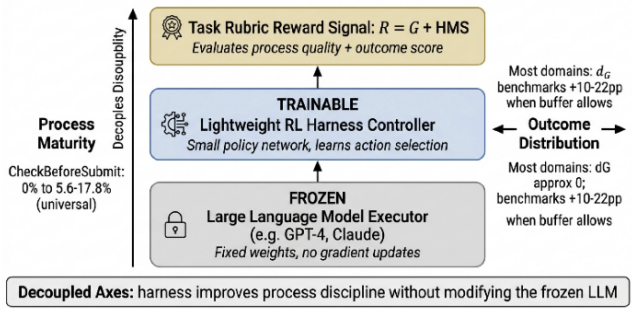
The execution harness around a frozen LLM is a learnable control layer that offline reinforcement learning can improve.
Reviewed by Pith at T0; open to challenge. T0 means a machine referee read the full paper against a public rubric. the ladder, T0–T4 →
T0 review · grok-4.5
2026-07-11 17:58 UTC pith:MZPCQMLF
load-bearing objection Solid methods paper: harness control as offline AW over a shared structural MDP is real; process gains are robust, biggest quality numbers are protocol-dependent. the 2 major comments →
Learning to Control LLM Agent Harnesses with Offline Reinforcement Learning
The pith
A machine-rendered reading of the paper's core claim, the machinery that carries it, and where it could break.
Core claim
Harness control is a learnable layer for frozen LLM agents. Formalizing the harness as a finite-horizon Harness MDP and training a lightweight controller with offline advantage-weighted regression on terminal task-rubric rewards alone consistently raises verification-before-submission and selectively raises final task quality when the offline buffer contains high-return support. Ablations against behavior cloning and Forced CHECK show the gains come from state-dependent control, not pure imitation or blindly adding checks.
What carries the argument
The Harness MDP: a finite-horizon Markov decision process in which a lightweight controller selects structural actions (OBSERVE, RETRIEVE, CALL-TOOL, DRAFT, CHECK, REVISE, SUBMIT) while the LLM executor stays frozen, trained by advantage-weighted regression from offline rollouts using only terminal task-rubric rewards. Theorem 2 then separates the two channels of offline learning—outcome gains bounded by the best return already in the buffer, versus process shifts that occur whenever a process statistic covaries with the advantage weights.
Load-bearing premise
The offline buffer must already contain enough high-return trajectories that link better control decisions to better final answers; without that support, better process habits will not raise task scores.
What would settle it
On a domain whose offline buffer has near-zero high-return support under a fixed calibrated verifier, large final-quality gains after advantage-weighted training would falsify the finite-buffer outcome bound; if CheckBeforeSubmit also fails to rise above base rates across domains, the process-learning claim would fail.
If this is right
- Agent systems can gain reliability by learning when to check and revise rather than only rewriting prompts or fine-tuning the model.
- Final-quality gains from harness learning are limited by whether high-return trajectories already exist in the offline buffer.
- Process habits such as verification-before-submit can improve even when final scores stay flat, so process and outcome must be measured separately.
- Uniform checking or pure imitation does not explain the gains; state-conditioned control is required.
- Closing the outcome gap requires expanding offline support through targeted data collection or online improvement.
Where Pith is reading between the lines
- A shared structural action interface could let production platforms ship one harness learner that adapts per deployment without model updates.
- Offline harness RL may be most useful first as a process regularizer, with outcome transfer treated as a data-support problem rather than a pure optimization problem.
- Verifier calibration itself can determine whether harness learning appears to work, so scoring design is part of the experimental claim, not only measurement detail.
- Richer action spaces or online controller updates are natural next tests of the finite-buffer ceiling the theory identifies.
Editorial analysis
A structured set of objections, weighed in public.
Referee Report
Summary. The paper formalizes the external control layer of a frozen LLM agent as a finite-horizon Harness MDP whose actions are structural operations (OBSERVE, RETRIEVE, CALL-TOOL, DRAFT, CHECK, REVISE, SUBMIT). A lightweight MLP controller is trained offline by advantage-weighted regression on terminal task-rubric rewards only; the LLM executor and prompts remain frozen. Final task quality Q is deliberately separated from a post-hoc Harness Maturity Score (HMS) that measures seven process events. Theory shows potential-based reward invariance (Theorem 1), a finite-buffer outcome ceiling and process-covariance identity (Theorem 2), and that action-pattern bonuses can change the optimum (Proposition 1). Empirically, across six controlled domains and two public-benchmark adapters, AW raises CheckBeforeSubmit in every setting and improves final quality most on adapted τ-bench retail (+18.2), adapted AgentBench DB-Bench (+13.2), and coding under a calibrated structural verifier (+10.0). Ablations against behavior cloning and Forced CHECK indicate the gains are not pure imitation or mechanical insertion of checks.
Significance. If the result holds, it cleanly isolates harness control as a learnable policy layer distinct from prompt, scaffold, or LLM fine-tuning. The finite-buffer analysis (Theorem 2) and the explicit process–outcome separation give a useful diagnostic for when offline reweighting can convert better process into better answers. Strengths include clean appendices proofs of the shaping and support results, public code, fixed cross-domain hyperparameters, bootstrap intervals on ΔG, and ablations that rule out two natural confounds. The contribution is therefore a well-scoped offline-RL formulation and diagnostic rather than a claim of universal agent improvement.
major comments (2)
- §5, Table 3 and Appendix E: the three largest reported final-quality lifts (coding +10.0, τ-bench retail +18.2, DB-Bench +13.2) are measured under recalibrated or adapted scoring protocols, not the native task evaluators. Under the original strict deterministic coding rubric the base harness is near ceiling (G≈0.929) and AW yields ≈−0.006; the +10.0 appears only after switching to the calibrated structural verifier. The adapters likewise replace native simulator/evaluator scores with plan-quality and deliberative-reasoning rubrics. Because the central claim is that offline AW converts process control into final-quality gains when the buffer has high-return support, the manuscript should either (i) report the same lifts under the original/native scorers or (ii) restate the outcome claim as protocol-dependent and move the strongest numbers to a clearly labeled sensitivity section.
- §5 and Table 5: final-quality gains are selective and often statistically weak outside the three highlighted settings (knowledge-work +1.4 with CI crossing zero, planning +2.6 with CI crossing zero, research/multi-tool/long-memory near zero or negative). The abstract and introduction still present “selectively improves final task quality” as a co-equal result with the robust process finding. The load-bearing empirical claim should be rebalanced so that the consistently demonstrated result is the process shift (CheckBeforeSubmit / HMS), with outcome transfer presented as conditional on buffer support and verifier choice.
minor comments (4)
- Figure 3 and Table 1: the abstract and main findings list “largest gains on adapted τ-bench retail, adapted AgentBench DB-Bench, and coding” without always repeating that these are adapter-level / calibrated-protocol scores; a single clarifying sentence in the abstract would prevent over-reading.
- Table 7 / §5: EarlySubmit rises sharply in research (0%→25%) and on DB-Bench (8.3%→27.8%), offsetting HMS gains; the discussion already notes this, but a short remark that verification and stopping are distinct control objectives would help readers interpret the localized process shift.
- Controller details (§3): the one-hidden-layer MLP (64 units), β=0.2, weight clip [0.1,10], entropy 0.01 are fixed across domains—good for fairness—but a one-sentence sensitivity note on β or clip range would strengthen reproducibility claims.
- Notation: G, Q, and ΔG are used somewhat interchangeably for terminal task quality; a single symbol convention in §3–§5 would reduce minor ambiguity.
Circularity Check
No significant circularity: terminal-task training, post-hoc HMS, and finite-buffer theorems are self-contained and do not force empirical claims by construction.
full rationale
The paper formalizes a Harness MDP, trains a controller solely with offline advantage-weighted regression on terminal task-rubric returns Q (Eq. 1, Definitions 1–2), and never optimizes the post-hoc Harness Maturity Score or its seven process events. Theorem 1 is the standard finite-horizon potential-based reward-shaping invariance (Ng et al.); experiments use the special case Φ ≡ 0. Theorem 2 and Corollary 1 are elementary identities for reweighted empirical measures (outcome ceiling by support, process shift = Cov(w, Ψ)/E[w]); they characterize rather than assume process–outcome decoupling and do not embed the target empirical rates. Ablations against BC and Forced CHECK, held-out evaluation, fixed hyperparameters, and explicit disclosure that coding’s +10 pt gain appears only under the calibrated structural verifier (while the original strict rubric yields near-ceiling base and ~0 change) further show that reported lifts are not definitional or fitted-input tautologies. Adapter scores are likewise labeled non-official. No load-bearing self-citations, uniqueness imports, or ansatz smuggling appear. The derivation chain is therefore independent of its own conclusions.
Axiom & Free-Parameter Ledger
free parameters (6)
- AW temperature β =
0.2
- AW weight clip range =
[0.1, 10.0]
- entropy regularization coefficient =
0.01
- EarlySubmit detector threshold =
0.25
- controller architecture / training schedule =
MLP-64, 20 epochs
- coding verifier calibration choice =
calibrated structural verifier
axioms (5)
- standard math Potential-based reward shaping preserves optimal policies of the terminal task-rubric objective (finite-horizon Ng et al. analogue).
- domain assumption Offline AW can only reweight trajectories present in the finite buffer; outcome improvement is bounded by buffer support ceiling G★_B.
- domain assumption A compact shared structural action space (OBSERVE, RETRIEVE, CALL-TOOL, DRAFT, CHECK, REVISE, SUBMIT) plus domain adapters is sufficient to control execution procedure without updating LLM parameters or prompts.
- domain assumption Terminal task-rubric scores from domain structural verifiers are valid proxies for task quality and may be used both as training returns and evaluation G.
- ad hoc to paper HMS seven-event detector (with EarlySubmit as penalty) is a valid post-hoc process diagnostic and is never used as training reward.
invented entities (2)
-
Harness MDP
no independent evidence
-
Harness Maturity Score (HMS)
no independent evidence
read the original abstract
Large language model (LLM) agents are usually improved by changing prompts, models, or hand-written workflows, while the execution harness around the model is treated as fixed infrastructure. We argue that this harness is itself a learnable control layer. We formalize harness operation as a finite-horizon Harness MDP, where a lightweight controller selects structural execution actions while the LLM executor remains frozen. The controller is trained from offline rollouts using advantage-weighted regression with only terminal task-rubric rewards. We also separate final task quality from a post-hoc Harness Maturity Score, which measures whether the harness follows reliable execution patterns rather than only whether the final answer is correct. This separation gives a finite-buffer view of harness learning: final-quality gains require high-return support in the offline buffer, while process behavior can shift whenever it aligns with advantage-weighted actions. Across six controlled domains and two public-benchmark adapters, the learned controller consistently improves verification behavior and selectively improves final task quality, with the largest gains on adapted tau-bench retail, adapted AgentBench DB-Bench, and coding with a calibrated structural verifier. Ablations against behavior cloning and Forced CHECK show that the gains are not explained by imitation or by simply adding checks. These results identify harness control as a learnable layer for frozen LLM agents, while showing that offline support limits when better process control becomes better final answers.
Figures


Reference graph
Works this paper leans on
-
[1]
AgentBench: Evaluating
Liu, Xiao and Yu, Hao and Zhang, Hanchen and Xu, Yifan and Lei, Xuanyu and Lai, Hanyu and Gu, Yu and Ding, Hangliang and Men, Kaiwen and Yang, Kejuan and Zhang, Shudan and Deng, Xiang and Zeng, Aohan and Du, Zhengxiao and Zhang, Chenhui and Shen, Sheng and Zhang, Tianjun and Su, Yu and Sun, Huan and Huang, Minlie and Dong, Yuxiao and Tang, Jie , booktitle...
-
[2]
arXiv preprint arXiv:2405.15793 , year=
SWE-agent: Agent-Computer Interfaces Enable Automated Software Engineering , author=. arXiv preprint arXiv:2405.15793 , year=
-
[3]
arXiv preprint arXiv:2410.10762 , year=
AFlow: Automating Agentic Workflow Generation , author=. arXiv preprint arXiv:2410.10762 , year=
-
[4]
arXiv preprint arXiv:2606.05922 , year=
Retrospective Harness Optimization: Improving LLM Agents via Self-Preference over Trajectory Rollouts , author=. arXiv preprint arXiv:2606.05922 , year=
-
[5]
Yao, Shunyu and Shinn, Noah and Razavi, Pedram and Narasimhan, Karthik , journal =
-
[6]
Zhou, Shuyan and Xu, Frank F. and Zhu, Hao and Zhou, Xuhui and Lo, Robert and Sridhar, Abishek and Cheng, Xianyi and Ou, Tianyue and Bisk, Yonatan and Fried, Daniel and Alon, Uri and Neubig, Graham , booktitle =
-
[7]
Yao, Shunyu and Chen, Howard and Yang, John and Narasimhan, Karthik , booktitle =
-
[8]
arXiv preprint arXiv:2311.12983 , year =
Mialon, Gr. arXiv preprint arXiv:2311.12983 , year =
-
[9]
and Yang, John and Wettig, Alexander and Yao, Shunyu and Pei, Kexin and Press, Ofir and Narasimhan, Karthik , booktitle =
Jimenez, Carlos E. and Yang, John and Wettig, Alexander and Yao, Shunyu and Pei, Kexin and Press, Ofir and Narasimhan, Karthik , booktitle =
-
[10]
Xi, Zhiheng and Ding, Yiwen and Chen, Wenxiang and Hong, Boyang and Guo, Honglin and Wang, Junzhe and Yang, Dingwen and Liao, Chenyang and Guo, Xin and He, Wei and Gao, Songyang and Chen, Lu and Zheng, Rui and Zou, Yicheng and Gui, Tao and Zhang, Qi and Qiu, Xipeng and Huang, Xuanjing and Wu, Zuxuan and Jiang, Yu-Gang , journal =
-
[11]
2024 , eprint=
Evaluating Very Long-Term Conversational Memory of LLM Agents , author=. 2024 , eprint=
2024
-
[12]
Qin, Yujia and Liang, Shihao and Ye, Yining and Zhu, Kunlun and Yan, Lan and Lu, Yaxi and Lin, Yankai and Cong, Xin and Tang, Xiangru and Qian, Bill and Zhao, Sihan and Hong, Lauren and Tian, Runchu and Xie, Ruobing and Zhou, Jie and Gerstein, Mark and Li, Dahai and Liu, Zhiyuan and Sun, Maosong , journal =
-
[13]
International Conference on Learning Representations (ICLR) , year =
Large Language Models Are Human-Level Prompt Engineers , author =. International Conference on Learning Representations (ICLR) , year =
-
[14]
International Conference on Learning Representations (ICLR) , year =
Large Language Models as Optimizers , author =. International Conference on Learning Representations (ICLR) , year =
-
[15]
and Moazam, Hanna and Miller, Heather and Zaharia, Matei and Potts, Christopher , journal =
Khattab, Omar and Singhvi, Arnav and Maheshwari, Paridhi and Zhang, Zhiyuan and Santhanam, Keshav and Vardhamanan, Sri and Haq, Saiful and Sharma, Ashutosh and Joshi, Thomas T. and Moazam, Hanna and Miller, Heather and Zaharia, Matei and Potts, Christopher , journal =
-
[16]
International Conference on Learning Representations , year=
ReAct: Synergizing Reasoning and Acting in Language Models , author=. International Conference on Learning Representations , year=
-
[17]
Yuksekgonul, Mert and Bianchi, Federico and Boen, Joseph and Liu, Sheng and Huang, Zhi and Guestrin, Carlos and Zou, James , journal =
-
[18]
Wang, Yinjie and Yang, Ling and Li, Guohao and Wang, Mengdi and Aragam, Bryon , journal =
-
[19]
Tornede, Alexander and Purucker, Lennart and Giglberger, Tobias and Tornede, Tanja and Beel, Joeran and Hutter, Frank , journal =
-
[20]
and Tan, Shangyin and Soylu, Dilara and Ziems, Noah and Khare, Rishi and Opsahl-Ong, Krista and Singhvi, Arnav and Shandilya, Herumb and Ryan, Michael J
Agrawal, Lakshya A. and Tan, Shangyin and Soylu, Dilara and Ziems, Noah and Khare, Rishi and Opsahl-Ong, Krista and Singhvi, Arnav and Shandilya, Herumb and Ryan, Michael J. and Jiang, Meng and Potts, Christopher and Sen, Koushik and Dimakis, Alexandros G. and Stoica, Ion and Klein, Dan and Zaharia, Matei and Khattab, Omar , journal =
-
[21]
arXiv preprint arXiv:2604.25850 , year =
Agentic Harness Engineering: Observability-Driven Automatic Evolution of Coding-Agent Harnesses , author =. arXiv preprint arXiv:2604.25850 , year =
-
[22]
2026 , eprint=
The Last Harness You'll Ever Build , author=. 2026 , eprint=
2026
-
[23]
2023 , eprint=
Reflexion: Language Agents with Verbal Reinforcement Learning , author=. 2023 , eprint=
2023
-
[24]
Wang, Guanzhi and Xie, Yuqi and Jiang, Yunfan and Mandlekar, Ajay and Xiao, Chaowei and Zhu, Yuke and Fan, Linxi and Anandkumar, Anima , journal =
-
[25]
International Conference on Machine Learning (ICML) , year =
Language Agent Tree Search Unifies Reasoning, Acting and Planning in Language Models , author =. International Conference on Machine Learning (ICML) , year =
-
[26]
Advances in Neural Information Processing Systems , volume=
Toolformer: Language Models Can Teach Themselves to Use Tools , author=. Advances in Neural Information Processing Systems , volume=
-
[27]
arXiv preprint arXiv:1910.00177 , year=
Advantage-Weighted Regression: Simple and Scalable Off-Policy Reinforcement Learning , author=. arXiv preprint arXiv:1910.00177 , year=
Pith/arXiv arXiv 1910
-
[28]
arXiv preprint arXiv:2005.01643 , year =
Offline Reinforcement Learning: Tutorial, Review, and Perspectives on Open Problems , author =. arXiv preprint arXiv:2005.01643 , year =
Pith/arXiv arXiv 2005
-
[29]
International Conference on Learning Representations (ICLR) , year =
Accelerating Online Reinforcement Learning with Offline Datasets , author =. International Conference on Learning Representations (ICLR) , year =
-
[30]
Offline Reinforcement Learning with Implicit
Kostrikov, Ilya and Nair, Ashvin and Levine, Sergey , booktitle =. Offline Reinforcement Learning with Implicit
-
[31]
, booktitle =
Pomerleau, Dean A. , booktitle =
-
[32]
International Conference on Artificial Intelligence and Statistics (AISTATS) , year =
A Reduction of Imitation Learning and Structured Prediction to No-Regret Online Learning , author =. International Conference on Artificial Intelligence and Statistics (AISTATS) , year =
-
[33]
International Conference on Learning Representations , year=
MetaGPT: Meta Programming for A Multi-Agent Collaborative Framework , author=. International Conference on Learning Representations , year=
-
[34]
International Conference on Learning Representations , year=
AgentVerse: Facilitating Multi-Agent Collaboration and Exploring Emergent Behaviors , author=. International Conference on Learning Representations , year=
-
[35]
2024 , eprint=
ADaPT: As-Needed Decomposition and Planning with Language Models , author=. 2024 , eprint=
2024
-
[36]
Wu, Qingyun and Bansal, Gagan and Zhang, Jieyu and Wu, Yiran and Zhang, Shaokun and Zhu, Erkang and Li, Beibin and Jiang, Li and Zhang, Xiaoyun and Wang, Chi , journal =
-
[37]
Process vs
Zhang, Wenlin and Li, Xiangyang and Dong, Kuicai and Wang, Yichao and Jia, Pengyue and Li, Xiaopeng and Zhang, Yingyi and Xu, Derong and Du, Zhaocheng and Guo, Huifeng and Tang, Ruiming and Zhao, Xiangyu , journal =. Process vs. Outcome Reward: Which is Better for Agentic
-
[38]
arXiv preprint arXiv:2510.25694 , year =
Process-Level Trajectory Evaluation for Environment Configuration in Software Engineering Agents , author =. arXiv preprint arXiv:2510.25694 , year =
-
[39]
Lu, Jiarui and Holleis, Thomas and Zhang, Yizhe and Aumayer, Bernhard and Nan, Feng and Bai, Felix and Ma, Shuang and Ma, Shen and Li, Mengyu and Yin, Guoli and Wang, Zirui and Pang, Ruoming , journal =
-
[40]
arXiv preprint arXiv:2606.07889 , year =
Strained Coherence: A Pre-Failure Signal in Coding Agent Execution Trajectories , author =. arXiv preprint arXiv:2606.07889 , year =
-
[41]
and Salakhutdinov, Ruslan and Manning, Christopher D
Yang, Zhilin and Qi, Peng and Zhang, Saizheng and Bengio, Yoshua and Cohen, William W. and Salakhutdinov, Ruslan and Manning, Christopher D. , booktitle =
-
[42]
Brandfonbrener, David and Whitney, Will and Ranganath, Rajesh and Bruna, Joan , booktitle =. Offline
-
[43]
Proceedings of the 16th International Conference on Machine Learning (ICML) , pages =
Policy Invariance Under Reward Transformations: Theory and Application to Reward Shaping , author =. Proceedings of the 16th International Conference on Machine Learning (ICML) , pages =
discussion (0)
Sign in with ORCID, Apple, or X to comment. Anyone can read and Pith papers without signing in.