REVIEW 4 minor 1 cited by
Gaia's precise distances and motions for two billion stars now give a detailed chronology of how the Milky Way formed some 12–13 Gyr ago, the review argues.
Reviewed by Pith at T0; open to challenge. T0 means a machine referee read the full paper against a public rubric. the ladder, T0–T4 →
T0 review · deepseek-v4-flash
2026-08-04 17:26 UTC pith:MZYPUVOW
load-bearing objection A thorough, authoritative DR3-era review of Gaia science; no new results, but a reliable and well-caveated synthesis worth having on the shelf.
Space Astrometry with Gaia: Advances in Understanding our Galaxy
The pith
A machine-rendered reading of the paper's core claim, the machinery that carries it, and where it could break.
Core claim
The review's central claim is that Gaia's astrometric catalogue, built from microarcsecond-level parallaxes and proper motions on an extragalactic reference frame, enables a 'rather detailed chronology' of how the Galaxy came into existence 12–13 Gyr ago. The paper presents a wide survey of results—from asteroids and exoplanets to the Galaxy's bar, warp, spiral arms, halo streams, and merger remnants, and to Cepheid-based distances—arguing that these all trace back to the same precise, all-sky astrometric measurements.
What carries the argument
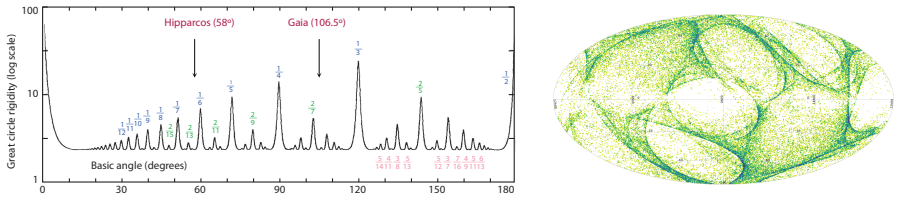
The enabling mechanism is the combination of two widely separated fields of view (basic angle 106.5°) for absolute parallax measurement, and the Astrometric Global Iterative Solution (AGIS), a cyclic block-iterative estimation of source parameters, spacecraft attitude, instrument calibration, and global parameters that converges to microarcsecond consistency. The review emphasizes that correcting the parallax zero point and bias (for example, a −21 microarcsecond weighted mean from a million quasars in EDR3) is essential for almost all distance-dependent conclusions.
Load-bearing premise
The review's conclusions depend on the accuracy of the Gaia parallax zero-point and bias corrections: if these systematic corrections are wrong, systematic distance errors propagate into nearly every distance-dependent result.
What would settle it
Compare Gaia EDR3/DR3 parallaxes of Cepheids or RR Lyrae stars in the Large Magellanic Cloud with independent geometric distances from eclipsing binaries or water masers; if a magnitude- or colour-dependent offset outside the quoted systematic uncertainties (e.g., 10–20 microarcseconds) emerges, the zero-point corrections underpinning the review's distance-scale results would need revision.
If this is right
- If the Gaia-derived distances and motions are accurate, stellar luminosities, radii, and masses become calibrated for billions of stars, transforming stellar evolution studies.
- The Milky Way's merger and accretion history can be reconstructed from phase-space fossils such as the Enceladus remnant, halo streams, and the phase-space spiral.
- Cepheid and RR Lyrae distance scales can be anchored geometrically, directly feeding determinations of the Hubble constant.
- Gaia provides a dense, accurate reference frame used for pointing and calibrating other observatories, from JWST to the New Horizons flyby.
- Future data releases extending to 5.5 and 10.5 years of observations will yield more precise parallaxes, proper motions, and binary orbit solutions for close to three billion sources.
Where Pith is reading between the lines
- Editorial inference: the review's survey implies that Gaia effectively converts astrometry into a discovery engine, not just a measurement service; the same data underlie fields as disparate as asteroid mass determination and cosmological distance-ladder calibration.
- Editorial inference: the reliance on quasar-based zero-point corrections suggests that any future revision of the parallax bias will propagate through distance-dependent results, potentially shifting the inferred Hubble constant or the age of the Galaxy.
- Editorial inference: the review's emphasis on homogeneous, all-sky catalogues hints that future space astrometry missions could push similar techniques to fainter magnitudes or other wavelengths, extending this style of science beyond the optical.
- Editorial inference: tests of the parallax zero point using independent geometric distances (e.g., eclipsing binaries, water masers, or pulsar parallaxes) would directly validate or correct the review's underlying data quality assumptions.
Editorial analysis
A structured set of objections, weighed in public.
Referee Report
Summary. This manuscript is a broad, authoritative review of the Gaia space astrometry mission and its scientific impact, written by a central figure in the mission. It begins with the historical and technical context of astrometry, describes the Gaia satellite and the data-processing pipeline (including AGIS, the astrometric solution, photometry, radial velocities, and the Apsis classification modules), and then surveys results across solar-system science, stellar structure and evolution, Galactic structure and dynamics, and Local Group/cosmology. The central claim is that Gaia's catalogue—roughly two billion sources with astrometry, photometry, and spectroscopy—has transformed stellar and Galactic astrophysics and provided a detailed chronology of the Milky Way's assembly over the past 12–13 Gyr. The paper is explicitly framed as an update of earlier reviews, with the aim of synthesizing the roughly 7000 refereed papers that have used Gaia data before the upcoming DR4 release.
Significance. If the synthesis is accurate, this will be a valuable reference for the community. The manuscript is particularly strong in its transparency: it explicitly acknowledges the parallax zero-point and bias problem (§4.3.4), the model-dependence of inferred stellar properties (§4.7), the effects of unresolved binaries on astrometric quality (§4.3.2), and the limitations of machine-learning-based classifications. The author's first-hand knowledge of the mission gives the technical sections unusual authority, and the extensive citation base makes the review a useful entry point for non-specialists and specialists alike. The paper does not present new measurements, but the relevant standard is whether the reviewed results actually support the claim that Gaia has transformed Galactic astrophysics. On that standard, the manuscript succeeds: the headline discoveries (halo streams, cluster kinematics, disk structure, phase-space spirals, and the like) are qualitative and corroborated across many independent analyses, and do not hinge on a single systematic correction. The explicit caveats about residual astrometric systematics and model-dependent quantities are appropriate and not hidden.
minor comments (4)
- [Table 2] In the DR1 row, the listing of both '5-parameter solutions' and '6-parameter solutions' as 2,057,050 is inconsistent with the body text and with the source-count arithmetic: DR1 contained the Tycho–Gaia Astrometric Solution (5-parameter) for ~2 million stars and 2-parameter solutions for the rest; there were no Gaia-only 6-parameter solutions in DR1. The row should be corrected (likely with the 6-parameter entry left blank), otherwise readers may be misled about the DR1 data content.
- [§4.3.4] The discussion of the Z5/Z6 parallax-bias correction functions is clear, but for a review that will be used as a reference it would help to give the exact applicability conditions (magnitude/colour/position ranges, 5-parameter vs 6-parameter solutions) in a compact table or boxed summary rather than only referring to the Python implementations. This is a readability suggestion, not a correctness issue.
- [§4.7] The caution about physics-driven versus data-driven spectral inference is welcome, but the sentence 'at least some algorithms which estimate [α/Fe] from the XP spectra do so by exploiting known correlations between [α/Fe] and other elements' is important enough that it could be elevated to a more prominent warning in the summary of the Apsis outputs. As written, it appears somewhat buried in the machine-learning subsection.
- [§11] The final summary is useful but mostly lists achievements. A short paragraph collecting the main systematics and model-dependencies (parallax zero point, unresolved binaries, synthetic photometry assumptions, model-dependent masses/ages) would help readers who skim the review and would mirror the transparency shown elsewhere in the text.
Circularity Check
No significant circularity: the review's synthesis rests on independent, externally benchmarked Gaia results, not on self-citation or fitted inputs.
full rationale
This is a broad review article rather than a new derivation or prediction. Its central claim—that Gaia has transformed stellar and Galactic astrophysics—is supported by the publicly released Gaia catalogues and the thousands of independent refereed papers that use them. The paper explicitly frames the astrophysical parameters as model-dependent and discusses known systematics, including the parallax zero point. Self-citations (e.g., Perryman 2010, 2012; Lindegren & Perryman 1996; Perryman et al. 2001, 2014a) appear only as historical or mission-design documentation, not as load-bearing evidence for scientific results. The parallax-bias correction is presented transparently as a calibration estimated from quasars and cross-checked against open clusters, VLBI, and independent analyses, so it is not a fitted input renamed as a prediction. No uniqueness theorem, ansatz, or known result is smuggled in via the author's prior work. The review's conclusions are corroborated by external, independent analyses and are predominantly qualitative in nature, making the synthesis self-contained with respect to circularity concerns.
Axiom & Free-Parameter Ledger
axioms (3)
- domain assumption The Gaia astrometric solution (AGIS) provides unbiased parallaxes after applying the published zero-point corrections.
- domain assumption The extragalactic reference frame is non-rotating.
- domain assumption The reviewed literature's results are correctly summarized.
Cite this review
Pith. "Pith review of Space Astrometry with Gaia: Advances in Understanding our Galaxy." pith.science (2026). https://pith.science/paper/MZYPUVOW
@misc{pith2026250910883,
  author       = {Pith},
  title        = {Pith review of: Space Astrometry with Gaia: Advances in Understanding our Galaxy},
  year         = {2026},
  howpublished = {\url{https://pith.science/paper/MZYPUVOW}},
  note         = {Machine review of arXiv:2509.10883}
}
read the original abstract
Gaia is a satellite mission of the European Space Agency which is creating a catalogue of extremely accurate positions, distances and space motions of two billion stars in our Galaxy, along with more than one hundred thousand solar system asteroids, and several million distant quasars, all on the same extragalactic reference system. Complementary information on each object's multi-epoch photometry and spectra provides a vast and unprecedented data base of (model-dependent) fundamental physical quantities, such as each star's mass, age, and chemical composition. I outline the field's historical context, and explain the key principles involved in these space measurements. This is followed by a broad review of the many areas of solar system science, stellar structure and evolution, and topics in Galactic structure, evolution, and dynamics, that are being derived from these data.
Figures










Forward citations
Cited by 1 Pith paper
-
The Stellar Abundances and Galactic Evolution Survey (SAGES). V. The First Data Release of the DDO51 Band
SAGES releases first DDO51 photometry for over 10 million stars across 2500 deg², confirming photometric dwarf-giant separation for late-type stars.
Reference graph
Works this paper leans on
-
[7]
97 Healy, B.F., McCullough, P.R., Schlaufman, K.C., et al., 2023
[ADS]. 97 Healy, B.F., McCullough, P.R., Schlaufman, K.C., et al., 2023. A study of stellar spins in 15 open clusters. ApJ 944, 39. [ADS]. 102 Healy, S., Horiuchi, S., Colomer Molla, M., et al., 2024. Red supergiant candidates for multimessenger monitoring of the next Galactic supernova. MNRAS 529, 3630–3650. [ADS]. 71 Heitmann, K., Uram, T., Frontiere, N...
Pith/arXiv arXiv 2023
-
[10]
146, 193 Liao, J., Du, C., Li, H., et al., 2023
[ADS]. 146, 193 Liao, J., Du, C., Li, H., et al., 2023. Hypervelocity stars track back to the Galactic centre in Gaia DR3. ApJ 944, L39. [ADS]. 137 Liao, S., Wu, Q., Qi, Z., et al., 2021. Probing the astrometric properties of Gaia EDR3 quasars at the faintest magnitudes. PASP 133, 094501. [ADS]. 190 Libeskind, N.I., Carlesi, E., Grand, R.J.J., et al., 202...
2023
-
[11]
[ADS]. 67 Bedding, T.R. & Zijlstra, A.A., 1998. Hipparcos period–luminosity relations for Mira and semi-regular variables. ApJ 506, L47–L50. [ADS]. 89 Bedin, L.R., Piotto, G., Anderson, J., et al., 2004.ωCentauri: the population puzzle goes deeper. ApJ 605, L125–L128. [ADS]. 165 Beekman, G., 2005. The nearly forgotten scientist Ivan Osipovich Yarkovsky. J...
Pith/arXiv arXiv 1998
-
[15]
191 Guo, S
[ADS]. 191 Guo, S. & Qi, Z., 2023. Oort constants and local stellar kinematics from GCNS. Universe 9, 252. [ADS]. 142, 143 Guo, Y ., Jogee, S., Finkelstein, S.L., et al., 2023. First look atz>1 bars in the rest-frame near-infrared with JWST early CEERS imaging. ApJ 945, L10. [ADS]. 156 Gurvich, A.B. & Geller, A.M., 2023. Firefly: a browser-based Interacti...
2023
-
[20]
68 Irrgang, A., Dimpel, M., Heber, U., et al., 2021
[ADS]. 68 Irrgang, A., Dimpel, M., Heber, U., et al., 2021. Blue extreme disk-runaway stars with Gaia EDR3. A&A 646, L4. [ADS]. 137 Irrgang, A., Kreuzer, S. & Heber, U., 2018. Hypervelocity stars in the Gaia era: runaway B stars beyond the velocity limit of classical ejection mechanisms. A&A 620, A48. [ADS]. 137 Isern, J., Hernanz, M. & Garcia-Berro, E., ...
Pith/arXiv arXiv 2021
-
[21]
135 Zahn, J.P., 2008
[ADS]. 135 Zahn, J.P., 2008. Tidal dissipation in binary systems, in: Goupil, M.J. & Zahn, J.P. (Eds.), EAS Publications Series, pp. 67–90. [ADS]. 125 Zahn, J.P. & Bouchet, L., 1989. Tidal evolution of close binary stars. II. Orbital circularization of late-type binaries. A&A 223, 112–118. [ADS]. 125 Zakharova, P.E., 1989. On the universality of initial m...
2008
-
[22]
36 Damasso, M., Sozzetti, A., Lovis, C., et al., 2020
[ADS]. 36 Damasso, M., Sozzetti, A., Lovis, C., et al., 2020. A precise architecture characterization of theπMensae planetary system. A&A 642, A31. [ADS]. 131 Dame, T.M., Hartmann, D. & Thaddeus, P., 2001. The Milky Way in molecular clouds: a new complete CO survey. ApJ 547, 792–813. [ADS]. 110 Damiani, F., Prisinzano, L., Pillitteri, I., et al., 2019. St...
Pith/arXiv arXiv 2020
-
[24]
57 McWilliam, A., Preston, G.W., Sneden, C., et al., 1995
[ADS]. 57 McWilliam, A., Preston, G.W., Sneden, C., et al., 1995. Spectroscopic analysis of 33 of the most metal-poor stars. AJ 109, 2757. [ADS]. 81 Medina, G.E., Hansen, C.J., Muñoz, R.R., et al., 2023. RR Lyrae stars as probes of the outer Galactic halo: chemical and kinematic analysis of a pilot sample. MNRAS 519, 5689–5722. [ADS]. 88 Meech, K.J., Wery...
Pith/arXiv arXiv 1995
-
[33]
[ADS]. 159 Kato, T., 2022. Gaia22ayj: outburst from a deeply eclipsing 9.36-min binary? arXiv e-prints, arXiv:2203.13975[ADS]. 68 Kato, T., Hambsch, F.J., Pavlenko, E.P., et al., 2021. Orbital and spin periods of the candidate white dwarf pulsar ASASSN-V J205543.90+240033.5. arXiv e-prints, arXiv:2109.03979[ADS]. 68 Kato, T. & Kojiguchi, N., 2021. ZTF J18...
Pith/arXiv arXiv 2022
-
[46]
133 Dal Tio, P., Mazzi, A., Girardi, L., et al., 2021
[ADS]. 133 Dal Tio, P., Mazzi, A., Girardi, L., et al., 2021. Dissecting the Gaia HR diagram within 200 pc. MNRAS 506, 5681–5697. [ADS]. 38 Dal Tio, P., Pastorelli, G., Mazzi, A., et al., 2022. Simulating the Legacy Survey of Space and Time stellar content with TRILEGAL. ApJS 262,
2021
-
[48]
168, 172 Naidu, R.P., Conroy, C., Bonaca, A., et al., 2021
[ADS]. 168, 172 Naidu, R.P., Conroy, C., Bonaca, A., et al., 2021. Reconstructing the last major merger of the Milky Way with the H3 survey. ApJ 923, 92. [ADS]. 169 Naik, A.P. & Widmark, A., 2022. The missing radial velocities of Gaia: blind predictions for DR3. MNRAS 516, 3398–3410. [ADS]. 29 Naik, A.P. & Widmark, A., 2024. The missing radial velocities ...
Pith/arXiv arXiv 2021
-
[49]
137 Brown, W.R., Geller, M.J., Kenyon, S.J., et al., 2005
[ADS]. 137 Brown, W.R., Geller, M.J., Kenyon, S.J., et al., 2005. Discovery of an unbound hypervelocity star in the Milky Way halo. ApJ 622, L33–L36. [ADS]. 137 Bruzual, G., 1983. Spectral evolution of galaxies. I. Early-type systems. ApJ 273, 105–127. [ADS]. 36 Buch, J., Fan, J. & Leung, J.S.C., 2020. Implications of the Gaia sausage for dark matter nucl...
Pith/arXiv arXiv 2005
-
[58]
107 Huston, M
[ADS]. 107 Huston, M. & Wright, J., 2022. Evolutionary and observational consequences of Dyson sphere feedback. ApJ 924, 78. [ADS]. 135 Hut, P., 1981. Tidal evolution in close binary systems. A&A 99, 126–140. [ADS]. 125 Hwang, H.C., 2023. The mystery in Gaia DR3 triples: occurrence rates, orientations, and eccentricities of wide tertiaries around close bi...
2022
-
[69]
193 Stothers, R
[ADS]. 193 Stothers, R. & Frogel, J.A., 1974. The local complex of O and B stars. I. Distribution of stars and interstellar dust. AJ 79, 456. [ADS]. 116 Straniero, O., Abia, C. & Domínguez, I., 2023. The carbon star mystery: 40 years later. European Physical Journal A 59, 17. [ADS]. 69 Straniero, O., Pallanca, C., Dalessandro, E., et al., 2020. The RGB ti...
1974
-
[91]
[ADS]. 126 Makarov, V .V ., 1998. Absolute measurements of trigonometric parallaxes with astrometric satellites. A&A 340, 309–314. [ADS]. 15 Makarov, V .V ., 2002. Computing the parallax of the Pleiades from the Hipparcos intermediate astrometry data: an alternative approach. AJ 124, 3299–3304. [ADS]. 106 Makarov, V .V ., 2007. Unraveling the origins of n...
Pith/arXiv arXiv 1998
-
[92]
68 Ness, M., Hogg, D.W., Rix, H.W., et al., 2015
[ADS]. 68 Ness, M., Hogg, D.W., Rix, H.W., et al., 2015. The Cannon: a data-driven approach to stellar label determination. ApJ 808, 16. [ADS]. 32 Nesvorný, D., Bottke, William F., J., Dones, L., et al., 2002. The recent breakup of an asteroid in the main-belt region. Nature 417, 720–771. [ADS]. 49 Nesvorný, D., Brož, M. & Carruba, V ., 2015. Identificati...
arXiv 2015
-
[106]
103 Tang, S.Y ., Pang, X., Yuan, Z., et al., 2019
[ADS]. 103 Tang, S.Y ., Pang, X., Yuan, Z., et al., 2019. Discovery of tidal tails in disrupting open clusters: Coma Berenices and a neighbour stellar group. ApJ 877, 12. [ADS]. 102 Tanga, P., Delbò, M., Hestroffer, D., et al., 2007. Gaia observations of solar system objects: Impact on dynamics and ground-based observations. Advances in Space Research 40,...
2019
-
[108]
104, 105 Brandner, W., Calissendorff, P
[ADS]. 104, 105 Brandner, W., Calissendorff, P. & Kopytova, T., 2023b. Benchmarking MESA isochrones against the Hyades single star sequence. MNRAS 518, 662–668. [ADS]. 105 Brandner, W., Clark, J.S., Stolte, A., et al., 2008. Intermediate to low-mass stellar content of Westerlund 1. A&A 478, 137–149. [ADS]. 108 Brandt, T.D. & Huang, C.X., 2015. Bayesian ag...
2008
-
[115]
200 Pearson, S., Küpper, A.H.W., Johnston, K.V ., et al., 2015
[ADS]. 200 Pearson, S., Küpper, A.H.W., Johnston, K.V ., et al., 2015. Tidal stream morphology as an indicator of dark matter halo geometry: the case of Palomar 5. ApJ 799, 28. [ADS]. 165 Pearson, S., Price-Whelan, A.M. & Johnston, K.V ., 2017. Gaps and length asymmetry in the stellar stream Palomar 5 as effects of Galactic bar rotation. Nature Astronomy ...
Pith/arXiv arXiv 2015
-
[128]
122 Chae, K.H., 2024
[ADS]. 122 Chae, K.H., 2024. Robust evidence for the breakdown of standard gravity at low acceleration from statistically pure binaries free of hidden companions. ApJ 960, 114. [ADS]. 122 Chakrabarti, S. & Blitz, L., 2009. Tidal imprints of a dark subhalo on the outskirts of the Milky Way. MNRAS 399, L118–L122. [ADS]. 183 211 Chakrabarti, S., Chang, P., P...
2024
-
[131]
146 Bovy, J., Erkal, D
[ADS]. 146 Bovy, J., Erkal, D. & Sanders, J.L., 2017. Linear perturbation theory for tidal streams and the small-scale CDM power spectrum. MNRAS 466, 628–668. [ADS]. 174, 175 Bovy, J., Leung, H.W., Hunt, J.A.S., et al., 2019. Life in the fast lane: a direct view of the dynamics, formation, and evolution of the Milky Way’s bar. MNRAS 490, 4740–4747. [ADS]....
2017
-
[139]
104 Cordoni, G., Milone, A.P., Marino, A.F., et al., 2023b
[ADS]. 104 Cordoni, G., Milone, A.P., Marino, A.F., et al., 2023b. Photometric binaries, mass functions, and structural parameters of 78 Galactic open clusters. A&A 672, A29. [ADS]. 103 Cordoni, G., Milone, A.P., Mastrobuono-Battisti, A., et al., 2020b. Three-component kinematics of multiple stellar populations in globular clusters with Gaia and VLT. ApJ ...
2022
-
[140]
146 Boylan-Kolchin, M., Springel, V ., White, S.D.M., et al., 2009
[ADS]. 146 Boylan-Kolchin, M., Springel, V ., White, S.D.M., et al., 2009. Resolving cosmic structure formation with the Millennium-II Simulation. MNRAS 398, 1150–1164. [ADS]. 192 Boyle, A.W. & Bouma, L.G., 2023. Stellar rotation and structure of theαPersei complex: when does gyrochronology start to work? AJ 166, 14. [ADS]. 100 Bozorgnia, N., Fattahi, A.,...
2009
-
[145]
145 Anderson, R.I., Koblischke, N.W
[ADS]. 145 Anderson, R.I., Koblischke, N.W. & Eyer, L., 2024a. Small-amplitude red giants elucidate the nature of the tip of the red giant branch as a standard candle. ApJ 963, L43. [ADS]. 24, 36, 78, 79 Anderson, R.I., Viviani, G., Shetye, S.S., et al., 2024b. VELOcities of CEpheids (VELOCE). I. High-precision radial velocities of Cepheids. A&A 686, A177...
Pith/arXiv arXiv 2020
-
[146]
45, 67 Chandra, V ., Naidu, R.P., Conroy, C., et al., 2023
[ADS]. 45, 67 Chandra, V ., Naidu, R.P., Conroy, C., et al., 2023. Distant echos of the Milky Way’s last major merger. ApJ 951, 26. [ADS]. 169 Chandra, V ., Semenov, V .A., Rix, H.W., et al., 2024. The three-phase evolution of the Milky Way. ApJ 972, 112. [ADS]. 32, 176, 177, 192, 193 Chandrasekhar, S., 1931. The highly collapsed configurations of a stell...
arXiv 2023
-
[153]
58 Smith, M.C., Mao, S., Wo´ zniak, P., et al., 2002
[ADS]. 58 Smith, M.C., Mao, S., Wo´ zniak, P., et al., 2002. Optical gravitational lensing experiment: OGLE-1999-BUL-19, the first multipeak parallax event. MNRAS 336, 670–684. [ADS]. 140 Smith, M.C., Ruchti, G.R., Helmi, A., et al., 2007. The RA VE survey: constraining the local Galactic escape speed. MNRAS 379, 755–772. [ADS]. 161 Sneden, C., Cowan, J.J...
2002
-
[159]
98, 152, 156 Shen, K.J., Boubert, D., Gänsicke, B.T., et al., 2018
[ADS]. 98, 152, 156 Shen, K.J., Boubert, D., Gänsicke, B.T., et al., 2018. Three hypervelocity white dwarfs in Gaia DR2: evidence for dynamically driven double-degenerate double-detonation Type Ia supernovae. ApJ 865, 15. [ADS]. 67, 73, 137 Shen, Y ., Hwang, H.C., Oguri, M., et al., 2023. Statistics of Galactic-scale quasar pairs at cosmic noon. ApJ 943, ...
2018
-
[160]
109 Zucker, C., Speagle, J.S., Schlafly, E.F., et al., 2020
[ADS]. 109 Zucker, C., Speagle, J.S., Schlafly, E.F., et al., 2020. A compendium of distances to molecular clouds in the Star Formation Handbook. A&A 633, A51. [ADS]. 110, 116 Zucker, C., Speagle, J.S., Schlafly, E.F., et al., 2019. A large catalogue of accurate distances to local molecular clouds: the Gaia DR2 edition. ApJ 879, 125. [ADS]. 110, 116 Zucke...
2020
-
[161]
187 Wambsganss, J., 2006
[ADS]. 187 Wambsganss, J., 2006. Part 4: Gravitational microlensing, in: Meylan, G., Jetzer, P., North, P., et al. (Eds.), Saas-Fee Advanced Course 33: Gravitational Lensing: Strong, Weak and Micro, pp. 453–540. [ADS]. 138 Wanajo, S., Fujibayashi, S., Hayashi, K., et al., 2024. Actinide-boosting process in black-hole–neutron-star merger ejecta. Phys. Rev....
2006
-
[166]
101 Unger, N., Ségransan, D., Barbato, D., et al., 2023
[ADS]. 101 Unger, N., Ségransan, D., Barbato, D., et al., 2023. Exploring the brown dwarf desert with precision radial velocities and Gaia DR3 astrometric orbits. A&A 680, A16. [ADS]. 127 Uppal, N., Ganesh, S. & Schultheis, M., 2023. The outer spiral arm of the Milky Way using red clump stars: tracing the asymmetry across the disk. A&A 673, A99. [ADS]. 15...
arXiv 2023
-
[207]
165 Dong, S., Mérand, A., Delplancke-Ströbele, F., et al., 2019
[ADS]. 165 Dong, S., Mérand, A., Delplancke-Ströbele, F., et al., 2019. First resolution of microlensed images. ApJ 871, 70. [ADS]. 140 Donlon, Thomas, I., Newberg, H.J., Kim, B., et al., 2022. The local stellar halo is not dominated by a single radial merger event. ApJ 932, L16. [ADS]. 169 Donlon, T., Chakrabarti, S., Lam, M.T., et al., 2025. The anomalo...
Pith/arXiv arXiv 2019
-
[216]
119 Winters, J.G., Henry, T.J., Lurie, J.C., et al., 2015
[ADS]. 119 Winters, J.G., Henry, T.J., Lurie, J.C., et al., 2015. The Solar Neighbourhood. XXXV . Distances to 1404 M dwarf systems within 25 pc in the southern sky. AJ 149, 5. [ADS]. 56 Witte, M.G. & Savonije, G.J., 2002. Orbital evolution by dynamical tides in solar type stars. Application to binary stars and planetary orbits. A&A 386, 222–236. [ADS]. 1...
2015
-
[274]
51 Teklehaimanot, B.T
[ADS]. 51 Teklehaimanot, B.T. & Gebrehiwot, Y .M., 2024. A and F spectral type runaway star candidates in the 30 Doradus region. New Astron. 106, 102128. [ADS]. 137 Teller, E., 1948. On the change of physical constants. Physical Review 73, 801–802. [ADS]. 45 Temmink, K.D., Toonen, S., Zapartas, E., et al., 2020. Looks can be deceiving: underestimating the...
2024
-
[275]
141 Oort, J.H., 1928
[ADS]. 141 Oort, J.H., 1928. Dynamics of the Galactic system in the vicinity of the Sun. Bull. Astron. Inst. Netherlands 4, 269. [ADS]. 161 Oosterhoff, P.T., 1939. Some remarks on the variable stars in globular clusters. The Observatory 62, 104–109. [ADS]. 88 Oppenheimer, B.R., Kulkarni, S.R., Matthews, K., et al., 1995. Infrared Spectrum of the Cool Brow...
1928
-
[276]
78 Bond, H.E., Nelan, E.P., VandenBerg, D.A., et al., 2013
[ADS]. 78 Bond, H.E., Nelan, E.P., VandenBerg, D.A., et al., 2013. HD 140283: a star in the solar neighbourhood that formed shortly after the Big Bang. ApJ 765, L12. [ADS]. 70 Bonnell, I.A., Clarke, C.J., Bate, M.R., et al., 2001. Accretion in stellar clusters and the initial mass function. MNRAS 324, 573–579. [ADS]. 61 Bono, G., Caputo, F., Castellani, V...
Pith/arXiv arXiv 2013
-
[299]
48 Clark, J.S., Negueruela, I., Crowther, P.A., et al., 2005
[ADS]. 48 Clark, J.S., Negueruela, I., Crowther, P.A., et al., 2005. On the massive stellar population of the super star cluster Westerlund 1. A&A 434, 949–969. [ADS]. 108 Clarke, C., 2019. The theory of multiple star formation in the Gaia era. Mem. Soc. Astron. Italiana 90, 386. [ADS]. 120, 121 Clarke, C.J., 2020. The distribution of relative proper moti...
Pith/arXiv arXiv 2005
-
[679]
189 Will, C.M., 2018
[ADS]. 189 Will, C.M., 2018. Theory and Experiment in Gravitational Physics. Cambridge University Press, 2nd edition. [ADS]. 41, 44 Williams, M.E.K., Steinmetz, M., Binney, J., et al., 2013. The wobbly Galaxy: kinematics north and south with RA VE red-clump giants. MNRAS 436, 101–121. [ADS]. 153 Williams, M.E.K., Steinmetz, M., Sharma, S., et al., 2011. T...
2018
discussion (0)
Sign in with ORCID, Apple, or X to comment. Anyone can read and Pith papers without signing in.